What is co-teaching? 6 co-teaching models to explore & tips to get started

As classrooms gain more and more diverse students, teachers need assistance in meeting these students’ needs. Using co-teaching models is a common instructional approach employed by many schools to provide that assistance and improve education for students.

Furthermore, the Individuals with Disabilities Education Act (IDEA) requires that students with disabilities have a free and appropriate public education (FAPE) on a continuum of placement options in the least restrictive environment (LRE) with the general education classroom as the first setting considered. Co-teaching models are a solution that can help schools meet the IDEA requirement, and education studies show that all students benefit from having more than one teacher in the classroom. Both of whom fully share the leadership responsibilities of being a teacher.

What is co-teaching?

According to the Wisconsin Department of Public Instruction, “Co-teaching is generally defined as two licensed educators, often a special education teacher and a general education teacher, sharing equal responsibility for planning, delivering, evaluating instruction, and learning to meet the diverse needs of students in a shared space. The overarching goal of co-teaching is to combine and expand upon the expertise of both professionals for the benefit of all students assigned to them.”

Co-teaching models

Because each school, student, and educator is different, co-teaching models are also varied. Below are a few models along with definitions of what makes them unique.

  • Parallel Teaching: The class is divided into groups with each teacher teaching the same material separately to their group.
  • Station Teaching: Three stations (or however many you need)—one with a general ed. teacher who teaches one aspect of the material, one with a special ed. teacher who teaches a different aspect of the material, and one independent station to give students a chance to work on their own.  Students rotate from station to station.
  • Team Teaching: Both teachers contribute to the lesson while teaching the same material to the whole class.  Also called “teaming” or “tag-team teaching.”
  • Alternative Teaching: One teacher teaches a large group while the other teaches a smaller group of students.
  • One Teach, One Observe: One teacher teaches up front while the other teacher is in the back observing and often collecting data.
  • One Teach, One Assist: One teacher teaches up front while the other teacher moves around the classroom to help students as needed.

Planning for co-teaching

So, as you consider the possibility of using a co-teaching model in your classroom, keep the following planning steps and tips in mind. Remember, if one co-teaching model doesn’t work, try another. 

Steps to get started

  • Explore co-teaching models together.
  • Select two to explore further.
  • Identify one model to implement based on course content, the number of students with disabilities and their needs, the number of general education students, and the interest of both teachers in trying the model.
  • Recognize that there are often “turf” issues to discuss and work out before beginning co-teaching.
  • Co-teaching is teaching together. It is not one teacher plus another as an expensive paraprofessional.
  • Plan and implement the model. 
  • Acknowledge that you will learn more as you gain experience and it will take time to figure it out.
  • If the model doesn’t work, try another model.

Advice for general educators

  • Get to know the special education teacher with whom you will collaborate.
  • Read the IEPs of your students and learn about their strengths, weaknesses, and needs
  • Recognize that you are responsible for implementing the goals, accommodations, and other appropriate sections of the IEP that pertain to your class.
  • You are the content area expert. Share your knowledge with the special educator.

Advice for special educators

  • Get to know the general education teacher with whom you will collaborate.
  • Be familiar with the IEP requirements of the students in the class and help inform your co-teacher about student needs including goals and accommodations.
  • Learn about the content area and the general education classroom.
  • You are the expert on disabilities and special education. Share your knowledge with the general educator.

What about both?

  • Ask questions.
  • Be open to sharing teaching responsibilities-a good co-teaching partnership helps ease the load on both teachers.
  • Remember, it takes time to build trust between both teachers.
  • Adopt the mindset that they are “our students” not “your students” or “my students.”
  • Search online or other resources to learn more about co-teaching.
  • Seek professional development opportunities to learn more about co-teaching and meeting the needs of all of your students.

This post was written by Dr. Wanda Routier, the director of graduate special education programs and associate professor of education at Concordia University-Wisconsin. 

Interested in getting your education degree at Concordia click here.

This blog was originally published on January 10, 2020. It has been updated to reflect current information.
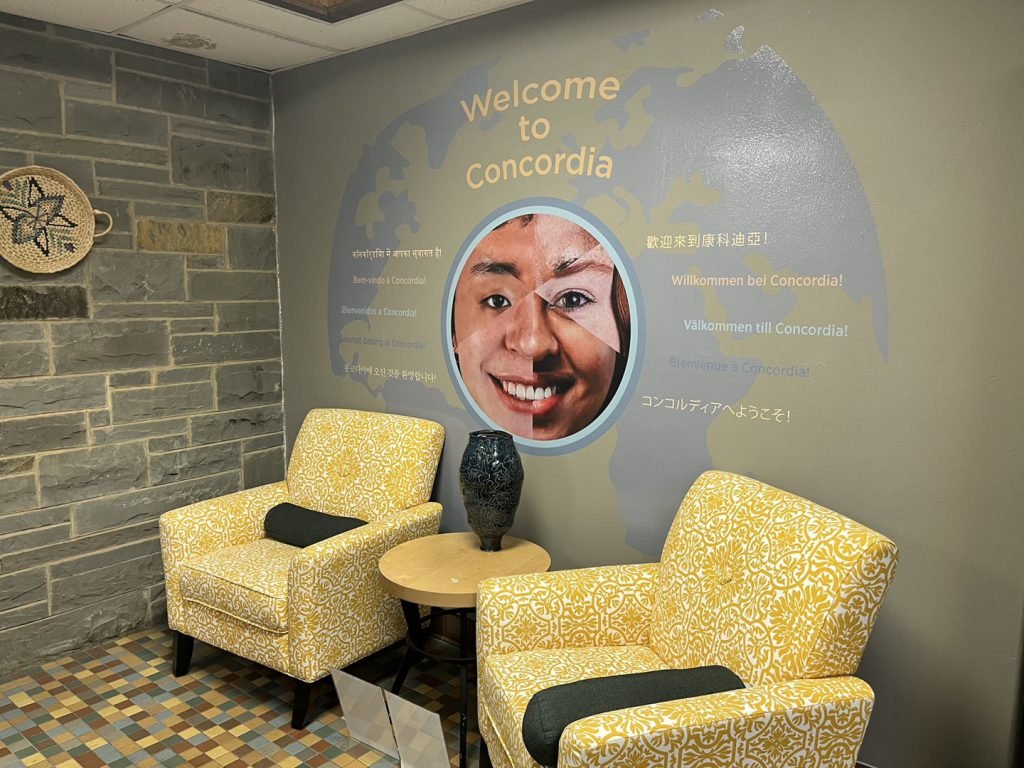
CUW visual comms major designs mural for International Center

The CIC has a new mural that is meant to depict the welcoming community that exists at Concordia.


Saul Leon feels the rewards of Concordia’s welcoming community, and he wants to help ensure others feel welcome here too.

Leon, a senior visual communication major, recently completed a wall mural for the Concordia International Center. His design combines the faces of several CUW international students into one large smiling face that greets you when you enter the CIC from on campus. Surrounding this focal point are several iterations of the phrase “Welcome to Concordia” written in various languages. He solicited photography help from international student Kelvin Kazibwe.

A new mural in the CIC

The son of Mexican immigrants, Leon said he felt a strong pull to this project because of his own experiences growing up in a predominantly Spanish-speaking household.

“I’ve seen international students on campus and it just really resonated with me,” Leon said. “My main goal with the mural was to depict being part of the Concordia family. I love being here and being part of the Concordia family myself. I hope others feel that as well.”  

The mural is the latest addition to an overall CIC refurbishment that was undertaken earlier this year. New loungers, sleek tabletops, wall décor, and reoriented furniture arrangements are all part of the fresh and welcoming aesthetic.

“We wanted to establish a clear hang-out place that’s inviting and accommodating for all students,” said Robin Kuzu, director of international scholar and student services. “It’s not just for our international students, but we do want them, in particular, to feel like they have a specific place on campus. In general, there’s a renewed energy in the CIC this year, and we hope people will come and visit us.”

The International Center is on the rebound from some of the upheaval brought on by the pandemic. Prior to COVID-19, Concordia had the fourth-largest international student enrollment of all universities in Wisconsin, including state schools giants UWM and UW-Madison. International enrollment dipped significantly during the pandemic due to travel bans, but Concordia’s international population is back up to a healthy status this year.

On the CUW side, Concordia has 280 international students representing about 30 different countries. The Ann Arbor campus contributes an additional 21 students.

Both campuses recently celebrated its international population during International Education Week, a joint initiative of the U.S. Department of State and U.S. Department of Education that universities nationwide take part in annually.

Want in?

We’ve welcomed hundreds of students from all over the world to Concordia. Now you can learn about how to apply, read student testimonials, and what’s it’s like to live in Wisconsin – all in your native language over at our International Microsite.


Uncommon Business Part 2: Transforming Business Sustainability through Impactful Education

Impactful education develops modern leaders and generates valuable solutions. It moves beyond discussing problems, to focus on sustainable outcomes and positive impacts. In case you missed Part 1 of this series on business sustainability, make sure to check it out. Now our approach to impactful education in our Business Sustainability concentration highlights three main areas:

  1. Applying the most modern strategies to assess environmental risks
  2. Engaging science and economics to promote innovation and generate value
  3. Implementing solutions that are ethical and sustainable

The primary purpose of these focus areas is to support entrepreneurial leaders. We have established several advanced learning experiences for emerging leaders and business practitioners to support complex decision-making, innovation, and sustainable business practices.   

Assessing Environmental Risks

Transforming business sustainability requires the application of the newest strategies to assess environmental risks. Modern leaders in business sustainability are increasingly using Dynamic Systems-Thinking (DST), a multi-methods approach, to analyze complex problems. Our DST approach explores transformative business practices and strategies to manage supply chain risks, resource scarcity, energy security, and new patterns of production and consumption.

By the end of our new course, Environmental Risks and Sustainable Solutions for Business, our learners are able to:

  • Use multiple methods to assess environmental risks
  • Apply innovative practices to change the carbon trajectory
  • Address energy security
  • Implement commodity tracking systems
  • Develop sustainable solutions for their business

Engaging Science and Economics

Modern businesses need to be able to engage science and ecological economics to address environmental challenges facing businesses in the competitive global market. To meet the triple bottom line, people-planet-profit, we need to apply concepts of decision sciences, circular economies, lifecycle analysis, and commodity tracking.

Circular economies improve environmental sustainability and boost economic growth through innovation while reversing planned obsolescence and reducing negative externalities. We have developed several new courses to address these emerging strategies, including Engaging Science to Promote Business Innovation, Ecological Economics and Sustainable Development, and Circular Economies and Supply Chain Stewardship.

They examine the newest methods to manage the energy-water-food-climate nexus, including strategies to minimize systematic waste. The objective of engaging science and economics is to improve sustainability, evaluate resource scarcity, address supply chain risks, deliver innovative solutions, and advance responsible corporate stewardship.

Ethical and Sustainable Solutions

To support entrepreneurial leaders, businesses need to re-train or upskill their emerging leaders in strategic leadership and environmental stewardship. They also need to support ethical work environments for innovators and foster sustainable solutions, as well as support efforts to align sustainability goals with master strategic plans.

We have established a capstone learning experience for our students to develop custom environmental stewardship plans for their businesses. Advanced students can also develop environmental stewardship plans with corporate partners or conduct environmental consultancy practicums. In the new course, Environmental Stewardship Plan Development for Business, students apply stewardship and strategic planning to support business ethics and promote sustainable business practices and learn multiple methods to measure and report on progress and impacts.

Through project-based learning experiences, our students gain knowledge in sustaining vital ecosystem services, generating value, and supporting corporate responsibility through environmental stewardship.

Our work in Business Sustainability is committed to transformative practices in sustainability, innovative leadership, and sustainable solutions.

Learn more

For additional information about business sustainability or DBA-related questions, contact Professor Jenny Kehl at jenny.kehl@cuw.edu or visit us here.

You can also learn more about DBA faculty Dr. Jenny Kehl here.

Concordia University makes list of best online colleges

Online learning rich in experience

Concordia University has been offering online education since 1998. That gives us quite a bit of experience in online degrees. Today, we have a robust online program to serve the needs of higher education students pursuing their bachelor’s or master’s degrees. Online college opens the doors for so many more to pursue their goals.

Concordia’s overall online program has been recognized as one of America’s Top Online Colleges for 2023. In fact, our ranking was #37 and that places us in the Top 20%!  There’s something to be said for a smaller-sized, more personalized approach as an online learning provider.

We recognize and fully support the need for flexibility in our online degree programs. It’s about understanding that every student has demands outside of the online classroom and that school sometimes isn’t the main priority. At Concordia, maintaining a healthy mind, body, and spirit is critical to academic success.

Degree offerings for online undergraduate and graduate college

Dive into the world of online learning at Concordia. There are numerous online degrees to pursue based on your interests, skills, and goals. Take a leap of faith in our Christian learning community to earn your first degree or enhance your current college degree.

  • School of Arts and Sciences
  • School of Business
  • School of Education
  • School of Health Professions
  • School of Nursing
  • School of Pharmacy

Enroll at Concordia University as online student. Reach your full potential and achieve your goals!

What it’s like being an OTD student

Here at Concordia, we believe we have an award-winning Doctor of Occupational Therapy Program. Our program empowers students to grow into their highest potential and become a leader in their community. The program emphasizes the importance of serving all clients with the best care possible. There is a wide range of OT settings that students are placed in, from a classroom or laboratory to clinic-based instruction.

Our program prepares students for the professional world and to make a significant impact in their communities. It enables students to develop leadership skills, solve occupational problems, and become change-makers. There are so many possibilities and opportunities that the OTD program offers. Don’t just take our word for it, here is what some of our students have to say.

Emily Furmanek

Emily Furmanek previously received her bachelor’s in psychology at Carthage College. But she didn’t stop there. She wanted to pursue higher education to eventually teach OT in a university setting. She says, “CUW offered me an opportunity to achieve an OTD degree allowing me to be one step closer to reaching my goal.”

What’s your favorite thing about your current capstone project/experience as an OTD student?

I absolutely love learning. This opportunity allows me to further practice the craft of writing curriculum and delivering it at a high level of education. The support CUW faculty provided me was tremendous, and only furthered my passion for this career.

How do you feel this project/ experience has prepared you for your future as a Registered Occupational Therapist (OTR)?  

It has allowed me to practice the leadership and communication skills that will prepare me greatly for my future as an OTR, no matter where I go.

Would you recommend the OTD program to others? Why?

Depending on your reason for OTD, I would say yes. Specifically, pursuing a career in higher education, was an easy yes for me.

“If you are even slightly considering pursing on OTD just do it! It is hard work, and requires a timely and organized work habit, but the work you do and the changes you can begin to create for the future of OT are endless.”

Emily Furmanek

Baylee Noe

Baylee Noe partnered with Mercy Hospital Janesville as her capstone site. Practicing OTR, Kayla Engelking, acted as Baylee’s capstone mentor at the hospital. Hear what they both had to say about the experience.

Why did you choose to do the OTD program at CUW?

Baylee: I knew pursuing a doctorate was the right choice because it would increase my understanding of research methodologies. As a result, this will help me advocate for the purpose and benefits of OT. I support the growth of the profession as healthcare is constantly changing and increasing in evidenced based-care techniques. I also aspire to teach later in my professional career as I have the desire to share what I have learned and inspire students who wish to take an innovative approach to OT.

What is your favorite thing about your current capstone project/experience as an OTD student?

Baylee: My favorite part was collaborating with my mentors and other staff in the hospital. I learned so much and was able to advocate for OT and its beneficial outcomes.

Kayla: My favorite part of the experience was watching the interdisciplinary collaboration on Baylee’s project. It has made a greater personal connection with our surgical team with therapy staff. I also greatly look forward to the research outcomes that I can immediately implement in my daily routine.

How do you feel this project/experience has prepared you for your future as an OTR?

Baylee: The capstone project better prepares you for your future career in OT. This is because you gain more experience being assertive and direct with other disciplines. I have been able to make professional relationships with other healthcare workers. The greater the teamwork, the better the patient care!

Kayla: We will be getting the most current research that we can immediately implement for our patients. It has also fostered greater communication between therapy and the nursing/ MD/ PA/ cardiothoracic team.

Would you recommend the OTD program to others? Why?

Baylee: If you are highly motivated and are willing to go the extra mile, DO the OTD program! The difference between the master’s program and the doctorate program has nothing to do with having the skills to be a better clinician, but the doctorate curriculum requires a lot more self-direction and independent study.

Any advice for future OTD students?

Baylee: Think about potential capstone topics very early. As early as the first semester. Also, reach out to current practicing OTs and faculty advisors to discuss needs in the community.

Want to learn more?

The OT program at Concordia is an excellent program that leads to a fulfilling career. It’s a career choice that offers numerous benefits the biggest one is feeling valued and knowing you are making a difference. The OTD program is one step further in that valuable journey. Consider the stories of Emily, Baylee, and Kayla and enroll in the OTD program.

Explore various MBA career paths

Are you looking to advance your education as a business professional? A Master of Business Administration (MBA) is a great route to advance your career. At Concordia University Wisconsin and Ann Arbor, MBA students are given the opportunity to specialize in an area of interest. As a result, you can focus on a topic that will give you the skills needed to reach your goals.

Not only do you have 13 concentrations to choose from, but our program also includes:

  • Can be done 100% online
  • Virtual and in-person options
  • Courses are 8 weeks
  • Taught by industry experts
  • Experiential learning is part of the program to help develop your employable skills

Check out our MBA career paths to choose from below.

Accounting

Accounting professionals work with financial transactions, including tax and financial planning. They also provide vital financial information in order for individuals or organizations to make informed decisions. Accountants can work in the government, for-profit or nonprofit organizations, schools, or firms. You can even become a CPA and work for yourself.

MBA students can expect to learn about intermediate accounting, advanced accounting, income taxes, and auditing. Your coursework will prepare you to sit for the national CPA exam and give you the skills you need to prepare for a career as a CPA.

Communications and Public Relations

Understanding how to convey thoughts and ideas in a compelling manner is an important skill in business. Communications and public relations professionals specialize in handling public communication for an individual, group, or organization. Those in the field can also find jobs in advertising, public image managers, consultants, and spokespeople.

MBA students will take courses in group dynamics, effective business writing, public relations, and public speaking. You will graduate will the skills to articulate and communicate your message.

Finance

If you have an interest in finance, our MBA in Finance is a great option. With an advanced education in finance, you have many opportunities for roles such as a finance manager, advisor, or analyst as well as an investment manager, or even a chief financial officer. You’ll learn how to master real estate investment, risk management, and corporate and international finance, to name a few. By graduation, you’ll have the knowledge and skills you need to be a powerful candidate in the field.

Healthcare Administration

Healthcare is one of the fastest-growing industries that need business-minded professionals to help run our facilities. A healthcare administrator has many responsibilities which can include developing work schedules, managing billing, and training staff members.

Having an MBA in Healthcare Administration, you will better understand management in healthcare. You’ll also develop the skills you need to oversee budgeting, human resources, public policy, and risk management.

Human Resource Management

Human Resource professionals work with employees in an organization. Usually, their tasks include recruiting, hiring, onboarding, firing, and managing employees. Additionally, HR professionals keep benefits and compensation fair, make sure practices are ethical, and work to decrease workplace burnout.

Our MBA in Human Resource Management will allow you to dive into a variety of topics that will prepare you for a significant impact in the field. You’ll have a deeper knowledge of labor and employment law, occupational fraud, unemployment, and disability.

Innovation and Entrepreneurship

Becoming an entrepreneur is both a pursuit and a mindset. It requires you to be a self-motivator and a determination to overcome challenges. Learning to think outside the box to turn your ideas into success is key.

Our innovation and entrepreneurship MBA will teach you how to pitch ideas, create successful startups, and manage a culture of innovation in your organization. Whatever your goals, we will help you start pursuing the ideas you’re passionate about.

Leadership

If you’re interested in developing your leadership skills and business knowledge, an MBA in Leadership may be a great path. You’ll discover your leadership strengths and integrate your technical competencies to lead teams and organizations. This approach will make you a well-rounded asset to your organization. During the program, your curriculum will dive into problem-solving in creative ways and learning about ethical leadership that enables and inspires teams of all sizes.

Management

Every organization needs leaders who are able to manage large-scale projects and diverse groups of people. Knowledge in management can equip you to build and manage strong teams and handle challenges when they arise. During the program, you’ll get hands-on experience in applying proven management techniques to bring into your role. Ultimately, you’ll come out as a stronger leader, a better communicator, and a strategic thinker.

Management Information Systems (MIS)

Individuals who study MIS learn about the relationship between people and technology in order to improve practices. By having a degree in MIS, you can work in many different roles such as IT consultant, web developer, systems or business analyst, or information systems manager.

An MBA in Management Information Systems will provide you with in-depth knowledge of database modeling, design, and implementation. You’ll gain experience implementing a database design by creating a physical database using the Oracle Application Express tool and SQL—and you’ll be prepared to sit for the Oracle Database SQL Expert exam.

Nonprofit Management and Public Relations

If you have an interest in working in the nonprofit sector, it’s essential to have the skills to motivate teams, implement new programs, and bring the mission of the organization to life. Working in nonprofit management requires knowledge of public relations, board governance, program evaluation, fundraising, and volunteer requirement. All of which our MBA program covers to make sure you are ready to take on your role.

Research for Business Applications

By choosing a concentration in research for business applications, you’ll take four research courses (12 credits) in our DBA program. You’ll learn the ins and outs of scholarly research, including statistics for research, quantitative research skills, and qualitative research skills.

While this program allows you to jumpstart your studies in the DBA program, it can also be used to improve your organization and your ability to sift through data driving the complex challenges your organization will face. As a result, it will also provide you with the skills necessary to perform solid academic research intended for peer-reviewed publications.

Strategic Marketing

According to Hubspot, strategic marketing involves research and establishing goals that will maximize the effectiveness and success of the overall marketing strategy. As a strategic marketer, you’ll be responsible for understanding your organization and grabbing the attention of customers.

As a graduate of our MBA in Strategic Marketing, you’ll understand the measurability and accountability of direct marketing and how it relates to your company’s overall strategy. This concentration was designed to teach you the skills you need whether you already work in advertising or you’re looking to break into the field.

Sustainability Management and Analytics

Corporations are discovering the value of social and environmental sustainability. Therefore, they need knowledgeable and well-rounded professionals to come to improve processes, reduce resource use and waste, and make better social and environmental decisions.

In our MBA in Sustainability Management and Analytics, you’ll dive into topics like micro and macroeconomics, decision science, statistical analysis, environmental chemistry and toxicology, environmental law, social entrepreneurship, and industrial ecology. Not only will you have knowledge of the field, but you’ll also have hands-on experience, certificates in sustainability methods, and exam prep if you decide to take the LEED Green Associate exam.

Interested?

We’re ready to help explore your MBA career path with you. Feel free to find out more about our MBA program below.

How to Pay for School as an Adult

Education is one of the greatest investments you will make in your lifetime and provides value personally, professionally, and financially. However, figuring out how to pay for school shouldn’t be something that keeps you up at night.

Whether you’re pursuing an accelerated undergraduate program, a master’s degree, or a doctorate, you have options beyond your savings account to pay for school. 

Scholarships 

Just because you’re an adult or non-traditional learner doesn’t mean you don’t have the opportunity to obtain scholarships. Scholarships are one of the best ways to pay for school because you never have to pay back the money you receive. Often, the only stipulation to receiving a scholarship is that you maintain the requirements outlined in the application like a certain GPA, for example. 

Sometimes universities will offer scholarships specifically for adult learners, like our uncommon scholarships, so be sure to check with your school to see if they provide anything similar. You should also check with your church to see if they have any scholarships available for which you could qualify. Otherwise, you can use our scholarship search tool to search through the scholarships we keep on file or use the Sallie Mae search tool to find ones specifically for graduate school. 

Tuition Reimbursement 

One great bonus of pursuing education as an adult is that many employers offer some kind of reimbursement to help pay for it. Some businesses even have partnerships with universities that allow their employees to pursue a degree there for a discounted price. This is something we offer through our business and community partnerships. 

Even if your company doesn’t have a partnership with a school, they might still have some kind of educational advancement initiative that could help you pay for at least a percentage. Always make sure to check with your human resources department to see if your employer offers anything like this. 

Loans

Loans are borrowed money that must be repaid with interest and can be either federal or private. A common myth is that adult learners don’t qualify for federal aid, but there are several different options that are available for you to consider: 

  • Subsidized loans—Loans given to undergraduate students who demonstrate financial need. If you’re an adult pursuing an accelerated undergraduate degree, you could qualify for this. The additional benefit is that these loans don’t start earning interest until you’re out of school. 
  • Unsubsidized loans—Loans available to all students are eligible and qualify for Title IV funding. These loans are different than subsidized ones in that they start earning interest as soon as they are disbursed. 
  • Graduate plus loans—Loans available to graduate students who are eligible. These can have a higher interest rate than subsidized and unsubsidized loans.  

Beyond federal loans, you can also get alternative loans (i.e. private loans) typically offered by a lender such as a bank or credit union. These often have a much higher interest rate than federal loans and don’t qualify for student debt forgiveness should you ever find yourself eligible. 

If you decide to pursue loans as a way to pay for school, always make sure you maximize your federal eligibility before you opt for private ones.  

Budget Payment Plans 

If you aren’t able to secure as much aid as you’d like, a payment plan can be a great way to take care of your outstanding bill. This helps you avoid facing that one giant bill typically due before your first class. For example, a payment plan might split up your remaining bill with a set amount of monthly payments for the remainder of the semester or year. Work with the financial aid office at your school to figure out what payment plans are available and choose the one that works best for you. 

What’s next?

Are you already back in school and struggling to balance all of the work with your job, life, and other responsibilities? We get it—it’s hard. But it is possible to balance it all without losing your mind. Check out our practical school tips for ideas on studying smarter, removing distractions, tapping into your support system for help, and more.   

This blog was originally published on February 10, 2020. It has been updated to reflect current information.

Student Spotlight: Kimber Powers

Today, there is high demand for nurses. Many individuals are now changing careers to meet this demand. But can someone already with a bachelor’s degree become a nurse without doing four more years? Absolutely. This is the exact situation Kimber Powers, a current ABSN student at Concordia University Wisconsin, was facing.

What is the ABSN program?

Concordia Wisconsin’s Accelerated Second Degree BSN (ABSN) program is made for those who have a bachelor’s degree in a non-nursing field and are ready to transition their career into nursing. The 14-month program combines online and in-person classes on our Mequon campus.

The program is geared towards giving you the skills you need to hit the ground running as a registered nurse. You will have hands-on experience with clinicals at Milwaukee area hospitals. When you graduate you will be ready to take on your new career.

After completing her bachelor’s degree, student Kimber Powers, found her passion to become a nurse and is now almost finished with Concordia’s ABSN program. Let’s hear about her experience.

Why did you choose to enroll in your nursing degree at Concordia University Wisconsin?

I chose to enroll at CUW after my positive experience with faculty and the community throughout the completion of my initial undergraduate degrees. The faculty are very supportive, and intentional. They truly care about my success and push me to be at my best. The small faculty-to-student ratio allows for individualized feedback on both strengths and weaknesses, which pushes me to do my best and inspires my when I have low motivation.

Would you recommend your program to others and why?

I would highly recommend this program to anyone who has graduated and wants to transition into the nursing field from a different field. This program is unique in that you complete the program in 14 months. It is flexible with work schedules and home life due to blended online and in-person learning and covers all needed textbooks and materials for the program within the tuition cost.

What are you hoping to do with your degree when you finish?

I am hoping to work as a bedside nurse for a few years. Then go back to school to become a Nurse Practitioner.

What advice would you give an individual contemplating a nursing degree?

The advice I would give would be to head into the program knowing it will be both intense and difficult, but you will make it through with plenty of support along the way and a rewarding career at the end.

What are a few challenges you encountered as a nursing student?

Some challenges I encountered were having a busy schedule between online classes, work, and clinicals, getting back into the flow of school after not having classes for a year, and remembering to focus on myself throughout the program. It is crazy to think I am almost to graduation when it feels like our cohort just started last month.

What are the greatest benefits of CUW’s nursing programs?

The relationships you build with other students and faculty, the supportive and accepting learning community, and the connections and good reputation you build in clinical experiences within the surrounding area.

What motivated/supported you through our program?

Knowing I will have a rewarding career ahead of me upon graduation, leaning on my fellow classmates and faculty for support, and my dog.

What is your advice to future students?

Take advantage of every opportunity to learn throughout this program because the time will go QUICK. Before you know it you’ll be walking across the stage at graduation and preparing to take your boards.

Want to become a nurse?

If you have your bachelor’s degree in a non-nursing field but want to become a nurse in 14 months, we have your back. Check out more information about our program below.

What are the requirements for PT school?

Wherever you go to college, each place will have a different set of requirements for PT school. Here at Concordia University Wisconsin, we want to make it easy for you to find and understand what steps you need to take to apply. Below we have laid out our admissions requirements for PT school and how to apply.

Doctor of Physical Therapy admission requirements

To apply for our DPT program you must have the following:

  • Minimum undergraduate GPA of 3.0
  • Bachelor’s degree from an accredited institution
  • Minimum GPA of 3.0 in all required sciences with no final individual science prerequisite course grade less than a C
  • Ability to perform Essential Functions of a physical therapist
  • Completion of the following courses:
    • Human Anatomy and Physiology I & II. Must include labs.
    • Chemistry I & II. Must include labs.
    • Physics I & II. Must include labs. Courses do not need to be Calculus-based.
    • Psychology
    • Statistics Course: one semester of the following courses meet statistics requirement: Biostatistics; Business: Statistics, Mathematics: Statistics; Psychology: Statistics; Education: Statistics

Special circumstances

Admission policy for partner schools

Current students and alumni of St. Norbert College (SNC) and Viterbo University (VU) will be given priority admission to the DPT program if they meet the following requirements:

  • A verified PTCAS application by the deadline
  • Earned a 3.30 in the science prerequisite courses
  • Have a 3.0 overall GPA
  • All science courses will need to be from SNC or VU

For additional requirements for SNC and VU graduates, please check with your pre-physical therapy advisor.

Accelerated DPT admission for CUW students

Students that start at CUW as a freshman will have the opportunity to complete the DPT in six years rather than seven. These students will receive a Bachelor’s in Rehabilitation Science on the way to their doctorate. If you’re interested in this path, feel free to check out the requirements here.

Applying for the DPT

To apply for our Doctor of Physical Therapy program, you will go through an online service called Physical Therapist Centralized Application Service (PTCAS). Visit PTCAS to learn more about the application process, prerequisites, CUW’s admission requirements, and admission deadlines.

Need more information?

If you need more information about becoming a Doctor of Physical Therapy, or about our program, visit our page below.

Let’s feed 1,000 children for a year

If we all work together, I believe this lofty goal is one we can reach here at Concordia, with the help of God and the Feed My Starving Children organization.


By Isaiah Mudge (’23)

According to the World Food Programme (WFP), about 25,000 people die each day from hunger. That equates to nine million people per year—or double the population of Louisiana.

I first came across those numbers during my freshman year at CUW as a part of a project for one of our general education classes. I think we’re surrounded by numbers in the millions and billions so frequently that we start to forget their true magnitude. Nine million people is enormous to the point that it’s basically unimaginable.

There are plenty of things to be passionate about on earth, but the WFP has argued that with $40 billion per year for 10 years, it could end world hunger. In a world economy of 85 trillion dollars, you’d think that could be done.

Life in a fallen world

While it’s great to talk about taking action, I think we need to remember that the presence of so many wrongdoings around us illustrates a disease.

We live sinful lives among a sinful people, in a world where evil cannot be escaped. There will never be an end to pain or starvation, and even if there is, then other problems will replace them. So, while Christians do need to be sources of change and goodness, we don’t do it because we want to make the world perfect; that’s not our job. Rather, we do it because God first loved us, and we wish to show that love to one another.

Most people know John 3:16, but do you know 1 John 3:16? It says, “This is how we know what love is: Jesus Christ laid down his life for us. And we ought to lay down our lives for our brothers and sisters.” Paul directly tells us how far we’re supposed to go to love one another. He also tells us why we should do it.

This verse has stuck with me the past few years in its shocking explanation of how we’re called to live. I have known many Christians through my life who have demonstrated it to me, many of them at CUW.

World hunger, the reality of a sinful world, God’s call for Christians to act—all these things were still on my mind during my junior year. Life was going back to normal after Covid, although campus still wasn’t nearly as lively as it had been before. Concordia was having difficulty with its presidential search, and there had also been recent turbulence at CUW regarding the suspension of a professor.  

I felt that we needed something that could help to rebuild our community, remind us what Christians do, and make a small dent in starvation at the same time. In the midst of praying about these events, I though I should also do something about them. I decided to start a Feed My Starving Children (FMSC) Mobile Pack event.  

Service to Christ in the world

For those unfamiliar, FMSC is a non-profit organization dedicated to fighting starvation. Third party organizations raise funds; FMSC uses those funds to buy ingredients and send them to the third party; volunteers then pack meals using the ingredients; then FMSC ships the meals to those in need. The meals are engineered so that each meal has the baseline nutrients a child needs for one day.

It strikes me that being a student at CUW may be the last time I’ll be a part of such a large faith community. So, I set a goal of 385,000 meals, which will require about 1,800 volunteers to pack with $100,000 for materials. When everything is complete, we’ll have packed enough meals to feed over 1,000 children for a year.

We can’t fix the world, but that’s okay, because God doesn’t ask us to. All he asks us to do is love each other sacrificially, just as he loved us.

Those are big numbers, but I think we can do it. I get the impression that people are looking for something to be a part of as Covid years are left behind. For example, this project is almost entirely led by student volunteers who put in hour after hour despite having other commitments.

It’s been humbling to see the willingness of my peers to put time into this, despite high class loads and other volunteer projects. Administration and faculty at CUW have also been a great blessing, helping these student volunteers across obstacles with willingness and encouragement.

A wider reach

As the project continues, we hope to reach out to the community as well. We’re looking for involvement from both private and public high schools in the area, as well as businesses and CUW alumni. I hope it’s a signal to our community that what makes Concordia unique is the people who go here and the God we serve.

As I wrap this up, the central idea I want to leave behind is that Christians are people who sometimes look at the world with sadness because we see its brokenness. However, we also look at the world with joy because we know we have been redeemed by the blood of Jesus Christ. We can’t fix the world, but that’s okay, because God doesn’t ask us to. All he asks us to do is love each other sacrificially, just as he loved us. Concordia’s identity has been formed through people who have known God’s love. Let’s spread that blessing to a world that needs it.

To learn more, donate, or get involved, click on the link below:


Campus Ministry at CUW

To learn more about student ministry opportunities at Concordia University Wisconsin, click on the link below.


—Isaiah Mudge (’23) is pre-seminary student majoring in Philosophy/Theological Language. He is the Service to Milwaukee Branch Coordinator for the CUW Campus Ministry Leadership Team and is planning to attend the Concordia Theological Seminary in St. Louis, Missouri, next year.