Degree Works: Your GPS for graduation


As an online student at Concordia University Wisconsin, you want flexibility, but you also need clarity. You need to know how your previous coursework applies, what requirements remain and which classes will keep you moving toward graduation.

That’s where Degree Works comes in.

Degree Works is an online degree-audit tool that gives you a clear view of your academic progress. It shows what you’ve completed, what is currently in progress and what requirements remain. For online students balancing work, family and other responsibilities, having that information in one place can make academic planning easier.


What is Degree Works?

Degree Works compares your completed and in-progress coursework with CUW’s degree requirements. Its easy-to-read worksheet shows how your classes apply to your program and gives you useful information to discuss with your advisor.

It can help answer questions such as:

  • Which requirements have I already completed?
  • How do my transfer credits apply?
  • What courses or credits do I still need?
  • Am I on track for my intended graduation timeline?
  • What should I discuss with my advisor before registering?

Degree Works does not replace your advisor. Instead, it gives you and your advisor a shared starting point for making informed academic plans.


Four areas of your degree audit

When reviewing your progress, focus on four main areas.

1. Completed Courses

These are the classes you’ve already finished, including approved transfer credits and electives. This section can help you see how your previous coursework is being applied toward your degree.

2. In Progress

This section shows the courses you are currently taking and how they fit into your degree requirements. Courses typically do not count as completed until final grades are posted.

3. Still Needed

Think of this as your academic to-do list. It identifies remaining requirements for your major, general education, electives or other areas of your program. This section is especially useful when preparing for registration.

4. Plan Ahead

Planning future terms with your advisor can help you consider course sequencing, prerequisites and your anticipated graduation timeline. Planning ahead also matters because not every course may be offered every term.


Three habits for success

Degree Works is most helpful when you use it regularly. Try building these three habits into your academic routine.

1. Check it every term

Review your audit at the beginning of each term, after adding or dropping classes, after final grades are posted and after transfer credits or substitutions are processed. Regular reviews can help you identify questions early rather than discovering an issue close to graduation.

2. Use it during registration

Before selecting courses, review the “Still Needed” section along with prerequisites, major or minor requirements, general education requirements and the total credits required for graduation. This can help you choose courses that apply toward your degree.

3. Review it with your advisor

Degree Works can help you plan, but it is not the final authority on your degree requirements. If a course appears in the wrong section, a requirement looks incomplete, transfer credit does not seem to apply correctly or something else looks unclear, talk with your advisor. Your advisor can help you interpret the audit and determine your next steps.


Why Degree Works matters for online learners

For adult learners, time matters. Many online students balance career goals, family commitments, military service, ministry and other responsibilities while working toward a degree. Knowing where you stand academically can make planning a little easier.

Degree Works brings much of that information together in one place. You can see how completed coursework and approved transfer credits apply while keeping an eye on the requirements that remain. Combined with regular conversations with your advisor, the tool can help you make informed decisions about registration, course loads and your anticipated graduation timeline.

At CUW, online education is designed for students who need flexibility while pursuing their academic goals. Degree Works is one resource available to help students stay informed and organized throughout their program.


Take the next step

If you’re considering an online program, you can begin by learning more about CUW’s undergraduate and graduate options. Online classes are offered year-round, with many programs featuring two eight-week mini-terms during the spring, summer and fall.

Connect with Concordia University Wisconsin’s admissions team by visiting CUW Online Undergraduate Admissions for undergraduate degrees or CUW Graduate Admissions for master’s degrees and licenses. You can also call 262-243-4300 to learn more.


Want in?

Concordia University Wisconsin is a Lutheran higher education community committed to helping students develop in mind, body and spirit for service to Christ in the Church and the world.

Where history comes to life


CUW alumna combines passions for history, graphic design and travel into a museum career that proves curiosity can become a calling.


Take a passion for history, pair it with a creative eye for design, and add a love of travel and museums, and you have alumna Erin Rice (’21). At Concordia University Wisconsin, Rice found a way to combine all of those interests by studying history and graphic design. Today, she’s carrying that unique blend of passions into a career that brings the past to life.

For the last three years, Rice has worked at the Wisconsin Automotive Museum, 147 N. Rural St., in the heart of historic downtown Hartford. The museum is the state’s largest automotive museum, with a 75,000-square-foot facility spanning two floors. It features a rotating collection of more than 120 classic automobiles, along with antique gas pumps and vintage petroliana that showcase the rich history of America’s automotive culture.

Visitors can explore automobile makes spanning nearly a century, from 1902 through the 1990s, with standout collections featuring iconic American brands such as Pontiac, Studebaker, Chevrolet, Kaiser, Ford and AMC. Beyond its impressive vehicle collection, the museum celebrates Wisconsin’s transportation heritage through exhibits including the Southeastern Wisconsin Short Track Hall of Fame, the Nash Car Club of America archives, a display of outboard motors manufactured in Hartford, and the beautifully restored Soo Line Steam Locomotive No. 1003.


Wearing many hats

“Working in a smaller institution means I get to wear many hats,” Rice said. “My role ranges from handling the admission window while I create the newest t-shirt design, to moving cars and building the latest temporary exhibit.”

Rice primarily serves as the museum’s graphic designer, and has worked on everything from the logo, to t-shirts, puzzles, books, administrative supplies like envelopes and letterhead, to countywide and national advertisements.

“There’s always something new to do,” Rice said. “On the more research-focused and incredibly nerdy side, I take so much joy in digging through 100-year-old newspapers and organizing advertisements in our archive. I think all aspects of myself are represented in this job (and I consider myself someone with a near infinite amount of facets), so working at the Auto Museum definitely is a dream come true.”

Her education mirrors her interests and has prepared her for her current role. As one of Rice’s professors and mentors at CUW, Betsy Pease, PhD, has witnessed that firsthand.

“Erin’s story is inspiring because she shows what an education in the humanities and the arts can lead to,” Pease explained. “She is building a career out of that interest, but she also has used her education to deepen her travel experiences and her cultural understanding of new people and new places. This is exactly what we think a liberal arts education provides for our students.”


Studying history where it happened

After graduating from CUW, Rice traveled to Europe to continue her studies at the University College London, ultimately earning a master’s degree in the history of art in 2024. There, she was able to delve into history topics she enjoyed.

At UCL, her research explored art and technology in 19th century France. “(That) sounds rather dry, but we were talking about early automatons, the monumentality of guillotines, and phantasmagorias (the combination of a seance and haunted house attraction),” she explained.

In addition, her dissertation focused on print technologies and the mass media that made commercial artist J. C. Leyendecker’s work synonymous with 1920s American culture.

“J. C. Leyendecker painted gorgeous covers for the Saturday Evening Post and is most famed for his Arrow Collar Man. I did a small presentation on him in one of my American history classes. My interest in him evolved at UCL, turning from fashion towards the technological. My dissertation focused on the print technologies and the mass media that made his work synonymous with 1920s American culture.”


Learning beyond the lecture hall

Rice discovered that there was nothing quite like studying art in London.

“The opportunities it affords cannot be understated,” she said. “I would pop into the National Gallery when I was bored after class. I attended gallery openings and exhibitions by famous artists like Yoko Ono and Sarah Lucas. For a brief period of time, I practically lived at the John Singer Sargent exhibit at the Tate. We took class trips to Paris and to the Venice Biennale.”

The opportunity also gave her the privilege of writing about history that she experienced first-hand.

She explained: “(That) sounds silly, but an example: One Wednesday, I set up an appointment with the Victoria and Albert Museum’s Prints and Drawings room. After class, I took the Tube down to South Kensington, rode a well-hidden lift up to their archives, and physically held a poster of Jules Chéret’s La Loïe Fuller, which was printed in 1900.

“By viewing the piece in person, I noticed that there were tiny speckles of blue paint on Fuller’s dress that don’t typically appear on the image you get off of Google photos. These speckles (known as crachis) cast an almost phantasmal glow on her figure. That discovery, in turn, connected to my main thesis (about) 1880s French posters (that) exhibit themes of lights, technology and entertainment.

“What this story shows, in a fairly roundabout way, is that I was really living the academic’s dream. It felt like the world was at my fingertips and most research was only a Tube stop away.”


A Concordia education in action

Rice’s ability to bring those experiences to life reflects a curiosity that extends well beyond the classroom. Pease described Erin’s enthusiasm for learning as “infectious.”

“This was evident in the monthly newsletters Erin shared during her time pursuing a master’s degree at University College London,” Pease said. “She wrote extensive updates on what she was learning, what museums or exhibits she had seen, where she had traveled, and even what music inspired her recently. As Erin’s former instructor, it was fun to see her engaging at a deeper level (about) many of the ideas we had begun exploring during her time at CUW.”

At Concordia University, students are able to customize their learning experiences, incorporating their interests into their lines of study. And Rice did just that with her history major.

“Our program builds in several opportunities for students to pursue projects on historical topics of their own choosing,” Pease said. “Erin was able to bridge her interest in art and history in a number of ways. She has an interest in the emergence of commercial art from the turn of the 20th century, and she was able to pursue a project on that in a U.S. history course with me.”

Those experiences didn’t happen by accident. Rice said they began with taking advantage of the people and opportunities around her at Concordia. That’s the same advice she now offers current students.

“Really take advantage of Concordia’s small class size and get to know your professors and classmates. You’ll be surprised by how those connections can shape the path of your life.”


“The School of &” blog series highlights the distinctive identity of Concordia University Wisconsin’s School of Arts & Sciences, where interdisciplinary connections shape learning and purpose. Each month, the series features students and alumni who have paired majors, minors and certificates in thoughtful and creative ways.

Their stories show how connecting areas of study can help students develop their gifts, discover their calling and prepare to serve the Church and the world.


Want in?

Concordia University Wisconsin is a Lutheran higher education community committed to helping students develop in mind, body and spirit for service to Christ in the Church and the world.

Why Concordia’s Compassion Care Certificate prepares you for any career

Students from every major learn that compassion may be one of the most valuable skills they take with them after graduation.


Technical skills may open doors, but compassion is what often changes lives.

Compassion is both innate and nurtured. It grows through relationships, experiences and a willingness to see others as Christ sees them. In a world where anxiety, loneliness and grief have become all too common, learning how to care for others may be one of the most valuable skills a person can develop.

Sometimes that learning begins with an unexpected teacher, like a beloved family pet. At CUW, it often begins with a comfort dog.

Through the Compassion Care Certificate, students combine coursework in trauma-informed care and social-emotional learning with hands-on experiences alongside Runner, Concordia’s comfort dog who participates in the program.

When Kylie Kapler first visited Concordia, the concept of comfort dogs caught her attention. It was something she hadn’t encountered at other universities. Now a senior interior architecture and design major, a student in the Compassion Care Certificate program, and the current treasurer of Concordia’s Comfort Dog Club, she says learning about the certificate changed her college experience.

“When I learned that there was a program on campus, it really sparked my interest to become a handler,” Kapler said. “I was excited about developing handling skills with comfort dogs and learning compassion caregiving skills that I can use now and into my future.”


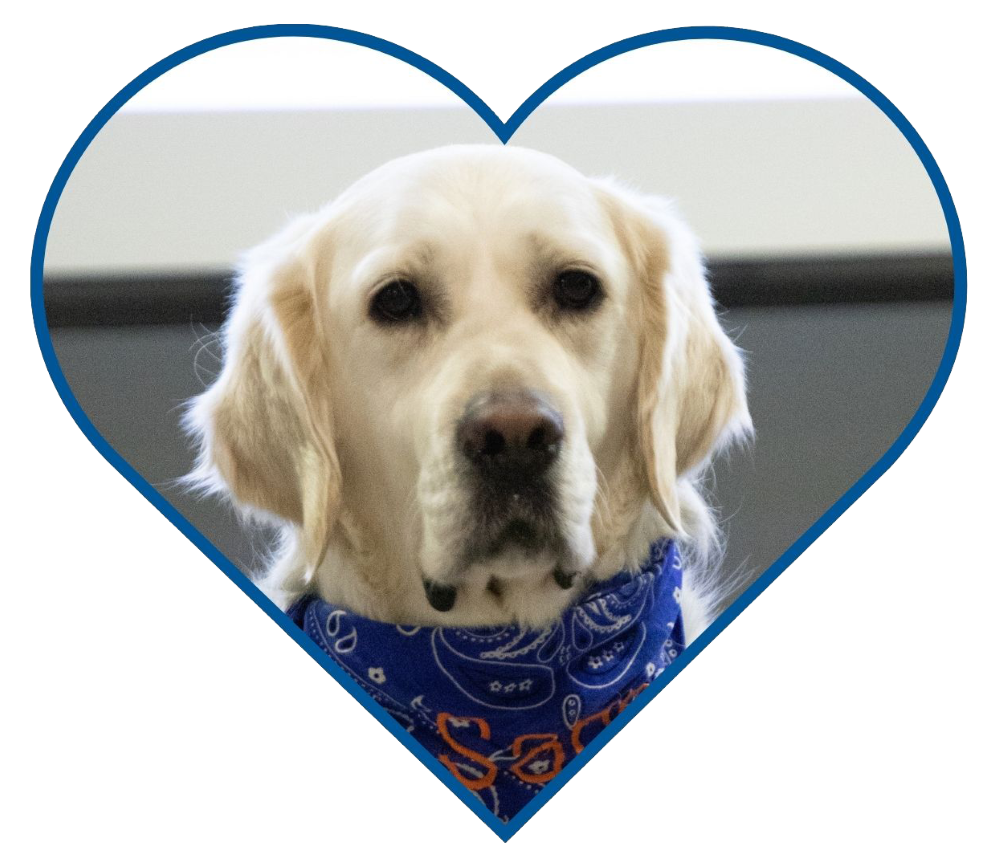
dog head in hear
Meet Runner! He is housed under the School of Education, but serves a variety of majors across campus.

Learning with purpose

Launched in 2021, the Compassion Care Certificate prepares students to serve others through coursework in trauma-informed care, social-emotional learning and compassionate caregiving. Students pair classroom learning with hands-on experiences alongside Runner. The beauty of the program is that they develop practical skills they can carry into any profession.

Rhonda Verdegan, PhD, professor of athletic training and co-creator of the Compassion Care Certificate, has watched students grow through the program since its inception.

“The dogs open the door,” she said. “They give students a way to connect with people who are hurting, grieving, struggling or simply having a difficult day. The certificate gives students tools they can carry into whatever profession they choose.”


Compassion isn’t limited to one profession

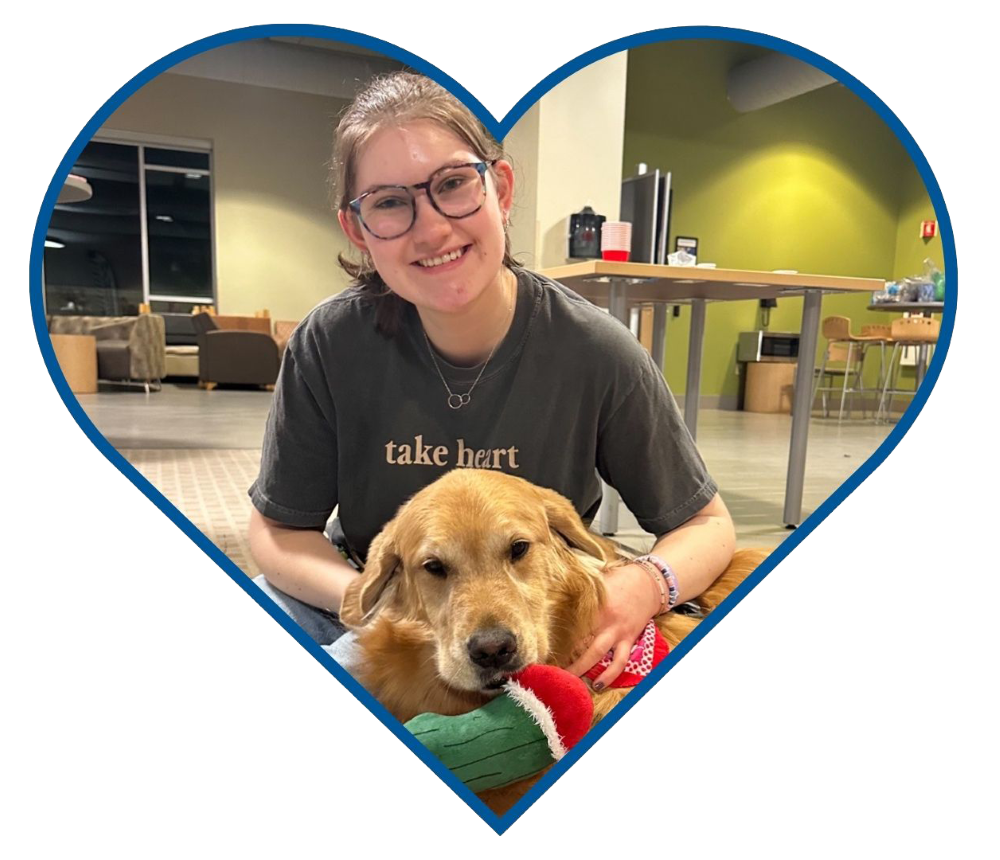
dog head and girl head in heart
“Runner brings smiles, laughter and calm to everyone he greets. He’s such a blessing to our Concordia family.” —Kylie Kapler

Fun fact: Although education students make up the largest group in the program, the certificate attracts students from psychology, counseling, social work, athletic training, physical therapy, occupational therapy and many other majors. Compassion has value in every profession.

“The classes help develop relationship-building skills that everyone can benefit from, regardless of what they are majoring in,” Kapler said. “I’ve developed leadership skills and have grown my self-confidence throughout this program. This is something that I can share with others.”

Verdegan sees that same growth in students each year. Through weekly handling responsibilities, reflection assignments and community outreach, students build confidence, strengthen interpersonal skills and learn to recognize when someone needs support.


Learning through service

The classroom is only one part of the experience. Student handlers accompany Runner during visits to schools, nursing homes, hospitals, churches and other community organizations. They learn that compassionate care often begins with simply showing up.

Some of Runner’s visits are planned in advance, while others come with little notice—a request from an alumnus whose parent is hospitalized, a school seeking comfort after the loss of a student or a call asking Runner to support those affected by a tragedy on campus.

“We’ll get invites from community people quite frequently,” said Verdegan. “Going to nursing homes, going to schools—we’ve gone to hospitals in the past. We’ll sometimes get special messages from people who know about Concordia or graduated from here saying, ‘My mom is really sick in the hospital. Is there any way Runner could come visit?'”

Those experiences reinforce the idea that compassionate care isn’t limited to one profession or setting. Whether supporting a grieving family, visiting residents in a nursing home or sitting quietly with someone who needs a listening ear, students learn that one of the greatest acts of service is simply being present.


A campus of care

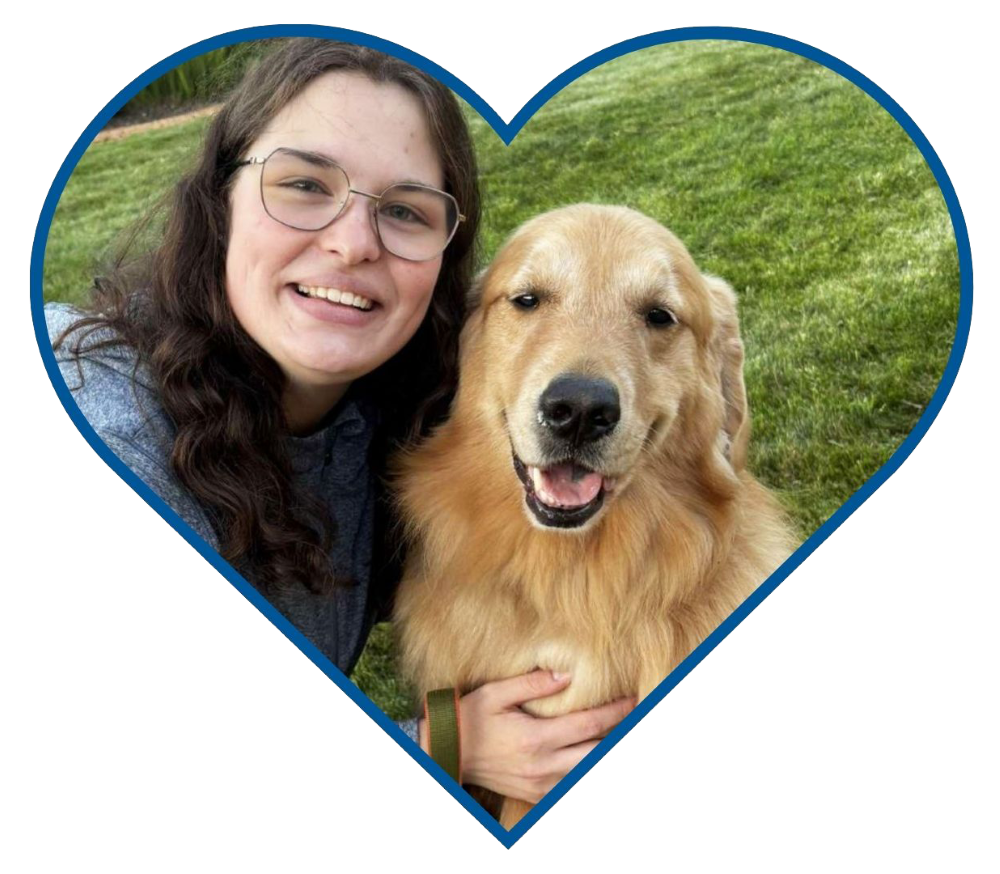
girl with glasses and dog
“The dogs help students forget about their issues for at least a few minutes.” —Brenna Bennett

That same spirit of care extends across campus with a second dog named Sage.

Junior accounting major Brenna Bennett, president of the Comfort Dog Club, says students naturally gravitate toward Runner and Sage wherever they go. While Runner participates in the

Compassion Care Certificate program, Sage serves through a separate ministry with Lutheran Church Charities (LCC). Both dogs bring comfort and companionship to the Concordia community.

dog head inside hear
Meet Sage! An LCC K-9 Comfort Dog serving through Concordia’s School of Health Professions.

“When I walk around campus with Runner, we always get stopped by students who want to pet him and say hi,” Bennett said. “I can always tell where Sage or Runner are because there will be a crowd of students sitting on the floor around them. The dogs help students forget about their issues for at least a few minutes.”

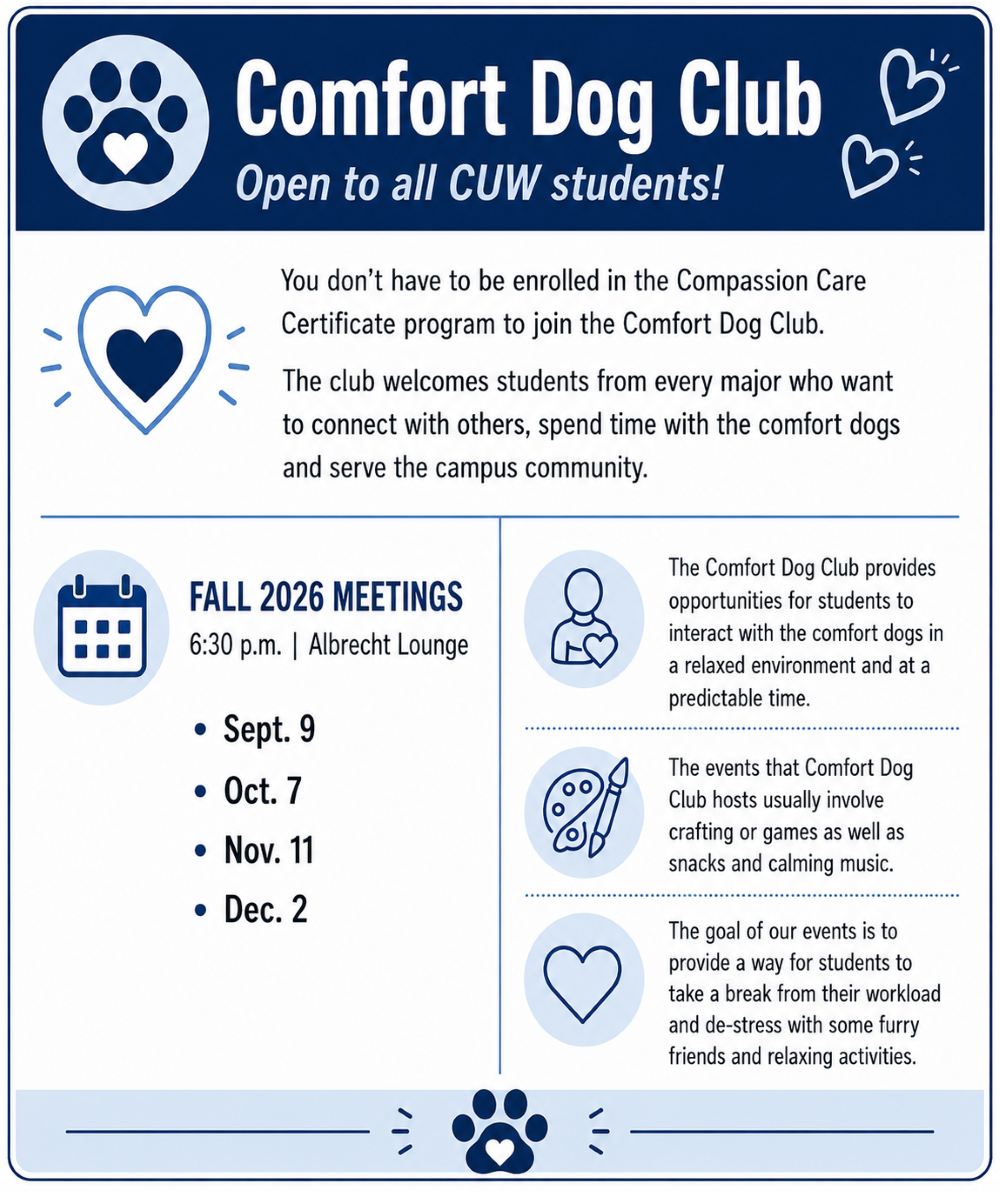
The Comfort Dog Club gives students from every major an opportunity to spend time with the dogs. Open to all students, the club hosts monthly gatherings featuring crafts, games, snacks, calming music and time with the comfort dogs.

“The goal of our events is to provide a way for students to take a break from their workload and de-stress with some furry friends and relaxing activities,” Bennett said.


Preparing students for a lifetime of service

Verdegan believes the need for compassionate caregivers is greater than ever. Through Runner and the students who serve alongside him, she has witnessed the difference a simple act of kindness can make in someone’s life. With tears in her eyes, she reflected on the lesson she hopes students carry with them long after graduation.

“I don’t think any of our struggles are going to go away,” she said. “Having someone recognize you and say, ‘How can I help you?’ or ‘How can I listen to you?’—those are really important things that we all need to continue to be thoughtful about when it comes to helping others.”

Kapler said the certificate has strengthened her understanding of Concordia’s mission and the importance of serving others through faith.

“CUW is deeply rooted in faith, focusing on how we can provide comfort and service to people on campus as well as out in the community,” she said. “There is always a need for giving and providing comfort, and I’m so grateful that the certificate offers this opportunity to students.”

Verdegan hopes the program continues to shape students for years to come because, in the end, it has never really been about the dogs alone.

“The dogs remind us that sometimes the most important thing we can do for someone is simply be present,” she said. “That’s why I hope the program continues to grow and remains part of Concordia for a long time.”

Editor’s note (Oct. 14, 2026): Sage is a Lutheran Church Charities K-9 Comfort Dog who serves through a ministry separate from Concordia’s Compassion Care Certificate program. Sage does not participate in the certificate program. We apologize for any confusion.

Like this article? Check out “The legacy of Concordia’s first comfort dog.”


Want in?

Concordia University Wisconsin is a Lutheran higher education community committed to helping students develop in mind, body and spirit for service to Christ in the Church and the world.

Aspirus donates ultrasound systems to prepare CUW’s future sonographers

Diagnostic Medical Sonography students gain more hands-on experience with technology used in clinical settings.


As a patient, you may not realize just how many buttons, knobs and controls there are on an ultrasound machine. But there are a lot, according to Concordia University Wisconsin Diagnostic Medical Sonography senior Tanner Marien. In fact, he describes it as “a million,” an exaggeration that illustrates just how much time students need to become comfortable and confident using medical equipment.

That time especially matters when the person on the exam table is no longer a classmate or practice model, but a real patient. For a DMS student walking into a clinical setting for the first time, all those controls can be intimidating, Marien emphasized.

“You can get stage fright when you’re scanning an actual patient,” he said. “It’s real life.”

That is why two ultrasound systems recently donated to Concordia by Aspirus mean much more to students like Marien and fellow senior Bryn Falk than simply having additional equipment in the scan lab.

The donated GE ultrasound systems (GE LOGIQ E9s, for those in the know) are similar to those DMS students encounter at many of their clinical sites. More access means more time to learn the controls, practice scanning and develop the muscle memory needed to operate the systems without constantly looking down.

“The machines definitely better prepare you for the clinical sites because a lot of them have GEs,” Marien said. “If you’re working on it at least once a week before you’re regularly scanning, you are definitely miles ahead.”

Falk, nodding in agreement, said that familiarity allows students to turn their attention to something far more important once they begin scanning patients: the person.

“It allows you to focus on the actual anatomy and pathology on your patient, rather than struggling with the machine,” Falk said, adding that the patient is “the most important part.”


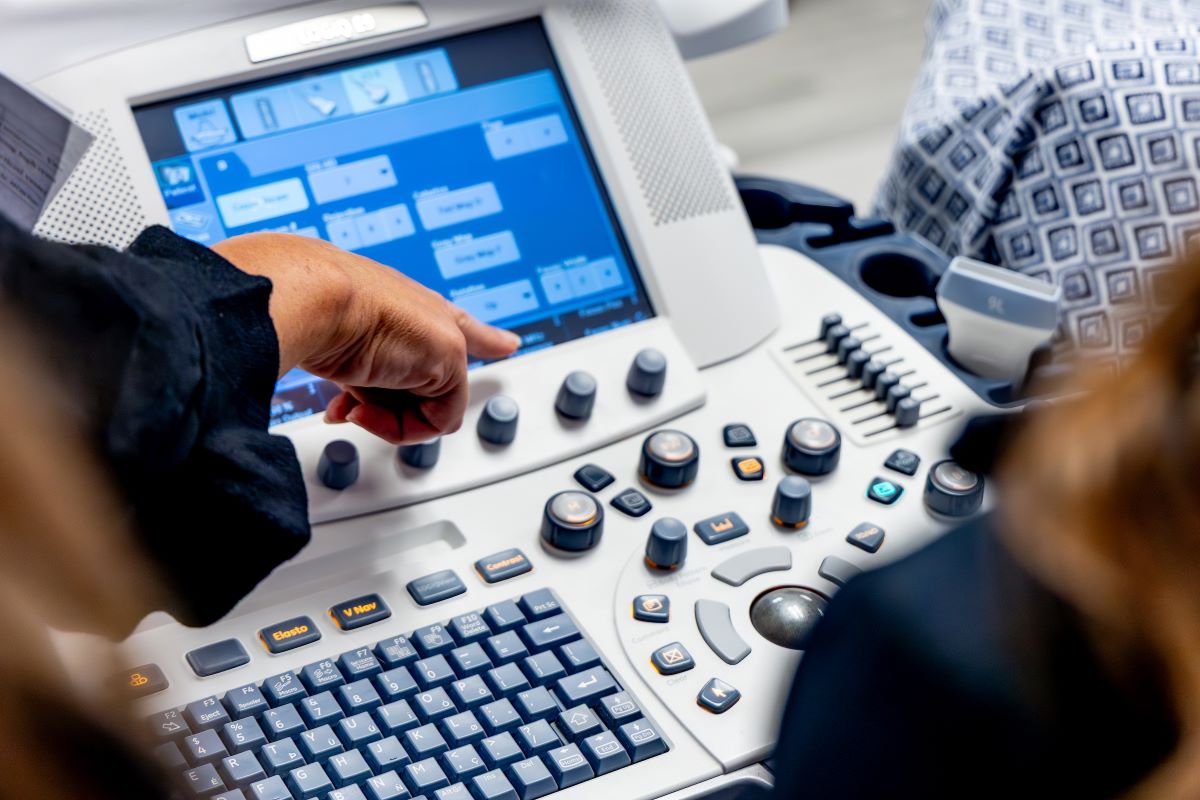
hand showing what buttons on ultrasound machine do
The donated GE LOGIQ E9 ultrasound systems are similar to those DMS students encounter at many of their clinical sites.

How does practice prepare you for clinicals?

Lisa Reimer, chair of CUW’s Imaging Department and director of the DMS program, sees the difference that familiarity can make.

Reimer compared learning to operate an ultrasound system to learning the controls of a car. After enough time behind the wheel, a driver no longer needs to look for the windshield wipers. The movement becomes automatic. Sonographers develop a similar type of muscle memory.

“We’re watching the screen, our left hand is typing and our right hand is scanning,” Reimer said. “The muscle memory to how far does my hand travel to get to this function, we’re not looking down trying to find it after we get familiar with the equipment.”

That familiarity becomes especially valuable because sonography requires students to perform several tasks at once.

“You’re watching, observing, making sense of the images, you’re keystroking to improve your images, you’re scanning, finding new windows to get that ideal picture,” Reimer said. “And then you’re talking with your patient to reassure them, make sure they’re doing OK.”

Knowing the equipment also allows students to give more of their attention to the patient.

“When you’re actually scanning patients in real life, you’re not wasting their time,” Marien said. “They feel comfortable having you scan as a student because you’re confident, and you already know what you’re doing before you even step foot in the hospital.”


girl looking as screen
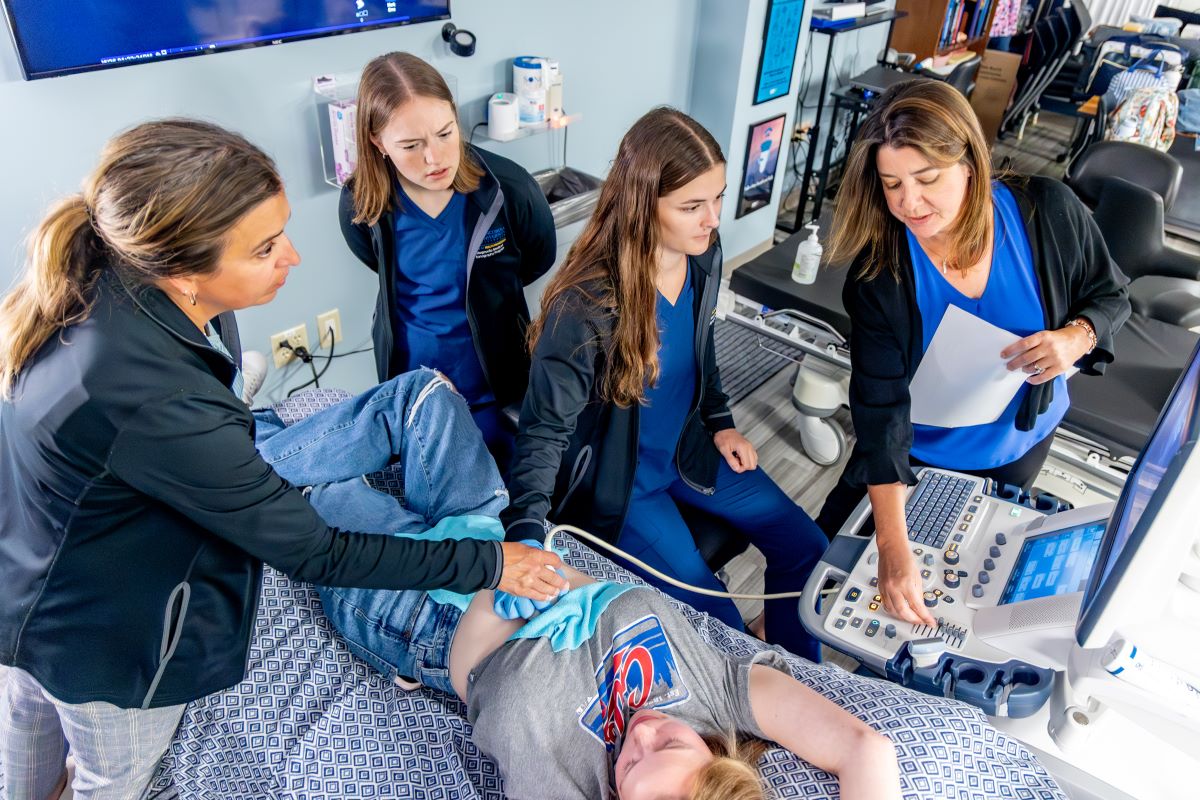
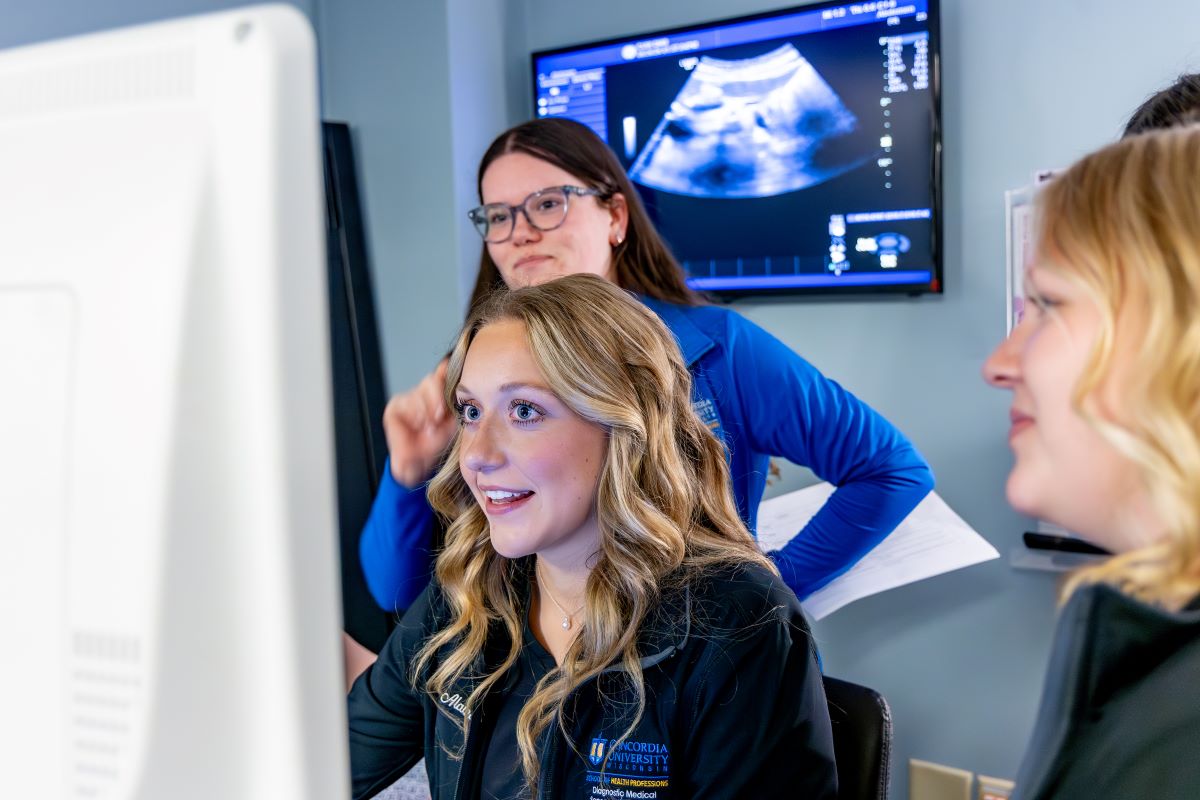
Senior Kaela (behind) collaborates with juniors Alaina (scanning) and Brie (right) as they learn the art and science of Diagnostic Medical Sonography.

When can you start scanning?

Concordia students begin scanning during their junior year, shortly after entering the professional phase of the DMS program.

The newest juniors got an introduction to the equipment during a scan lab led in part by senior students. Marien, Falk and their classmates walked the juniors through buttons, knobs and other machine functions. Students also practiced by scanning Jell-O molds containing hidden objects, an exercise that allowed them to practice scanning while testing their ability to identify what they saw on the screen.

The Aspirus donation gives students more opportunities to work on equipment comparable to what they may use during clinical rotations. Previously, students rotated among the university’s available systems, including older equipment. With a variety of systems now available, students can spend more of their lab time developing familiarity with newer equipment.

That practice extends beyond learning which button does what. Sonographers must learn how to adjust depth, gain and other settings to produce diagnostic-quality images. Among students and professionals, Falk said, there is a simpler phrase for getting it right: making a “pretty image.”

“You’re also looking through the entire organ, so you have to make sure that your depth is good and your gain is good,” Falk said. “All the different little functions that optimize your images are really good so that you can make sure that you get the most out of your scan for your patients.”

And no two patients are exactly alike.

“Even though you’re scanning a liver on 50 patients, it’s not going to look the same for any patient because everybody’s unique in their own ways,” Falk said.

Knowing the equipment gives students more freedom to concentrate on those differences.


How did CUW get the ultrasound systems?

The two systems came to Concordia because Aspirus was upgrading its own ultrasound equipment and the units being replaced had no trade-in value, Reimer said. That presented the healthcare organization with another option: donation.

“When the opportunity arose to donate these ultrasound systems, we wanted to ensure they would continue to provide value by helping educate the next generation of sonographers,” said Laurie Lemke, Northern Region manager of Imaging Services at Aspirus. “Concordia University Wisconsin was a natural choice because of its outstanding reputation for excellence in sonography education and its commitment to preparing highly skilled imaging professionals.”

For a university program, equipment that has reached the end of its service within one healthcare setting can still have years of educational use.

Hospital-grade ultrasound systems can cost hundreds of thousands of dollars, making regular replacement across an entire teaching lab difficult. Donations can help programs expose students to newer technology while giving existing medical equipment another useful purpose.

“When you buy new equipment and you don’t get anything on your trade-in and you’re just going to dispose of it anyway, we will take it,” Reimer said. “These are really great pieces of equipment.”

Aspirus has also indicated that additional probes, or transducers, will be donated to accompany the systems.

“This has been our biggest gift to date,” Reimer said. “We are really grateful people are thinking of Concordia as an option.”


students learning ultrasound machine
DMS students work together during a hands-on lab, putting what they learn in the classroom into practice.

Where could a career in sonography take you?

Through this new connection with Aspirus, Reimer has learned more about the demand for sonographers in northern Wisconsin, including communities around Eagle River and Tomahawk. The donation has also opened conversations about future opportunities for CUW students and alumni.

“We didn’t know that need existed,” Reimer said. “Some good conversations are coming out of that, and what a gift. We can now stay connected, and when they have job postings, we can make sure those get in front of our alumni and our current students.”

For now, the most visible effect of the Aspirus gift can be found in the DMS program’s scan lab at Concordia.

There, students can practice until reaching for a control becomes instinctive. They can learn how an image changes from one patient to another. They can make mistakes, ask their professors questions and try again.

Then, when the patient is real, they can focus less on finding the right button and more on the person in front of them.

“I feel like it’s so important to get hands-on experience before you enter the clinical setting,” Marien said. “The fact that we have access to more of these machines now … is so important to helping the students succeed.”


How to donate medical equipment or supplies?

two students side by side
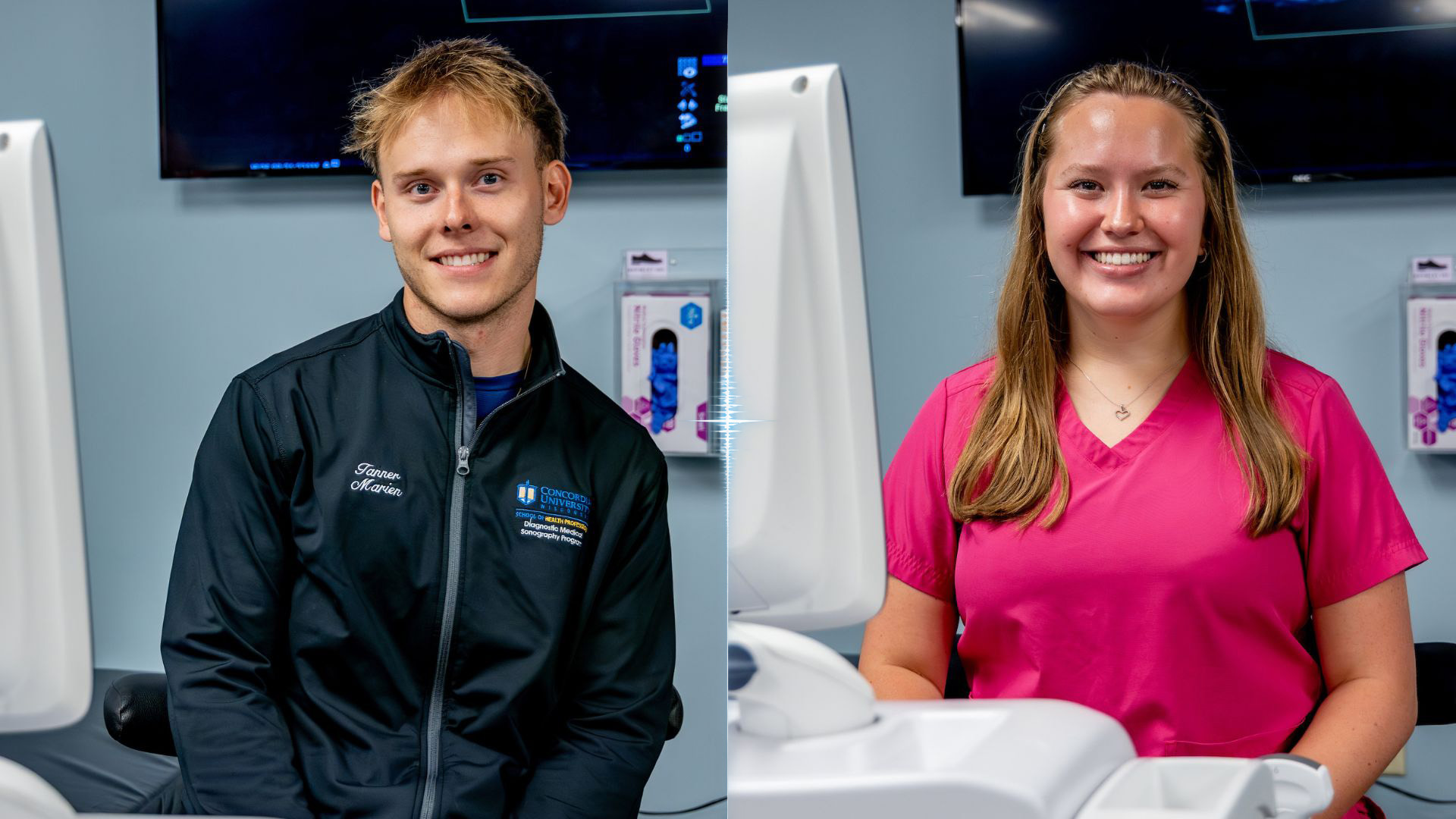
Meet two of CUW’s future diagnostic medical sonographers: seniors Tanner Marien (left) and Bryn Falk (right).

When healthcare organizations upgrade equipment or retire supplies that can no longer be used for patient care, those resources may still have educational value for Concordia students.

Concordia’s Diagnostic Medical Sonography program welcomes conversations with healthcare organizations about equipment and supplies that could support hands-on student learning.

Potential donations may include:

  • Ultrasound systems
  • Ultrasound probes and transducers
  • Medical supplies suitable for educational use
  • Expired supplies that can safely be used for training, such as sterile trays

“Even though they can’t be used on patients anymore, they can be used for education,” Reimer said.

Interested in donating? Contact Lisa Reimer at Lisa.Reimer@cuw.edu or 262-243-2172.


Want in?

Concordia University Wisconsin is a Lutheran higher education community committed to helping students develop in mind, body and spirit for service to Christ in the Church and the world.

Finish what you started with Concordia online


Your life doesn’t need to fit around your degree. Your degree needs to fit into your life.


Finishing a degree after time away can raise a lot of questions. Will your previous credits transfer? Can you fit classes around work and family? Can you get back into the rhythm of school?

Concordia University Wisconsin online graduates Ashley Eickert and Dalton Stewart came to Concordia under different circumstances, but both needed a path that allowed them to earn their degrees without putting the rest of their lives on hold.

Eickert, a mother of three from Brillion, Wis., returned to school after a career in nursing and recently earned her bachelor’s degree in education. She was nervous about fitting in, keeping up academically and managing school alongside family life and a family business. Those concerns began to ease once she got to know her professors.

Concordia’s team helped Eickert understand which credits would transfer, how they applied to her degree plan and what she still needed to complete.

“They were really intentional about building relationships with me, checking in, and easing my worries,” Eickert said. “They walked me through every step.”

Stewart also had little room in his schedule to spare. The St. Louis-area student is married with two children, works full time and is preparing to enter Concordia Seminary in St. Louis.

With help from Concordia staff and his advisor, Stewart mapped out an ambitious academic plan. He earned a Bachelor of Arts in theological studies with a minor in human resource management while continuing to meet his responsibilities at work, at home and in leadership.

His advice to future students is simple: “Do it.”


Online learning built around your life

Concordia Wisconsin’s online programs are designed for students balancing work, family and other responsibilities. Whether you are working full time, raising a family, serving your community, preparing for a new career or returning to school after time away, you can pursue your degree while remaining present for the other parts of your life.

Eickert said online learning gave her the flexibility she needed at home while finishing her degree. “I could structure my coursework around my family schedule,” she said.

Stewart balanced coursework with a full-time job, raising children and serving in union leadership. Staying engaged and communicating with his professors helped him keep going.

“The sacrifice is great,” Stewart said, “but the reward that you get from those sacrifices far outweighs the sacrifice.”


Support from start to finish

Support can take different forms throughout the process, from transfer credit review and advising to course planning and conversations with professors.

For Eickert, asking questions and trusting the people around her became an important part of the experience. “Concordia truly meets you where you’re at,” she said. “The faculty, the staff, the advisors, they want you to succeed.”

Stewart offers similar advice, especially when life gets busy. “Stay in contact with your professors,” he said. “It doesn’t matter what the situation is.”

What mattered to both was having people to turn to for help as they worked toward graduation.


Ready to finish what you started?

If you have been thinking about finishing your degree, transferring credits or preparing for something new, you do not need to have everything figured out before you begin.

CUW offers online undergraduate and graduate courses year-round, with most programs offering two eight-week terms during the spring, summer and fall.

Take the next step. Connect with Concordia’s admissions team through CUW Online Undergraduate Admissions or CUW Graduate Admissions, or call 262-243-4300.


Want in?

Concordia University Wisconsin is a Lutheran higher education community committed to helping students develop in mind, body and spirit for service to Christ in the Church and the world.

One conversation can change healthcare

Concordia alumna Kayla Hensley (’23) advocates for patients and providers on Capitol Hill.


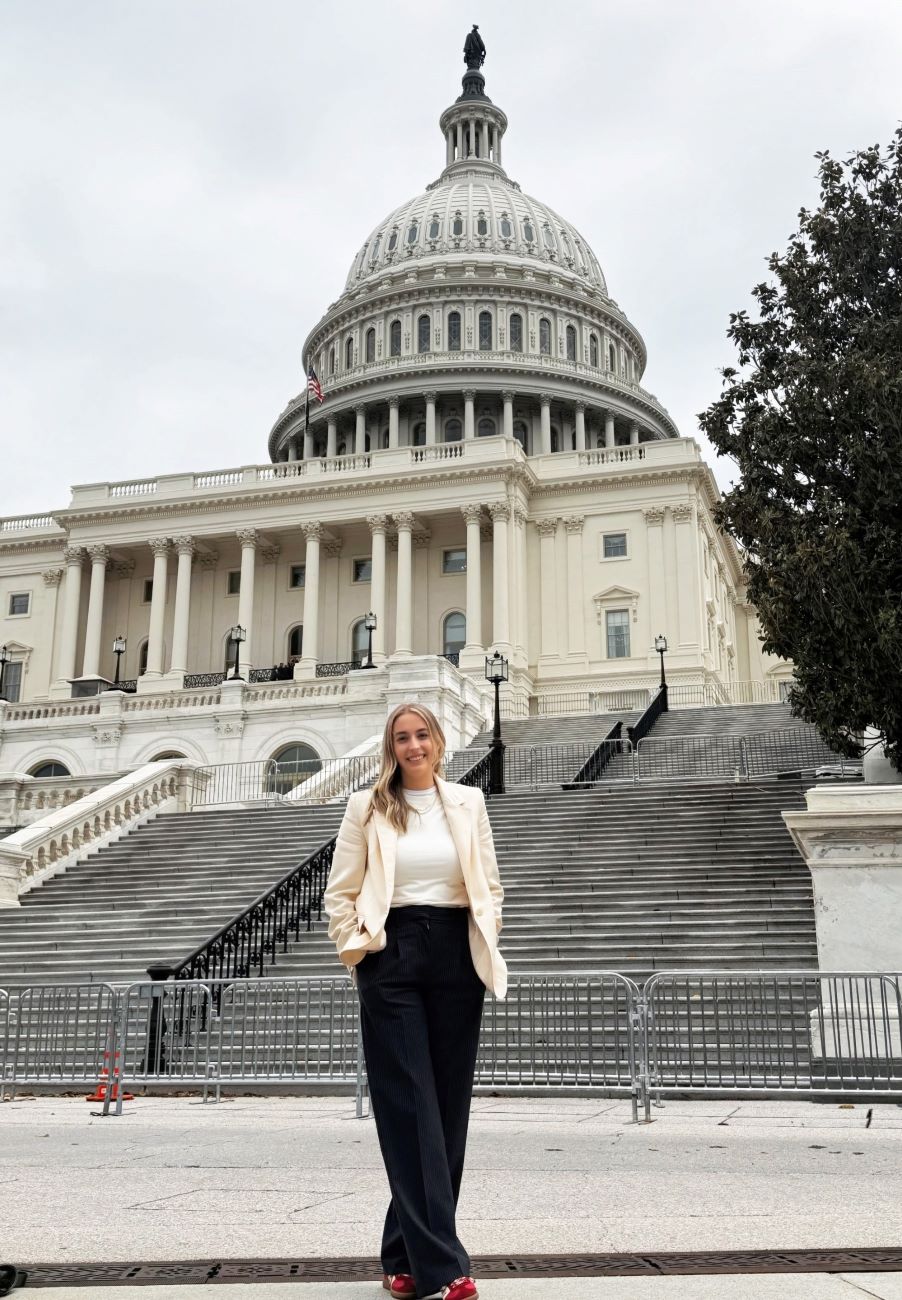
Kayla Hensley, a 2023 graduate of CUW’s Speech-Language Pathology program and current regional vice president for Continuum Therapy Partners, traveled to Washington, D.C., earlier this year as part of the National Association of Rehab Providers and Agencies (NARA) Advocacy Expert Program.

Alongside rehabilitation leaders from across the country, she met with congressional staff members and healthcare leaders to discuss issues affecting patient care, telehealth access, reimbursement policies and the future of rehabilitation professions.

The experience gave Hensley the opportunity to represent not only speech-language pathologists, but rehabilitation professionals across multiple disciplines.

“We need to build relationships with legislators so they understand how policies affect our professions, our students and our patients,” Hensley said. “They can’t make informed decisions unless healthcare professionals are part of those conversations.”


Learning to lead through advocacy

woman dressed professionally in front of Capital

The NARA Advocacy Expert Program prepares therapy professionals for advocacy work at the state and federal levels through a yearlong initiative. Participants receive training on healthcare policy, legislation, reimbursement structures and communication strategies before meeting directly with lawmakers in Washington.

Leaders within her organization nominated Hensley for the program, and the selection committee chose her as part of the program’s second cohort.

“I was shocked and very appreciative,” she said. “Advocacy is already a large part of what therapists do every day when we advocate for patients and services. This experience took that advocacy to another level.”

During meetings on Capitol Hill, Hensley and her cohort discussed several pressing healthcare topics. One major issue involved telehealth services for therapy disciplines, including speech-language pathology, occupational therapy and physical therapy.

As current legislation stands, expanded telehealth access for some therapy services could expire in 2027 unless lawmakers take additional action.

“We talked a lot about how important telehealth is for rural communities, especially in states like Wisconsin,” Hensley said. “Some patients may have to drive hours to access care. Telehealth allows them to receive services more safely and efficiently.”

The group also addressed Medicare reimbursement reductions affecting therapy providers and the financial barriers students face while pursuing advanced healthcare degrees.

For Hensley, one of the most eye-opening parts of the experience was realizing how heavily lawmakers rely on clinicians to explain what is happening within healthcare systems.

“What stood out most was how much legislators and staffers genuinely didn’t know about what’s happening in our field,” she said. “That reinforced how important advocacy is.”


A foundation built at Concordia

Although advocacy work took Hensley to Washington, she says the foundation for that work began at Concordia.

After earning her undergraduate degree from Indiana University, Hensley moved to the Milwaukee area and worked as a hearing instrument specialist before deciding to pursue graduate school. Concordia’s smaller program and close-knit faculty support drew her in.

“I really wanted a program where I had quick access to professors and strong support systems because of how intensive clinical education is in speech-language pathology,” she said. “Concordia stood out immediately.”

Now working closely with universities and clinical placement programs across Wisconsin, Hensley says CUW students continue to impress healthcare partners.

“The feedback we consistently receive from clinical instructors is that Concordia students are very well prepared,” she said. “Their clinical education is top notch.”

“Kayla’s dedication to excellence was evident in every setting—classroom, clinic, and research—where she led with integrity and followed the data,” said Dr. Cindy Lund, CCC-SLP, C/NDT, associate professor of speech-language pathology. “What impressed me most was her readiness to do the hard, ethical thing when no one was watching; that’s the kind of clinician patients deserve.”

“As Kayla’s advisor and mentor, I saw her lead with quiet conviction—speaking up and advocating for what’s ethically right,” Lund added. “Across settings, she paired evidence with empathy, modeling the kind of advocacy-driven leadership our profession needs.”

Hensley credits several faculty members for helping shape both her educational experience and professional path, adding that the support she received at Concordia continues to this day.

“The entire program really stays connected with students long after graduation,” she said.


Looking ahead

That sense of connection and purpose continues to influence the way Hensley approaches leadership today.

“Concordia emphasizes service, leadership and vocation,” she said. “Being grounded in my faith and understanding that my work serves patients and clinicians has been really meaningful.”

Hensley plans to continue advocating throughout her career, even though advocacy is not formally included in her job title. She is especially passionate about mentoring students entering the profession and helping them understand healthcare’s clinical and policy sides.

“When students complete clinical placements within our facilities, we teach them not only clinical skills, but also how healthcare systems and regulations work,” she said. “I want students to feel confident entering the profession and understand how to advocate for themselves and their patients.”

Looking back on her experience, Hensley says the trip reinforced how much progress can begin with a single conversation.

“You don’t have to go to Washington, D.C., to advocate,” she said. “You can start within your own state, your organization, or your professional network.”

Her journey from Wisconsin to Washington reflects the growing role healthcare professionals play in shaping the future of patient care. It also highlights how CUW graduates are stepping into leadership roles far beyond the classroom.


Want in?

Concordia University Wisconsin is a Lutheran higher education community committed to helping students develop in mind, body and spirit for service to Christ in the Church and the world.