New driving simulator enhances driver assessment training for occupational therapy students.
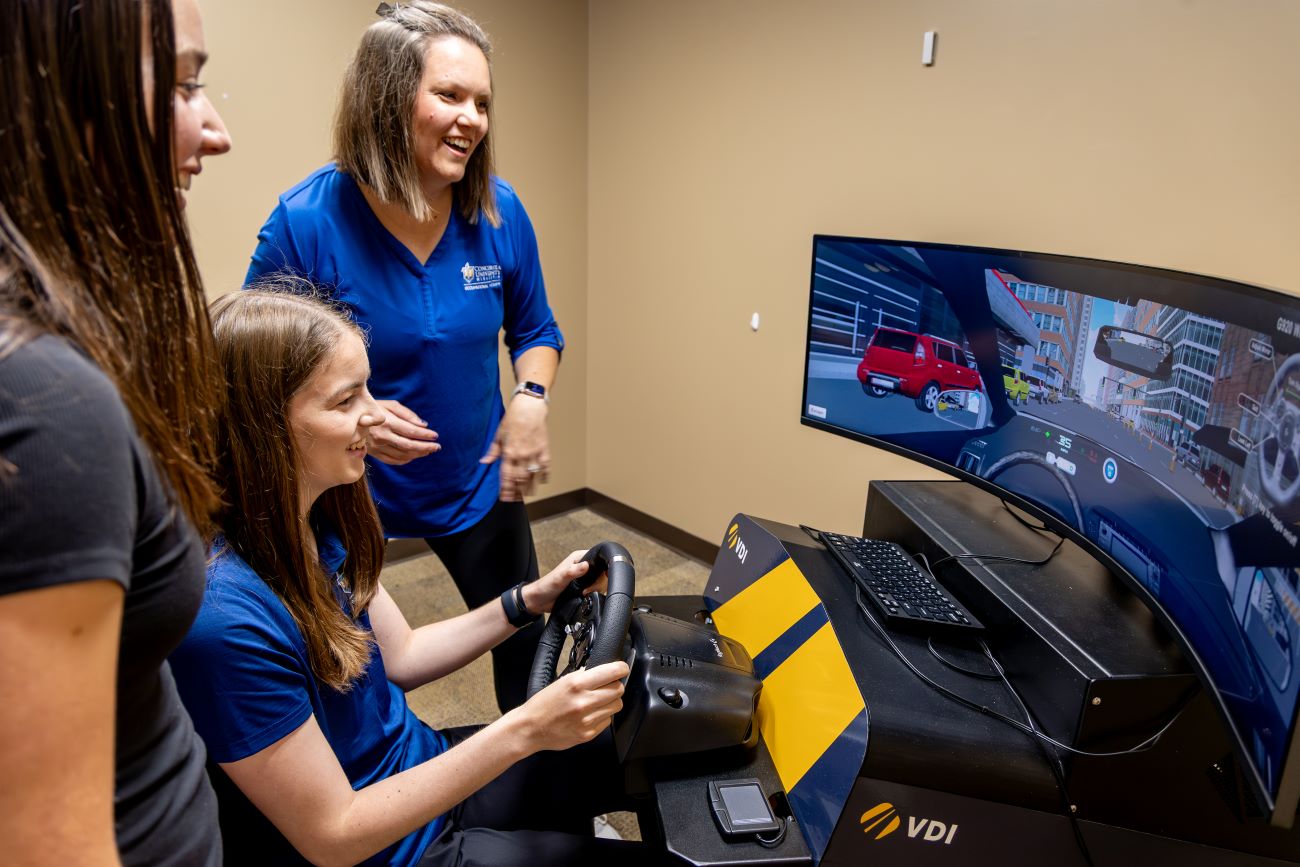
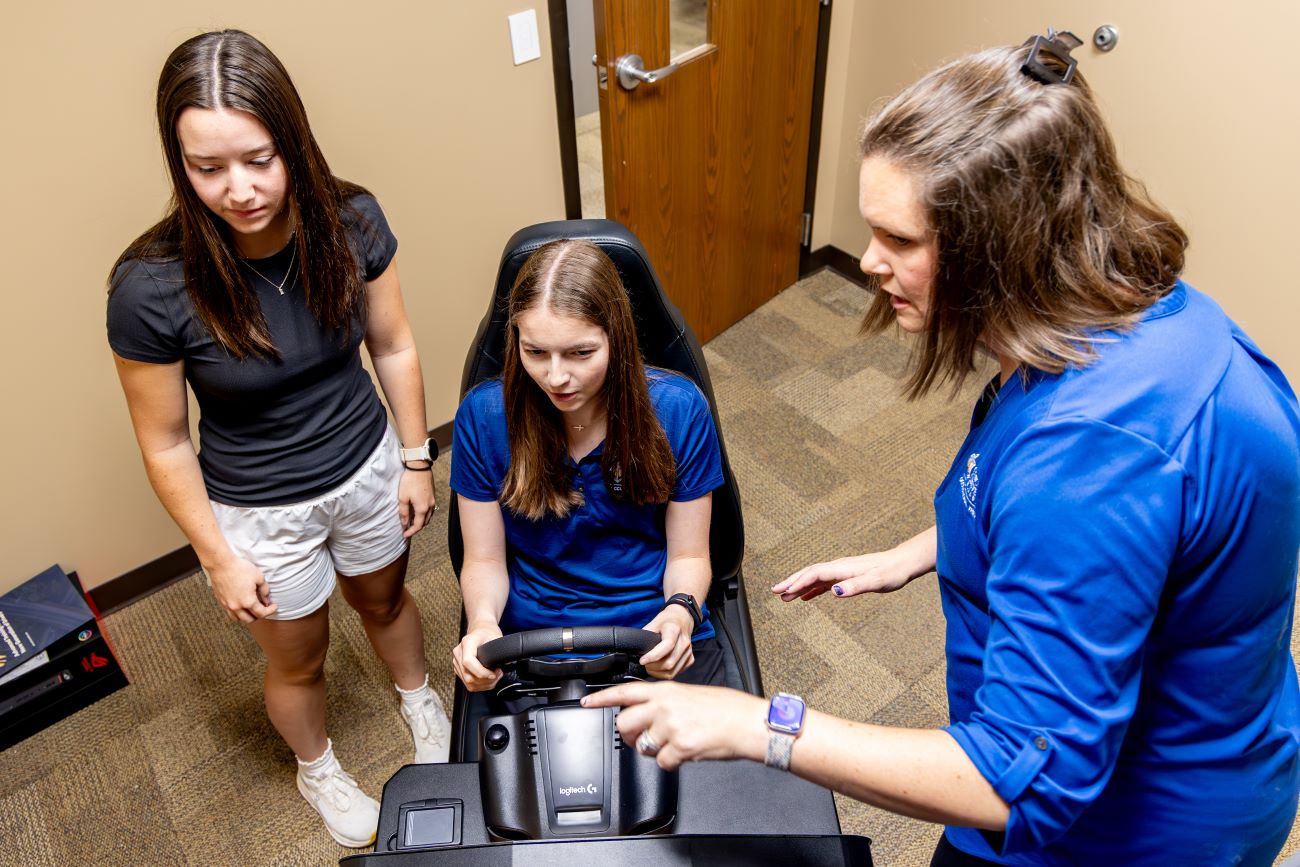
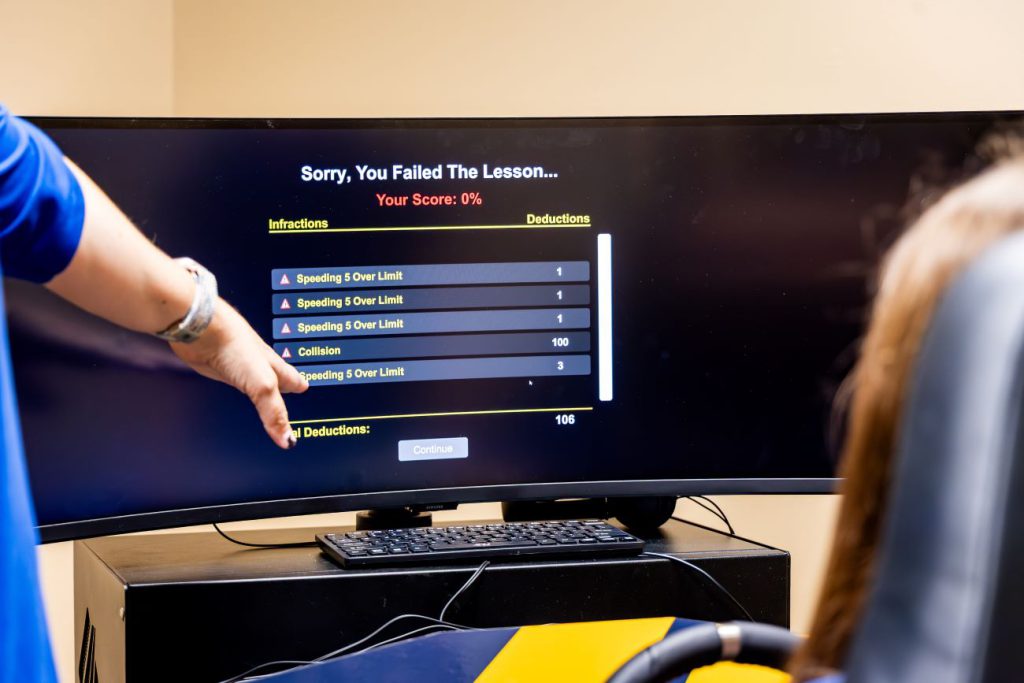
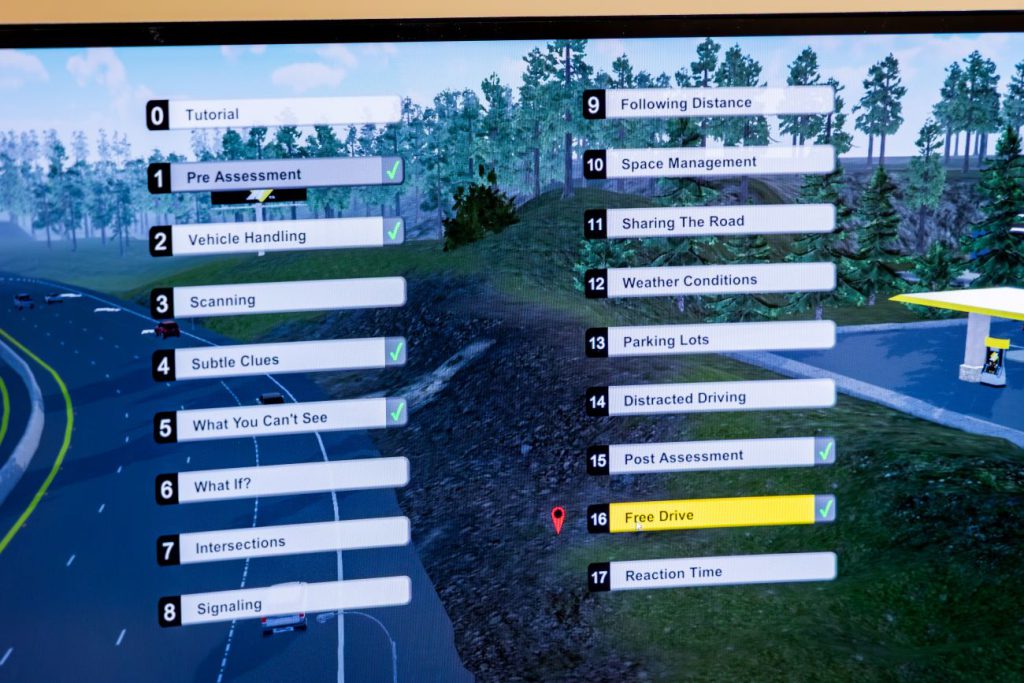
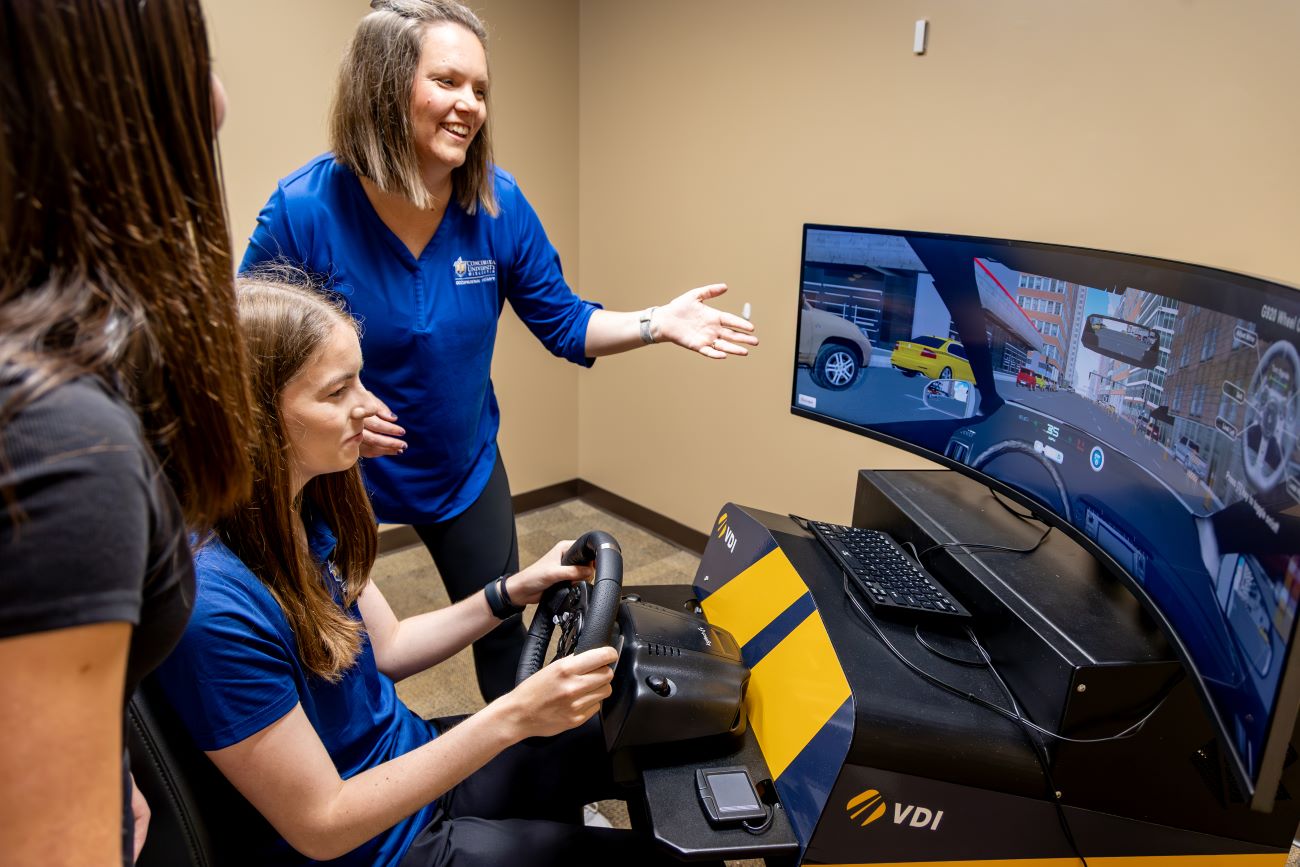
Thanks to a generous gift from the Kott Memorial Charity Trust, the new driving simulator brings classroom learning to life. Through realistic driving scenarios, occupational therapy students evaluate driving performance, strengthen clinical reasoning and apply what they’ve learned before working directly with clients.
“Driving simulators are an exciting and innovative teaching tool. They bring to life what students have read in their textbooks and give them opportunities for hands-on practice. As a professor, I’m always looking for ways to make that happen,” said Anne Martin, OTR/L, assistant professor of occupational therapy.
OT and driving go hand in hand
Driving is more than a convenience. It allows people to work, attend school, keep medical appointments, complete daily errands and stay connected to their communities. Occupational therapists help clients maintain or regain their independence by evaluating the physical, visual and cognitive skills needed to drive safely.
Behind the scenes, students learn to assess the roles, habits and routines that influence a person’s ability to drive. They also examine how injury, illness or changes in cognition affect driving. Those insights help them determine when occupational therapy interventions can support a client’s safe return to the road.
“It was a great experience to get a sense of what the driver simulator could do and what to observe and look out for when assessing a client’s driving ability,” said Anna Pace, a Doctor of Occupational Therapy student expected to graduate in 2027. “We learned how it could help us assess and provide safe, client-centered recommendations and interventions.”
Bridging the gap between textbook and practice
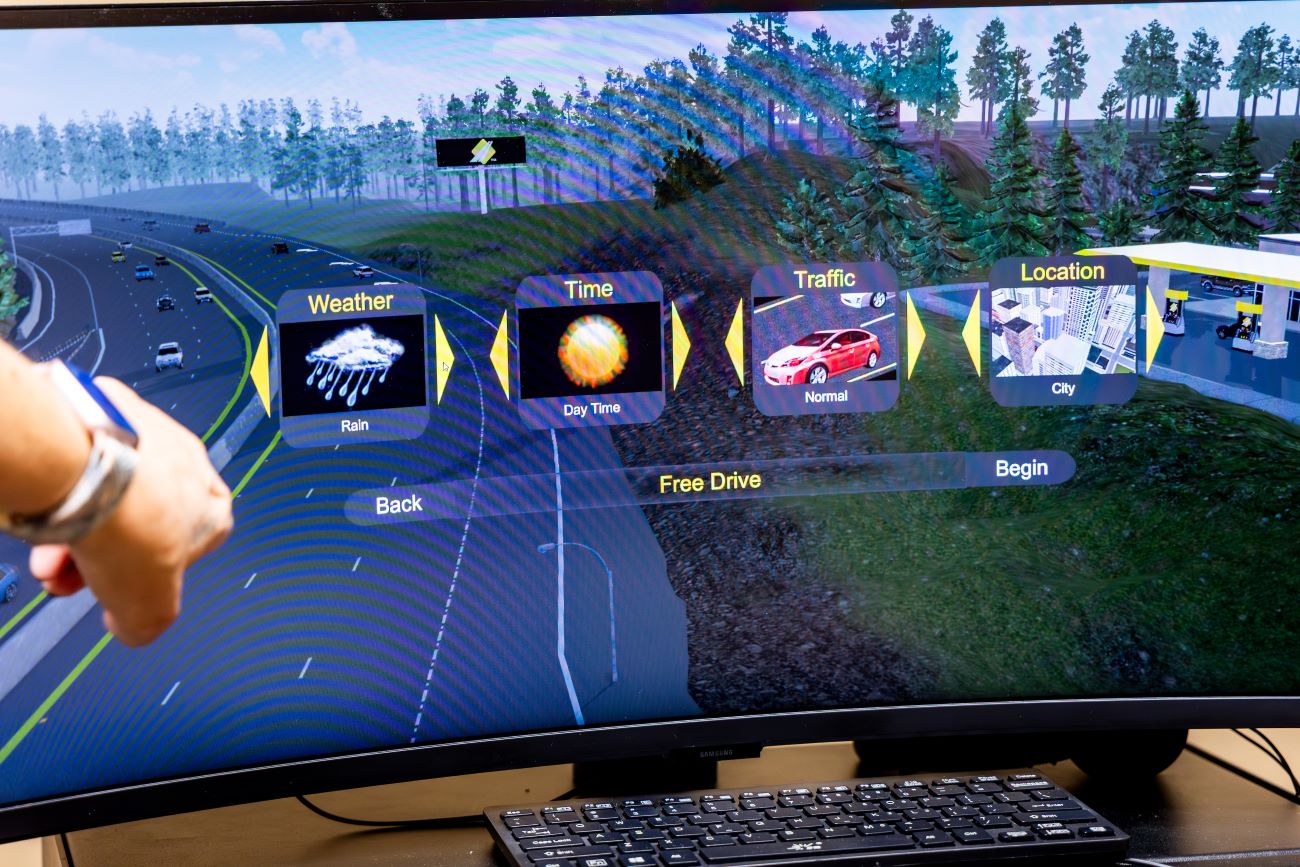
The simulator recreates a variety of driving conditions, from sunny afternoons to snowy evenings, during both daytime and nighttime travel. Learners experience suburban neighborhoods, rural highways, busy city streets and other driving environments. They also practice responding to distracted driving, speed control, reaction time and other scenarios that influence driving safety.
Martin said the simulator also gives students opportunities to practice communicating recommendations with clients—one of the most important aspects of occupational therapy. In doing so, it allows them to apply classroom learning in meaningful ways before entering fieldwork, preparing them to better serve the clients and communities they’ll one day support.
Anne Martin, OTR/L, assistant professor of occupational therapy, contributed to this article.
Editor’s note: The driving simulator was made possible through the generous support of the Kott Memorial Charity Trust, whose investment is helping prepare the next generation of occupational therapists.
Want in?
Concordia University Wisconsin is a Lutheran higher education community committed to helping students develop in mind, body and spirit for service to Christ in the Church and the world.
What began with the university’s first comfort dog, Zoey, has grown into a lasting ministry of compassion, presence and care.
Born on Nov. 11, 2012, Zoey arrived at Concordia in January 2014.
Just like humans, every dog has two sides: one that works and one that plays. Concordia’s first comfort dog, Zoey, was remarkable at both.
According to alumna Erika Buchel (’18, ’22), a PharmD graduate and one of Zoey’s original handlers, Zoey possessed a gentle, calming soul. (Just look at those eyes.)
“Her purpose was to be the bridge to open communication, provide comfort and give emotional support to any and all who needed it,” recalled Buchel.
“She fulfilled this purpose and so much more,” she continued. “She was a hard worker when vested and a fun, playful, sassy girl when unvested.”
In 2015, as Buchel began her college journey, she remembers seeing the young pup during a campus visit and immediately feeling called to work with her. “I knew I wanted to be involved,” Buchel said.
Over the years, that sentiment rang true for many under Zoey’s watch. Though she is essentially retired today and occasionally visits campus, Zoey has paved the way for the next generation of comfort dogs. Her impact has reached far beyond the people she comforted. It has shaped the environment of compassion and care that continues to grow at Concordia.
Former director of the Counseling Center for 27 years, Dave Enters, MS, who now serves in a part-time counseling role, recognized the ministry’s promise the day Lutheran Church Charities first proposed it. Months after LCC visited campus to present its Comfort Dog Ministry, Enters continued researching the opportunity. When no one else stepped forward to lead the effort, he presented the idea to the Administrative Council for approval. With then-President Patrick Ferry’s full support, he established the program at Concordia with Zoey arriving in January 2014.
“I remember thinking, ‘This is too good of an idea to let go,'” Enters said. Zoey’s ministry was broad by design. Because neither she nor Enters was attached to one particular department or school, they served the entire university. “We were all things to all people,” Enters said.
After studying the ministry’s mission, developing a vision and consulting with Lutheran Church Charities—where Zoey was trained—Enters worked through how a comfort dog could function on a college campus.
“Eventually, I created the job description that became the foundation of Zoey’s work,” he recalled.
The making of a comfort dog
Dave Enters with Zoey
From the start, Zoey seemed called to something bigger. At 8 weeks old, this four-legged girl was well on her way. She trained to become an LCC K-9 Comfort Dog for roughly a year prior to serving at Concordia. By the time she graduated, Zoey could respond to 55 commands.
“Looking back, Zoey was probably over-trained for most of her work at CUW,” Enters said with a smile. Only about 30 of those commands were regularly used. However, all of that training became essential when Enters, Zoey and other handlers began responding to national tragedies through LCC.
When Zoey arrived at Concordia, LCC was still expanding its K-9 Comfort Dog Ministry. One of her primary responsibilities was serving the university community, but an equally important part of her role was deploying to communities devastated by tragedy.
A ministry without walls
Zoey receives a smile as a young girl shows her the comfort dog’s business card during a national deployment.
One of Zoey’s first deployments came in 2013, when she was still in training. Following the aftermath of the Sandy Hook Elementary School shooting in Newtown, Conn., she was called to help comfort victims and families, especially children.
These deployments became a defining part of Zoey’s ministry. Alongside other comfort dogs and handlers from across the country, she entered communities experiencing unimaginable loss. The goal wasn’t to solve anyone’s pain or suffering, but simply to be present with those carrying it.
For LCC, the comfort dogs’ presence often opened the door to sharing compassion, faith and the hope of Jesus Christ.
During her years in the K-9 Comfort Dog Ministry, Zoey also responded to:
2013: Boston Marathon bombing
2016: Pulse nightclub shooting in Orlando
2016: Baton Rouge officers ambush
2020: Molson Coors shooting in Milwaukee
2021: Waukesha Christmas Parade tragedy
Alumna Erika Buchel embracing Zoey for a photo.
A ministry of presence
Zoey’s work carried her from the front door of a student’s residence hall to communities across the country. At Concordia, she spent her days surrounded by student handlers, hugs from students in need of comfort and quiet moments with members of the campus community. Off campus, she served communities navigating unimaginable grief, as well as individuals simply struggling with everyday life.
Zoey was highly intuitive. “She was able to sense the emotions of those around her, and she adapted her behavior to accommodate what people needed,” Buchel said.
Buchel accompanied Zoey to several crisis-response deployments, as well as visits to local nursing homes and the behavioral health unit at a local hospital.
Zoey visits with residents at a local nursing home.
Enters, like Buchel, recalls many moments when Zoey’s presence led to what felt like God moments. Some of the most meaningful moments happened just around the corner from campus during visits to local nursing homes.
“Whenever we visited a nursing home, the staff almost always directed us to the memory care unit first,” Enters said. The residents in that unit were often living with various stages of dementia.
“You would walk into a common room and see people sitting quietly, often not interacting with one another,” he continued. “The television might be on, but everyone seemed isolated, even though they were sitting together. Then we’d walk in with Zoey. Suddenly heads would lift and people became engaged.”
Zoey enjoyed greeting each person individually, and some would begin sharing stories about dogs they had owned.
Healing beyond words
The same quiet presence that reached nursing home residents also brought comfort to people facing mental and emotional health challenges. One of Buchel’s most memorable experiences with Zoey happened in the behavioral health unit at a local hospital. There, Zoey gently responded to a patient with anxiety around dogs. The process was slow but remarkable.
“I led Zoey over and she so slowly and gently laid her head on the patient’s lap, and the patient lowered her head toward Zoey to embrace her, and cried,” Buchel said. “You could feel the relief of the patient in the room and how Zoey allowed them to embrace their feelings and let them go onto Zoey. It was a definitive breakthrough in the patient’s therapy.”
Buchel’s college journey was shaped by Zoey. She spent three years as one of Zoey’s handlers during her undergraduate studies and continued working with her periodically throughout pharmacy school.
“Being her handler for so many different settings and experiences allowed me to become a more empathetic and intuitive healthcare provider within my community,” said Buchel.
Today, as a mother, Buchel especially sees how those experiences are life changing. The impact comfort dogs and service dogs can have on people in need of emotional support is powerful.
“Her presence was truly nurturing in ways that are incomprehensible until you have experienced it yourself.”
Zoey greets guests during the Passing of the Vest ceremony for Sage, the newest Lutheran Church Charities K-9 Comfort Dog, in 2018.
Passing the leash
Education professor Nicole Muth and athletic training professor Rhonda Verdegan, PhD, saw the impact Zoey had around campus and eventually joined Enters’ team as handlers in 2015. The experience they gained working alongside Enters and Zoey became the catalyst for developing the Compassion Care Certificate at Concordia, which launched in 2021.
“They are the architects of the certificate program,” Enters said. “I introduced them to the leadership side of comfort dog work, and then they took the leash and ran with it.” Though Enters’ Comfort Dog Ministry has retired, the Compassion Care Certificate continues to grow. Verdegan now works primarily with another comfort dog, Runner, helping carry forward the ministry Zoey helped build.
“Zoey has brought so much love to everyone who has crossed paths with her,” Verdegan said. “She has earned her time and can just chill, relax and kind of do her own thing.”
The School of Health Professions is home to Sage, who works primarily with the occupational therapy, physical therapy and speech-language pathology programs. Runner is housed under the School of Education, but serves a variety of majors across campus. Together, they are the “next generation,” as Enters calls them, carrying on Zoey’s legacy—the very outcome he had hoped for.
“When we started in 2014, we were the only university in the country with a highly trained comfort dog owned by the university and operating under a defined job description,” Enters said. “The success is overwhelming, and the evidence is irrefutable.
“Students here receive an experience that very few college students around the country ever have. They’re learning through service and ministry in ways that can’t be replicated in a traditional classroom.”
Zoey was the trailblazer. Her gift for accompanying people through difficult circumstances with joy and compassion was central to a ministry unlike any other. Her legacy lives on in the memories of all those whose lives she touched.
Zoey and Sage
Fast facts
Age 13.5
Placed through Lutheran Church Charities
Concordia’s first comfort dog(not a service dog; service dogs are trained to assist one person with a disability, while LCC K-9 Comfort Dogs serve anyone in need.)
Joined campus in January 2014
Served as the first comfort dog prior to the Compassion Care Certificate which launched in 2021
Concordia University Wisconsin is a Lutheran higher education community committed to helping students develop in mind, body and spirit for service to Christ in the Church and the world.
Healthcare employers are facing unprecedented challenges—from staffing shortages to rising patient complexity. To meet these demands, organizations are increasingly investing in MSN-prepared nurses who bring advanced clinical expertise, leadership skills, and a systems-level perspective. An MSN isn’t just a credential—it’s a workforce strategy for building resilient, ethical, and future-ready healthcare teams.
Introduction: The Leadership Gap in Healthcare
Hospitals and healthcare systems today are under pressure from every direction. Nurse shortages persist. Patient populations are aging. Regulations and quality expectations continue to rise. At the same time, many experienced nurses are being asked to step into leadership roles without formal preparation for managing teams, budgets, or organizational change.
Employers are recognizing a hard truth: strong clinical skills alone are no longer enough. The future of healthcare depends on nurses who can lead—nurses who understand both patient care and the broader systems that support it. That’s why more organizations are investing in Master of Science in Nursing (MSN)-prepared professionals.
MSN programs prepare nurses to move beyond task-based care and into advanced decision-making roles. Whether serving as nurse leaders, educators, or advanced practice clinicians, MSN-prepared nurses are trained to analyze complex situations, apply evidence-based practice, and think proactively rather than reactively.
For employers, this means fewer breakdowns in care coordination, stronger clinical outcomes, and leaders who can navigate ambiguity with confidence.
Leadership Development Employers Can’t Afford to Ignore
From Charge Nurse to Change Leader
Many nurses are promoted because they are excellent clinicians. But managing people, leading change, and aligning teams around shared goals require a different skill set.
MSN curricula emphasize:
Leadership and organizational behavior
Healthcare policy and ethics
Quality improvement and systems thinking
Communication across interdisciplinary teams
This preparation allows MSN-prepared nurses to lead initiatives, mentor staff, and foster healthier workplace cultures—directly addressing burnout and turnover.
For employers, investing in MSN education is a proactive way to grow leaders internally instead of relying solely on external hires.
Improving Patient Outcomes Through Education
Better Education, Better Care
Research consistently shows that higher levels of nursing education are linked to improved patient outcomes. MSN-prepared nurses are trained to evaluate research, implement best practices, and measure results.
In practice, that means:
Fewer preventable errors
Stronger adherence to quality standards
Better patient education and advocacy
Healthcare organizations benefit when clinical excellence is paired with analytical and leadership capability.
Retention, Resilience, and the Employer ROI
Education as a Retention Strategy
Turnover is costly—financially and culturally. Employers who support nurses in earning an MSN often see higher engagement and loyalty. Tuition assistance, flexible scheduling, and clear advancement pathways send a powerful message: We’re invested in your future.
MSN-prepared nurses are also more likely to:
Step into long-term leadership roles
Contribute to succession planning
Serve as mentors for newer nurses
The return on investment isn’t just higher-level staffing—it’s organizational stability.
Values-Based Leadership in a High-Stakes Environment
Healthcare decisions aren’t purely technical; they’re deeply human. Ethical dilemmas, end-of-life care, equity concerns, and staff well-being require leaders grounded in strong values.
Faith-informed institutions like Concordia University Wisconsin emphasize:
Ethical decision-making
Servant leadership
Care for the whole person—mind, body, and spirit
Employers benefit from MSN-prepared nurses who lead with integrity, compassion, and purpose—qualities that build trust with patients, families, and teams.
How MSN Programs Align with Employer Needs
Flexible, Workforce-Friendly Education
Today’s MSN programs are designed with working professionals in mind. Online and hybrid formats allow nurses to continue contributing on the job while developing advanced skills.
For employers, this flexibility means:
Minimal disruption to staffing
Immediate application of learning in the workplace
Stronger alignment between education and organizational goals
At CUW, MSN pathways are built to support adult learners while preparing them for real-world leadership in healthcare settings.
FAQ: Employers and MSN-Prepared Nurses
Why are employers encouraging nurses to earn an MSN? Because MSN-prepared nurses bring leadership, advanced clinical expertise, and systems-level thinking that improve care quality and workforce stability.
Does an MSN benefit healthcare organizations beyond clinical care? Yes. MSN-prepared nurses strengthen management, education, policy implementation, and quality improvement efforts.
How does an MSN support nurse retention? Employers who invest in education often see higher engagement, loyalty, and internal promotion, reducing costly turnover.
Are MSN programs realistic for working nurses? Many programs, including CUW’s, offer flexible online or hybrid formats designed specifically for working professionals.
Conclusion: Investing in the Leaders’ Healthcare Needs Next
The future of healthcare depends on leadership that understands both people and systems. MSN-prepared nurses are uniquely positioned to bridge that gap—bringing clinical excellence, strategic insight, and values-driven leadership to an increasingly complex environment.
For employers, investing in MSN education isn’t just about filling roles. It’s about cultivating resilient teams, improving patient outcomes, and preparing for what comes next.
At Concordia University Wisconsin, MSN programs are designed to develop nurses who lead with skill, compassion, and purpose—ready to serve their organizations and communities with confidence.
Students, alumni, families and friends are invited to join Concordia at three signature summer events across Ozaukee County.
Summer in Wisconsin brings communities together. From county fairs and outdoor concerts to neighborhood festivals, people gather to enjoy some of the year’s most anticipated traditions. Concordia’s participation in these events reflects its commitment to serving and connecting with the communities it calls home.
As Executive Vice President Steven P. Taylor, EdD, explains, “Connection beyond campus is where education becomes lived experience—where partnerships turn into shared impact and lasting relationships.”
This summer, Concordia will be part of three popular events throughout Ozaukee County.
Photos courtesy of Rise and Shine in the Park
Spend an evening at Rise and Shine in the Park
July 27 | Mequon
Rise and Shine in the Park has become a summertime tradition for many local families. This year’s event features Christian recording artist Jamie MacDonald, along with live music from The Praise & Spirits Band. Guests can enjoy food vendors, a beer garden, and opportunities to gather with neighbors and friends.
This free community event takes place at The Foxyard at Foxtown Station in Mequon and does not require registration.
Concordia will once again join the celebration, offering attendees an opportunity to connect with Falcons, while enjoying an evening centered on faith, music and community.
Lori Lorenz, president of the Mequon-Thiensville Community Foundation, said Concordia has been a valued partner of the Rise and Shine Music Series since its launch in 2022.
“They have supported our annual concerts featuring Christian artists such as Danny Gokey, Cain, Unspoken and now Jamie MacDonald,” she said. “With Concordia’s support, it has grown into a vibrant community gathering rooted in hope, worship and unity.”
Doors open at 4:30 p.m. The Praise & Spirits Band performs at 5:30 p.m., followed by Jamie MacDonald at 7 p.m. Please bring lawn chairs.
Location: The FoxYard at Foxtown Station, 6209 W. Mequon Rd., Mequon, Wis.
Photos courtesy of Ozaukee County Agricultural Society
Celebrate a community tradition at the Ozaukee County Fair
July 29-Aug. 2 | Cedarburg
Concordia will be part of the festivities at the Ozaukee County Fair, one of Wisconsin’s longest-running community traditions.
Now in its 167th year, the fair welcomes thousands of visitors each summer for five days of entertainment, agriculture, food and family activities. It also remains one of the last free county fairs in the state.
For generations, the fair has brought together families from across Ozaukee County and beyond, making it a summer tradition for many in the community.
Students and alumni visiting the fair are encouraged to stop by the Concordia booth to connect with university representatives and fellow Falcons.
This year’s fair will feature the world-famous Budweiser Clydesdales, making one of only a few Wisconsin appearances during their 2026 tour. Fairgoers can see the iconic horses throughout the week.
Families can enjoy carnival rides throughout the week, with ride hours beginning at 4 p.m. Wednesday and noon Thursday through Sunday. Special accommodations will be available from noon to 2 p.m. Friday, when free midway rides will be offered to individuals with special needs.
Location: Ozaukee County Fair Grounds, W67 N866 Washington Avenue, Cedarburg, Wis.
Photos courtesy of Country in the Burg
Look for Concordia at Country in the Burg
Aug. 28-29 | Cedarburg
Concordia’s largest sponsorship of the summer will take place at Country in the Burg.
As the event’s exclusive higher education partner and entrance sponsor, CUW will have a visible presence throughout the two-day music festival. Attendees will see Concordia branding at the main entrance, on-site engagement opportunities and recognition before featured performances.
The event draws visitors from across Wisconsin and northern Illinois, creating a lively atmosphere for country music fans and festivalgoers alike.
Students, alumni, faculty and staff can also look for Concordia’s booth, where university representatives and student ambassadors will be available to connect with attendees throughout the weekend.
Country in the Burg founder and organizer Alex Uhan believes the partnership is a natural fit.
“CUW and Country in the Burg are the perfect partners. It’s a great way for students, faculty and staff to kick off the school year with the region’s largest country music festival right down the road from campus before the fall semester begins,” he said. “It’s also great for Country in the Burg because we can promote CUW as the festival’s official university partner and give our fans a chance to see what CUW is all about as an amazing university.”
Location: Cedar Creek Park, N54 W5900 Portland Road, Cedarburg, Wis.
Growing community
Some traditions are worth showing up for because some of the best moments happen outside the classroom.
Whether it’s gathering for an evening of worship and music, spending a day at the county fair with family or making memories with friends at a summer festival, these experiences have a way of bringing people together across generations. They remind us that relationships are built one conversation, one shared experience and one moment at a time.
Whether you’re reconnecting with fellow Falcons, enjoying live music or celebrating a local tradition, these events offer meaningful ways to be part of the places Concordia proudly calls home.
Concordia University Wisconsin is a Lutheran higher education community committed to helping students develop in mind, body and spirit for service to Christ in the Church and the world.
July 4 has always been a special holiday for me. I started out my teaching career as a high school American history teacher.
My master’s degree is in early American history. I read around 20-25 American history books and biographies each year. I love reading and studying American history, and don’t take for granted the freedoms and liberties we enjoy as Americans. And if I’m honest, the week of July 4 is one of the few times where I finally feel like I can “get away” and vacation with my family. There are few things I enjoy in life more than a family barbeque over the fourth.
Every July 4, I’m reminded of two great blessings in my life that I had absolutely no control over:
1. I was born into a Christian home with two loving, Christian parents.
2. I was born in the United States of America.
With these two realities alone, I can say I’ve been incredibly blessed by God. As an American, we can’t forget our history. On July 4, 2026, the United States will celebrate its 250th birthday—and well we should! While certainly a flawed and sin-filled nation, our country’s inalienable principles of “life, liberty and the pursuit of happiness” remain just as important today as it did at the founding. We are blessed!
Why remembering matters
As a Christian, we can’t forget our history either. Indeed, the Bible is literally filled with thousands of “remember” reminders and pleas from God. While American history is being taught less, or in a radicalized way, if at all, even fewer people are hearing or being taught the Word of God, at least as a percentage of the populace.
This is a sad reality because Christianity is a religion based on history and firmly grounded in historical facts and historical events. Jesus really did walk and live on earth. Numerous historical records, documents, witnesses and artifacts attest to these facts and truth claims. And Jesus really did die on the cross and really did rise from the dead. Abundant historical records, documents, witnesses, and artifacts attest to these facts and truths, too.
As readers engage with these devotions, they’ll be looking back to the American Revolution and, more importantly, even farther back to the life of Jesus and the ancient and perfect Word. My prayer is that the Holy Spirit may work on readers’ hearts and minds and have their faith strengthened through these devotions.
The battle over history and truth
George Orwell’s “1984” has the often-quoted line, “Who controls the past, controls the future. Who controls the present, controls the past.” Indeed. If history can be destroyed, suppressed or forgotten, then people might forget about Jesus and what He has done for all people. This is precisely why Satan and so many in the secular world have declared war on history, truth and Jesus. The stakes are high and eternal.
Winston Churchill, who is not an American and did not fight in the American Revolution, once said, “The farther backward you look, the farther forward you are likely to see.” While not divine, his words ring true today and provide a useful metaphor for the hopes I have for “Sacred Inspiration.“
A July 4 prayer of thanksgiving
Every July 4 is like Thanksgiving for me. The holiday reminds me to give thanks for our country and the liberties and freedoms we have and that came at a cost. And it also reminds me of the cost of our redemption—with Jesus, who died on the cross to redeem us from our sins.
One of our most founding fathers, Patrick Henry, left these words in his last will and testament. “This is all the inheritance I can give to my dear family. The religion of Christ can give them one which will make them rich indeed.” Amen.
Blessed July 4 to you and your family. And happy birthday, America!
About the author: Dr. Jim Pingel is Concordia University Wisconsin’s dean of the School of Education and professor of Education.
Want in?
Concordia University Wisconsin is a Lutheran higher education community committed to helping students develop in mind, body and spirit for service to Christ in the Church and the world.
At the Batterman School of Business, preparing ethical leaders begins by investing in the teachers who shape the next generation.
As the United States prepares to celebrate its 250th anniversary in 2026, the Batterman School of Business at Concordia is investing in the people who will tell that story: teachers.
Backed by a $1.1 million grant from the U.S. Department of Education, the Concordia Free Enterprise Center (CFEC)—housed within the Batterman School—launched America 250: Teaching History & Civics Through Economic Lenses. The three-year initiative provides middle and high school educators with curriculum, classroom resources, and professional development centered on the economic and civic ideas that shaped the nation.
The initiative reflects the mission of the CFEC, which promotes the ideals of a free and virtuous society while encouraging economic opportunity, ethical leadership and human flourishing. By equipping teachers with meaningful classroom resources, the center is extending that mission well beyond Concordia’s campus and into classrooms across the Midwest.
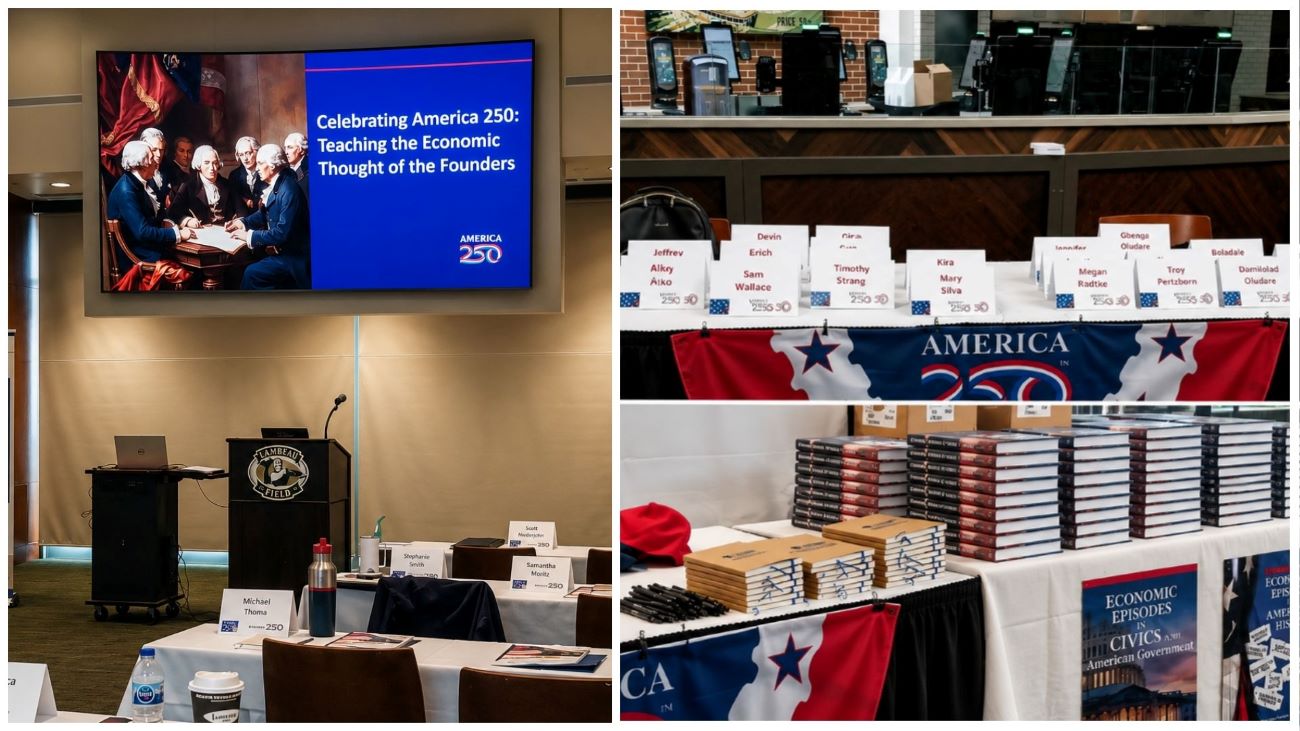
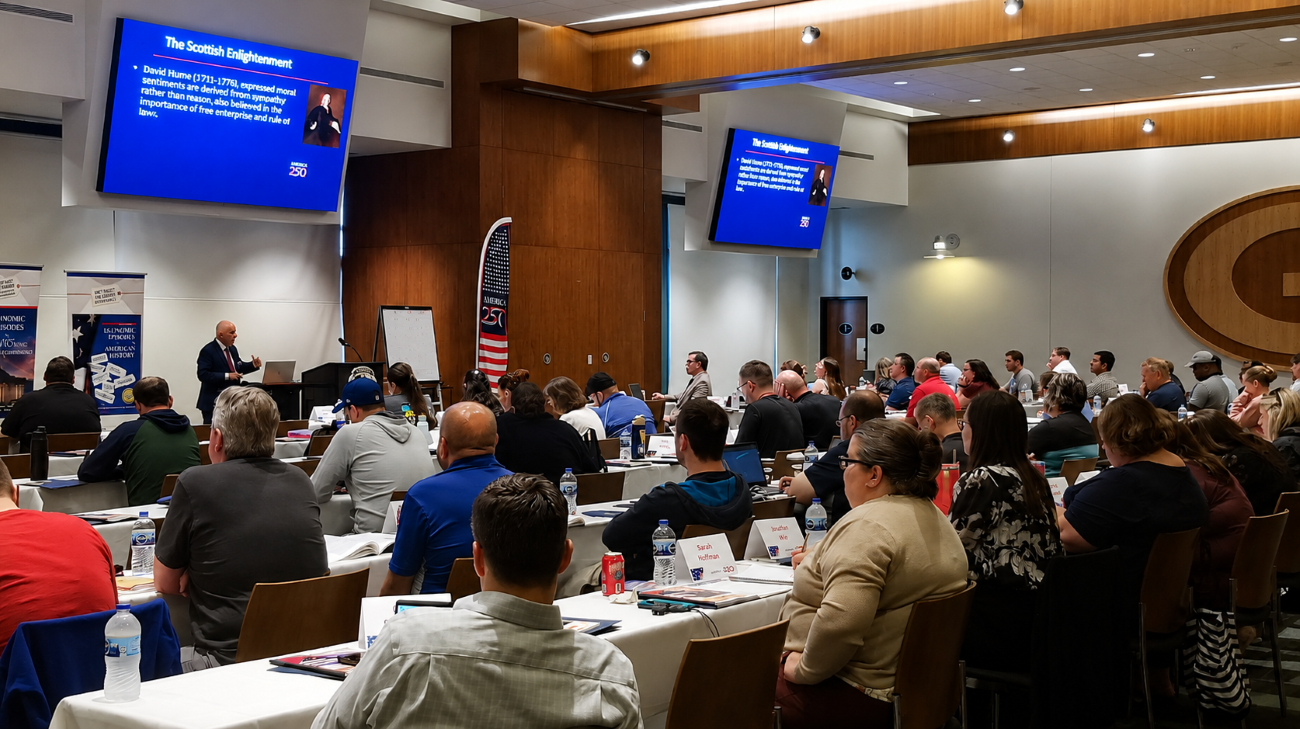
That vision came to life June 11-12 at Lambeau Field, where educators from across the Midwest gathered for the Lambeau Summit. The two-day workshop introduced teachers to classroom-ready lessons, activities and historical resources designed to help students better understand America’s founding as the country approaches its semiquincentennial.
Dr. Scott Niederjohn, dean of the Batterman School and director of the CFEC, co-authored the successful grant proposal. He said the initiative is designed to give teachers the tools they need to help students understand the economic ideas that shaped the U.S.
“When teachers are equipped with strong curriculum and meaningful professional development, that impact reaches far beyond a single classroom.”
Bringing the Founders into today’s classrooms
Dr. Mark Schug, affiliated scholar at CUW, presents on Adam Smith during the Lambeau Summit at Lambeau Field.
Niederjohn and a team of co-authors, including Dr. Mark Schug, former professor and director of the Center for Economic Education at University Wisconsin-Milwaukee, developed 10 essays examining the economic ideas of individual American Founders. The curriculum also includes classroom-ready slide decks, quizzes and activities that teachers can immediately use in their classrooms.
During the summit, Niederjohn and Schug introduced participants to the economic thought of Thomas Jefferson and Benjamin Franklin while also exploring the connection between Adam Smith and America’s founding. Smith’s The Wealth of Nations, published in 1776, coincided with the signing of the Declaration of Independence and offers a strong defense of economic liberty.
History, hope and the American story
The summit’s keynote speaker, Dr. Wilfred McClay from Hillsdale College, encouraged teachers to view American history through the lens of hope.
In addition to serving as a professor of history, McClay is the author of Land of Hope: An Invitation to the Great American Story and serves on the America250 Commission, officially the U.S. Semiquincentennial Commission. He shared insights from his work on the commission and discussed how the nation’s founding documents established religious, economic and political liberty that continues to shape the American story.
Learning by doing
The conference also emphasized hands-on learning. In one activity, each participant received a $10 gift card to a random retailer and rated their satisfaction before taking part in a free-trade exercise. Teachers were free to trade gift cards with one another, and satisfaction levels rose as participants exchanged cards for ones they valued more.
The exercise demonstrated the benefits of voluntary exchange while also sparking classroom ideas. Many teachers discussed adapting the activity for their own students, with candy emerging as a popular alternative to gift cards.
Building a lasting community
The learning didn’t end when the summit concluded. Each participant was enrolled in a Concordia Canvas course. There, they continue to receive curriculum resources, professional development and support from a community of fellow educators.
Teachers returned home with practical classroom tools, fresh ideas and new connections. More importantly, they returned prepared to help students better understand the ideas that shaped the nation.
For the Batterman School, that is the lasting impact of America250. The initiative is not only preparing teachers for the nation’s 250th anniversary. It is investing in educators whose influence will reach thousands of students, strengthening civic understanding one classroom at a time.
Concordia University Wisconsin is a Lutheran higher education community committed to helping students develop in mind, body and spirit for service to Christ in the Church and the world.
At a time when many colleges and universities are increasing costs, Concordia University Wisconsin is taking a different approach.
The university has lowered tuition for its online undergraduate programs and several graduate programs, helping remove financial barriers for working adults and students seeking to advance their careers.
This decision reflects Concordia’s ongoing commitment to expanding opportunities for learners who may have delayed their educational plans because of cost.
For many students, cost remains one of the biggest obstacles to pursuing a degree. Concordia’s new tuition model lowers costs directly while helping students better understand the true cost of attendance from the start.
“Concordia decided to lower tuition because we wanted to make our online undergraduate and graduate programs more affordable, transparent and accessible,” said Kevin Sheridan, vice president for Enrollment. “While scholarships had helped offset costs in the past, they also made the published tuition price appear higher than what many students actually paid. By reducing tuition directly, we are giving students a clearer understanding of their investment from the beginning.”
Making education more attainable
“This tuition reduction tells prospective students who may have delayed completing or starting a degree, because of cost, that Concordia is working to make that next step more attainable,” Sheridan said. “By lowering tuition directly and making pricing more transparent, we are reducing uncertainty and helping students better understand the true cost of their investment. The message is clear: If cost has been holding you back, now may be the right time to reconsider Concordia.”
The change also makes Concordia’s programs more competitive and easier for prospective students to evaluate alongside other institutions.
“These reductions are significant because they make Concordia’s online undergraduate and several graduate programs more transparent, more competitive and easier for prospective students to evaluate against other programs in the region,” Sheridan said. “Many students compare programs before applying, and a lower, more straightforward tuition rate can make Concordia stand out as an affordable, high-quality option.”
Supporting working adults and career-minded learners
The new tuition rates are expected to benefit a wide range of learners, particularly those who are carefully weighing cost, value and return on investment.
“The students who will benefit most are working adults, career changers, first-generation graduate students, and those who are paying out of pocket, using loans or relying on employer reimbursement,” Sheridan said. “These students are often very focused on affordability, transparency and return on investment. By lowering tuition directly, Concordia is making our high-quality education more financially realistic for students who may have delayed or dismissed the possibility because of cost.”
For students balancing careers, families and financial responsibilities, the reduced tuition rates provide a more predictable pathway toward educational advancement and long-term career goals.
Addressing workforce needs in education
The impact of affordability extends beyond individual students. It also affects communities and professions facing critical workforce shortages.
Across Wisconsin and the nation, schools continue to seek qualified teachers, administrators, counselors and educational leaders. Dr. James Pingel, dean of Concordia’s School of Education, says affordability plays an important role in helping address those challenges.
“‘Affordability’ has been the term that’s been spoken about and felt, perhaps more than any other the last five years,” Pingel said. “Since so many people are living paycheck to paycheck, anything universities can do to lower costs, including tuition, the more affordable higher education becomes for families and prospective teachers.”
Current educators often face two significant barriers when considering graduate education.
“Time and money have always been barriers for earning a post-bachelor’s degree,” Pingel said. “Most people who would like to pursue a master’s degree are already working fulltime jobs and they also are living paycheck to paycheck. Moreover, many schools used to provide extra professional development funds that teachers could use to earn their master’s degree, but many schools are no longer providing this monetary support. So current teachers have to weigh if the time, money and lack of employer-funded scholarships are worth it.”
Reducing tuition helps make advanced degrees, certifications, and leadership preparation more attainable for those already serving in classrooms and schools.
More than a degree
While affordability is important, Concordia leaders emphasize that education is about more than earning a credential.
“While earning your advanced degree can do a lot for you (that’s the transactional), it’s what the learning does to you that matters even more (that’s the transformational aspect of lifelong learning),” Pingel said. “And as you grow and learn, you become a more effective teacher or administrator and a better citizen. You are modeling the way!”
As educators and professionals continue to grow, they share their knowledge and experience with others, creating a ripple effect throughout schools, organizations, churches and communities.
Living out Concordia’s mission
The tuition reduction reflects Concordia’s mission of helping students develop in mind, body and spirit for service to Christ in the Church and the world. It also aligns with the university’s commitment to increasing access and opportunity for learners.
“This decision reflects Concordia’s commitment to affordability, access and student success because we are always looking for ways to increase student access by making our education more affordable,” Sheridan said. “By lowering tuition directly, we are reducing financial barriers, making costs more transparent, and helping students better understand the investment required.”
Looking ahead, university leaders see affordability initiatives as an investment in both students and the communities they serve.
“Affordability initiatives like this help Concordia strengthen the leadership pipeline by making our online undergraduate and graduate education more accessible to talented students who are already serving their communities,” Sheridan said. “In turn, communities benefit from graduates who are equipped to lead with skill, purpose and a commitment to service.”
For Pingel, the significance goes beyond the numbers.
“The real story is that we care about our students beyond a transaction, a tuition payment,” he said. “We know the affordability challenge is real for many of them, and a tuition reduction—of any size—demonstrates that we are listening and attuned to their circumstances and needs.”
By lowering costs and increasing transparency, Concordia continues its commitment to helping students pursue their calling, advance their careers, and prepare to make a meaningful difference in the Church and the world.
Want in?
Concordia University Wisconsin is a Lutheran higher education community committed to helping students develop in mind, body and spirit for service to Christ in the Church and the world.