At the Batterman School of Business, preparing ethical leaders begins by investing in the teachers who shape the next generation.
As the United States prepares to celebrate its 250th anniversary in 2026, the Batterman School of Business at Concordia is investing in the people who will tell that story: teachers.
Backed by a $1.1 million grant from the U.S. Department of Education, the Concordia Free Enterprise Center (CFEC)—housed within the Batterman School—launched America 250: Teaching History & Civics Through Economic Lenses. The three-year initiative provides middle and high school educators with curriculum, classroom resources, and professional development centered on the economic and civic ideas that shaped the nation.
The initiative reflects the mission of the CFEC, which promotes the ideals of a free and virtuous society while encouraging economic opportunity, ethical leadership and human flourishing. By equipping teachers with meaningful classroom resources, the center is extending that mission well beyond Concordia’s campus and into classrooms across the Midwest.
That vision came to life June 11-12 at Lambeau Field, where educators from across the Midwest gathered for the Lambeau Summit. The two-day workshop introduced teachers to classroom-ready lessons, activities and historical resources designed to help students better understand America’s founding as the country approaches its semiquincentennial.
Dr. Scott Niederjohn, dean of the Batterman School and director of the CFEC, co-authored the successful grant proposal. He said the initiative is designed to give teachers the tools they need to help students understand the economic ideas that shaped the U.S.
“When teachers are equipped with strong curriculum and meaningful professional development, that impact reaches far beyond a single classroom.”

Bringing the Founders into today’s classrooms
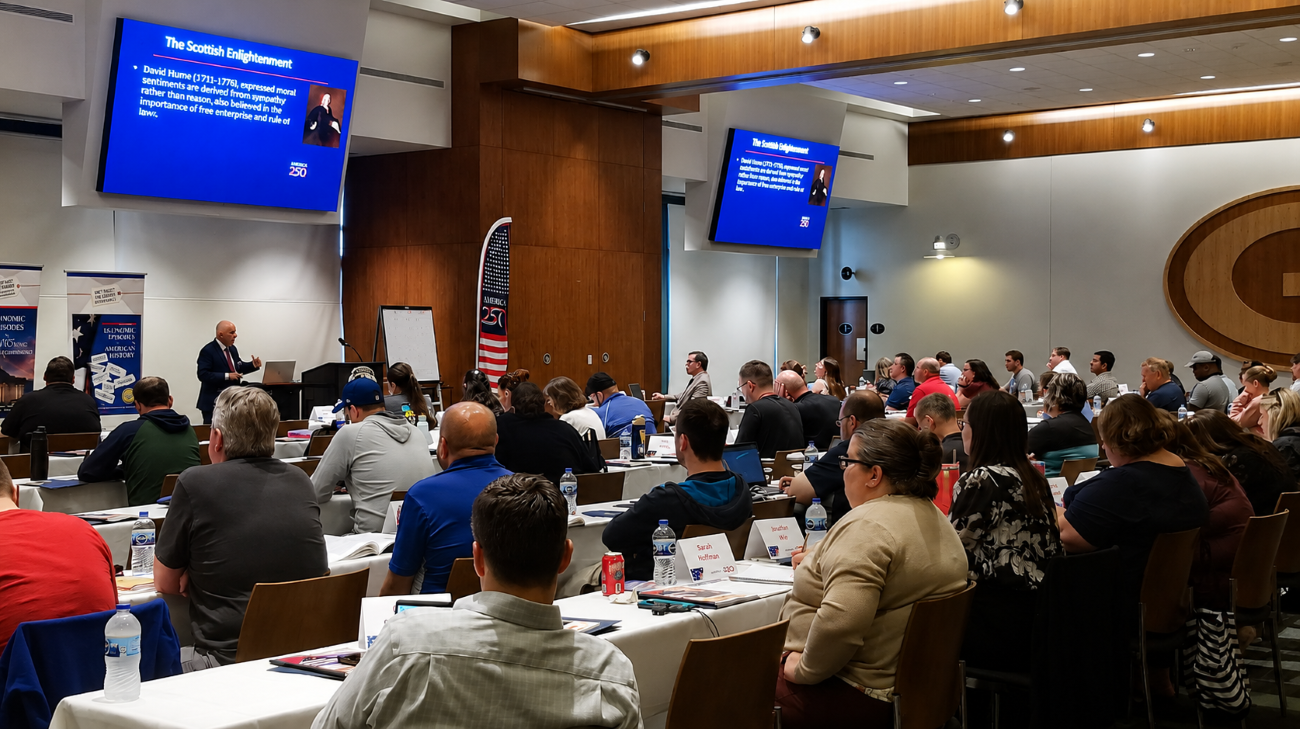
Niederjohn and a team of co-authors, including Dr. Mark Schug, former professor and director of the Center for Economic Education at University Wisconsin-Milwaukee, developed 10 essays examining the economic ideas of individual American Founders. The curriculum also includes classroom-ready slide decks, quizzes and activities that teachers can immediately use in their classrooms.
During the summit, Niederjohn and Schug introduced participants to the economic thought of Thomas Jefferson and Benjamin Franklin while also exploring the connection between Adam Smith and America’s founding. Smith’s The Wealth of Nations, published in 1776, coincided with the signing of the Declaration of Independence and offers a strong defense of economic liberty.
History, hope and the American story
The summit’s keynote speaker, Dr. Wilfred McClay from Hillsdale College, encouraged teachers to view American history through the lens of hope.
In addition to serving as a professor of history, McClay is the author of Land of Hope: An Invitation to the Great American Story and serves on the America250 Commission, officially the U.S. Semiquincentennial Commission. He shared insights from his work on the commission and discussed how the nation’s founding documents established religious, economic and political liberty that continues to shape the American story.
Learning by doing
The conference also emphasized hands-on learning. In one activity, each participant received a $10 gift card to a random retailer and rated their satisfaction before taking part in a free-trade exercise. Teachers were free to trade gift cards with one another, and satisfaction levels rose as participants exchanged cards for ones they valued more.
The exercise demonstrated the benefits of voluntary exchange while also sparking classroom ideas. Many teachers discussed adapting the activity for their own students, with candy emerging as a popular alternative to gift cards.
Building a lasting community
The learning didn’t end when the summit concluded. Each participant was enrolled in a Concordia Canvas course. There, they continue to receive curriculum resources, professional development and support from a community of fellow educators.
Teachers returned home with practical classroom tools, fresh ideas and new connections. More importantly, they returned prepared to help students better understand the ideas that shaped the nation.
For the Batterman School, that is the lasting impact of America250. The initiative is not only preparing teachers for the nation’s 250th anniversary. It is investing in educators whose influence will reach thousands of students, strengthening civic understanding one classroom at a time.
James Schultz, who graduated in May 2026 with a bachelor’s degree in secondary education (broad field social studies), contributed to this article.
Want in?
Concordia University Wisconsin is a Lutheran higher education community committed to helping students develop in mind, body and spirit for service to Christ in the Church and the world.