Why July 4 is special to me: A lifelong love of history

July 4 has always been a special holiday for me. I started out my teaching career as a high school American history teacher.


My master’s degree is in early American history. I read around 20-25 American history books and biographies each year. I love reading and studying American history, and don’t take for granted the freedoms and liberties we enjoy as Americans. And if I’m honest, the week of July 4 is one of the few times where I finally feel like I can “get away” and vacation with my family. There are few things I enjoy in life more than a family barbeque over the fourth.

Every July 4, I’m reminded of two great blessings in my life that I had absolutely no control over:

1. I was born into a Christian home with two loving, Christian parents.

2. I was born in the United States of America.

With these two realities alone, I can say I’ve been incredibly blessed by God. As an American, we can’t forget our history. On July 4, 2026, the United States will celebrate its 250th birthday—and well we should! While certainly a flawed and sin-filled nation, our country’s inalienable principles of “life, liberty and the pursuit of happiness” remain just as important today as it did at the founding. We are blessed!


Why remembering matters

As a Christian, we can’t forget our history either. Indeed, the Bible is literally filled with thousands of “remember” reminders and pleas from God. While American history is being taught less, or in a radicalized way, if at all, even fewer people are hearing or being taught the Word of God, at least as a percentage of the populace.
This is a sad reality because Christianity is a religion based on history and firmly grounded in historical facts and historical events. Jesus really did walk and live on earth. Numerous historical records, documents, witnesses and artifacts attest to these facts and truth claims. And Jesus really did die on the cross and really did rise from the dead. Abundant historical records, documents, witnesses, and artifacts attest to these facts and truths, too.

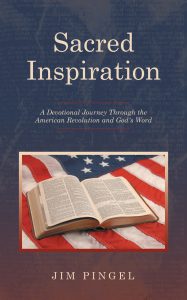
Recently I published, “Sacred Inspiration: A Devotional Journey Through the American Revolution and God’s Word.” The book is made up of approximately 40 devotions that lead with a story from the American Revolution and then finish with Scripture related to the topic.

As readers engage with these devotions, they’ll be looking back to the American Revolution and, more importantly, even farther back to the life of Jesus and the ancient and perfect Word. My prayer is that the Holy Spirit may work on readers’ hearts and minds and have their faith strengthened through these devotions.


The battle over history and truth

George Orwell’s “1984” has the often-quoted line, “Who controls the past, controls the future. Who controls the present, controls the past.” Indeed. If history can be destroyed, suppressed or forgotten, then people might forget about Jesus and what He has done for all people. This is precisely why Satan and so many in the secular world have declared war on history, truth and Jesus. The stakes are high and eternal.

Winston Churchill, who is not an American and did not fight in the American Revolution, once said, “The farther backward you look, the farther forward you are likely to see.” While not divine, his words ring true today and provide a useful metaphor for the hopes I have for “Sacred Inspiration.“


A July 4 prayer of thanksgiving

Every July 4 is like Thanksgiving for me. The holiday reminds me to give thanks for our country and the liberties and freedoms we have and that came at a cost. And it also reminds me of the cost of our redemption—with Jesus, who died on the cross to redeem us from our sins.

One of our most founding fathers, Patrick Henry, left these words in his last will and testament. “This is all the inheritance I can give to my dear family. The religion of Christ can give them one which will make them rich indeed.” Amen.

Blessed July 4 to you and your family. And happy birthday, America!

About the author: Dr. Jim Pingel is Concordia University Wisconsin’s dean of the School of Education and professor of Education.


Want in?

Concordia University Wisconsin is a Lutheran higher education community committed to helping students develop in mind, body and spirit for service to Christ in the Church and the world.


Thinking 360: A Doctoral Mindset

A number of studies conducted in Canada and the United States asked a politically diverse, well-educated group of adults to read arguments confirming their beliefs (and perhaps their biases) about controversial issues. Participants were then given a chance to read contrary arguments—and get paid for doing so. However, two-thirds refused to even look at the counterarguments, never mind seriously considering them.

Researchers concluded that the more scientifically literate adults are, the more likely it is that they become dogmatic about politically polarizing topics in science. Put another way, the more intellectual someone might be, the better they know how to find evidence to confirm their feelings. How sad that in a world that clamors for diversity, too many are afraid to even hear an idea or thought that might differ from their own.

Perhaps you swim in everyday waters where confirmation bias is alive and well. But is that really what our world needs today—people not listening to others or considering other ideas, new ways of doing things, or different points of view? Are people so afraid that their convictions, beliefs, ideas, or thoughts won’t survive even the softest of scrutiny or the most innocent of inquiry?

The doctoral mindset

One essential hallmark of doctoral students or those who hold terminal degrees is their ability to see things—people, issues, contexts—from multiple perspectives. In our complex, global world today, the challenges and obstacles that leaders face are complex and comprehensive.

One quick, soundbite answer won’t solve them. That’s why the very best literature reviews in dissertations show evidence of a doctoral student analyzing an issue from all sides. They suspend their biases and aren’t afraid to look under the microscope or hood. Then they research and experiment. Doctoral students don’t hide or ignore the evidence that doesn’t fit their preconceived notions. They also listen and ponder. Finally, they question their own convictions and thoughts while practicing healthy skepticism for other ideas. In short, doctors do their homework.

The 360-degree perspective

Effective leaders today must be able to examine and analyze societal and organizational challenges from all sides and angles—a 360-degree perspective. Only then can they provide the direction and leadership that will solve the problem or advance the cause.

Of course, looking at things from a 360 perspective doesn’t mean you will abandon the truth. As a Christian institution, we find comfort in the words of the Bible—that the “testing of your faith produces steadfastness. And let steadfastness have its full effect, that you may be perfect and complete, lacking in nothing.”

Concordia University Wisconsin’s doctoral program of Leadership in Innovation and Continuous Improvement will train and equip you to do just that—to lead and think with a 360-degree mindset. This mindset and skill set are critical to the growth, development, and success of any leader or organization. So earn your Doctor of Education at CUW, and think differently.       

The impact of getting a doctorate as a Christian

In this past summer’s blockbuster movie Top Gun: Maverick, Maverick sits in the office of his commanding officer and former rival, Ice Man. Maverick struggles to make a decision and wonders about his impact as a teacher and fighter pilot in the navy. “It’s not what I am,” Maverick says to Ice Man, “it’s who I am. How do I teach that?”

To me, this suggests a man who lacks a basic understanding of who he is and what skills make him a great pilot. We all have heard how critical self-awareness is to our growth and potential, both personally and professionally. What was that ancient Greek maxim again? Everyone together now, γνῶθι σεαυτόν! (“know thyself”). While the original intention was likely more classist in nature than our typical modern usage, clearly self-awareness has been crucial to civilized societies for millennia. But as Christ-followers, we know there is more to our story.

While treading softly on the cliché, considering who we are and whose we are is a question of identity. Here’s what we believe: You have been “fearfully and wonderfully made,” created in His image, chosen, and appointed to bear much fruit. You “are his workmanship, created in Christ Jesus for good works, which God prepared beforehand” for you to do. And God has grand plans for you and your future, even if you do not know precisely what those plans may be.

Who you are and Whose you are are two foundational reasons to consider getting a doctorate, allowing it to create a larger platform to impact and influence others for service to Christ in the church and the world. 

How will I use a doctorate degree?

One question we often get from prospective doctoral students is “how will I use this degree in the future?” It’s a fair question. Of course, we know that a doctorate gives people access to higher-level and higher-paying leadership positions—whether it be in education, business, health professions, non-profits, or other endeavors. But these responses answer the “what am I” questions, not the “who am I” ones. And the “who am I?” question is so essential for a doctoral student to wrestle with, reflect upon, and truly embrace.  

Learning at Concordia

CUWAA’s doctoral program, known as LICI (Leadership in Innovation and Continuous Improvement), is focused on both your future “employability” as well as the formation and maturation of your heart and mind. Just as important as answering the question, “what can I do with this learning?”, the LICI program will certainly have you reflecting upon the question, “what is all this learning doing to me?” 

Christian apologist G.K. Chesterton once noted that “education is not a subject and does not deal in subjects. It is instead a transfer of a way of life.” A Christian education integrates students into the life of the church and faith creating an accurate worldview even while our LICI cohorts welcome students of all faiths or no faith backgrounds.

A letter to Christians

Dear Christian brother or sister, we need you out there in the marketplace of ideas, the public square, the ivory towers, the business and corporate offices, the home, and the rooms where things happen. We need your influence and presence in the innovative and creative spaces which manifest important change and movements in our culture and society.

We need more biblically-inspired Christians with terminal degrees sharing God’s love and promises in unique ways and venues with terminally ill souls in our midst. Perhaps God is calling you to be a doctor so that you can serve in special places and spaces in these spiritually sick times.  

Explore your calling

If you feel God is leading you to investigate and solve a problem, create something special, explore your passions and interests in a deeper and scholarly way, personalize and build your expertise so that you make an essential difference and impact, make new connections or discover new opportunities to serve, start your doctoral journey today. We’d love to help you. With God, all things are possible.