A simple gift can make a child’s Christmas day a little brighter.
Christmas has a way of reminding us how much the little things matter. A thoughtful gift, a simple act of kindness or knowing someone is thinking of you can make the season that much more special. Concordia University Wisconsin students, faculty and staff once again have an opportunity to share some of that Christmas joy with 191 children at St. Peter Immanuel Lutheran School in Milwaukee.
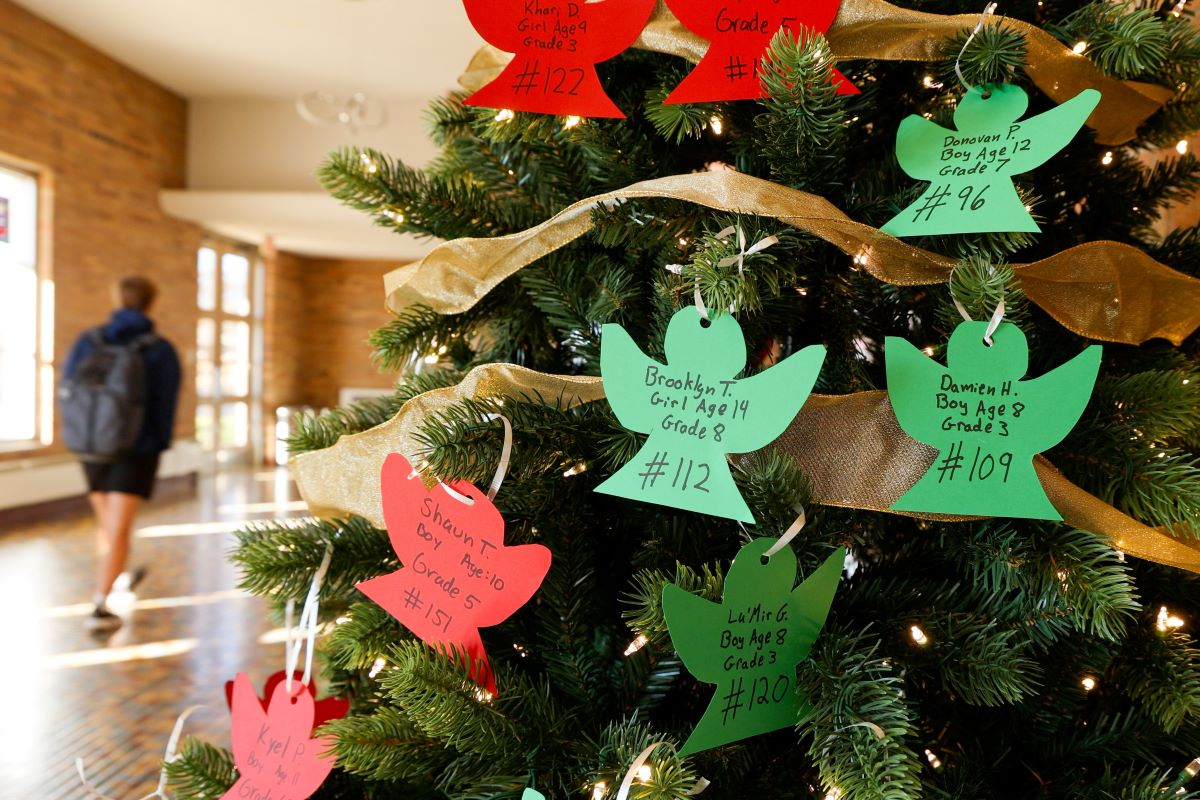
Organized by KidMin, CUW’s children’s campus ministry, the annual Angel Tree project invites the campus community to purchase gifts for local schoolchildren. Two Angel Trees are located on campus, one in the Chapel hallway and another in the Pharmacy Building. Each tree is decorated with paper angels representing children at St. Peter Immanuel Lutheran School, each carrying a Christmas wish from one heart to another.
A little kindness goes a long way
Harmony Dohm, a senior majoring in communication sciences and disorders who expects to graduate in spring 2027, is one of KidMin’s co-coordinators. She is helping organize this year’s project alongside Lauren McMahon and Molly Chopp. Although this is Dohm’s first time coordinating an event of this size, the response from the Concordia community has already been encouraging.
In fact, two students were so eager to participate that they were already on their way to Target to purchase gifts when one emailed KidMin with a question. The two roommates had apparently wasted little time getting into the Christmas spirit.
“We loved that they were so inspired that they immediately wanted to go find a gift,” Dohm said.
And they’re not alone. Students and others on campus have been signing up and expressing interest in the project, which has grown from approximately 125 children in previous years to 191 this year.
“Angel Tree is something that KidMin does every year, and it just brings me so much joy to know we may be able to help a child smile,” Dohm said. “I have never run anything this size before, and I am just excited to see how everyone comes together for a common goal.”
The Angel Tree is more than a campus service project. It’s an opportunity for the whole community to put faith into practice. “I have always wanted to help and serve others, but often times life and busy schedules get in the way,” Dohm said.
Through KidMin, she has found a way to share the blessings she’s received while serving others. “He has placed me in a position of ministry with certain talents and desires to spread the love of Christ to others,” she said.
Although she may never meet the children receiving the gifts, Dohm hopes those considering taking an angel will remember what made Christmas so special when they were young. She recalls the Christmas hymns, church services, colorful lights, music, snow days and cookies. These are the little things that often become our fondest childhood memories.
“We don’t know anything about these kids and their lives, but I hope people realize that a small act of kindness, like giving a small gift, can simply make a kid and their family very grateful,” she said.
How to participate in Angel Tree
Participating is easy, and there’s still time to select an angel before the Dec. 2 deadline.
Choose an angel. Visit the Angel Tree in the Chapel hallway or Pharmacy Building and select a paper angel.
Sign up. Find the corresponding number on the sign-up sheet to see the child’s gift wishes. Add your name and email address or phone number.
Purchase a gift. Plan to spend approximately $25 per child. If a requested item costs more, consider purchasing a gift card that can help the child buy the item.
Return your gift. Securely attach the original angel tag to your gift and place it in the designated box corresponding to the child’s grade. Gift wrapping is optional.
Meet the deadline. All gifts must be returned by Wednesday, Dec. 2.
Once the gifts are collected, KidMin will partner with LIGHT, CUW’s women’s Bible study, to host a Christmas wrapping party. Dohm, McMahon and Chopp will then deliver the presents to St. Peter Immanuel Lutheran School during finals week.
A Christmas worth sharing
With 191 children on this year’s list, Angel Tree is asking a little more of you. But judging by the response so far, you’re more than willing to help. And perhaps that’s what makes this annual tradition so meaningful. You don’t need to make an elaborate gesture or purchase an expensive gift to let someone know they’re remembered.
Sometimes, all it takes is a paper angel, a trip to Target and your desire to make a child smile.
Want in?
Concordia University Wisconsin is a Lutheran higher education community committed to helping students develop in mind, body and spirit for service to Christ in the Church and the world.
Explore how international missions give you opportunities to share Christ’s love, learn from others and put your faith into practice beyond campus.
Ruth Dolde had never been back to China, the country where she was born. This past summer, however, an open spot on a mission team gave her a reason and an opportunity to return. The Concordia University Wisconsin junior, who was adopted from China, joined a group through Concordia University, Nebraska, for six weeks in Hong Kong and Shenzhen.
“God works all things for good, and I felt called to show others the love of Christ,” Dolde said. About 20 years after her adoption, she returned to teach, help lead Vacation Bible Schools and share Christ’s love with the children she met.
Her experience is just one example of how serving internationally can help you learn more about your faith, the people around you and the vocation you may feel called to pursue. This year, CUW is renewing its emphasis on international mission experiences, with trips planned to the Czech Republic, Poland and Costa Rica. These opportunities offer different ways to serve and learn alongside missionaries and local communities.
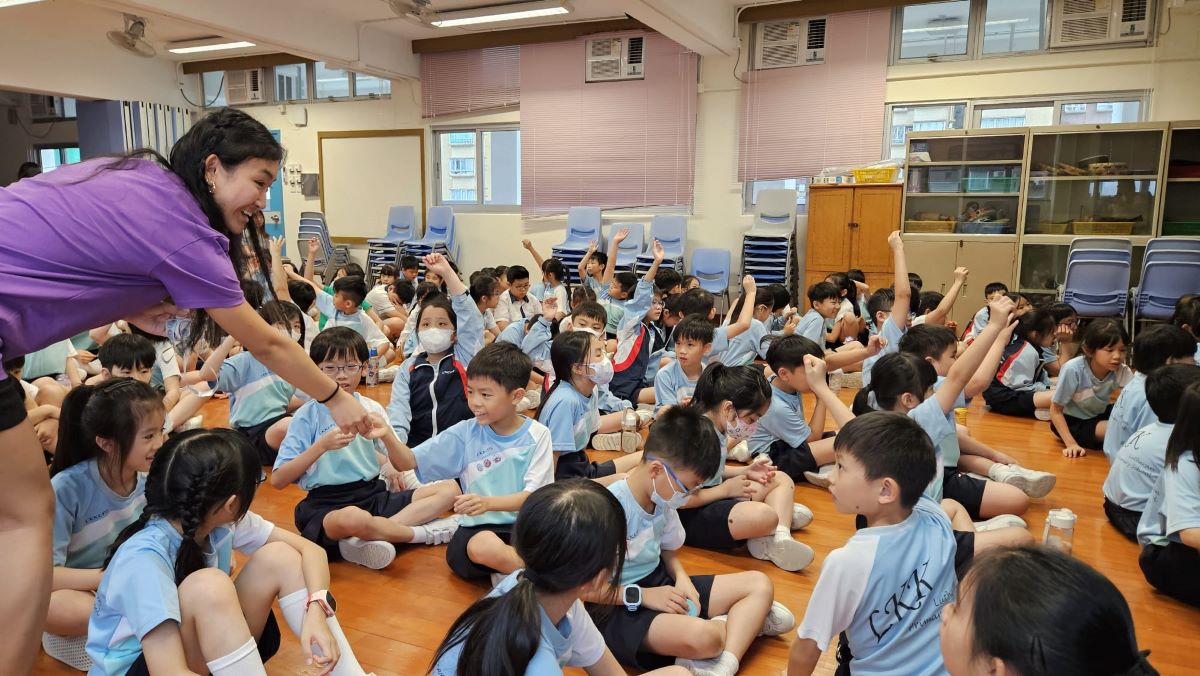
CUW junior Ruth Dolde, left, connects with children during Vacation Bible School in Hong Kong. Dolde spent six weeks serving in Hong Kong and Shenzhen this past summer through a mission trip organized by Concordia University, Nebraska. Photo courtesy of Dr. Vicki Anderson at CUNE.
Sharing faith across cultures
Dolde’s team spent about three and a half weeks in Hong Kong, staying with the Lutheran Church–Hong Kong Synod and leading Vacation Bible Schools at local schools and churches. During that time, she connected with a high school student who helped lead VBS. The girl was thankful they could serve together and that she could learn about Jesus.
Ruth Dolde
Another memory that stayed with Dolde was the children singing together, their faces lighting up as they praised God. “I was able to see God’s love working all the way across the world,” she said.
The remaining two and a half weeks took the group to Shenzhen. There, they taught English during a two-week program that helped students transition from classes taught in Mandarin to classes taught in English. Although most team members were education majors, Dolde was not. She put her own skills to work by co-teaching a 10th grade class.
Now pursuing two bachelor’s degrees at CUW, one in social work and one in art, she plans to graduate in spring 2028. She hopes to work in adoption and eventually earn a master’s degree in social work. “I will go wherever the Lord takes me,” she said.
The trip gave her practice working with different people, hearing their experiences and adjusting to unfamiliar situations. “As I am pursuing a helping profession, I see that this experience equipped me by enabling me to be compassionate, understanding and adaptable,” she said.
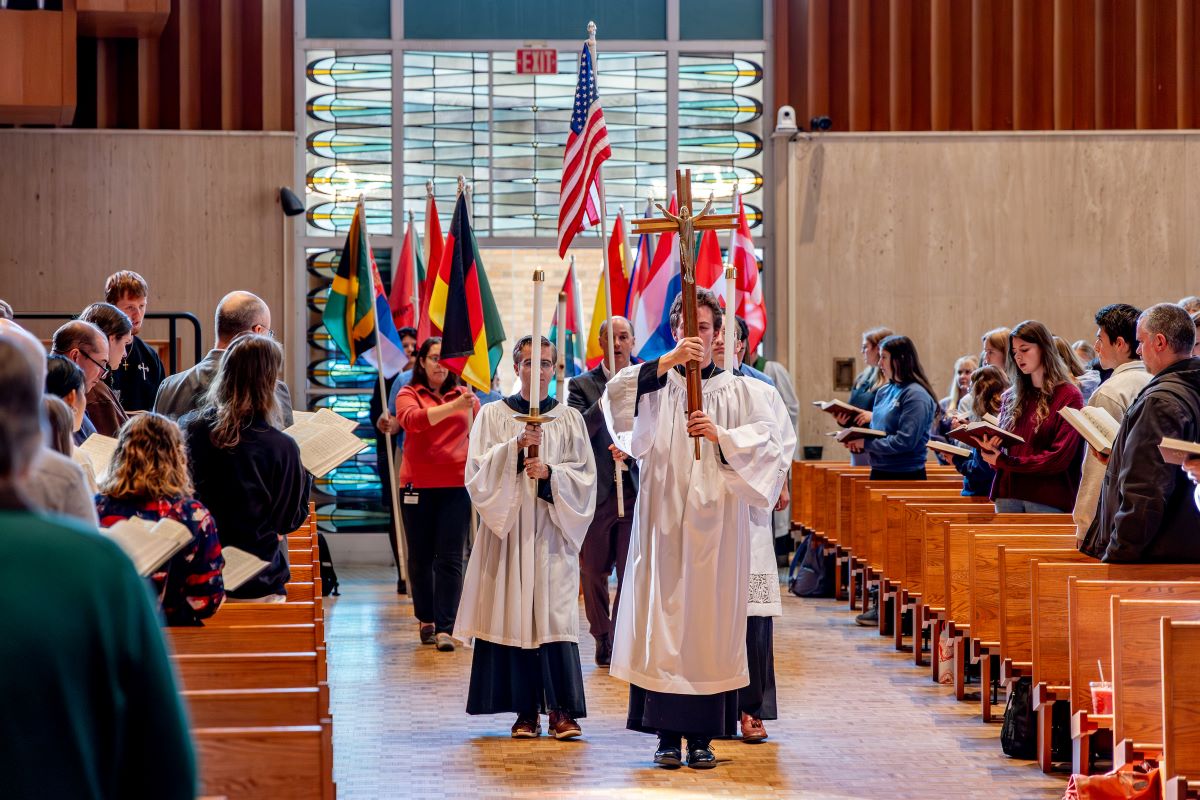
Participants carry flags through CUW’s Chapel of Christ Triumphant during the International Education Week Parade of Flags. Photo by Mike Zimmerman.
What international missions can look like
Teaching is one way you can serve. Other experiences give you a chance to learn alongside missionaries, spend time with local congregations or assist with activities for children and families. Kristin Schneider, international education events and marketing coordinator, is organizing CUW’s planned spring break mission education trip to the Czech Republic and Poland.
Participants will get a closer look at the everyday work of LCMS missionary Benjamin Helge, learning about the people he serves and how culture, language and history influence his ministry. The itinerary includes Prague, Ostrava and Krakow, with opportunities to interact with children and adults through local churches and ministry activities.
Getting to know the communities you visit begins before you leave. Schneider said the group will practice basic Czech phrases before traveling and continue learning during the trip. Even knowing a little of someone’s language can help start a conversation.
Another CUW mission trip is planned for May 8–15, 2027, at Camp Penuel in Costa Rica, where participants will serve children and their families. Interest has already met the trip’s eight-student capacity. Heather Fortuine, associate professor of rehabilitation science and the trip’s primary contact, hopes it can become a regularly offered experience.
Praying about the possibilities
Deciding to serve internationally is a big step. You may have questions about the cost, your schedule, the language or simply being far from home. Schneider suggests beginning with prayer, then talking with a trip organizer to understand what to expect and whether the experience is a good fit. Depending on your schedule, a short mission trip may be more feasible than a full semester abroad.
Preparation for the Czech Republic and Poland trip will include group meetings, Bible study and orientation. You’ll discuss cultural expectations, what to pack, how to handle money and other details before leaving. You do not need to have everything figured out before expressing interest. Asked what experience students need to participate, Schneider offered a simple answer: “Just a willingness to learn and to try things.”
Dolde also encourages you to pray, talk with a pastor or another faith mentor and weigh your options. Support from people back home helped her feel ready to go. Once she arrived, she said, she was so busy that she did not have time to be homesick. Seeing the children respond to the group’s work helped her appreciate the decision she had made.
“I knew I would regret NOT doing it more than the fear of going,” she said.
Growing through service
Schneider’s first international mission trip took her to Japan. She later taught preschool, where many of her students came from countries around the world. Looking back, she sees how those experiences helped prepare her to work with people from different cultures at CUW.
“I feel like part of the reason why I’m in the job that I’m in is because I did an international mission trip,” Schneider said. She hopes you’ll consider how an experience abroad might shape your own faith, relationships and future vocation.
Dolde returned with greater confidence and experiences she can carry into social work. She also came home with memories of the children she taught, the people she served alongside and her first visit back to the country where her life began.
“Christ was at the center of this opportunity, and this was truly a trip of a lifetime,” she said.
Meet the missionary you’ll learn alongside
Benjamin Helge has served with the LCMS Office of International Mission since January 2014. Based in Ostrava, Czech Republic, he is the shared ministries manager for the Eurasia region, helping connect people and coordinate ministry opportunities across national borders. Locally, he serves as lay leader of the K4 Community Center, which includes a Lutheran church plant. His work involves a children’s club, an English conversation group for teens, workshops and support for worship services led by a Czech pastor.
The planned Czech Republic and Poland trip will introduce you to three pillars of Lutheran mission work: spreading the gospel, planting Lutheran churches and showing mercy.
The journey begins in Prague, continues east to Czech Silesia and ends with a day in Krakow, Poland. Along the way, you’ll meet LCMS missionaries and explore how the region’s history has shaped Christian life and ministry today. You’ll also help children practice English at a local elementary school and assist with an after-school program where the gospel is shared.
“The goal of mission education isn’t to serve the entire week, but it is to experience and learn at a deeper level what Lutheran mission means,” Helge said. His hope is that you’ll return better able to explain what mission means and ready to put that understanding into practice in your own community, whether at CUW or wherever God leads you.
Learn more about international missions
CUW’s planned spring break mission education trip to the Czech Republic and Poland costs about $2,100, including airfare, housing, meals, in-country transportation, excursions and insurance.
To learn more, contact Schneider at kristin.schneider@cuw.edu or 262-243-4294 for current availability, registration details and preparation requirements.
Concordia University Wisconsin is a Lutheran higher education community committed to helping students develop in mind, body and spirit for service to Christ in the Church and the world.
What happens after you land? Starting fresh doesn’t have to mean starting alone.
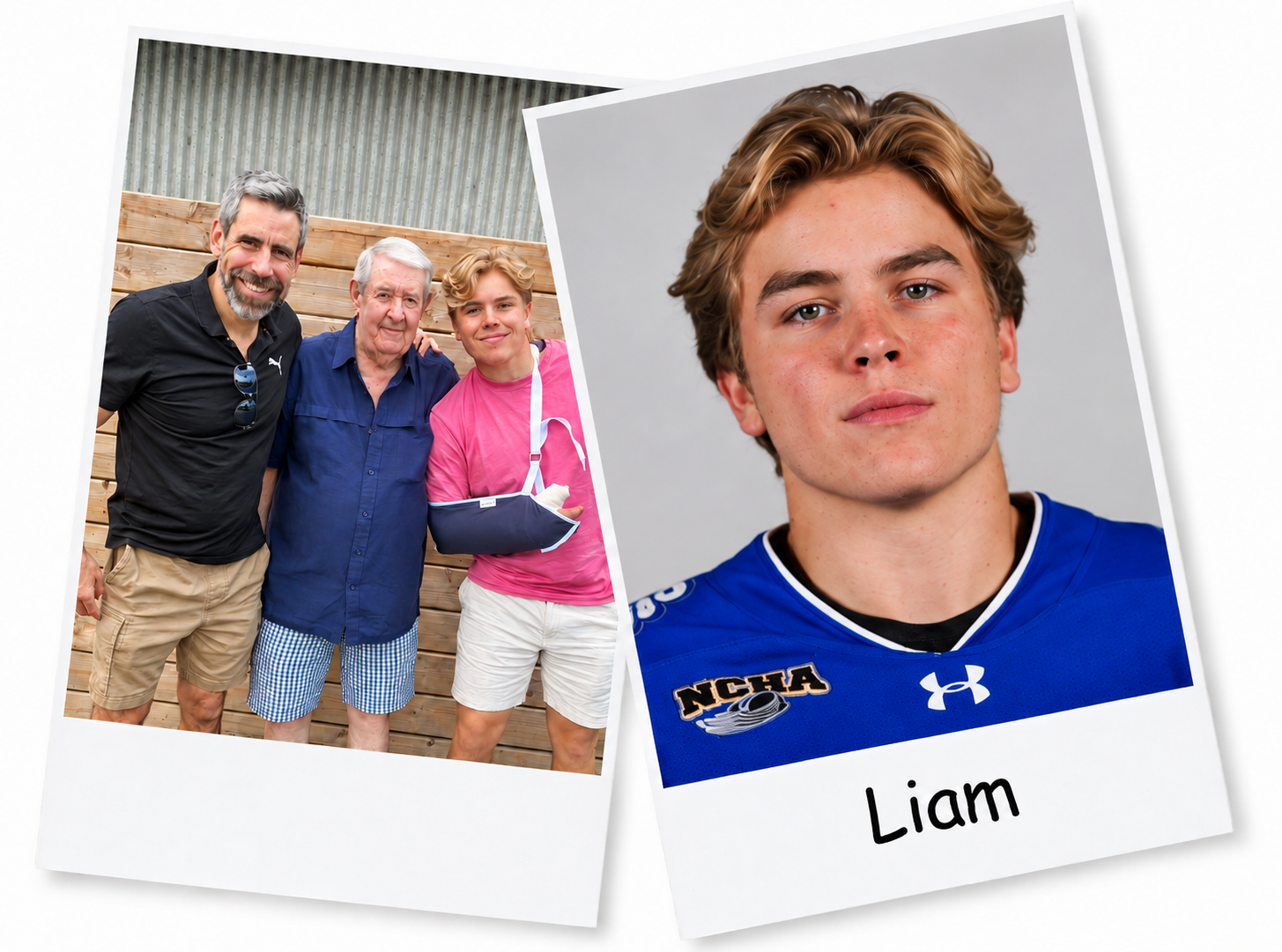
Above Liam Lucas’ bed hangs a Canadian flag. On his desk sits a framed photo of his mom, dad, brother and himself. Both keep home close while he studies finance and communications at Concordia University Wisconsin.
A member of the Class of 2028, Lucas came to CUW from Châteauguay, Quebec, about 20 minutes outside Montreal and a 15-hour drive from campus. He has never lived this far from family, but his Canadian teammates and roommates help ease the transition.
“The hockey world is small,” Lucas said. Mutual friends and shared experiences playing junior hockey give them plenty in common.
As you prepare for your own move, your first connections might be teammates, classmates or someone welcoming you at the airport. Having people to turn to can make settling in easier.
Jennifer Tadeo, EdD, international student and scholar services (ISSS) manager, said her team addresses questions about transportation, shared bathrooms and other aspects of campus life. That support begins before you even land and continues throughout your college journey.
Here are four ways CUW helps you get comfortable.
1. Someone to meet you at the airport
After a long trip, seeing someone holding a sign with your name on it can feel reassuring.
CUW provides airport pickup for new international students planning to live on campus. A university contact meets you at baggage claim at the Milwaukee international airport and helps you get to campus.
Once you’re admitted and planning your arrival, request airport pickup through the International Student Hub with your flight details. Check the designated arrival dates before booking your flight so you can plan around pickup availability.
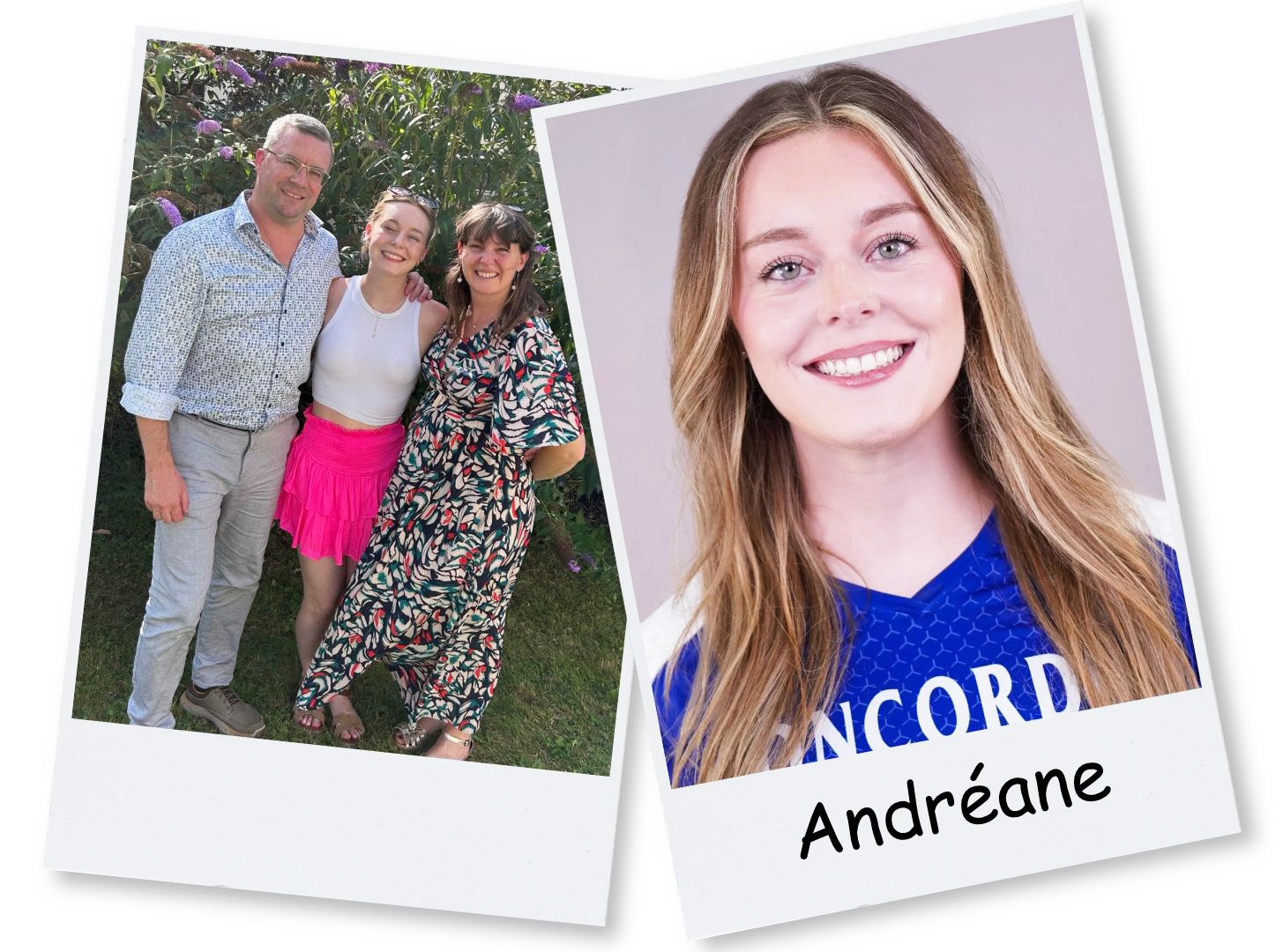
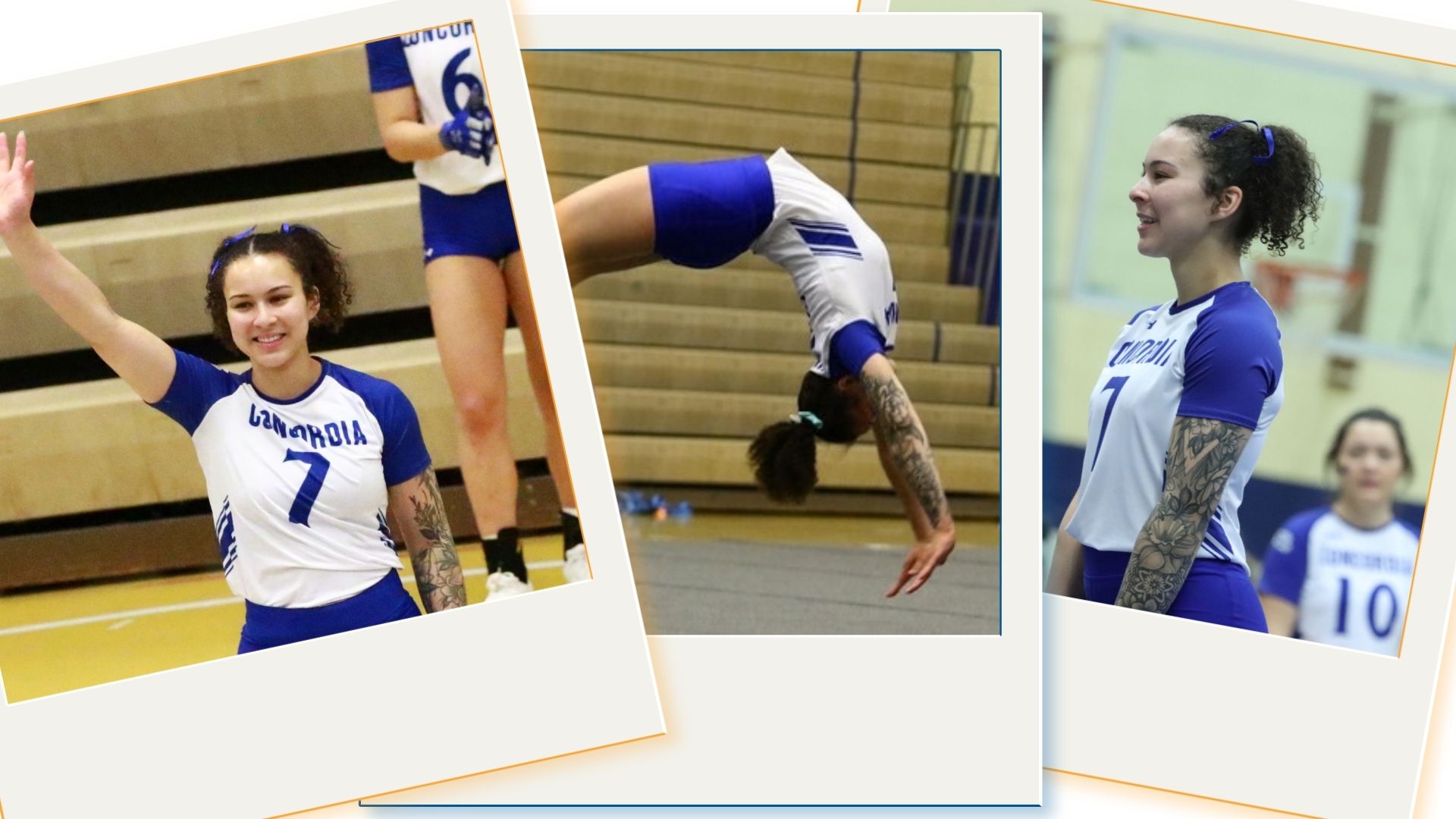
Andréane Hiron, a senior from France studying interior architecture and design, is also a member of CUW’s acrobatics and tumbling team. At left, Hiron, center, is pictured at home.
2. A few comforts waiting in your room
Luggage fills up quickly when you’re packing for college. Once you pack your clothes, electronics and personal belongings, there may be little room left for a pillow or blanket.
CUW provides an initial linen bag containing a blanket, pillow, sheet and towels. A welcome gift bag in your room typically includes snacks and small toiletries, such as a toothbrush and toothpaste.
Tadeo recommends bringing your clothes, phone, computer and photos from home. You can purchase additional toiletries and larger items after arriving.
Leave a little space for something personal, too. After about 15 hours of air travel from France, Andréane Hiron arrived in fall 2023 with stuffed animals, printed photos and gifts from her mother. Now a senior studying interior architecture and design, she still remembers those gifts: a letter with messages from family and friends and a personalized blanket she slept with during her first few days.
These reminders made her room feel more comfortable and kept her connected to loved ones back home.
3. Help with everyday needs
Once you unpack and see your room, it’s easier to decide what else you need.
A store trip during international student orientation gives you a chance to purchase personal supplies and anything that didn’t fit in your luggage without arranging transportation yourself.
If you’re buying bedding, look for Twin XL to fit CUW’s residence hall beds. Laundry is free, which also helps when planning your living expenses.
Support continues during university breaks if you can’t travel home. You can sign up to remain in campus housing, and the Concordia International Center provides a grocery shuttle before breaks so you can stock up on food. Campus food services typically offers boxed meals during some holidays.
Many CUW families also welcome international students for holiday meals—a chance to get to know people, experience their traditions and share your own.
Check with housing staff and the CIC before each break about arrangements, meals and transportation.
4. People to help you feel connected
Some connections happen through a shared interest. Others begin when you ask for help.
Before arriving, Hiron worried about whether people would understand her English and whether she would make meaningful friendships. Saying goodbye to her father was difficult, and she spent her first night without her roommates, who had not yet moved in.
The next day, cheerleading gave her something to do and people to meet. Friendships followed as her roommates arrived.
“We immediately became really good friends,” she said. She also liked her classes and could understand everything. “That helped me feel better and more at home.”
Lucas also knows whom to turn to for assistance. He credits Jessie Peters, international operations manager, with helping Canadian students with their documents and keeping them informed about travel updates.
“I have helped students in a variety of ways, from signing their paperwork to connecting them with a counselor or helping them get groceries,” Peters said. “Every student has different needs, and we are happy to help explore solutions with you.”
The international admissions and ISSS teams help you find answers and connect with other campus offices. International student workers offer guidance based on their own experiences adjusting to college in another country.
Housing staff, resident directors, resident assistants and faith associates are also available as you settle in. The friendship families program connects international students with U.S. families, while the CIC activities offer opportunities to meet people and spend time together.
Liam Lucas, a finance and communications student from Canada, finds friendship and a familiar routine on CUW’s men’s hockey team. In the photo at left, Lucas stands at right next to his grandpa and uncle back home.
Finding your everyday routine
Developing familiar routines and finding people to turn to takes time. Questions don’t end after orientation, and ISSS staff are available by email and phone during normal business hours. Walk-in advising hours are posted on the International Student Hub.
“Do not be afraid to reach out to the international admissions team!” Peters said. “They have a lot of experience helping students from all different backgrounds. They are dedicated and happy to assist you.”
Lucas’ first week included his first Major League Baseball game at Wrigley Field, a Milwaukee Bucks game and a Pitbull concert. Yet when asked what really helped him feel at home, he said hockey practice.
His connection started before most students arrived. Upperclassmen welcomed Lucas and his parents, showed them around campus and helped him move into his room. Now he shares daily practices with teammates who understand just what it means to live far from family.
Looking back on their arrivals, both Lucas and Hiron point to the people and friendships that help make CUW feel like home.
“I love my teammates,” Lucas said.
“What I wished I had known before I arrived was just that everything was going to work out,” Hiron said.
Concordia University Wisconsin is a Lutheran higher education community committed to helping students develop in mind, body and spirit for service to Christ in the Church and the world.
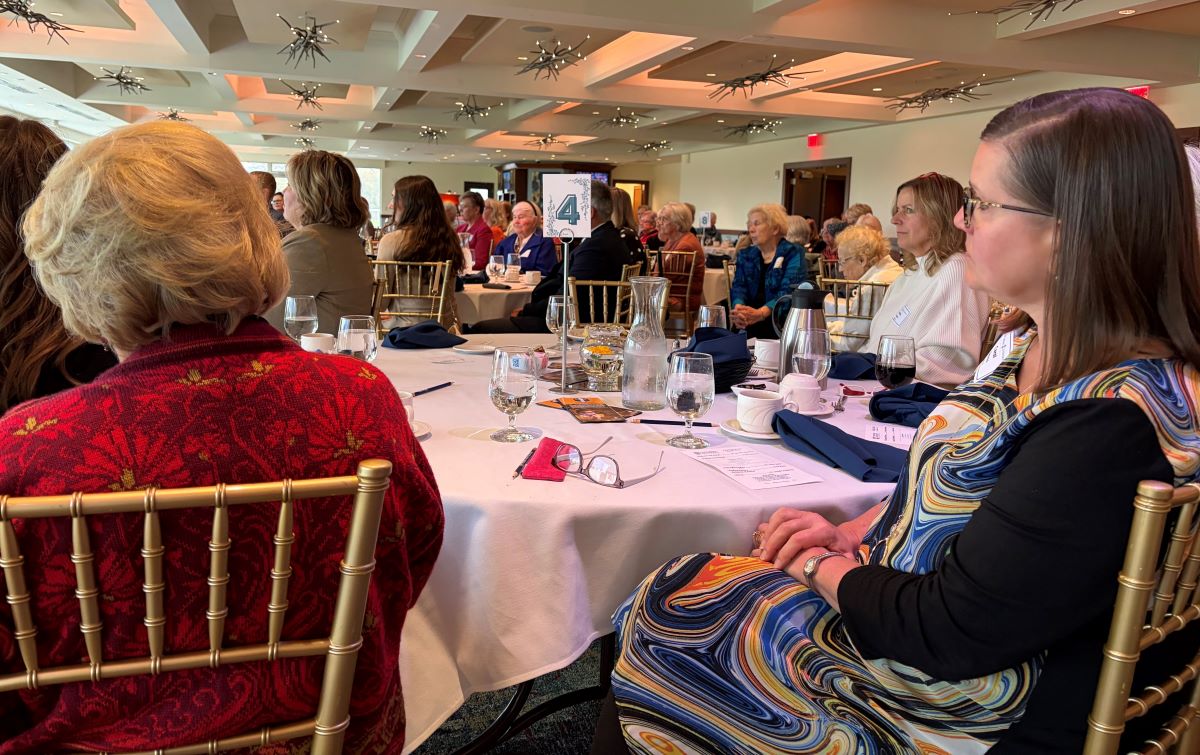
More than 100 women gathered at CUW’s Living Grace Women’s Luncheon for fellowship, faith and encouragement for the holiday caregiving season.
The cookies, the cards, the Christmas Eve service. Holiday traditions can mean so much. But when you’re also caring for someone you love, even your favorite things can start to feel overwhelming. Consider the familiar airplane analogy. You know the one flight attendants share before takeoff: Put on your own oxygen mask before helping others. It’s a reminder worth keeping when caring for someone else leaves little room to care for yourself.
Since November is National Family Caregivers Month, this message is especially timely. At Concordia University Wisconsin’s Living Grace Women’s Luncheon on Nov. 11, Susan Hurst, a medical and geriatric social worker with 30 years of experience, encouraged women to approach the holidays with realistic expectations, shared responsibilities and grace for themselves. Hosted by CUW’s Office of Advancement, the event took place at the River Club of Mequon.
The gathering began with a welcome and prayer from Jennifer Ankerberg, wife of President Erik Ankerberg. A student testimonial from senior Payton Steward and a university update from Executive Vice President Steve Taylor, EdD, preceded Hurst’s presentation, “Finding Balance During the Holidays.”
Faith in everyday life
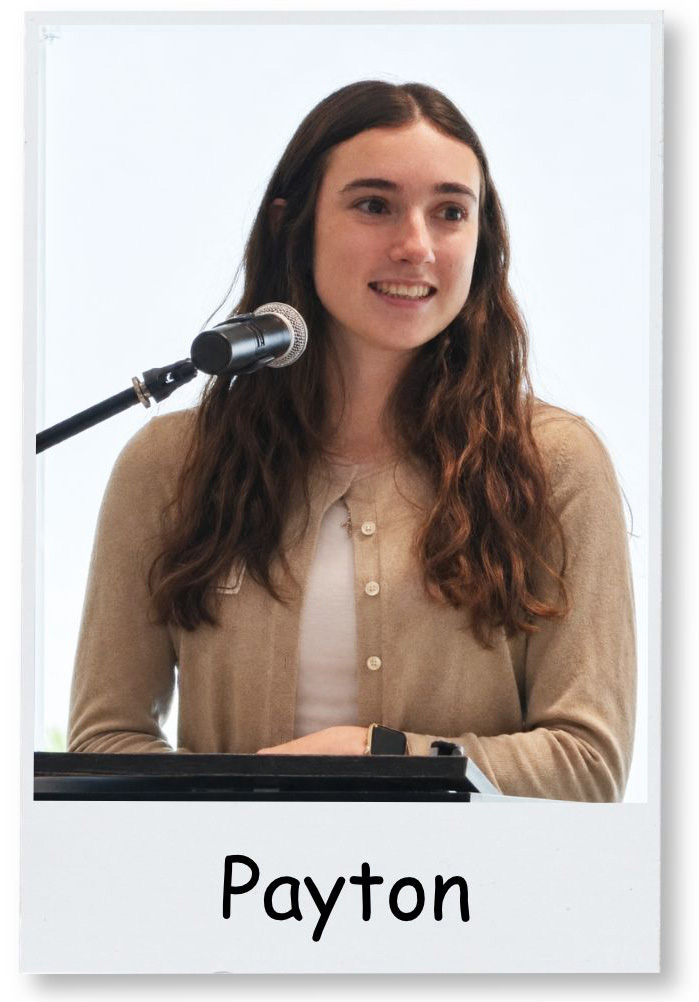
Payton Steward speaks at the Living Grace Women’s Luncheon.
Steward, an Appleton native studying human resources with a minor in business communications, shared a heartfelt reflection on how CUW has shaped her faith and career goals. She began MBA classes this semester and hopes to return to the Fox Valley after graduating in May.
“I chose Concordia because I wanted to study Human Resources with a foundation rooted in Christ,” Steward said. “I was looking for a place where I could gain practical, professional skills and also be formed as a Christian for today’s workplace.”
She described her time on CUW’s women’s tennis team as a blessing, with opportunities to encourage teammates through difficult losses and pray together before matches. Campus leadership roles have also helped prepare her to serve others through a career in HR.
“Over these four years, I’ve learned what it means to live for Christ in every setting, studying, competing, working, or resting,” Steward said. “I’ve learned that faith isn’t a separate box from academics or athletics, it’s the foundation under both.”
She also recognized the women’s support of her education.
“Your prayers, your hospitality, and your generous giving have made it possible for students like me to study and to grow in faith,” she said.
Her message resonated with attendee Colleen Mueller, who thought about her own grandchildren.
“This is exactly what I would hope for each of my college age grandchildren as they pursue their career goals and find their calling from the Lord,” Mueller said.
A family tradition
Following Steward’s speech, Taylor invited attendees to support CUW by praying, sharing its story, referring prospective students and giving.
Since 1996, Living Grace has brought women together for Christian growth and fellowship while strengthening their connection to CUW and its mission. The university hosts luncheons in late fall and early summer, welcoming alumnae, parents and community friends, particularly women from churches throughout the greater Milwaukee area.
For Mueller and her family, the gathering became a cherished tradition. Her father, Dick Schmidt, served as CUW’s development director, and her mother began attending before inviting Mueller and her sister, Holly, to join her.
“My mom is not able to attend anymore, at 98 years young, but my sister and I find ourselves carrying on this tradition!” Mueller said.
Now, the sisters are caring for their mother, who wishes to remain at home. They are considering assisted living, a possibility Mueller described as overwhelming. The Scripture passages Hurst shared reassured them of God’s strength and guidance as they navigate those decisions.
Their experience was one of many stories among the more than 100 women gathered, reflecting the encouragement Living Grace was created to offer.
Making room for what matters
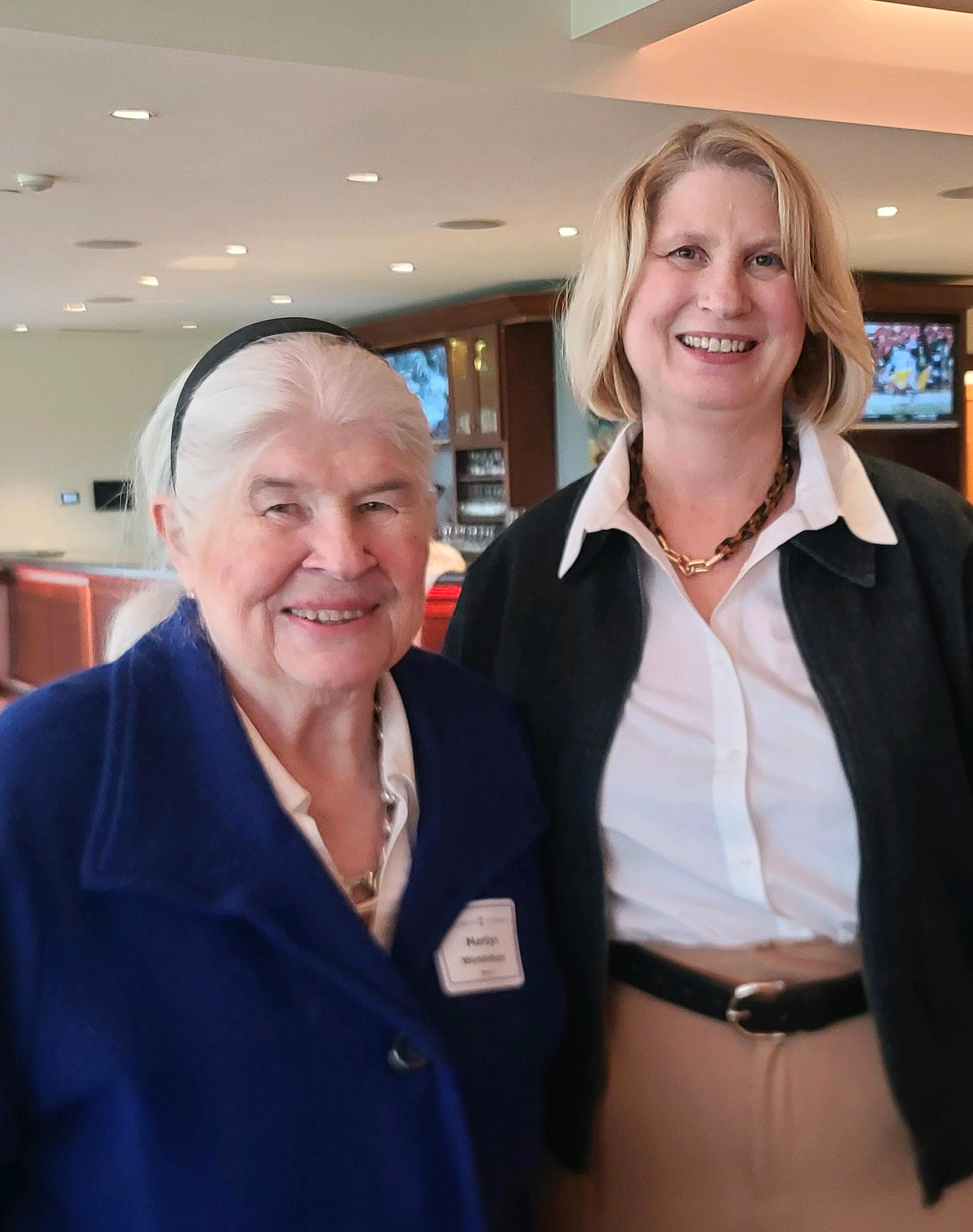
Susan Hurst, right, with her mother at CUW’s Living Grace Women’s Luncheon Nov. 11 at the River Club of Mequon. Hurst credited her mother’s example of caring for family members with helping shape her own calling to serve older adults.
During the presentation, Hurst acknowledged how holiday expectations can add to the daily demands of caregiving.
“What I want caregivers to remember is that they don’t have to create a perfect holiday to create a meaningful one and that they are not alone in their journey,” she said. “God sees their sacrifices, understands their struggles, and walks alongside them, even in the most difficult moments.”
Turning to the biblical account of Mary and Martha, Hurst noted that caregivers may relate to Martha’s frustration over everything that needs to be done. She encouraged making room for both serving others and sitting with Jesus, even through a brief prayer or devotion.
“Choosing presence over perfection means giving ourselves permission to let go of the expectation that everything needs to be done exactly as it always has been,” Hurst said.
Her suggestions for making the holidays more manageable included small, specific adjustments:
Simplify the celebration. Choose a favorite tradition and scale back elsewhere, whether that means preparing a less complicated meal or baking fewer cookies.
Consider a different schedule. An earlier Christmas Eve service may work better for an older adult or a family with young children.
Ask for specific help. Someone could bring a meal, wrap gifts or stay with a loved one while the caregiver runs errands.
Make space for quieter visits. Look through photo albums, listen to favorite Christmas carols or read the Christmas story together.
Talk before the gathering. Let family members know about routines, energy limits and what help would make a difference.
“Simplifying holiday plans doesn’t mean you’re giving less love or care, and reaching out for help doesn’t mean you’re failing,” Hurst said. “Taking time for yourself doesn’t mean you’re being selfish.”
She pointed to Matthew 11:28 and Christ’s invitation to the weary and burdened to find rest in Him.
“If you feel guilty about taking time for yourself, I encourage you to replace the guilt with grace,” Hurst said. “Give yourself the same grace and compassion that you give others.”
To learn more about Living Grace and future gatherings, contact Michelle Buss atmichelle.buss@cuw.eduor 262-243-4337.
Want in?
Concordia University Wisconsin is a Lutheran higher education community committed to helping students develop in mind, body and spirit for service to Christ in the Church and the world.
CUW freshman Gabe Hengst and professor Jonathan Balsman share the story behind their celebrity moment, their love of baseball and the classroom connection that started it all.
Elementary and middle education major Gabe Hengst can picture himself teaching second or third grade, becoming an athletic director or even teaching middle school history someday. But making a little Concordia history himself? That probably wasn’t on his radar—until a post involving the Milwaukee Brewers went viral.
While the Brew Crew was making baseball history with its first World Series championship win on Oct. 28, 2026, the Concordia University Wisconsin freshman and Jonathan Balsman (’14), PhD, an assistant professor of education and mathematics, were helping CUW make a little social media history of its own.
Several posts featuring their friendly rivalry, an assignment extension request and some very different baseball loyalties (yes, Balsman is a Cubs fan) drew attention from FOX6 Milwaukee. By Thursday, Oct. 29, CUW’s follow-up posts had reached a combined 4 million views across Instagram, Facebook, TikTok and YouTube.
Not bad for two people just going about their day.
It helps to know your professor
Anyone who knows Hengst knows he’s a lifelong Brewers fan. Balsman is just as much of a sports fanatic, although his loyalty lies with the Cubbies. They first shared a classroom this fall, but it didn’t take long for these two to find common ground.
According to Balsman, Hengst is one of the first students to arrive in class each day, giving them time to talk about sports, school or whatever else comes up. That relationship helped Hengst feel very comfortable making a rather public request for a little extra time on his assignments during a television news interview.
“I figured that if anyone’s gonna take a joke, it’d be him,” Hengst said.
He was right.
Balsman found the request hilarious. His two young daughters were pretty excited about their dad’s shoutout, too, although his kindergartner is still working out the difference between appearing on the news and starring in a television show.
He admits the attention has been fun and smiled as he described what a strange week he’s having, especially with the looks he’s getting while walking down the hall.
Outnumbered by students and Brewers fans, of course, he’s taking it all in stride.
“It would not have gone as far as it did if Gabe already wasn’t doing proactive good work in my class,” Balsman said.
Hengst had even earned a perfect attendance certificate at midterm. So it came as no shock to Balsman when he submitted his work the same day he asked for the extension. He also made it to class for his test the day after celebrating the Brewers’ championship win.
Two teams, one very familiar feeling
Hengst’s love of the Brewers goes back to childhood baseball camps, elementary school and a wardrobe that left little doubt about his favorite team. He remembers wearing Brewers gear day after day during their 2018 postseason run. He also remembers how much it hurt when that season ended.
This year, he watched the World Series from Milwaukee’s Deer District alongside friends and generations of fans who have waited a long time for this moment. At just 19, Hengst is ecstatic to witness a championship his parents, uncles and grandparents have waited decades to see.
Balsman understands that feeling, even if his preferred celebration includes a cute little bear cub.
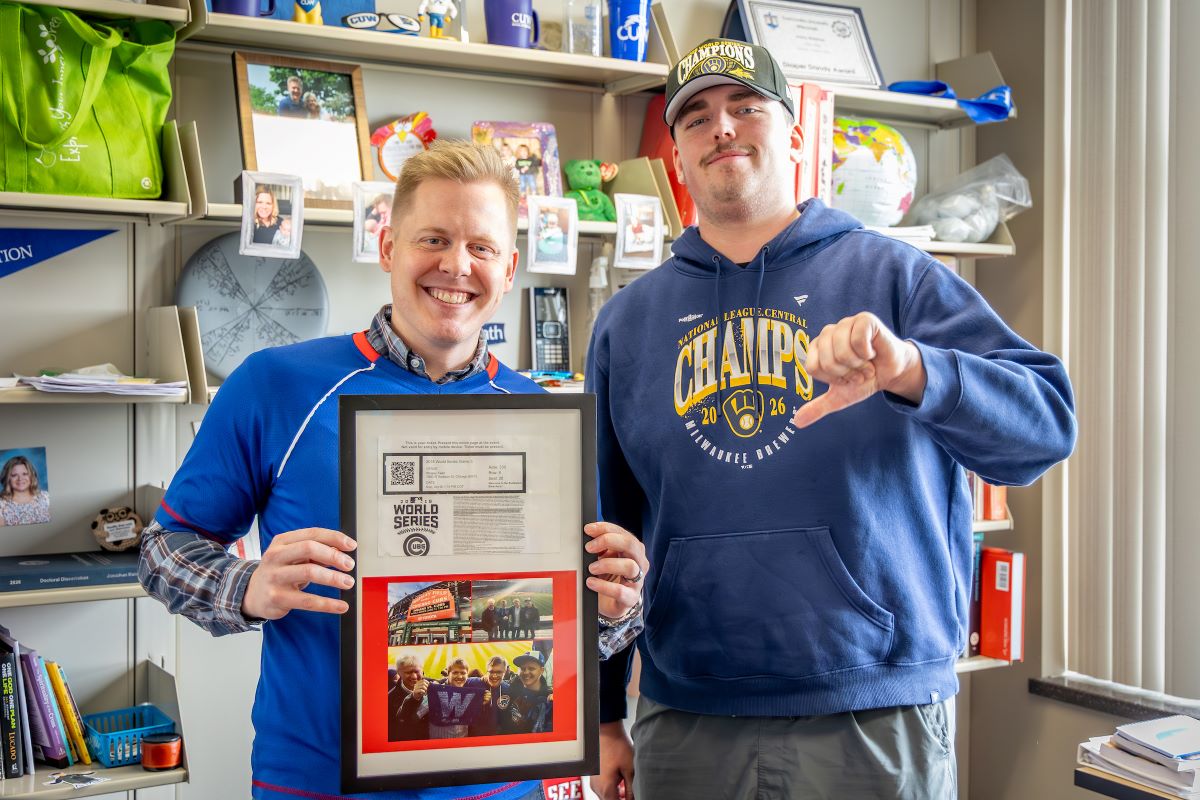
He attended Game 5 of the 2016 World Series at Wrigley Field and remembers seeing tears in his father’s eyes when the Cubs finally won the championship. Watching Hengst experience that kind of joy this past week has brought back fond memories of his own.
“The first time you get to experience your team do that, even if they do it later on in your life, it won’t ever match what your first experience was,” Balsman said.
So yes, there has been plenty of teasing. But there is also a shared appreciation for what this means to the people who love the game.
There’s a future teacher in here, too
Somewhere between baseball conversations, ongoing text messages and Instagram notifications, Hengst is preparing for a classroom of his own. From the looks of his reel, he may be a natural fit.
His experience broadcasting high school volleyball and basketball games may have something to do with it. Balsman sees the same energy and personality that made Hengst’s social post entertaining as strengths he can bring to the classroom.
“So much of teaching is a performance,” Balsman said. Even after a difficult day, teachers need to bring energy to the classroom and keep their students engaged. Hengst has already shown he can do just that, with views climbing and comments pouring in.
Balsman knows both the work and the joy of preparing future teachers. A CUW graduate in Lutheran secondary education in mathematics, he returned to teach after working as a high school math teacher. Now in his fifth year on the faculty, he appreciates the opportunity to teach students like Hengst at a place he loves.
He also wants students to know their professors as people they can talk to, laugh with and learn from. That part of this story was already happening before millions of people got to see it firsthand.
Dr. Jonathan Balsman, left, shows off his Cubs memorabilia while CUW freshman Gabe Hengst offers his review. Their baseball loyalties may differ, but their friendly rivalry has brought plenty of laughs—and social media attention—to Concordia. Photos by Mike Zimmerman.
A little friendly competition
We put Hengst and Balsman’s friendly rivalry to the test with a few questions. Neither disappointed.
1. Which one of you is letting the newfound fame go to his head?
Hengst: “Oh my gosh. I think it’s Dr. Balsman. I think he’s loving this a little bit more than I am.”
Balsman admitted he brought up their newfound fame in class that morning.
Balsman: “Letting it get to my head as a Cubs fan is also bringing more fear than excitement, so… both things are true.”
2. Who takes a loss harder?
Hengst: “I think it’s got to be me, honestly.”
Balsman: “I was gonna say, Gabe.”
Hengst: “Dr. Balsman has handled this so well. I mean, I’ve been ripping on him since, you know, the Cubs lost, and he’s taken it very well. I would say if the Brewers would have lost to the Cubs, I wouldn’t have taken it the same way.”
3.Say one nice thing about the other person’s team.
Hengst, on visiting Wrigley Field: “It is a great stadium. You have an awesome tradition.”
Balsman, on the Brewers: “The pitching is insane.”
4. If you went to a game together, who would be explaining the statistics?
Hengst: “I know he’s a total math nerd.”
He pictured Balsman sharing a player’s statistics against a particular pitcher.
Hengst: “I’d be like, wow, man, that’s cool, let’s watch the game.”
Balsman: “That… that is… that is very close to how I actually watch baseball. Yeah, that’s where Gabe would probably go get another snack.”
5. Any final words?
Hengst: “Go Brewers!”
Balsman: “Fly the W, go Cubs.”
Note: Responses excerpted from the interview for length.
Want in?
Concordia University Wisconsin is a Lutheran higher education community committed to helping students develop in mind, body and spirit for service to Christ in the Church and the world.
Concordia pharmacy students Jocelyn Wilson and Tsu Ming Ong spend their research days working with machine learning, chemical reactions, plenty of questions and, occasionally, a flask filled with black goop.
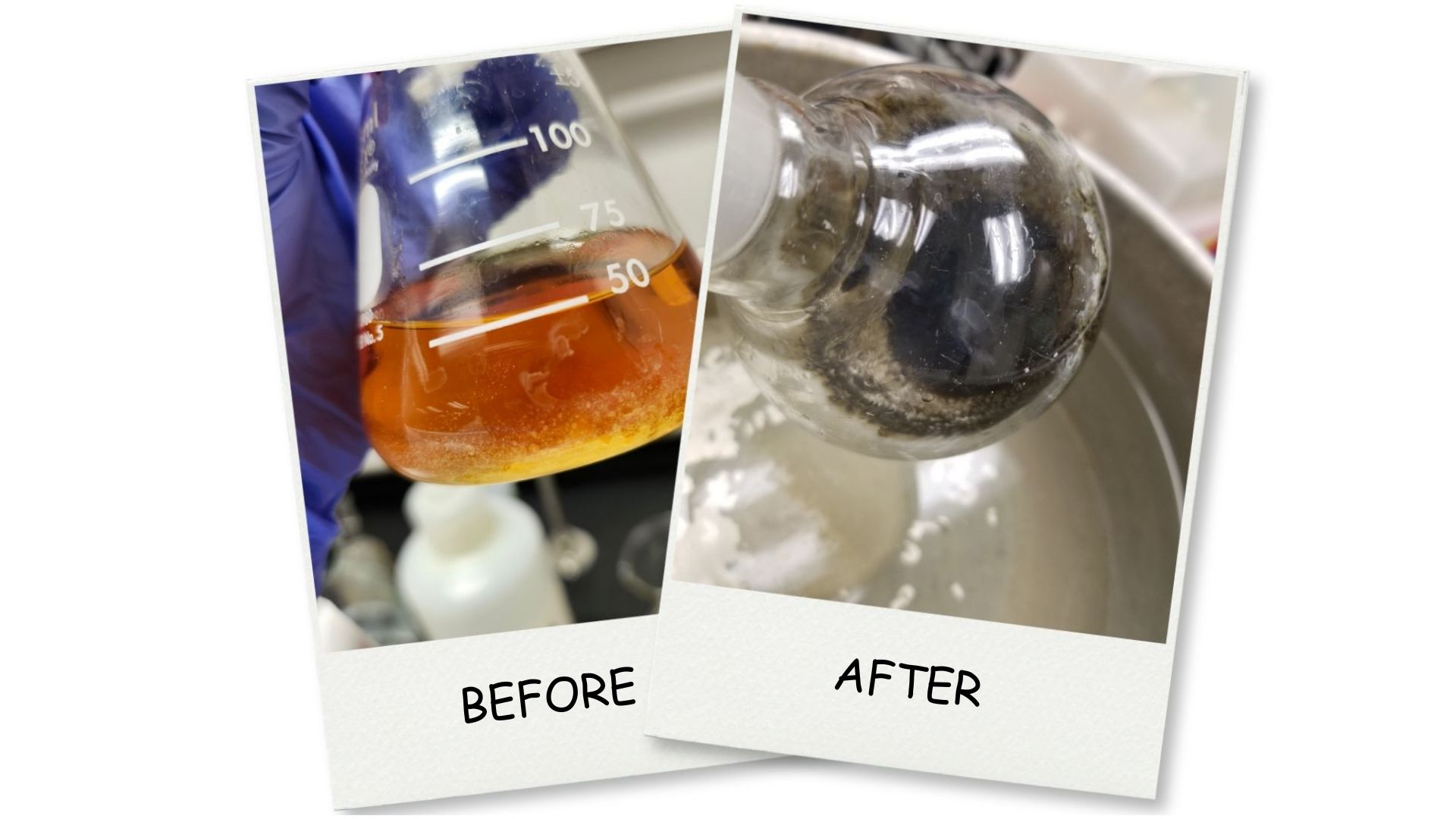
Fourth-year PharmD student Jocelyn Wilson has burned her research product more times than she would probably like to admit. She vividly remembers walking into the chemistry lab at Concordia University Wisconsin, looking at the round-bottom flask and finding the same thing waiting for her: sticky black oil.
“Like something out of a horror movie,” she said. Then, like so many students before and after her, she would try again.
Third-year PharmD student Tsu Ming Ong knows something about that feeling, although his research looks very different from Wilson’s. His work doesn’t involve standing over chemical reactions. He uses computational chemistry and machine learning to study compounds that interact with opioid receptors. And sometimes his models don’t work either.
“One thing I’ve learned is that research isn’t always about getting an exciting result,” Ong said. “Sometimes the most important part of the day is figuring out why something didn’t work.”
So, welcome to a day in the life of a research-focused PharmD student. At Concordia, that “day” can look remarkably different depending on the student, the project and even the hour. Wilson’s research has meant synthesizing compounds in a chemistry lab. Ong’s means working with chemical structures, datasets and computer models. Both are learning that research rarely moves in a straight line.
And maybe that’s part of the point.
Morning: Check the notebook
Wilson isn’t spending her days in the research lab anymore, but she remembers them vividly, especially how early they began. She would arrive at the chemistry lab, turn on the fume hood and check her notebook to figure out exactly where she had left off the day before. Some of her reactions required hours of heating and stirring, so the earlier she could get one started, the better.
Equipment came out. Reagents were measured. The reaction began. Then came the waiting, checking and documenting.
Wilson worked on the SCPI-1 project with Chris Cunningham, PhD, associate professor of pharmaceutical sciences, performing chemical synthesis and extraction of a compound being studied for its potential to treat symptoms of opioid withdrawal. Throughout a reaction, she would remove small samples and use thin-layer chromatography and UV light to see how things were progressing.
A successful reaction still meant there was more to do: extraction, more testing, an NMR run to confirm the compound’s identity, labeling, documentation and preparing samples to be sent to research partners. An unsuccessful one meant going back to the notebook. Those notes helped Wilson remember what changed, what failed and what might be worth trying next.
Ong, meanwhile, is still actively involved in research, although his days look quite different. His work begins with data.
Midday: Teach a computer about chemistry
Ong didn’t arrive at Concordia with plans to become a researcher. Originally from Malaysia, he grew up primarily in Wisconsin and became interested in pharmacy partly because his father is a community pharmacist. When he entered pharmacy school, Ong pictured himself working directly with patients as a clinical pharmacist.
Then Cunningham gave him an opportunity to try research.
“I knew I enjoyed science, but I didn’t initially understand what research in pharmacy could look like,” Ong said. He soon became interested in drug discovery and computational methods. Coding, cheminformatics and machine learning followed.
Today, his research uses machine learning and computational chemistry to identify and predict compounds that interact with opioid receptors. Rather than testing every compound individually, Ong uses computer models to study the relationship between a compound’s chemical structure and how it interacts with a receptor. The goal is to narrow the possibilities and identify compounds worth studying further.
Before he can do that, though, Ong has to make sure the information going into his models is accurate. He spends part of his day reviewing datasets, verifying chemical structures and checking activity values. He uses programs including KNIME, Mordred and RDKit to process molecular structures and generate descriptors of their chemical properties.
Then he trains and evaluates his models. Sometimes he gets what he hoped for. Sometimes he doesn’t.
Afternoon: Get comfortable with failure
Research has a way of making “didn’t work” part of the daily vocabulary, and Wilson learned that lesson repeatedly in the chemistry lab.
“Sometimes you can think you’re following a protocol to a T and still fail to get any yield,” she said.
A reaction might need a change. An extraction method might need another attempt. Even after she finally produced something, Wilson still had to determine whether she had made what she intended to make. It could be slow and frustrating, but she learned to be more comfortable when things didn’t work out.
“I became a lot more resilient to failure by doing research, which really helped with starting pharmacy school,” she said. Before beginning research, Wilson didn’t consider chemistry one of her strongest subjects. Working with Cunningham helped build her confidence in what she could do. “I realized I didn’t need to be an A+ chemist to be a part of research,” she said.
Ong has had his own lessons in persistence. He remembers developing a machine learning model that initially performed poorly. Rather than assume the entire approach was wrong, he kept working. He cleaned and restructured the dataset, changed how variables were represented and experimented with different modeling approaches. Little by little, the results improved.
“Research progress isn’t always one big breakthrough,” Ong said. “Sometimes it’s a series of small improvements that eventually lead to something meaningful.”
The experience also taught him something he didn’t expect. Research isn’t always about finding the right answer. Sometimes it’s about figuring out whether you’re asking the right question in the first place.
Whenever possible: Find people who help you figure it out
Neither student has done this work alone. Wilson first connected with Cunningham while she was still an undergraduate student at Concordia. Curious about the opportunities available, she contacted the School of Pharmacy Admissions Office and received a list of faculty members conducting research. Cunningham’s work caught her attention, so she reached out. That email eventually put her in a lab coat.
Cunningham became Wilson’s main research mentor and encouraged her to present their work at symposiums and conferences. “He was really in my corner supporting me for the whole process,” Wilson said.
Ong describes his relationships with CUW faculty Cunningham and Terry-Elinor Reid, PhD, associate professor of pharmaceutical sciences, in a similar way. Both offer guidance when he needs it, but they also trust him enough to make his own decisions and mistakes. That freedom led to one of Ong’s most memorable realizations.
While working through a modeling workflow, he noticed something had changed. He wasn’t simply following instructions anymore. He was deciding how to handle the data, determining which variables were meaningful, choosing how to evaluate the model and interpreting what it produced.
“At some point, I realized that I wasn’t simply learning about research anymore,” Ong said. “I was starting to think like a researcher.”
Late afternoon: Research gets bigger
Eventually, the compound Wilson had worked on left the lab. Literally. Her work was one piece of a project involving researchers at multiple institutions. Wilson helped produce the compound at Concordia. Partners at UW-Milwaukee performed further purification and in vitro metabolism studies, while partners at Johns Hopkins conducted in vivo studies to evaluate its effects.
That surprised her. When Wilson first pictured research, she imagined the work happening in one place. Instead, she found herself part of a network of people bringing different skills and resources to the same project.
One presentation at AACP’s Pharmacy Education 2025 meeting in Chicago also stands out. Wilson remembers arriving nervous, worried that she might forget what they had done or wouldn’t know enough to answer questions. By the end of the night, things felt different. “I was talking with other pharmacists and credentialed researchers with ease,” she said.
Wilson, who served as president of CUW’s Industry Pharmacists Organization (IPhO) chapter during the 2025-26 academic year, is now completing her advanced pharmacy practice experience (APPE) rotations. Her time in the lab, opportunities to present research and experiences in pharmacy practice have helped her see just how many places research and pharmacy intersect.
When research meets patient care
Ong sees that connection from another angle. As an intern at Froedtert West Bend’s inpatient pharmacy, he sees patients who rely on specialized medications. That experience puts him close to the individuals affected by those therapies.
Research allows him to see that work on a larger scale. Drug development and health outcomes research can influence therapies used by patients far beyond one hospital or community, and that possibility has changed the career Ong once pictured for himself.
“I still really value patient care, but my perspective has expanded significantly,” he said. Ong is now interested in bringing together pharmacy, research, data and the pharmaceutical industry. Health economics and outcomes research, real-world evidence, data analytics and medical affairs are among the areas that have caught his attention.
Wilson’s picture has changed, too. She entered pharmacy school knowing she wanted research somewhere in her future, although she wasn’t sure what that meant. She considered becoming a clinical research associate in the pharmaceutical industry for a time. Her APPE rotations now have her thinking about another possibility: finding a career that allows her to remain close to patients while continuing to participate in research.
Oncology pharmacy and investigational drug services are among the possibilities she is considering. “Research has expanded my idea of what pharmacists can be and do,” Wilson said.
So, is research for you?
Wilson’s advice to students who are curious about research is simple: Give it a try. Spend a few hours a week on a project. Stop by a lab before class. Stay a little later. Ask a faculty member what they’re working on. Students with a research idea of their own can start by talking with a faculty member or advisor who can help connect them with someone who shares that interest.
“The worst thing that can happen is you don’t have the time, or you don’t like it,” Wilson said.
Ong didn’t know research would become such a large part of his pharmacy experience when he initially started college. His involvement has grown in other ways, too. After serving as Wilson’s vice president in CUW’s IPhO chapter last year, Ong is serving as president for this 2026-27 school year.
His advice to students curious about research is much the same as Wilson’s: Try it before deciding it isn’t for you. As both students discovered, there are probably a few possibilities you don’t yet know exist.
More than a job
Figuring out where pharmacy might take him is tied to a larger question for Ong: How will he use what he has been given to serve God?
“As a Christian, I believe we are called to use the talents and abilities we’ve been given to glorify God and serve others,” he said. He doesn’t know exactly where his career will take him, but he wants his faith to guide the decisions he makes and the way he uses his knowledge. Research has given him another way to think about that calling.
Wilson came to Concordia already looking for research. Ong found it after he arrived. Wilson worked in a chemistry lab, while Ong found his place working with computers and data. What do they have in common? Neither has every detail of the future figured out, and neither needs to.
There are still questions to ask, experiments to run, models to test and probably a few things that won’t work the first time. Tomorrow, they’ll try again.
Want in?
Concordia University Wisconsin is a Lutheran higher education community committed to helping students develop in mind, body and spirit for service to Christ in the Church and the world.
Design and athletics may have brought her to Concordia. But the relationships she formed, experiences she gained and faith she developed gave her so much more.
It doesn’t take much for alumna Jessi Alexander (’23) to recognize how her time at Concordia University Wisconsin helped shape who she has become today, both professionally and as a child of God.
“I’m absolutely honored,” Alexander said. “I never could have imagined something like this coming from simply showing up each day and trying to do my best.” Alexander was quick to acknowledge the recognition wasn’t hers alone.
“It’s hard to look at an award that I’ve received and not see all the people who are also standing behind it,” she continued. “It’s truly not me. It’s God first and foremost, but it’s also the community and fellowship that we have in this industry.” She acknowledged that much of the industry is about who you know and the people willing to encourage you along the way.
“I have a million amazing people behind me who have pushed me to try different things and made me comfortable enough to spread my wings,” she said.
Alexander’s story begins with creativity and curiosity. By her junior and senior years of high school, she knew she wanted to be involved in design and architecture. She loved playing sandbox-style video games where she could move around, try new things and just build. What started as a hobby became a passion and eventually a stepping stone toward her calling.
“I loved them so much,” she said with a chuckle. “I was like, ‘I just want to keep designing things.’ It sounds silly, but games like The Sims or Minecraft—truly, that’s what I loved.” That same feeling of getting lost in a project, where it can be hard to come up for air because you’re so engulfed in the work, followed her into 3D design and digital drafting programs like SketchUp, Revit and AutoCAD.
“You’re working with forms and shapes and models,” Alexander said. “You get to tinker around, and you truly can get lost in it.”
Strength beyond the mat
Growing up in Plainfield, Illinois, Alexander was also a high school cheerleader who earned multiple regional and national titles while maintaining honor-roll status. When it came time for college, she sought a place where she could pursue design while being recognized for her strength and technical ability as an acrobat.
CUW offered her both. Alexander joined the university’s acrobatics and tumbling team, which was a major draw in her decision to attend Concordia. Being part of an athletic team helped her with time management, problem-solving, collaboration and building stronger relationships with people.
“Those skills have carried directly into my professional life,” Alexander said. “No matter where you go or what career you might pursue, you’re going to have to work with other people. You’re going to have to communicate. You’re going to have to manage your priorities and solve problems.”
During her senior season at CUW, Alexander competed in eight meets and helped the Falcons earn a Division III national event title in the 450 salto toss, a skill in which athletes launch a teammate into the air to perform a rotation before catching her.
The best of both worlds
Athletics was only one part of what drew Alexander to Concordia. She also wanted a traditional college experience without giving up her passion for design. CUW’s Interior Architecture and Design program, offered in partnership with the Milwaukee Institute of Art and Design (MIAD), gave her what she described as “the best of both worlds.”
“I got to have that well-rounded balance of Concordia with the incredible design program that MIAD offered,” Alexander said. Along the way, she found friends and professors who would influence her life well beyond graduation and was introduced to a faith that would become increasingly important to her.
“A friend of mine at Concordia invited me to church time and time again, and I turned them down every single time until I finally decided to go,” she said. “I found a community of believers that were the most welcoming, down-to-earth people that I have ever met in my life.” Today, Alexander continues to grow in her faith and is actively involved with her church.
One CUW professor and mentor who stands out in particular is Theresa Kenney, PhD, who played an instrumental role in Alexander’s college experience. “She absolutely poured so much love into me and into my fellow students,” Alexander said. “You could tell that she really breathed life into my artwork and creative process, and gave me plenty of room to grow.”
Having that steady person throughout all four years meant a lot to her. “I remember being so nervous walking into her class freshman year. She really helped me feel more comfortable. Then fast forward to graduation day, one of the flowers on my cap started falling off, and she was right there to help me glue it back on,” she said.
Kenney remembers Alexander vividly and how her presence helped guide those around her. “Jessi is the kind of student every professor hopes for. Throughout her time at CUW, she combined exceptional talent with genuine kindness, always meeting deadlines and always ready to help a classmate.”
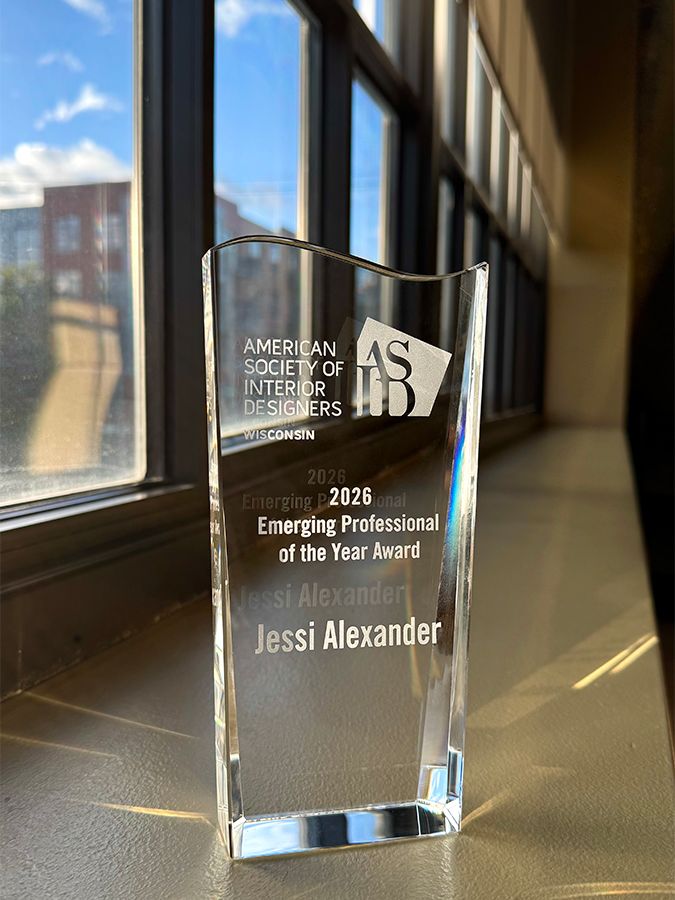
Regardless of the medium, Alexander lifted up those around her while producing outstanding work of her own, according to Kenney. She believes the recognition from ASID is well deserved. “I can’t wait to see the spaces she creates and the designers she inspires next.”
Another professor who was instrumental in shaping Alexander’s future was the late Rev. Dr. Daniel Paavola. His influence extended far beyond the classroom, helping shape her faith as well.
“Dr. Paavola’s influence on both my education and my faith has left me with an appreciation for not only what he taught, but the way he taught it,” Alexander said. “His passion, teaching style, and genuine ability to connect with anyone he met made a lasting impression on me. He was truly a once in a lifetime kind of person. It’s hard to put into words just how much of an impact he had.”
While keeping up with her academics, Alexander was named to the National Collegiate Acrobatics & Tumbling Association (NCATA) Academic Honor Roll multiple years, received Concordia’s Visual Arts Award and landed an internship with La Macchia Group, a design-build firm specializing in banks and credit unions.
Finding fulfillment all around her
Much of what Alexander learned at CUW and MIAD has carried directly into her professional life. One skill she developed that proved especially useful was learning how to confidently present her work and ideas to colleagues.
“I think that is a very underrated part of studying in this profession,” she said. “How you present yourself and your ideas and your projects can make a world of difference in how someone is interpreting them. You can have a great design, but knowing how to communicate it and present it confidently is just as important.”
Alexander first joined La Macchia Group as an intern while still a student and transitioned into a full-time role after graduating. “I’m truly fulfilled by the work that I do here,” she said. “That is something I’ve been holding on to because it’s just not something everyone gets to say.”
Professionally, Alexander has her sights set on ASID Wisconsin’s Design Excellence Awards, where she will be submittingsome of her own projects for consideration. Personally, she recently got engaged. And spiritually, she plans to continue serving at her church, Rise MKE.
Overall, she has found herself exactly where she wants to be. The Concordia-MIAD program brought her to an area rich in art and design, while introducing her to the people, opportunities and community she calls home.
Now, just a few years into her career, she gets to do work she loves in the city she has a hand in designing. “I love what I do, I love who I do it with, and I love who I do it for,” Alexander said.
Want in?
Concordia University Wisconsin is a Lutheran higher education community committed to helping students develop in mind, body and spirit for service to Christ in the Church and the world.
Faculty, professionals and alumni encouraged students to think deeply about the responsibilities they will carry into their careers and communities.
Before panelists explored artificial intelligence, violence against women, missing persons investigations and the future of justice leadership, Kenneth Harris, PhD, had a question for the room.
With everyone gathered in the Collaboratorium of CUW’s Robert W. Plaster Free Enterprise Center, Harris asked: How can people participate meaningfully in the justice system if they struggle to read or think critically?
The room was quiet. Thank goodness for the complimentary coffee on the back table. It’s an important question, but a heavy one to process at 9 a.m. A wake-up call in more ways than one.
According to Wisconsin Literacy, 1 in 7 Wisconsin adults struggle with low literacy, which can make tasks such as completing forms and following written instructions difficult.
As chair of the Department of Justice and Public Policy, Harris wanted attendees to dig deep and think about what that challenge means for their communities. If people struggle to understand the system, how can they ask questions, weigh information or have a voice in decisions that affect their lives?
Organized by Harris and held Wednesday, Oct. 14, the Justice Summit brought faculty, justice professionals, alumni and students together under the theme “Old Wine in New Bottles: New Challenges Facing the American Justice System.” Members of Beyond a Reasonable Doubt (BARD), CUW’s law and law enforcement club, helped with the event.
Preparing students for those challenges was a focus of Rachel Ware Carlton’s opening remarks. The dean of the School of Arts & Sciences highlighted the “&” in the school’s name, explaining that students need both dimensions to be informed and formed for their future vocations.
President Erik Ankerberg emphasized Concordia’s role in advancing conversations about justice and preparing students to lead with strength and compassion. He encouraged students to listen carefully and consider the kind of leaders the world needs.
Throughout the day, conversations returned to questions of truth, accountability and human dignity.
“Justice Summit 2026 was more than a gathering of professionals; it was an opportunity to exchange ideas, challenge assumptions, inspire future justice leaders, and strengthen the relationships between education and professional practice,” Harris said.
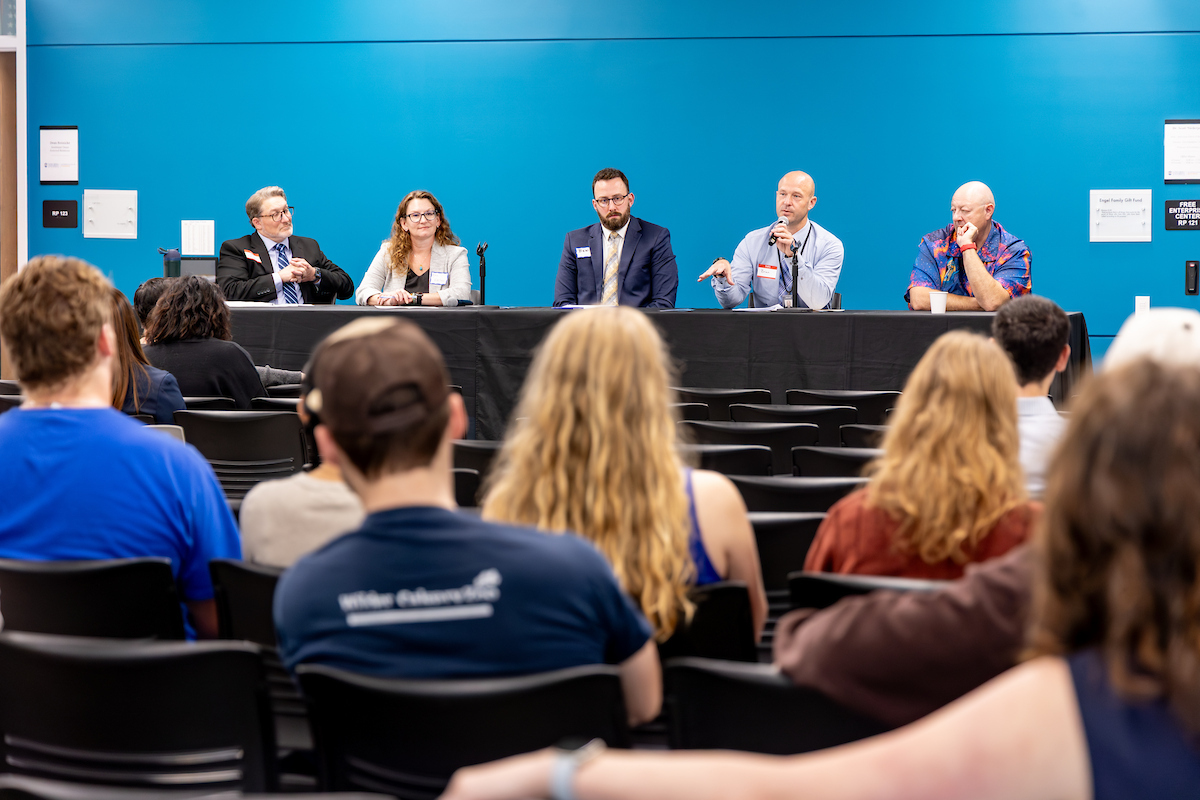
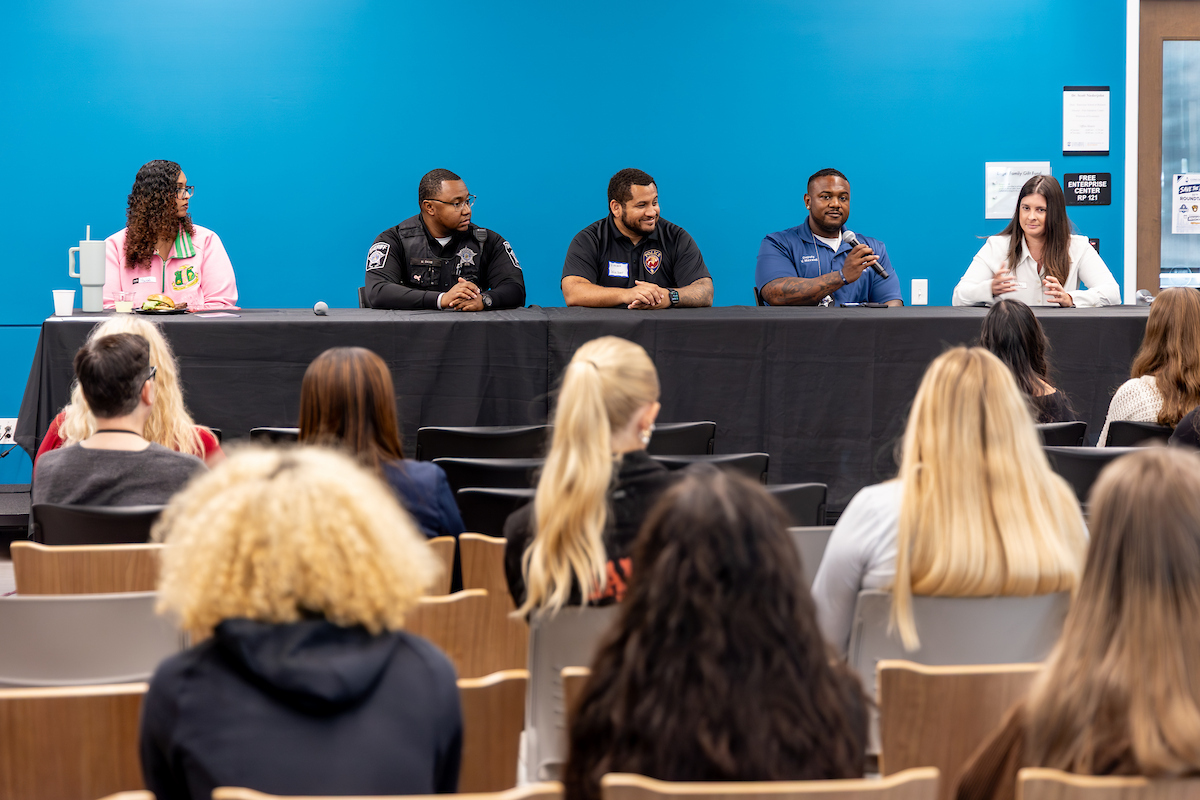
From left: Matthew Mac Kelly, JD, EdD, associate professor of justice and public policy; Erin Karshen, an assistant district attorney in Milwaukee County’s Sensitive Crimes Unit; Benjamin Lindsey, Ozaukee County district attorney; Capt. Brian Damon of the Milwaukee Police Department; and Michael Litman, PhD, professor of computer science.
Panel 1: Artificial Intelligence in the Justice System
Artificial intelligence can help investigators analyze information, identify leads and prepare transcripts. But when a decision could change someone’s life, what responsibility must remain with a human being?
The summit’s opening panel explored that question with Michael Litman, PhD, professor of computer science; Matthew Mac Kelly, JD, EdD, associate professor of justice and public policy; Capt. Brian Damon of the Milwaukee Police Department; Benjamin Lindsey, Ozaukee County district attorney; and Erin Karshen, an assistant district attorney in Milwaukee County’s Sensitive Crimes Unit.
Panelists emphasized using AI as a starting point, with people responsible for verifying information. Lindsey explained that an arrest can damage relationships and a person’s standing in the community, making the consequences of inaccurate information significant.
“We must be thoughtful on how we proceed,” he said.
Harris pressed the panel on accountability: Who bears responsibility when these tools contribute to injustice? Mac Kelly acknowledged the difficulty of assigning accountability while emphasizing the shared responsibility of policymakers, educators and justice professionals.
Throughout the discussion, panelists returned to the importance of experience, empathy, integrity and compassion. Using AI responsibly requires professionals who can evaluate its output, recognize its limitations and exercise sound judgment.
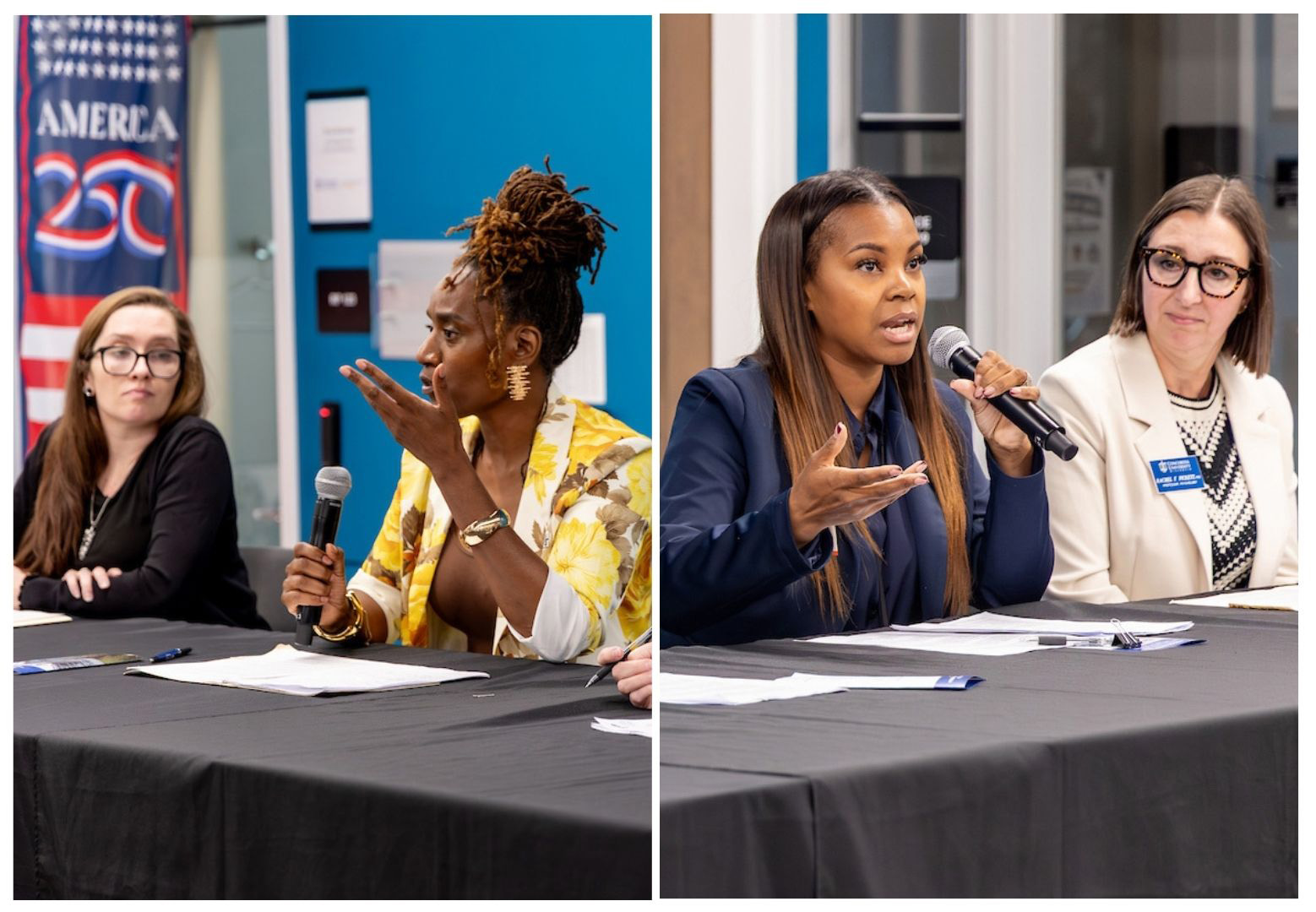
From left: Jessica Behling, an assistant district attorney in Milwaukee County’s Domestic Violence Unit; Assistant Professor Lisa Adams-Qualls of CUW’s social work program; Milwaukee Police Detective Shirley Thomas-Baldwin; and Rachel Pickett, PhD, chair of CUW’s Department of Psychology.
Panel 2: Violence Against Women
Leaving an abuser can mean losing housing, money or transportation. It can also bring greater danger. During the panel, Rachel Pickett, PhD, chair of CUW’s Department of Psychology, explained that harmful behavior may feel normal to someone who grew up around it, making the need to leave harder to recognize.
Pickett joined assistant professor Lisa Adams-Qualls of CUW’s social work program; Milwaukee Police Detective Shirley Thomas-Baldwin; Maria Rozek, a trauma counselor and victim advocate with the Milwaukee Police Department’s Sensitive Crimes Division; and Jessica Behling, an assistant district attorney in Milwaukee County’s Domestic Violence Unit.
Adams-Qualls explained how financial dependence, shared housing and concerns involving children can complicate leaving. “As a social worker, I understand it is not enough to simply tell someone to leave an abusive relationship,” she said.
Pickett emphasized preparing Concordia students to recognize those practical challenges alongside the emotional toll. “My goal as a psychology professor is to help them understand that as therapists it is important to support survivors’ mental health and safety, as well as their practical needs,” she said. She also noted that judgment or blame after someone discloses abuse can cause further harm.
Harris broadened the conversation by challenging the assumption that victims are always women. Panelists shared examples of men experiencing abuse and discussed how fear of others’ reactions can keep them from seeking help. According to the National Domestic Violence Hotline, citing a 2010 CDC survey, approximately 1 in 4 women and 1 in 7 men in the U.S. have experienced severe physical violence by an intimate partner during their lifetime.
When Harris asked about preventing victimization, Thomas-Baldwin responded: “Speak up!” But as the group acknowledged, that can be easier said than done. Fear can keep someone silent and make investigations more difficult when victims hesitate to participate.
The conversation ultimately returned to prevention.
“Prevention before intervention,” Adams-Qualls said.
She explained that families can model respectful communication, teach boundaries and show children how to handle conflict, while schools reinforce those lessons through age-appropriate education.
Rozek also emphasized that prevention starts with teaching healthy relationships at home. Behling called for communities to rethink funding priorities, while Pickett highlighted early childhood development and programs that help parents keep children safe and healthy.
Former JPP graduates discussing career preparation.
Alumni: JPP Graduate Panel
During the lunchtime alumni panel, justice and public policy graduates shared advice about internships, professional skills and finding their way after graduation.
Isaiah Lubner, a current justice and public policy major in the Class of 2027, left with plenty to think about—and a new career interest.
“After speaking with an alumnus, I developed a strong interest in pursuing a future career with the FBI,” he said. “These conversations helped me better understand my own career goals and gave me a clearer direction for my future.”
CUW alumna Veronika Metanova’s advice also stuck with him: Make a plan, work toward your goals and understand that mistakes are part of learning along the way. Fellow alumna Hayat Ibrahim reminded students that it’s also OK to change course.
“Give yourself permission to change direction,” said Ibrahim, who graduated in May 2025 with a bachelor’s degree in justice and public policy.
Ibrahim’s most recent contract position was as a legal administrative assistant at Associated Bank. She credited Concordia with strengthening the research, analytical and communication skills she put into practice during an internship at Ritter Law Office. Along the way, Harris and Mac Kelly offered guidance beyond the classroom.
“Being away from home, they provided guidance, encouragement, and support in ways that felt very much like having father figures there for me,” she shared.
Now navigating life after graduation, Ibrahim encouraged students to give themselves that same room to grow. “Your first job does not have to be your forever job, and your original plans do not have to define your future,” she said.
Other advice shared during the panel included “Take risks and be brave” and “Be adaptable.” Ibrahim echoed that encouragement, urging students to ask questions, advocate for themselves and remain open to opportunities they had not anticipated.
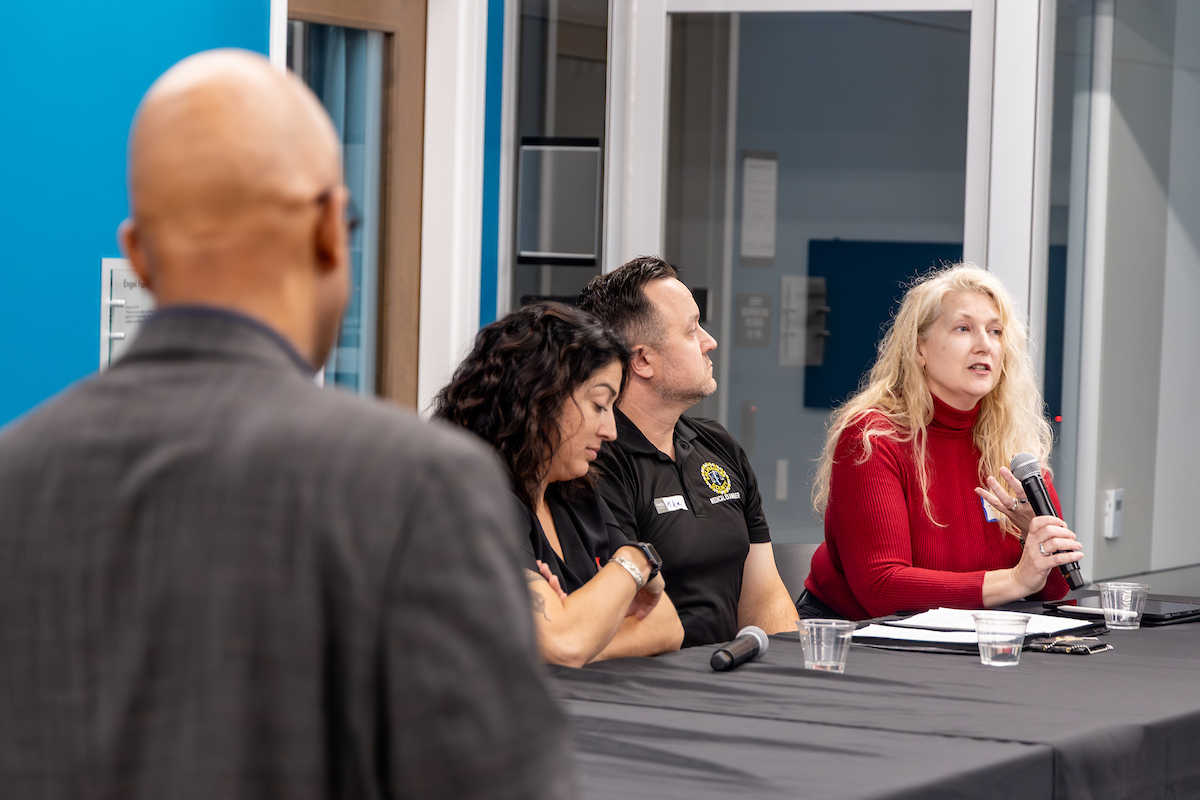
From left: Milwaukee Police Officer Jamie Sromalla, Michael Simley of the Milwaukee County Medical Examiner’s Office and Kim Sternhagen of the Milwaukee Police Department’s Sensitive Crimes Division discussed finding missing people and identifying unknown individuals.
Panel 3: Missing and Unidentified Persons
The third panel focused on missing persons investigations, perhaps one of the day’s most difficult topics to grasp.
“It’s a bigger problem than we think,” said Jamie Sromalla, who has served with the Milwaukee Police Department for 10 years, including the past two years working on missing persons cases.
Sromalla joined Kim Sternhagen of the department’s Sensitive Crimes Division and Michael Simley of the Milwaukee County Medical Examiner’s Office to discuss finding missing people and identifying unknown individuals.
Milwaukee alone has approximately 450 open missing persons cases, about half involving juveniles, Sromalla reported. Thirty-five are cold cases dating back 10 to 20 years. While that’s down from more than 700 when she started, keeping up remains difficult. Closing 10 cases can be followed by 15 more coming in, she said.
All three panelists emphasized an important distinction, one that can be hard for people to accept: Going missing is not a crime. An adult may choose to leave without sharing their location with friends and family, limiting what investigators can do.
Other challenges include accessing phone records and social media accounts, along with finding people willing to share information. Sromalla said community members sometimes fear coming forward, especially in front of others in their neighborhoods.
Identifying someone who has died presents another set of challenges. Simley, who has 18 years of experience, emphasized careful observation and thorough information gathering.
“The truth is in the details,” he said.
Identification may involve a black-and-white photograph of the deceased or scientific methods such as fingerprints, DNA and dental records. Details from those reporting someone missing, including an old injury or tattoo, can help investigators narrow the search.
Panelists also discussed reviewing older records and the time required for testing. Helping families understand that process is part of the work, especially when answers come more slowly and with less certainty than television might suggest.
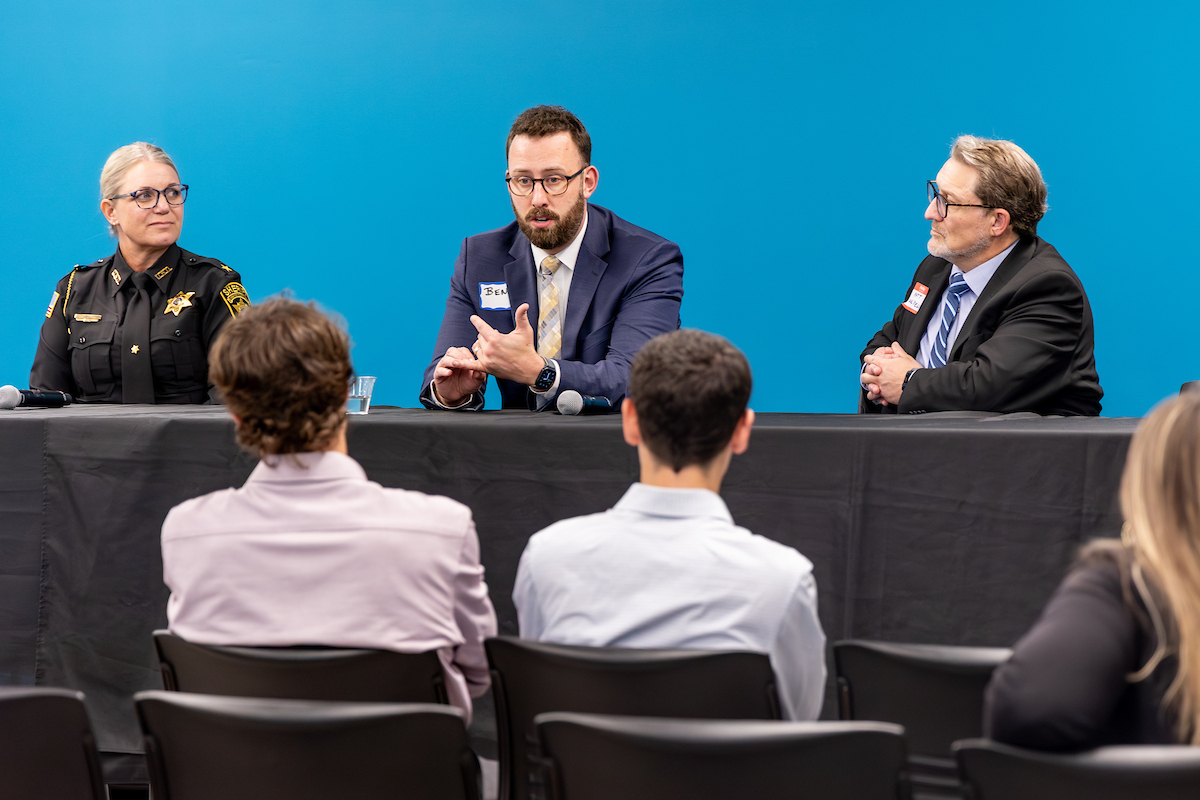
From left: Ozaukee County Sheriff Christy Knowles, Ozaukee County District Attorney Benjamin Lindsey and Matthew Mac Kelly, JD, EdD, associate professor of justice and public policy at CUW.
Panel 4: The Future of Justice Leadership
The day ended with a conversation about what it takes to lead. Harris and Mac Kelly joined Ozaukee County Sheriff Christy Knowles and Lindsey to discuss the qualities justice professionals need, especially when stepping into positions of power.
Lindsey emphasized humility first and foremost. Knowles spoke about having a strong value system, staying true to what you stand for and remaining adaptable as you work toward your goals. Both agreed that leaders must make difficult decisions, including some that others will not like.
Knowles also acknowledged that the “letter,” or political affiliation, attached to a leader’s name can influence how people perceive them. Lindsey agreed that leadership changes a person’s relationship with the community. Remaining anonymous in a crowd is a luxury leaders don’t have, he said.
Above all, the panelists emphasized integrity. Listening, owning your mistakes and taking responsibility matter when people are looking to you for leadership. Mac Kelly connected those everyday choices to the future students will help shape.
“The future of the criminal justice system, public policy, and society as a whole depends on empathy, compassion, communication; how we carry out our collective responsibilities to one another today determines our future,” he said.
That message resonated with BARD president Makayla Runyon, a sophomore studying philosophy, politics and economics who hopes to fight human trafficking through a career in the legal field.
“The sheriff and DA’s conversation about how necessary good character is really stuck with me and challenged me to continue to strengthen the character I believe Jesus has helped cultivate in me, not just for my own peace of mind, but for my future vocation too,” she said.
Get to know BARD
Beyond a Reasonable Doubt (BARD) is CUW’s law and law enforcement club, open to students of any major. The club helps students understand the criminal justice system and how laws apply to their everyday lives. To learn more, contact club president Makayla Runyon at makayla.runyon@cuw.edu.
Want in?
Concordia University Wisconsin is a Lutheran higher education community committed to helping students develop in mind, body and spirit for service to Christ in the Church and the world.
Senior Rachel Webb discovered the importance of relationships, cross-cultural ministry and compassionate service while interning with immigrant youth in Milwaukee.
Rachel Webb did not know exactly what to expect when she walked into Benediction Lutheran Church for the first time.
In fall 2025, she had recently transferred from CUAA and was beginning her first semester in CUW’s Director of Church Ministries program. Looking for an internship centered on outreach and missions, she was drawn to Benediction’s uniquely diverse ministry setting and began interning there in January 2026.
“What drew me was the fact that it’s one church, but they minister to four different ethnic groups,” Webb said. “I was just looking for something different, and I found it.”
Benediction serves multiple congregations under one roof, including traditional English-speaking worshippers, a Hmong congregation, a French African congregation and a German-speaking ministry. Webb spent most of her semester-long internship serving with the church’s French African youth group.
“At first, I thought the kids didn’t like me because they reacted differently than students I was used to working with,” Webb said. “Later, I realized that once I learned more about their culture and built relationships with them, I was able to be more confident.”
Rev. Dr. Kurt Taylor, professor of theology and director of Church Ministries, said Webb’s compassion and commitment to ministry stood out from the beginning.
“Rachel is one of the most talented and passionate students I’ve ever had,” Taylor said. “I can’t wait to see what God has in store for her. And I am certain that, strengthened by Him, she is going to be a powerful instrument toward changing lives with the Gospel of Jesus Christ. Her internship at Benediction is an early step in what will be an amazing life of service.”
Faithfully stepping into unfamiliar spaces
From the beginning, Webb knew the experience would stretch her in ways she had not anticipated. “I had never been to a French African service before, so I didn’t really know what to expect,” she said.
The service structure looked different from the traditional Lutheran services Webb grew up attending. There were no printed bulletins. Worship flowed naturally between music, prayer, preaching and conversation. At first, the spontaneity caught her off guard.
“Everyone just kind of started praying, but it wasn’t the same prayer, and I didn’t know what was going on,” Webb recalled with a laugh. “I was like, ‘Okay … what is happening right now?’”
Still, what stood out most to her was how quickly the congregation welcomed her in.
“After the service, even though I had never met any of them before, I had them coming up to me, talking to me like they had known me my entire life,” she said. “They were so welcoming.”
Throughout the semester, Webb worked primarily with the church’s youth. She led Sunday school lessons, guided discussions, helped with Bible studies and built relationships with students ranging from elementary school to high school.
Building relationships first is key
What surprised Webb most was the students’ eagerness to engage. “A lot of them genuinely wanted to be there,” Webb said. “You can really tell that a lot of them are passionate about Christ and passionate about the gospel.”
The students regularly asked thoughtful questions about Scripture and theology—questions Webb admits she was not asking at their age.
“We were talking about the Beatitudes one day, and they started coming up with ways we can apply those things to people today,” she said. “I was like, ‘This is not stuff that I would have thought to do in ninth and 10th grade.’”
Many of the students and families at Benediction had emigrated from the Congo within the last several years. This internship quickly became an opportunity not only to teach, but to learn.
“A lot of them were learning a second language, and they were also learning a new culture, too,” she said. “That added another layer to everything.”
The experience ultimately reshaped her understanding of ministry itself. Before entering the internship, she believed ministry centered primarily on preaching and teaching. What she discovered instead was the importance of relationship-building, especially in cross-cultural and inner-city ministry settings.
“You cannot do it without having relationships with every single person you’re working with,” she said. “If you don’t have a relationship established with the people you’re serving, especially in inner-city ministry, it’s hard to do ministry well. People in challenging situations need that relationship more than anything.”
Understanding that trust often opens doors for deeper conversations about faith helped shape her approach. “The gospel message and everything else of your ministry is going to flow from that,” Webb said.
Growing through any new challenge
The internship initially pushed her outside her comfort zone as she adapted her teaching style to a different cultural environment. Eventually, she realized the students were simply interacting with authority differently than what she experienced growing up. As she learned more about the culture and built stronger relationships, her confidence grew.
“Adaptability and flexibility are huge,” Webb said. “That was something I learned very well.”
The students quickly became the highlight of her semester. One student named Joey jokingly asked her on the first day, “Why are you here? Did none of the other churches take you?”
By the end of the internship, Joey had become one of her most engaged participants in class discussions.
The older girls in the youth group also began asking Webb questions about school, friendships and preparing for college. “It kind of turned into one of those moments where I became kind of like an older sister to them,” she said.
When her internship ended near the close of the spring semester, the students surprised her with a party after church. “I was so sad when I left,” Webb said. “They were probably some of the best kids I’ve ever worked with.”
Looking ahead
Webb said the experience has influenced the direction of her future vocation. Alongside ministry work, she is considering graduate studies in social work or Christian counseling.
“I want to be someone that is in the church that not only can help with the spiritual aspects of things, but also can help with the outside aspects of that,” she said.
For her, Benediction offered more than internship hours. It offered a clearer picture of ministry rooted in compassion, relationships and meeting people where they are.
“You really got to be there for people,” she said.
Want in?
Concordia University Wisconsin is a Lutheran higher education community committed to helping students develop in mind, body and spirit for service to Christ in the Church and the world.
With political science and history claiming the majority and philosophy still in the running, Danika Burkett is preparing for law school without giving up the subjects she simply loves.
Growing up, Concordia University Wisconsin senior Danika Burkett and her dad talked politics. A lot. So, it isn’t surprising that she chose to study political science. What is surprising is that she found time for all three.
By the time she arrived at Concordia, Burkett was already envisioning law school. Political science was a natural fit, while philosophy offered a chance to consider other viewpoints and make stronger arguments. History? Well, she wasn’t giving that up either. “I just really like it,” she said with a smile.
The more history courses she took, the more she wanted to keep going. Burkett wondered whether she could squeeze a second major into an already busy schedule.
Turns out, she could.
“I really enjoyed the classes and the professors,” Burkett said. “I thought, ‘If I can already do some of it, why not do more?’”
What each subject brings
Political science, history and philosophy may sound like natural companions, but Burkett finds something different in each. In political science, she looks at power and why people seek it. History asks her to consider the motivations of different groups of people and how their actions affect one another. Philosophy takes her outside of both to consider ideas from a broader point of view.
“Philosophy does a good job of broadening your horizons,” Burkett said. “Even if you don’t agree with certain philosophers, they might have valid points that can help bolster your own arguments.”
Not bad preparation for a future lawyer.
This summer, Burkett interned in Washington, D.C., for Iowa Sen. Chuck Grassley on the Senate Judiciary Committee. She wrote memos, spoke with witnesses, helped write letters and spent time in the hearing room, where she observed Senate votes, meetings and hearings.
“I got to see the Capitol and watch things I’d studied in both my history and political science classes come to life in D.C.,” she said.
Back at Concordia, her professors have seen those interests develop in the classroom, too. Jeff Walz, PhD, professor of political science, first met Burkett in a Christian Citizen course. Since then, he has watched her become more involved on campus, take on leadership roles in Student Government Association and grow as a thinker.
“In the classroom, I have been struck by Danika’s attentiveness to class ideas, her classmates’ thoughts and why the issues matter,” Walz said. “She works ahead on assignments and explores each class with great depth.”
Walz believes those qualities, coupled with her willingness to study across disciplines, will serve her well in law. “Danika has a very keen mind that is so attuned to details and specifics while seeing the big picture,” Walz said. “She has an incredible work ethic, is thoughtful and will bring a Christian scholar’s perspective to the law profession.”
More than a future career
Burkett admits that fitting two majors and a minor into four years hasn’t necessarily been easy. She has carried a course overload for the past couple of years while also staying active on campus. She has served in Student Government Association since her freshman year, including as vice president and Rules Committee chair. Burkett also finds time for Campus Ministry and Quaestus.
How does she do it? Burkett credits her professors with helping her make it all work.
“The professors here are very collaborative, have hallway conversations on a regular basis, and work hard to see that students can fulfill their academic interests, including across multiple disciplines,” Walz said.
That freedom mattered to Burkett. Had she attended somewhere else, she isn’t sure she would have pursued the same path. She suspects she might have felt pressure to choose.
“Could I have chosen? Yes,” she said. “But it was great to have the opportunity not to say, ‘I prefer this,’ or, ‘This would be better for my career.’”
Called to serve others
Burkett’s time at Concordia has also helped her think about law through the lens of vocation. “How can I be a good citizen? How can I help people? How can I serve people?” Burkett said.
Those questions are closely tied to her faith. She grew up Lutheran and wanted a college where she could continue growing in that faith. At CUW, she has served through Campus Ministry, including as a leader and coordinator for LIGHT women’s ministry and now as coordinator of Campus Fellowship.
“Everything I do, I hope I’m doing because that’s my calling from God,” she said. “I want to serve Him, and I want to serve my neighbors by serving Him.”
Graduating in May 2027, Burkett hopes to attend law school in St. Louis, where her fiancé, whom she met at Concordia, plans to attend seminary. As for students still figuring out their own academic paths, she has a bit of advice:
“I think people get so focused on what they hope to do when they leave Concordia that they forget to study the things they enjoy while they’re still here,” Burkett said. “Yes, you’re doing it for a future career, but there’s more to the experience than just that.”
“The School of &” blog series highlights the distinctive identity of Concordia University Wisconsin’s School of Arts & Sciences, where interdisciplinary connections shape learning and purpose. Each month, the series features students and alumni who have paired majors, minors and certificates in thoughtful and creative ways.
Their stories show how connecting areas of study can help students develop their gifts, discover their calling and prepare to serve the Church and the world.
Want in?
Concordia University Wisconsin is a Lutheran higher education community committed to helping students develop in mind, body and spirit for service to Christ in the Church and the world.