Learning to ‘Write it Right’ at handwriting camp

For nearly a decade, this innovative program has helped kids reach their potential while providing CUW OT students with a valuable fieldwork opportunity.


By Maggie Aschenbrener, OTRL/M

As Pediatric Clinical Coordinator for the Occupational Therapy (OT) Department at Concordia University, I have the privilege of both teaching in the occupational therapy department and creating clinical opportunities for our students in the community, which includes our Write it Right Handwriting Camp.

During college, I spent two summers working as a camp counselor at Camp Gray in Baraboo, Wisconsin, and one summer as a camp counselor at Camp Adventure, on an American military base in Garmisch-Partenkirchen, Germany. I also spent the spring semester of my sophomore year of college living and studying in the Rocky Mountains as a student with the National Outdoor Leadership School (NOLS). Never would I have imagined that these amazing experiences would have led me to teach graduate level OT students at Concordia University of Wisconsin!

I think this week was more than just working on handwriting. I think we each learned something new from each other and I will be forever grateful for that.

Olivia Seng, CUW Occupational Therapy student

The ‘write’ partnerships

Pediatric occupational therapy helps children fulfill their roles as sons, daughters, siblings, students, and peers, among other things. Often, pediatric occupational therapy focuses on the fine motor skills that help children fulfill these roles. One area that pediatric occupational therapists often focus on in the school setting is handwriting. For nine years, the Concordia Occupational Therapy Department has partnered with local elementary schools in southeastern Wisconsin for the Write it Right Handwriting Camp to provide local children the opportunity to improve upon their handwriting skills in a fun, safe, and supportive environment.

This summer, the Concordia Occupational Therapy Department partnered with Ozaukee Christian of West Bend, St. Paul’s of Grafton, and St. Josephs Academy of Milwaukee for a week of handwriting camp which was free to the public. In the handwriting camp, CUW students gained experience with a multisensory approach to handwriting while K4-3rd grade students were able to improve upon and continue to practice their handwriting. The handwriting camps serve as a level one fieldwork experience for our occupational therapy students, which provides CUW OT students with an introduction to the pediatric population.

Undivided attention

During Write it Right Camp, CUW students are paired 1:1 with a camper to teach them the basic mechanics of handwriting in a fun, play-based environment. This summer, themes included outer space, dinosaurs, campout, and superhero. Campers participated in gross motor, fine motor, and handwriting activities that supported these themes. Throughout the week, campers engage in obstacle courses, relay races, games, outdoor activities, crafts and a variety of other activities that support physical and neurological development that work to improve handwriting. CUW’s comfort dog Sage even plays an integral part in the week’s activities!

Not only do campers learn, they also have fun. Cam Ruetz, a nine-year-old camper, said his favorite part of camp was “hanging out with his OT student Jeff,” and playing games that incorporated handwriting and his favorite sport, basketball. Cam reported that by the end of the week, he was able to write the lowercase alphabet “perfectly.” While Cam enjoyed the basketball, his mom, Katie Ruetz, was excited to see his handwriting and his overall confidence improve throughout the week! Occupational therapy student Olivia Seng said, “I think this week was more than just working on handwriting. I think we each learned something new from each other and I will be forever grateful for that.”


Want in?

Wherever you’re at in your journey into occupational therapy, Concordia University has options for you at the undergraduate, master’s, and doctoral levels. As a Christ-centered university, our program will help you advance in your calling, by learning from experienced therapists in a hands-on environment and developing a foundation in ethical leadership.


—Maggie Aschenbrener, OTRL/M, is the pediatric clinical coordinator for the Occupational Therapy Department at Concordia University Wisconsin.
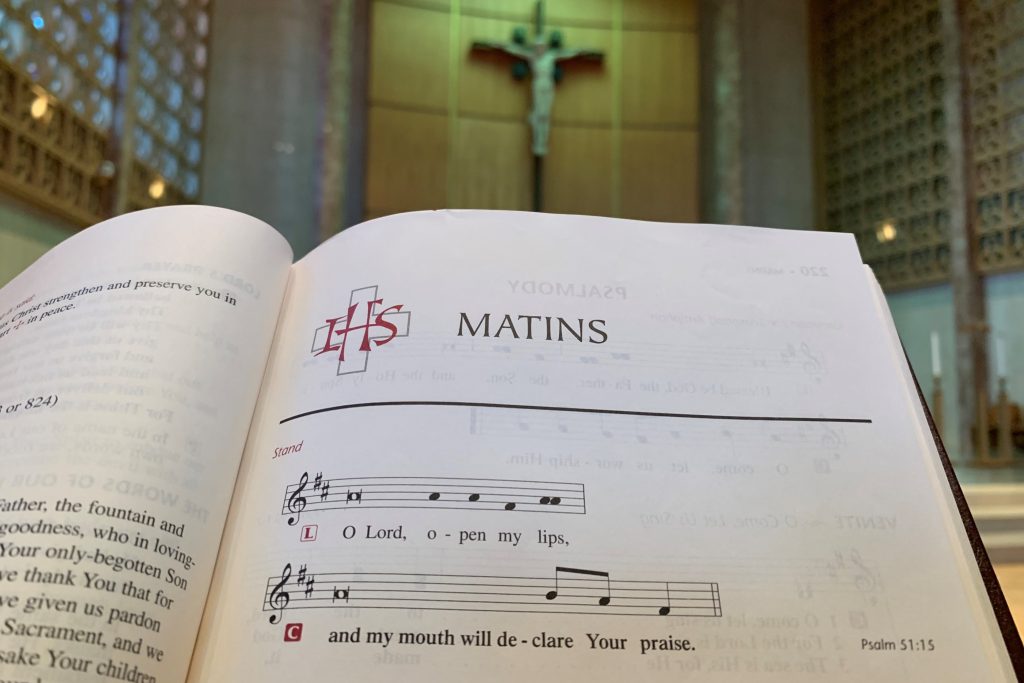
‘O Lord, open my lips …’

“… and my mouth will declare your praise.” A closer look at “our old friend, Matins,” with CUW Campus Pastor, Rev. Steve Smith.


If you’re new to the CUW daily Chapel experience, you may not be familiar with a particular type of service called “Matins.” I certainly wasn’t when I first came to Concordia about two-and-a-half years ago.

Some say it is characterized by “chanting”; but that’s not how I would describe it. To my ear it’s definitely singing, though perhaps the “melodies” aren’t necessarily as catchy as you might be used to, either in traditional hymns or contemporary Christian music.

Derived from the Latin word for “morning,” Matins refers to the ancient practice of different prayers for different times of day. It goes hand-in-hand with Vespers, which is an evening prayer, and a service called Compline, which is traditionally the last prayer of the day.

“The practice predates Lutheranism,” said Rev. Steve Smith, campus pastor for Concordia University Wisconsin. “Before the Reformation, monks in the monasteries would pray what were called the ‘hours of the day.’ They would pray literally every three hours; they would wake up in the middle of the night, have a prayer service, and then go back to bed. It was their way of ‘praying without ceasing,’ as described in Scripture.” (1 Thes. 5:17)

These days, however, Matins services are not as common in Lutheran churches as they once were, Smith said. But that’s just all the more reason to do them regularly here on campus.

“I feel that no matter where you come from, when you come to Concordia, your worship experience ought to be expanded,” he explained. “And Matins is a great traditional service that many people don’t know about.”

An ‘acquired taste’

Sometimes, when introducing a Matins service, Smith uses the analogy of drinking coffee. Not many people like coffee the first time they try it, he says. And it can be much the same with Matins.

“The first time many people have coffee, myself included, they think, ‘This is bitter and it’s not good! Why do people do this?’” Smith explained. “And if you take the time to get used to it, then it becomes that thing with which you can’t be without. Like, ‘I have to have this.’”

That certainly is how it worked for me. I was confused the first couple of times I attended a Matins service, but I took our pastor’s words to heart and stuck with it. I resisted the temptation to skip those services, and soon the confusion and uncertainty gave way to a familiar feeling of peace and contemplation. I found comfort in the words and the music, and began using the time to feel closer to God.

Coming from a church background that tends to push against the idea of anything that feels like a “ritual,” I’ve come to realize that great comfort can be found in doing some things essentially the same way every time.

Components of Matins

In that spirit, with some variations for different church seasons—such as Lent and Easter—the basic components of the Matins service remain essentially the same (quotes are from Pastor Smith):

Call to God

“This is essentially the introduction; there is no formal invocation in a Matins service. We call out to God that He would work in our hearts, that we can praise Him, that the glory would be to the Father.”

Psalmody

Defined as “the singing of psalms or similar sacred canticles, especially in public worship.”

  • Antiphon: “a short sentence sung or recited before or after a psalm or canticle.”
  • Venite: Latin for “come,” this section consists of five sung verses taken nearly word for word from Psalm 91:1-7. “O come, let us sing to the Lord ….”
  • Office Hymn: A prayer from the hymnal generally chosen to fit thematically with the designated readings.
  • Responsory: “This part is taken from Psalm 119 and Luke 11, giving glory to the Father. There are different ones that we use during Lent or Easter.”

Readings

“The Scripture reading is the pinnacle of the service, because that’s God’s Word. It is God’s Word purely spoken. We generally follow the Lectionary [verses prescribed by the church to read in a given week], and use that Psalm.

“In some traditions, the leader will chant or sing all the prayers and special petitions, so that the Scripture reading is the only spoken part of the entire service, which gives it additional emphasis.”

Canticle

Defined as “a hymn or chant, typically with a biblical text, forming a regular part of a church service.”

This can be the Te Deum (a hymn that begins, in Latin, Te Deum laudamus, meaning “We praise You, O God”), the Benedictus (the “Song of Zechariah” from Luke 1:68-79), or another canticle.

Prayer

  • Kyrie: “This is a short prayer, derived from Mark 10:47, calling for God to have mercy.”
  • Lord’s Prayer: As Jesus taught his disciples in Matthew 6:9-13.
  • Collects (pronounced KAH-lect): “The idea of a collect prayer is that it attempts to collect all the thoughts of the day. There is a collect prescribed for each Sunday—the Collect of the Day—that attempts in a short way to reflect the theme of all that readings for that Sunday. It also introduces the special petitions, or ‘prayer requests,’ of the day. And then we finish with the Collect for Grace, which is very powerful.”
  • Benedicamus: From Psalm 103:1 (“Bless the Lord, O my soul,”) “it literally means ‘let us bless.’”
  • Benediction: “Most people are familiar with this word, but not its literal meaning. In Latin it means ‘Good Word.’ So it’s a good word, or blessing, from God.”

One sip at a time

Sound complicated? It’s not, really. The different parts are spelled out pretty clearly in the hymnal (page 219!) and Pastor Smith does a great job of leading the congregation through it. If it feels too mysterious or daunting the first time, just listen and pray. Don’t feel pressure to sing. Just be present in the House of the Lord and let the music, the Word of God, and the Holy Spirit wash over you.

Before you know it, you may just be saying, “I didn’t know I needed that!”

“Then all the people said, ‘Amen!” and praised the Lord.’ (1 Chronicles 16:36b)


Want in?

Daily Chapel services at Concordia University Wisconsin are at 9:30 a.m. Monday thru Friday in the Chapel of Christ Triumphant when school is in session. It’s just one of the many ways Christian worship and fellowship are incorporated into daily life on the CUW campus. To learn more, visit the Christian Life page at cuw.edu.

Cracking the Talent Management Code

Since the pandemic, human resource professionals have been pushed into an ever-changing landscape, witnessing a surge of buzzwords and challenges. These emerging trends and issues, such as the Great Resignation, Quiet Quitting, Quiet Firing, The Big Quit, Moonlighting, Proximity Bias, and the Great Reimagination, have added complexity to the already demanding role of talent management.

In the face of these hurdles, HR professionals must navigate a delicate balancing act. They must stay knowledgeable of these developments while trying to cultivate an outstanding workplace that draws and retains top-tier talent.

How to crack the code

Productivity and employee satisfaction are undeniably the two fundamental keys to effectively solving the complex puzzle of talent management. A highly productive workforce is the foundation of any successful organization, as it drives innovation, efficiency, and overall performance. When employees are motivated and engaged, their dedication to the organization’s mission deepens.

Equally vital is employee satisfaction, as content and fulfilled employees are more likely to remain loyal, committed, and eager to contribute their best efforts. By prioritizing both productivity and employee satisfaction, organizations can create an environment that attracts and retains top talent, fosters a high-performance culture, and ultimately propels the company toward sustained success.

While there is unfortunately no magic code buster that can solve all of the talent management challenges, here are three suggestions that can be implemented today to foster a workplace culture of productivity and employee satisfaction.

Create Purpose-Driven Employees

When people feel connected to their purpose at work, both their performance and commitment to the employer increase. Additionally, satisfied employees are more likely to stay with their employer for longer, assume leadership roles, and even get sick less often. So, how is this done? Connecting employees to their purpose requires a thoughtful and deliberate approach by employers, HR, and talent management professionals. Check out some key strategies to achieve this.

  • Clarify the Organizational Purpose: It’s essential to define and communicate the company’s purpose and mission. Employees should understand how their role contributes to the organization as a whole. Having a clear sense of purpose gives employees a meaningful context for their work.
  • Align Individual Goals: Encourage employees to set goals that align with the organization’s mission. Aligning these goals ensures that employees see the value of their work and its impact.
  • Recognize and Celebrate Achievements: Recognize those who embody the company’s purpose in their work. Celebrating achievements reinforces the connection between individual efforts and the organization’s overall purpose.
  • Provide Autonomy and Ownership: Grant employees autonomy and decision-making authority in their roles. When employees have the freedom to shape their work and contribute their unique skills, they are more likely to feel a sense of ownership and purpose in what they do.

Be Intentional with Your Company’s Culture

Being intentional with workplace values and culture involves defining, cultivating, and actively reinforcing the desired principles and behaviors within the organization. Furthermore, it requires thoughtful planning, consistent communication, and dedicated efforts to ensure that the workplace reflects the core values and fosters a positive culture.

One way to achieve this is to lead by example. We know that leaders play an integral role in shaping the workplace culture. Therefore, when employees see leaders living the values of the company, it reinforces the importance that others usually follow. Having a workplace that has a positive culture will attract the right candidates.

Incorporate Work/Life Integration

The COVID-19 pandemic revolutionized the way millions of employees conducted their work, starting an era of remote work. Now, employers are pushing for a return to in-person work, causing friction between them and their employees. Rather than focusing solely on the concept of work/life balance, talent management professionals should now direct their attention toward promoting work/life integration and fulfillment.

Work/life integration recognizes the need for flexibility and adaptation. Therefore, allowing individuals to seamlessly intertwine their professional responsibilities with their personal aspirations. Employees can efficiently manage their work commitments while having the freedom to nurture their personal lives, leading to improved overall satisfaction and well-being. Embracing this approach allows for the creation of a high-performance culture that optimizes productivity through a harmonious blend of work and personal life.

According to a workplace culture report conducted by the Society of Human Resource Management (SHRM), turnover costs were estimated at a staggering $223 billion. The SHRM President, Johnny C. Taylor, Jr., lamented, “Billions of wasted dollars. Millions of miserable people. It’s not a warzone – it’s the state of the American workplace.”

Want to dive deeper?

Organizational performance and change (OPC) is a dynamic field that focuses on improving an organization’s effectiveness, efficiency, and adaptability in response to internal and external challenges. Business leaders, managers, HR professionals, consultants, and anyone involved in driving transformation within an organization need to understand OPC trends.

Learning about OPC is crucial because it equips individuals with the knowledge and tools to navigate the complexities of change and achieve sustainable success. Understanding how to manage change effectively empowers leaders to lead their teams through transitions, optimize resources, and maintain a competitive edge in today’s fast-paced and ever-changing business landscape.

To crack the talent management code, professionals must focus on creating a workplace culture that fosters purpose-driven employees and embraces work/life integration. By prioritizing these aspects, organizations can lay the foundation for a thriving workforce and effectively address talent management challenges. You will also be engaging in critical OPC tactics that keep your organization continuously improving.

Train people well enough so they can leave, treat them well enough so they don’t want to.

Richard Branson

Go for the gold…Vitality Gold!

Week 31

With the summer heat comes an increased risk of dehydration. You may have received a challenge from Vitality already, but regardless if you entered their sponsored challenge, you can set a goal in Vitality to track your hydration levels! Go to goals, set your personal goal plan, and check in weekly for those 30 points!

Week 32

SPIN THE WHEEL! This is for app users only, but each week in the app, Vitality sets a target activity point level for you (individualized based on your typical activity level). Each standard workout (10,000 steps) counts for 10 points each day. If you hit your weekly target, Vitality will prompt you to spin the wheel in your app. You can earn Vitality points or even gift cards!

Week 33

Even if you have perfect vision, an annual eye exam is important. Many eye diseases have no warning signs and can only be detected during an exam. Earn 200 Vitality Points per program year for completing an annual eye exam.

To receive Vitality Points, you must submit proof of your exam, which can include an explanation of benefits, medical record, or copy of your screening results.

Week 34

While your financial needs, goals and dreams may change, protecting your loved ones will always be important. Take a quick assessment to find out how much life insurance you really need. Complete your assessment with Benefit Scout and earn 100 Vitality Points. 

1. Log in to Benefit Scout
2. Complete the assessment
3. Come back to Vitality and submit a screenshot of the recommendations to this category and earn 100 Vitality Points.

Turning Self-Doubt into Growth

When considering starting or returning to college as an adult an all-too-familiar companion often lurks in the shadows – self-doubt. It’s that nagging voice inside that questions our abilities, worthiness, and potential, leaving us cautious and uncertain. But what if we could transform this seemingly negative force into a catalyst for growth?

According to a survey of Americans interested in online learning, nearly half (45%) of individuals fear they won’t be successful in school. Self-doubt makes us question our ability to accomplish anything from meeting class deadlines to paying for school.

But, by understanding the power of self-doubt and embracing it as a stepping stone rather than a roadblock, we can unlock a remarkable path of personal and intellectual development. This journey not only enriches our time in college but also shapes our future endeavors. So, let’s explore the art of turning self-doubt into growth.

The nature of self-doubt in college

Earning your degree, while exciting and transformative, can simultaneously be challenging. This is where self-doubt tends to creep in. Several scenarios commonly lead to self-doubt in college students such as academic pressure, social comparisons, change in routine, and imposter syndrome.

So, what does self-doubt do for us? Well, the real question is, what does self-doubt do to us? It can take a great toll on our psychological and emotional well-being, impacting various aspects of our lives. Self-doubting can lead to anxiety and stress, low self-esteem, procrastination or avoidance, isolation, and mental health issues. In order to recognize self-doubt in ourselves and others, it’s important to be aware of the signs.

  • Negative Self-Talk: Students experiencing self-doubt may be talking negatively to themselves, such as constantly criticizing themselves and being skeptical of their own abilities.
  • Fear of Failing: When facing new challenges, students may have an intense fear of failing and belief that they are incapable of success. This can lead to less engagement in academic work.
  • Perfectionism: Unrealistic standards and a relentless pursuit of perfection.
  • Avoidance: Students may avoid challenges or opportunities that require stepping outside of their comfort zone.
  • Emotional Distress: Common displays of emotional distress, such as sadness, frustration, or anger, without an apparent cause, could be linked to underlying self-doubt.

We must see self-doubt for what it is by understanding the impact it has on ourselves and others. Recognizing and facing self-doubt is the first step in addressing the challenge.  

Embracing Self-Doubt as a Catalyst for Growth

Rather than shying away from self-doubt, embracing this feeling can lead to transformative growth. By reframing it as a natural part of the learning process, students can change their mindset and see it as an opportunity for self-improvement. Recognizing that self-doubt is a common experience for many individuals, students can approach challenges with greater resilience and adaptability.

Contrary to its negative connotation, self-doubt can serve as a powerful motivator. When students doubt their abilities, they become determined to prove themselves wrong and achieve their goals. This inner conflict motivates them to work harder, explore new possibilities, and strive for excellence. By harnessing self-doubt as a driving force, students can unlock untapped potential and push beyond their perceived limitations.

As discussed, many students face self-doubt. Recently, I worked with a student returning to school as an adult who feared starting a degree in education. Despite her desire to move her career forward, she stalled. Her self-doubt got in the way and it was holding her back from reaching her goal. After being in school for a couple semesters, she came to the realization of her self-doubt and was no closer to the full-time teaching position she sought. When she reached out, she told me, “I have to just jump in, enroll, and get going!”

Coming to the realization, that we are holding ourselves back out of fear, is when we start to cultivate our resilience.

Trust in the Lord with all your heart and lean not on your own understanding; in all your ways submit to him, and he will make your paths straight.  

Proverbs 3:5-6  

The Power of Resilience

Resilience is a powerful tool that can help individuals overcome self-doubt and navigate the challenges that life throws their way. By being able to adapt to difficult situations individuals can develop the strength to confront doubts head-on and emerge stronger.

It requires effort and practices to build resilience and self-confidence, and some effective strategies to strengthen resilience include:

  • Embrace a Growth Mindset: A growth mindset is a belief that abilities and knowledge can be strengthened through dedication and hard work. Students will see challenges as chances to learn and improve, rather than as limitations or barriers. This perspective empowers them to tackle self-doubt with determination.
  • Set Realistic Goals: We all tend to bite off more than we can chew, which can create an overwhelming sense of self-doubt. Creating attainable goals allows students to achieve goals in smaller steps, rather than too much at once. This can lead to greater self-confidence, proving they can overcome obstacles and grow.
  • Nurture a Supportive Network: Having a network of friends, family, or mentors who encourage personal growth and resilience can provide much-needed reassurance and guidance.
  • Practice Self-Compassion: Recognizing that everyone has moments of doubt and failure is essential for self-compassion. Rather than being overly critical of oneself, students should treat themselves with kindness and understanding, knowing that self-improvement is a gradual process.
  • Learn from Setbacks: Resilient individuals view setbacks as learning opportunities. Analyzing what went wrong and identifying lessons from the experience helps them grow and develop better strategies for future challenges.

By adopting strategies to build resilience and fostering a growth mindset, students can develop the inner strength and confidence needed to thrive in the face of adversity.

Combating Uncertainty in College

As a student, self-doubt can be a common and challenging experience. The academic environment, combined with social pressures and personal expectations, can lead to feelings of inadequacy and uncertainty. However, there are effective strategies to combat self-doubt and foster a positive and confident mindset.

First, don’t hesitate to seek guidance and clarification if facing academic challenges. Reach out to professors or an academic advisor. Then you can ask questions to gain a better understanding of the topics to gain clarity.

Next, avoid comparing yourself to other students, as it can be detrimental to your self-confidence. Each individual’s learning journey is unique, and it’s essential to focus on your own progress and growth.

Finally, celebrate your strengths and talents, both academically and personally. Acknowledging your unique qualities can help build a positive self-image and counteract self-doubt. Overcoming self-doubt is an ongoing process. Be patient with yourself and recognize that building self-confidence is a journey that takes time and effort.

Facing Self-Doubt as an Adult Student

Returning to school as an adult or even attending college as a parent comes with its own unique set of challenges. Many adults returning to school have concerns about adequate time to devote to homework, too many years away from school, tuition costs, and the length of time it will take to finish. 

Yes, these are legitimate and important concerns that you may have. Here at Concordia, we are in the business of making your educational dreams a reality. If it’s your goal to reskill or upskill, reinvent your professional self, or discover your true potential, let us make a way for you. It’s never too early to take that next step toward achieving your goals.  

So, how can we help?

CUWAA’s Adult Accelerated programs are offered year-round. As an adult returning to school, you still have time to register and enroll for the upcoming Fall 2023 Semester. The next mini-term begins on Monday, August 28th. 

Whether you have already been admitted to a Concordia Adult Accelerated program; have yet to enroll; have started but never completed an application; or are considering the possibility of a degree, connect with our team for personalized solutions to your unique situation.

If you feel like self-doubt might be holding you back, take your next step toward that goal today. You might just find you’re more ready than you thought.

Our home-turf ‘best eats’

For our fellow Lutherans who will be traveling to Milwaukee this weekend, some Wisconsin natives offer their ‘best eats’ recommendations for while you’re at the National Convention.


Thousands of LCMS members will soon descend upon Milwaukee, Wisconsin for the 68th annual National Convention. Since the convention happens to be in CUW’s backyard, the Strategic Communications team polled a few Wisconsin lifers to hear their favorite ‘best eats’. We thought we’d offer up their hot takes on top eats while you’re in the Cream City.

All of these are within walking distance from the convention hall, or they’re just a quick Uber away. Here are the recommended “bests” when it comes to Milwaukee eats.

Best business lunch

Zarletti

Why: The ambiance is top notch, as is the food. For Italian lovers, Zarletti is a must. Generous portions of filling pasta… you’ll be sure to have leftovers for tomorrow’s lunch!

Location: 741 N. Milwaukee St.

Distance from Baird Center: 0.4 miles

Zarletti

Best breakfast (and lunch)

Build-a-Breakfast/Build-a-Burger

Why: The sky is the limit with “Build.” You get to completely customize your meal and create your favorite omelet, breakfast burrito…or burger. Lots of sauce and topping options, too!

Location: 633 W. Wisconsin Ave.

Distance from Baird Center: 1.0 mile

Build-a-breakfast

Best Coffee

Colectivo

Why: Colectivo is like the Starbucks of Wisconsin. It started in 1993 and has since grown to be a common vendor in grocery stores, coffee shops, and beyond. It recently expanded into Chicago, but it’s still a predominantly iconic Wisconsin brew. The Foundry on 1st St., in particular, is a great place to escape the bustle of the convention and answer a few work emails.

Location: 170 S. 1st St.

Distance from Baird Center: 1.4 miles

Colectivo

Best grab-and-go meals

Third Street Market Hall

Why: It’s the new hotspot in downtown! Third Street Market has food and entertainment. With novelties like a self-service beer garden, Topgolf suites, a selfie bar, and more, you’ll have no shortage of spectacles while you enjoy some good eats.

Location: 275 W. Wisconsin Ave.

Distance from Baird Center: 0.2 miles

Third Street Market Hall

Best group outing

Milwaukee Public Market

Why: If you’re lunching with a large group, there’s sure to be a variety of palettes. The Milwaukee Public Market houses dozens of local favorites under one roof, so your group can stick together without having to sacrifice their preferred cuisine. Plus, the Public Market is a fixture of Milwaukee. You can’t travel to Milwuakee without paying it a visit at least once.

Location: N. Water St. and E. Michigan St.

Distance from Baird Center: 0.5 miles

Milwaukee Public Market

Best German food

Mader’s Restaurant

Why: Do as a good German-Lutheran would do and make your way to the best German cuisine in town. Mader’s has an authentic setting to match its authentic menu. It’s a true nod to the birthplace of the LCMS.

Location: 1041 N Doctor M.L.K. Jr Dr

Distance from Baird Center: 1.1 miles

Mader's Restaurant

Best chill and have a cocktail

The Outsider

Why: The Outsider nails the rooftop bar aesthetic. There’s a full menu of craft beers, creative cocktails, and more libations. It’s the perfect setting to kick back and relax with friends at the end of a long day.

Location: 310 E. Chicago St.

Distance from Baird Center: 0.6 miles

The Outsider

Best sweet treat

Purple Door Ice Cream

Why: You’ve had ice cream, but you probably haven’t had a whiskey-flavored or honey & black pepper scoop! Purple Door takes artisanal ice cream to a new level. Don’t worry, if you’re looking for the staples, they have those, too.

Location: 205 S. 2nd St.

Distance from Baird Center: 1.1 miles

Purple Door Ice Cream

Best late-night snack

Real Chili

Why: There’s no better comfort food than a warm bowl of chili. Real Chili has been a staple of downtown Milwaukee for years. You get your chili fast, and you can order ala carte. Plus, there’s the added “hospitality” flair of getting crackers thrown at you.

Location: 419 E. Wells St.

Distance from Baird Center: 1.8 miles

Real Chili

Best ‘iconic Milwaukee’

The Safe House

Why: This spy-themed bar/eatery truly lives up to its reputation. The floorplan is replete with nooks and corners that beg for exploration. It’s an immersive experience like none other!

Location: 779 N. Front St.

Distance from Baird Center: 0.7 miles

The Safe House

Want more?

If this is your first time in Wisconsin, you can’t miss a visit to CUW! Schedule a stop today.


Dissertation Experience: Transitioning from dependent coursework to independent scholar

Students generally join a doctoral program after achieving academic excellence in their previous graduate degree. But they usually achieve success by being good students, completing work on time, and following instructions from their teachers. These qualities are undoubtedly valuable.

However, what distinguishes the doctoral experience is the undertaking of original research through the dissertation. As aptly stated in an article, “being a good course-taker is not enough.”

When thinking about their future dissertation experience, many students overlook the importance of doing independent research for their doctoral degree. The transition is gradual, not instant. Our Doctor of Education program helps students on this journey.

What is a dissertation?

A dissertation is a substantial paper that is based on original research. It allows students to explore a specific research question or topic of interest in great depth. Through this, students demonstrate their ability to conduct independent research, analyze data, and present coherent arguments.

It’s like a long essay where they explore a specific question or topic they’re interested in. Students have to do research, study what others have written, and come up with their own ideas. The goal is to add something new to what’s already known in that subject.

Writing a dissertation takes a lot of time and effort. Students need to carefully plan what they want to study, collect and analyze data, and then explain their findings in a clear and formal way. It’s not just a regular school assignment; it’s a significant piece of work that contributes to the knowledge of that subject and shows the student’s expertise.

Dependent vs. Independent

During the program, I ask students to think of terms that they associate with the words “dependent” and “independent.” Usually, the lists seem completely different, and the students agree that “dependent” and “independent” belong to different areas. However, they are hardly as mutually exclusive as we might think.

In order to understand this concept, I decided to present students with an image that would spark a debate on the ideas of dependence and independence. The image I showed them was that of a teenage individual with a beaming smile, confidently holding a set of car keys. This visual served as a starting point for our discussion about the extent to which this image portrayed dependence or independence. The answers diverge in either direction, with some claiming it’s both.

teen holding car keys
Teen holding car keys.

When a teenager embarks on the journey of learning how to drive, they find themselves in a position of reliance on an adult figure. The adult assumes the responsibility of guiding, teaching, and supervising the teenager as they navigate the complexities of the road. At this stage, the teenager does not possess the full freedom to drive wherever they desire. Therefore, they are bound by the rules and regulations set forth by their adult supervisor.

However, despite this initial reliance on an adult, the teenager gradually gains a sense of autonomy over time. As they improve their driving skills and become more confident, they begin to drive the car by themselves and become more independent.

Striving to be an independent scholar

The student driver example shows the gradual and intentional transition from dependence to independence. It’s a fitting illustration for doctoral students who excel as “dependent” course-takers, yet are also on the road to becoming more independent scholars. Such a transition takes time and hard work and fundamentally involves a process of identity formation.

Students must both recognize and accept that achieving a doctoral degree goes beyond simply gaining expertise in a subject matter. In addition, it involves a transformation of one’s identity, which is a fundamental aspect of becoming a self-sufficient academic.

The significance of an identity transformation lies in recognizing that dissertation work encompasses more than just acquiring techniques or skills. In fact, the journey toward becoming an independent scholar involves immersing oneself in the department’s social environment, exploring diverse methodological disciplines, and grappling with fundamental questions surrounding the essence of scientific research. This continuous learning process during one’s academic pursuit inevitably nurtures and supports profound shifts in students’ mindsets and worldviews.

In our Doctor of Education program, students begin their dissertation experience in the first month. This means that students will be working on the dissertation in manageable pieces throughout the program, something that makes our program unique. The dissertation work occurs through a series of independent study seminar courses that each tackle a specific phase of the dissertation.

The early seminars have built-in much more guidance to help support student knowledge and skill development. Students are, after all, just learning to drive a car.

But as the student’s dissertation progress moves forward, the amount of direction and instruction in the seminars is reduced. All of this is an intentional decision in our curriculum to offer support when needed most but phased out as independence grows.

What’s next?

Are you interested in such a journey? If so, I would encourage you to consider learning more about what the Doctorate of Education in Leadership program can do for you and your goals. It won’t be easy; then again, the transition from dependence never is. The good news is we will be there for you during your dissertation experience every step of the way. However, as you stride across the commencement stage, adorned with your doctoral degree, you do so as an accomplished independent scholar.

Faculty Spotlight: Dr. Gary Locklair

Dr. Gary Locklair has been at Concordia since 1986, teaching students in the computer science and information technology department. He’s both a professor and chair of the department and stays involved with students beyond the classroom by serving as a faculty advisor for the Alpha Chi honor society and the faculty coordinator for Concordia’s Student of the Month program.

How long have you been at Concordia? Why did you choose Concordia?

After completing my undergraduate degree with a BS in Computer Science and a BA in Chemistry, I worked in the computer industry for 10 years. While I enjoyed my industrial career, I felt compelled to do something different and more meaningful. I contacted all of the schools in the Concordia University school system to see if any school needed a computer science professor. The Mequon campus responded, and I began my vocation here in 1986.

What do you love most about Concordia?

Effective teaching is about passion. You must love what you do. The way to keep the fire alive is to understand teaching as a vocation. While I enjoyed my career in the computing industry, the work I did there didn’t have a real impact on people. Teaching at a Lutheran university allows me to combine computer science with a Christian worldview.

That combination is powerful and energizing. It allows us to see God’s gift of creativity as a means to love and serve our neighbor. Not only can we prepare people for meaningful vocations, but we can also share the most important message of all – eternal life is freely available in the person of Jesus Christ.

What’s your education and career background? Where did you study? What did you do before Concordia?

I was originally a chemistry major in college. I had no direction or advice in college and chose chemistry because I liked my high school chemistry teacher. As a senior, I discovered there were no jobs available for chemistry majors. I had been minoring in computer science just because I enjoyed it. At that point, I decided to complete a computer science major. (I tell students to minor in something that interests them, since it might be helpful someday.)

After graduation, I worked for the California Department of Transportation as a programmer/analyst. I created programs that simulated the effect of earthquakes on roadbeds. After that, I joined Hewlett-Packard Company in Cupertino, California aka “Silicon Valley.”

During my time with HP, I completed my Master of Science in computer science (Oregon State and University of Idaho). My Ph.D. in computer science is from Nova Southeastern University in Ft. Lauderdale, FL. At Concordia, I completed the Lutheran Education Colloquy program.

What are you most passionate about in your work here at Concordia?

I am most passionate and thankful for the ability to integrate and relate a Christian worldview to my discipline. I ask students at the end of class, “What will you remember about this class five years from now?” Since it’s before the final, students will offer all kinds of answers. But, the reality is they won’t remember anything about the specifics of the class in five years. Eternal life is a “little” longer and much more important than discipline-specific material.

In addition to computer science, I am blessed to teach a course in Cosmogony (the science of origins) here at Concordia. The opportunity to share information about evolution and creation in a scientific context is exciting. Concordia is a place where the truth of origins can be freely explored as we value God’s world and God’s Word.

What’s the one key lesson from your courses/work here at Concordia that you hope students take away from interacting with you and learning from you?

Computer science is a vocation. The purpose of computer science is to love and serve our neighbors by creating useful and effective tools which solve important problems. Computer science is a liberal art; it requires integrating many branches of knowledge to produce a good system. There’s no room for geeks who can only work with technology in computer science.

Being a computer scientist is about understanding people and their problems and then creating problem-solving tools which people enjoy using. Computer science is exciting since it is a creative endeavor. Reflecting God’s image, we sub-create everything from physical systems to virtual worlds.

What’s the most interesting thing about your field of study that the general public might not know?

Computer science is not the study of computers. Computer science is the study of problem-solving. A computer is only a tool. The people who create the tool and use the tool are much more interesting and important. To understand computer science and 21st-century technology, a student must understand the grand ideas of the discipline, and not merely the specifics of current technology. The specifics change constantly; however, the conceptual grand ideas have served as the foundation of the discipline for hundreds of years.

I trace the roots of computer science back to the 17th-century Lutheran pastor and professor, Wilhelm Schickard. Schickard was a genius who applied his depth of liberal art knowledge to creating the world’s first mechanical calculator. While not a computer, his device spurred the investigation into algorithmic problem-solving which culminated in the true computer of the 20th century. Schickard created the calculator in love and service for his friend, Johan Kepler, the Lutheran astronomer who solidified the heliocentric model of the solar system.

Lastly, why should students study your field/discipline?

Every educated person must understand how to solve problems well. It is a foundational skill. Computer science provides a framework for solving difficult problems well. Every job, career, and vocation requires the use of computer technology today. While you can use a computer without significant training, you can be much more effective (and useful to employers) if you understand the concepts which underlie the technology.

The computer science and information technology fields consistently rank among the most “in demand” degrees for job applicants. Every business needs computer systems and technology. A computer science or information technology degree opens the door to a world of employment options.

Related: Should You Get a MSCS or MBA MIS?

Why should students consider Concordia?

We investigate current and exciting topics in computer science, such as artificial intelligence, machine learning, speech synthesis, face recognition, animation, 3D printing, app development, software engineering, data security, game programming, robotics, and many more all in the context of helping students develop in mind, body, and spirit for service to Christ in the church and the world.

Computer scientists create the world. Information technologists run it. That’s common knowledge. Uncommon? Learning computer science and information technology in order to love and serve our neighbor. That’s Concordia.

At Concordia, we offer programs in both computer science and information technology. If you’re interested in our programs but not quite ready to apply, you can connect with a counselor and request more information.

CUW seeks alumni mentors for new student mentorship program

Join your fellow alumni! Apply now to mentor a CUW student.


You have wisdom to share. Why not share it with a Concordian?

The benefits of mentorship are widely documented and far-reaching – both for the mentee and the mentor. That’s why Concordia University Wisconsin is pleased to launch a new university-wide mentorship program to support students in their vocations and prepare them for their next steps after graduation. The CUW Alumni Mentor Program aims to establish meaningful, personal, and professional coaching relationships between current CUW students and alumni. The new program will begin this academic year. It will officially kick off with a “launch event” on Sept. 20.

Formed from alumni and student feedback

In 2021, Concordia’s Office of Alumni Relations sought to receive feedback from Concordia’s alumni base through the Alumni Attitude Survey, a third-party survey tool that has been used by dozens of universities nationwide.

According to survey results, CUW alumni are highly pleased with their decision to attend Concordia. 90% of alumni surveyed described their decision to attend CUWAA as “good” or “great,” while 92% described their overall opinion of the university as “good” or “excellent.” Both numbers exceeded national averages.

Within the survey, alumni also shared vital feedback that led to the creation of the new mentor program. Among the “Top Four” priorities survey respondents indicated was a desire to “mentor students and provide job shadowing opportunities” as well as “serve as ambassadors promoting CUWAA to others.”

“We have alumni who are living the mission vocationally, whether it’s through their careers, service, or as parents and friends. These are people who understand the mission of Concordia and live out that mission regularly,” says Director of Alumni Relations Greg Witto. “They have invaluable wisdom to share with current Concordia students who are looking for answers as to how they, too, can live out the mission as a teacher, pharmacist, nurse, or any other profession.”

The vocational aspect is something that sets Concordia’s mentoring program apart, explains Stacy Tolomeo, assistant director of Industry Relations.

“From a student perspective, they ask, ‘How do I live out my faith in the workplace?’ Depending on the workplace, that might be a tricky question to answer, but we know our Concordia alumni will be prepared to answer that in a more nuanced and authentic way than we ever could.”

What you’d be committing to

Program organizers will select alumni who apply for their belief in the CUW mission, expertise in their industry, and commitment to vocation. Mentors will then match one-to-one with a student mentee. The pair is encouraged to meet in person when possible, but no one will be excluded from participation based on geographical location.

The time commitment is a monthly, minimal obligation. Mentors can expect to commit to:

  • Mentor training (in-person and virtual options available)
  • A 60-minute launch event on September 20
  • One-hour (minimum) monthly meetings from September through April arranged according to the mentor/mentee’s schedules
  • A year-end celebration in April (Date TBD)

Want in?

Christ-minded. Ethical. Hard working. Respectful. Curious. Leader. While all our students are different, certain qualities unite our community and make us Concordians. We look forward to welcoming you to the ranks of our alumni.


Faculty Spotlight: Megan Fleischman

Megan Fleischman, PharmD, BCACP, is an Assistant Professor of Pharmacy Practice at Concordia’s School of Pharmacy. Read more about her experience as a pharmacist.

What is your education and career background?

I received my Doctor of Pharmacy degree from UW-Madison back in 2010. From there I completed two residencies both focusing on ambulatory care. My first residency was at Monroe Clinic, the second at the Univeristy of Pittsburgh Medical Center. I’ve worked in many settings, such as Target Pharmacy, the University of Illinois Chicago, and Froedtert and the Medical College of Wisconsin.

What are some of your career accomplishments?

I take great pride in the relationships I made and the services I provided to patients during my tenure in diabetes management and pulmonary care. It’s gratifying to know that students from my previous job still feel comfortable reaching out to me for support.

Additionally, I am grateful for the connections I have formed through my volunteer work with professional organizations, where I have had the opportunity to speak and serve on committees. These experiences have enriched my professional network and allowed me to contribute to the field in a meaningful way.

What brought you to Concordia?

I moved to Milwaukee to be closer to my family. It was during this time that I became aware of Concordia’s outstanding reputation as a supportive institution with highly accomplished and well-prepared pharmacy students. As I contemplated the next steps in my career, I came to the realization that teaching in the Applied Patient Care Lab was my true passion.

Throughout my various roles, I noticed a recurring inclination toward project organization and process improvement. However, I often found that this aspect brought me job satisfaction beyond the scope of my expected responsibilities. Coordinating the lab allows me to fulfill my innate desire to actively participate in organizing and enhancing processes. Simultaneously, it enables me to pursue my passion for educating students about delivering exceptional patient care.

What do you like to do for fun?

In the midst of a bustling career and a lively household, I find joy in moments with my husband, three children, and our dogs as we snuggle up on the couch to enjoy a movie beneath a luxuriously soft blanket. However, my family and I also thrive on staying active together.

We enjoy attending sporting events and embarking on walks or bike rides. We also love discovering new local and international destinations and indulging in the pleasures of exploring diverse cuisines and beverages. Balancing moments of relaxation with adventures and shared experiences brings immense joy to our lives.

Why should students join our pharmacy program? Why Concordia?

Our pharmacy program caters to students who appreciate smaller class sizes and value personalized interaction with faculty and staff. From my observations at Concordia, I have noticed that the level of student involvement and networking opportunities is comparable to larger pharmacy schools. This reinforces the notion that our students will have ample chances to engage and network. Resulting in greatly contributing to their professional growth and the development of their pharmacy careers.

At Concordia University, there is a culture that prioritizes student learning across the board. This stands in contrast to the stereotype often associated with universities, where faculty members may be primarily focused on the number of publications, research projects, or lectures. Furthermore, the central focus is on equipping students with the skills to learn and collaborate well with patients and healthcare professionals. We hope to enable them to excel in the dynamic and ever-evolving healthcare landscape.

What’s the most interesting part of your field that people may not know?

Pharmacists often acknowledge that we struggle with marketing ourselves effectively. It’s crucial for us to convey to incoming students that the field of pharmacy offers a wide array of career opportunities. While many individuals may find themselves in dispensing or clinical roles within community, hospital, or clinic settings, the possibilities with this degree are vast.

For instance, since my graduation, I have worked in multiple clinics (including my residency rotations) and served as a retail pharmacist. I have also taken on a leadership role in a multidisciplinary committee. Additionally, I became a faculty member and currently dedicate two days a week to specialty practice.

Initially, when I started school, I had set my sights on becoming a retail pharmacist. However, as I progressed through my final two years of pharmacy school, my inclination shifted toward pursuing a career as a hospital pharmacist. At present, I feel that I have found the position in which I plan to retire, although I remain open to the unpredictable nature of the pharmacist’s journey.

My husband serves as another inspiring example. Initially, he had aspirations of becoming an ER pharmacist and followed that path for a period of time. However, he later discovered a keen interest in pharmacy management. This ultimately led him to hold a unique role as a clinical pharmacist in a highly specialized field. Pharmacy schools impart us with the necessary skills to learn and effectively collaborate with others. It’s truly remarkable to witness the diverse trajectories our careers can take us on.

What is your advice to students?

If you are a pharmacy student – take your time in pharmacy school. Make connections with your peers and faculty. Ask about unique opportunities to get involved and exposed to different areas of the profession. And remember, your faculty are people too. Many of us have been in the field for a while where we have either been in different settings or have connections to pharmacists in different settings.

If you are not a pharmacy student yet, expose yourself to as much as you can during undergrad. You can volunteer somewhere, live in another country, or take an art or acting class. Figure out what you have a passion for because you most likely can integrate it as a pharmacist.

Do you want to know more?

We are proud to have such knowledgeable and passionate faculty, like Megan Fleischman, PharmD, BCACP. If you’re interested in learning more about the pharmacy program at Concordia University Wisconsin, visit below.