How FAFSA changes are transforming aid for CUW church work families

For dependents of church workers in the U.S., changes made at the federal level to the FAFSA have been a boon to families’ bottom line at CUW, putting the average tuition costs paid by church work students on par or lower than other schools in the Concordia University System.


In 2020, Congress passed the FAFSA Simplification Act which set out to streamline the Free Application for Federal Student Aid (FAFSA) application process, increase access to Pell Grants, and make it easier, in general, for students and families to apply for federal financial aid. It took three years for the changes to go into effect, but in December 2023, the new FAFSA form was released.

New FAFSA doesn’t factor in housing allowance

One noticeable benefit for CUW applicants? A church worker’s housing allowance no longer counts toward income on the new form, making it more likely for dependents to qualify for Pell and state aid, says Assistant Vice President of Financial Aid Kevin Sheridan.  

“On the old FAFSA application, there was the Clergy Housing Allowance that applied to all church workers,” says Sheridan. “Basically, housing for church workers used to go towards income, so it would actually make these families less likely to qualify for the Wisconsin State Grant or Federal Pell Grant. The new form doesn’t even ask about housing.”

The result is that more students than ever are experiencing lower out-of-pocket costs to attend CUW—especially students pursuing church work careers who are coming from families with church workers in them, says Sheridan. In 2024, the first year the new application went into effect, the average price paid for tuition by church work students at CUW was $5,300. For those pursuing a Lutheran Teacher Diploma (LTD), specifically, the average was around $3,000.


$5,300

Average tuition paid in 2024 by church work students at CUW (under the new FAFSA rules).

~$3,000

Average tuition paid in 2024 by Lutheran Teacher Diploma students at CUW.

The LCMS church work recruitment initiative Set Apart to Serve has published a 2025-26 tuition overview for each of the church work programs offered at the institutions within the Concordia University System. You may access these overviews here.


“The new FAFSA has made a ton of our church worker population Pell eligible, which is aid above and beyond the scholarships they receive from Concordia,” Sheridan says. “We had 15 percent more students qualify for state aid last year totaling more than $500,000.  This was more than any year prior and I expect even more students to qualify moving forward.”

How CUW compares

CUW’s approach to financial aid sets it apart from its peers. Unlike other schools in the Concordia University System, CUW does not blend Pell and state aid into its sticker price. Instead, it treats the aid as additional support on top of institutional scholarships and tuition packages.

“This philosophy is part of our commitment to transparency and support,” Sheridan says. “Families can see exactly what they’re getting from us, and they know to what extent any federal or state aid is helping to reduce their costs beyond that.”

PROGRAMTUITION (after institutional financial aid and discounts)AVERAGE TUITION (after state aid and grants)
Pre-seminary education$7,697$5,300
Lutheran education$7,697$3,000
Dir. of Church Ministries$7,697$5,300
Dir. of Church (Parish) Music$7,697$5,300

Church work programs at CUW

Concordia University Wisconsin’s church work student population is annually among the largest within the Concordia University System. The campus offers four main routes to church-work professions:

Pre-seminary

Is God calling you to teach the Gospel and administer the Sacraments as an LCMS pastor? We encourage pre-seminary students to take a major in Theology with a Pre-seminary concentration and a major or a minor in Theological Languages. However, Pre-seminary students can major in any program at the university, such as Business, Education, Graphic Design, or Biblical Studies, for example. You will take required courses like New Testament, Biblical Theology, and Greek, in order to provide you with a solid foundation before heading off to Seminary. Learn more here.

Lutheran teacher

God has called and equipped you to be an inspiration and impact teacher. You will be prepared to share the Gospel using the gifts and platform God has given you. Earn your Lutheran Teacher Diploma in early childhood, elementary, a dual major of early childhood and elementary, special education, and secondary levels, which include numerous majors. Students can focus on concentrations which have been carefully and creatively designed to meet the needs of students for today and tomorrow. Over the past five years, we’ve placed nearly 100% of our graduates. Learn more here.

Director of Church Ministries (DCM)/Pre-deaconess

Your calling is to serve the Church in evangelism, mission, parish teaching, youth ministry, or even pre-deaconess/social ministry. You’ll be ready to support Bible studies, community outreach, mercy work, and administrative duties. Since no two graduates will have the exact same roles, you’ll take management and leadership courses that will help you adapt to any situation. You’ll get a solid foundation with a theology major, and you’ll diversify your skillset with two minors. The first minor is in church ministries and the second minor is in nonprofit management so that you can understand how operations work at a church or nonprofit organization. Learn more here.

Church music

Church musicians (sometimes called parish musicians) teach the faith through music. Discover the many ways you can serve the Church through music. From learning to direct choirs and instrumental groups, to supporting the structure of the Divine Service, you’ll develop your skills from training with practicing church musicians. As you learn to lead the congregation through music, you’ll have many opportunities to grow in your vocation as a parish musician. Learn more here.


Want in?

The 2025-26 FAFSA is now open. This form is for students planning to attend college between July 1, 2025, and June 30, 2026. The deadline to submit is June 30, 2026.

Financial aid is also available to students looking to attend Concordia. Aid is awarded based on financial need, field of study, academic record, underrepresented groups, or your area of residence.
Concordia to transition to Canvas for enhanced student experience

With students’ ease-of-use top-of-mind, Concordia University Wisconsin has adopted a new learning management system, called Canvas. The system will go into full effect May 1, 2025.  


When Sansara Deshpande first began to look at which university she should attend to earn her Doctor of Pharmacy degree, her list of priorities included things like reputation of the program, class sizes, faculty-to-student ratio, and culture.

One thing that wasn’t necessarily on her list? The learning management system (LMS) the institution used. As it turns out, maybe it should have been included.

Deshpande, an Ann Arbor native, completed her undergraduate degree at the University of Michigan, which uses an LMS called Canvas. But when she began Concordia’s PharmD program last fall, she transitioned to CUW’s historically used LMS, Blackboard, and found the switch cumbersome.

“Canvas is so much better than Blackboard,” Deshpande says. “I didn’t realize I’d care so much about the technology platform where my grades and assignments would be posted, but now that I’ve experienced something other than Canvas, I’d hate to go back to anything else.”

This semester, with students’ ease-of-use as its primary goal, Concordia has begun the migration process from Blackboard to Canvas. Deshpande is part of a pilot group of Concordia students who transitioned to the system early to help the university meet its migration deadline of May 1.

A growing LMS preference amid the higher ed landscape

Over 7,000 K-12 and higher education institutions worldwide use Canvas to organize and manage online courses, facilitate communication between student and teacher, and deliver education content to students. The LMS is renowned for its easy-to-use interface, seamless mobile integration, and powerful collaboration tools that enhance the educational experience for students.

Yet, less than 30% of higher education institutions nationwide currently utilize the platform, and most of the schools that have adopted it are Big 10 institutions or Ivy League schools. But soon, Concordia will also be among the schools that utilize the famously user-friendly software. The system will touch every single class and student at Concordia, integrating key tools such as the gradebook, syllabus, discussion boards, quizzes, syllabi, assignments, and video lectures.

‘Easy to use’ prioritized

Concordia’s Information Technology Department began December 2023 to explore LMS options, with AVP of Information Technology Mark Newhouse giving just one directive to the team that would ultimately select a system: “Make sure it’s easy to use.”

In anticipation of the switch to Canvas, Assistant Director of Learning Management Systems Tyler Shadick said Concordia piloted the system in January 2025 with a group of 16 pastors who were enrolled in a Continuing Education course.

“It was a demographic with a wide variance of technology literacy, but we received no support tickets,” Shadick says. “Everyone was able to figure it out seamlessly.”

Even if they hadn’t, help isn’t far away. Another unique feature of Canvas compared to others is the virtual tech support team they employ. In addition to Shadick, CUW students and faculty will have access to 24/7 online support staffed by Canvas.

Concordia currently has 400 students—including undergraduates and graduate students, online and in-person learners—already onboarded to Canvas to ease into the May 1 switchover.

“The feedback has been overwhelmingly positive,” says Shadick. “Our decision to move to Canvas was made with students in mind. With this transition, we’re reaffirming our commitment to providing an accessible, user-friendly, and innovative digital learning environment that supports all learners.”


Want in?

Canvas is just one of the many reasons to give Concordia a look! We’re also known for our location with its breathtaking view of Lake Michigan, small class sizes, professors who care, and commitment to the holistic, Christ-centered growth of our students.


Concordia offers opportunity for community members to explore assistive technology

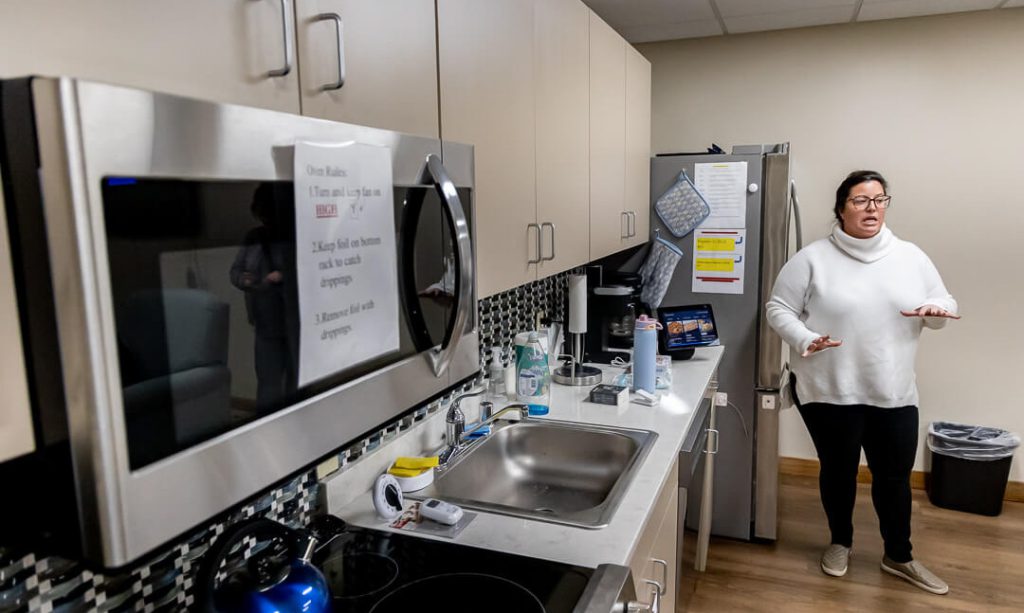
By enhancing its simulated on-campus apartment with assistive and adaptive technology, Concordia University is addressing critical gaps in support, accessibility, and independent living resources for those in Ozaukee County and beyond.


A new effort at Concordia University Wisconsin is turning the university’s on-campus simulated apartment into a vital resource for individuals in the community who could benefit from assistive technology.

Showcasing assistive technology

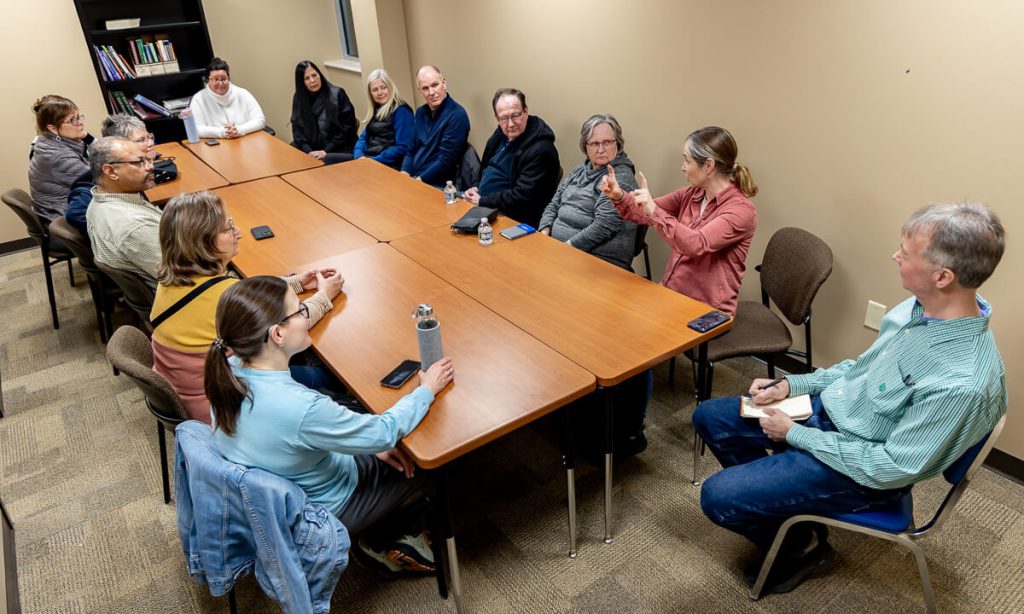
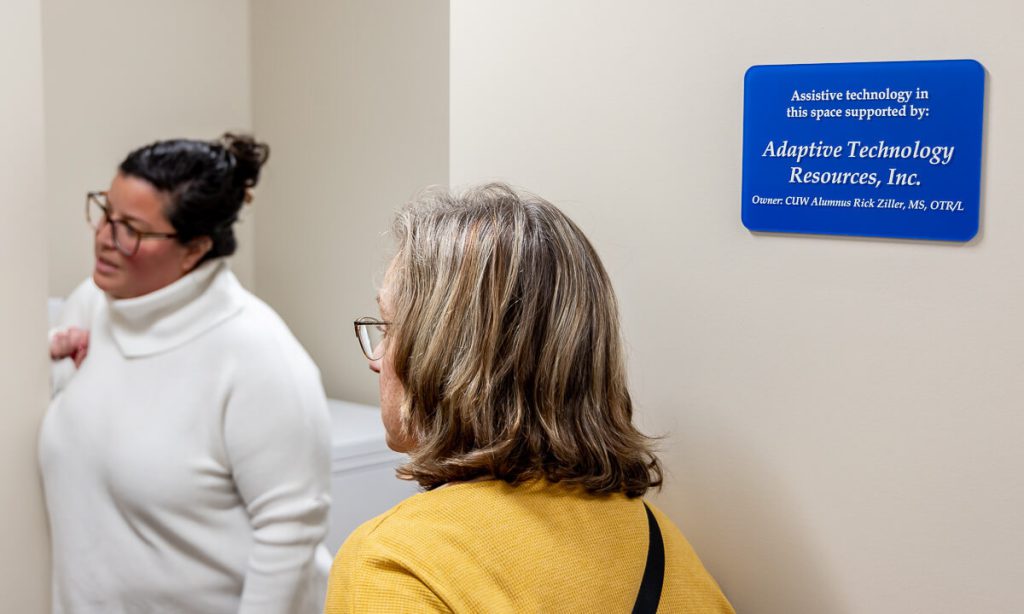
CUW Associate Professor of Rehabilitation Science Lois Harrison, DPT, has partnered with Rick Ziller, a double CUW alumnus who is president of Adaptive Technology Resources, Inc., to furnish the apartment in Concordia’s Interprofessional Clinic with a variety of assistive technology devices. Assistive technology includes any software or equipment that is used to increase, maintain, or improve the functional capabilities of individuals with disabilities.

Harrison first assembled a task force that included a variety of stakeholders—faculty, non-profit representatives, parents and a vendor—to identify practical, cost-effective items for Concordia to purchase. The purchase of the equipment was made possible by a grant Concordia received from the Russell and Josephine Kott Memorial Charitable Trust. Ziller, who graduated from CUW’s undergraduate rehabilitative science program in 2009 and its Master of Occupational Therapy program in 2009, then donated his time for installation and consultation.

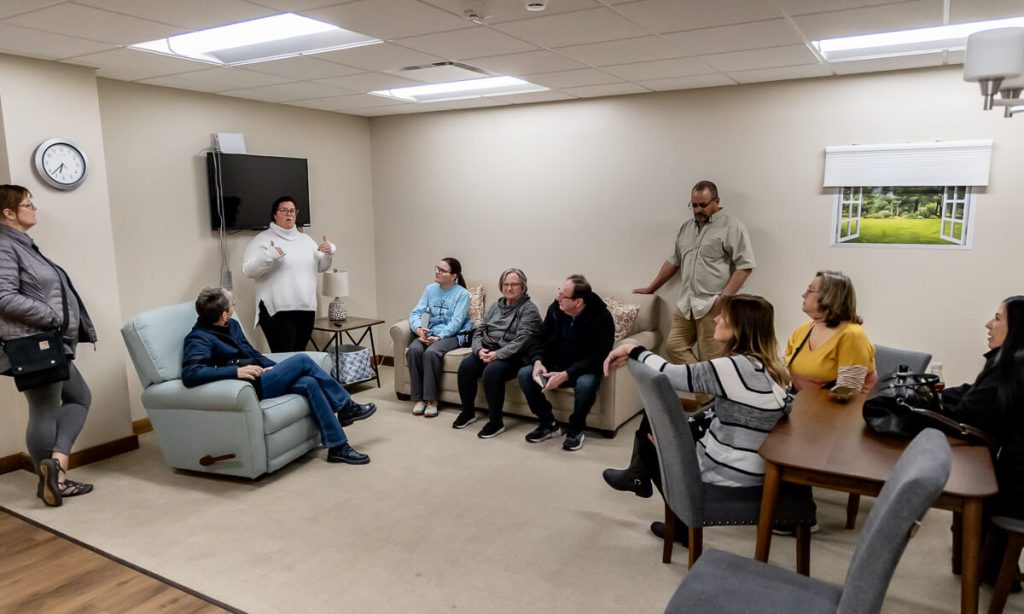
With the addition of the devices, the apartment has now become a sort of interactive showroom that allows families, caregivers, and individuals to explore assistive technology in a realistic setting and learn how even inexpensive tech—such as Amazon Echo Dots for voice control or vibrating alarm clocks—can make a profound difference.

Examples of assistive technology in the apartment include:

  • Amazon Echo Show 10 for interactive communication and control
  • Smart motorized blinds for ease of use
  • Bed pressure sensors for enhanced safety monitoring
  • August Smart Lock Deadbolt and Keypad for secure, accessible entry
  • Cabinet locks and kitchen timers tailored for individuals with executive functioning challenges

A community resource

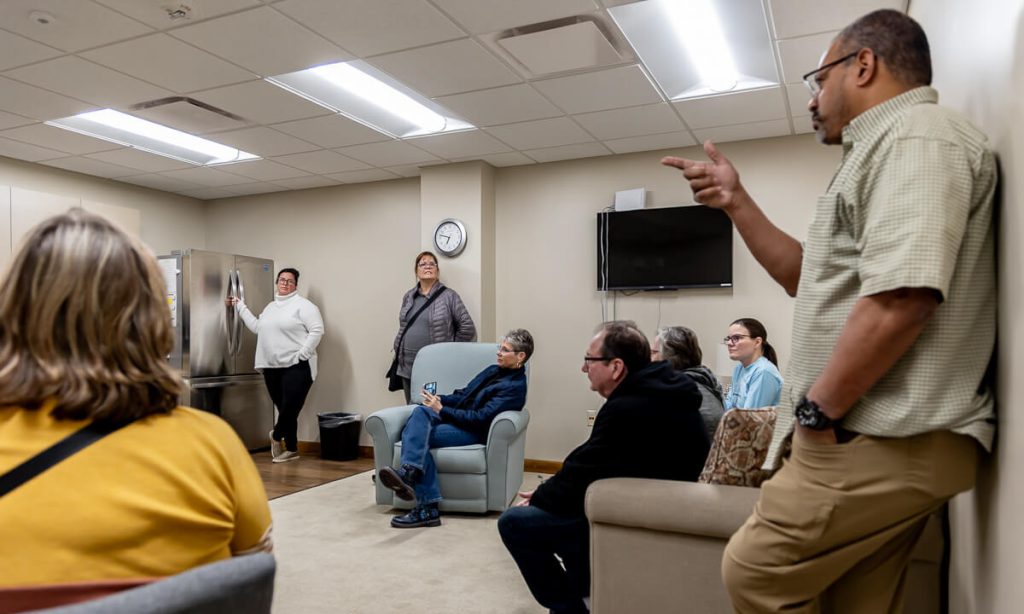
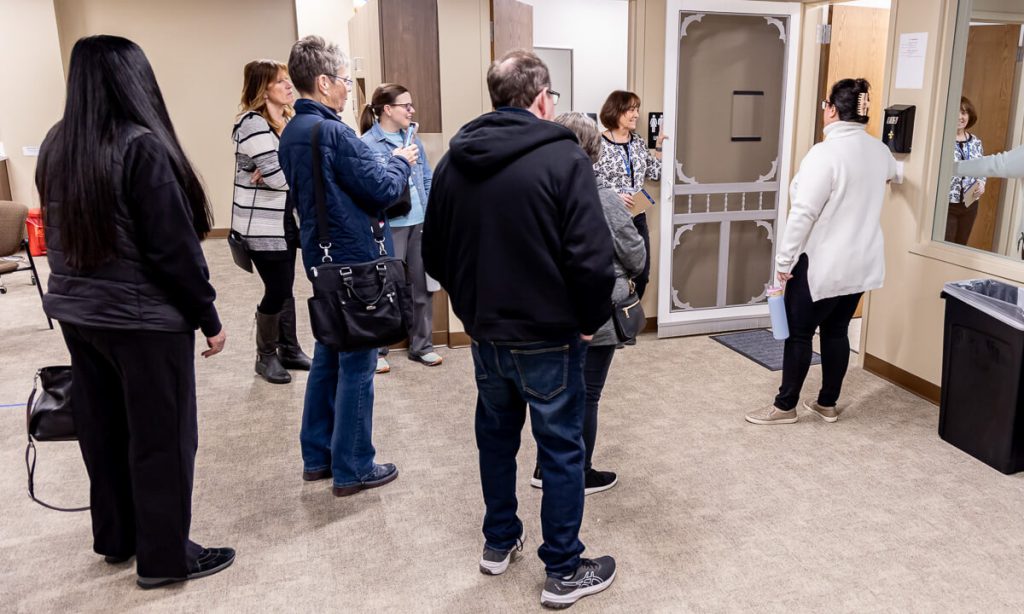
Earlier this year, Harrison welcomed the first group of families from Ozaukee County to campus and into the space. To identify families in the area who would benefit from attendance, Harrison connected with Samantha Bear, who serves as executive director of Blossom IDD. The Cedarburg-based nonprofit supports adults and families throughout the Ozaukee and Northern Milwaukee areas who care for individuals with IDD—many of whom have transitioned or are transitioning from school-based IDD services to semi-independent living in the community.

About two dozen parents and guardians from Blossom IDD’s Morning Glory parent-guardian group toured the apartment on Feb. 24 and observed various tech in action.

“These families are in this transition abyss and they’re yearning for resources,” says Bear. “Their son or daughter is five-to-10 years out of high school where they received a lot of built-in supports through the school system, and now they’re navigating things on their own. The event at Concordia triggered ideas for their loved ones, as well as ‘what else can we learn?’”

Addressing a critical need

For individuals with IDD, striving for growth often hinges on access to the right resources, something that has historically been difficult for families to navigate, explains Bear. There are options through the state’s assistive technology program, called WisTech, which is funded under the federal 21st Century Assistive Technology Act. However, these programs are sometimes difficult to navigate or might overlook quality-of-life enhancements that support executive functioning skills like time management, sequencing, or flexible thinking.

“Many families don’t even know these resources exist,” Bear says. “The biggest barrier of all is awareness.”

The model apartment at Concordia aims to bridge this knowledge gap by offering hands-on demonstrations of assistive technology.

“My vision is to have this be a free resource for nonprofit organizations in the area serving individuals with disabilities,” Harrison said. “There’s not really a community place for people to go anymore to just explore the possibilities available to them, and we want to change that.” 


Want in?

Those interested in touring Concordia’s apartment and exploring its assistive technology may reach out to Lois Harrison (Lois.Harrison@cuw.edu) directly to schedule an appointment.

Rick Ziller’s Adaptive Technology Resources, Inc. conducts onsite assessments and curates customized solution packages to allow clients with unique physical and cognitive barriers to quickly and efficiently achieve their specific goals. Learn more about Adaptive Technology Resources, Inc. at adaptivetr.com.

Blossom IDD welcomes families to connect with them and learn more about their services through their website: blossomidd.org.


The purchase of Concordia’s new assistive technology was made possible by a grant from the Russell and Josephine Kott Memorial Charitable Trust.

Concordia psychology students (back)pack on the service for the Milwaukee-area foster kids

Last month, Concordia University Wisconsin students donated more than 200 backpacks stuffed with daily essentials to the Milwaukee-based nonprofit Kids Matter.


Hundreds of Concordia students from 13 psychology classes recently wrapped up a service-learning project titled “Fostering Resilience through Service.” The three-day initiative was a collaborative effort between the Psychology Department and the CUW Psychology Club.

Assistant Professor of Psychology Vittoria Sipone, PhD, and CUW Psychology Club Vice President Mikayla Dolan spearheaded the effort, which combined education, service, and faith-based reflection to benefit local children and families in crisis. Students involved learned about the realities of foster care and the struggles many children face, particularly the instability and trauma associated with frequent moves.

“The Fostering Resilience Through Service project was very close to my heart,” says Dolan, who is majoring in Psychology and Social Work at CUW. “There are thousands of children in the foster care system that have had to navigate great challenges, and many people are unaware of what a difficult process it can be for the children, their families, and their foster families.”

Learning through service

As part of the project, CUW students had the opportunity to participate in learning sessions with seven guest speakers who shared their expertise on family trauma, child welfare challenges, and mental health support for vulnerable populations. The speakers approached the subjects from varying lenses such as pastoral care, counseling, or social work.

Students then put their knowledge into action by assembling backpacks and activity bags and distributing them to local children and teens through a partnership with Milwaukee-based Kids Matter. Faculty worked to integrate the service experiences into the curriculum, reinforcing themes of trauma, resilience, and Christ-like compassion.

Bridging academic studies and real-world impact

By engaging in this service project, students connected psychological theories to practical applications, witnessing firsthand how their studies could make a meaningful impact. One tangible way students sought to make an impact was by providing backpacks filled with essentials, that could be gifted to youth in the foster care system. The donations were meant to ensure the recipients had something of their own rather than using garbage bags to transport their belongings from dwelling to dwelling—as Concordia students learned can sometimes be the case.

“A garbage bag sends the message that they are not important or that they’re seen as disposable, when they’re absolutely not,” says Dolan. “With this project, we wanted to provide backpacks specifically to show foster kids that we see them. We want them to know that they know they matter.”

With the help of a $900 grant from Concordia’s Service Learning Project committee, and through community outreach, students supplied over 200 backpacks, along with six boxes of diapers and wet wipes. They also provided kits for families to throw birthday parties, as well as books that can be read together with families even if there is physical separation. These resources allowed students to participate in a meaningful service-learning experience while making a direct impact on the lives of children in need.


Want in?

The CUW Psychology Club is one of the largest and most active student clubs at Concordia. Whether a CUW student is pursuing a major in psychology or not, they’re welcome to join the club, which gives students a chance to practice leadership roles, work as a team, and learn about the diverse and interesting field of psychology while getting involved in campus life and in the community. The group is responsible for creating and facilitating major psych-educational service events that serve the community.

Concordia also offers a variety of degrees in psychology or psychology-related fields. Explore our Department of Psychology by clicking on the link below.


Concordia names Scott Niederjohn as dean of its School of Business

A distinguished expert in economic education and public policy analysis with more than two decades of experience in higher education has been named Dean of Concordia University’s Batterman School of Business.


Scott Niederjohn, PhD, officially steps into his new role May 1, 2025, positioning one of CUW’s largest academic schools for continued growth and excellence.

“I love Concordia and the Batterman School of Business,” says Niederjohn. “I am committed to making it exceptional. It’s an honor to serve students and my colleagues in this capacity, upholding Concordia’s Christian mission.”

An accomplished economist, scholar, and teacher

A prolific scholar, speaker, and writer, Niederjohn has co-authored three books and written or co-written nearly 100 journal articles, monographs, reports, op-eds and curriculum materials. He has worked closely on behalf of local think tanks such as Badger Institute and Wisconsin Institute for Law and Liberty. He is a regular contributor to local news media, having lent his expertise to multiple Milwaukee-area news outlets over the years, as well as Money Magazine and The Chicago Tribune.

Niederjohn joined Concordia in 2021 as the founding Director of the Concordia Free Enterprise Center (CFEC), which exists to promote human flourishing and the ideals of a free and virtuous society. Under his adept leadership, the Center has made significant strides in advancing its mission through research, education, application, and public policy advocacy. Its biannual “Economics, Politics, and Philosophy on the Bluff” speaker series regularly draws individuals of national and international repute, including former U.S. President Ronald Reagan’s Economic Policy Advisory Board member Art Laffer, North Korea defector Yeonmi Park, and Wall Street Journal columnists Jason Riley and Mary O’Grady.

A Passion for Teaching and Business Innovation

Niederjohn’s new appointment will afford him the opportunity to stay on as Director of the CFEC and continue teaching, which he calls one of his “great passions”. At Concordia, he instructs students at both the undergraduate and graduate levels.

Early in his career he was awarded a Fulbright Scholarship to teach at the University of Luxembourg, and he has been awarded the Governor’s Financial Literacy Award four times over for his work in shaping the landscape of the financial education curriculum. He holds a PhD in Economics from the University of Wisconsin-Milwaukee and an MBA with an applied economics concentration from Marquette University.

Building business momentum

As dean, Niederjohn will oversee the strategic direction of Concordia’s Batterman School of Business, fostering partnerships with industry leaders, enhancing academic programs, and expanding opportunities for students to engage in real-world business experiences. His vision includes strengthening Concordia’s focus on innovation, ethics, and free-market principles within its business curriculum, equipping graduates with both business acumen and a value-driven mindset.

The Batterman School of Business is one of six academic schools at Concordia, offering 17 undergraduate majors, four master’s degree programs, and two doctoral degrees. Those majoring in these programs represent approximately 23% of the university’s total enrollment, making it a cornerstone of Concordia’s academic offerings. 

Rooted in Christian values, the school is dedicated to developing transformational business leaders who combine integrity, innovation, and service. Graduate of the Batterman School of Business leave with exceptional competitive skills and an unwavering commitment to ethical leadership, prepared to make a lasting impact in their fields.


Want in?

The Batterman School of Business offers a complete range of business education programs and degrees including bachelor’s programs in Sport and Entertainment Business, General Business, Finance, Healthcare Administration, Marketing, Accounting, Justice and Public Policy, and Actuarial Science. Business undergraduate students also participate in the Concordia Core, a rigorous, liberal arts curriculum integrated with Lutheran distinctives.

Graduate programs include Concordia’s highly ranked Master of Business Administration (with 14 concentrations), Master of Science in Leadership, Master of Science in Accountancy, Master of Science in Business Analytics, and two doctoral programs—a Doctor of Business Administration and a Doctorate of Philosophy in Business Administration.


In the media: Concordia honors students, campus safety officers who helped save Humberto Barraza’s life

In a remarkable display of courage, three Concordia University Wisconsin students became real-life heroes last October when they administered life-saving CPR to a fellow student who had collapsed in his residence hall.


On March 12, the Concordia community came together to honor the heroic actions of students and celebrate CUW student Humberto Barraza’s miraculous survival and recovery.

In the media

Crews from CBS, TMJ4, and WISN came to the ceremony to capture the story of how the Concordia community rallied around one of their own. Click on the images below to access the news segments.

CBS58

TMJ4

WISN

Life-saving intervention

After experiencing some heart palpitations on the evening of Oct. 7, 2024, Barraza returned to his dorm room to rest. However, the situation turned dire when he collapsed suddenly and became unresponsive. CUW student Makayla Kabitzke, who was with him at the time, and one of his roommates, Aidan Batiansila, sprang into action and began to perform CPR. Two of CUW’s campus safety officers, along with another CUW student, Brooke Trendel, arrived on the scene soon after. Trendel, an athletic training major at CUW, is also a certified emergency medical technician (EMT) with the Southern Ozaukee Fire Department. The three of them continued CPR and applied a defibrillator to Barraza until city first responders arrived and transported him to a nearby hospital.

Barraza’s condition was critical. He flatlined three times throughout the evening. Yet, against all odds, he survived. He spent five days in a coma and remained in the hospital for a month. Doctors eventually diagnosed him with Wolff-Parkinson-White Syndrome, a rare genetic condition that can cause an abnormally fast heart rate.

Healing in process

His recovery is ongoing, but Barraza has made significant progress. Though he still walks with a cane and experiences some memory loss due to the trauma, he is expected to make a full recovery. He plans to return to Concordia this fall to complete his bachelor’s degree in secondary education. He plans to now graduate in spring 2027.

“I’m overwhelmed by the number of people from Concordia who have reached out to me and told me they are praying for me,” says Barraza. “It’s not lost on me what a gift it is that I’m alive.”

The Concordia community gathered on Wednesday, March 12, for a special ceremony celebrating Barraza’s ongoing recovery and honoring those who helped to save his life. The event highlighted the bravery of students Batiansila, Trendel, and Kabitzke, as well as CUW Campus Safety Officers Emmitt Smith and Rick Aamodt.

“I have a son who is in college, so this hits hard knowing that Humberto is about his age,” Smith says. “We treat all of the students here like they’re our kids.”

Campus Pastor Jonathan Bakker opened the ceremony with a prayer. CUW President Erik Ankerberg followed with heartfelt remarks. Barraza’s parents, both of whom are deaf, shared their gratitude through a translator, expressing deep appreciation for the outpouring of support their son received.

An outpouring of support

Throughout Barraza’s hospitalization, Concordia students, faculty, and staff continuously visited him, providing encouragement and hope during his recovery. Students also organized a fundraising event – “Bowling for Berto” – to help offset his medical costs.

“Whenever people tell me, ‘You saved his life,’ well, no, I think God really saved my friend’s life,” says Batiansila. “I’m just so thankful my friend is alive.”


Want in?

Concordia University Wisconsin is a Lutheran higher education community committed to helping students develop in mind, body, and spirit for service to Christ in the Church and the world. Our community is comprised of students and employees who truly care about the individual. Schedule a visit today!


CUW expands engineering offerings with new mechanical engineering bachelor’s program

Building upon the success of its inaugural two engineering bachelor’s degree programs, Concordia will introduce this fall a Bachelor of Science in Mechanical Engineering.


In addition to bachelor’s degree programs in industrial engineering and chemical engineering, Concordia will soon expand its repertoire with the launch of a BS in Mechanical Engineering. Students may apply now for a fall 2025 start.  

This strategic program addition positions Concordia to meet growing industry demand, while maximizing the resources and expertise already in hand—or soon to be added—at CUW, explains Department Chair Subha Kumpaty, PhD, DMin, PE. For students, it will increase opportunities for interdisciplinary learning. First-year engineering students across all three programs will take foundational courses together. This increases opportunities for them to practice teamwork and collaboration that will be essential for their real-world success.

And all of it will continue to be done through Concordia’s distinctly Lutheran approach to higher education.

“Our programs will not only instill the technical competencies and practical skills necessary, they will approach the disciplines from a uniquely Christian perspective,” Kumpaty says. “Faculty here will personally champion students’ success.”

Career prospects for mechanical engineers

Mechanical engineers play a vital role in designing, developing, building, and testing mechanical and thermal sensors and devices. Their work spans across various industries and sectors, including manufacturing, energy, robotics, automotive, aerospace, engineering services, and research and development. While most mechanical engineers work on design and analysis in office settings, they also work in manufacturing plants and prototyping laboratories, and visit worksites and energy facilities to address specific technical challenges.

In the U.S., market demand for mechanical engineers continues to grow, making this program a timely addition. While industrial and chemical engineers are crucial in today’s workforce, companies like Milwaukee Tool and others in the region often prioritize hiring mechanical engineers due to their versatile skill set, explains Kumpaty.

“By introducing this program, CUW is helping to fill a critical workforce gap and preparing students for promising career opportunities,” he says.

The future looks bright for those pursuing a career in this field. According to the U.S. Bureau of Labor Statistics, the median annual wage for mechanical engineers was $99,510 as of May 2023. The profession is expected to grow by 11% from 2023 to 2033. This is much faster than the average for all occupations. With an estimated 19,800 job openings per year, graduates entering the field can expect strong career opportunities.

Why Choose Concordia for engineering?

At CUW, students will receive a unique educational experience characterized by personalized attention and a supportive community. The faculty are deeply committed to student success, offering mentorship, internship advocacy, and career guidance throughout the program, says Kumpaty.

“A lot of universities, they weed you out, but we want to weed you in.”

Kumpaty also emphasizes CUW’s commitment to whole-student development—in mind, body, and spirit. This philosophy ensures that students receive the support they need to thrive in their personal, academic, and professional journeys.

Students at CUW have numerous opportunities to engage in extracurricular activities and faith development. With daily chapel services and 32 varsity athletic programs, among many other options, many students enrolled in the university’s two existing engineering majors cite the balance between academics and extracurriculars as a key factor in their decision to attend CUW.


Want in?

Mechanical engineering is a field of study that involves the design and development, and analysis and control of devices and systems. Mechanical engineers address many challenges related to things all around us: household refrigerators, automotive engines, airplanes, and more.

Earn your degree in mechanical engineering at Concordia. Gain hands-on practice and receive real-world preparation from experienced faculty.


CUW has a new Director of Residence Life

Alexia Bowe is making herself at home as Concordia University Wisconsin’s new Director of Residence Life.


Even though she’s lived most of her life in Texas, Bowe is a Midwest gal at heart. She will readily (and jokingly) tell people she was “forcefully removed” from Wisconsin at age 8 when her father’s job prompted the family to relocate to the Lone Star State. Ever since, she’s been waiting on God’s timing to return to her roots.

His timing, as it turns out, is now. Earlier this month, Bowe moved from Belton, Texas, to Mequon, Wisconsin to begin her role as Director of Residence Life at Concordia. She brings to the role nearly a decade of experience in residence life and a deep passion for student development.

A talent for nurturing growth in others

Bowe—pronounced like the hair adornment, and “Alexia” like the Amazon virtual voice assistant, she likes to tell people—recently earned her Master of Science in Higher Education, Student Affairs. Though she has a full career in rising residence life positions at three different universities, this is her first time overseeing the entirety of an institution’s residence life team. Most recently, she served as Resident Director at her alma mater, University of Mary Hardin-Baylor.

It was at Mary Hardin-Baylor that her love of the profession began. Originally, she was in pursuit of becoming a teacher. As a sophomore, however, she applied to become a Resident Assistant and found she loved the role so much that, after graduating, she pursued a job in the field.

“I’ve always loved teaching, but I realized I didn’t want to do that in a traditional classroom setting,” Bowe says. “I’m excited to help people learn and grow, just in a slightly different environment.”

Developing a dynamic team

Bowe has extensive experience in student leadership, programming, crisis management, and departmental development. With a master’s degree now in hand, she is eager to bring her knowledge and experience to Concordia, not just to lead but to invest in the growth of her team.

At Concordia, her team includes five Resident Directors who oversee six student Assistant Resident Directors, 46 student Resident Assistants, and four student Alternate Resident Assistants stationed in eight residence halls. In any given year, up to 1,623 undergraduate students live in on-campus housing at Concordia, and, together with her team, Bowe is responsible for ensuring these students’ Concordia home-away-from-home is as comfortable and enriching as possible.

“For me, it’s not just about sitting behind a desk,” Alexia shares. “I know firsthand the challenges Resident Directors and down the line face. My goal is to pour into my team here, support them in their professional development, and help prepare them for their next steps, whether in residence life or beyond.”

She emphasizes the importance of walking alongside her team to provide guidance. “I’m not afraid to put the mud boots on and get into the dirt if I need to, because I’ve been there.”

A strong sense of community

One of the things that drew Bowe to Concordia was the strong sense of community she felt when she visited here. Raised in the Christian faith, she says she is excited to join a community where faith is at the core.

The unique physical layout of Concordia was also a draw as it helped to foster said community. “The tunnel system. It sounds kind of silly but that was one of the most exciting things for me when I learned about that,” she says. “It essentially creates one big building that fosters a larger community. The accessibility and support among students, RAs, and RDs is truly special.”

As she steps into her new role, Bowe looks forward to getting to know the students, staff, and faculty at Concordia. She is eager to build upon the university’s already strong foundation of residence life, ensuring that every student finds a place where they feel supported, challenged, and prepared for life beyond college.


Want in?

Living on campus at CUW is a fantastic opportunity to interact with other students from different backgrounds, cultures, and experiences. You can fully soak in the true “college experience,” by getting involved in the social, intellectual, physical, cultural, and spiritual events CUW offers. Take a peek at our residence halls and learn more about residence life at Concordia.


Concordia University Wisconsin: A transfer-friendly solution for Northland College students 

Concordia University offers attractive transfer options for students in the wake of Northland College’s closure announcement.   


Concordia’s community extends its thoughts and prayers to the students, faculty, staff, and alumni of Northland College. The northern Wisconsin campus has announced its plans to close at the end of the semester after more than a century of service.  

In light of this announcement, Concordia is committed to helping ease the transition for any Northland students looking to transfer to CUW:  

  • All completed Northland College undergraduate credits will be accepted as transfer credits to Concordia University Wisconsin (There may be exceptions in academic programs leading to state licensure, i.e., through the Department of Public Instruction.)
  • Smooth credit transfer process into a comparable degree program  
  • Direct admission to online or in-person programs whenever you are ready to begin at CUW 
  • Exclusive ‘Direct to CU’ scholarship offered at the online undergraduate level; Competitive financial aid packages available at the traditional undergraduate level 

Tips to help us with your transfer 

It may take some time for you to receive your transcripts from Northland. Help expedite your potential transfer by sharing an unofficial transcript – courses and credits completed – with us when you apply. Be sure to add our FAFSA code (003842) to your financial aid application. 

Concordia will present you with a competitive financial aid package within just a few business days after receiving a FAFSA and completed documents, or after you complete Concordia’s non-need form.  

Program highlights 

Concordia offers multiple compatible programs for Northland students. Some of our highlighted program areas include: 

  • Environmental Science 
  • Business  
  • Healthcare 
  • Education

Visit us 

The best way to tell if CUW is the right fit for you is to pay us a visit. We have scheduled a Visit Day for March 14 and would love for you to register to attend. If March 14 doesn’t work, we invite you to find a date for a personalized visit.  


Want in?

Ethical. Hard-working. Respectful. Curious. Welcoming. Christ-minded. While all our students are different, certain qualities unite our community and make us Concordians. We look forward to welcoming you! 

If you have preliminary questions or concerns, please contact our Admissions Office at Admissions@cuw.edu. Otherwise, we invite you to go ahead and start your application. 


CUW shines at Wisconsin Student Nurses Association Convention, Mara Kiekhoefer elected President

CUW nursing student Mara Kiekhoefer is the new Wisconsin Student Nurses Association (WSNA) president. Students enrolled in Bachelor of Science in Nursing programs throughout Wisconsin elected her at the recent WSNA Convention.


The WSNA exists to help future nurses develop professionally and learn how to advocate for the profession. The association offers resources, leadership opportunities, and career guidance year-round, but its hallmark event is the annual State Convention. This year’s convention took place Jan. 31-Feb. 2 in the Wisconsin Dells. Each year, the convention brings together WSNA members and non-members from nursing schools throughout the state for engaging speakers, professional development opportunities, giveaways, and voting on the next year’s elected representatives.

Mara Kiekhoefer (left) with Brigit Burkett (’25) and Ally Cisco (’25). Burkett and Cisco concluded 2024-25 terms at the state level as Projects Director and Stat Editor, respectively.

Kiekhoefer’s election carries on a tradition of strong CUW SNA representation at the state level. Kiekhoefer, who will earn her BSN degree from Concordia in May 2026, served on the Executive Cabinet this past year. She says her CUW SNA Advisor Geny Vernon, DNP, and peers strongly encouraged her to step into a bigger role after participating at the state level in 2024-25.   

“This coming year, I hope to draw from my experiences as a cabinet member,” says Kiekhoefer. “As President, I hope to further encourage more attendees to our State’s Convention. I am looking forward to continuing to grow my skills and influence future nursing students.”

CUW had healthy attendance at this year’s convention, proving that the university’s nursing program not only produces top-notch professionals but also leaders dedicated to shaping the future of healthcare. Nearly a dozen CUW nursing students attended this year’s event, which was one of the strongest showings of any university in Wisconsin.

Community service and legislative influence

One of the many things that sets Concordia’s nursing program apart from others in Wisconsin is its approach to student involvement with the WSNA. At CUW, every pre-nursing and nursing student automatically becomes a member of the Wisconsin Student Nurses Association, with no dues or fees required to join. This is a distinction from other nursing schools, where students often have to pay membership fees or wait until they are officially enrolled to participate.

This inclusive approach ensures that every nursing student at Concordia can engage with the WSNA and attend the state convention.

“We want to demonstrate to our students that community service matters and that it’s important to have your voice heard at the state level,” says Vernon, who has served as the CUW SNA Faculty Advisor for the past 13 years. “What we do at the WSNA level does make a difference on Capitol Hill. If we want to affect change and influence what our jobs look like, we need to make our voices heard.”  

We want to demonstrate to our students that community service matters and that it’s important to have your voice heard at the state level. —CUW Assistant Professor of Undergraduate Nursing Geny Vernon, DNP  

One of the most powerful aspects of WSNA involvement is the opportunity to influence healthcare policy, particularly at the state and federal levels. The convention provides a chance for delegates from nursing schools across Wisconsin to discuss resolutions that impact healthcare and nursing practice. For CUW, the involvement in these resolutions is an opportunity to shape the future of the profession and advocate for legislation that addresses issues like nursing burnout and nursing shortages, says Vernon.

At the local level

Because every nursing student is an automatic member of the WSNA, Concordia’s local chapter is one of the more active student groups on CUW’s campus. About once a quarter, CUW’s SNA brings in an expert from the nursing field to demonstrate the diverse job opportunities that exist. Past presenters have included nurses who specialize in forensics and mental health, and those who work with Flight for Life or prison populations.

Service is also at the heart of CUW’s SNA activities. Over the years, students have made blankets for children’s hospitals, assisted with blood drives, volunteered at nursing homes, and worked at first-aid stations at marathons.

Affecting change

Ultimately, CUW’s nursing program and its active involvement in the Wisconsin Student Nurses Association highlight the importance of student engagement, leadership development, and advocacy for change in the healthcare system. By empowering students to make a difference in their communities and at the state level, Concordia is preparing the next generation of nurses who will have a lasting impact on the profession and the world around them.

“What a nurse’s job looks like is not necessarily up to the individual employers; it starts at the Legislative level,” Vernon says. “We can create the wording in these documents to represent our best interests as professionals. Then it’s voted on and it becomes a larger voice. A need is seen and then declared so that our lawmakers can hear it.”

Want in?

The School of Nursing develops nurses ready to excel in today’s challenging health care context. As a nursing student, you will learn to care for people of all ages in both acute care settings and the community. Instructors and classroom experiences blend curricular rigor with a passion for care, a balance that develops you uniquely both to serve with professional excellence and to fulfill your sense of calling as you care and serve throughout your career. Nursing undergraduate students also participate in the Concordia Core, a rigorous, liberal arts curriculum integrated with Lutheran distinctives.