We are halfway through the year…let’s talk REWARDS! Vitality has continued to add new gift cards to improve your reward experience. Do you reward yourself each time you hit 2500 bucks for a $25 gift card? Or do you save it for Christmas shopping or another special occasion? New this year-there are now gift cards for several airlines! There are also a couple gift cards that require as little as 1000 points-including Spotify. One quick reminder-cashing in gift cards does qualify as a taxable “gift.” Consider whether it’s in your best interest to cash out slowly over time to minimize the impact of taxes withheld on your paycheck. Use Vitality to do what works for YOU and reward yourself as you go for GOLD!
Week 27
Is weight loss or weight management one of your goals? Vitality offers a program called Shapa that awards points for the accountability of daily weigh-ins. Shapa focuses on behavior change to help you achieve long term weight management. It pairs a numberless scale with an app that gives you a personalized program of daily missions based on your habits, personality and environment. This program is not free, but it is less than other weight loss programs you see advertised. You can use your reward bucks already accumulated to purchase the scale and year-long subscription. Earn up to 800 points annually, by doing regular daily check-ins!
Week 28
Consider attending a Health FYI Webcast. Each month Vitality offers a special health-related webcast. You can attend in person, or watch an archived video. Just be sure to pay attention to the whole thing-the video will prompt you to answer one question which verifies you are watching. July’s webcast is Thursday, July 20 at 3:00EST/2:00 CST and focuses on how gradual changes in your activity can make a big difference. Each webcast will net you 50 points, and you may learn some new tips and tricks to a healthier YOU!
Week 29
The month of June is big for retirements within CUWAA, as it’s the end of our fiscal year. Regularly running retirement scenarios can help you know if you are on track to retire or if you need to make adjustments. Earn 50 Vitality Points for running a retirement projection with either Retirement Connection or Vision.
To receive Vitality points, submit proof that you’ve done so: a photo or screen shot of your retirement model graph with Retirement Connection or your “on track” projection with Vision.
Week 30
Have you considered attending a spiritual retreat? Maybe you already do and didn’t know you could receive Vitality points for doing so! Earn 200 Vitality Points for attending a spiritual retreat organized and sponsored by your district, circuit, or congregation. In order to be eligible for points, the retreat should be at least one full day in length and focus on spiritual or emotional well-being.
To receive Vitality Points, you must submit proof of your spiritual retreat, which can include copy of your retreat registration, agenda or curriculum.
It has been 40 years since CUW made the move from downtown Milwaukee to Mequon. Here’s what else was happening in the world 40 years ago.
On Sept. 15, 1982, The Lutheran Church-Missouri Synod purchased 102 acres from the School Sisters of Notre Dame on behalf of CUW. At the time, the school was the fastest-growing Lutheran college in America. The new property allowed Concordia to relocate from its original stomping grounds in downtown Milwaukee to wide-open possibilities in Mequon. The move was made ahead of the 1983-84 academic year. On Sept. 11, 1983, Synod and college leaders officially dedicated the new campus.
The move to the new campus was a momentous occasion in Concordia’s history, and one that many who experienced it remember well. Click below to watch a video from 2008 (the 25th anniversary of the move to Mequon) where Concordia professors and leaders share about the transition.
Elsewhere in the world in 1983
But what else was happening in the world in 1983? Let’s put Concordia’s historic move into context. In 1983:
The average cost of a new house was $82,600.
The average annual income was $21,070.
You couldn’t turn on the radio without hearing Michael Jackson, The Police, Donna Summer, or Hall & Oates.
Terms of Endearment won the Oscar for best picture.
The Cabbage Patch Kids craze swept the nation.
Nestle introduced a new sugary treat, Nerds.
The first Mario Bros. game jumped into arcades in Japan.
Ronald Reagan was president.
Shoulder pads were a fashion trend for women.
Gas was $0.96 a gallon.
Top baby names were Jennifer and Michael.
The series finale of M*A*S*H hit television sets.
McDonald’s made Chicken McNuggets available in restaurants worldwide.
The world’s population was about 4.72 billion; China’s population surpassed 1 billion.
Chuck Hull invents the 3D printer.
Word processor software “Multi-Tool Word” (later to become Microsoft Word) was released in the U.S.
The popular children’s television show Reading Rainbow debuted.
Lech Wałęsa, former president of Poland, won the Nobel Peace Prize.
The Price is Right added Plinko to its roster of games.
A gallon of milk cost $1.17.
The holiday favorite was A Christmas Story.
Schools “dared” to keep their kids off drugs with the introduction of the D.A.R.E. program.
Want in?
You can become a part of Concordia’s history, too! Join the tens of thousands of alumni who have call CUW their alma mater. Start by scheduling a visit to our beautiful campus!
Will the Chicago NASCAR street races really bring economic benefits for the Windy City? These economists say no.
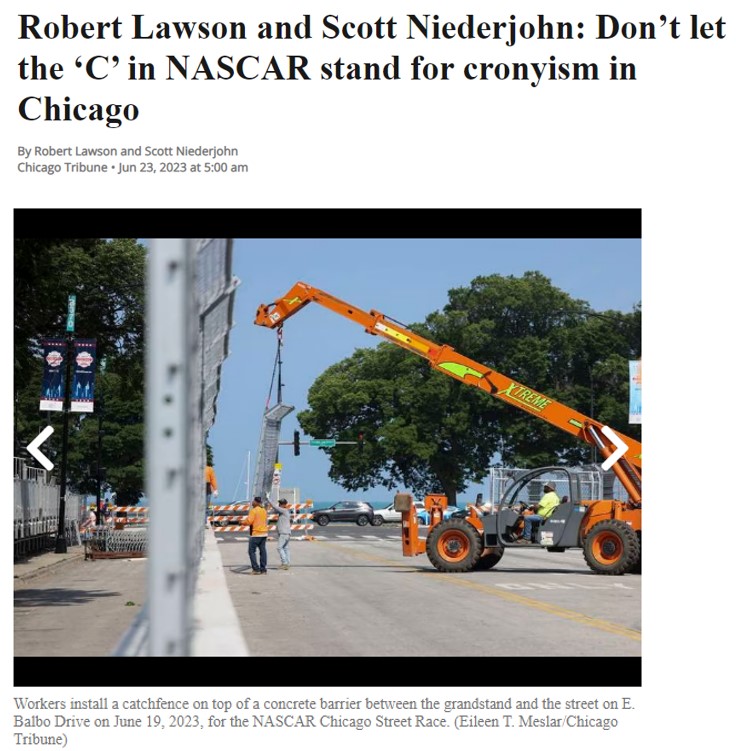
Setup for the inaugural NASCAR event in Chicago is off to the races. A three-year deal that former Chicago Mayor Lori Lightfoot signed into existence will bring stock car drivers to the Windy City for a competition that’s a first of its kind in more ways than one.
Typically, NASCAR races take place at privately owned tracks that are specifically designed for spectators. The Chicago NASCAR races will instead utilize existing city streets: a 2.2-mile circuit that will take drivers past some of the city’s most iconic landmarks and most notable streets. As one could imagine, traffic will be significantly impacted for the two-day event. Temporary stands and event staging is being erected. It’s a massive undertaking.
But will the bottom line be worth it for Chicago? NASCAR officials say yes. Concordia’s Scott Niederjohn and fellow economist Robert Lawson say not so much.
Niederjohn, a professor at CUW, serves as the director of the Concordia Free Enterprise Center. Lawson is an economics professor and director of the Bridwell Institute for Economic Freedom at Southern Methodist University’s Cox School of Business. Both share a passion for car racing.
In the media
On Friday, the Chicago Tribune published their co-authored op-ed titled, “Don’t let the ‘C’ in NASCAR stand for cronyism in Chicago.” Click below to subscribe to the Tribune to read their piece, or scroll on to read a few key points.
Chicago NASCAR Takeaways
“Almost all racetracks are privately owned by entrepreneurs trying to make a buck. … However, if the other major sports can slop up billions of dollars from the taxpayer trough through publicly financed stadium deals, for how long can the two premier racing series in North America – NASCAR and IndyCar – resist the urge to join in the feeding frenzy? The answer, sadly for NASCAR at least, is that they can’t.”
“The costs to the city have not been well publicized, which suggests a lack of government transparency. Still, news media reports suggest huge and ill-specified subsidies are involved.
“Undoubtedly, city leaders will point to the intangible ‘benefits’ to the city of having NASCAR in town. Though a NASCAR-commissioned report estimates an economic impact of $113 million, neutral analysts view such studies as unreliable.”
“With the sharply limited seating available on a street circuit compared with a fixed road course or oval track, prices are at least two to three times higher than for normal races. …(And) unlike regular racing venues where you can bring in your own food and beer, outside food and drink are banned at the Chicago races. Fans can count on adding a couple of hundred extra bucks, given festival prices.”
“On the NASCAR Cup schedule, the Chicago street race venue replaces Road America in Elkhart Lake, Wisconsin. Did this legendary American racing venue lose out to Chicago in free and open market competition? No, the privately owned Road America lost this event to a government-subsidized deal. … Road America lost because Chicago politicians subsidized NASCAR with money that they took from Chicago residents.”
Want more?
Niederjohn oversees the Concordia Free Enterprise Center (CFEC). CFEC promotes the ideals of a free and virtuous society, which ultimately unleashes the nearly unlimited creative potential of the human spirit while producing remarkable levels of economic and human flourishing.
You’re ready to further your education, but let’s face it, it can be overwhelming choosing a college when there are so many options. We can help! Once you know what you want in a college, you can search online to narrow down your options. The Best Colleges search engine is a good place to start.
However, there are many factors to consider in your search. So, below we listed some things to help you figure out what fits you best.
Programs offered
If you’re pretty set on the program you want to pursue, it’s crucial to make sure it’s offered at the schools you’re considering. However, if you have broad interests, be sure to look closely at the curriculum to make sure you know what you’re signing up for. Take some time to reflect on what you’re passionate about. While not everyone loves going to school, earning a degree can be more enjoyable if you like what you’re studying.
Location
Location is important when considering where you want to go to school. Consider what you need in your college’s location when narrowing down your list of schools. If you’re pursuing education in a healthcare field, do the colleges on your list have access to a good hospital system and/or clinical opportunities? Being close to a major metropolitan area often means more access to internships and events.
However, while it’s important to think about important things like clinicals and internships, it’s also important to consider what you want out of your college experience. Are you a city person? Does hopping on public transit and exploring a new neighborhood sound exciting to you? Or, would you rather escape the hustle and busyness of the city for a more peaceful location? Concordia University Wisconsin, for example, is located on serene Lake Michigan and is close to many state parks, but is also a 20-minute drive from downtown Milwaukee.
Cost
A big factor for many students is the cost of attendance. This can differ by many factors including:
In-state or out-of-state tuition
Living on or off-campus
In-person or online classes
Public or private schools
We recommend creating a spreadsheet of each college of interest and then comparing the cost of each. Most schools have a net price calculator to help you see how much you may spend.
Financial aid options
Financial aid is just as important as cost. Take the time to find out how to pay for your education and to know what you’re paying for. Colleges vary by how many scholarships they give, but it is important to ask and apply for them. There are many outside scholarships and you may fit the criteria for outside scholarships, so check those out too.
Student Services
Student services might sound boring, but you don’t want to overlook this important aspect of your college education. The term “student services” means different things at each university, so be sure to do your research.
Library services
At some universities, student services include library services. What are you hoping for regarding access to digital archives, books, and information? What about study spaces? Ask about these things on your next college visit.
Student health services
Check out what’s available for taking care of your physical and mental health while in college. From routine primary care and preventative medicine to behavioral health and more, many colleges offer some level of healthcare support to their students.
Disability and access services
Don’t forget to research disability and access services, especially if you need to use them. These services aim to provide support for students to ensure that they can access and participate in opportunities at the college.
Accreditation
Accreditation helps indicate whether or not a college has met minimum standard requirements. It’s a voluntary act that the college initiates, and they go through a rigorous process of evaluation, which includes site visits.
Find out if the college you’re considering is accredited because it could determine whether or not you’re eligible to sit for certain certifications or exams upon completing your program. Accreditation also impacts the ability to apply for financial aid, so be sure to find out if your institution is accredited.
Academic Quality
We all know some of the “big name” schools that have strong reputations for academic quality. If you can go to one of those colleges, that’s great. If not, how do you find out if the college you’re looking at offers high-quality academics? First of all, research the faculty and facilitators. Find out as much as you can about the programs you’re interested in.
Ask admissions counselors about programs of study, and try to get more information on the quality. Sometimes, admissions counselors are able to connect you with a current student in your desired program or a recent graduate so that you can ask honest questions to someone who’s experienced it.
Campus Environment
Spend some time researching the culture at various colleges, specifically the school you’re considering. What’s the school’s history? What do the students, staff, and faculty value? How does leadership handle conflict? Concordia University Wisconsin, for example, is a Lutheran university, so activities like daily chapel and prayer are things that the community values.
You should also dig into student activities and find out what kinds of social events, clubs, and organizations gather on campus. Getting involved in your campus community is a great way to feel connected to your college.
So, how do you find the right college?
Finding the right college for you can feel overwhelming. Remember to determine what’s important to you in a college, research your questions, and talk to actual students to get a sense of what campus life is like. Do you want to know more about what life is like at Concordia University Wisconsin?
As one of the newest members of CUW’s Admissions team, Alex brings fresh ideas and excitement to the front lines of our new student outreach efforts. He comes to the bluff from Milwaukee’s Eastbrook Academy, where he helped bring in students to learn and grow in a Christian education environment, and UW-Milwaukee, where he earned a B.S. in Education, an M.S. in Administrative Leadership, Higher Education Administration, and worked for five years in admissions.
That’s basic stuff. Read on to learn a few fun facts about Alex Riehle!
Alex Riehle
Director of Enrollment
Years at Concordia?
This is my first year at CUW.
What book or show changed your life?
Thinking, Fast, and Slow by Daniel Kahneman
What is your fondest childhood memory?
Learning how to make ice cream the old fashioned way.
What was your first car?
1999 Yellow Saturn S-Series 3-Door Coupe.
Name a teacher or a leader you admire and briefly tell why.
My favorite educator is Milwaukee’s historian John Gurda. For nearly 30 years, Gurda’s lectures, television series, books, and regular newspaper columns have helped put Milwaukee on the global stage and given the locals much to appreciate about the place we call home.
Any unique hobbies? Or any skills/talents you wish you had?
I play Ultimate Frisbee on weekends. I want to learn how to play blues harmonica.
What is the best advice you ever received?
“The harder you work, the luckier you get.” – Ted Lasso.
Besides the basic necessities, what is one thing you couldn’t go a day without?
Coffee.
What is your favorite thing about school?
Friendship and social connections.
What was the first thing that attracted you to Concordia?
The mission-driven community.
Want in?
There’s something special about Concordia University Wisconsin and Ann Arbor. For the past four years, the university has ranked among the Milwaukee Journal Sentinel’s best places to work. See if there’s a job fit for you at CUWAA.
The Doctorate of Education in Leadership, Innovation, and Continuous Improvement (LICI) is an online program. However, one of the first experiences students have is an in-person residency. Our Wisconsin program hosts two residences on our Mequon campus. The first takes place in January, partially online. The second is a full, in-person residency in the month of July during the second year. Alternatively, our New York program has one in-person residency in February.
Importance of residencies
So, what is the rationale behind an in-person residency for an online program?
Time together in person provides an opportunity for students and faculty to learn about one another and have rich discussions. We build relationships as a foundation for students to know they have support from the start of their doctoral program. We strive to build trust between students and professors. This creates a supportive network of people that students can rely on when they need help.
Additionally, it provides time for talking through the program, research, and topics related to the courses. While we continue these conversations online, starting with face-to-face conversations helps to solidify the relationships for years to come.
Connecting through faith
Residency is a chance for adult students to connect or reconnect with their faith. One of the most beautiful experiences I had with faith happened this year at our New York residency. Each day of residency, I always ask students if anyone would like to lead us in prayer.
In New York, I asked someone to lead the prayer on the first day of residency. After that, students asked me if they could lead the prayer on the subsequent days. I was moved by the student’s enthusiasm for leading prayer that week.
Unexpectedly, on the last day, the prayer was conveyed through a song. The powerful time together as a group, glorifying God, was a perfect ending to our residency.
Time together is worth it
The LICI team understands that, as adults, it can be hard to find time amid work and family commitments for residency. Nevertheless, the time spent with cohort members and professors is invaluable.
One student confided in me. She had been trying to find excuses not to attend a residency as the planning seemed too much. She eventually understood that it was a requirement of the program. Despite the obstacles that blocked her path, she persisted.
While she came to the residency looking at it as a requirement, she quickly changed her perspective. She realized the importance of her residency. On the second day, she told me she had already gained something from the experience that made it all worthwhile.
LICI students return for a second residency in the second year of the program. This time together is a joyous opportunity to reunite, share research topics and progress, and catch up with one another.
Our students come back together with new perspectives and insights to share and with renewed determination. They are excited to see the friends they have connected with and want to nurture their relationships with their professors, too. They have built these relationships throughout the program.
Residency is a time of preparing for the doctoral journey in mind, body, and spirit. Relationships formed during the doctoral program are often enduring. They provide strength and a sense of community throughout the program and beyond. Graduates benefit from these relationships even after they graduate.
If you’re thinking about starting a doctorate program, check out Concordia’s Doctorate of Education below.
In honor of Father’s Day, we asked a few CUW employees to submit their favorite Dad Jokes.
It’s a day to celebrate the dads in your life. And what better way to let fathers shine on their special day than to share a few jokes from their namesake genre?
Even better, we’ve solicited Dad Jokes straight from the source. Here are some favorites from a few CUW employees who are fathers.
Steve Taylor
Vice President of Student Life
What’s red and smells like blue paint?
Red paint
What’s red and bad for your teeth?
A brick
What’s green and has wheels?
Grass. I lied about the wheels.
Adam Paape
Assistant Dean of School of Education
I saw my math teacher with a piece of graph paper yesterday.
He must be plotting something!
David Hengst
Associate Director of Graduate Admission
What do you call a deer with no eyes?
Noideer (Pronounced: No idea’r)
Scott Van Ornum
Professor of Chemistry
Dr. Van Ornum offers a joke that combines nods to his preferred pen color to use in class and his family pets, three beloved Ragdoll cats.
What is a Ragdoll cat’s favorite color?
Puuuurrrrrple!
Chris Brandt
Director, Business Intelligence
Cassette tapes had a side A and a side B.
It was only natural that the successor was the “CD”!
When I was young, I was poor.
After many years of hard work, I am no longer young.
Why is gravity so cheap?
It’s MASS produced!
What do you call 100 rabbits walking backwards?
A receding HARE line!
Why was 2019 afraid of 2020?
They got in a fight over COVID masking in 2021!
The adjective for “metal” is “metallic.”
But for “iron” it’s “ironic.”
Want in?
Dads can be students, too! Our post-traditional programs offer flexibility so that you don’t have to sacrifice those precious life moments while pursuing your degree. See what CUW has to offer!
It doesn’t have quite the stature of the “Fishers of Men” statue, but the CUW “Beach Cross” has become an icon on campus. Learn the untold, unfinished story of how it came to be.
Our quest begins with a simple question submitted on one of our social media pages: “Does anyone know the story behind the driftwood cross on CUW beach?”
After asking around a little bit, no answer came immediately. “I always assumed it was probably a Campus Ministry thing,” I said. So I asked Associate Campus Pastor Doug Bender what he knew. As it turns out, Pastor Doug recalled a conversation from a few years ago with a man who may have been the instigator. “I’m still Facebook friends with him,” Doug told me. “Let me see what I can find out.”
Next thing you know, I had a phone interview scheduled with a man named Rick.
Mind, body, and spirit
As Rick tells it, the beach cross has its origins when the beach below the bluff was quite new, not long after the renovation, probably in 2008 [*see update below]. Rick is a retired personal trainer; he’s also in recovery—both facts are relevant to this story. Back then, he would frequently take people he was training up and down the bluff stairs and switchbacks. “It’s the perfect place for training,” he said. “So I started going there quite often.”
One day, he ventured all the way up to where the beach is, on the north end of the shoreline. He found what looked like a bonfire site, with a stack of wood waiting to be burned. Among the sticks of driftwood was what appeared to be a cross, loosely lashed together with a piece of rope.
Maybe some students put it together it and weren’t happy with the results, so they were just going to burn it. Maybe it wasn’t even meant to be a cross. We don’t actually know. But whatever its original intent and purpose, Rick decided it was worth saving. So he pulled it from the pile, tied it up a little tighter, stuck it in the ground, and put some rocks around it to stabilize it.
Satisfied with his work, he went on his way. “Okay, I feel better now,” he thought to himself.
A few weeks later when he came back, the cross was back in the pile. So he saved it again—only this time he “really poked it down in there pretty good!” He made sure it would stay put, and that there would be no doubt he meant for it to stay put. “It would take more than just a couple of guys and girls to yank it out!”
After that he started visiting the cross on a regular basis. He made it part of his morning routine, to go to the cross and pray. Sometimes by himself. Sometimes with friends or clients. Sometimes with his son. It helped him stay close to God.
For years he visited with two friends in particular, Lee and Don. Lee, who Rick credits as his “spiritual advisor,” was a strong Christian. Don is now a senior pastor at a local church. “So Don and Lee and I would go down to the cross and pray. It became very much a part of my life.
“And the reason the cross worked so well for me was, beyond the cross I could see nothing manmade,” Rick explained. “There was nothing interfering with the view. It was just perfect.”
It also helped him stay sober. “I’ve been clean and sober for 28 years now,” he says.
The power of the cross
As Christians, we talk a lot about “the Cross.” It’s a powerful symbol of the faith we hold in common, representing the death that Christ died to pay for all of our sins.
A the front of the CUW Chapel of Christ Triumphant, it is represented with a crucifix; that is, a cross with our Savior still nailed, in the throes of His final hours or minutes—or perhaps already gone from His (pre-resurrection) earthly life. The image of Christ on the cross challenges us to remember the suffering He endured on our behalf.
As Protestants, we more often see the empty cross, which urges us to think about the risen Christ, and what His resurrection means for our salvation. (In our Chapel, this idea is represented by the stained glass depicting “Christ Triumphant” above the main Chapel doors.)
When you think about it, the cross is kind of an odd symbol of hope. Once, early in my faith walk, a spiritual mentor asked me, “Why are you wearing an ancient execution device around your neck?” He was being facetious—sort of. In fact, he was challenging me to remember what the cross around my neck really represented: A Savior who unjustly suffered and died to repay a debt that I never can.
A symbol of death that represents eternal life: Just one of the many seeming paradoxes found in our amazing faith.
In the old rugged Cross, stain’d with blood so divine A wondrous beauty I see For ’twas on that old cross Jesus suffered and died To pardon and sanctify me
“The Old Rugged Cross” | Hymn by George Bennard
Mystery remains
These days, Rick doesn’t get down to visit the cross very often. “My knees are shot,” he says. But he thinks about it often. And people sometimes will text him a picture and say, “Hey, I saw the cross today!” He considers the bluff to be “holy ground,” and his hope is to have his ashes scattered there after he dies.
“Weird, huh?” he says.
Not really. For someone whose physical and spiritual wellbeing have been shaped so much by one special place, it makes sense to want an eternal connection.
“And once you’re out there, and you feel and really understand the power of that cross, you wouldn’t want to turn your back on it,” he adds.
But nothing of this earth lasts forever. Even the beach cross will turn to dust one day. And we still don’t really know the true origin of these lashed pieces of driftwood. Rick doesn’t want credit for anything—it’s why he asked his last name not be used. And he knows he didn’t really create anything. He just helped preserve it. “Somebody else found those two pieces of driftwood and lashed them together,” he says.
We just don’t know who that was. Do YOU? If you have any information regarding the true origin of the beach cross, let us know. (You can email me at michael.zimmerman@cuw.edu.) There’s no reward for information, other than the heavenly reward awaiting those who put their faith in Jesus Christ and the cleansing power of the blood He shed on the cross.
“For the word of the cross is folly to those who are perishing, but to us who are being saved it is the power of God.” – 1 Corinthians 1:18
A picture from the day Josh first built the cross.
UPDATE:
Shortly after the publication of this article, I heard from Tyler Shadick (‘12), learning management system administrator for the CUW IT Department. Tyler reports that it was a friend of his, Josh Leone, who originally built the cross in October 2010. In a phone call, Josh explained that he was visiting Tyler, who was a student at the time, when he saw the logs on the beach and thought they would make a cool cross. So he bought some rope, lashed the logs together, and planted the cross in the ground. Thanks, Tyler and Josh, for sharing this additional information!
Want in?
Concordia University Wisconsin is part of the Concordia University System, a nationwide network of colleges and universities that are each independently run but all affiliated with The Lutheran Church-Missouri Synod. Our university educates students across a broad range of professional fields, and also offers professional church career education in the areas of Pre-Seminary studies, Lutheran teacher training, parish music, and church ministries leadership.
Preston Cosgrove, Ph.D. is an Associate Professor in Concordia’s Doctorate of Education in Leadership in Innovation and Continuous Improvement (LICI) He has been teaching at Concordia since 2018 but has worked in higher education since 2006. Aside from teaching, he has held various leadership roles within academic departments, accreditation efforts, and strategic planning.
Why did you choose a career in education?
My father is a recently retired college professor and my mother is a retired college librarian. As a child, I remember them reading to me as I fell asleep, visits to museums and libraries, and exploring nature. Over time, I formed a deep love of learning and an intellectual curiosity.
Perhaps it is unsurprising then that my top “Strengthsfinder” themes are Intellection, Learner, Analytical, and Context. As a result, I found working in higher education and teaching adult graduate students to be the perfect avenue for helping others grow in their own thinking and curiosity about the world.
What is your favorite course to teach in the LICI program?
Without a doubt, the course on Qualitative Research. Given that we live in a world saturated by “big data” and statistics, most students start the course with significant misconceptions about the topic and low expectations for its relevancy. I love tackling such beliefs head-on and helping students slowly build their knowledge of qualitative research and why it’s important to understand our complex world.
What is your research interest in the education field?
I typically find myself interested in researching anything that connects to my teaching. Recently that has been the nature of Christian higher education. What makes the education one receives “Christian” in some way? That is a challenge and an opportunity that I get to undertake at Concordia every day.
Also, I have an interest in the philosophy of social science research. That sounds quite boring to most. But it unpacks important questions like: What is the nature of reality and truth? How can we gain knowledge of that? What constitutes credible ways to engage in research? In the LICI program, such questions are vital as our students must undertake their own dissertation research.
Why do you feel the cohort model is critical to a student’s success in the LICI program?
The doctoral journey is never a road traveled alone. Critical to that is our cohort model, which gives students not only academic support but social and emotional as well. Many of our graduates speak to the close personal and professional friendships they developed through their cohort experience. Just recently I had a conversation with a group of students who were in the same cohort many, many years ago. And long after their program had finished, the deep friendships remained.
What are the strengths of Concordia’s Ed.D. program compared to others?
Two things stand out immediately. First, the quality, responsiveness, and intentionality of our faculty and staff. From their first inquiry into the program through their dissertation defense, our students know they are cared for and supported by our LICI team.
Second, students write their dissertations through a series of 1-2 credit research seminars, taught by their dissertation chair. These courses provide the necessary support and information for students exactly when they need it. This is unique compared to most programs where students write their dissertations on the side. Instead, students engage with their research and their dissertation chair right in the curriculum.
What advice do you most often give to your LICI students as they write their dissertations?
On the first day of the program, I tell students that if they are going to complete coursework and their dissertation, they are going to have to give up something they like, and it could be something they love. Not forever give up! But for a season of their life. Otherwise, in a schedule already filled with work, family, hobbies, etc., what gets squeezed from their schedule is the dissertation.
The second piece of advice I give about the dissertation is to remember the proverbial “marathon, not a sprint.” No one can blitz or rush their way to completion. Instead, the slow, steady work that they put in, day after day, will pay off.
If you’re considering a Doctorate in Education, check out what students are saying.
Meet CUW’s most tenured occupational therapy faculty member, Michael Borst, OTD.
The Occupational Therapy team at Concordia is made up of faculty with a variety of personal and professional backgrounds. Among them is Michael Borst, OTD.
Dr. Borst is CUW’s longest standing faculty member, having joined the CUW OT department in 2007. He has a rank of full professor, and is the team’s go-to person for technology troubleshooting.
What is your educational and career background?
I earned a B.A. in Psychology at Calvin University in Grand Rapids, Michigan. After a couple post-college gap years, I was ready to start graduate school, and I attended Western Michigan University, where I earned a M.S. in Occupational Therapy. At WMU, I was mentored by the legendary Dr. David L. Nelson, who taught me the essence of occupation and got me involved in research. After I started teaching, I earned a post-professional Doctor of Occupational Therapy degree with a focus on hand therapy from Rocky Mountain University of Health Professions.
I worked clinically at UW Hospital and at Meriter Hospital in Madison, WI. I have had lots of experiences in inpatient acute care, inpatient rehabilitation, and outpatient hand therapy. While working at Meriter Hospital, I earned a certificate in NeuroDevelopmental Treatment (Bobath), and became a Certified Hand Therapist.
What is your educational and career background?
Between family life and work life, I am kept pretty busy. When I do get some time away, I like being outdoors – hiking and camping in the summer, and cross-country skiing in the winter. I also enjoy tinkering. There’s always something to fix on our 1999 Coleman pop-up camper!
What brought you to Concordia?
It was a surprising path. I presented an educational institute at a Wisconsin Occupational Therapy Association annual meeting in 2004, and Carrie Scheel (an Occupational Therapy faculty member at CUW) was assigned to my room to introduce me, make sure everything went well, etc. We chatted for a bit, and went our separate ways. Three years later, Carrie called me out of the blue and asked me if I would be interested in a faculty position at CUW! A week later I interviewed, and two weeks after that, I was hired.
What is your area of expertise within Occupational Therapy? Share a little bit about the ways you share this with students/community.
I’ve worked with adults with physical limitations or injuries in a variety of settings, and my most focused experience is as a hand therapist. Hand therapists work with people who have had arm injuries or diseases and address their rehabilitation needs. I get to share this with students through the classes that I teach: “Occupational Kinesiology” and “Orthopedic Rehabilitation.”
What’s an interesting part of your field that people might not know?
The profession of Occupational Therapy originated in mental health practice in the 1910s. At the time, people with mental health problems were removed from society and thus lost access to many of their usual interactions with the world around them. The founders of Occupational Therapy saw that this occupational deprivation made people worse, not better, and started providing people with purposeful occupations in order to improve their health.
These origins explain why the focus of Occupational Therapy is on occupation, rather than medical interventions (though we do that too!). The early Occupational Therapists saw that people had to engage the body, mind, and spirit in the process of healing – mirroring Concordia University’s mission of helping students develop in mind, body, and spirit for service to Christ in the Church and in the world.
What does your research line involve?
My research line is eclectic, which is a fancy way of saying I cannot stick to just one thing! I have published research on the integration of faith and learning in higher education, and have written textbook chapters on evidence-based practice, orthopedic intervention, and physical agents (like heat, cold, and ultrasound). Currently I am co-writing a textbook on applied kinesiology for occupational therapists.
What do you love about the CUW OT program?
I love that I get to share both my Christian faith and the profession that I love with students. That is a pretty unique opportunity in the field of occupational therapy! I also love the diversity of our students. Every semester I teach undergrad students, post-baccalaureate students, and occupational therapy assistants who are currently practicing. Our students come from a variety of backgrounds, and I think that strengthens our program.
What is your advice to potential OT students?
You don’t need to know exactly which part of occupational therapy you want to practice in yet. The beauty of occupational therapy is that you can work with any age range, in any setting, addressing pretty much any need. Occupational therapy is about occupation (i.e. the things that people do every day that give them a sense of purpose). Occupation is like vocation; it is not only about work, but rather all the activities that God gives us to do.
Want in?
Wherever you’re at in your journey into occupational therapy, Concordia University has options for you at both the undergraduate, master’s, doctoral levels.
As a Christ-centered university, our program will help you advance in your calling, by learning from experienced therapists in a hands-on environment and developing a foundation in ethical leadership.
We offer the following programs in Occupational Therapy:
Master of Occupational Therapy
Accelerated track (for incoming freshmen)
Bridge track
Post-Baccalaureate track
Entry Level Doctorate of Occupational Therapy (OTDe)