11 places social workers change lives

Social workers are everywhere—quietly making an impact in schools, hospitals, nonprofits, and even corporate boardrooms. Their work is essential to individual and community well-being. For many, social work is more than a career. It’s a calling.


At Concordia University Wisconsin, social work students are equipped to lead with compassion, competence, and conviction. Our Bachelor of Social Work (BSW) program emphasizes ethical practice, Christ-centered care, and a deep commitment to serving others. Whether pursuing a traditional path or one of the field’s many emerging opportunities, Concordia graduates are ready to live uncommon lives of purpose and impact.

“At Concordia, we don’t just prepare students for a career; we guide them to become courageous advocates and compassionate leaders who recognize the God-given dignity and worth in every person.,” says Nichole Ostrowski, CUW’s BSW program director. “Our BSW graduates are equipped to create meaningful change with their skills, their voice, and their hearts.”

Places & spaces of great impact

Here are 11 settings where social workers serve—and how CUW prepares students to thrive in each one.

1. Healthcare settings

Social workers in hospitals, clinics, hospice centers, and rehab facilities support patients and families through medical crises, chronic illness, and recovery. They help people understand diagnoses, navigate complex systems, and access vital resources.

At CUW, students learn to care for the whole person—body, mind, and spirit—recognizing the sacredness of each life.

2. Mental health facilities

In psychiatric hospitals and community mental health centers, social workers provide therapy, crisis intervention, and ongoing support for individuals facing mental illness, trauma, or addiction.

Our students are trained in evidence-based practice while developing a deep empathy rooted in the Christian understanding of human dignity.

3. Corporate settings

Social workers are increasingly valued in employee assistance programs (EAPs), HR departments, and wellness initiatives. They promote mental health, mediate conflict, and create inclusive, supportive work environments.

Concordia’s focus on servant leadership gives graduates a unique edge in corporate settings—bringing integrity, care, and compassion to the modern workplace.

4. Nonprofit organizations

From domestic violence shelters to food banks and advocacy groups, nonprofit social workers are on the frontlines of social change. They manage cases, connect people with resources, and help communities thrive.

CUW social workers embody Christ’s call to serve, providing hope and healing to those often overlooked.

5. Private practice

Licensed clinical social workers in private practice offer counseling and therapy tailored to individual needs. They may work with families, couples, or individuals managing mental health, trauma, or grief.

Our graduates are prepared to offer ethical, client-centered care, and when appropriate, gently integrate faith into the healing process.

6. Correctional facilities

In jails and juvenile detention centers, social workers provide prevention and rehabilitation services, support mental health, and help people prepare for life after incarceration.

CUW forms students to serve with humility and purpose trusting in the redemptive power of grace and transformation.

7. Veterinary services

Social workers in veterinary clinics and animal shelters help clients process pet loss and assist veterinary staff with compassion fatigue and difficult ethical decisions.

This growing niche allows Concordia graduates to extend Christ-like compassion in creative and meaningful ways.

8. Schools

School social workers help students thrive socially, emotionally, and academically. Whether in K–12 or higher education, they manage crises, advocate for students, and work to remove barriers to learning.

CUW’s commitment to education and spiritual formation makes our graduates especially well-suited to support students holistically.

9. Policy and research institutions

Social workers also shape public policy. They work in think tanks, universities, and nonprofits to conduct research, develop solutions, analyze data, and advocate for just systems.

We prepare students to approach policy work with knowledge, conviction, and a Christ-centered vision for human rights.

10. Military and veteran services

From VA hospitals to military bases, social workers support active-duty members and veterans as they navigate trauma, housing, reintegration, and benefits.

Concordia students graduate with a deep respect for those who serve—and a readiness to walk alongside them with strength and compassion.

11. Government and public agencies

In Child Protective Services (CPS), Adult Protective Services (APS), and foster care systems, social workers protect vulnerable populations and advocate for safe, supportive environments.

CUW’s emphasis on justice, mercy, and service equips graduates to lead with integrity in these high-impact roles.


Further Reading:


Want in?

Concordia University Wisconsin is a Lutheran higher education community committed to helping students develop in mind, body and spirit for service to Christ in the Church and the world. If you’re passionate about helping others, social work could be the career for you. Concordia’s Bachelor of Social Work program combines rigorous academic training with hands-on field experience and a Christian worldview. Students even have the option to complete their BSW and Master of Social Work (MSW) in just five years. Learn more about CUW’s social work program, or connect with BSW Program Director Nichole Ostrowski at Nichole.Ostrowski@cuw.edu.


Summer Shuffle: Inside CUW’s Moves and Campus Improvements

This summer, 105 people—which includes multiple departments—were relocated in order to serve students more efficiently and effectively. Some areas of campus were even improved on.


Ever think about how much time and effort goes into rearranging your home or office? Well, imagine having to move and improve key departments within a university’s timeline.

Steve Hibbard, director of buildings and grounds for CUW and his team, successfully moved 105 staff members within a month, along with updating specific areas of the campus throughout summer.

“Steve Hibbard is the linchpin, because he’s a part of every single one of those things,” says Dr. Steven Taylor, executive vice president & VP of innovation. “Steve and Kevin [Sheridan] really are the architects that carry the water for this … it was a significant move.”

Taylor has been at CUW for roughly 26 years, with Hibbard coming in right behind him at 25. Kevin Sheridan, assistant vice president of financial aid and student accounts, has been with Concordia for about 15 years and proposed the idea in spring 2024 to gauge the interest of key stakeholders. The idea really gained momentum in March 2025.

Prior to the move, the online and graduate student populations had the most difficulty maneuvering campus and would get lost according to Sheridan. “They were really struggling trying to get to people,” he says.

Agreeing with Sheridan, Taylor says, “It’s about putting people in the right place.” Students and staff can benefit from the proximity. For example, if a family is in the Admissions office but they need information from another department, Admissions can now walk over to that particular office without having to hike across campus. It streamlines the process while putting students and families first.

However, it was no easy feat. What would have taken months and months was completed in a short, effective, and efficient way. “It was impressive,” notes Taylor. “It was absolutely incredible,” says Sheridan. “Steve’s team should absolutely be commended for all of their work on it.”

Office locations relocated to benefit the student experience

blue sign with arrows and a hallway

Here is a table showing where offices are now.

DEPARTMENTNEW LOCATION
AdvancementSiebert 101
FinanceSiebert 103
Marketing/Strat CommHeidelberg 002
Traditional Undergraduate AdmissionLuther 108
Online/Graduate AdmissionsLuther 106
Financial AidLuther 100
Enrollment OperationsLuther 112
Billing OfficeLuther 104
Accounts PayableSiebert 103
CAACELuther 114
Registrar’s OfficeLuther 114
Hesed Transition ProgramRincker 004

Campus updates enhance the University

chapel skylight
tables in library area
softball field with green and blue
concrete paved
  • Softball turf replacement
  • Chapel roof and skylight replacement
  • Library upgraded to increase table/study spaces for students
  • New Diagnostic Medical Sonography lab in the works
  • Parking lot near Albrecht repaved
  • Resident hall updates such as new carpeting, curtains, furniture, etc.
  • New office locations (see table above)

Click here for Campus map.


Fun fact

gas tank in ground

“It was a busy summer for projects,” says Hibbard, confirming that everything went well. However, there was one mysterious surprise along the way. The paving project had a slight hiccup due to the discovery of a 1,000-gallon gasoline tank found underneath the asphalt. “It was a functioning gasoline tank when the nuns were out here, and through some of the expansions or changes, they maybe went to an above ground tank and decided to just leave that one there.”


Take a campus journey with us

Take a walk through CUW with us and see some of these renovated spaces!

Want in?

Concordia University Wisconsin is a Lutheran higher education community committed to helping students develop in mind, body, and spirit for service to Christ in the Church and the world.


A picture-perfect four-day weekend to kick-off the new school year!

From freshman move-in day on Thursday through Opening Service and the President’s Picnic on Sunday, God blessed us with wonderful weather, amazing new students, and fired-up faculty and staff to start the new school year.


It’s a time filled with highlights and memories–from thrilling arrivals to tearful goodbyes and heartfelt worship. In-between are lots of unloading, lifting, and lugging, with loads of loving current students on hand to cheerfully serve their new fellow Falcons and introduce them to the ways of life on campus. It brings out the best in all of us and is a shining example of this year’s theme, “Free to Serve,” rooted in our theme verse, Galatians 5:13-14:

“For you were called to freedom, brothers. Only do not use your freedom as an opportunity for the flesh, but through love serve one another. For the whole law is fulfilled in one word: ‘You shall love your neighbor as yourself.'”

The weekend in pictures


Want in?

Concordia University Wisconsin is a Lutheran higher education community committed to helping students develop in mind, body, and spirit for service to Christ in the Church and the world. To learn more about Christian life at CUW, click the link below.


CUW Named a Top 10 University in Wisconsin

Concordia University Wisconsin has once again been recognized among the top universities in the state, earning a place in the Top 10 of the 2025 Niche rankings.


The Milwaukee Journal Sentinel reported on the announcement, highlighting the best colleges across Wisconsin and affirming CUW’s standing among the state’s leaders in higher education.

Niche is a national leader in college research and rankings, drawing on millions of student reviews and comprehensive data about academics, campus life, affordability, and outcomes. Its widely used rankings help prospective students and families compare schools.

Niche’s rankings combine data sources with student perspectives. Drawing on information from the U.S. Department of Education, the National Science Foundation, and verified student reviews, Niche evaluates colleges on factors ranging from academics and value to campus life and safety.

“Students, alumni, faculty, and staff already know what these rankings confirm: Concordia University Wisconsin offers a transformational educational experience—one that blends academic excellence, personal support, and a Christ-centered mission,” said President Dr. Erik Ankerberg. “Rankings capture important data points, but the true measure of CUW’s impact is found in the lives of our graduates—women and men shaped by faith, knowledge, and service who go on to lead with integrity in their communities, workplaces, and churches.”

At the heart of CUW’s mission is the integration of faith and education. Every discipline is grounded in a commitment to forming students not only in mind, but also in body and spirit. This holistic approach ensures graduates are ready for their careers while also equipped to serve as compassionate leaders in the Church and the world.

From the liberal arts and business to health professions, pharmacy, education, and theology, CUW offers more than 70 rigorous academic programs. These programs are continuously refined to meet workforce needs while remaining rooted in Concordia’s Lutheran identity.

Want in?

Concordia University Wisconsin is a Lutheran higher education community committed to helping students develop in mind, body and spirit for service to Christ in the Church and the world. To learn more about what makes CUW so special, click the link below.

5 note-taking methods for students

It’s back to school time and that means your schedule is packed solid from academics to extracurriculars to service-related endeavors. So, by finding a good note-taking method, you will help streamline your studying process.

It’s important to note that every student may have their own way of note-taking. But beyond just scribbling down or typing out key points when you hear them, you can take advantage of a few different methods to up your information retention and learning experience going forward. 

No.1: The charting method

The charting method of note-taking

Separate your paper into columns headed by categories. These could include important dates, people, events, phrases, etc. For example, the columns in a history class could be “Date,” “Person,” and “Significance.” During class or as you read, write down the information that you learn under the appropriate column. This is a great method to use when the content is difficult to understand or presented quickly, as it allows you to get an overview of the lecture in your own words. This is also a good way to organize your thoughts and helpful for visual learners to memorize content.

No. 2: The Cornell method

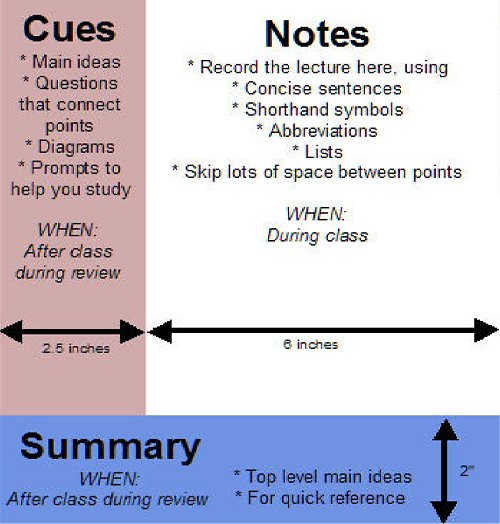
The Cornell method of note-taking

Separate your paper into three sections. The largest section is where you will record information from the lecture using sentences. After the lecture is completed, you will fill out the column to the left of the largest section. This is where you will record the main ideas and anticipate test questions. Finally, at the bottom of the paper, is a summary of the lecture. This should be completed immediately after the lecture because this is when the information will be freshest in your memory. The Cornell method of notetaking is excellent because it utilizes the “three-pass” approach to learning—meaning you encounter the material in three different ways. This is optimal for retaining the information in your memory for good.

No. 3: The outline method

The outline method of note-taking

Place the main and most important points farthest to the left of your paper. As information that is more specific is given, indent to the right. The more to the right a point is, the less important it is. It’s important to note that once a new topic is started, you should begin at the left margin once more. Your outline should be a well-organized system where each subheading relates back to the original heading in the left margin. Outlining reduces editing, records content, and relationships, and allows for easy reviewing.

No. 4: The sentence method

The sentence method of note-taking

Simply write every new thought, topic, or fact on a new line. While similar to the outline method, this method is easier to use when the material is difficult or delivered quickly. It is best to immediately review these notes after class and rank what information is most important and least important. It’s also helpful to rewrite your notes into an organized outline or map so that you can visually see the ordered relationships and connections.

No. 5: The mapping method

The mapping method of note-taking

Identify the main topic and underline it at the top or middle of your paper. Identify the sub-topics or supporting main ideas and place them around or under the main topic. Continue down or outward until you cover all the relevant information. Color coding or changing the shape of the bubble depending on where the information came from could be helpful. For example, a rectangle for book information and an oval for lecture information. The mapping method allows you to clearly see a topic from a global perspective.

Note-taking methods: Which is right for you?

Nursing student typing on laptop

If you’re unsure which note-taking method fits your learning style best, start from the top and try each one. Keep in mind that one method might work well for one class but not necessarily all of your classes. So, don’t be afraid to try out multiple and keep switching them out when you feel your retention starts to stall.

Additional reading opportunities

Check out, “Concordia’s Different Learning Formats,” for further reading on learning styles in a university setting.

AAC Social Group addresses vital community need in a rapidly evolving technology landscape

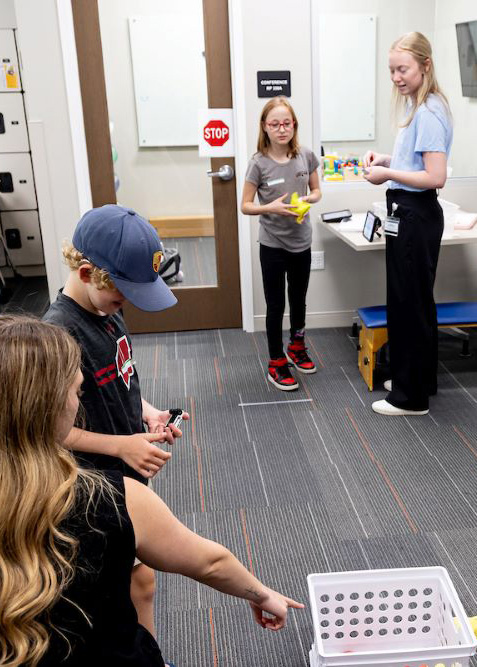
For the second summer, Heather Pauly, PhD, CUW’s assistant professor of speech-language pathology, hosted a social group for youth with speech and language impairments. Participants were separated into similar age peer groups to socialize with each other under the guided instruction of graduate students.


Augmentative and Alternative Communication (AAC) is a blend of electronic devices and low-tech options, like picture boards and sign language, which are used to assist individuals with speech and language impairments. The AAC devices help people express themselves, understand others, and fully participate in activities. This summer was the second time Assistant Professor Heather Pauly, PhD, successfully introduced a social skills group surrounding AAC at CUW that was open to the community and also part of the Master’s in Speech-Language Pathology curriculum.

three students working with young boy in sensory bin

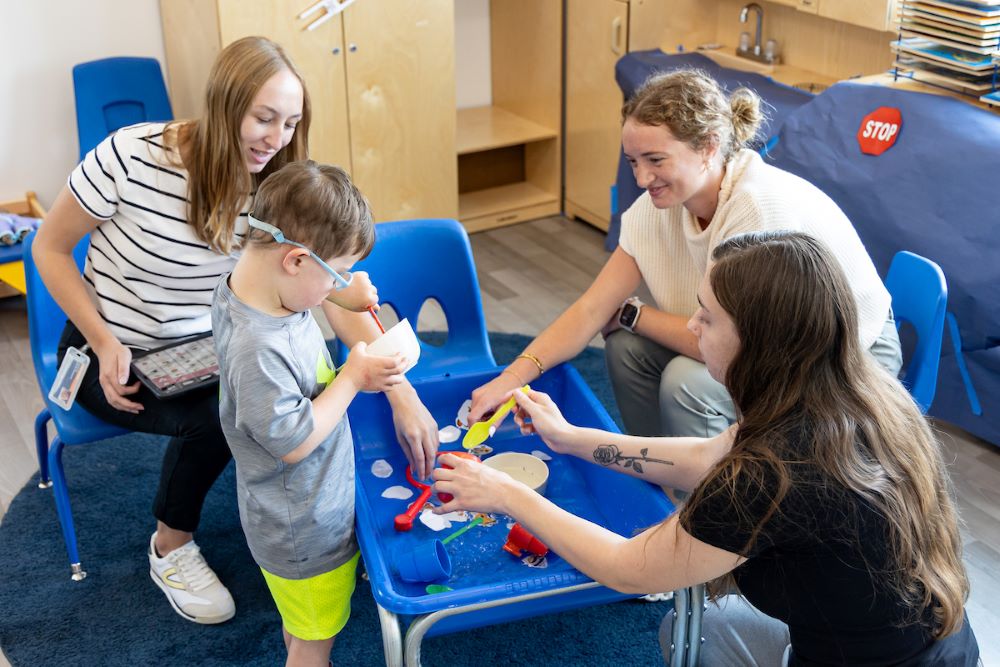
As part of an eight-week class on theory, evidence, and practice around AAC, students (course SLP 5600) like Delaney King are given the opportunity for hands-on, real-world experience that also benefits community participants and their caregivers. She is pursuing this master’s degree because she wants to help others holistically.

“My faith motivates and guides the reasons behind why I do what I do,” says King. “I think AAC is a really important tool, as it makes communication more accessible for those who may not be able to verbally communicate.” King believes that using AAC devices doesn’t take away from spoken language, sign language, or other forms of communication, but rather enhances the user’s overall communication abilities.


multiple children playing game

The catalyst: the community

So how did the AAC Social Group come to fruition? At the Ozaukee County Resource Fair in 2022, caregivers were asking as to whether the SLP program at Concordia had any groups for AAC users. Pauly says that changing the program schedule to teach the AAC course in summer allowed them to meet this community need. So starting last year, Pauly collaborated with Erin Regis-Bailey, PhD, the clinical education director, to get this project operational.

“In speech-language pathology education, we feel that it is important to have both theoretical and practical training, particularly with AAC, which seems daunting due to the ever-changing technology,” says Pauly. “Once we put the idea together, it came to fruition within four months, which was possible by sticking within the confines of an existing course.”

Pauly has done extensive research on the importance of these groups globally. Her findings allowed her to create a suitable and structured day program that consists of grouping youth appropriately and offering engaging activities. She employed her experience from the Chatter Matters Communication Camp at UW-Whitewater—an overnight camp for children using AAC—in which she visited in 2024, to set the bar high at CUW. She was impressed at the generosity of the educational leaders there that offered her ideas and resources.

“The group is possible because of the community support, my department, and collaborations with SLPs from other institutions involved with Chatter Matters.”


boys with student

Reaping the rewards

These groups allow AAC users to socialize in a low pressure setting with others that use similar forms of communication. Meanwhile, parents and caregivers were gathered in a separate area of the Robert W. Plaster Free Enterprise Center in order to network and socialize while their youth engaged.

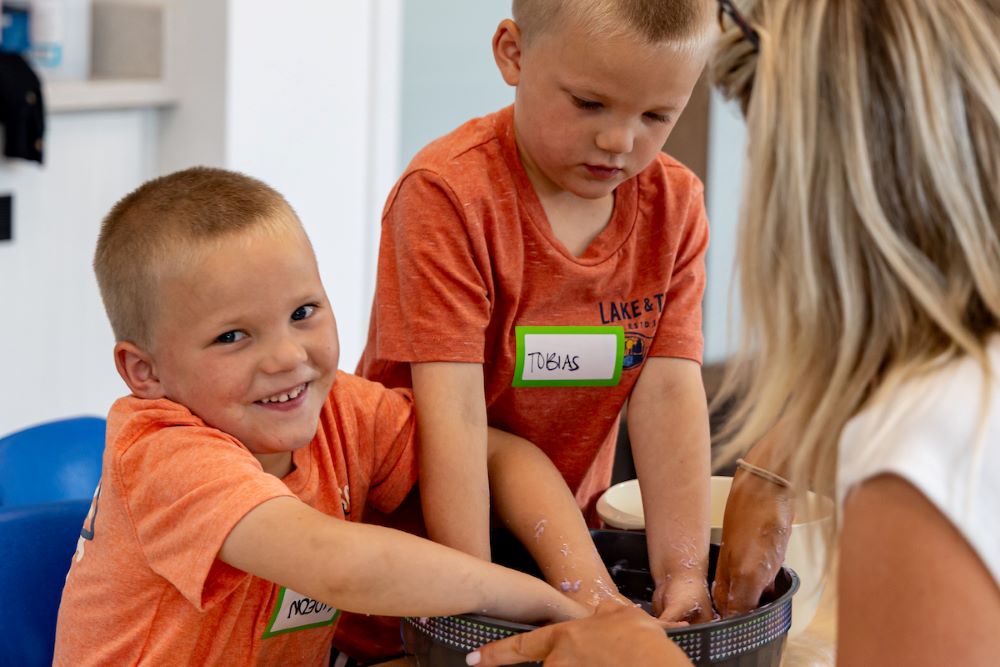
Abigail Novak (mother of the two twins photographed above, Gideon and Tobias) attended this group for the first time. However, her sons, who are diagnosed with childhood apraxia of speech and expressive language disorder, use CUW’s Speech, Language & Hearing clinic frequently for individual speech therapy.

Both boys have had their own AAC devices for over a year now, but struggle with using them to socialize. “They are still learning to use their devices, especially in social settings, which is why this camp [group] was so important,” highlights Novak. Novak did research on devices prior to purchasing the iPads with the TouchChat app. “They were getting so frustrated from not being able to tell us what they wanted and needed,” she confirms.

After the group, Novak noticed her sons were more confident and proud to have had the opportunity to learn new things about these devices, as well as use them socially. The only con for Novak was that this group was only offered two days.

Justin Wienke, parent and physical therapist, agrees with Novak saying that sessions were limited and that ” … there is a critical niche need for these camps for the Milwaukee area Special Needs community.” He hopes to have more opportunities like this for his 11-year-old daughter Caroline to participate in and would love to come back to CUW.

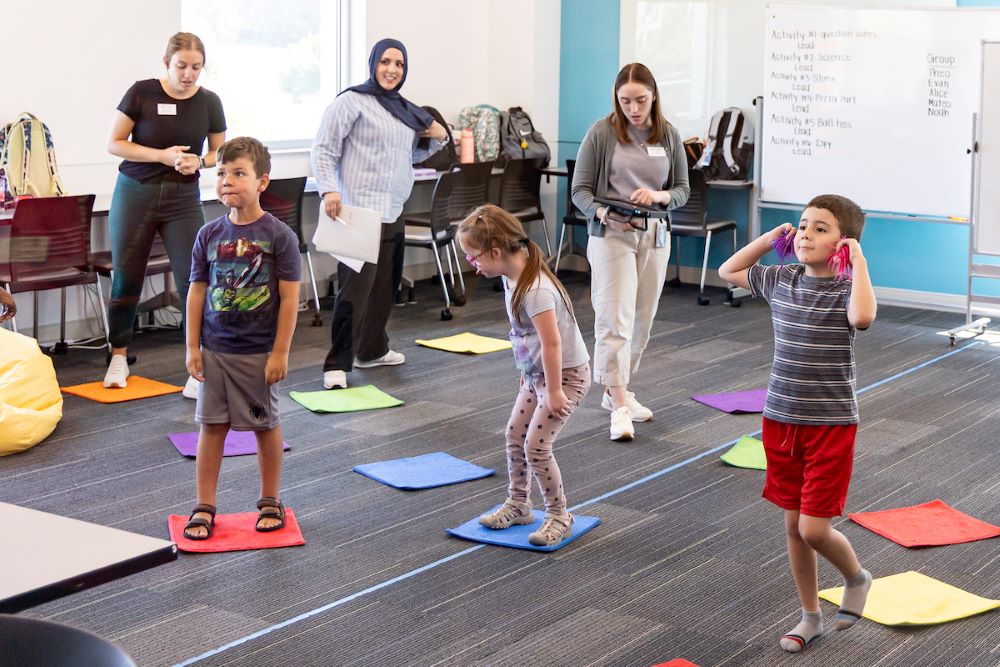
kids playing bean bag toss

After group, Caroline gave her father a big grin when asked if she enjoyed it, expressing that she wanted to do more “speech camp.” Caroline is diagnosed with Bainbridge-Ropers Syndrome & Autism Spectrum Disorder. She uses a program called TouchChat on an iPad system called “WEGO” from Talk to Me Technologies. “Caroline’s AAC device has become a critical resource for her daily living much like a Jedi Knight’s lightsaber—if you are familiar with Star Wars.”

However, although verbal speech is still her preferred (fastest) form of communication, Caroline usually experiences a noticeable boost in device use after similar opportunities.  “Again, any time Caroline gets to practice communication in a fun, social setting—particularly one where AAC device use is normalized amongst other device users—she is highly motivated and has a blast.”

As an SLP student instructor, King notices that AAC users and their families may feel isolated from others who are similar to them and may not know other AAC users. “The social group helps to bring these individuals together,” she says.

Sometimes in the school system, according to Pauly, there may only be one student in a grade that is using AAC, which leads to very little socialization opportunities making groups like this vital.


A sidenote

Pauly sees these groups as part of her calling here at the University. She quotes a Bible verse, Matthew 25:40, which reads: “The King will reply, ‘Truly I tell you, whatever you did for one of the least of these brothers and sisters of mine, you did for me.'”

She continues, “We are not all equal in human form, we have varied strengths and weaknesses, and these groups are a step toward equity (in which some people need different support than others) for a group (AAC users) whose voices are rarely heard or valued. Through these groups, our SLP students are learning to serve the body of Christ in the world.”

This year there was a representative from an AAC company present to support parents with device trouble shooting, as well as offer ideas for how to integrate AAC use into the home. Many parents/caregivers inquired afterwards on whether or not CUW will offer future opportunities for their children to attend similar events, preferably on a regular basis, displaying the high need in our community.


kid on sensory toy

Fun fact:

The qualitative and survey data collected as part of these groups led to two presentations, a write up, and also inspired an instructor at Marquette to run groups during the summer of 2025. Higher education is often siloed, but in this example, Pauly collaborated with a former SLP instructor at UW-Whitewater, an SLP professor at Viterbo, and encouraged the new groups at Marquette. 


Interested in learning more about SLP? “How to become a speech pathologist.”


Want in?

Concordia University Wisconsin is a Lutheran higher education community committed to helping students develop in mind, body, and spirit for service to Christ in the Church and the world. People who would like to get children or young adults involved for next summer (ages 4-23ish) can email heather.pauly@cuw.edu.

In order to obtain a master’s degree in speech-language pathology, a bachelor’s degree in communication sciences and disorders (or equivalent from another school) is required. Concordia offers the undergraduate and graduate degree programs, and a one-year leveling program for students with a non-speech bachelor’s degree, needed to prepare learners to graduate as competent practitioners. Learn more about our programs by clicking below.


Meet the 2025 RAs!

The 2025-26 Resident Assistants are ready to welcome you to your home away from home!


Which residence hall will you be living in this semester? Take a look below to see the friendly faces you will be seeing around your building!

Augsburg & Regents

students in group with blue shirts

Resident Director: Mason Brown

Augsburg (AU) is made up of double and triple rooms for women and single rooms for both men and women. Men and women are separated by floors and all single rooms have personal sinks. Community bathrooms are shared by floor.

Regents (RE) offers suite-style living. Four-person suites have two double-occupancy bedrooms, a living area, and a bathroom. Five-person rooms have five single bedrooms, a living area, and a bathroom. Men and women are separated by a common lounge on each floor. Handicap accessible rooms are available. Regents Hall residents are primarily upper-class students.

Chemnitz

group of students with blue shirts on rocks

Resident Director: Josh Warlick

Chemnitz (CM) is our newest residence hall, featuring suite-style living. Each suite is made up of 3 triple rooms. Suite-mates share a shower and two bathrooms.

Coburg & Katharine

bunch of students in blue shirts on rocks

Resident Director: A.J. Theisz

Coburg (CO) is located along Lake Michigan and offers suite-style living. Each suite consists of four single bedrooms, a shared living space and a bathroom. Men and women are separated by wing. Each floor has a kitchen and lounge area overlooking Lake Michigan. Coburg Hall residents are primarily upper-class students.

Katharine (KA) is a suite-style all-female residence hall. Each suite has between two and four occupants who share a bathroom. Some rooms have a lake view. Some handicap accessible rooms are available.

Heidelberg, Wartburg & Wittenberg

students in blue shirts

Resident Director: Jada Gresens

Heidelberg (HE) is an an all-male residence hall. Rooms vary but most are triples or quads sharing a community bathroom.

Wartburg (WA) is an all-female residence hall with suite style living. In most rooms, four residents share a living space and two bedrooms. They also share a floor community bathroom. Some two person suites are available with a personal bathroom.

Wittenberg (WI) is a female and male residence hall (separated by floor). Rooms vary greatly but most are triples or quads sharing a community bathroom. There are some single rooms and rooms with personal bathrooms.


Hesed RAs

group of students with blue shirts on rocks

The Hesed Transition Program is a distinctive post-secondary initiative that empowers individuals with intellectual and developmental disabilities to experience the fullness of college life. Students live in integrated residence halls on the CUW campus and take courses that combine a liberal arts foundation with practical skill development.

Hesed Resident Assistants (RAs) play a vital role in supporting students’ success. Their responsibilities include coordinating structured programming during their shifts, leading Study Labs to assist with coursework, and helping facilitate events. RAs also complete two evening rounds per shift, ensuring students have cleaned their living spaces, and are prepared for the next day’s classes. In addition, they provide in-class support to help students fully engage in their academic experience.

Looking for more information on move-in/orientation? Click here!

For additional reading, check out “The 4 C’s of living on campus: A faith-filled path to growth.”


Want in?

Concordia University Wisconsin is a Lutheran higher education community committed to helping students develop in mind, body, and spirit for service to Christ in the Church and the world. To learn more or apply today, click the link below.


Meet your 2025 Concordia Crew Leaders!

This superb staff of super-helpful servants is on-hand this weekend (and beyond!) to help new students navigate those challenging (and amazing!) first few days and weeks of life at CUW!


girl with long brown hair and blue shirt

Emily Brown

Position: Concordia Crew Leader
Hometown: Waupun, Wis.
Fun Fact: I am a part-time plumber back home.
Advice: Don’t be afraid to talk to new people. I bet they are just as nervous as you are.


black girl with dark hair and blue shirt

Gilead Adams

Position: Concordia Crew Leader Intern
Major: Music Therapy
Year: Junior
Hometown: Milwaukee, Wis.
Fun Fact: Both of my parents are from Africa!
Advice: Don’t hesitate to ask for help! There are so many people willing to help you 🙂


girl with long brown hair and blue shirt

Amelia Clovis

Position: Concordia Crew Leader Intern
Major: Public Health
Year: Junior
Hometown: Albuquerque, N.M.
Fun Fact:  I love hazelnut lattes.
Advice: The best way to make friends on campus is to get involved in clubs and activities


girl with long hair and blue shirt

Allie Renzelmann

Position: Concordia Crew Leader
Major: Public Health
Year: Senior
Hometown: Merrill, Wis.
Fun Fact: I’m a lifeguard and teach swim lessons.
Advice: At the Co-Curricular Fair, sign up for everything! You don’t have to go, but at least you have the info.


girl with curly brown hair and blue shirt

Leah Drachenberg

Position: Concordia Crew Leader
Major: Sonography
Year: Sophomore
Hometown: Arena, Wis.
Fun Fact: I grew up on a farm!
Advice: Be yourself, don’t be afraid to try new things!!


girl with mid-length brown hair and blue shirt

Ellen Egger

Position: Concordia Crew Leader
Major: Philosophy/Graphic Design
Year: Sophomore
Hometown: St. Louis, Mo.
Fun Fact: I love to paint!
Advice: Don’t be afraid to start conversations with strangers!


girl with long dark hair with blue shirt

Maddie Eggers

Position: Concordia Crew Leader
Major: Healthcare Administration
Year: Sophomore
Hometown: Hamburg, Minn.
Fun Fact: My birthday is on St. Patrick’s Day.
Advice: Involve time for studying, handing out with friends, taking time for yourself, and any other commitments that you may have


girl with long blonde hair and blue shirt

Grace Farrell

Position: Concordia Crew Leader
Major: Rehabilitation Science, Pre-OT
Year: Sophomore
Hometown: Frankfort, Ill.
Fun Fact: I like to go for runs outside!
Advice: My best advice is to go to everything possible, being outgoing and putting yourself out there is the best way to meet new people and make friends.


girl with long brown hair and blue shirt

Nora Finnegan

Position: Concordia Crew Leader
Major: Elementary Ed Cross Categorical Special Ed
Year: Sophomore
Hometown: Mchenry, Ill.
Fun Fact: I love pickleball!
Advice: Don’t stress about making friends because the right ones will come to you.


girl with brown hair and blue shirt

Alyssa Gaeth

Position: Concordia Crew Leader
Major: Graphic Design
Year: Senior
Hometown: Jackson, Wis.
Fun Fact: I flip old historic buildings with my mom and turn them into coffeehouses.
Advice: Get out of your comfort zone! You’ll meet so many great people along the way!


girl with blonde hair and blue shirt

Noelle Geidel

Position: Concordia Crew Leader
Major: Rehabilitation Sciences, Pre-OT
Year: Sophomore
Hometown: Seward, N.E.
Fun Fact: I like to read.
Advice: Get involved and participate in as many activities as you can!


man with dark hair and glasses

Donovan Hang

Position: Concordia Crew Leader
Major: Biomedical Sciences
Year: Sophomore
Hometown: Milwaukee, Wis.
Fun Fact: I have a broken kneecap that is still broken till this day.
Advice: Try everything that you get offered! Don’t be shy to get outside of your comfort zone and if you need that extra push become friends with me and I’ll be the one pushing you.


girl with long brown hair and blue shirt

Shea McMullen

Position: Concordia Crew Leader
Major: Illustration
Year:  Sophomore
Hometown: Adell, Wis.
Fun Fact:  I’ve played the piano for 15 years and it’s something I like to do in my free time.
Advice: My best advice for incoming students is to get involved. Get involved, don’t be afraid to try new things, and meet new people outside of sports team and roommates because you see them enough already.


girl with long hair and glasses

Kate Pittman

Position: Concordia Crew Leader
Major: Social Work
Year: Junior
Hometown: Sussex, Wis.
Fun Fact: I was captain of my high school’s fencing team.
Advice: Go to events! They might seem out of your comfort zone, but you will find people at the events who are in the same boat as you.


girl with dark hair and blue shirt

Evangelina Ornelas

Position: Concordia Crew Leader
Major: Secondary Education (Social Studies)
Year: Sophomore
Hometown: Pewaukee, Wis.
Fun Fact: I have 7 siblings!
Advice: This is a new experience for everyone, so you’re not the only one who feels nervous 🙂


girl with blue shirt and blonde hair

Abbey Proctor

Position: Concordia Crew Leader
Major: Biology
Year: Junior
Hometown: Pleasant Prairie, Wis.
Fun Fact: On the weekends, I work as a farrier trimming horse hooves!
Advice: I know that starting college can be stressful, but don’t forget to enjoy this transition time! You’re going to grow and learn so much about yourself in the process. Embrace the change; be open to meeting new people and exploring new opportunities as they find you!


girl in blue shirt with brown hair

Melena Weber

Position: Concordia Crew Intern
Major: Mass Communications
Year: Junior
Hometown: St. Louis, Mo.
Fun Fact: In 2022, I read over 115 books!
Advice: Get involved and meet more people! Going out of your comfort zone is so worth it!


girl with long brown and blonde hair with blue shirt

Hannah Saari

Position: Concordia Crew Leader
Major: History
Year: Sophomore
Hometown: Stoughton, Wis.
Fun Fact: I coached a youth dance team in high school!
Advice: Don’t be afraid to get out of your comfort zone and try new things!


girl in blue shirt with blonde

Olivia Race

Position: Concordia Crew Intern
Major: Psychology and Social Work
Year: Junior
Hometown: Neenah, Wis.
Fun Fact: I’m allergic to shrimp.
Advice: Put yourself out there! College is a great time to try new things. I have experienced so much more in my first year than I ever thought possible because I was willing to meet new people and join so many activities.


girl with long brown hair and blue shirt

Nicole Scheunemann

Position: Concordia Crew Leader
Major: Finance and Marketing
Year: Sophomore
Hometown: West Bend, Wis.
Fun Fact:  I love to travel.
Advice: Use the library and use your time wisely.


girl with short dark black hair and blue shirt

Leah Soderling

Position: Concordia Crew Leader
Major: Undeclared, but looking at Hospitality & Business Management
Year: Sophomore
Hometown: Pasadena, Calif.
Fun Fact: I have two birthdays.
Advice: You are not alone, others are in the same boat as you. Just be yourself!


girl in blue shirt with brown hair

Leah Flolo

Position: Coordinator of Student Activities and Orientation
Hometown: Elgin, Ill.
Fun Fact: I’ve been in a mascot suit!
Advice: You will find your people here. It may not happen immediately, but God has so many good plans for you, you just have to walk through the door! Don’t be afraid of the awkward moments, because they happen for everyone!


girl with blue bird costume

Kara Janowski

Position: Director of Student Engagement
Hometown: Littleton, Colo.
Fun Fact: I grew up in New Zealand and had a “kiwi” accent as a kid (called my Mom “Mum!”).
Advice: It is okay to not have it all figured out! Take it “one step at a time, with a general plan in mind”– but be willing to adjust that plan if you need or want to! You might discover a passion or opportunity that leads you in a new direction!


Want in?

Concordia University Wisconsin is a Lutheran higher education community committed to helping students develop in mind, body, and spirit for service to Christ in the Church and the world. To learn more about life at CUW, click the link below.


Second Concordia Summit for Educators and Leaders served up fellowship and professional development for attendees

Hundreds of participants—presenters, educators, and leaders—from Lutheran and Christian schools, visited CUW’s campus for this one-day event featuring 60+ workshops.


The Concordia Summit for Educators and Leaders, has returned due to “popular demand,” according to Dr. Jim Pingel, dean of the School of Education and founder of the event that was held on August 8. The Summit was comprised of over 450 educators and leaders from Lutheran and Christian daycares, grade schools, and high schools from Wisconsin and Illinois.

New tools, new ideas, new experiences

CUW’s School of Education professors were extremely excited to serve their brothers and sisters in Christ by offering their expertise and encouragement at the Summit.

people in chapel

The day started with a worship service in the Chapel of Christ Triumphant followed by three breakout sessions, 60+ workshop choices, four Lunch & Learn options, and a networking event for fellowship. The topics covered in the workshops were diverse with over 20 CUW School of Education professors leading them. Click here to view the itinerary.

Pingel hosted a morning session called, “The Leadership Kitchen: Key Ingredients and Supplies for the Church Worker (So You Can Cook).” The workshop offered practical insights and strategies for educators and leaders to utilize in times of challenges (or opportunities), in which they may glorify God and flourish in the ministry. There were around 20 attendees providing an intimate yet enthusiastic environment. “We managed to laugh a little together too. All in all—a wonderful session with some dedicated church workers,” says Pingel.

New this year, educator and speaker Trisha DePasquale from Florida, felt honored to be at CUW. She comes from a family of Lutheran educators and pastors, and currently teaches at a Lutheran school in south Florida. Her workshop entitled “Passport Adventures and American Adventures” is about global awareness for early childhood and lower elementary grades. “Teaching children about the world is my passion,” says DePasquale. She shared tips and resources on how to help kids pretend they’re exploring the world right from their classrooms.

“God gave us this beautiful world that is meant to be explored. Teaching kids about His creation is a key part in bringing global awareness to them.” DePasquale offered ideas and strategies to transform students into “world travelers.” There were free resources for attendees to download and fun giveaways.

“It was an incredible experience sharing teaching ideas with those that attended my sessions,” says DePasquale. “Seeing adults using their imaginations by pretending to ride camels in Egypt and floating in the Dead Sea were moments I will not forget!”

Everything turned out well according to Pingel. “It was so fun to nurture, encourage, and challenge attendees in their leadership journey and personal growth.”

women at summit

The day concluded with fellowship held afterward at the Mequon Highland House.

This event is sponsored by CUW School of Education and LCMS South Wisconsin District.


Want in?

Concordia University Wisconsin is a Lutheran higher education community committed to helping students develop in mind, body, and spirit for service to Christ in the Church and the world. Our Education programs focus on optimizing your abilities to serve students, schools, and the community through education. We develop well-rounded educational professionals that can teach and lead in rural and urban communities. With a Christian-centered focus, relevant curriculum, and engaging faculty you can play a meaningful role in the world of education. For more information, click the link below.


Politics, Philosophy, and Economics: On the Bluff (Updated)

Steve Forbes, chairman and editor-in-chief of Forbes Media, and Kyle Mann, editor-in-chief of ‘The Babylon Bee,’ headline the slate of speakers this fall.


The mission of the Concordia University Free Enterprise Center rests upon four distinct pillars of work: Research, Education, Application, and Public Policy. It is focused around promoting the ideals of a free and virtuous society, which ultimately unleashes the nearly unlimited creative potential of the human spirit while producing remarkable levels of economic and human flourishing.

The Center’s Politics, Philosophy, and Economics: On the Bluff speaker series hosts nationally-known thought leaders that attract large audiences of student, faculty, staff, and community members. Speakers in the past have included such luminaries as John Stossel, Karl Rove, Art Laffer, and former Wisconsin Governor Scott Walker. This fall’s lineup carries on the tradition with more outstanding speakers and events.

All events are FREE, though registration is preferred. Click the “Learn More/Register” button to sign up for individual events.


man with dark hair and facial hair

Mr. Kyle Mann

September 24 | 6 p.m. | Robert W. Plaster Center Collaboratorium

Mr. Kyle Mann is the editor-in-chief of The Babylon Bee. A prolific comedy writer, public speaker, and podcast host, Kyle has written thousands of Babylon Bee headlines and articles, along with the published works he’s authored or co-authored: “The Sacred Texts of The Babylon Bee,” “The Babylon Bee Guide to Wokeness,” “The Babylon Bee Guide to Democracy,” “How to Be a Perfect Christian,” and “The Postmodern Pilgrim’s Progress,” addressing hot topics like censorship, wokeness in comedy, and the importance of laughter and humor. Kyle has delivered keynote speeches, sat on panels, and addressed large crowds at large events across the country.

The reception begins at 5 p.m.; the presentation starts at 6 p.m.


man with gray hair and glasses

Liberty, Faith, & Economics Summit

October 7 | 11:30 a.m. to 7 p.m. | Keynote Speaker: Mr. Steve Forbes | Robert W. Plaster Center Collaboratorium & Concordia Center for Environmental Stewardship

Liberty, Faith, and Economics: Advancing Human Flourishing is an all-day event (includes lunch and reception) featuring keynote speaker Mr. Steve Forbes, chairman and editor-in-chief of Forbes Media, along with sessions by Mr. Rick Esenberg, founder of Wisconsin Institute for Law & Liberty (WILL), Dr. Samuel Gregg, president of American Institute for Economic Research, and Dr. Andrew Stuttaford, editor of National Review Capital Matters. This event is sponsored by Young America’s Foundation as part of their Free Enterprise Lecture Series.


man with gray hair and glasses

Dr. Michael Munger

December 2 | 6 p.m. | Robert W. Plaster Center Collaboratorium

Voluntary Exchange and Coercion: Locke’s ‘Venditio’
Dr. Michael Munger is a professor of political science and director of the PPE Certificate Program at Sanford School of Public Policy. His primary research focus is on the functioning of markets, regulation, and government institutions. He has taught at Dartmouth College, University of Texas, and University of North Carolina (where he was director of the Master of Public Administration Program), as well as working as a staff economist at the Federal Trade Commission during the Reagan Administration.

The reception begins at 5 p.m.; the presentation starts at 6 p.m.


Want in?

Concordia University Wisconsin is a Lutheran higher education community committed to helping students develop in mind, body, and spirit for service to Christ in the Church and the world.

The Batterman School of Business enrolls the most students out of CUW’s six academic schools. The BSB offers a complete range of business education programs and degrees including bachelor’s degrees for undergraduate and adult accelerated students, as well as licensures and certifications. Graduate programs include our highly ranked Master of Business Administration program (with 9 concentrations), and master’s degrees in accountancy, business analytics, and more. The school also offers a Doctor of Business Administration degree, the only one of its kind in the Milwaukee area, as well as a Ph.D. in Business Administration.