5 note-taking methods for students

It’s back to school time and that means your schedule is packed solid from academics to extracurriculars to service-related endeavors. So, by finding a good note-taking method, you will help streamline your studying process.

It’s important to note that every student may have their own way of note-taking. But beyond just scribbling down or typing out key points when you hear them, you can take advantage of a few different methods to up your information retention and learning experience going forward. 

No.1: The charting method

The charting method of note-taking

Separate your paper into columns headed by categories. These could include important dates, people, events, phrases, etc. For example, the columns in a history class could be “Date,” “Person,” and “Significance.” During class or as you read, write down the information that you learn under the appropriate column. This is a great method to use when the content is difficult to understand or presented quickly, as it allows you to get an overview of the lecture in your own words. This is also a good way to organize your thoughts and helpful for visual learners to memorize content.

No. 2: The Cornell method
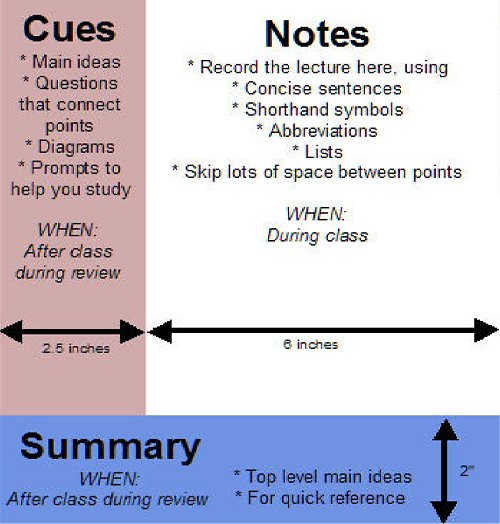
The Cornell method of note-taking

Separate your paper into three sections. The largest section is where you will record information from the lecture using sentences. After the lecture is completed, you will fill out the column to the left of the largest section. This is where you will record the main ideas and anticipate test questions. Finally, at the bottom of the paper, is a summary of the lecture. This should be completed immediately after the lecture because this is when the information will be freshest in your memory. The Cornell method of notetaking is excellent because it utilizes the “three-pass” approach to learning—meaning you encounter the material in three different ways. This is optimal for retaining the information in your memory for good.

No. 3: The outline method

The outline method of note-taking

Place the main and most important points farthest to the left of your paper. As information that is more specific is given, indent to the right. The more to the right a point is, the less important it is. It’s important to note that once a new topic is started, you should begin at the left margin once more. Your outline should be a well-organized system where each subheading relates back to the original heading in the left margin. Outlining reduces editing, records content, and relationships, and allows for easy reviewing.

No. 4: The sentence method

The sentence method of note-taking

Simply write every new thought, topic, or fact on a new line. While similar to the outline method, this method is easier to use when the material is difficult or delivered quickly. It is best to immediately review these notes after class and rank what information is most important and least important. It’s also helpful to rewrite your notes into an organized outline or map so that you can visually see the ordered relationships and connections.

No. 5: The mapping method

The mapping method of note-taking

Identify the main topic and underline it at the top or middle of your paper. Identify the sub-topics or supporting main ideas and place them around or under the main topic. Continue down or outward until you cover all the relevant information. Color coding or changing the shape of the bubble depending on where the information came from could be helpful. For example, a rectangle for book information and an oval for lecture information. The mapping method allows you to clearly see a topic from a global perspective.

Note-taking methods: Which is right for you?

Nursing student typing on laptop

If you’re unsure which note-taking method fits your learning style best, start from the top and try each one. Keep in mind that one method might work well for one class but not necessarily all of your classes. So, don’t be afraid to try out multiple and keep switching them out when you feel your retention starts to stall.

Additional reading opportunities

Check out, “Concordia’s Different Learning Formats,” for further reading on learning styles in a university setting.

All about the Doctorate of Education in Leadership in Innovation and Continuous Improvement

With consumer demand ever-evolving in the marketplace, industry leaders are forced to embrace innovation more than ever. 

But there is hope. And it comes in the form of interprofessional collaboration.

To maintain a competitive edge, business leaders and healthcare providers must work together. In fact, those that refuse to collaborate with others don’t stand a chance in the marketplace.

That’s why we created our Doctorate of Education (Ed.D.) in Leadership in Innovation and Continuous Improvement (LICI)—to solve real-world issues. Our goal is to help individuals from various industries work together to tackle issues through the use of innovation and continuous improvement science.  

What is the Doctorate of Education in Leadership?

Collaborative Learning Environment

Our LICI program focuses on interprofessional application. Each cohort is made up of a diverse group of students from business, education, and health professions.

“I think one reason [this program] works at Concordia is that we’re a very collaborative community and we learn from each other,” said Dr. James Pingel, program director and Dean of the School of Education. “We have some great leadership in all our schools—they don’t just talk about collaboration, they live by it.”

The goal is to build a true environment of interprofessional learning. Students get to connect with peers from different industries to solve problems together. They also learn from a range of professors spanning multiple industries.

“They learn from one another,” Dr. Pingel said. “There’s knowledge and skills that each field can learn from one another.”

Creating Real Impact for Learners

Some doctorate programs focus just on leadership development, the study of continuous improvement, or how to be an agent of innovation. However, our Ed.D. combines all three to fully equip students to create a real impact in their careers.

The program has a core of three pillars:

  • Leadership core
  • Innovation and improvement science core
  • Research core

Students also get the chance to customize their experience by choosing between business or education emphasis electives. Throughout the coursework, students can practice everything they learn in either their dissertations or ongoing projects in their workplace.

“It is a project-based philosophy,” Dr. Pingel said. “They need to apply some of the continuous improvement best practices to a project they’re working on at work. Using these practices, they can improve efficiency or enhance their organization. It’s very pragmatic in its approach where [students] will be doing real-world projects, real-world scenarios.”    

A Unique Dissertation Approach

Building off of the project-based mindset of the curriculum, the program also takes a unique approach to the dissertation. Traditional doctorate programs wait to begin the process until students are a few years into the coursework. However, with this program, students begin their dissertation work in the first month. This approach builds on the project-based learning structure, giving students the ability to apply lessons and projects directly to their dissertations.

“We know people are busy, they’re working, but they want to climb the ladder and achieve more wherever they’re at or for some future job,” Dr. Pingel said. “We want this to be a transformational experience for them. One that they can not only apply what they’ve learned but also feel good that they’ve got that diploma in hand.”

Along the way, program participants are encouraged to consider all the theories they learn and projects they complete through the lens of faith.

“We’re very excited that we can offer this program from a Christ-centered perspective,” Pingel said. “We welcome students from all faith backgrounds. But it’s our chance to certainly shed a light, share, and expose people to God’s word in our own noncoercive yet upfront way.”  

Learning in an Online, Asynchronous Environment

We know that earning your doctorate is a true commitment of your time and resources. Therefore, we built our LICI program with the value of flexibility in mind. You’ll have the ability to do asynchronous online learning. From the courses to group discussions and meetings with faculty, you can complete it all online as you pursue your degree.

Asynchronous?  What does that mean?  Asynchronous describes online learning where the course material is continuously present (always there, ready and waiting for you). As a student, you have the convenience of doing your coursework at times that fit your schedule. For asynchronous learning, you can do your online lesson on a weekend morning, or maybe you work better later on weeknights. It’s more focused on meeting your learning needs and the optimal time for you to learn.

Ready to embrace innovation and continuous improvement?

Regardless of the industry you’re in or the title of your position, you can achieve success through the use of innovation and continuous improvement. As Dr. Pingel says, “It’s intense. It’s tough. But it’s worth it.”

If you’ve been trying to figure out what the next step forward is toward accomplishing your career goals, consider this your invitation to explore the Ed.D. program.

This blog was originally published on 12/06/2018. It has been updated to reflect current information.

Jobs in Health Care: 8 Unusual Options

With so many different and unusual options for jobs in health care, where will you go next?

Whether you’re entering the health care field for the first time or are a long time professional searching for a new career path, your job options are vast. Some of them are even unusual. From working with humans, animals, veterans, and vacationers to engaging with evolving technology, you have a plethora of unusual and fulfilling jobs in health care that you can choose from to find the perfect fit.  

Veterans’ Social Worker

You can help a hero. Even within the area of veteran care, there are many different kinds of jobs social workers can pursue. Specializations include suicide prevention, mental health, readjustment counselor, substance abuse, and homeless assistance. While this job can be taxing, it is incredibly fulfilling to serve those who have served this country. Eager to get your social work career started? Here at Concordia, we offer both a bachelor’s in social work as well as a master’s in social work.

Hippotherapist

What about working with people AND horses? Occupational therapists, physical therapists, and speech & language therapists can be a part of treating patients through experiences with horses. Typically, the therapist guides both the horse and the rider to improve the patient’s neuromuscular disorders, walking ability, and general motor function. This work can be not only enjoyable but also powerful.

Pediatric Physical Therapy

Physical therapy is needed in many different settings. One of those settings is school. As a pediatric physical therapist, you will likely work with children who have physical development or motor skill delays. Typically, the therapy will focus on active play and positioning. This job is rewarding as you see evidence of your ability to improve the lives of young people. Explore our physical therapy program to see how you could catapult your PT career forward. 

Ultrasound Technician

Ultrasound technicians get to look at people’s (including children’s) organs! Although more common than some of the other careers on this list, ultrasound technicians have very unique experiences. Within this truly fascinating career, technicians specialize in obstetrics, breast, or vascular sonography. If you want to be an ultrasound technician, consider a degree in Diagnostic Medical Sonography or Radiologic Technology.

Nuclear Pharmacist

This job is not for the faint of heart. These specially trained and licensed pharmacists dispense and compound radioactive materials. The materials are then used for medical procedures and imaging. If you want to be a pharmacist, but aren’t interested in working directly with patients, this job is for you. Nuclear pharmacists work strictly with their scientific peers.

Veterinary Pharmacist

So you love pharmacy and have a passion for animals? Then this job might be for you. As a pharmacist, job responsibilities still include dispensing drugs and prescription information. However, the patients are much cuter. This unusual job is very rewarding as you care for our favorite pets. Check out our School of Pharmacy to see the different degrees that we offer. 

Forensic Nurse

Forensic nurses deal with victims and perpetrators of abuse, assault, and neglect by caring for the patient’s medical needs, collecting evidence, and testifying in court. The service that forensic nurses offer is truly one of a kind. In this career, you can specialize in sexual assault, domestic violence, child abuse and neglect, elder mistreatment, death investigation, corrections, or the aftermath of mass disasters. Nurses aspiring to become forensic nurses will receive special training in the legal system before entering the field.

Cruise Ship Nurse

Forget about taking time off of work for a vacation. Why not be on vacation as you work? Cruise ships hire nurses to work throughout the journey. However, this job can be very challenging. Because access to hospital care is very limited while at sea, nurses will treat everything from bumps and bruises to heart attacks and dehydration. That being said, who wouldn’t want to be able to relax in the Caribbean between shifts? To get started on your nursing career, check out our School of Nursing.

With so many jobs in health care to choose from, where will you go next in your career?

Here at Concordia, we prepare our students to lead a career marked by excellence, compassion, and service no matter what direction they go in. We do this because we believe that if you build a solid foundation of care through thoughtful education, you really can go anywhere and do anything in the health care field. To learn more, check out our School of Pharmacy, School of Health Professions, or School of Nursing.  

This blog was originally published on November 12, 2018. It has been updated to reflect current information.

Career Goals: 5 Steps for Success

Don’t let those career goals elude you for yet another year. Follow these five steps to set yourself up for success in 2023.

This year is already making headway and going by quickly. It is never to late to start making goals for yourself, its not just something for New Years.

Wherever you are, whatever you’re feeling, now is the time to take stock, make some notes, and begin preparing goals for yourself. Because no matter what career goals you left unturned or undone in 2022, they can always be pursued this year. So lets start being intentional and setting ourselves up for success. Slow down, pause for reflection, and prayerfully plan out what you need to accomplish. I promise you won’t regret it.

Ready to get started? Here are five steps you can take to intentionally prepare for your 2023 career goals.

1. What Worked?

The first step to any good reflection is to take stock of what has already taken place. Do you already have healthy habits? Which ones worked? What did you like about them? For example, you could have had a goal to speak up more in meetings. Did you grow that into a habit? If so, what was the result of that work? Think through all of the things that you have changed (or intentionally kept the same) and pinpoint what worked. What impacted you enough to make you a mentally, spiritually, and physically healthier person today? Focus on the progress you have made and continue to implements the habits that do work.

2. What Didn’t Work?

The second step is to consider all the things that didn’t work. Are there habits that you put in place that ended up creating more stress or didn’t have the desired effect you had in mind when you created them? Did you set goals that you couldn’t meet only to end up stuck in fatigue and guilt today? Perhaps you made a goal of starting a new project every month and weren’t able to maintain that consistently. Make a note of that. Figuring out what didn’t work is just as important as outlining what worked.

3. Where Do You Want to Go Next?

If nothing was hindering you, what would be the biggest thing you want accomplished this year? As you think through this, don’t just focus on your career. Rather, consider every facet of your life including finances, service/volunteerism, family, friends, faith, etc. Because even if you achieve that career goal of obtaining a promotion, enrolling in a master’s program, starting a new side business, or getting a pay raise, if the other areas of your life aren’t in order, achieving those career goals won’t be sustainable long term.

So take stock of everything. How good is your support system? Are your finances in a healthy place? Do you have a plan set up to save for retirement? Are you pouring enough into your family and friends? How strong is your faith? This is where the transformation happens, so dream big.

4. Put a Plan in Place

Once you figure out where you want to go, put a plan in place for how you’ll get there. Just like a road trip, ideas and destinations are nice to imagine, but then, at the end of the day, they’re just that—imaginations. By taking the time to outline how you’ll get from point A to point B, you can guarantee yourself a higher chance of success. For example, if you’re unhappy in your career or you’re ready to try something new, you could list out continuing education options, conferences, or degrees to check out—all of these tools are ways that you can begin to change your current circumstance into a healthier one—to actually get from point A to point B rather than simply dreaming about a promotion in your cube for another year.

5. Share the Plan and Get Support

The last step is to share your plan with a few key, trusted people to set up some accountability. By sharing with these people, you can ensure that someone will help keep you on track. We’re all familiar with the mid-year slump, but this year you can beat it by bringing some trusted friends in on the journey with you.

If you need even more motivation to work on your goals, you can also set up incentives for yourself. For example, if you’re researching schools for that next degree that you want to obtain, you could make a goal of having a list researched by March with an incentive of having to pay each support team member $20 if you miss the deadline.

Preparing well for your goals is no small task. However, it can be not only a fun but also a transformational experience. So I encourage you, don’t take lightly the task of proper preparation. All of us here at Concordia believe that you have a unique calling on your life and we’re excited to see how a little reflection and preparation can go a long way in helping you fulfill that calling.

If you’re ready to take an even bigger step toward achieving your career goals, check out our free email course “Functioning Above Entry Level.” This course will walk you through a few key lessons on how you can recognize and utilize your personal strengths to make strides in your career. 

This blog was originally published on December 6, 2018. It has been updated to reflect current information.

Emerging Jobs in Tech

We’re excited to share that of the top 10 emerging jobs on the list, our master’s degree in computer science prepares graduates for half of them. It’s evident that jobs in tech are booming, and now, the statistics clearly show that graduating with a degree in computer science is going to prove valuable and necessary for today’s job market.   

1. Data Scientist

This role has been featured on LinkedIn’s list for three years. These individuals are responsible for taking immense amounts of data and figuring out ways to make sense of it to help whatever company they work for. This job also spans multiple different industries—data scientists are found in financial services, internet services, computer software, higher education, and more. 

How Concordia prepares you for this role: 
  • Artificial Intelligence—an advanced course in current trends in artificial intelligence that builds on our undergraduate AI course. An emphasis is placed on emerging tools as well as robotics.
  • Applied RESTful APIs and Integrations—an advanced course in current trends in server-side web development that builds on our undergraduate web technology course. This course takes content from several undergraduate courses in data structures, software engineering, databases, and web technologies and focuses on creating HTTP-based CRUD services that provide real-time data to integrate applications.
  • Advanced Algorithms—an advanced course in current trends in problem-solving and algorithms that build on our undergraduate courses, data structure, and computer science theory. This course looks at emerging algorithms across the grand ideas of computer science. As new technologies emerge, new algorithms must be explored to support them.

2. Full Stack Engineer

With a 35% annual growth, this oldie but a goodie is seeing a renewed interest across industries as technology continues to change the landscape, putting companies in need of these individuals. 

How Concordia prepares you for this role: 
  • Cybersecurity—an advanced course in current trends in cybersecurity and penetration testing that builds on our undergraduate cybersecurity course. Emphasis is put on emerging threats and their detection, prevention, and recovery.
  • User Experience (UX)—an advanced course in current trends involving how humans use technology and the appropriate and changing interfaces required. This extends the undergraduate human-computer interaction course, emphasizing fundamental user experience theory. User experience tackles emerging technologies and their unique interface requirements with human beings.
  • Applied Computer Networking—an advanced course in current trends in computer networking and security that builds on our undergraduate networking course. Focus is placed on advanced topics still related to traditional computer networking concepts.
  • Applied RESTful APIs and Integrations—an advanced course in current trends in server-side web development that builds on our undergraduate web technology course. This course takes content from several undergraduate courses in data structures, software engineering, databases, and web technologies and focuses on creating HTTP-based CRUD services that provide real-time data to integrate applications.
  • Advanced Algorithms—an advanced course in current trends in problem-solving and algorithms that build on our undergraduate courses, data structure, and computer science theory. This course looks at emerging algorithms across the grand ideas of computer science. As new technologies emerge, new algorithms must be explored to support them.
  • Compilers—an advanced course in current trends of compiler design and implementation.  Students will create a modern trends-inspired compiler for a well-known modern programming language.
  • Language Theory—an advanced course in current trends of programming language design and implementation.  Students will create a modern trends-inspired programming language and solve traditional problems using their creation. This course builds on our undergraduate language theory class.

3. Data Engineer

Data engineers and data scientists go hand in hand. They are the ones behind all of the infrastructure that equips companies to use their most valuable asset—data. Industries demanding these professionals go beyond the typical computer software, financial services, and hospital & health care ones to now include retail and automotive. Everyone, it seems, is making use of data. Without a smart data engineer at the helm, opportunities get missed.  

How Concordia prepares you for this role: 
  • Cybersecurity—an advanced course in current trends in cybersecurity and penetration testing that builds on our undergraduate cybersecurity course. Emphasis is put on emerging threats and their detection, prevention, and recovery.
  • User Experience (UX)—an advanced course in current trends involving how humans use technology and the appropriate and changing interfaces required. This extends the undergraduate human-computer interaction course, emphasizing fundamental user experience theory. User experience tackles emerging technologies and their unique interface requirements with human beings.
  • Applied Computer Networking—an advanced course in current trends in computer networking and security that builds on our undergraduate networking course. Focus is placed on advanced topics still related to traditional computer networking concepts.
  • Applied RESTful APIs and Integrations—an advanced course in current trends in server-side web development that builds on our undergraduate web technology course. This course takes content from several undergraduate courses in data structures, software engineering, databases, and web technologies and focuses on creating HTTP-based CRUD services that provide real-time data to integrate applications.
  • Advanced Algorithms—an advanced course in current trends in problem-solving and algorithms that builds on our undergraduate courses, data structure, and computer science theory. This course looks at emerging algorithms across the grand ideas of computer science. As new technologies emerge, new algorithms must be explored to support them.
  • Compilers—an advanced course in current trends of compiler design and implementation.  Students will create a modern trends-inspired compiler for well-known modern programming.
  • Language Theory—an advanced course in current trends of programming language design and implementation.  Students will create a modern trends-inspired programming language and solve traditional problems using their creation. This course builds on our undergraduate language theory class.

4. Cybersecurity Specialist

The rise of technology and data value makes cybersecurity specialists even more necessary to smooth and safely run companies. This is another role that is spread across industries, particularly as attacks and hackers get more and more sophisticated and data becomes increasingly personal and confidential. 

How Concordia prepares you for this role: 
  • Cybersecurity—an advanced course in current trends in cybersecurity and penetration testing that builds on our undergraduate cybersecurity course. Emphasis is put on emerging threats and their detection, prevention, and recovery.
  • Applied Computer Networking—an advanced course in current trends in computer networking and security that builds on our undergraduate networking course. Focus is placed on advanced topics still related to traditional computer networking concepts.
  • Advanced Networking—an advanced course that focuses on modern trends in computer networking technology. While this course will be related to the other networking courses in this curriculum, it takes a different approach. Focus is placed on advanced topics related to emerging computer networking concepts.
  • System Design—an advanced course that focuses on the design of software and hardware-based systems and their related integrations. This course explores the problem-solving approach of taking a project proposal and turning it into a working, multi-technology solution.
  • System Administration and Maintenance—an advanced course focusing on the administration and maintenance of existing systems. This course deals with the unique administration problems associated with system solutions for emerging technologies.

5. Artificial Intelligence Specialist

According to the LinkedIn report, this role has seen an annual hiring growth of 74% over the past four years and boasts rather large salaries. Individuals in these roles include engineers, researchers, and many others who specialize in machine learning and artificial intelligence. 

How Concordia prepares you for this role: 
  • Artificial Intelligence—an advanced course in current trends in artificial intelligence that builds on our undergraduate AI course. An emphasis is placed on emerging tools as well as robotics.

Where do you fit in?

As you think about your own future, do you see yourself filling any of these roles? If LinkedIn’s data says anything, it’s job security. And we would love to be the ones setting you up for success in the job of your choice. Click here to learn more about our master of science in computer science. 

How to Pay for School as an Adult

Education is one of the greatest investments you will make in your lifetime and provides value personally, professionally, and financially. However, figuring out how to pay for school shouldn’t be something that keeps you up at night.

Whether you’re pursuing an accelerated undergraduate program, a master’s degree, or a doctorate, you have options beyond your savings account to pay for school. 

Scholarships 

Just because you’re an adult or non-traditional learner doesn’t mean you don’t have the opportunity to obtain scholarships. Scholarships are one of the best ways to pay for school because you never have to pay back the money you receive. Often, the only stipulation to receiving a scholarship is that you maintain the requirements outlined in the application like a certain GPA, for example. 

Sometimes universities will offer scholarships specifically for adult learners, like our uncommon scholarships, so be sure to check with your school to see if they provide anything similar. You should also check with your church to see if they have any scholarships available for which you could qualify. Otherwise, you can use our scholarship search tool to search through the scholarships we keep on file or use the Sallie Mae search tool to find ones specifically for graduate school. 

Tuition Reimbursement 

One great bonus of pursuing education as an adult is that many employers offer some kind of reimbursement to help pay for it. Some businesses even have partnerships with universities that allow their employees to pursue a degree there for a discounted price. This is something we offer through our business and community partnerships. 

Even if your company doesn’t have a partnership with a school, they might still have some kind of educational advancement initiative that could help you pay for at least a percentage. Always make sure to check with your human resources department to see if your employer offers anything like this. 

Loans

Loans are borrowed money that must be repaid with interest and can be either federal or private. A common myth is that adult learners don’t qualify for federal aid, but there are several different options that are available for you to consider: 

  • Subsidized loans—Loans given to undergraduate students who demonstrate financial need. If you’re an adult pursuing an accelerated undergraduate degree, you could qualify for this. The additional benefit is that these loans don’t start earning interest until you’re out of school. 
  • Unsubsidized loans—Loans available to all students are eligible and qualify for Title IV funding. These loans are different than subsidized ones in that they start earning interest as soon as they are disbursed. 
  • Graduate plus loans—Loans available to graduate students who are eligible. These can have a higher interest rate than subsidized and unsubsidized loans.  

Beyond federal loans, you can also get alternative loans (i.e. private loans) typically offered by a lender such as a bank or credit union. These often have a much higher interest rate than federal loans and don’t qualify for student debt forgiveness should you ever find yourself eligible. 

If you decide to pursue loans as a way to pay for school, always make sure you maximize your federal eligibility before you opt for private ones.  

Budget Payment Plans 

If you aren’t able to secure as much aid as you’d like, a payment plan can be a great way to take care of your outstanding bill. This helps you avoid facing that one giant bill typically due before your first class. For example, a payment plan might split up your remaining bill with a set amount of monthly payments for the remainder of the semester or year. Work with the financial aid office at your school to figure out what payment plans are available and choose the one that works best for you. 

What’s next?

Are you already back in school and struggling to balance all of the work with your job, life, and other responsibilities? We get it—it’s hard. But it is possible to balance it all without losing your mind. Check out our practical school tips for ideas on studying smarter, removing distractions, tapping into your support system for help, and more.   

This blog was originally published on February 10, 2020. It has been updated to reflect current information.

Is Church Ministry Work for You?

That’s what the Director of Church Ministries Certificate program is for. To train and prepare individuals just like you for work alongside pastors throughout the LCMS network.

According to Rev. Dr. Kurt Taylor, the goal of the program is twofold. To help individuals gain a deeper understanding of the Christian faith and become better equipped to serve in the Church. Achieving this goal starts with a deep dive into theology.

The first level of the program is the “Foundations for Service.” Participants will encounter religion classes on the Old and New Testament, biblical theology, religion in America, and Christians through the ages. With that foundation, Rev. Taylor says, “They can be the most theologically knowledgeable person in the church besides the pastor.”  

What is the curriculum like?

But preparation for church ministry in this program doesn’t stop at theology. The course curriculum also includes an entire level dedicated to “Practice in Serving.” Here participants learn about Christian caregiving, family and youth ministry, youth and adult religious education communicating Bible messages and missions. We believe learning and theology are about the whole person so we integrate that concept into our program.

Rev. Taylor uses a baseball analogy to describe the outcome for graduates of the Director of Church Ministries Certificate program.

“We’re creating utility infielders,” Rev. Taylor said, referring to the breadth and depth of knowledge and experience program participants receive. “We want to give the widest variety of exposure to what goes on in parish ministry.”

The program consists of traditional students eager to dedicate their lives to the Church to retirees wanting professional church work. In a time when the question of survival hangs in the balance for the Church, Rev. Taylor remains optimistic, even hopeful.

“I get excited when I see these young people and their love for the Lord,” Rev. Taylor said. “The future of our Church is in good hands.”

Our Director of Church Ministries Certificate is a non-degree program that is offered 100% online. The first and final course, each of which consists of a three-day residency at the Mequon campus. The online theology certificate program follows a cohort model. A new cohort starts every June, made up of courses that run for eight weeks at a time. On-campus students working on their Bachelor of Arts at Concordia can also take advantage of the certificate. 

Finishing up the program

Finishing the program, participants who receive certification can be rostered in the LCMS with the designation: Minister of Religion Commissioned — Lay Minister. Meanwhile, progress is being made toward this designation changing to Minister of Religion Commissioned — Director of Church Ministries.

Participants without a Bachelor of Arts degree will be unable to receive certification. If you wish to receive certification from the program but lack a bachelor’s degree you still can. You can take additional courses to earn your bachelor’s degree through our online adult learning theology major. This can be done alongside the certification program.

The Director of Church Ministries Certificate program is also open to any layperson curious about theology with a desire to learn more at a collegiate level. Lay people are invited to take as many courses as they want.

To learn more about the certificate, visit the program page. You can also explore the admissions process and get started on your application.

This blog was originally published on April 8, 2019. It has been updated to reflect current information.

5 Signs You Belong in Business

Have you ever considered going into business? Curious to see if you belong in the business field? Here are a few key characteristics that successful business people have.

The world of business spans many disciplines. In almost every corner of the world and within every kind of operation, good business people are needed. If you have an interest in entering the business world and filling that need, here are a few key characteristics you must possess.

Leadership Skills

Leadership skills not only set you apart, but they also equip you to climb the ladder and even build your own business someday. Part of being a good leader is proving to others (peers and managers!) that you are reliable and trustworthy. If you expect people to follow you, they have to be able to trust you. So, work on establishing trust by keeping your appointments, bringing others new opportunities, and refusing to fuel office politics.

Competitive Ambition

Being in business comes with risks. A good business person has to have an ambitious drive and be able to quickly identify new opportunities. They should have a competitive streak and the ability to take the risk necessary to follow through on the opportunity. And when those risks don’t pan out, which does happen eventually happen, a good business person has to be able to learn, move forward, and try again.

Curious & Adventurous Spirit

Right along with competitive ambition follows a curious and adventurous spirit. It takes a lot of intellect to survive the business world, and with constant changes, you have to maintain a curious spirit. The term “life-long learner” defines a successful business person; always eager to learn more.

Solid Communication Skills

When you’re not selling, you’re building relationships. So, no matter what sector of business you work in, you have to be a good communicator. The good news is that communication is a skill that you can learn. If you don’t already have a solid grip on communication, focus on developing and growing your skills. A few ways to be a more effective communicator are, to be an active listener, be clear, and be aware of your body language.

Integrity

We emphasize integrity a lot here at Concordia. You have the opportunity to stand apart in the business world by having a steadfast dedication to integrity in everything that you do. Integrity in business looks like playing fair, maintaining promises, looking out for your coworkers or staff, and keeping your customers’ best interests in mind.

If you already possess these characteristics and are interested in pursuing a business career, your next step is to invest in training and education. Whether it’s starting with a bachelor’s degree or elevating your education to a master’s degree, we’ve got you covered here at Concordia.

Learn more about the benefits of getting an MBA here.

This blog was originally published on March 19, 2019. It has been updated to reflect current information.

Parish Nursing 101

Parish nursing is a form of nursing with deep roots in the Christian faith. It is focused on healing the mind, body, and spirit. It’s about the whole person’s wellness rather than just care after diagnosing and treating a physical symptom.  

Although parish nursing holds great significance for many congregations throughout the United States, it’s a mission-based occupation that is often not fully understood by everyone. To clear up some of the confusion, here are a few frequently asked questions about the occupation, its application, and its mission.

What is a parish nurse?

A parish nurse is a registered nurse who works for a congregation to provide for a variety of needs. They provide medical, emotional, and spiritual ones. They are individuals who are passionate about their congregation and have expertise in holistic wellness. Parish nurses can be volunteers, part-time employees, and full-time employees—depending on the church’s needs. Oftentimes parish nurses also work at a local healthcare facility.   

What does a parish nurse do?

In some rural communities, a parish nurse can be the quickest route to health care for congregation members. However, rather than tending to medical needs firsthand, a parish nurse works with the patient to recommend and plan for the best route of care. The care has special emphasis given to emotional and spiritual care. Oftentimes a parish nurse can be found doing a variety of tasks. Driving elderly people to and from appointments, providing a listening ear for a lonely individual, recommending a nutrition plan for a sick person, and more.  

Why do parish nurses exist?

Alongside the Lutheran Church—Missouri Synod, we see parish nursing as a vocation tied directly to the Great Commission. It mirrors the same concern that Christ had for the people He encountered. Complete holistic care for mind, body, and spirit. Because parish nurses focus on the wellness of the whole person, they’re able to bear witness to the Gospel message. They help individuals experience God as they tend to their emotional, social, spiritual, and physical needs.

How do I become a parish nurse?

In order to become a parish nurse, you must first obtain your nursing degree. You will also need a license to practice in your state. After completing your degree and license, you can then receive parish nurse training. This allows you to officially function as one in your congregation.

But nurses aren’t the only ones who should consider learning more about parish nursing. In fact, any healthcare professional with a desire to help patients experience true healing in every part of their mind, body, and spirit can benefit from parish nursing training.

Here at Concordia, we provide this training through traditional education. We also have a conference that is offered every summer. The Christian Caregiving Conference is open to any health care provider, parish nurse, and clergy member. Come and spend four days on our Mequon campus to learn all the basics of Christian caregiving. This conference is even available for credit by audit for nurses who are seeking continuing education opportunities for their RN license renewals.

What if I don’t have a medical background? Can I still get involved?

Absolutely! Parish nurses often function best when supported by a group from the congregation. Locate your parish nurse and ask what needs he/she might have. It could be something as simple as providing transportation for a member or helping to coordinate a prayer ministry. Either way, your parish nurse will be grateful for the help.

If your congregation doesn’t yet have a parish nurse, consult with your ministry leaders on the possibility of adding one. By starting this conversation, you could help to provide much-needed assistance to the most vulnerable in your community.

If you’re interested in parish nursing or our annual Christian Caregiving Conference, please contact Carol Lueders Bolwerk at carol.lueders.bolwerk@cuw.edu

This blog was originally published on January 11, 2019. It has been updated to reflect current information.

Social Work Jobs: Three Areas to Consider

Most of us, if prompted with the right question would say that we care about human struggle. To some degree, the suffering of others tugs at our hearts. Sometimes the tug is even strong enough that we follow through on the conviction to do something about it. But then there are people who feel so strongly to create a direct impact that they dedicate their entire careers to the work.

“Social work is extremely broad in scope, in terms of practice and employment opportunities,” said Dr. Elizabeth Talbot, chair and professor of social work. “They work with individuals, families, groups, communities, and organizations. . . I think people don’t realize how broad the profession is, or how many options there are with a degree in social work.”

All of those employment opportunities fall into one of three categories of social work, according to Social Work Guide. These jobs can include roles of big-picture planning and policy change in politics all the way to one-on-one work as an advocate for a child or a family.

So, if you’re someone who is passionate about dedicating your career to this kind of work, here are the three areas of social work where you can make a difference.

MICRO

Micro social work focuses on helping a family or an individual. These are jobs that often come to mind when people think about social work. They’re the common child and family social worker jobs that focus on getting people the resources they need right now to help change their individual circumstances. Some job options include:

  • Clinical social worker
  • Psychiatric social worker
  • Child and family social worker
  • Social and human service assistant
  • Healthcare social worker (including roles like a geriatric social worker and a hospice social worker)
  • Mental health and substance abuse social worker

MACRO

Macro social work is work done to create an impact on a large scale in areas like community systems or institutions. Because of the nature of this type of social work, most efforts are done through a government or non-profit agency. Some job options include:

  • Public policy social worker
  • Administrative social worker
  • Health care administrator
  • Research social worker
  • Environmental health worker and administrator
  • Public health administrator

MEZZO

Mezzo social work is the catch-all bucket that covers any of the areas that fall between micro and macro work. It typically includes work that focuses on support groups, task forces, and neighborhoods. Some job options include:

  • School social worker
  • Community social worker
  • Community health worker and administrator
  • Social and community service manager
  • Health educator
  • Group social worker

Social Work Guide notes that not everyone within the field of social work agrees on how these three areas of micro, macro, and mezzo should be split up. However, it’s still important to understand the function of each one as the success of social work in each category feeds into the success of the other categories. When each one is given the proper tools and resources to impact individuals and large groups, then sustainable, long-term change begins to happen.

Pursuing a social work degree at Concordia

The promise of that long-term change is what motivates us forward here at Concordia. We’re excited to help shape the next generation of social workers who will change the circumstances of those who need it most.

“One of the nice things about a Christian University is that we can talk about our faith. We integrate the impact of Christianity on social work across the curriculum,” Dr. Talbot said. “Here, faculty talk about how our faith in God impacts our work with people. Likewise, we talk about how our faith in God changes our practice behaviors and changes our perspective of people and their situations. We have the freedom to talk about God and our faith in the classroom. It is a privilege that does not exist in public schools.”

Theoretically, we emphasize the strengths perspective in practice. We hope the added benefit of a Christian perspective will help our students make an even stronger impact on the people and organizations they serve.

Wanting to advance your career in social work? Check out our Bachelor of Social Work and Master of Social Work degrees.

This blog was originally published on December 6, 2018. It has been updated to reflect current information.