Lance Allan shares lessons on faith—and the Brewers—at Christian Leadership Series event


After a career spent covering unforgettable championship moments across Wisconsin sports, Lance Allan checked off one final bucket list experience when the Milwaukee Brewers won their first World Series in franchise history.


Fresh off covering the Brewers’ historic postseason run, CBS 58 sports director Lance Allan visited Concordia University Wisconsin on Nov. 5 for “Where Faith Meets the Playing Field,” part of the university’s Christian Leadership Series. Allan shared stories from the postseason and reflected on faith, teamwork and the relationships behind the headlines.

Having covered Super Bowls, the NBA Finals, the Final Four and the Olympics, he fulfilled a longtime professional goal by covering the Brewers in the World Series. This year’s run brought him inside champagne-soaked clubhouses and alongside a team whose personalities and contributions made a lasting impression.

He remarked that his clothes had needed four trips to the cleaners to remove champagne and cigar smoke from the team’s celebrations. Underpinning his humorous anecdotes was gratitude for witnessing a milestone he had spent decades hoping to cover.


Finding peace on baseball’s biggest stage

Some of Allan’s most meaningful postseason moments happened away from the cameras.

Before Game 5 of the World Series, he recalled walking toward the field alongside Brewers pitcher Aaron Ashby. Their conversation turned to faith, prayer, and handling the pressure of the postseason.

Allan asked what the pitcher had learned through his playoff experience. Ashby shared that he and his wife had prayed before the postseason began and described an inner peace he was feeling during his dominant relief pitching throughout the playoffs.

The conversation illustrated the value of relationships that reach beyond an athlete’s performance.

“The way you witness to people is by getting to know them on a deeper level and just talking to them and kind of sharing their common experiences or realizing that they go through struggles; they’re human too,” he said.

He also pointed to the faith of Brewers Joey Ortiz and Brice Turang, describing how their professed trust in God provides direction for each of them through the uncertainty and setbacks of a professional sports career.

Getting to know the players personally also deepened Allan’s appreciation for what they accomplished together. He described a team of different personalities united by a common goal, with contributions coming from throughout the roster.

Asked to identify the greatest plays he had witnessed, Allan highlighted Jake Bauers’ lengthy at-bats against elite Dodgers pitching and Garrett Mitchell’s home-run-saving catch in San Diego. Choosing a single highlight from the Brewers’ run was difficult, he explained, because so many players had helped make the championship possible.

“You sacrifice for the greater good, and you’re better as a whole when everybody is contributing in some fashion,” he said.

That lesson, he explained, carried beyond the clubhouse to workplaces, Christian communities and Concordia itself: Individual contributions matter most when they serve a shared purpose.
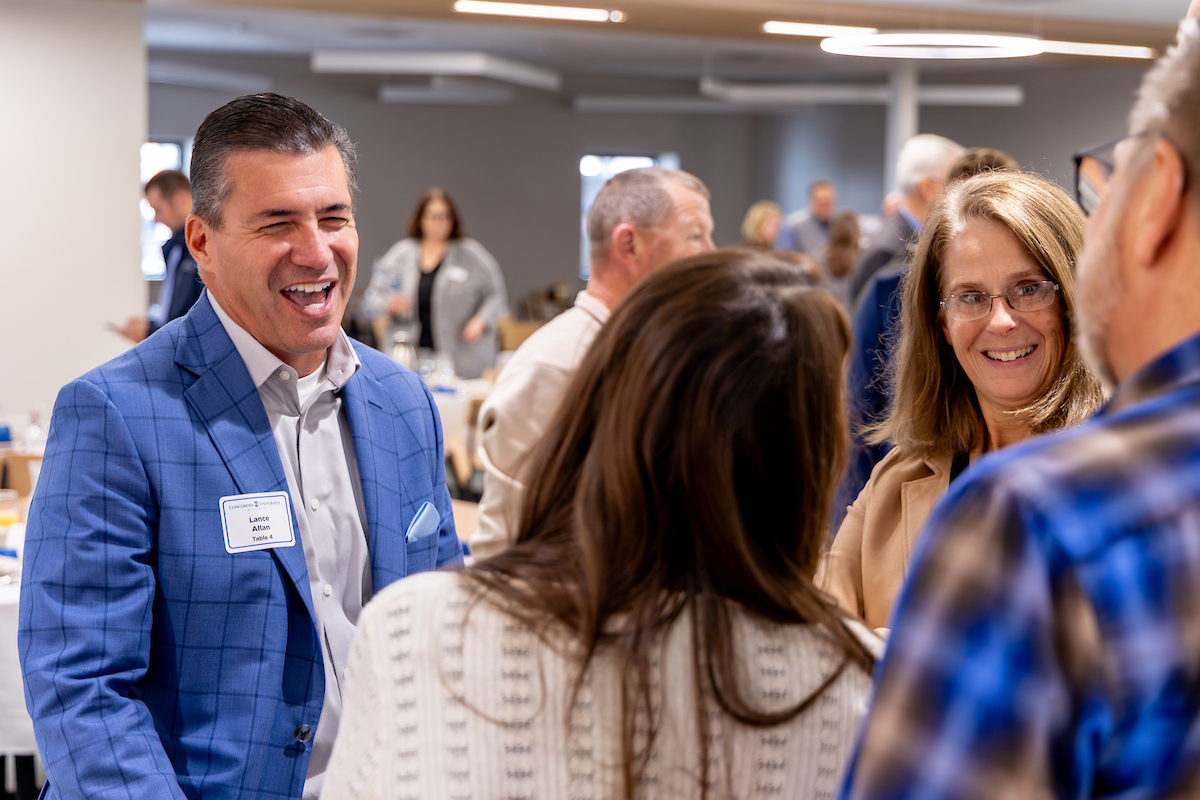

Lance Allan chats with attendees at Concordia University Wisconsin’s Christian Leadership Series breakfast.

Recognizing God’s preparation

Allan’s own path to those championship clubhouses began at a small radio station in Rice Lake, Wisconsin.

At 16, he asked for a broadcasting opportunity and accepted a Sunday morning job preparing church programming, playing country music, and reading news, weather, and sports. Arriving before dawn mattered little to a teenager excited to get started.

After college, his first television job in Rhinelander involved forecasting the weather. Although he wanted to cover sports, the assignment taught him to adapt, speak without a script, and think on his feet — skills that later became essential for interviews, coaches’ shows, and live reporting.

His transition into sports reporting took him from Rhinelander to Green Bay, where he covered the Packers’ Super Bowl XXXI championship team, and eventually to Milwaukee, where he has spent the past three decades.

Looking back, he saw God preparing him through opportunities that did not initially match his plans.


Bringing faith into daily work

Allan also acknowledged the demands behind the excitement of sports journalism. Championship coverage means travel, late nights, and time away from family. He credited his wife, Amy, and emphasized the importance of friendships, Bible study, and people who provide encouragement and accountability.

He also explained how faith shapes his treatment of athletes, particularly following difficult losses. He described the Golden Rule as a guide for asking necessary questions while respecting the person answering them.

Listening, he added, has become one of his most valuable professional skills.

“The way I’ve become a better interviewer is by becoming a better listener,” he said.

His message was grounded in 2 Timothy 2:15, a verse he said held particular meaning for his reflections on faith in the workplace:

“Do your best to present yourself to God as one approved, a worker who does not need to be ashamed and who correctly handles the word of truth.” —2 Timothy 2:15 (NIV)

That calling extends to how Allan uses his voice and the opportunities his career provides.

“One of the reasons why I felt like I was led to get into broadcasting or public speaking or doing something of this nature, was to use the small little platform that I have for the greater good,” he said.

Want in?

Concordia University Wisconsin is a Lutheran higher education community committed to helping students develop in mind, body and spirit for service to Christ in the Church and the world.


“Moneyball” MLB executive Billy Beane to headline CUW’s Ignite & Inspire Conference May 12


As Wisconsin celebrates the Milwaukee Brewers’ World Series championship, Concordia University Wisconsin will welcome a leader next year who helped reshape how baseball teams find talent and build winners.

Billy Beane, whose innovative use of analytics helped the Oakland Athletics reach the playoffs in four consecutive seasons from 2000 to 2003 despite one of baseball’s smallest payrolls, will headline CUW’s Ignite & Inspire Conference on May 12, 2027, on its Mequon campus.

Hosted by the Batterman School of Business, the conference will explore the theme, “Imagine More: Leading with Creativity, Purpose, and Vision.”

As general manager of the Oakland Athletics from 1997 to 2015, Beane challenged conventional approaches to evaluating baseball talent. By using data to identify undervalued players, including those whose ability to get on base was overlooked, he helped build winning teams on a limited budget. His approach became the subject of Michael Lewis’s book Moneyball and the subsequent 2011 film starring Brad Pitt.

The analytical movement Beane helped popularize continues to shape baseball, including in Milwaukee. Teams such as the Brewers combine advanced data with scouting and player development to uncover overlooked talent, improve performance, and compete against clubs with greater financial resources.

Those lessons extend beyond baseball. Beane’s experience illustrates how questioning assumptions, recognizing overlooked value, and using data to guide decisions can help organizations make the most of their resources.

Ignite & Inspire will feature other keynote presentations and workshops. Additional speaker and workshop information will be announced as details are finalized.

Early bird registration is $80. Tickets are available here.


Want in?

Concordia University Wisconsin is a Lutheran higher education community committed to helping students develop in mind, body and spirit for service to Christ in the Church and the world.


An uncommon journey from EMT to MLB

Brooke Trendel didn’t always know exactly what she wanted to do, but she always knew two things: she loved sports, and she wanted to help people.


Growing up in Waukesha, Wisconsin, she spent her childhood immersed in athletics, playing basketball and soccer and staying active year-round. But it wasn’t until an injury in high school changed her path that everything began to come into focus.

“I dislocated my shoulder twice,” she said. “I had to get surgery, and I was out for about five months.”

That recovery process introduced her to something new. While rehabbing, she began shadowing her high school athletic trainer.

“I just fell in love with it,” said Trendel, who is graduating with a Master of Science in Athletic Training. “It’s sports and helping people combined into one. That’s exactly what I wanted to do.”

It was a turning point that would ultimately lead her to Concordia.


Finding the Right Fit

Concordia offered a strong reputation in athletic training, an accelerated program, and early immersion in the major.

“They jump you into your classes right away,” Trendel said. “And the reputation really precedes the school.”

There were other factors, too—proximity to home, the campus environment, even the view of Lake Michigan. But what mattered most was the sense that she had found the right place to grow.


From Student to Professional

During her time at Concordia, her commitment to her studies led to one of the most competitive and defining experiences of her college career: securing the Milwaukee Brewers athletic training internship.

“I was floored when I got it,” she said. “I went to my dorm room and I was like, ‘I can’t believe it!’  Because growing up around here, I went to Brewers games. I was so excited.”

The opportunity didn’t come easily. After being turned down the first time she applied, Trendel leaned into feedback, worked closely with faculty mentors, and tried again.

“The second time, it went my way,” she said.

What followed was a full season embedded with a Major League Baseball organization, an experience that helped shape her understanding of the profession. From early afternoons preparing the training room at American Family Field, to late nights focused on player recovery, the work was intense and constant.

“Every home game, I was there,” she said. “We had a lot to do before the game and then a little bit afterwards, but it was super fun. I felt like I became a different student after the internship, and I fell in love with the sport. I fell in love with the intensity of it.”

Brooke Trendel leads a patient through athletic training exercises.

Memories with the Brewers

She was part of the Brewers’ historic 2025 season, highlighted by 97 regular-season wins and a dramatic Game 5 playoff victory over the rival Chicago Cubs in the National League Division Series.

“The champagne showers after we beat the Cubs,” she said. “That’s something I’ll never forget.”

There were moments, too, when she felt fully part of the clubhouse. During one stretch, players Christian Yelich and Trevor Megill jokingly challenged her to sing the national anthem in front of the team.

“It just showed how welcoming they were,” she said.

She quickly discovered that athletic training at the professional level is very much about relationships and routine.

“Players all have their routines, and we’d help them out with those routines,” she said. “You’re helping them prepare, recover, and stay ready every single day.”

Saving a Life

While her work with the Brewers highlighted her growth in sports medicine, another moment revealed something deeper: her readiness under pressure.

For four years, Trendel has worked as an EMT, balancing coursework, clinicals, and long shifts in emergency response. That experience proved critical one evening on Concordia’s campus.

After finishing clinicals, she became aware of an emergency unfolding in a nearby residence hall. A student had collapsed suddenly and was unresponsive.

When she arrived, others had already begun CPR. Trendel stepped in alongside fellow students and campus safety officers, continuing life-saving efforts and helping apply a defibrillator. The situation was dire. The student had flatlined multiple times and spent days in a coma before beginning a long recovery. Against all odds, he survived.

Later, seeing him walking again brought the moment into full perspective for Trendel.

 “Sometimes as an EMT, you don’t get to see the after effects of what you do,” she said. “But seeing him walking around was really great to see and very gratifying.”

Brooke Trendel was among a group of first responders who were honored for saving a student's life.
Brooke Trendel was among a group of first responders who were honored for saving a student’s life.

The Path Forward

Trendel credits much of her journey to persistence and to faith. There were setbacks along the way, including early rejections while applying for professional roles. But each moment, she said, ultimately led her where she was meant to be.

“There’s a reason for everything,” she said. “Looking back, the timing worked out exactly how it was supposed to.”

That perspective carried her through the next major step in her journey: securing a position after graduation with the Houston Astros organization.

After months of applications, interviews, and networking, she received an offer to join the Corpus Christi Hooks, the Houston Astros’ Double-A affiliate in Corpus Christi, Texas. Just days after graduation, she will relocate to begin her role, stepping fully into the professional world she has worked toward for years.

“They were willing to hold a spot for me,” she said. “I was so grateful.”

Faith and Resilience

Looking ahead, Trendel hopes to continue working her way up through professional baseball, with the long-term goal of reaching the major leagues. In addition she wants to continue as a role model for women in what is a traditionally male-dominated field.

“I knew I could always rely on God in moments of need,” she said. “There would be hard times where I was kind of burnt out from everything I’d be going through, but no matter what was going on, whatever high stress was going, I always knew this is part of God’s plan, and he’s going to set you on the right path.”


Editor’s note: This is one in a series of stories highlighting a few Concordia’s uncommon graduates. Faculty and staff submit candidates for consideration. Stories are posted in the days leading up to or after commencement. View more uncommon graduates here.

Want in?

Concordia University Wisconsin’s Master of Science in Athletic Training program combines classroom learning with extensive clinical experience to prepare students for careers in sports medicine. The CAATE-accredited program equips graduates with the skills needed to pass the Board of Certification exam and work in a variety of healthcare and athletic settings.


The uncommon graduates who found calling, creativity, and community through theatre

Inside Todd Wehr Auditorium, the stage lights illuminate scripts in hand, music echoing through the space, and students move through scenes in preparation for opening night.


These are the moments when performance, production, and creativity merge in anticipation of the rise of the curtain. However, something even deeper takes shape as well, especially for graduating seniors Aimee Zarder, Tirzah Schmickle, and Wyatt Michaels. For them, these experiences have been about a sense of calling, vocation, and the gift of friendship.

“We met almost immediately,” Aimee said of her friends Tirzah and Wyatt. “And then through the classes, since everyone takes many of the same classes, we just become very tight-knit.”

Over time, those shared experiences create something deeper.


Different Paths, Shared Passion

For Tirzah and Wyatt, that connection began even before Concordia. Both were homeschooled and participated in a homeschool theatre group, where they performed together prior to college.

Each student entered Concordia with a passion for the arts, but their understanding of that passion evolved during their time on campus.

“When I was in high school, I loved music, and I thought, ‘I’ll just teach,’” Tirzah said. “And then as I got in college, performing is more where my passion is. After a lot of prayer and thought, I just realized like performance is part of what I want my vocation to be.”


Developing Their Craft

Tirzah is a voice major who also plays violin, piano, and guitar, and performs locally with her band, Letters to the King.

Wyatt has immersed himself fully in Concordia’s theatre program, performing in every production during his time on campus while also directing and gaining professional experience outside the university. He described a similar sense of clarity, shaped by his experiences in the program.

“The more I did productions and classes, I realized I really want this to be what I do for the rest of my life,” he said.


Taking the Stage

For Aimee, a theater and communication arts double major, the journey has connected multiple creative interests. Her work spans acting, dance, and music—she writes original songs, organizes concerts, and is already planning a Midwest tour.

“I kind of grew up surrounded by the arts and trying a bunch of different forms of it,” she said. “And it wasn’t until middle school or high school that I started trying theater.”

At Concordia, that interest deepened and connected with other creative pursuits. More recently, that has extended into original music and live performance.

“My first concert, walking out onto the stage and seeing way more people than I thought would be there, and people knowing the words to things that I created in my bedroom, is like nothing I’ve experienced,” Aimee said.


Defining Moments

Moments like these, both in and beyond the classroom, have helped each student recognize a sense of direction.

For Tirzah, one of those moments came in a directing class.

“I was like, ‘Oh my gosh, I can’t do this,’” she said. “But then I did it, and that’s kind of when I was like, this is what I want to do.”

Wyatt, a theater major, pointed to experiences both on stage and in the classroom that helped shape his direction. Performing as Sherlock Holmes in Baskerville: A Sherlock Holmes Mystery challenged him to step into an iconic role and connect with live audiences, including packed student matinees. But it was an earlier moment that first set the tone.

“I think for me it was probably our first Acting 1 class,” he said. “The more the semester went on, the more I was like, wow, this is like really what I enjoy.”

Among their shared experiences, one production stands out.

All three pointed to a student-led show from last February, Where the Light Gets In, a student production co-directed by Aimee and Wyatt which explored how people experience and overcome hardship. Using three distinct characters representing sadness, anger, and hope, the production told a story of resilience, recovery, and the transformation that can emerge from life’s most difficult moments.

“It was really fun to create something with one of my best friends, and then to see the impact that it had on the people who saw it,” Aimee said.


A Deep Friendship

That connection extends beyond the stage. The three have spent countless hours together outside of rehearsals, including traveling to concerts, which has become a shared ritual and creative outlet.

“I go to maybe 30 a year,” Aimee said with a laugh

Whether staying local or driving farther for a favorite artist, the group has made a habit of turning concerts into moments of connection, experiencing live performance not just as audience members, but as artists learning from the energy, storytelling, and craft unfolding in front of them. For Aimee, one standout was seeing Gracie Abrams, an artist whose songwriting and performance style resonate deeply with her own creative work.


Carrying Confidence Forward

That willingness to step outside of comfort zones is something each of them now carries forward.

“Don’t be afraid to fail,” Tirzah said. “Failure is just an opportunity to see a new perspective of how you can grow.”

As graduation arrives, their next steps are taking shape.

Tirzah plans to teach theater and music in homeschool programs while continuing to perform with her band. Wyatt hopes to work in local theatre and eventually pursue graduate study. Aimee plans to continue performing, teaching dance, and developing original work, with longer-term plans to move and expand her opportunities.

For these three graduates, Concordia’s theatre program has been a place to grow, to take risks, and to discover what it means to pursue both passion and purpose.

“I’ve really learned about having theater as a vocation and  a calling and how like I can use that calling that I have to create my entire career, and find ways to serve the Lord through that,” Wyatt said.


This is one in a series of stories highlighting a few Concordia’s uncommon graduates. Faculty and staff submit candidates for consideration. Stories are posted in the days leading up to or after commencement. View more uncommon graduates here.


Want in?

Concordia University Wisconsin is a Lutheran higher education community committed to helping students develop in mind, body and spirit for service to Christ in the Church and the world.


Commencement 2026: Purpose, not perfection, defines the path forward

For the Class of 2026, the message was clear: the path ahead may not unfold exactly as expected, but purpose, perseverance, and faith will continue to guide the way forward.


Concordia University Wisconsin celebrated its spring 2026 graduates over the course of two days, with ceremonies held May 1–2 in the R. John Buuck Field House. Graduate commencement exercises took place across three ceremonies on Friday, followed by undergraduate commencement on Saturday. A Baccalaureate service was held Saturday morning in the Chapel of Christ Triumphant, reflecting on the calling of God in each graduate’s life.

Processional participants in white robes carry a cross down the center aisle of the chapel during Concordia’s Baccalaureate service as attendees stand in the pews.
Participants process down the aisle during Concordia University Wisconsin’s Baccalaureate service in the Chapel of Christ Triumphant.

Student speakers reflect on the journey

Across the university’s ceremonies, student speakers returned to a shared idea: that the path forward is rarely linear—and that growth is often shaped in the moments when plans change.

At the 11 a.m. graduate ceremony for the School of Arts & Sciences and School of Education, Vanessa Pender, who earned her Master of Science in Education, encouraged her classmates to release the pressure of perfection and embrace adaptability.

“As you walk across this stage today and into whatever comes next, I hope you remember that your life will not be defined by how perfectly you follow a plan, but rather by how courageously you pivot when that plan changes,” she said.

Her message set the tone for the day, framing graduation not as the end of a carefully mapped journey, but as the beginning of something far less predictable, and far more meaningful.

That theme continued at the 3 p.m. graduate ceremony for the School of Nursing, School of Health Professions, and School of Pharmacy, where Amanda Reavey, Master of Social Work, shifted the focus from plans to purpose, urging graduates to think more deeply about the why behind their work.

“Vocation is more than a job title or professional path; it is the unique way each of us is called to serve others using our gifts, passions, and experiences,” she said. “As we move forward, may we continue to discern where we are needed most, trusting that our skills and our faith will guide us toward work that is successful and deeply purposeful.”

At the 7 p.m. Batterman School of Business ceremony, Isabelle Kobes, who completed her Doctor of Business Administration, reflected on the reality that growth often comes through challenge, emphasizing that leadership is not formed in ease, but through perseverance and lived experience.

“The path to success is rarely a straight line, but with support, perseverance, and purpose, it can lead places we never thought possible,” she said. “As we leave Concordia, we carry more than the knowledge gained through our studies. We carry the responsibility to apply what we have learned in ways that serve others and strengthen our communities.”

That perspective carried into Saturday’s undergraduate ceremony, where Brianna Lusk, Bachelor of Arts in Visual Communication, reflected on the shared experiences that defined the college journey.

“The real lesson? College isn’t just about specializing; it’s about embracing chaos, bonding over misery, and discovering that sometimes the most important skill isn’t in your major.”

Taken together, the voices of the Class of 2026 reflected a consistent message: that while each journey is different, purpose, perseverance, and a willingness to adapt will continue to guide the way forward.

Undergraduate graduates in caps and gowns walk through the ceremony, smiling and holding programs as they process past a seated audience.
Undergraduate students process into the commencement ceremony, celebrating the culmination of their time at Concordia University Wisconsin.

Special commencement awards

The ceremonies also provided an opportunity to recognize faculty, alumni, and students whose contributions exemplify Concordia’s mission and commitment to excellence.

Dr. Linda Hensel — Faculty Laureate
Paul Wangerin — Distinguished Alumnus

Ryan Zierath — Marsha Konz Graduate Educator Award
Kayla Mulder — American Bicentennial Award
Mikayla Dolan — E. R. Brann Citizenship Award
Kaitlyn Kotula — CUW Visual Arts Award
Eden Kruse — Tess and Jack Kenney Art Award
Shayla Fackler — Marsha Konz Student Educator Award
Ellie Lankey — Moeller Award in English
Matthew Diercks — Moeller Award in Greek; Søren Kierkegaard Philosophy Award; Zondervan Publishing House Award (Biblical Hebrew)
Samuel McCullough — Moeller Award in Hebrew; Zondervan Publishing House Award (Biblical Greek)
Maddie Loehr — Moeller Award in Spanish
Constansa Herrmann — Nightingale Nursing Award
Clara Wiegert — Nightingale Nursing Award
Lakyn Carter — Northrup-Bartelt Music Award
Paige Mielke — Religion Award
Abigail Barnhardt — Wilheim Schickard Award in Computer Science
Emma Ahrens — Science Award (Life Sciences)
Owen Drummond — Science Award (Mathematics)
Jeffrey Koepke — Science Award (Physical Sciences)
Micah Hoehner — Walter W. Stuenkel Award
David Koester — Zondervan Publishing House Award (Biblical Studies)
Alexander Loest — Zondervan Publishing House Award (Theology)
Wyatt Michaels — Theatre Leader of the Year
Ephraim Young — Campus Ministry Leader of the Year
Emily Brown — Student Engagement Leader of the Year
Mikayla L. Sells — Student Government Leader of the Year
Josh Michel — Music Leader of the Year

Undergraduate speaker Brianna Lusk delivers remarks at the podium in cap and gown during Concordia’s commencement ceremony.
Brianna Lusk addresses the Class of 2026 as the undergraduate commencement speaker at Concordia University Wisconsin.

Commencement Fun Facts: The Class of 2026

32 states represented
881 total graduates
347 undergraduate students
534 graduate students
344 bachelor’s degrees
432 master’s degrees
100 doctoral degrees
2 associate degrees
3 Hesed certificates
31 churchwork students
25 military veterans
203 international students

To see a list of all of the graduates for the most recent year, click here.

Graduate in cap and gown poses for photos with family near Lake Michigan, holding flowers and a diploma cover.
A graduate poses with family along the Lake Michigan bluff following Concordia University Wisconsin’s commencement ceremony.

Want in?

Concordia University Wisconsin is a Lutheran higher education community committed to helping students develop in mind, body, and spirit for service to Christ in the Church and the world.


Meeting a Growing Need: Concordia Prepares the Next Generation of Physical Therapists

At Concordia University Wisconsin, the Doctor of Physical Therapy (DPT) program prepares students to become highly skilled clinicians who are equipped to serve patients with compassion, expertise, and purpose.


That commitment to excellence is reflected in Concordia’s recognition as a 2026 Best Graduate School by U.S. News & World Report.

Through a rigorous academic experience, hands-on clinical training, and a Christ-centered approach to care, Concordia equips future physical therapists to make a meaningful impact in the lives of their patients and communities.


Focused on what matters most: Outcomes and preparation

Physical therapy is a profession grounded in trust, expertise, and real-world application. Demand for physical therapists continues to grow nationwide, with job growth projected to increase 11% over the next decade, according to the U.S. Bureau of Labor Statistics. As a result, the need for well-prepared, patient-centered clinicians has never been greater.

An aging population, increased focus on mobility and quality of life, and advances in rehabilitation are all contributing to expanded opportunities across the field. Physical therapists play a critical role not only in recovery from injury, but in helping individuals maintain independence and long-term health.

The physical therapy profession continues to evolve with more clinical practice areas and increasing professional autonomy. For example, physical therapists are practicing in expanding practice areas such as oncology, women’s health and telehealth.  Furthermore, professional privileges such as ordering medical imaging improve patient access and enhance the position of physical therapists as primary providers in the healthcare system.

Concordia’s doctoral program emphasizes clinical readiness—developing practitioners who can evaluate, diagnose, and treat movement dysfunction across diverse patient populations. Students engage in a comprehensive curriculum that blends foundational sciences with applied clinical practice, preparing them for licensure and long-term success in the field.

“Our focus has always been on preparing students to be excellent clinicians—individuals who can think critically, adapt to complex situations, and provide high-quality care,” said Dr. Dale Gerke, chair of the physical therapy program. “That’s what ultimately defines the strength of a program.”


Hands-on learning in a collaborative environment

Experiential learning is central to Concordia’s DPT program. Students gain extensive hands-on experience through lab work, simulation and multiple clinical education placements in a variety of healthcare settings.

Faculty bring deep clinical expertise into the classroom, creating a learning environment that is both academically rigorous and highly practical. Small class sizes and close faculty mentorship ensure that students are supported throughout their academic and professional journey.

Graduates leave the program well-prepared to meet the demands of the profession, with the skills and confidence needed to serve patients effectively and compassionately.

“Our Doctor of Physical Therapy program is designed to prepare students for meaningful, impactful careers in healthcare,” said Dr. Linda Samuel, dean of the School of Health Professions. “Our Christ-centered environment makes a difference by shaping graduates who not only excel clinically, but who approach each patient with compassion, integrity and a true sense of calling.


Want in?

The Doctor of Physical Therapy (DPT) program at Concordia University Wisconsin combines strong academic preparation with extensive hands-on clinical experience to develop practice-ready clinicians. Grounded in a Christ-centered learning environment, the program equips graduates to deliver high-quality, compassionate care across a variety of healthcare settings.


Concordia’s Occupational Therapy Program Ranked Among Top 25% Nationally

At Concordia University Wisconsin, a commitment to preparing students for lives of purpose and service continues to gain national recognition. Concordia’s Occupational Therapy program is ranked among the top 25% of programs nationwide by U.S. News & World Report in its 2026 Best Graduate Schools rankings.


With more than 500 occupational therapy programs across the country, this distinction reflects Concordia’s growing reputation for academic quality, hands-on preparation, and faith-centered formation.


A program grounded in purpose

Occupational therapy is about helping individuals live fuller, more independent lives—whether recovering from injury, navigating developmental challenges, or adapting to life changes. At Concordia, that work is rooted not only in clinical excellence, but in a deeper sense of calling.

Students in both the Master of Occupational Therapy (MOT) and entry-level Occupational Therapy Doctorate (OTD) programs are prepared to serve with compassion, skill, and integrity—equipped to make a difference in the moments that matter most.

“Being recognized among the top 25% of occupational therapy programs nationally is an affirmation of the work our faculty and students are doing every day,” said Dr. Meghan Watry-Christian, chair and director of Occupational Therapy. “We are proud to prepare occupational therapists who lead with both high levels of competence and a strong sense of purpose.”


Hands-on learning that makes a difference

Concordia’s OT programs emphasize experiential learning from the start. Through hands-on lab experiences, hospital simulations, treating in the campus clinic, community engagement, and fieldwork placements, students gain the practical skills needed to thrive in a wide range of settings—from hospitals and rehabilitation centers to schools and community-based organizations.

Faculty bring both academic expertise and real-world experience into the classroom, mentoring students as they develop clinical reasoning, problem-solving abilities, and a client-centered approach to care.


Flexible pathways to advance your calling

Whether students are beginning their journey or advancing their professional goals, Concordia offers pathways designed to meet them where they are:

Both programs are designed to support students academically, professionally, and personally—within a Christ-centered community that values growth in mind, body, and spirit.

“This recognition speaks to the strength of our health professions programs and the intentional way we prepare students for impactful careers,” said Dr. Linda Samuel, dean of the School of Health Professions. “We are committed to developing graduates who are not only highly skilled, but who serve with compassion and purpose in their communities.”


Want in?

Concordia’s OT program makes stepping forward in your calling as an occupational therapist attainable no matter where you are in your journey. Our multiple program pathways and hybrid course formatting will prepare you holistically through our faith-based, student-centered curriculum, and diverse, hands-on, clinical experiences. You’ll graduate ready to help your patients thrive in a variety of settings.


Win the Day: Vin Baker Brings Powerful Testimony to Christian Leadership Series

In the heart of Vin Baker rests a simple but transformative truth: hope is stronger than any obstacle, and winning the day begins with looking up.


That theme resonated throughout Concordia University Wisconsin’s Christian Leadership Series on Thursday, Nov. 20, as Baker—Milwaukee Bucks assistant coach, four-time NBA All-Star, and recovery advocate—shared a raw, faith-filled testimony of redemption and purpose.

More than 200 business and community leaders gathered at the River Club of Mequon for the semi-annual event, sponsored by PWSB, where Baker’s keynote—“Hoops to Hope: Life’s Lessons in Perseverance”—delivered laughter, honesty, and a deeply personal call to embrace each day as a gift.

From the moment Baker stepped to the microphone, he brought a warmth and authenticity that immediately connected with the room.

“I don’t go far into my story without telling you exactly why I’m here,” he said. “It’s by God’s grace, favor, and His mercy that I’m standing before you today.”

In April, he will mark 16 years of sobriety—a milestone he described not as an accomplishment, but as a miracle.

A Journey Marked by Triumph—and Collapse

Baker shared the improbable arc of his life: from a ninth-grader who was actually cut from his basketball team to averaging 28 points per game as a senior at the University of Hartford; from the No. 8 pick in the 1993 NBA Draft to a four-time NBA All-Star, Olympian, and Jordan Brand athlete.

But 1997 marked a turning point—not upward, but downward. Following a playoff run with the Seattle SuperSonics, Baker picked up alcohol “and couldn’t put it down.” In the span of a few years, he went from one of the most respected players in the game to a man losing everything: his career, finances, reputation, and health.

“In 2006, I was done playing basketball,” he said. “I was a full-blown alcoholic, and I was out of the league. No one wanted me around. In 2014, I was working at Starbucks. I had lost essentially everything except God.”

He described the lowest moment of his life: standing in a bathroom, weak from addiction, asking God simply to save his life—not his image, not his career—just his life. That prayer led him to detox, then to recovery, then to an unexpected door cracking open.

The Slow, Steady Climb Back

Baker’s return to the Milwaukee Bucks began humbly. A former teammate, Jason Kidd, brought him on to assist part-time with the team and with broadcasting. Eventually, Baker transitioned fully onto the coaching staff, where he now works with players—including NBA superstar Giannis Antetokounmpo, whom he affectionately called “like a son.”

The Bucks’ historic 2021 NBA Championship run was an incredibly proud moment, but even that ring, he told the audience, was not his proudest moment.

“Outside of my kids, my most crowning moment as a human being was being able to open up the Vin Baker Recovery Center,” he said. “There’s nothing like being able to pay forward what God has blessed you with. I often say that coaching the Bucks is my day job. Recovery is my mission and my passion. I’ve been there where the patients are.”

The center, launched in 2024 as part of his Bouncing Back Foundation, provides compassionate treatment and mentorship to people battling addiction.

Hope as the Path Forward

Throughout his remarks, Baker returned to a simple but profound theme: winning the day.

Sobriety, he said, isn’t built in years—it’s built in moments, in small victories, in choosing hope over despair again and again.

“If you only carry one thing throughout your entire life,” he told the audience, “let it be hope. Let it be the hope that better things are ahead. Hope is what got me here today.”

He tied the idea to Scripture, reading from Psalm 121—“I lift up my eyes to the mountains. Where does my help come from?”—and then illustrated his point with a story about a buzzard, a bat, and a bumblebee, each trapped not by walls but by habit. People, he said, often do the same.

“We struggle with all our problems and frustrations, never realizing that all we have to do is look up,” he said. “The escape route and the solution to any problem is to look up at God. Sorrow looks back, worry looks around, but faith looks up.”

Want in?

Concordia’s Christian Leadership Series is a signature, semi-annual event that exists to recognize and encourage ethical leadership principles and provide networking opportunities for business and community leaders to come together in a dynamic, Christian, higher education environment.


Former Milwaukee Mayor Tom Barrett Reflects on Time as U.S. Ambassador to Luxembourg

Former Milwaukee Mayor and U.S. Ambassador to Luxembourg Tom Barrett visited Concordia University Wisconsin Oct. 16 to discuss his experiences representing the United States in one of Europe’s most innovative nations.


Barrett, who served as Milwaukee’s mayor for 18 years and previously represented Wisconsin in the U.S. Congress, shared stories and lessons from his three-year diplomatic post, describing Luxembourg as “a small country with a big footprint.”

From Farmland to Space

Barrett traced Luxembourg’s transformation from an agricultural society to a modern powerhouse of finance and space technology. “They threw the dice in the 1960s, thinking, agriculture has gone away, steel is going away. What do we bet on next? And the next bet was the finance industry. But then, going back again to the late 1980s, that’s when they made the decision as a government that they wanted to get into the space industry.”

He explained how Luxembourg became home to SES, “the largest satellite company in the world,” and how it established a national space agency to support private innovation and mineral rights in outer space. “They made the decision then after that also to create a space agency within the government. And they along with the United States passed legislation that dealt with ownership of minerals in space to really set the benchmark so that you had incentives for people, private companies, and others to do the exploration.”

Barrett said Luxembourg’s willingness to take calculated risks has paid off. “They’re professional gamblers when it comes to the country,” he said. “It’s an amazingly wealthy country. Per capita, number one, number two, number three, depending on how people do it, but it is way up there.”

From Farmland to Space

Barrett emphasized the strong bond between Luxembourg and the U.S. “They love the United States. They want to be with us on just about anything they can, particularly when it relates to finance or space exploration, because they trusted us. They trusted us immensely.”

Former Milwaukee Mayor and U.S. Ambassador to Luxembourg Tom Barrett makes a point during his speech at CUW.

He also highlighted Luxembourg’s participation in international agreements such as the Artemis Accords, which outline principles for cooperative space exploration. “It was led by the United States and the State Department and NASA,” Barrett said. “But one of the original signers to this was Luxembourg because again they want to be, as I would describe it sometimes, the big kid on the block.”

A Culture of Peace and Perspective

Reflecting on the country’s modern stability, Barrett said, “Because of NATO, because of our investment there, because of what happened, Luxembourg has endured its longest period of peace in over 300 years. Eighty years without a war.”

He also noted that the memory of past occupation still shapes Luxembourg’s worldview. “They have much more of a sensitivity, for example, when Russia invaded Ukraine, because as people would say to me, you as an American don’t understand what it’s like to have another country occupy you. We understand that.”

Multilingual, Modern, and Financially Disciplined

He described Luxembourg as “the most multilingual place I’ve ever been in my life,” saying that “over half of the people who live in Luxembourg can speak four or more languages. And as an American, it’s very humbling. Because on a daily basis, they would speak French, German, Luxembourgish, English, large Portuguese population, Spanish presence, just unbelievable. And so they’re very, very linguistically gifted.”

“If you look at France, for example, right now, where there’s turmoil in government for the last 13 months, a big part of it is their budget goals, where I think their debt is going to be 122% of their gross domestic product. In Luxembourg, their debt is going to be 30% of their gross domestic product.”

As he concluded, Barrett connected his European service and Luxembourg’s memories of World War II to his upcoming travels in Asia, where he plans to visit Vietnam.

“I’ve been watching this Ken Burns documentary, which is 18 hours long, and it’s not a fun thing to watch about French involvement in Vietnam, American involvement in Vietnam, and all the challenges that occurred there 50 years ago,” he said. “I can’t help but think about that experience, very controversial at the time, and still in some quarters controversial. I juxtapose that with this amazing, amazing perception that my wife and I had seen in Luxembourg, that we were beloved because we [the United States] saved the country.”


Want in?

Concordia University Wisconsin is a Lutheran higher education community committed to helping students develop in mind, body, and spirit for service to Christ in the Church and the world.


CUW Named a Top 10 University in Wisconsin

Concordia University Wisconsin has once again been recognized among the top universities in the state, earning a place in the Top 10 of the 2025 Niche rankings.


The Milwaukee Journal Sentinel reported on the announcement, highlighting the best colleges across Wisconsin and affirming CUW’s standing among the state’s leaders in higher education.

Niche is a national leader in college research and rankings, drawing on millions of student reviews and comprehensive data about academics, campus life, affordability, and outcomes. Its widely used rankings help prospective students and families compare schools.

Niche’s rankings combine data sources with student perspectives. Drawing on information from the U.S. Department of Education, the National Science Foundation, and verified student reviews, Niche evaluates colleges on factors ranging from academics and value to campus life and safety.

“Students, alumni, faculty, and staff already know what these rankings confirm: Concordia University Wisconsin offers a transformational educational experience—one that blends academic excellence, personal support, and a Christ-centered mission,” said President Dr. Erik Ankerberg. “Rankings capture important data points, but the true measure of CUW’s impact is found in the lives of our graduates—women and men shaped by faith, knowledge, and service who go on to lead with integrity in their communities, workplaces, and churches.”

At the heart of CUW’s mission is the integration of faith and education. Every discipline is grounded in a commitment to forming students not only in mind, but also in body and spirit. This holistic approach ensures graduates are ready for their careers while also equipped to serve as compassionate leaders in the Church and the world.

From the liberal arts and business to health professions, pharmacy, education, and theology, CUW offers more than 70 rigorous academic programs. These programs are continuously refined to meet workforce needs while remaining rooted in Concordia’s Lutheran identity.

Want in?

Concordia University Wisconsin is a Lutheran higher education community committed to helping students develop in mind, body and spirit for service to Christ in the Church and the world. To learn more about what makes CUW so special, click the link below.