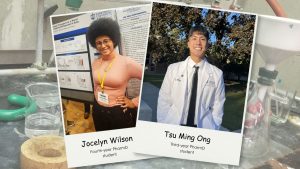
Concordia pharmacy students Jocelyn Wilson and Tsu Ming Ong spend their research days working with machine learning, chemical reactions, plenty of questions and, occasionally, a flask filled with black goop.
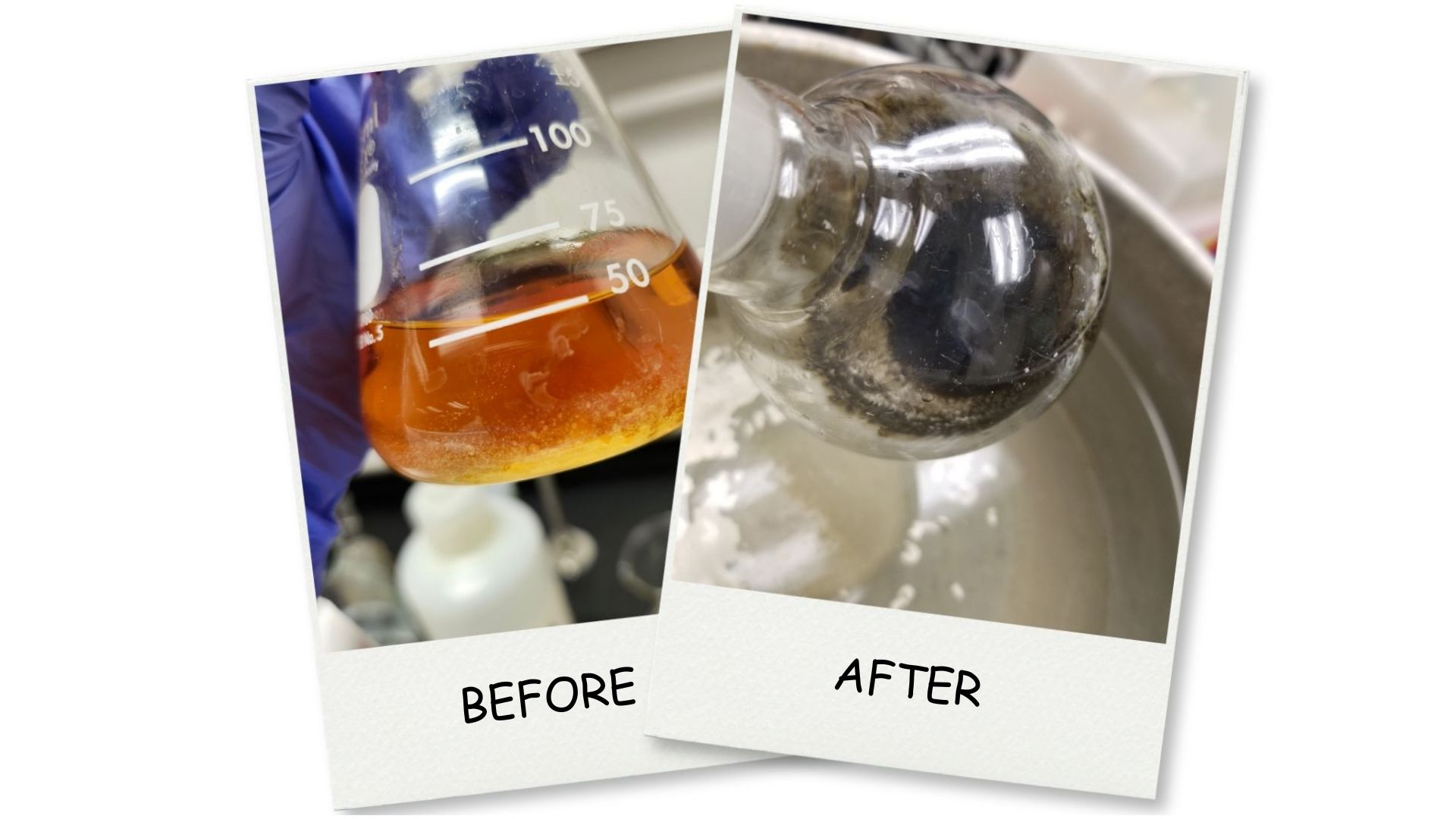
Fourth-year PharmD student Jocelyn Wilson has burned her research product more times than she would probably like to admit. She vividly remembers walking into the chemistry lab at Concordia University Wisconsin, looking at the round-bottom flask and finding the same thing waiting for her: sticky black oil.
“Like something out of a horror movie,” she said. Then, like so many students before and after her, she would try again.
Third-year PharmD student Tsu Ming Ong knows something about that feeling, although his research looks very different from Wilson’s. His work doesn’t involve standing over chemical reactions. He uses computational chemistry and machine learning to study compounds that interact with opioid receptors. And sometimes his models don’t work either.
“One thing I’ve learned is that research isn’t always about getting an exciting result,” Ong said. “Sometimes the most important part of the day is figuring out why something didn’t work.”
So, welcome to a day in the life of a research-focused PharmD student. At Concordia, that “day” can look remarkably different depending on the student, the project and even the hour. Wilson’s research has meant synthesizing compounds in a chemistry lab. Ong’s means working with chemical structures, datasets and computer models. Both are learning that research rarely moves in a straight line.
And maybe that’s part of the point.
Morning: Check the notebook
Wilson isn’t spending her days in the research lab anymore, but she remembers them vividly, especially how early they began. She would arrive at the chemistry lab, turn on the fume hood and check her notebook to figure out exactly where she had left off the day before. Some of her reactions required hours of heating and stirring, so the earlier she could get one started, the better.
Equipment came out. Reagents were measured. The reaction began. Then came the waiting, checking and documenting.
Wilson worked on the SCPI-1 project with Chris Cunningham, PhD, associate professor of pharmaceutical sciences, performing chemical synthesis and extraction of a compound being studied for its potential to treat symptoms of opioid withdrawal. Throughout a reaction, she would remove small samples and use thin-layer chromatography and UV light to see how things were progressing.
A successful reaction still meant there was more to do: extraction, more testing, an NMR run to confirm the compound’s identity, labeling, documentation and preparing samples to be sent to research partners. An unsuccessful one meant going back to the notebook. Those notes helped Wilson remember what changed, what failed and what might be worth trying next.
Ong, meanwhile, is still actively involved in research, although his days look quite different. His work begins with data.
Midday: Teach a computer about chemistry
Ong didn’t arrive at Concordia with plans to become a researcher. Originally from Malaysia, he grew up primarily in Wisconsin and became interested in pharmacy partly because his father is a community pharmacist. When he entered pharmacy school, Ong pictured himself working directly with patients as a clinical pharmacist.
Then Cunningham gave him an opportunity to try research.
“I knew I enjoyed science, but I didn’t initially understand what research in pharmacy could look like,” Ong said. He soon became interested in drug discovery and computational methods. Coding, cheminformatics and machine learning followed.
Today, his research uses machine learning and computational chemistry to identify and predict compounds that interact with opioid receptors. Rather than testing every compound individually, Ong uses computer models to study the relationship between a compound’s chemical structure and how it interacts with a receptor. The goal is to narrow the possibilities and identify compounds worth studying further.
Before he can do that, though, Ong has to make sure the information going into his models is accurate. He spends part of his day reviewing datasets, verifying chemical structures and checking activity values. He uses programs including KNIME, Mordred and RDKit to process molecular structures and generate descriptors of their chemical properties.
Then he trains and evaluates his models. Sometimes he gets what he hoped for. Sometimes he doesn’t.
Afternoon: Get comfortable with failure
Research has a way of making “didn’t work” part of the daily vocabulary, and Wilson learned that lesson repeatedly in the chemistry lab.
“Sometimes you can think you’re following a protocol to a T and still fail to get any yield,” she said.
A reaction might need a change. An extraction method might need another attempt. Even after she finally produced something, Wilson still had to determine whether she had made what she intended to make. It could be slow and frustrating, but she learned to be more comfortable when things didn’t work out.
“I became a lot more resilient to failure by doing research, which really helped with starting pharmacy school,” she said. Before beginning research, Wilson didn’t consider chemistry one of her strongest subjects. Working with Cunningham helped build her confidence in what she could do. “I realized I didn’t need to be an A+ chemist to be a part of research,” she said.
Ong has had his own lessons in persistence. He remembers developing a machine learning model that initially performed poorly. Rather than assume the entire approach was wrong, he kept working. He cleaned and restructured the dataset, changed how variables were represented and experimented with different modeling approaches. Little by little, the results improved.
“Research progress isn’t always one big breakthrough,” Ong said. “Sometimes it’s a series of small improvements that eventually lead to something meaningful.”
The experience also taught him something he didn’t expect. Research isn’t always about finding the right answer. Sometimes it’s about figuring out whether you’re asking the right question in the first place.
Whenever possible: Find people who help you figure it out
Neither student has done this work alone. Wilson first connected with Cunningham while she was still an undergraduate student at Concordia. Curious about the opportunities available, she contacted the School of Pharmacy Admissions Office and received a list of faculty members conducting research. Cunningham’s work caught her attention, so she reached out. That email eventually put her in a lab coat.
Cunningham became Wilson’s main research mentor and encouraged her to present their work at symposiums and conferences. “He was really in my corner supporting me for the whole process,” Wilson said.
Ong describes his relationships with CUW faculty Cunningham and Terry-Elinor Reid, PhD, associate professor of pharmaceutical sciences, in a similar way. Both offer guidance when he needs it, but they also trust him enough to make his own decisions and mistakes. That freedom led to one of Ong’s most memorable realizations.
While working through a modeling workflow, he noticed something had changed. He wasn’t simply following instructions anymore. He was deciding how to handle the data, determining which variables were meaningful, choosing how to evaluate the model and interpreting what it produced.
“At some point, I realized that I wasn’t simply learning about research anymore,” Ong said. “I was starting to think like a researcher.”
Late afternoon: Research gets bigger
Eventually, the compound Wilson had worked on left the lab. Literally. Her work was one piece of a project involving researchers at multiple institutions. Wilson helped produce the compound at Concordia. Partners at UW-Milwaukee performed further purification and in vitro metabolism studies, while partners at Johns Hopkins conducted in vivo studies to evaluate its effects.
That surprised her. When Wilson first pictured research, she imagined the work happening in one place. Instead, she found herself part of a network of people bringing different skills and resources to the same project.
She also discovered she loved talking about the work almost as much as doing it. Once the team had something to share, she wanted to share it, so she presented the research several times in poster format. Her SCPI-1 poster received the Best Commercialization Potential Award at Concordia’s Wisconsin Interdisciplinary Research Symposium in 2025.
One presentation at AACP’s Pharmacy Education 2025 meeting in Chicago also stands out. Wilson remembers arriving nervous, worried that she might forget what they had done or wouldn’t know enough to answer questions. By the end of the night, things felt different. “I was talking with other pharmacists and credentialed researchers with ease,” she said.
Wilson, who served as president of CUW’s Industry Pharmacists Organization (IPhO) chapter during the 2025-26 academic year, is now completing her advanced pharmacy practice experience (APPE) rotations. Her time in the lab, opportunities to present research and experiences in pharmacy practice have helped her see just how many places research and pharmacy intersect.
When research meets patient care
Ong sees that connection from another angle. As an intern at Froedtert West Bend’s inpatient pharmacy, he sees patients who rely on specialized medications. That experience puts him close to the individuals affected by those therapies.
Research allows him to see that work on a larger scale. Drug development and health outcomes research can influence therapies used by patients far beyond one hospital or community, and that possibility has changed the career Ong once pictured for himself.
“I still really value patient care, but my perspective has expanded significantly,” he said. Ong is now interested in bringing together pharmacy, research, data and the pharmaceutical industry. Health economics and outcomes research, real-world evidence, data analytics and medical affairs are among the areas that have caught his attention.
Wilson’s picture has changed, too. She entered pharmacy school knowing she wanted research somewhere in her future, although she wasn’t sure what that meant. She considered becoming a clinical research associate in the pharmaceutical industry for a time. Her APPE rotations now have her thinking about another possibility: finding a career that allows her to remain close to patients while continuing to participate in research.
Oncology pharmacy and investigational drug services are among the possibilities she is considering. “Research has expanded my idea of what pharmacists can be and do,” Wilson said.
So, is research for you?
Wilson’s advice to students who are curious about research is simple: Give it a try. Spend a few hours a week on a project. Stop by a lab before class. Stay a little later. Ask a faculty member what they’re working on. Students with a research idea of their own can start by talking with a faculty member or advisor who can help connect them with someone who shares that interest.
“The worst thing that can happen is you don’t have the time, or you don’t like it,” Wilson said.
Ong didn’t know research would become such a large part of his pharmacy experience when he initially started college. His involvement has grown in other ways, too. After serving as Wilson’s vice president in CUW’s IPhO chapter last year, Ong is serving as president for this 2026-27 school year.
His advice to students curious about research is much the same as Wilson’s: Try it before deciding it isn’t for you. As both students discovered, there are probably a few possibilities you don’t yet know exist.
More than a job
Figuring out where pharmacy might take him is tied to a larger question for Ong: How will he use what he has been given to serve God?
“As a Christian, I believe we are called to use the talents and abilities we’ve been given to glorify God and serve others,” he said. He doesn’t know exactly where his career will take him, but he wants his faith to guide the decisions he makes and the way he uses his knowledge. Research has given him another way to think about that calling.
Wilson came to Concordia already looking for research. Ong found it after he arrived. Wilson worked in a chemistry lab, while Ong found his place working with computers and data. What do they have in common? Neither has every detail of the future figured out, and neither needs to.
There are still questions to ask, experiments to run, models to test and probably a few things that won’t work the first time. Tomorrow, they’ll try again.
Want in?
Concordia University Wisconsin is a Lutheran higher education community committed to helping students develop in mind, body and spirit for service to Christ in the Church and the world.