Teaching America’s story through America250

At the Batterman School of Business, preparing ethical leaders begins by investing in the teachers who shape the next generation.


As the United States prepares to celebrate its 250th anniversary in 2026, the Batterman School of Business at Concordia is investing in the people who will tell that story: teachers.

Backed by a $1.1 million grant from the U.S. Department of Education, the Concordia Free Enterprise Center (CFEC)—housed within the Batterman School—launched America 250: Teaching History & Civics Through Economic Lenses. The three-year initiative provides middle and high school educators with curriculum, classroom resources, and professional development centered on the economic and civic ideas that shaped the nation.

The initiative reflects the mission of the CFEC, which promotes the ideals of a free and virtuous society while encouraging economic opportunity, ethical leadership and human flourishing. By equipping teachers with meaningful classroom resources, the center is extending that mission well beyond Concordia’s campus and into classrooms across the Midwest.

That vision came to life June 11-12 at Lambeau Field, where educators from across the Midwest gathered for the Lambeau Summit. The two-day workshop introduced teachers to classroom-ready lessons, activities and historical resources designed to help students better understand America’s founding as the country approaches its semiquincentennial.

Dr. Scott Niederjohn, dean of the Batterman School and director of the CFEC, co-authored the successful grant proposal. He said the initiative is designed to give teachers the tools they need to help students understand the economic ideas that shaped the U.S.

“When teachers are equipped with strong curriculum and meaningful professional development, that impact reaches far beyond a single classroom.”


three photos collaged from 250 conference

Bringing the Founders into today’s classrooms
teachers and professors at summit
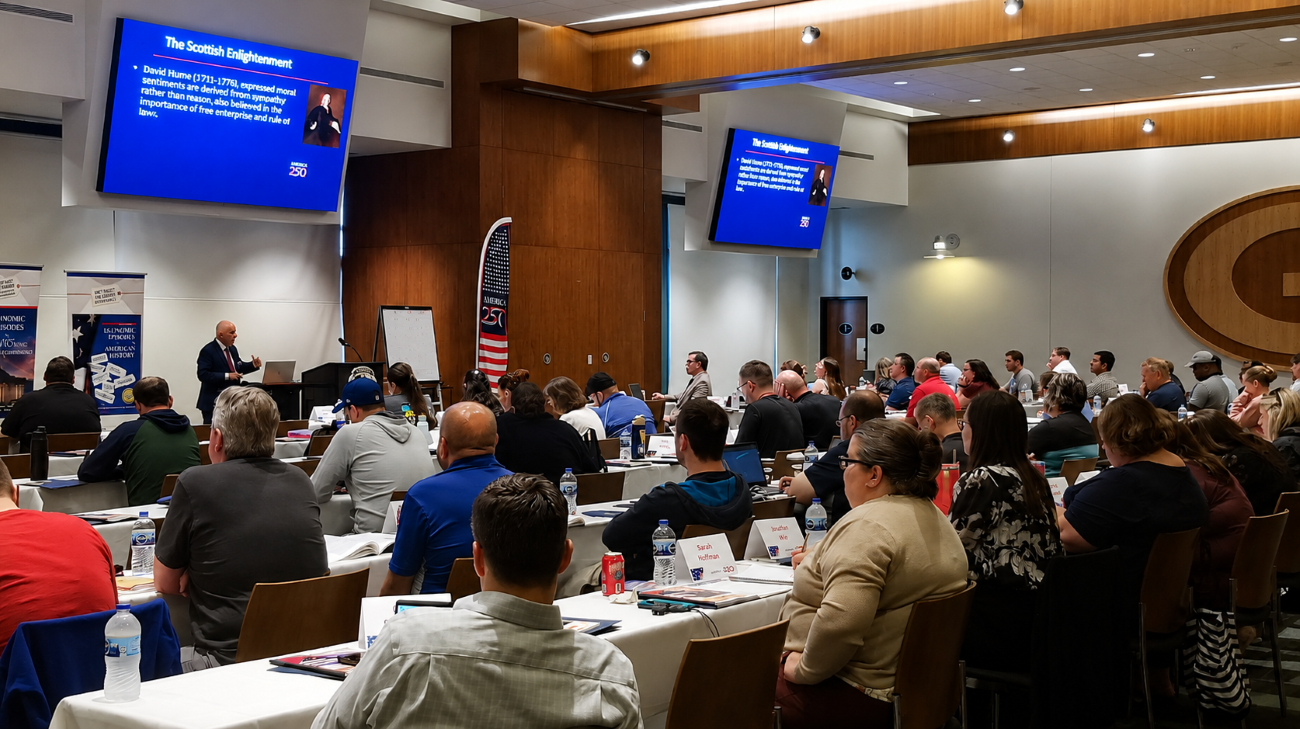
Dr. Mark Schug, affiliated scholar at CUW, presents on Adam Smith during the Lambeau Summit at Lambeau Field.

Niederjohn and a team of co-authors, including Dr. Mark Schug, former professor and director of the Center for Economic Education at University Wisconsin-Milwaukee, developed 10 essays examining the economic ideas of individual American Founders. The curriculum also includes classroom-ready slide decks, quizzes and activities that teachers can immediately use in their classrooms.

During the summit, Niederjohn and Schug introduced participants to the economic thought of Thomas Jefferson and Benjamin Franklin while also exploring the connection between Adam Smith and America’s founding. Smith’s The Wealth of Nations, published in 1776, coincided with the signing of the Declaration of Independence and offers a strong defense of economic liberty.


History, hope and the American story

The summit’s keynote speaker, Dr. Wilfred McClay from Hillsdale College, encouraged teachers to view American history through the lens of hope.

In addition to serving as a professor of history, McClay is the author of Land of Hope: An Invitation to the Great American Story and serves on the America250 Commission, officially the U.S. Semiquincentennial Commission. He shared insights from his work on the commission and discussed how the nation’s founding documents established religious, economic and political liberty that continues to shape the American story.


Learning by doing

The conference also emphasized hands-on learning. In one activity, each participant received a $10 gift card to a random retailer and rated their satisfaction before taking part in a free-trade exercise. Teachers were free to trade gift cards with one another, and satisfaction levels rose as participants exchanged cards for ones they valued more.

The exercise demonstrated the benefits of voluntary exchange while also sparking classroom ideas. Many teachers discussed adapting the activity for their own students, with candy emerging as a popular alternative to gift cards.


Building a lasting community

The learning didn’t end when the summit concluded. Each participant was enrolled in a Concordia Canvas course. There, they continue to receive curriculum resources, professional development and support from a community of fellow educators.

Teachers returned home with practical classroom tools, fresh ideas and new connections. More importantly, they returned prepared to help students better understand the ideas that shaped the nation.

For the Batterman School, that is the lasting impact of America250. The initiative is not only preparing teachers for the nation’s 250th anniversary. It is investing in educators whose influence will reach thousands of students, strengthening civic understanding one classroom at a time.

James Schultz, who graduated in May 2026 with a bachelor’s degree in secondary education (broad field social studies), contributed to this article.


Want in?

Concordia University Wisconsin is a Lutheran higher education community committed to helping students develop in mind, body and spirit for service to Christ in the Church and the world.


Belize through the eyes of a student

An online learner shares how a week of service and cultural engagement fostered professional growth, meaningful connections and a deeper sense of purpose.


woman with brown hair pulled back

When I signed up for the Belize Global Education Experience, I knew it would be meaningful. What I did not fully understand was how much it would impact me personally, professionally and spiritually.

As an online student, I had not met anyone going on the trip beyond a few Zoom meetings. I had not even met my professor in person before we left. Walking into an experience like this can feel intimidating. It did not take long, though, for strangers to become teammates, friends and, by the end of the week, a family.


Learning and serving together

Our week began in San Ignacio, Belize, where we stayed at Hode’s Place and prepared for our time serving students at Mount Carmel Primary School in Benque. I had the opportunity to work alongside an incredible interdisciplinary team made up of students and professors from special education, occupational therapy, physical therapy and speech-language pathology.

Each discipline brought a different perspective. Together we were able to look at the whole child and support them in meaningful and functional ways.

During the mornings, we worked with special education students at Mount Carmel. In the afternoons, we provided therapy sessions for clients at Hode’s Place. One of the greatest blessings of the week was working with an individual who had survived a serious motorcycle accident. Our group quickly grew to care deeply for this person. While we were there to provide support, I believe we gained just as much from the experience as they did.

The week was full of learning beyond the clinical and classroom settings. We visited Cahal Pech, explored San Ignacio, and participated in Zumba at a local park. We also spent time at the San Antonio Women’s Cooperative, where we made pottery and corn tortillas from scratch. These experiences helped us better understand the culture, community and people we were serving.

By the final day, the teachers shared their gratitude for the work they had seen happening with their students. Their words were emotional and meaningful. It reminded me that even short-term service can have an impact when it is done with humility, respect and a willingness to learn.

After a week of service, documentation and late nights, we ended our trip with time in Caye Caulker. We snorkeled, swam with stingrays, jumped from the platform at The Split, sang karaoke and celebrated the hard work our team had put in throughout the week.

This trip reminded me that being an online student does not mean being disconnected. This experience helped me feel deeply connected to my university, my professors, my classmates and the mission of serving others.

As the oldest student in the group (and older than some of the professors), I was lovingly referred to as the group’s “mama.” That is something I will always treasure.

I came home from Belize with a full heart. I am grateful for the opportunity to serve, to learn from other disciplines, to experience a beautiful culture and to see God’s work through the people around me.

This trip was more than a class requirement or a global education experience. It was a reminder of why I chose special education and why serving others matters.

Written by Jamie Frazer [Frazer graduated in May 2026 from CUW’s Bachelor of Arts in Cross Categorical Special Education (Online) program.] 


About the Belize Global Education Experience

CUW’s School of Health Professions offers an interprofessional global education experience in Belize that brings together students and faculty from speech-language pathology, occupational therapy, physical therapy and education. Through school- and community-based service, participants support children, adults, families and educators while gaining experience in interprofessional practice, cultural humility, clinical reasoning and servant leadership. The program helps students apply their skills while serving communities in a global setting.


Want in?

Concordia University Wisconsin is a Lutheran higher education community committed to helping students develop in mind, body and spirit for service to Christ in the Church and the world.


A quid for your thoughts: Stay posh and carry on

A final day exploring London’s financial roots and British traditions.


This is the fifth article in the series, “A Quid for Your Thoughts,” written by members of the BUS 7040: Study Abroad in London course. The series captures reflections from students’ study abroad experience in the United Kingdom during spring break 2026.


Today we got dressed to the nines for our final day of planned adventures. Our first stop was in the Financial District at Lloyd’s of London. Lloyd’s began in a coffeehouse (more on this later) and started as an insurance company for ships. In fact, Lloyd’s insured the Titanic for £1,000,000, convinced it truly was unsinkable. Today, Lloyd’s serves as a marketplace for insurance and specializes in covering unique risks. Some of the most interesting examples we heard during our tour included insurance policies for celebrities’ legs, vocal cords and even chest hair.

building

Lloyd’s has had three “buildings” throughout its history: the original coffeehouse, a headquarters building and its current structure. The company moved locations several times because it continually outgrew its office space. To address this and create a building that could last for centuries, Lloyd’s architect designed the structure “inside out.” Its unique design places all the mechanical elements on the exterior, allowing for a large, open-concept interior. The primarily stainless steel and glass exterior is cleaned entirely by hand and takes nearly four months to complete — just in time for the team to start the process all over again. You definitely would not want to be on that janitorial staff.

After our tour of Lloyd’s, we met up with our guide, who walked us through much of London’s Financial District. Notable stops included the Bank of England, the Royal Exchange and the London Stock Exchange. As mentioned earlier, Lloyd’s began as a coffeehouse, and we learned there is a strong historical connection in London between finance and coffeehouses. We even saw the site of the first coffeehouse, which still has the original stone step from when it opened hundreds of years ago. It is now worn down from centuries of foot traffic. This is also where the phrase “mind your step” originated.

Coffeehouses were where many of London’s early financial exchanges began. They welcomed people from all backgrounds — from merchants to nobles — to participate in trading and discussions. During auctions in those days, a candle would be lit with a pin placed one inch from the bottom. Bidding could continue until the candle burned down and the pin dropped, which is where the saying “you could hear a pin drop” is said to originate.

off white building and street in front of it

After our financial district tour concluded, we headed to Fortnum & Mason for our formal afternoon tea experience. There we had the pleasure of tasting various famous teas alongside small bites, including sandwiches, scones and desserts. It was a wonderful opportunity to experience a unique British tradition and enjoy classic dishes.

To cap off the day, we headed to the West End to watch a live show at the Victoria Palace Theatre. Through laughter and tears (Jack), we experienced the story of Alexander Hamilton. The show gave us a deeper appreciation for Hamilton’s legacy and its connection to the development of financial institutions in the United States. It also offered a glimpse into the shared historical roots between America’s founding and England.

Overall, the day brought memorable experiences and provided a wonderful conclusion to our trip and our week.

Written by Julia Quartuccio, marketing with a minor in psychology, ’26; Noelle Smith, management and finance, ’26; Sierra Breuker, entrepreneurship with minors in nonprofit management and finance, ’27; and Merin Merkle, business management with a minor in ethics, ’27


For further reading on the 2026 study abroad trip to London:


Want in?

Concordia University Wisconsin is a Lutheran higher education community committed to helping students develop in mind, body and spirit for service to Christ in the Church and the world. This study abroad experience is offered through the Concordia University Free Enterprise Center. During the first 8 weeks of the semester, students meet on campus to study the economy, government, politics and culture of the United Kingdom. The course concludes with a spring break trip to London, including a visit to Cambridge and Westfield House.

CUW offers more than 500 study abroad programs in 48 countries. Students have the opportunity to experience new cultures, broaden their global perspective and gain professional insight — all while earning a degree.

Expand your horizons. Experience the world.


A quid for your thoughts: From Cambridge reflections to a Premier League night

Concordia University Wisconsin students spend a day in Cambridge before experiencing the energy of English football in London.


This is the fourth article in the series, “A Quid for Your Thoughts,” written by members of the BUS 7040: Study Abroad in London course. The series captures reflections from students’ study abroad experience in the United Kingdom during spring break 2026.


The Concordia University Wisconsin group began Wednesday’s adventures early with a light breakfast before boarding a charter bus for the trip to Cambridge, England. The peaceful ride carried the group through the wooded countryside and rolling landscapes outside London.

foggy cemetery

The first stop was the Cambridge American Cemetery and Memorial, a solemn site where the graves of more than 3,000 American soldiers rest beneath the cool morning fog. Students and faculty paused to reflect on the sacrifices made by those who served.

From there, the group continued into Cambridge and made its way to the banks of the River Cam for a punting session. Punting — a flat-bottomed boat pushed along with a long pole — offered a guided tour of several of Cambridge’s historic colleges from the river.

After the tour, the group walked through the city center, passing many historic buildings, including King’s College, Cambridge, while making its way to Westfield House. There, the group met with two staff members who serve with the Evangelical Lutheran Church of England, a synod in communion with The Lutheran Church–Missouri Synod.

soccer field

During the visit, students presented their final class projects on topics including Lloyd’s of London, British tea culture, The Championships, Wimbledon, and other aspects of British society and culture.

Following their time in Cambridge, the group returned to the buses and traveled back to London for the evening’s next event — a Premier League football match. After grabbing a quick bite to eat, the group headed to the London Underground, commonly known as the Tube, with their destination set for Craven Cottage in Fulham.

The match delivered an electric atmosphere. Although the game ended in a 1–0 victory for West Ham United over the home side, Fulham F.C., chants and friendly banter filled the stadium and continued during the journey back to Paddington Station.

The day concluded with ice cream at McDonald’s, offering the group a small but comforting reminder of home after a full and memorable day.

Written by Jack Fritz, accounting, ’26, and Micah Hoehner, finance, ’26


For further reading on the 2026 study abroad trip to London:


Want in?

Concordia University Wisconsin is a Lutheran higher education community committed to helping students develop in mind, body and spirit for service to Christ in the Church and the world. This study abroad experience is offered through the Concordia University Free Enterprise Center. During the first 8 weeks of the semester, students meet on campus to study the economy, government, politics and culture of the United Kingdom. The course concludes with a spring break trip to London, including a visit to Cambridge and Westfield House.

CUW offers more than 500 study abroad programs in 48 countries. Students have the opportunity to experience new cultures, broaden their global perspective and gain professional insight — all while earning a degree.

Expand your horizons. Experience the world.


A quid for your thoughts: Mind the gap and pardon the history

MBA students explore the Tower of London, Portobello Road Market and the city’s historic Underground on their London experience.


This is the third article in the series, “A Quid for Your Thoughts,” written by members of the BUS 7040: Study Abroad in London course. The series captures reflections from students’ study abroad experience in the United Kingdom during spring break 2026.


If you had told us on day one that we would be navigating the Tube without looking like lost tourists, we probably wouldn’t have believed you. But here we are on day four with a better understanding, more confidence, and the ability to guide ourselves throughout London.

Our day started with breakfast at the hotel. The spread included French toast, omelets, pastries and toast, along with a classic English breakfast featuring eggs, beans, mushrooms, tomatoes, sausage and bacon. We also had access to a full buffet with mini chocolate croissants (our favorite), fresh fruit, meats, cheeses, cereals and yogurt — perfect fuel for a busy day ahead.

After meeting our guide in the hotel lobby — along with Dr. Niederjohn, whose guiding we’ve almost forgotten about as he has seamlessly become one of the group, just a slightly older one—we hopped on the Tube to the Tower of London. There, we were lucky enough to witness the changing of the Tower Guard and see the Crown Jewels in person while also capturing scenic photos of Tower Bridge. Photos of the jewels weren’t allowed, but trust us — they were brilliant.

Our guide also shared stories about the tragic events that have taken place at this historic castle, fortress and former prison. We explored other areas of the Tower and experienced firsthand the weight of its darker history.

From there, we walked along the River Thames to Dickens Inn for lunch. Most of our group enjoyed fish and chips — an English staple — while taking in picturesque views of London. After lunch, we split up for some free time. A small group of us rode the Circle Line to Notting Hill Gate, where we explored Portobello Road Market, browsing street vendors and admiring the colorful buildings lining the street.

Before heading back, we stopped by the Notting Hill Travel Bookshop, famously featured in the 1999 romantic comedy Notting Hill, starring Hugh Grant and Julia Roberts, to pick up a few souvenirs. Others traveled to London’s financial district to tour the Bank of England as part of their course projects.

To wrap up another day in London, our class is meeting for dinner at the Sawyers Arms, just a few blocks from Hyde Park and close to our hotel, before getting a good night’s sleep ahead of our trip to Cambridge tomorrow.

Written by Taylor Van Brocklin, strategic marketing ’26; Kathleen Lococo, strategic marketing ’26; and Korvika Tripathi, operations management, sustainability and analytics ’26


For further reading on the 2026 study abroad trip to London:


Want in?

Concordia University Wisconsin is a Lutheran higher education community committed to helping students develop in mind, body and spirit for service to Christ in the Church and the world. This study abroad experience is offered through the Concordia University Free Enterprise Center. During the first 8 weeks of the semester, students meet on campus to study the economy, government, politics and culture of the United Kingdom. The course concludes with a spring break trip to London, including a visit to Cambridge and Westfield House.

CUW offers more than 500 study abroad programs in 48 countries. Students have the opportunity to experience new cultures, broaden their global perspective and gain professional insight — all while earning a degree.

Expand your horizons. Experience the world.


A quid for your thoughts: Stone, scripture and skyline

From ancient churches to skyline views, Concordia students spend a new day discovering London’s history and landmarks.


This is the second article in the series, “A Quid for Your Thoughts,” written by members of the BUS 7040: Study Abroad in London course. The series captures reflections from students’ study abroad experience in the United Kingdom during spring break 2026.


inside of old church

We started our day at Westminster Abbey and learned about its rich history, dating back to A.D. 1066. The abbey has hosted coronations, royal weddings, and many high-profile burials. The architecture and intricate artwork have stood for nearly a millennium and remain carefully maintained today. Our group was astonished by the sheer size of the building and wondered how it was constructed without modern technology. Many peaceful views around the abbey left us speechless.

After our tour, we visited the oldest surviving church in London, St. Bartholomew the Great. Our brief stop included a walk through the sanctuary and a short lesson about St. Bartholomew. We also learned the church has appeared in several well-known films, including a scene from Avengers: Age of Ultron.

After our visit, our professor — and impromptu tour guide — Dr. Scott Niederjohn showed us the London Wall. Built by the Romans around A.D. 200, portions of the wall are still standing today. From there, we went together to Ye Olde London Pub for food and conversation.

Rejuvenated from a tasty meal, we walked to the British Museum. The museum is widely known as the world’s first national public museum and houses more than 8 million objects. To make the most of our time, we focused on a few exhibits, including the Parthenon, Ancient Egypt, Rome, Europe, and Japan.

From the British Museum, we made our way to the London Eye, a Ferris wheel that rises more than 400 feet above the city. Some of the most scenic views of the day came from this vantage point, where we could see Big Ben, Westminster Abbey — which we had visited earlier — and the Houses of Parliament at the same time. A ride during sunset provided excellent photo opportunities from about 450 feet above the River Thames and created memories that will last for years.

Day two was a success for the group, and there was never a dull moment. The trip already feels like it is going by quickly, and we look forward to seeing what else London has in store.

Written by Jonathon Weir, finance, ’27; Kyle Steiner, finance and sports & entertainment management, ’27; and Ernst Vonfrankenburg, business administration and management (MBA), ’28


For further reading on the 2026 study abroad trip to London:


Want in?

Concordia University Wisconsin is a Lutheran higher education community committed to helping students develop in mind, body and spirit for service to Christ in the Church and the world. This study abroad experience is offered through the Concordia University Free Enterprise Center. During the first 8 weeks of the semester, students meet on campus to study the economy, government, politics and culture of the United Kingdom. The course concludes with a spring break trip to London, including a visit to Cambridge and Westfield House.

CUW offers more than 500 study abroad programs in 48 countries. Students have the opportunity to experience new cultures, broaden their global perspective and gain professional insight — all while earning a degree.

Expand your horizons. Experience the world.


A quid for your thoughts: From worship to Wimbledon

CUW business students reflect on their first days studying business, history and culture in London.


This is the first article in the series, A quid for your thoughts, written by Concordia University Wisconsin business students participating in a spring 2026 study abroad experience in the United Kingdom. The series captures reflections from students as they explore the intersections of business, government, culture and faith abroad.


Touchdown in London

After an overnight flight from Chicago, the group arrived in London tired but excited for the week ahead. Rather than slowing down, students embraced the city immediately, visiting some of London’s most iconic landmarks.

From Big Ben and the Palace of Westminster to 10 Downing St., Buckingham Palace and Trafalgar Square, the first day provided an introduction to the heart of British history and government. Seeing these historic sites in person brought to life many of the topics discussed during the first 8 weeks of on-campus preparation. It was a memorable way to begin the trip.


A morning of worship at St. Paul’s

students in London

After a full night of rest, day 2 began in the City of London with morning matins at St. Paul’s Cathedral. Worshiping in one of the most architecturally significant cathedrals in the world was an unforgettable experience. The cathedral’s choir and organ filled the space, offering a moment of reflection amid a full schedule.

Following the service, students participated in a brief walking tour of the historic financial district before traveling to the afternoon destination — one of the most prestigious venues in sports.


Inside the business of Wimbledon

inside view of Wimbledom

At the All England Lawn Tennis and Croquet Club, home of The Championships, Wimbledon, the focus shifted to business operations.

Wimbledon is the only Grand Slam tournament still played on grass courts — the original surface of the sport. As the oldest tennis tournament in the world, it maintains longstanding traditions while operating as a global sporting event.

Students explored the infrastructure behind the tournament, including event management, branding, logistics and international broadcasting. Standing inside Centre Court and No. 1 Court — where the semifinals and finals are played — provided a deeper appreciation for the planning and precision required to host an event of this scale.


An evening in the city

The evening concluded with dinner in Covent Garden, followed by a visit to Piccadilly Circus to experience London illuminated at night. The energy of the city, combined with the day’s academic experiences, highlighted how study abroad offers learning opportunities far beyond the classroom.

Written by Mikiah Poock, junior finance major, and Hava Zodrow, junior accounting major and business scholar


For further reading on the 2026 study abroad trip to London:


Want in?

Concordia University Wisconsin is a Lutheran higher education community committed to helping students develop in mind, body and spirit for service to Christ in the Church and the world. This study abroad experience is offered through the Concordia University Free Enterprise Center. During the first 8 weeks of the semester, students meet on campus to study the economy, government, politics and culture of the United Kingdom. The course concludes with a spring break trip to London, including a visit to Cambridge and Westfield House.

CUW offers more than 500 study abroad programs in 48 countries. Students have the opportunity to experience new cultures, broaden their global perspective and gain professional insight — all while earning a degree.

Expand your horizons. Experience the world.


CUW students prepare to pack hope

A campus MobilePack™ event for Feed My Starving Children (FMSC) invites students to serve globally while living out Concordia’s call to servant leadership.


On March 19, the CUW Psychology Club and Campus Ministry Leadership Team plan to host a MobilePack™ with Feed My Starving Children (FMSC), a Christian nonprofit dedicated to seeing every child whole in body and spirit. Donations fund nutritious meal ingredients, volunteers hand-pack MannaPack® meals, and the meals are donated to FMSC food partners around the world, where malnourished children are fed and lives are saved.

Hunger is the world’s largest solvable problem. According to the World Health Organization, 1 in 11 people worldwide faced hunger in 2023, 1 in 5 in Africa. This crisis can be addressed, and FMSC is tackling it head-on while sharing the Gospel.

This academic year, CUW students are reflecting on a theme verse that identifies what servant leadership looks like in a radical way. In the book of Galatians, Paul calls those redeemed in Christ to demonstrate their freedom from the chains of sin through service to others.

“For you were called to freedom, brothers. Only do not use your freedom as an opportunity for the flesh, but through love serve one another. For the whole law is fulfilled in one word: ‘You shall love your neighbor as yourself.’” Galatians 5:13-14

The Lutheran identity of Concordia itself demonstrates a commitment to service. With the goal of enriching students to grow in mind, body and spirit and preparing leaders to serve Christ in the world, this verse encapsulates the values Concordia seeks to instill in its students to further its mission.

With this in mind, students this year have sought opportunities to complete service projects that assist the wider community beyond the university. One such project is approaching rapidly as an opportunity to reflect on past student service and inspire it in the future.

girl with hair net packing food

Through this event, organizers hope to show students they can use their God-given gifts to serve in meaningful ways wherever they are placed. The event has been spearheaded and organized by students dedicated to ensuring Christ’s love is demonstrated in a radical way to neighbors around the world.

This is not something that can be done alone. To host the event, organizers must raise $30,000, which will directly pay for more than 100,000 meals to be packed and sent to children around the world. Donations are an impactful way to advance this mission. Even a donation as small as $1 allows a child to be fed and hope to be shared. Together, as a Christian community, we can demonstrate our freedom and share Christ’s love with neighbors around the world.

To learn more and donate, follow the link: https://give.fmsc.org/cuw

Written by Mikayla Dolan, double major in psychology and social work


Want in?

Concordia University Wisconsin is a Lutheran higher education community committed to helping students develop in mind, body and spirit for service to Christ in the Church and the world.


The 95 Theses of a modern student

Inspired by Martin Luther’s historic demonstration, students today can learn from this in mind, body and soul.


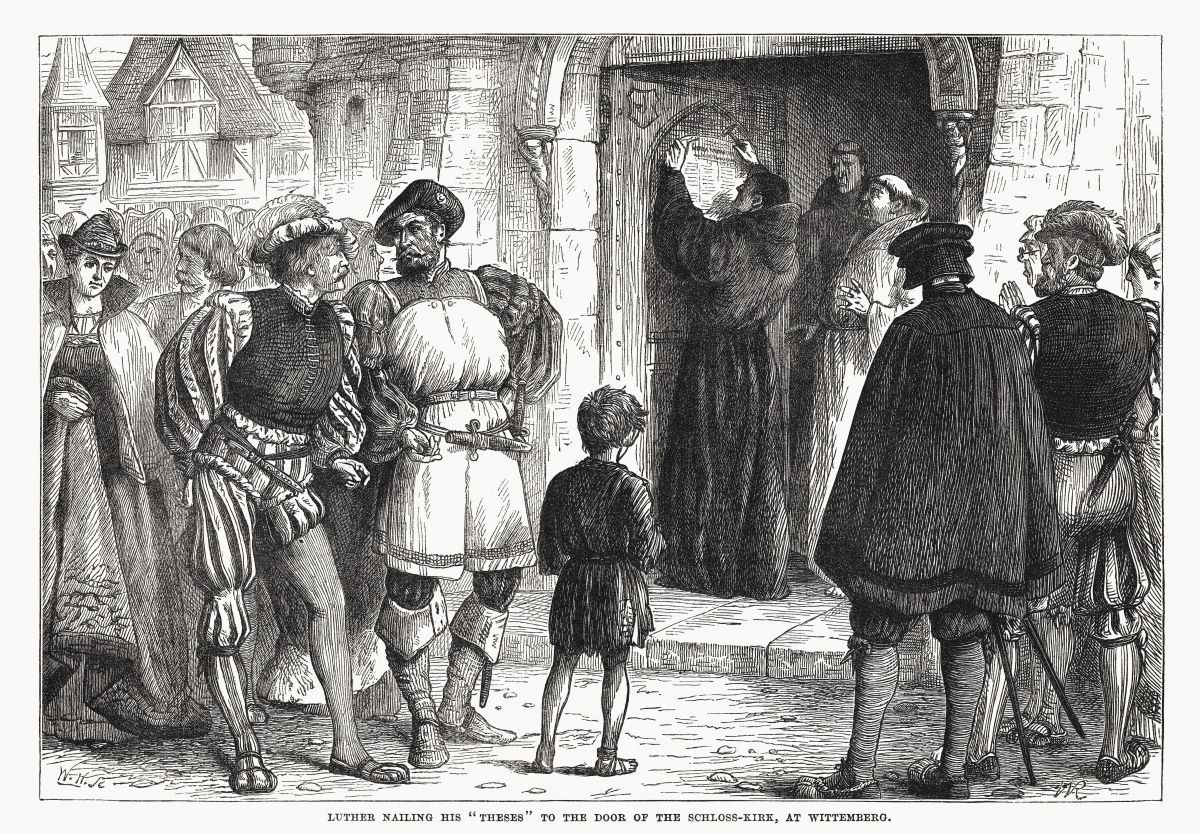
On Oct. 31, 1517, Martin Luther nailed his 95 Theses to the door of Castle Church in Wittenberg, Germany. These theses addressed clerical abuse in the German Catholic Church, specifically issues relating to the power of the papal office.

While students today are not battling papal backlash, they do struggle with mental health crises, an increasingly divisive culture and a lack of hope for the future.


1. Mental health and academic burnout

If you ask around campus how students are doing, you’ll hear a mix of answers — from “good!” to “just trying to keep up.” There could be many reasons for this, but digging deeper often reveals that some students experience stress, anxiety and, in some cases, depression.

Speaking as a student, much of this stems from heavy workloads and the desire for high grades—overwork leads to burnout. Students need time to rest. We’re often congratulated for going “above and beyond,” which only raises expectations for future performance. Burnout should not be celebrated.

On the other hand, it’s often overlooked. I (Adam) have found that people ask why I run myself into the ground trying to work. I don’t want to, but I’m constantly trying to meet the expectations of my professors—especially since they all assign a lot of work. Having five classes (four of which are back-to-back) in a week leaves little time to relax.

People need to understand that school consumes much of a student’s time, and there aren’t enough hours in the day to do everything. Therefore, when someone says they need time to recover, we shouldn’t look at them with disdain but with compassion and understanding. Everyone has their own cross to bear, and for some, that cross is being overworked.

Here at CUW, we see this issue being corrected. In some of the classes Rachel and I are taking, the professors have scheduled certain days throughout the semester as time off to catch up on assignments, take care of personal business—such as appointments—or simply relax. It’s nice that, at the beginning of the semester, our professors set aside days for us to recharge because it gives students time to plan their catch-up days.

Also, CUW offers chapel services every day. As church work students, Rachel and I attend chapel almost every day because we appreciate that it’s both a 30-minute break from classes and a time to rejuvenate spiritually through the Morning Prayer and Matins services.


2. Building community and connection

Another way universities can improve students’ well-being is by fostering a sense of community across campus. Genesis 2:18 states: “Then the Lord God said, ‘It is not good that the man should be alone; I will make a helper fit for him.’”

God created Eve because humans were designed to have relationships with one another. While this statement was specific to its time, it remains relevant today. People are meant to connect with others.

Unfortunately, many college students feel a lack of community within their school environments. This often stems from the prevalence of online classes and “drop-in” campus events, which make it difficult to form meaningful relationships.

This can be improved by offering online classes only when necessary—such as for fully online degrees or unavoidable scheduling conflicts—and by creating more events centered on community building rather than individual activities.

Here at CUW, there are plenty of activities and clubs to get involved in. Chances are, if you have an interest in something, there’s a club you can join that aligns with that interest.

Some of our favorites are the men’s and women’s Bible studies, the Comfort Dog Club (you get to pet dogs—it’s amazing!) and the intramural sports teams on campus. These are all great ways to meet new friends!


3. Hope for the Future

Everywhere you go, you are confronted by people who talk about how terrible the world is and how there’s no hope for improvement.

That attitude brings no reassurance, but it has motivated me (Rachel) to seek ways to create positive change. Many university students share this drive. One of the main reasons we attend college is to innovate in our chosen fields.

Realistically, we won’t solve every global issue overnight. But we can start by pushing for innovation and change within our areas of work. For Adam and me as church workers, that could mean emphasizing evangelization within our ministries to bring more people into the church.

That alone won’t magically make the world better, but growing the body of believers is a step in the right direction.

To achieve this, we need support from our universities. Professors should encourage students to engage with modern culture to bring about positive change. Once we’ve adapted our practices to today’s world, success will follow.

One of CUW’s main missions is to provide a Christ-centered education in all that it does. By putting Christ at the forefront, students are able to recognize Him in their daily lives. This gives us the hope for the resurrection and the eternal life that we have because of Christ’s work on the cross.

Because CUW has instilled this hope in their young men and women, they are motivated to go out and be the light in their communities and workplaces. This gives the students the opportunity to live out their faith, as well as allowing the people they interact with to come to know Christ.


Let’s fix it together

black and white photo of Luther

While our version of the 95 Theses may seem like large fixes, they are actually attainable goals for universities.

Mental health can be addressed by cultivating more understanding classrooms. While students must complete assignments well and on time, professors should be compassionate when granting extensions for heavy workloads. This goes both ways—students should communicate their stress and ask for help when needed.

Community and connection can improve through more opportunities for in-person interaction and events that build lasting bonds.

Finally, as Christians, we should instill others with hope for the future. We hold the hope of resurrection on the Last Day, and universities can encourage students to share the Gospel within their careers. This might look like a business student praying before a presentation, a teacher connecting a lesson to Christ or an athlete leading prayer after a game.

If you look past the standard college student’s burned-out, energy drink-fueled exterior, you’ll see brilliant young adults with the potential to create a more Christ-centered world. Luther sparked change in the church by nailing his 95 Theses to the door of Castle Church; likewise, students today seek to reform their learning environments into places that prepare them to be better leaders.

We aren’t trying to overthrow the education system. Rather, we’re advocating for ways to “live uncommonly” and share that uncommon lifestyle with the world around us.

By By Adam Everroad (’26), theology major, and Rachel Webb (’27), theology major


Read more articles related to the Reformation:


Want in?

Concordia University Wisconsin is a Lutheran higher education community committed to helping students develop in mind, body and spirit for service to Christ in the Church and the world.


Breaking the silence around Latino mental health

Hispanic Heritage Month is a time to celebrate, reflect and heal.


It’s when we honor the stories, sacrifices and spirit that have shaped generations of Latino families. But celebration also means reflection—acknowledging not just where we’ve come from, but what we continue to carry.

In the Latino community, we’re taught from a young age to be strong, to keep pushing and to never let anything break us. We hear phrases such as “échale ganas” (give it your all) or “no te rindas” (don’t give up) —words meant to inspire resilience but that can also teach us to hide what we feel. Many of us grew up in families where mental health wasn’t discussed. If you were struggling, you were told to pray, work harder or be grateful—anything but admit you were hurting.

This silence comes from love and survival. Our parents and grandparents faced hardships they couldn’t afford to break down from—crossing borders, working endless hours and building lives from nothing. They believed staying strong meant staying silent—and in doing so, we learned to bury emotions that needed to be felt.

Hispanic Heritage Month reminds us that our heritage is not only about music, food and tradition—it’s also about healing. It’s about recognizing that our stories include both joy and struggle, faith and fear, resilience and rest.

Mental health isn’t a weakness; it’s part of being human. Healing starts when you stop running from pain and begin accepting it—not as who you are, but as something that walks beside you. There’s no magic fix—it’s daily work: getting up, breathing and doing one small thing that helps you feel like yourself again.

Healing isn’t loud; it’s reading a few pages, going for a walk, calling someone you trust or resting without guilt. You can be hurting and healing at the same time. Acceptance doesn’t mean giving in; it means saying, “This is part of my story, but not the whole story.” That’s when things start to shift.

Loving your mental health doesn’t mean loving the pain. It means loving what it teaches you: discipline, growth and self-understanding. Struggle can push you to start therapy, get active or open up to loved ones. Struggling doesn’t mean you’re weak; it means you’re alive and still fighting.

For our community, healing is an act of revolution. Talking about mental health, showing emotion and seeking help challenge generations of silence. Strength isn’t always keeping it together—sometimes it’s sitting with your pain and saying, “I’m still here.”

So this Hispanic Heritage Month, let’s honor our ancestors by doing what they couldn’t always do—by speaking, feeling and healing out loud. Because “échale ganas” doesn’t just mean push through. It can also mean take care of yourself, breathe and keep going—gently.

— Written by Ramon Rios, student VP for Latino Student Union (LSU). He is a junior and Business Administration major.


Take a moment

Take a moment today to check in with yourself, a friend or a loved one. CUW offers counseling for students that need it.


Want in?

Concordia University Wisconsin is a Lutheran higher education community committed to helping students develop in mind, body, and spirit for service to Christ in the Church and the world.

CUW’s Counseling Center staff are here to provide caring, competent counseling to students, faculty and staff in a confidential setting whenever you need us. We even have a comfort dog, Runner, on staff if you need non-human companionship. If you are struggling, please know you are not alone. Reach out to the Counseling Center. We’re here for you in your time of need.