The Essential Guide to Earning a Rehabilitation Science Degree

Are you someone who has a deep love for people? Does helping someone recover from an injury or a medical condition sound right for you? Rehabilitation sciences could be the perfect field for you.

What is rehabilitation science?

Rehabilitation science is an interdisciplinary field that studies and applies principles to enhance the quality of life, functional abilities, and independence of individuals with disabilities or those recovering from injury, illness, or surgery. It encompasses many disciplines, including physical therapy, occupational therapy, speech-language pathology, kinesiology, psychology, and more.

Rehabilitation professionals have a vital role in mitigating the effects of a health condition on an individual’s daily life. They work to maximize functioning and minimize the impact of disability. The scope of rehabilitation extends beyond preventive and curative care, aiming to enable those with health conditions to maintain independence and engage in education, employment, and meaningful life roles. Rehabilitation can be relevant to anyone during their lifetime, whether due to injury, illness, disease, or age-related decline in functioning.

Why are rehabilitation professionals important?

The biggest reason rehabilitation professionals are crucial is that they provide services that allow people to return to regular life functions. This includes the person’s physical, emotional, psychological, and economic functions. What is often overlooked in the medical field is what happens after someone is released from the hospital or treatment. Rehabilitation professionals are there every step of the way after an initial accident or treatment. Rehabilitation professionals want to get clients back to their regular everyday activities and ensure their procedures/ practices have long-term effects rather than short-term benefits.

What are some pros and cons of being a rehabilitation professional?

While a career in rehabilitation sciences can be highly fulfilling, it can also be exhausting. Here are some pros and cons of becoming a rehabilitation professional.

Pros:

  1. Rewarding work: People go into this field primarily to help clients overcome challenges and improve their quality of life.
  2. Diverse Opportunities: Rehabilitation includes various disciplines such as physical therapy, occupational therapy, speech-language pathology, and more.
  3. Variety: Every client will have a different condition, story, and reason they are there. Professionals get the opportunity to work in several different settings.
  4. Work-life balance: The ability to have a schedule that accommodates an individual’s lifestyle is a top priority for many people. Rehabilitation professionals have the opportunity for a flexible work schedule.

Cons:

  1. Physical Demand: Working in this field will take a physical toll on the body. Standing most of the day, heavy lifting, and coming home sore can be exhausting. 
  2. Challenging Patients: Everything is about the client, but occasionally, you will encounter patients who are challenging to work with. The job is not always easy, and there will be patients who will resist the help you are trying to give them. Sometimes, it will be uncomfortable, and issues could become complex.
  3. Paperwork on Top of Paperwork: For every patient you work with, there will be piles of documentation to fill out.
  4. Exposure to Germs: When working with people, sickness is always possible. Especially when working with patients because you might treat people with a contagious disease.

Working in this field is extremely rewarding, but it does have its demands.

What are rehabilitation sciences jobs?

There are numerous jobs to get within rehab sciences; here are a few:

  1. Case Manager: Coordinates treatments for clients and helps them understand what they need specifically for their condition.
  2. Occupational therapist: Assists patients recovering from injuries or disabilities to develop everyday skills.
  3. Physical Therapist: Helps patients lessen the pain caused by an illness, injury, or disability.
  4. Rehabilitation Director: Responsible for all of the operations at a rehab facility.
  5. Design engineer: Creates products for people with disabilities, such as prosthetics, to assist with daily household activities.
  6. Clinical research coordinator: Does medical studies, runs clinical trials, and collects data obtained from research.

You can find opportunities in diverse sectors depending on your interests and additional skills. However, many career opportunities in rehabilitation sciences require additional education. Let’s look at two career opportunities Concordia offers to further your career.

All About Occupational Therapists

Occupational therapists use functions of everyday life to promote health and allow patients to participate in life activities. These activities include getting ready in the morning, cooking, going to school, working, running errands, etc.

An occupational therapist differs from other healthcare professionals. Occupational therapy focuses on the entire person rather than one specific thing. When a patient goes home from the hospital after surgery or an injury, a nurse might help with the pain or explain how to take care of dressing changes. An occupational therapist will tailor their recommendations to each client specifically. Based on each person’s lifestyle and situation, occupational therapists assist patients with their own needs.

Here are some key responsibilities and skills of an occupational therapist:

  1. Evaluating the patient: Each patient is assessed for their specific condition and needs.
  2. Develop a plan: Once the patient is evaluated, a treatment plan can be created based on the patient’s specific lifestyle.
  3. Documentation: Throughout the process, documentation is always being filled out.
  4. Communication: Occupational therapists must communicate effectively with their patients to understand their needs.
  5. Problem-solving: Every patient will be different; flexibility and exploring other options is essential.

How to become an occupational therapist

Similar to other healthcare professions, occupational therapy requires extensive education and training. Occupational therapists enter the workforce with a master’s degree or an entry-level doctorate degree in occupational therapy.

  1. Do research and gain experience: No matter what profession someone goes into, it is always important to research the occupation. Before entering the medical field, having some experience is helpful. 
  2. Obtain a bachelor’s degree: Start by earning a bachelor’s degree in pre-occupational therapy or a degree in a health or science field.
  3. Earn an advanced degree: To work as an occupational therapist, at least a master’s degree is required. A doctorate is also common for many occupational therapists.
  4. Obtain state licensure: To practice as a professional occupational therapist, you must obtain a license from your state’s licensing board. Licensure requirements vary by state but will all require passing the National Board for Certification in Occupational Therapy (NBCOT) exam.

Remember that the specific steps and requirements can vary based on your location. It’s important to research the requirements in your state to ensure you’re on the right path toward becoming a licensed occupational therapist.

According to the Bureau of Labor Statistics, occupational therapists earn a median salary of $85,570.

All About Physical Therapists

Physical therapy is all about preventing injury and recovering. Physical therapists find cost-effective ways to improve mobility. Their treatments help relieve pain and reduce the need for surgery and other prescription drugs. Every treatment and recovery plan is designed for each patient’s individual needs.

A physical therapist can work in various settings. Examples include hospitals, private practices, schools, and fitness facilities. These locations need physical therapists to help people develop healthier physical lifestyles.

Here are some key responsibilities and skills of a physical therapist:

  1. Examination of the patient: Every physical therapist must evaluate patients’ medical history, review medications, and perform tests to ensure they treat each patient accurately.
  2. Make a diagnosis: A physical therapist must develop a diagnosis once the evaluations are complete.
  3. Treat a variety of different conditions: There are several types of conditions physical therapists will work with; some include arthritis, brain injury, chronic pain, obesity, or sports injuries, along with others.
  4. Detail-oriented: Physical therapists need to pay close attention to detail. Different diagnoses and documentation will have detailed questions and things to note.

How to become a physical therapist

Similar to other healthcare professions, physical therapy requires extensive education and training. Physical therapists enter the workforce with an entry-level doctorate degree.

  1. Do research and gain experience: No matter what profession someone goes into, it is always important to research the occupation. Having some experience in the medical field may be helpful.
  2. Obtain a bachelor’s degree: Start by earning a bachelor’s degree in pre-physical therapy or obtain a degree in a health-related field.
  3. Earn an advanced degree: To work as a physical therapist, a master’s degree is required. Just like occupational therapy, many people get a doctorate degree as well.
  4. Obtain state licensure: To practice as a professional physical therapist, you must obtain a license from your state’s licensing board. Licensure requirements vary by state but will all require passing the National Physical Therapy Examination (NPTE) exam.
  5. Complete a residency (optional): Some physical therapists choose to complete a residency before entering the job market. More experience and credibility with patients can be gained by completing a residency.

Remember that the specific steps and requirements can vary based on your location. It’s important to research the requirements in your state to ensure you’re on the right path toward becoming a licensed physical therapist.

According to the Bureau of Labor Statistics, physical therapists earn a median salary of $97,720.

Are rehabilitation professionals in high demand? Why?

Yes! Any health profession occupation, specifically within rehabilitation professions, is always important and in high demand.

People seek occupational or physical therapy to recover from an accident or illness. These injuries and conditions are always apparent. There are always clients who need rehabilitation. Some people will specialize in a specific therapy area because of the increased demand for those services.

Rehabilitation professionals work with people of all ages. There is continually a need for more and more workers in the field.


What makes Concordia’s Bachelor’s in Rehabilitation Science program unique?

Concordia’s Bachelor in Rehabilitation Science program offers two options: pre-occupational therapy and pre-physical therapy.

Our exceptional instructors contribute to a personalized learning experience for our students. These dedicated educators actively engage in their respective fields, offering individualized attention and bringing current real-life examples and research into the classroom.

Additionally, the flexibility of our online coursework proves invaluable to students leading busy lives and other commitments outside of their educational journey.

How is Concordia University unique?

Concordia is a Lutheran Christian school that integrates those Christian values with our programs. In this model, students acquire knowledge and skills in liberal arts disciplines that prepare them to serve Christ in the Church and the world. We bring a holistic approach to every class we offer our students.

We challenge our students academically but allow them to grow spiritually with us in ways they may not find at other universities. Concordia is a community whose calling is to ensure student success and well-being.

How long does it typically take to complete the degree?

Pre-occupational therapy students can complete the Master of OT in 4.5 years or the Doctor of OT degree in 5 years. Pre-physical therapy students can complete the Doctor of PT degree in 6 years rather than 7.

What format is offered? How long are the classes?

Our Bachelor’s in Rehabilitation program is offered in person with options for some online classes. Classes vary in length depending on the class type. Lab requirement courses will be longer than other traditional courses. Online classes will either be asynchronous or self-paced.

Who are the faculty in the program? Will students have regular communication with them?

Backed by a dedicated team, our program benefits from the expertise of faculty members actively in the field or experienced rehabilitation professionals.

Our professors want the best for our students. They are here to help with any questions or concerns students may have. There will be a constant flow of communication between professor and student. Additionally, if students have questions or need to contact a professor, they will have ways to do that.

How much does the program cost?

Check here for tuition prices and fees. There are 120 total hours required.

Are there scholarships available?

Yes! We have many scholarships and grants available for undergraduate students. Additionally, you can fill out a Free Application for Federal Student Aid (FASFA) to find out if you qualify for any Federal or State aid.

Entrance Requirements

  • High School Diploma
  • 3.0 GPA for full acceptance

Admission Requirements

  • Apply Online
  • Official High School transcripts (College transcripts if applicable)
  • Official ACT or SAT scores

Ready to start?

Check out our program page below to learn more about the Bachelor’s in Rehabilitation Science degree.

Information provided by Steven M. Cope, ScD, a Professor and Chairperson for the Department of Rehabilitation Science at Concordia Wisconsin and Ann Arbor.
How to prepare for the job market

Finding the right job is not always an easy task. However, there are ways to make sure you are ready to face the job market. By taking the time to develop your skills and knowledge, you’ll become an attractive candidate for employers.

To make sure you’re a strong candidate, focus on improving your communication skills and your ability to work with others. Finally, prepare to discuss your qualifications and experiences during the interview process. These steps can help you achieve the qualities desired by employers and become the perfect employee.

Research, research, research

The job market can be overwhelming. The first step is to do thorough research to know exactly what is out there and what you want. Think about these questions during your research process.

  • What industries or companies interest me?
  • What are my expectations for the position?
  • What skills do I need for the job?
  • What is the process to obtain the position I want?
  • What are the goals and values of the company?

After narrowing your search, choose positions that interest you, and review specifics on the role and the company. You want a position that fits your skills and values.

Interview the right way

Interviews are an inevitable part of getting a job. Many times there are many other candidates fighting for the same role. So, you need to stand out and show why you’re perfect for the job. How can you stand out in this job market?

Know the company

It’s critical that you have some background knowledge about the company. Don’t go in blind! Look closely at your resume and modify it to reflect why you are perfect for the position. Have specific examples that demonstrate how your skills will fit into the role.

Take time to understand more about the company and its mission. Hiring managers appreciate applicants who demonstrate their commitment by researching and familiarizing themselves with the company.

Have questions at the ready

Interviewer: “Do you have any questions for us?”

Candidate: “I don’t think so.”

Every interview always ends with this question, and most of us say no which then ends the interview. However, this is the part where you get to ask questions and make sure they are the right fit for you.

Prepare thoughtful questions about the position, the team or department, and the overall direction of the company. Some of my favorite questions to ask are:

  • What’s your favorite part about working here?
  • What you are looking for in an ideal candidate?
  • Can you tell me what the day-to-day will look like?

Preparing questions can demonstrate your intelligence, seriousness, and ability to provide value to the company fast. It’ll also spare you the awkward, “Nope, I’m good.”

Bring your notebook

Taking careful notes during interviews is a must. Being able to look back on information discussed with the interviewer, such as a department’s goals or difficulties, will help you stand out. Additionally, demonstrating an understanding of the company’s systems and how they fit together will display your value to the company.

Practice makes perfect

To be sure of yourself during an interview, it is necessary to PRACTICE beforehand. Doing mock interviews with a trusted friend or family member is a great way to prepare without anything being official. Try answering common interview questions until you feel comfortable. This will help you walk into your interview ready to represent yourself well and put your best foot forward.

Build a strong network

Forming professional relationships is one of the biggest sources of success when it comes to the job market. Your network can help you find jobs and different opportunities. 

You have more connections than you might even realize. Friends, family, neighbors classmates, your church congregation, and social media followers are all connections. 

Start to interact with people who might have a connection or are part of an industry you are interested in and build your network.

Cultural competence

Not everyone looks, thinks, or believes the same way you do. Can you navigate those differences to work well with others? If you’re culturally competent, you’re conscious of the difference between yourself and employees of other cultural, ethnic, or even socioeconomic backgrounds. Embrace your differences, appreciate them, and learn from them, to strengthen your working relationships.

Become a better communicator

Communication is something we all do, but are not all good at. Nevertheless, it’s a part of every area of our lives. Both written and oral communication are skills crucial to being a great employee. 

If you’re a weak communicator, you’ll have a hard time meeting expectations and being understood. Just like communication is the key to a relationship, it is also the key to any role.

Check this out: Unlock Your Dream Job With 3 Hirable Skills

Be ready to adapt

With the world constantly changing it’s important that you’re adaptable. Be flexible with new tools, teams, and environments. A company might make a number of changes to the workforce or company in general for a number of reasons.

So, how can you become adaptable? Be willing to learn. Keep up with current trends in your field. Or ask your employer for personal development opportunities.

When you are flexible and adaptable, you’ll become a valuable and better employee.

Feel ready to tackle the job market?

Don’t rush yourself if you don’t feel prepared; take some time to hone your skills and bolster your assurance. But, if you are confident and ready, you have the capability to accomplish your goal!

Unlock Your Dream Job With 3 Hirable Skills

Getting a job takes more than just what’s on your resume. The way you present yourself is what will make you stand out and become extremely hirable.

Regardless of what field you work in, there are key hirable skills that are in high demand. Mastering these three soft skills can set you up for success no matter where your career takes you.

Communication, Communication, Communication

Everyone is a communicator, but good communicators are hard to come by. Communication is not only an important skill for any job but it is also important in life. Effective communication helps people to express their needs and understand the world around them. So, what is effective communication? Effective communication is the ability to have a conversation with others that is engaged, focused, consistent, and offers value.

Why does being a good communicator matter in the workplace?

Employers search for professionals that can effectively communicate with co-workers, leadership, and clients. Effective communication can transform productivity and build stronger relationships with your peers. Communication has many benefits such as fewer misunderstandings, more motivation from team members, and better collaboration.

Here are some tips to develop stronger communication:

  • Think things through: Before you say something always take a step back. Make sure you know what is important to say and what you are trying to accomplish.
  • Keep things simple: Be clear and concise. The simpler you make your conversation the less room for misunderstanding.
  • Be prepared: Know what you are going to say and how you are going to say it.
  • Build your emotional intelligence: Check out these 4 tips for growing your emotional intelligence.

Teamwork

The ability to work well on a team is crucial. It creates a more collaborative and productive workplace. Employers look for candidates who work well with others and want to reach a common goal rather than just achieve things for themselves. They want their workplace to run smoothly, therefore having a team that can work well together helps accomplish that goal.

What teamwork skills are important?

In a team setting, it is important to possess a diverse range of skills. Having a diverse set of skills can help a team work together efficiently and effectively. In fact, having a variety of skills allows each team member to contribute to the team in different ways, ultimately leading to more successful outcomes. Some important skills to possess are:

  • Accountability
  • Adaptability
  • Communication
  • Conflict Resolution
  • Flexibility
  • Listening
  • Problem-Solving
  • Respectfulness
  • Supportiveness

How to become a better team player

There are many ways you can start to improve your teamwork skills:

  • Actively Listen: Listen and thoughtfully respond to what the speaker is saying. Try rephrasing and repeating what was said to you, showing that you heard and understand what was said.
  • Celebrate the successes of others: If a team member succeeds, make sure to recognize and celebrate it. Also, show interest in their personal lives and take the time to celebrate personal milestones.
  • Be a problem-solver: If there is a problem, take action to solve it by brainstorming solutions and asking for team feedback.
  • Communicate: You should be in constant communication with your team. Therefore, you ensure that you’re all working towards the same goal. Check in on each other’s progress.

Problem-Solving

We already said that teamwork involves problem-solving skills, but what does that mean? Problem-solving skills demonstrate that you have the ability to handle difficult or complex situations. Employers want employees that can act quickly when situations arise and think creatively. Furthermore, they are not afraid of the unknown, which is invaluable to employers who lean on employees to find and solve problems.

How to show your problem-solving skills

What is the STAR method? This is an interviewing method that helps you explain a situation where you problem-solved effectively.

  • Situation: Start by explaining what the situation was.
  • Task: What was the task at hand. What was the goal?
  • Action: What steps were taken to achieve that goal?
  • Result: What were the results of your actions?

This is also a great tool to use when you need to solve a problem. Ask yourself those questions when a problem or conflict arises.

Building your problem-solving skills

Whether you’re a natural problem-solver or need to learn, there are a couple ways you can improve these skills:

  • Brainstorm solutions with a team: Collaborating with others to gain insights on an issue provides a valuable opportunity to perceive alternative perspectives that might be challenging to discern in isolation.
  • Visualize the problem: Expressing the situation through writing or drawing can facilitate a quicker and clearer understanding, enabling more efficient problem-solving.

How to build these hirable skills

In order to develop these skills and continue to work on them, you need to be intentional. Set goals for yourself aimed to be a better communicator, teammate, and problem-solver. Surround yourself with people who encourage you and want you to succeed. Lastly, when you are in the hiring process, seek out jobs that will help you grow and develop these skills further.

This blog was originally published on 07/01/2019. It has been updated to reflect current information.

OTD Student Presents Research at National Medical Conference

Dr. Baylee Noe is an OTD student of our first graduating cohort of CUW’s entry-level Occupational Therapy Doctorate (2022). Here she shares her experience of presenting her capstone project research at a large, multi-disciplinary conference.

Baylee’s Experience

The American Congress of Rehabilitation Medicine (ACRM) conference occurred in November 2022 in Chicago, IL. The poster presentations were scheduled for a whopping five minutes, including time for questions. You would think I’d be relieved to only have a few minutes to present, but somehow I felt even more nervous preparing such a short presentation.

I decided to quickly throw an application together with the help of my OT faculty advisor Dr. Susan Wilbanks. Weeks later, I checked my email and noticed that my application to present at ACRM was accepted along with congratulations from Dr. Wilbanks. She also was not hesitant to schedule a meeting to discuss the poster and how I would go about presenting my project at one of the largest multi-disciplinary conferences in the nation.

I presented my Occupational Therapy Doctoral capstone project titled, Exploring Facilitators and Barriers to Early Mobility in the ICU in Patients Post-Cardiovascular Procedure. This project turned into something more than I expected. However, the results were not the main highlight of the capstone experience. The best part was the professional relationships that I developed throughout the process. Collaborating with everyone who helped me with the details of the project aided in building my confidence and even encouraged me to partake in the ACRM.

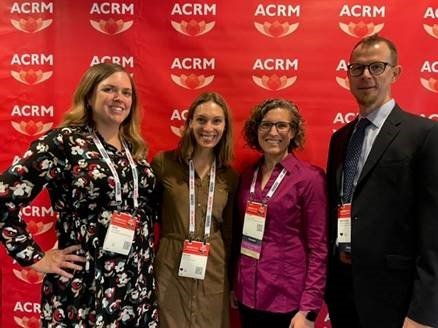
While attending, I explored the conference a little bit before I was greeted by several members of the Concordia University Wisconsin OT faculty. There was a good number of us representing CUW including Dr. Wilbanks, Dr. Michael McKinnis, and Dr. Anne Martin. When my turn was up to speak, I was not nervous, but excited. I could sense they were proud of me and all my hard work.

OTD Students
Left to right: Dr. Anne Martin, Dr. Baylee Noe, Dr. Susan Wilbanks, and Dr. Michael McKinnis

Reflection

Overall, this conference was a great opportunity that posed a positive kick-off to my career in Occupational Therapy. I feel like this experience adds a bit of glamour to my resume. I have learned that I enjoy speaking in front of people, especially about things that I am passionate about.

Occupational Therapy at Concordia University

The OTD program at Concordia University Wisconsin offers a variety of opportunities for students. Our program is geared to prepare students to be the best occupational therapist they can be. This fulfilling career is not for everyone but for those who are willing to and are driven to put in the work will love the program. Ultimately, students will be serving their communities in so many ways. Baylee is just one example of what opportunities are ahead for OTD students.

Learn more about Baylee’s story along with a few other Occupational Therapy students and what they love about the program.

What it’s like being an OTD student

Here at Concordia, we believe we have an award-winning Doctor of Occupational Therapy Program. Our program empowers students to grow into their highest potential and become a leader in their community. The program emphasizes the importance of serving all clients with the best care possible. There is a wide range of OT settings that students are placed in, from a classroom or laboratory to clinic-based instruction.

Our program prepares students for the professional world and to make a significant impact in their communities. It enables students to develop leadership skills, solve occupational problems, and become change-makers. There are so many possibilities and opportunities that the OTD program offers. Don’t just take our word for it, here is what some of our students have to say.

Emily Furmanek

Emily Furmanek previously received her bachelor’s in psychology at Carthage College. But she didn’t stop there. She wanted to pursue higher education to eventually teach OT in a university setting. She says, “CUW offered me an opportunity to achieve an OTD degree allowing me to be one step closer to reaching my goal.”

What’s your favorite thing about your current capstone project/experience as an OTD student?

I absolutely love learning. This opportunity allows me to further practice the craft of writing curriculum and delivering it at a high level of education. The support CUW faculty provided me was tremendous, and only furthered my passion for this career.

How do you feel this project/ experience has prepared you for your future as a Registered Occupational Therapist (OTR)?  

It has allowed me to practice the leadership and communication skills that will prepare me greatly for my future as an OTR, no matter where I go.

Would you recommend the OTD program to others? Why?

Depending on your reason for OTD, I would say yes. Specifically, pursuing a career in higher education, was an easy yes for me.

“If you are even slightly considering pursing on OTD just do it! It is hard work, and requires a timely and organized work habit, but the work you do and the changes you can begin to create for the future of OT are endless.”

Emily Furmanek

Baylee Noe

Baylee Noe partnered with Mercy Hospital Janesville as her capstone site. Practicing OTR, Kayla Engelking, acted as Baylee’s capstone mentor at the hospital. Hear what they both had to say about the experience.

Why did you choose to do the OTD program at CUW?

Baylee: I knew pursuing a doctorate was the right choice because it would increase my understanding of research methodologies. As a result, this will help me advocate for the purpose and benefits of OT. I support the growth of the profession as healthcare is constantly changing and increasing in evidenced based-care techniques. I also aspire to teach later in my professional career as I have the desire to share what I have learned and inspire students who wish to take an innovative approach to OT.

What is your favorite thing about your current capstone project/experience as an OTD student?

Baylee: My favorite part was collaborating with my mentors and other staff in the hospital. I learned so much and was able to advocate for OT and its beneficial outcomes.

Kayla: My favorite part of the experience was watching the interdisciplinary collaboration on Baylee’s project. It has made a greater personal connection with our surgical team with therapy staff. I also greatly look forward to the research outcomes that I can immediately implement in my daily routine.

How do you feel this project/experience has prepared you for your future as an OTR?

Baylee: The capstone project better prepares you for your future career in OT. This is because you gain more experience being assertive and direct with other disciplines. I have been able to make professional relationships with other healthcare workers. The greater the teamwork, the better the patient care!

Kayla: We will be getting the most current research that we can immediately implement for our patients. It has also fostered greater communication between therapy and the nursing/ MD/ PA/ cardiothoracic team.

Would you recommend the OTD program to others? Why?

Baylee: If you are highly motivated and are willing to go the extra mile, DO the OTD program! The difference between the master’s program and the doctorate program has nothing to do with having the skills to be a better clinician, but the doctorate curriculum requires a lot more self-direction and independent study.

Any advice for future OTD students?

Baylee: Think about potential capstone topics very early. As early as the first semester. Also, reach out to current practicing OTs and faculty advisors to discuss needs in the community.

Want to learn more?

The OT program at Concordia is an excellent program that leads to a fulfilling career. It’s a career choice that offers numerous benefits the biggest one is feeling valued and knowing you are making a difference. The OTD program is one step further in that valuable journey. Consider the stories of Emily, Baylee, and Kayla and enroll in the OTD program.

5 Questions About Your Emotional Intelligence

When thinking of intelligence, most individuals tend to picture something like IQ. While IQ can tell you a great deal about your ability to problem solve through learning, application, and logic, it does not paint a very accurate picture of your ability to succeed in complicated life circumstances. That’s where emotional intelligence comes in.

Simply put, emotional intelligence is your ability to understand and influence emotions, both in yourself and in others. It is a measurement of awareness. Numerous studies show that emotional intelligence is directly linked to strong performance. Thankfully, emotional intelligence can be learned (unlike IQ). Certain individuals may be more naturally predisposed to high levels of emotional intelligence, but you can always work towards improving.

Below are five questions you can ask yourself to gauge your own emotional intelligence:

How aware are you of emotions, from yourself or others, on a daily basis?

Typically, people with emotional intelligence are not only aware of their own emotions but also the emotions of others. Emotions are projected through both verbal and non-verbal signals. An emotionally intelligent person can often sense emotions right away when entering a room. This does not require any verbal contact at all; someone’s facial expression or body language alone can communicate a great deal.

In conversation, emotionally intelligent people usually put themselves in someone else’s shoes, connecting with the other person on an empathetic level. Usually, emotionally intelligent people can relate to people and can feel what they are feeling.

Emotional intelligent people are curious about everyone around them. They are not always so concerned with themselves, but also with the emotional health of those around them. Because people with high emotional intelligence are so socially aware they tend to be good judges of character and can read others well.

Listening to others and paying attention to others is a part of being an emotionally intelligent person. When you listen to others, do you tune them out or are you genuinely interested in how they feel? If you are interested and empathize with them, you may have high emotional intelligence.

Do you have the ability to manage your own emotions?

Take a moment to think about difficult moments you have had in your life. How did you react?

Emotionally intelligent individuals do not typically wear their emotions on their sleeves. Though they may feel emotions strongly, they understand how their attitude impacts others. Throughout the day a host of negative emotions arise. Anger, jealousy, and irritation are things emotionally intelligent people actively seek to identify in order to resolve the core of the issue.

Part of managing your emotions means you are able to let things go. This means letting go of your mistakes and not dwelling on them. Learn from your mistakes and don’t let them ruin your outlook on life.

Every day we experience an array of emotions. The way we handle emotions and show them through our attitude and body language is what makes the difference between being and not being emotionally intelligent.

Are you able to use your emotions in a constructive way?

Emotions are a good thing. They are protective and allow us to make sense of our lives. However, sometimes emotions can be destructive. Simply put, emotionally intelligent people don’t let emotions become a negative factor in their lives. Reflect on the impact your emotions make on your life. If you struggle to identify positive outcomes from emotional situations, this can signal issues.

Emotionally intelligent individuals also recognize when they are having negative self-talk and stop themselves from continuing to talk negatively. Instead, they will think and speak positively. This is because negative self-talk changes our brain chemistry and affects how we handle our emotions.

Handling your emotions effectively is the best way to grow emotional intelligence. Making sure we manage our emotions in a constructive manner. Know what our strengths and weaknesses are. Be able to talk about emotions while also considering the emotions of those around us.

Do you do well under pressure?

Our lives are not perfect; there are many bumps in the road along the way. Another key to emotional intelligence is staying in control under pressure when everything seems to be falling apart. For example, if a stressful situation occurs at work, how do you react? Emotionally intelligent people are aware that remaining calm in those instances is crucial both for your professional and emotional well-being. Think about a time when something was stressful and how you handled it. Then think about what you could have done better to improve your emotional intelligence.

Change is an inevitable part of life. When we become flexible and can adapt to change, our emotions are not as extreme. Being able to handle change is a good indicator that you also do well under pressure.

Are you honest with yourself?

Emotionally intelligent people take time to reflect. They think critically about life circumstances and occurrences. They enjoy “quiet time” and reflection. It is hard to turn off our cell phones or televisions and ask ourselves hard questions, but the payoff is invaluable.

Emotionally intelligent people also know how to say “no” to both themselves and to others. No is a powerful word that many people are afraid of. Being able to say no shows a sense of self-control that yields people from making impulsive decisions and are better able to handle their emotions.

Grow your emotional intelligence

How does your emotional intelligence compare? Here are 4 tips to grow your emotional intelligence.

This blog was originally published on March 21, 2016. It has been updated to reflect current information.

How to become a CPA

Becoming a certified public accountant (CPA) is a great career to pursue and is well-praised in the world of finance. There are many benefits for accountants who become licensed CPA’s. Let’s get the easy one out of the way, yes, you will make more money as a licensed CPA. But don’t discount the numerous opportunities offered to CPAs along with the increased job security of a respected position. The list continues with improved benefits, incentives, and job flexibility.

Now, you want to know the steps involved in pursuing this promising career path.

Since every state has its own set of rules to become a CPA, make sure to check your states requirements. If you plan on getting your CPA in Wisconsin, take a look below at the steps you will need to take.

Get your education

Your first requirement is to have 150 semester hours of college credit and at a minimum, a bachelor’s degree. Most bachelor’s degrees in accounting consist of 120 credit hours. Therefore, many people earn a master’s degree or a post-baccalaureate certificate to gain the additional required 30 credits. However, business law and income taxation courses from an accredited bachelor program are required. Having knowledge in both those topics is helpful as a CPA.

According to the Wisconsin State Department of Regulation and Licensing, they will approve all accounting degrees that were earned through colleges and universities located anywhere in the country that have accreditation recognized by the U.S. Department of Education.

Take the CPA exam

After completing only 120 of the 150 required credit hours, applying for the CPA exam is the next step. Applying as soon as you have the courses completed will be important. It will pay off in the long run so that you don’t waste time taking the exam later. The benefit of becoming a CPA in WI is that students can take the exam 30 days before graduating. This saves you time and gives you the freedom to not worry about the exam after graduation.

You can apply through the National Association of State Boards of Accounting and send in all of the required documents. After a few weeks of processing, you then will be able to register for a date to take the exam. This exam comes at a cost, so a tip when registering is not to register for all four sections at the same time. It will end up costing less in the long run. If you end up needing to re-register for a new date to take the exam it will cost you less if you are only registered for one section rather than all four.

Most importantly, make sure you are prepared for the exam. Start by taking a practice exam to see where you would score. Based on that initial score create a study plan and don’t push it off.

Gain the necessary experience

Congratulations, you’re a certified CPA! But you’re not satisfied yet, you want that full license don’t you? Well, after becoming CPA certified, Wisconsin requires 1-year or 2,000 hours of paid public accounting experience. You will not be able to receive a license until you have the required experience. Before searching for your experience make sure to look at the boards’ qualified experience criteria. Also pay attention to the equivalents and jobs that are not viable for accounting. It would be devastating to find out after a few months that your hard work doesn’t qualify.

Some common experiences that people do take are accounting positions in industry and government. Any positions titled accounting, auditing, or financial analyst are common. But a bank teller, restaurant manager, or cash register clerk are not equivalent experiences to public accounting.

Get your CPA license

You’re in the final stretch. To get your CPA license, you must mail all required documentation to the Wisconsin Department of Regulation and Licensing. It will take 4-6 weeks for your documentation to be processed and approved. Then you will complete a 50-question, untimed ethics exam. This exam is taken online and there is a textbook available for preparation. The ethics exam will test your ethical principles and knowledge that are needed for a professional career. After this exam, all of your hard work has paid off. You are not a certified public accountant!

Continuing Education

Yes, there is more school in your future. This is not a requirement by the state of Wisconsin, but many CPAs will elect to join the Wisconsin Institute of Certified Public Accountants (WICPA) to keep their license intact.

It’s important to stay up to date on information and continuing education because you will need to renew your CPA license once every other year. Be sure to always continue your education and further your accounting knowledge to continue renewing your license. Concordia offers an MBA program for accounting which is a great option to continue your education and increase your level of influence and expertise at your company.

Accounting programs at Concordia

It can be overwhelming when searching for an accounting program, but Concordia makes it easy by having it all in one place. Each of these programs meets the requirements of the state of Wisconsin to take the CPA exam.

  • Traditional bachelor’s degree in accounting
  • Accelerated online bachelor’s degree in accounting
  • MBA in Accounting
  • Master of Science in Accountancy

Whether you are looking to get your bachelor’s, or master, or continue your education in accounting, at Concordia you can do it all. Our new Master of Science in Accountancy program offers a CPA exam review in the curriculum which further prepares students for their future as an accountant.