Nine burning questions for FLAME

Meet CUW’s December commencement speaker and Grammy-nominated Lutheran rap artist, FLAME.


Born and raised in the inner city of St. Louis, Missouri, FLAME has been on the Christian music scene since he released his first studio album in 2004. He recently converted from Reformed Baptist theology, a branch of evangelicalism, to Lutheranism and earned a master of arts degree from Concordia Seminary, St. Louis. FLAME tours worldwide and is co-founder of Clear Sight Music, “a boutique record label raising the bar in Christian hip-hop and beyond.”

The artist has released nine albums to date and agreed to answer nine of our most burning questions in advance of his address to graduates at Concordia University Wisconsin’s December commencement ceremony on Saturday, December 17.

1. Where did the moniker “FLAME” come from?

Like the Biblical character Jeremiah, I, too, have been shaped with a fire for speaking Biblical truths, even if it is uncomfortable or when people don’t want to hear it. Jeremiah said, ‘God, I’m not going to make mention of your name anymore, but your word is like a fire shot in my bones.’ I took on the moniker FLAME after learning about Jeremiah as a reminder of my inner fire to speak on behalf of God.

2. Much has been written about your difficult childhood; is where you came from essential to the Grammy-nominated artist you’ve become?

The unique arrangement of things that God exposed me to—the good, the bad, and the ugly—shaped me into a person who sees the world in a way that gives favor to the style of music that I create, the kind of conversations that I have, and the type of emphasis I make in my human expression. I am grateful for all of it.

3. Who are your fans, and what do you bring to their lives?

My fans are rap listeners because the rhythm, poetry, sonic sound, and style fit the genre. They are also people who read, people who think a lot, and people who enjoy thought, discussion, and nuance. They are looking for answers to the disintegration, complexity, and hypocrisy within us, and they want to make sense of it all.

My music bridges lofty theological truths and the lived human experience. I want people ultimately to know that God is for us. He’s kind, He forgives, and we can lean in on him for peace and assurance on the journey.

4. How are you received in the rap community?

In the Christian rap community, I think people enjoy the common themes, things that we all agree with as Christians, and they also appreciate that my content goes beyond what they hear regularly. They like being exposed to academic seminary-type discussions, which is something they may not oftentimes hear or engage in.

In the non-Christian rap community. What people appreciate is that I remain true to the genre. In mainstream rap music, people want clear statements of beliefs. I’m clear about my Christian faith, and I understand that life is rough, but then I want to convey that God cares. People respond to my honesty and transparency.

5. Who were the mentors and role models in your life?

Certainly, my grandmother. She gave me the genius idea of taking what I enjoy naturally, which was rap music and then fusing it with my Christianity and my education. Later on, a group called Cross Movement was doing Christian rap in a way that captured my attention. As of late, I’m inspired by the things I’m exposed to on my Lutheran journey, including the Lutheran Reformation and the heroes like Luther, Melanchthon, and Chemnitz.

6. What advice or wisdom do you offer to the graduating class of 2023?

I love that Lutherans have such a beefy understanding of vocation. Commencement is an excellent opportunity for students well-informed in their craft to move into the world. As they do, I hope that they are kind and gentle and that they do great art, great business, great science, and great math for the good of humanity. I want them to remember that they represent Christianity in all they do and that when people marvel at their intelligence and brilliance, they give credit to our God.

7. Our brand platform is Live Uncommon. What does Live Uncommon mean to you?

I love that challenge to take the normalcy of what God calls us to do while living out loud as Lutherans. For Christians, that means to go out and do good in all you do, in all of your contemporary expressions, and do it to glorify God. Help people know that all you do is tied to ancient realities that stemmed from God’s care for the world in Christ Jesus. I love that!

8. How do you connect with non-believers?

We can all share the emotions and the feelings of just being human. And, as we find ourselves in that common space, I can share with them what drives me to smile or create art in a world where I’ve experienced loss, suffering, and pain. My connecting point with Christians and non-Christians is sharing my frailty, humanity, hope, joy, and desire to live and do good in the world.

9. What’s next?

I have so many things! I just completed a book where I’m articulating my journey to Lutheranism. The book is not the didactic, weighty theological waxing you hear in my music; it is about the joys and the lows of my lived experience and how that impacted relationships. I want to continue releasing projects about vocation, law and gospel distinction, confession, and absolution. I’m also working on things that encourage other artists, dancers, stylists, and people in the arts and film to make good art and tell good stories for the sake of the gospel and the good of humanity.


Want in?

Concordia University is an uncommon community of students, faculty, alumni, and staff who are gifted by grace and ever-preparing to live out our purpose to serve Christ in the Church and world. For more information about our academic programs and campus life, click on the link below.

Learn more

50 questions to ask on a college tour

Choosing the right college can be a stressful task. After doing your online research and narrowing it down, how do you choose? The best way to decide if a college is right for you is to be there.

Colleges offer campus tours throughout the year for students and families to check out. But what exactly is important to find out when visiting? To help you get all the answers you need, we’ve put together a list of questions to ask on a college tour.

College Overview

First, it’s important to understand the college as a whole. Getting to know the culture of the university can help you determine if it fits your personality. A good way to do this is by asking your tour guide (normally they’re a student).

  1. What are the students like? What would you say if you could describe the “typical student”?
  2. Why did you choose [name of college]?
  3. How many students go here?
  4. What would you say are the college’s strengths? What is the most significant benefit of being a student here?
  5. Do you feel safe on campus?
  6. Is it easy to get around campus? What is the most common way to get around?
  7. What’s most unique about the college?
  8. What are the college’s most important values, and how does it demonstrate this to students?
  9. How does your school demonstrate commitment to diversity, equity, and inclusion?
  10. What would you say is the biggest challenge on your campus?

Academics

This is why you go to college right? So of course it’s critical to ask about the courses, faculty, and opportunities within your major. It’s essential to know exactly what type of education you will be receiving.

  1. What majors are the most popular?
  2. How big are most classes?
  3. Do you like the faculty and staff?
  4. How many courses do most students take per semester?
  5. Is there an opportunity to study abroad?
  6. Do students have access to tutoring or writing centers?
  7. How successful are your graduates? What’s the job placement rate after graduating?
  8. What type of support can I receive during courses?
  9. How satisfied are you with academic advising?
  10. How often are collaborative work or group presentations required?

Student Life

It’s helpful to know the place you will be spending the majority of your time. Getting to know the campus culture, facilities, and students can you help vision yourself as a student.

  1. What types of clubs and sports are on campus?
  2. What does an average day for a student look like on campus?
  3. What facilities are available to students?
  4. What makes the student body unique?
  5. Are students required to live on campus?
  6. How are the dorms? How are they assigned?
  7. Can I choose a roommate or am I assigned one?
  8. How’s the food on campus?
  9. What are some of the school’s main traditions or events?
  10. Are there medical resources close by if needed?

Resources

Being aware of the resources available to you on campus can help you to be successful throughout your college experience.

  1. Are there accessibility services for students?
  2. How easy is it to find summer jobs and other kinds of work through your school?
  3. What type of career services are available?
  4. What types of support services are available for students?
  5. Can I apply for financial aid?
  6. Are there any scholarships available to students?
  7. Can you receive help from professors outside of the classroom?
  8. What types of work-study jobs are available on campus?
  9. Is there a tuition payment plan to pay monthly installments?
  10. What services are available for struggling students?

Questions for online learners

Even online students should make sure the college is a good fit for them and their goals. Here is a list of online-specific questions to ask before choosing a program.

  1. How flexible is the program?
  2. How easy is it to balance work, school, and life during the program?
  3. Do you have many working students?
  4. Are there any support resources for online students?
  5. How accessible are professors if I have questions?
  6. Do I have access to on-campus resources?
  7. How are classes structured? Will my online classes be mostly synchronous (live courses in real-time) or asynchronous (prerecorded, available at my own pace?)
  8. May I take classes on campus, if possible?
  9. Do you have technical support available?
  10. How long has the college been doing online learning?

RELATED: Online Learning: What sets Concordia apart?

Before you go

College visits are the perfect way to immerse yourself in the campus and see how it feels to be there. Remember, there are no silly questions on a tour, so make sure to ask anything you are unsure of or want to learn more about. Campus staff and tour guides are there to make sure you have the best visitor experience possible. If you’re interested in visiting Concordia University Wisconsin’s campus, click the button below. Happy touring!

Featured Alumni: Kourtney Anderson

Alumni, Kourtney Anderson, graduated from Concordia University Wisconsin and Ann Arbor’s Doctorate of Education program. Anderson is currently an Academic & Career Planning Coordinator for the Milwaukee Public School District. Take a look at Anderson’s experience as a graduate student at Concordia.

Why did you choose the Doctor of Leadership in Innovation and Continuous Improvement (LICI) program at Concordia?

I chose to enroll in the LICI program at Concordia based on my past experience within the Master of Science-Professional School Counseling program. During the counseling program, the CUW staff not only showed care and concern for my studies but for my personal life as well.

If I missed a class or didn’t seem like myself, I could always count on the professors to check on my well-being. No matter the professor, I felt worthy, supported, and understood by all of my professors during my educational journey. For this specific reason, I knew that if I was to continue to further my education, it would be here.

How did this program help take your career to the next level?

My goal in this program was to increase my impact in an educational environment. The LICI program gave me the expertise to effectively help students by assessing both small and large organizations.

Discuss your experiences with the cohort model.

The cohort model was a wonderful and supportive experience. Since each cohort begins their study together and progresses through the program collectively, there is an opportunity to build relationships and utilize classmates’ strengths. Having the opportunity to work together and progress through the program together provided an extra layer of support that is greatly needed when pursuing a doctorate degree.

What did you learn from your cohort peers?

I learned from my peers that there is always room to improve and grow. They showed me new educational techniques and practices I hadn’t seen before. This helped me understand that you can always make progress when introducing ideas and curricula to students.

What are your goals with your new Ed.D.?

I got a job in an educational environment that enables me to apply the knowledge I obtained with my Ed.D. My aim is to make use of my place as an Academic & Career Plan Coordinator by designing academic and career planning curricula and tools to assess programs. I hope to also generate materials for counselors and students. My ultimate goal is to establish academic and career planning chances and lessons tailored to students in urban settings, to bring back hope in this particular student group.

How did the LICI program transform you?

It has transformed me by enhancing my creativity and innovation skills. Since participating in the program, I’m more creative in the development and implementation of educational programs and activities with students. Additionally, I develop innovative materials and documents that can be useful for both families and counselors during the enrollment process.

What was a pleasant surprise about the LICI program?

I was pleasantly surprised by the support received throughout each course on the formation and completion of the dissertation. At the start, I was nervous and worried about how I would progress in the creation of the dissertation.

After beginning, I quickly received support and direction on how to choose and construct a dissertation topic. From constructing dissertation topics and ideas to researching supporting themes, and constructing each chapter within the document, the LICI professors offered support with the entire dissertation journey.   

What were the hardest and easiest aspects of completing a dissertation?

The easiest aspect of completing the dissertation is the formation of a dissertation question or problem. If you are passionate and knowledgeable about a topic, finding new research for the dissertation will come easily.

The hardest aspect is narrowing down the exact themes, research articles, and information to use. During the research process, numerous research articles are reviewed and determined for usage. If you determine all information is useful within the dissertation, the narrowing of articles can be difficult and can become overwhelming.

How did you grow personally and academically during your dissertation process?

Personally, the dissertation process helped me to gain knowledge about topics of interest within my field which helped me to evolve professionally and be considered for promotions within my organization. Academically, the dissertation process has helped me to strengthen my critical thinking and writing skills to properly contribute to my field of study.

What connections did you make with your LICI professors?

The strong connections I made with the LICI professors ultimately resulted in meaningful and long-lasting relationships. They provide me with professional references who can elaborate on my academic performance and personal growth.

These connections also are a great network for a plethora of career opportunities, as well as valuable guidance from distinguished individuals within the field. I will be forever grateful for the knowledge received, skills gained, and relationships built from my participation in the LICI program.

What were your most memorable experiences in the LICI program?

My most memorable experience was the completion of the group project during the second residency. During the project, I worked with peers who had various strengths to create a new educational program or system. The most valuable takeaway was understanding the value of having a team that is diverse in abilities, career backgrounds, and perspectives.  

If you’re interested in hearing more stories from alumni, start here. Or if you’re looking for information on the LICI program, click below.

2022 December commencement: What you need to know

Please join us in congratulating the 444 candidates for December graduation. Here is everything you need to know about the upcoming ceremony.


Concordia University Wisconsin will host a commencement ceremony for undergraduate and graduate students on Saturday, December 17 at 1:30 pm in the R. John Buuck Field House on the CUW campus.

Tickets are required for guests. Each graduate can request up to a total of six tickets, which are free. For details regarding how to secure your tickets, please visit here.

For those unable to attend in person, the event will also be livestreamed, beginning five minutes before the start of the ceremony:


Baccalaureate Ceremony and Student Awards

The Baccalaureate Ceremony will take place at 10 a.m. in the Chapel of Christ Triumphant.

At CUW, the baccalaureate ceremony is a Christian worship service with hymns, scripture lessons, a message, prayers, and special recognitions. It is an opportunity for our Christian community to celebrate all of God’s blessings associated with higher education and the earning of a degree. It is also a time to recognize and to thank God for all our vocations, what we do in our various careers to honor and to serve our Creator and Redeemer.

The Marsha Konz Student Educator Award:
Katie Borcherding
for superior achievement in the field of teacher education

The Marsha Konz Graduate Educator Award:
Claudine Harper
for outstanding performance as an educator and as a student in graduate education studies


Commencement Speaker

FLAME—Lutheran hip-hop artist

FLAME is a GRAMMY® nominated hip-hop artist. He is a well-versed leader in the Christian hip-hop scene with a growing list of accolades, including a GRAMMY® nomination, several Dove and Stellar Award nominations, and multiple Billboard chart toppers. He was born and raised in the inner city of St. Louis, MO. He has released 9 albums to date and Stellar Award winning “God Knows” (2018) under his own imprint.

For over a decade, FLAME has traveled throughout North America & the Caribbean, Africa, Europe, and Asia performing music that has impacted the masses. In addition to touring, writing, recording and co-producing his own projects, FLAME founded and helms Clear Sight Music, a burgeoning record label raising the bar in Christian hip-hop and beyond. He has a Master’s degree in theology with a minor in counseling.


Student Speaker

Candice T. Wright—Doctor of Education in Leadership in Innovation & Continuous Improvement

In addition to the doctorate degree she will receiving on Saturday, Wright has already earned not one, but two master of science degrees from Concordia University Wisconsin. That’s quite an accomplishment for anyone, but especially for someone how is the owner and operator of not one, but two small businesses. Those would be Granny’s House, Inc., a chain of assisted living facilities in Milwaukee and Washington County, and Lily Rose Care Coordination, a prenatal care organization serving pregnant women and families.

In addition, Candice is a yoga and meditation instructor, focusing on development of the mind, body, and soul—one who offers free or lowest cost services as a way of giving. And she also serves as president of the Upsilon Mu Omega chapter of Alpha Kappa Alpha Sorority and the Diamond Jubilee Pearls Foundation, two organizations whose mission is to serve mankind.

On top of all this, Candice and her husband, Doctor of Veterinary Medicine Ramard D. Wright, are the parents of TEN biological children, a brood they have nicknamed “The Perfect 10.”


Special Awards

Master Educator Award—Elementary Education:
Jeff Potter, Boca Raton, Florida

Jeff graduated from Concordia University Wisconsin in 2008, and taught briefly at Jackson Elementary in Jackson, Wisconsin. He then accepted a call to teach fourth and fifth grades at Trinity Lutheran in Holly Hill, Florida, where he also served as acting principal for a time. In 2014, he was called to become assistant principal at St. Paul Lutheran School in Boca Raton, where he has served there ever since.

In the words of St. Paul Principal James Richards: “Jeff is a person who strives to accomplish a task with vigor and grit. He does not take shortcuts and will think outside the box about handling obstacles.  He volunteers constantly and is someone our entire ministry counts on. Simply put, St. Paul would not be the same without him.”

Master Educator Award—Secondary Education
Todd Huebner, Brookville, New York

Todd Huebner has deep Wisconsin roots, having graduated from Milwaukee Lutheran High School in 1986 and from Concordia University Wisconsin, with a Bachelor of Arts degree in education, in 1990. It’s in New York, however, where he’s made his mark as a Lutheran educator. He is currently serving in his 33rd year at Long Island Lutheran Middle and High School in Brookville, New York.

In addition to being an outstanding teacher, Todd has remained extremely active in student activities. He coached the school’s varsity baseball team from 1991 to 2005 and served as athletic director from 2006 to 2021. Today, he continues as assistant AD and is known as “the Voice of the Crusaders,” announcing at all the team’s football games and some basketball games.

He has also gone on two Luther High mission trips to Puerto Rico, in 2019 and 2020, with plans in the works to return again in 2023.

Perhaps most importantly, Todd is known for his positive spirit and energy. In the words of Paul Wenger, retired principal of Long Island Lutheran: “Beyond all his professional responsibilities he is one of the most positive people I have ever known. I cannot think of a teacher more deserving of the Master Teacher Award than Todd Huebner.”


For complete details regarding the December 2022 commencement ceremony, click HERE.


Want in?

Concordia University Wisconsin is a Lutheran higher education community committed to helping students develop in mind, body, and spirit for service to Christ in the Church and the world. Want to learn more or apply today? Just click the link below!


Faculty Spotlight: Dr. Jim Pingel

Interested in the faculty members behind our programs? Get to know them through our monthly faculty spotlight. Learn about Dr. Jim Pingel’s education and some of his favorites.

Why did you choose to work at Concordia University?

God called me to serve at Concordia University. There were other times during my ministry where there was an opening at Concordia, but I never applied. I loved serving at the two Lutheran high schools I was called to serve at. I truly believed if God wanted me at Concordia, He would let me know on His timeline. Back in 2013, Dr. Michael Uden reached out to me and offered me a wonderful opportunity. I felt God working through him and through the process, and now I’m here.

There are plenty of colleges and universities to work at, but I wanted to be serving at one where you can share God’s Word freely and unapologetically within your field of study. Nothing, nothing is more important than knowing Jesus Christ as your Lord and Savior.

My personal feeling is if you want what is best for students, if you really care for them, you want to give them the very best. And we know what’s best for them–God’s Word and Jesus. If I don’t or didn’t share that with my team members or students, I feel like I’d be letting them down and not giving them my best.

What are your goals for your program?

I love our university mission statement which focuses on “helping students develop in mind, body, and spirit for service to Christ in the Church and the world.” The section which really speaks to me on our School of Education mission statement revolves around the notion of “lifelong learning.” I want our faculty, curriculum, and programs to inspire a love for the Lord and for learning in our students.

If we can help students follow and pursue their passions, curiosities, and inspirations, then learning will always remain a central part of their lives and joy while serving here on earth. Hopefully Concordia University is not only an oasis on their life journey, but resource which they can plug into and be renewed and recharged with for the rest of their lives.

What’s the one key lesson you hope students take away from your courses/program?

I think at the end of the day, I want each student to know they are “fearfully and wonderfully made,” loved and set apart for a purpose here on earth—thanks be to God! If we can impart that sentiment and belief in each student who matriculates through the School of Education, we can consider ourselves blessed.

What’s your education and career background?

I went to public schools all my life as I grew up in Sun Prairie, WI. I received a well-rounded education in most aspects but didn’t have the religious training and instruction. Post-high school, I went to Concordia University Wisconsin for my bachelor’s degree in Secondary Education – History & Athletic Coaching (1992).

I received 2 different Masters degrees. One Master’s Degree in Early American History from Marquette University (1994). And a Master’s degree in Educational Administration from CUW (2001). In 2008, I earned my Ph.D. in Educational Leadership from Cardinal Stritch University.

  • 1994-1999: I served as a social studies teacher, and basketball and volleyball coach at Mayer Lutheran High School.
  • 1999-2004: I transitioned into leadership and became the Executive Director of Mayer Lutheran High School until 2004.
  • 2004-2013: I served as the Executive Director of Sheboygan Area Lutheran High School.
  • 2014-Present: I’ve served at CUW as Secondary Education Department Chair, Director of Graduate Education, and now Dean of SOE (since 2018).
  • 2016-Present I’ve also served as Executive Assistant to the Association of Lutheran Secondary Schools (ALSS)

What are some of your career highlights?

  • Top Tier Ranking for “Faith and Mission” (2019, 2017, 2016, 2015)
  • South Wisconsin District Administrator of the Year (2012)
  • Minnesota State Basketball Coach of the Year (Section IV, Class A) (2000)
  • James Madison Memorial Fellowship Recipient (1992)

One of my favorite accomplishments has been helping launch the Doctorate of Education in Leadership in Innovation and Continuous Improvement (LICI).

What’s the most interesting part of your field that the general public might not know?

1) Teaching is the ultimate motivational sport.

If you can get kids or adults excited about learning and developing mindsets, habits, skills, and dispositions, you can do almost anything.

2) If you love a good story, you’ll love teaching.

In each class—in person or online—you have 15 or 20 different stories sitting before you or staring back at you. And every single biography is different. Read them all! You’ll never be the same.

What do you like to do for fun?

I enjoy researching, reading, and writing, but probably reading the most.  I also like to watch movies and go out to dinner with friends (pre-pandemic times). As I have become older, I treasure having a coffee with my daughter, a golf outing with my son, and a glass of wine with my wife.

What is the best part about being a teacher?

Kids, colleagues, and intentional professional growth opportunities—each one of these brings me great joy. I love seeing the excitement in a student’s eye when one experiences an “ah-ha!” moment. My Concordia University colleagues truly inspire me with their expertise, talent, and dedication. And I love going to conferences, reading professional journals, and being a part of book clubs to learn more about God’s wonderful world and creation.

Why should students study education?

First of all, every single one of us is a teacher whether we admit it or not. As Mark Twain once said, we shouldn’t let schooling get in the way of education. So just learning more about how the brain learns as well as the art and science of teaching—these are all aspects that will serve each of us well in a plethora of vocations.

More specifically, however, almost all of us know the impact of teachers. Whether it was a truly positive or negative experience, we all remember our teachers—everything from the way they dressed, smelled, and talked to us to the various life lessons, habits, skills, and dispositions they imparted to us. That’s the impact that teachers have—they shape lives for life! And Christian teachers can shape and impact their students’ lives, with the power of the Holy Spirit, for eternity!

Why should students consider coming to Concordia?

We are a Christ-centered, excellent school of education, dedicated to giving our students the best in a comprehensive, whole-life manner—a life connected to Christ, a teacher preparation plan equipped in the arts and science of teaching, a state, and national network to meet their career aspirations, and a confidence that they can bring their whole self to the teaching profession to help students in ways far beyond the diploma.

Their Concordia University professors will become, not just mentors and guides for them while they are at Concordia University, but Christian friends for life.

Learn about the core of Concordia’s education.

This blog was originally published on January 28, 2021. It has been updated to reflect current information.

DBA or EdD: Which Doctorate Should You Choose?

When comparing Doctorate of Business Administration (DBA) programs with Doctorate of Education (EdD) programs, it can be hard to determine which one is the best fit for you.

What are your career goals?

Nobody knows your goals and dreams better than you do. So, what are your career goals? Why are you pursuing a doctorate? Thinking through your “why” is an essential part of selecting the program that fits you best.

Concordia offers both DBA and EdD programs. The infographic above explores the similarities and differences between both doctorate programs. The similarities are in the middle, and each program’s distinct features are to the left and right, respectively.

DBA vs LICI program diagram

Concordia’s DBA Program

The Doctorate of Business Administration program prepares you for the complexities that are ever-present in the business world. Concordia University takes a holistic approach to prepare Christian leaders, and the students in our program will learn to address these problems by combining both quantitative and qualitative business concepts. This approach leads to real change that translates to long-term growth and profitability.

The DBA Program has four concentrations:

  • Finance and Economic Management
  • Organizational Change and Performance
  • Business Sustainability

What sets Concordia’s DBA apart from other programs?

Our program will prepare you as a leader to make data-informed decisions through the study of real-world business and organizational trends. We will address not only quantitative business concepts but qualitative concepts as well. Our doctorate is much more balanced. The qualitative aspect of teaching the human element and a holistic approach sets us apart from other schools. 

Students are coming to us because of the way we structure our research project. You’ll begin your research right away, and you’ll have 1:1 mentoring and support throughout the process.

Who is the ideal student for the DBA program?

If you’re highly motivated and looking at improving both your personal situation and your organization, you should consider this program. Often, a DBA is preferred for candidates seeking promotions. Our program emphasizes leadership and administration, and if you can see yourself enjoying one of our three concentrations, this program could be a great fit for you.

Concordia’s EdD (LICI) Program

Concordia’s Doctorate of Education in Leadership in Continuous Improvement (LICI) is a cross-disciplinary program that will help you develop into an innovator who can make an impact in any vocation.

The mission of the EdD (LICI) program is to prepare and equip you to be driven to learn.

There are three core areas of concentrated study in this program.

  • Leadership Core
  • The Innovation and Improvement Science Core
  • The Research Core

You can customize these cores to meet your needs. Additionally, you can choose either the Business Emphasis or the Education Emphasis for your electives, or a combination of the two.

What sets Concordia’s EdD (LICI) program apart from other programs?

Innovation and continuous improvement are vital to the health of any organization. These two aspects are the foundation of our program. Also, the interdisciplinary nature of the program is much more realistic and global than what other programs can offer. Our student makeup reflects this as well. Students begin their dissertation work on day one. This doctorate is for working professionals, and we structure our research to meet their unique needs. Our program infuses Christian teachings along the doctoral journey.

Who is the ideal student for this program?

Growth-minded individuals who want to apply teaching and learning across disciplines will love this program. The research process will be especially enjoyable if you want to find real-world answers to big problems. Our focus is on continuous improvement and innovation, so anyone who wants to grow personally and help their organization improve will be a good fit.

Next Steps

You’ve just learned a little more about Concordia’s DBA and EdD (LICI) programs. If you’re still feeling unsure about which direction you want to go, feel free to request more information about our DBA or EdD (LICI) programs. Our university’s name, Concordia, literally means “hearts together.” Your journey continues one step at a time, and we’d love to walk alongside you.

This blog was originally published on December 23, 2020. It has been updated to reflect current information.

Concordia’s Accelerated Bachelor of Arts in Applied Computer Science

Are you looking for a new degree that will open the door to new possibilities?

Concordia University Wisconsin’s online Applied Computer Science Bachelor of Arts degree for accelerated students may be the right door to open!

What is the Applied Computer Science degree?

It wasn’t that long ago when students could get a basic degree in Computer Science or a technical degree in Information Technology. However, in the advancing world of technology, more defined and focused degrees are coming into play. We live in a computer-based society with ever-increasing opportunities for students to solve problems using technology.

While traditional Computer Science degrees typically focus on the theoretical understanding of hardware, software, operating systems, databases, interfaces, and coding, the Applied Computer Science degree provides the flexibility to connect computer theory to a wide range of industries. Applied Computer Science students are empowered to solve daily problems by writing software, designing webpages, and creating applications.

The Applied Computer Science degree provides practical knowledge and skills to immediately enter into technology-based positions.

CUW’s program director Dr. Michael Litman states, “An Accelerated Degree in Computer Science prepares students in fields such as Software Development creating applications for iPhone, Android, Smart TV, Xbox, PlayStation, as well as Full-Stack web development.”

Why would an accelerated student study Applied Computer Science?

These days, most accelerated learners have been working under the influence of computers in the workplace. Some may wonder how computers work but others are intrigued by using computers to make things better and more efficient.

Most working adults looking for a degree have seen the value and the salary increases that can come from applied computing skills.

As stated in the NACE’s Fall 2019 Salary Survey, salaries for computer science positions increased by almost 10.2% between 2018 and 2019. The demand for workers with computer-related skills has sky-rocketed. So, Concordia University has created an exciting offering for busy accelerated students looking for online and evening-based classes.

Who should pursue an Applied Computer Science degree?

You don’t need to have a formal background in computer science. As Dr. Litman suggests, “Any previous degree work is fine. Students with a science or math background likely have the easiest transition. However, the program assumes no prior experience, so nobody would be at a schooling-based disadvantage. Those with natural talent and interest in the field would have an additional advantage.”

The most successful students in any computer field possess analytical abilities and a natural curiosity for logical problem-solving. Accelerated students motivated through their previous work experience to advance their careers. Students with computer skills, and a drive to adapt software, manage information systems, and develop new programs will excel in this exciting program.

Concordia’s Applied Computer Science degree prepares you to serve in the community.

Led by our Christ-centered values, we believe that the best technology leaders demonstrate both uncompromising compassion and unmatched competitive skills.

As a Concordia Applied Computer Science graduate, you can expect to excel as you develop a genuine, ethical mindset complemented by business analytical acumen that is unmatched in the market. In addition to the necessary computer skills, students learn from The Concordia Core which embraces our distinctive Lutheran theology in the context of a dynamic educational experience.

You will be prepared to achieve your God-given potential in this 21st-century career context through the study of Faith, Society and Culture, Human Creativity and Expression, The Natural World, Human Beings and Being Human, and Communication and Language.

An Applied Computer Science degree equips you to work in any industry.

Graduates of the program can use their skills in a broad range of industries including healthcare, financial services, manufacturing, retail, non-profits, consumer internet, automotive, and education. As Dr. Litman suggests, “Many companies have software development needs in all sorts of industries.  Places like banks, insurance companies, and marketing agencies, along with more obvious companies like Facebook, Twitter, Microsoft, Apple, and Google. These are all potential employers for people with a degree in Software Development.”

The door to the world of computers is open.  Are you ready to step through?

For more information, contact CUW’s Accelerated Admission Counselor Nicholas DeLeon at nicholas.deleon@cuw.edu.

Find out more about the Computer Science program at Concordia University Wisconsin.

This blog was originally published on December 3, 2020. It has been updated to reflect current information.

A season of anticipation for ‘12.25’

CUW education alum Josh Atkinson (’09) leads a unique music ministry at Milwaukee Lutheran High School—one that just dropped its fourth album.


By Dr. Michael Uden

Upon his graduation from Concordia University Wisconsin with a degree in education in 2009, Josh Atkinson was called by the Holy Spirit to commissioned ministry as a Lutheran educator … as well as a Christian hip-hop performer? Josh indicates that early in his service at his alma mater, Milwaukee Lutheran High School, he realized even more acutely the importance of developing authentic relationships as well as mutual trust and respect with the students he was serving. Recognizing the overwhelming popularity of the hip-hop musical genre among his students, Mr. Atkinson spent hours listening and mimicking Christian hip-hop artists so he could connect the Gospel message with a musical style that was most popular with the audience of students he wanted to reach.

In many ways, he was attempting to do something quite authentically Lutheran. Martin Luther, whose compositions included music borrowed from secular sources, recognized the impactful way music could affect youth. One legacy that can still be felt today is Luther’s belief that there must be a balance between a simple, accessible musical style and the use of the vernacular in the text. As he put it, “Both text and music, accentuation, melody and gait, must come from the true mother tongue and voice.” (Holman, 2018).

Beginning with the performance of a Christian hip-hop cover song during a chapel at Milwaukee Lutheran High School in 2016, Mr. Atkinson eventually began to write original Christian hip-hop music as well. That avocation not only gained the attention and admiration of many of his students but ignited an interest in them to participate in Christian music composition and performance. Within a few years, ATK Ministry, a 501(C)3 with a mission to share Jesus through music and the arts, was formed. Today the afterschool program of ATK Ministry mentors Milwaukee Lutheran High School students in hip-hop and contemporary gospel music composition, performance and production as well as in dance technique and performance.

IN THE NEWS: Josh Atkinson on CBS58

According to Josh, “The vision for ATK Ministry is to provide the appropriate tools and coaching to support the incredible artistic talents of the youth we serve. We seek to engage our youth with a high level of instruction, equipment and performance opportunities and, above all, to share the Gospel of Jesus Christ with them.”

Current Concordia University Wisconsin sophomores KaiJay Jiles and Za’Nadia Young are alumni of the ATK Ministry program and have had their original work featured on the organization’s professionally produced albums. ATK Ministry’s fourth album, 12.25, a Christmas collection, released yesterday. 12.25 is available for download through all of the major music streaming sites including iTunes and Spotify, and direct financial contributions can be made to ATK Ministry through its website.

I should like young people, who in any case should be instructed in music and in other proper arts, to have at their disposal something that will rid their minds of lascivious and sensual songs, and teach them instead something wholesome, and in their way they may become acquitted with goodness in a joyous manner, as benefits the young.

Martin Luther

Fans of Flame

Participating in the professional production of a studio album represents an amazing opportunity for Milwaukee Lutheran High School students involved in the ATK Ministry’s afterschool program, to be sure. Yet Christmas will also be “coming early” for these young musicians in another way.

Next week, current and alumni ATK Ministry student participants will engage with national Christian hip-hop artist Flame, CUW’s December commencement speaker. The artist, also known as Marcus Tyrone Gray, holds a MA from the Concordia Theological Seminary in St. Louis. As a confessional Lutheran since 2020, Flame has noted, “It wasn’t until I stumbled upon Lutheran thought that I discovered the treasure found in the liturgical and sacramental side of things.” According to the artist, Flame’s 2021 album release, Christ for You, was so named to reflect “the joy and freedom that I’ve found in the sacraments.”

During his time on the Mequon campus for the commencement service, Flame will host ATK Ministry for a private Q & A session and time of fellowship on Friday, December 16.  Their engaging discussion will focus upon the growing world of contemporary Christian music, all through a distinctly Lutheran lens.


Want in?

At CUW, our education programs focus on optimizing your abilities to serve students, schools, and the community through education. We develop well-rounded educational professionals that can teach and lead in rural and urban communities. With a Christian-centered focus, relevant curriculum, and engaging faculty you can play a meaningful role in the world of education.


—Dr. Michael Uden is Vice Provost of Student Enrollment and Engagement at Concordia University Wisconsin.


Greek VI class digs deep into ancient texts

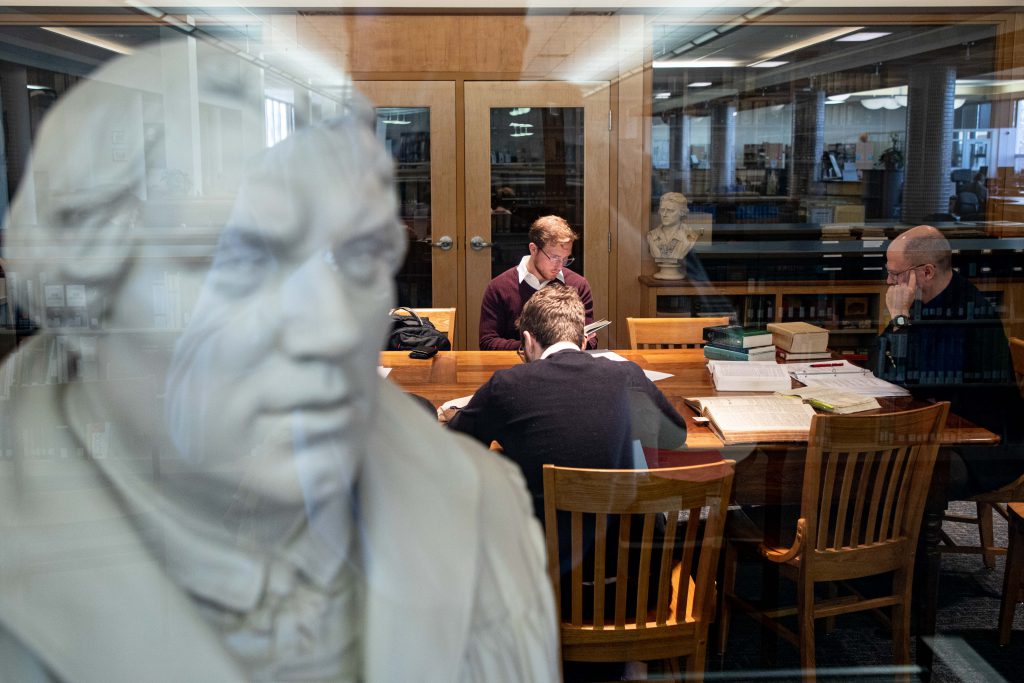
CUW pre-seminary students utilize the Rincker Library’s Rare Book Room to access centuries-old biblical commentary that is often not available in English.


For many students studying to become pastors, learning the ancient languages—such as Hebrew and ancient Greek—is one of the biggest scholarly challenges they face. For others, however, digging deep into these theological languages becomes a passion. After all, the closer you look at biblical interpretation the more important it becomes to be well-versed in the languages of the original writers.

That’s why Rev. Dr. Jason Soenksen, professor of theology at CUW, is so excited about this semester’s group of Greek VI students. Though small in number, they are each passionate about the subject matter. And he’s taking advantage of the intimate learning environment to take a little different approach.

“In this class, I’m trying to teach my students not just Greek,” Soenksen explains. “That’s the main thing, but I also want to introduce them to some of the ancient resources for studying the Bible.”

Found in translation

Studying theological languages is a passion for Soenksen because of how it shines a light onto ancient interpretation. In particular he finds himself drawn to what you might call the “Lutheran Orthodox” interpretation of the Bible. That is, he wanted to know more about how Martin Luther and those who came soon after him studied the holy scriptures.

“And it turns out there’s quite a bit of biblical interpretation that’s not available in English translation,” he explains.

The three students in the class are Isaiah Mudge, Joe Moore, and Peter Pohlod. As seniors majoring in theological languages, each has taken at least a year of German or Latin, Soenksen explains. His hope for the class is to help the students take that study from the theoretical realm to more practical application.

“I think it would be a shame if students don’t ever really get a chance to see what benefit studying German or Latin could be as a theologian studying the Bible.”

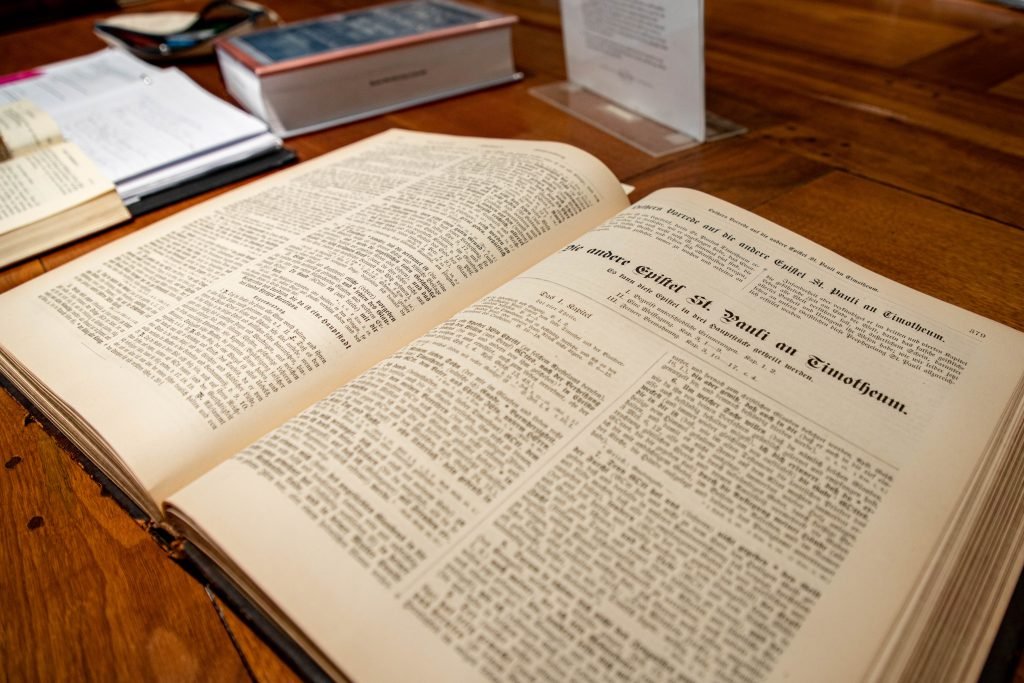
One of the key texts they’re examining is known as the Weimar Bible, a sort of 17th Century German study Bible. In addition to the biblical text, the volume includes notes and commentary from Johann Gerhard and Salomo Glassius, two influential Lutheran theologians of the time. No English translations are available, so studying it in the original German provides nuance that translations can’t.

Another resource is a biblical commentary by Abraham Calov, a younger contemporary of Gerhard and Glassius. Again, no English translation is available, so having a copy available in the Rare Book Room represents a unique opportunity for study.

“I’m working on a section from Philippians,” Peter says, “and it’s really cool to be able to read that and get commentary that is otherwise unavailable. What would be totally inaccessible to me is now a treasure trove of wisdom and resources.”

Isaiah gives an example of how detailed translation can be helpful in accurate interpretation:

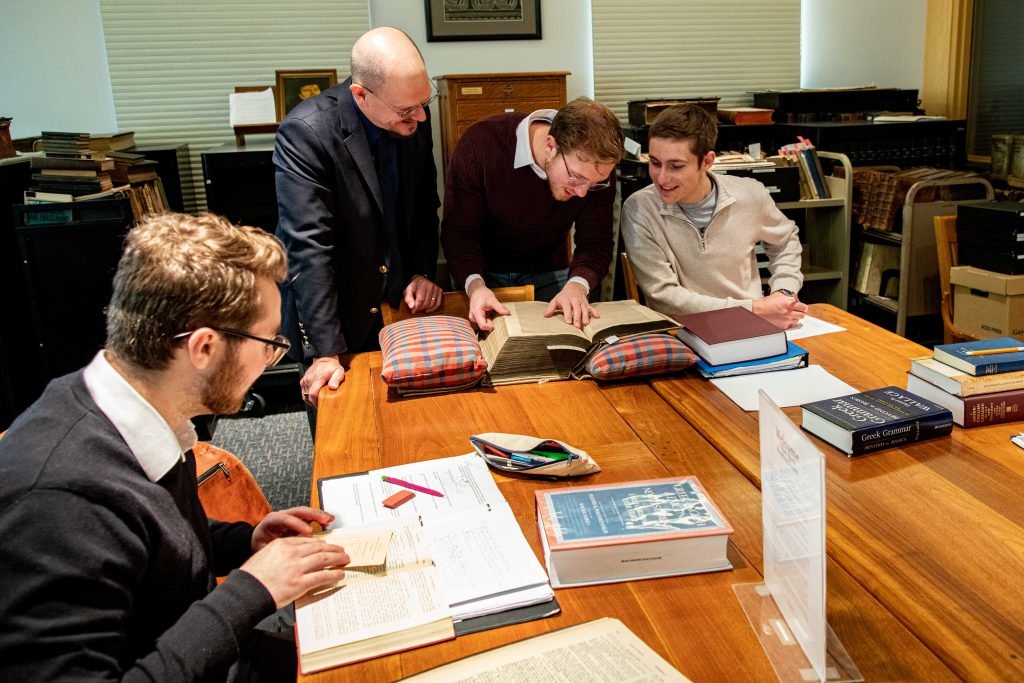
Left to right: Joe Moore, Rev. Dr. Jason Soenksen, Isaiah Mudge, and Peter Pohlod.

“You can see Christ’s actions in the type of word they choose to use,” he explains. “One word might suggest a long, enduring action, while another might mean an action that occurs at one time. For instance, when you see a verse that talks about Jesus Christ, and it says that ‘Jesus died to save us,’ and the word ‘save’ means a long, enduring action, it means he died to save us at all times, all people, in all places.

“Or, if a word means a single-time action, it might mean that the death was a one-time thing: nobody needs to die again; it’s been done. So, it’s really amazing what you can see in the language.”

A gift from God

All things considered, the course represents a unique opportunity to study and learn God’s Word in an in-depth way.

“This class really is something special, in that I don’t even think a lot of people at seminary necessarily get to have an experience like this,” Joe says. “We get to sit down with a very well-trained professor, who’s even written a Concordia Commentary volume, and we get to emulate and learn from him, step by step, his thinking, his process of thinking about the text, and working with the text.

“We’ve learned so much, and we’ve covered so much, in terms of vocabulary and principal parts and the changings of words,” he adds. “I think it’s like a once in a lifetime experience, honestly, because we’ve gotten to see the process of a professional and take part in that.”

No doubt, the Arnold H. & Verna L. Moeller Rare Books Room is a special resource. One that we’re very blessed to have available on campus.

RELATED: A treasure trove of treasured tomes

“The good Lord provides and provides for this special space, and we continue to be thankful,” says Director of Library Services Christian Himsel. “Especially since the majority of old tomes housed therein are related to our Lutheran and Christian heritage in the forms of scripture, doctrine and hymnody. We really do have some uniquely special books which continue to touch the lives of students and faculty alike.”

“And without this class I may never have had the opportunity to step in here, let alone translate this book,” Peter says. “I’ve really, really enjoyed it. I love working through this stuff.”


Want in?

At CUW, you can expect members of the Theology Department to teach the timeless truth of the Bible with energy and warmth, applying the Gospel message to each student’s life. Our faculty have a wide range of experience in church ministry and teaching. CUW students come from a wide range of religious backgrounds and are encouraged to bring those experiences into the class discussion. Together, professors and students gather around the truth of the Scripture to be shaped by the Gospel of Jesus Christ for lives of faithful service.


Are You Ready to Get Your Teaching License in Wisconsin?

You can get your teaching license through Concordia University’s CAPTL program.  CAPTL stands for Concordia Accelerated Programs for Teacher Licensure.

What is the curriculum like?

Our curriculum emphasizes working with diverse student populations. Additionally, you’ll grow as a reflective practitioner and understand how to differentiate instruction to meet the academic needs of all learners.

Once you complete student teaching, you’ll finish your capstone project. You’ll earn a master’s and a teaching license with our Master of Science – Teaching and Learning degree!

This program is ideal for working adults who wish to achieve their dream of becoming licensed teachers in Wisconsin, and it does qualify for financial aid.

It is accredited by the Higher Learning Commission and a regional accreditation agency recognized by the U.S. Department of Education. Additionally, it is approved by the Wisconsin Department of Public Instruction.

Step 1. Decide What You Want to Teach

What do you want to teach?

We need great teachers, and are so excited to help you on this journey!

What age of students are you hoping to work with? This will help you determine what kind of licensure you want to pursue. Is there a certain subject area you’re passionate about?

If you’re unsure about these things, connecting with a counselor can help you identify what kind of licensure matches your career goals.

An initial teaching license in Wisconsin is the license you get when you first begin your teaching career.

Initial Teaching Licenses in Wisconsin:

  • Special Education: Cross-Categorical (Grades 4K-12)
  • Elementary (Grades 4K-9)
  • Early Childhood (Birth –  grade 3) and Elementary (Grades 4K-9)
  • Secondary (Grades 4-12 or 4K-12th depending on content area)
    • Licenses available: Art Education, Broad Field Social Studies, Science, Business Education, English/LA, Mathematics, Physical Education, World Languages (Spanish)
    • Please note! For a Secondary license, you must already have content knowledge in the area. We suggest an undergraduate major in the content area you are looking to become licensed in.

Step 2. The Transcript Evaluation

This program requires a bachelor’s degree.

  • Send unofficial transcripts to your admissions counselor. Include any transcripts where college credit was received.
  • Our program coordinator will evaluate your transcript to make sure you are eligible for the license you are seeking.
  • The program coordinator will reach out to you with that evaluation, including information about our next cohorts!

Step 3. The Application

After learning that you are eligible for licensing, we welcome you to apply!

After you apply…

You’ll have to submit a few items along with your application. The application page will prompt you for each item. You do not need to complete the application in one sitting.

  • Send your official transcripts (electronically or through the mail) to Concordia University Wisconsin Admissions (electronically or through the mail).
  • Upload a current resume.
  • Upload a personal essay, describing your reasons for obtaining a teaching license and pursuing our program. What goals do you have?
  • Submit two letters of recommendation.

Step 4. Acceptance!

Our program directors will review you application.

  • If you get accepted, you will receive an initial acceptance letter with a required Letter of Understanding and Background Check forms to complete.
  • Return those documents, signed.
  • Congrats! You’ll be fully accepted at this point!
  • Check out our Uncommon Scholarships.

Frequently Asked Questions:

How long are the classes?

  • Classes are 8 weeks long

Are classes face-to-face or online?

  • Fall cohort: virtual classes
  • Spring cohort: online classes
  • In-person requirements: Clinical observations, pre-student teaching, and student teaching

How long is the program?

  • Program length: 24-36 months, depending on the license.

Didn’t see your question? Ask a counselor here!

If you still have questions about what it takes to get your teaching license through Concordia University, you can book a call with one of our Inquiry Support Specialists.

This blog was originally published on December 14, 2020. It has been updated to reflect current information.