CUW announces 2025–26 theatre season celebrating creativity, community and hope

Concordia University Wisconsin invites the community to experience an inspiring lineup of theatre performances for the 2025–26 season.


Featuring a family-friendly musical, an original student-devised work, and a Shakespearean comedy, this year’s productions highlight the talent and creativity of CUW’s student performers, directors and designers.

All performances will take place in the Todd Wehr Auditorium on CUW’s Mequon campus, located at 12800 N. Lake Shore Drive.

Season lineup

“Madagascar”

November 6–9 at 7:30 p.m.

Based on the DreamWorks animated film, “Madagascar” follows Alex the Lion, Marty the Zebra, Melman the Giraffe, and Gloria the Hippo as they escape from the Central Park Zoo and find themselves on the island of Madagascar. Packed with lively music and laughs, this production promises fun for all ages.

Photo by Anastasia Gountis
Student Emily Walz rehearses for the production of “Madagascar.”

“Where the Light Gets In”

February 19–21 at 7:30 p.m. | February 22 at 1:30 p.m.

This original, student-devised production explores stories of hope and healing in times of challenge. Created collaboratively by CUW students, “Where the Light Gets In” shines a spotlight on resilience, faith, and the light that breaks through darkness.

Shakespeare’s “Twelfth Night”

April 16–17 at 7:30 p.m. | April 18 at 1:30 p.m. | April 19 at 7:30 p.m.

The season concludes with one of Shakespeare’s most beloved comedies—a whimsical tale of love, mistaken identity, and joyful chaos. Full of humor and heart, “Twelfth Night” celebrates both laughter and grace.


Creativity, collaboration and community

“Our season brings together a wide range of stories that celebrate what it means to be human,” said CUW Theatre Director Lori Woodall. “Whether it’s a laugh-out-loud musical or a student-created work of reflection, each show is rooted in our commitment to creativity, collaboration and community.”

Tickets will be available online at www.cuw.edu/theatre  and at the box office on the night of each performance.

Community members, families, and schools are encouraged to attend. Group reservations and school matinee inquiries can be made by emailing theatre@cuw.edu.

For more art-related events, check out “Fall Fine Arts Guide 2025.”


Want in?

Concordia University Wisconsin is a Lutheran higher education community committed to helping students develop in mind, body and spirit for service to Christ in the Church and the world. Concordia provides a wealth of academic experiences in the creative and performing arts. These programs are open to all students in the Concordia community, regardless of academic major or minor, as an enriching part of a broad liberal arts education.


Honoring excellence: Dr. Mark J.P. Wolf recognized as CUW’s first Distinguished Professor

A lifetime of scholarship, teaching, and faithful service earns Concordia’s highest faculty distinction


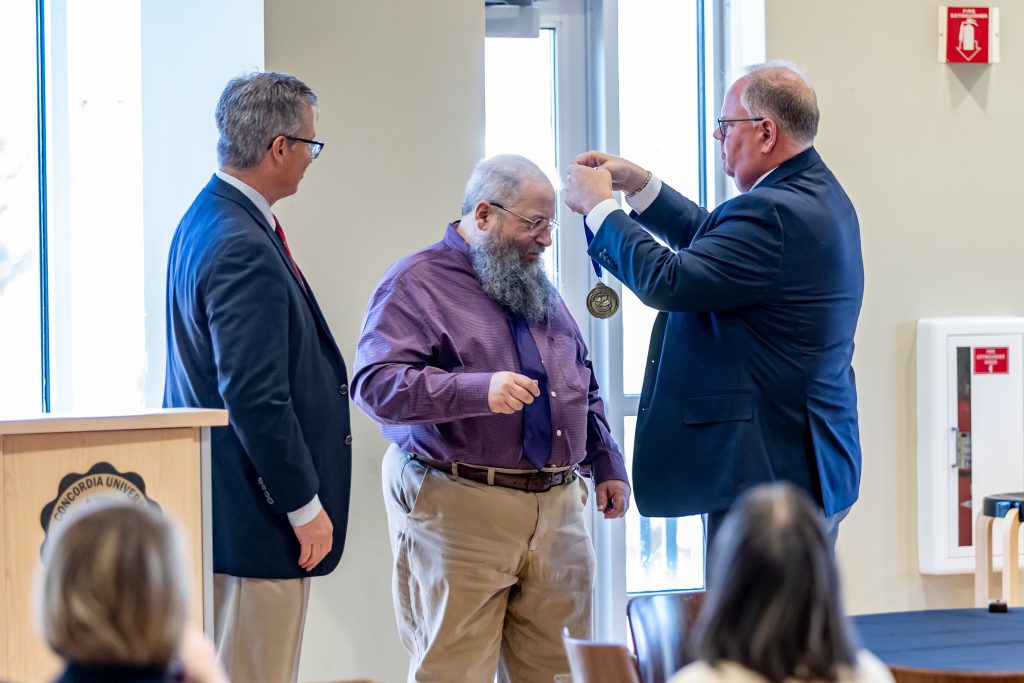
The Concordia community recently gathered to celebrate its first Distinguished Professor, Dr. Mark J.P. Wolf.

Wolf, a professor of communication with 30 years of experience at Concordia University Wisconsin, has published 29 books, and most importantly, “has shaped the academic and personal lives of countless students,” said Dr. Erik P. Ankerberg, president of the university.

“The Distinguished Professor designation was created by the faculty in 2017 to honor long-serving faculty members who have been truly outstanding,” said Dr. Leah Dvorak, vice president for Academics and chief academic officer.

“The criteria are stringent: you must have been a full-time member of the faculty for at least 25 years and have a long-standing record of exceptional performance in teaching, scholarship/research and service, with distinction in at least one of those three categories. In Mark’s case, his scholarship is especially outstanding. He is a prolific and very well-respected writer and scholar in his field.”


An honor and a privilege

Wolf said it was an honor and a privilege to receive the award, especially as the first recipient at Concordia.

“What a blessing it is to teach our students, enriching and transforming their lives, watching them grow from high school graduates to adults entering the working world,” he said as he accepted the award. “How rewarding it is to work together to proclaim God’s Word, influence the culture, and do our part in reshaping the world.”

In addition to being a prolific writer, Wolf contributes to the scholarly community by reviewing numerous manuscripts and serving on several editorial boards. He also has taught 28 different courses, 15 of which he created himself.


Well-known author

His most well-known publications for general audiences include Video Games FAQ (2017);  101 Enigmatic Puzzles: Fractal Mazes, Quantum Chess, Anagram Sudoku, and More (2020); and The Seven Stones (2024).

“Dr. Wolf’s scholarly contributions don’t just meet the standards; they far exceed them,” said Dr. Rachel Ware Carlton, dean of the School of Arts and Sciences and professor of music. “And his international speaking engagements have taken him to Taiwan, Japan, Argentina, England, China, Turkey, Canada and Germany. He is a sought-after expert within his discipline.”

Echoing those sentiments, Rev. Dr. Harald G. Tomesch, professor of theology, offered his own reflection to CUW’s first Distinguished Professor. “Your dedication, brilliance and unwavering passion for excellence has inspired countless minds and elevated your field. You’ve shown us what it means to lead with knowledge, heart and vision. This award is not just a recognition of your accomplishments, but a testament to the impact you made on students, colleagues and the world.” To learn more about Wolf, read this.

Want in?

Concordia University Wisconsin is a Lutheran higher education community committed to helping students develop in mind, body, and spirit for service to Christ in the Church and the world.


A new era of innovation: CUW opens AI & Quantum Innovation Lab to inspire servant leaders in science, technology

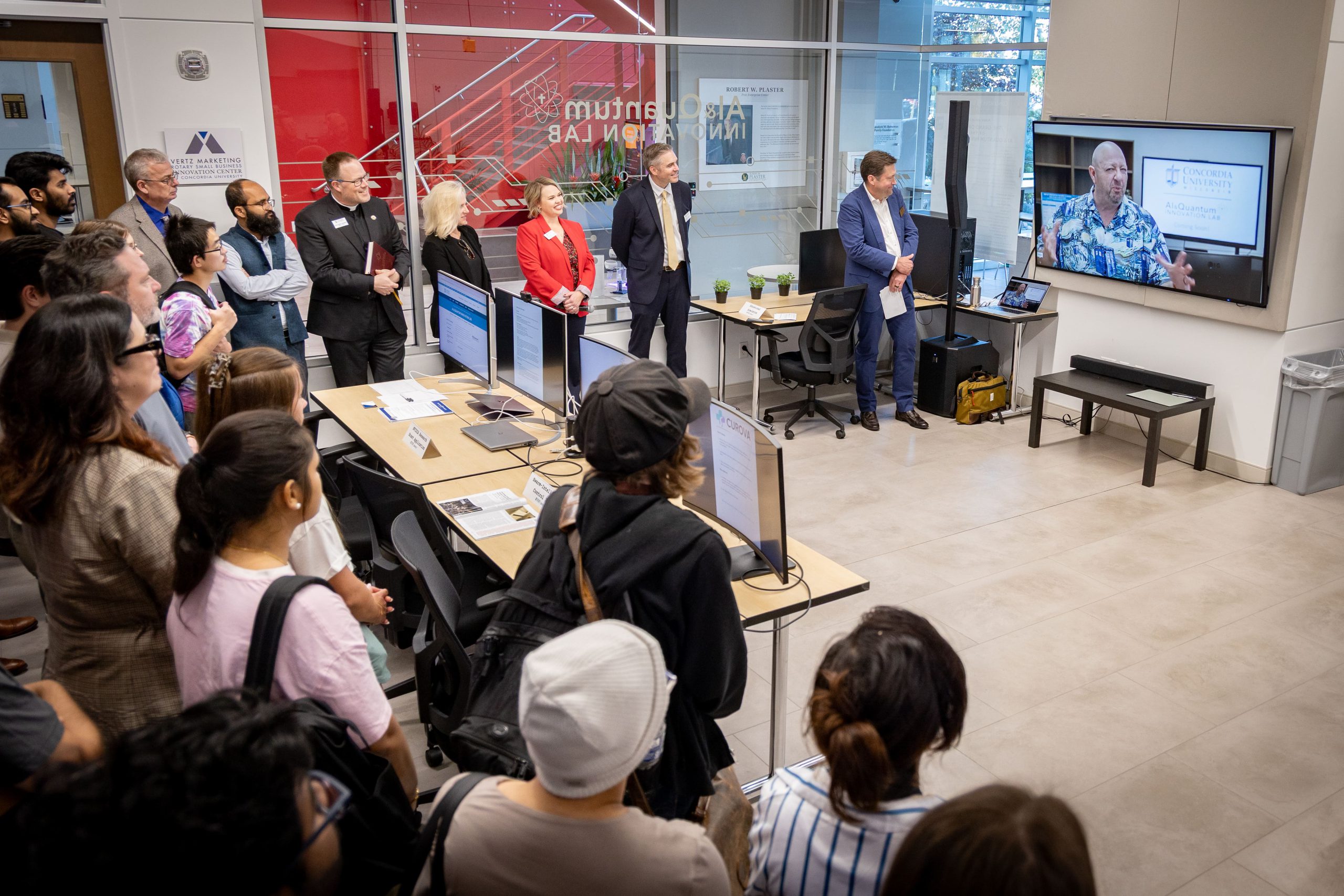
Students, faculty, staff and community members gathered October 7 to celebrate the unveiling of Concordia University Wisconsin’s new AI & Quantum Innovation Lab on campus.


The university’s newest space not only anchors the school’s cutting-edge Artificial Intelligence program, but also provides tools to expand human creativity and discovery.

The celebration featured special remarks and interactive demonstrations, including virtual reality experiences and an introduction to “Solomon,” the university’s most powerful computer, developed by Dr. Michael Litman, professor and chair of Computer Science.

“The lab will be a place where innovation meets integrity,” said Dr. Robert Balza, associate vice president of Academics for Teaching, Learning and Academic Innovation. He emphasized that the space, which is rooted in Concordia’s mission to help students develop in mind, body, and spirit for service to Christ in the Church and the world, treats AI and quantum not merely as engines of efficiency, but as tools for service, preparing vocation-ready graduates.

However, the program, which leads to a Bachelor of Science in Applied Artificial Intelligence, doesn’t start with tools; it starts with values. Concordia’s “Christian emphasis on the distinctive powers of the human soul and the ethical use of AI” is imperative, explained Dr. Angus Menuge, professor and chair of Philosophy.

Mission of CUW’s AI & Quantum Innovation Lab

What distinguishes Concordia’s Innovation Lab from others in the state is its mission-driven foundation—integrating faith and technology to deepen and enrich learning.

The new lab will strive to:

  • Deepen understanding of Artificial Intelligence and Quantum Computing while confronting the ethical dilemmas these technologies pose.
  • Build bridges between students, faculty, and industry partners to create meaningful collaborations that advance both knowledge and application.
  • Provide hands-on opportunities through internships, projects, and research that prepare students to serve and lead in a rapidly evolving technological landscape.
  • Incubate and accelerate student and faculty-led initiatives, including grant-funded projects, that align innovation with service to community and society.

More information on AI at CUW

  • To learn more about the lab, including current research and areas of focus, click here.
  • View the biblical guidelines created by members of CUW’s Theology Department here.
  • To consult with the AI team about a project, fill out the form here.
  • Read the article on the Applied Artificial Intelligence program here.

The AI & Quantum Innovation Lab is located in the lower level of the Robert W. Plaster Free Enterprise Center on Concordia’s campus, 12800 N. Lake Shore Drive, Mequon.


Want in?

Concordia University Wisconsin is a Lutheran higher education community committed to helping students develop in mind, body, and spirit for service to Christ in the Church and the world. The Applied AI program is designed to prepare students to lead in one of the fastest growing career paths today using technical skills, ethical reflection, and real-world problem-solving skills.


5 tips for getting “unstuck” as an online learner

Life is full of ups and downs, patterns and ruts, surprises and challenges. Years ago, during a summer spent performing odd jobs and fieldwork in the farmlands of Nebraska, I assisted in repairing fences for a farmer who owned several sheep. As we moved along the fence line, we came upon the first of several sheep that poked their heads through the fence trying to reach greener grass on the other side. As a result, their heads got stuck. Have you ever been stuck? 

While I waited for some instructions on what to do, the farmer simply said “do something about it.”  No five-step plan. No warnings. Just, “do something about it.”

I work with many online learners who have stopped working on their degrees. Many of them seem stuck, unsure of how to proceed or if they can restart their academic plans. My advice? Do something about it.

Tips to get “unstuck” an adult learner

Whether you are returning to finish your degree through Concordia’s accelerated programs or at another college, you can use these tips to get “unstuck” and accomplish your goals.

Do something

This begins with a new application. University systems make changes often, therefore submitting a new application will help get you started. When you apply to Concordia’s online programs you will be connected with an admissions counselor (like myself) who can help resurrect or start your file.

Locate your records

While not required, digging out your old records and communications with advisors and other staff will help you become familiar with your academic standing. Many times, we remember things differently than they actually are. Therefore, this process will help you pick up where you left off. Some students may even have unpaid balances that must be resolved before being re-admitted.

Understand the evaluation process

Concordia’s degrees and programs are routinely updated to reflect current trends and requirements of the professional community. The records of returning students must be evaluated first. Then, degree plans may need to be adjusted if changes have occurred.

Concordia’s student record analyst, who works in the registrar’s office, Amy Hillenbrand states “Students need to fulfill the requirements of the catalog year in which they are re-entering. This may mean that previously taken courses may no longer apply to their major or core plan and new courses may be required.”

The leadership of each program is given responsibility for considering older courses and determining if older credits can continue to be counted within a degree. This may create some delays as the registrar’s office works with the departments. Once completed, your assigned Career & Academic Advisor will discuss the evaluation and how best to re-start your degree.

Trust the professionals

Getting back into your classes involves a variety of changes. That’s why we have many professionals in place to assist you such as advisors, tutors, resource professionals, IT specialists, and financial aid counselors. The online program is designed to be flexible for you as an adult learner. Our professionals are familiar with changes and helping each individual. Trust them and the process!

Have faith in yourself

Past failures and challenges don’t define your academic future. Like a sheep stuck in the fence, you do not have to stay there. Once you make the decision to return, address everything that you can control like your finances, schedule, and motivation.

Students just like you have returned to finish degrees and most, through the experiences of life, have found a new attitude and passion for completing their degree.

Ready to dive in?

To learn more about the online degrees and programs offered for adult learners, please visit CUW Accelerated Admissions or CUW Graduate Admissions. You can also call us at 262.243.4300

Ready to Lead? Consider a degree in Communication & Leadership

For better or worse, communication and leadership go hand-in-hand. Many have assumed leadership roles or aspire to leadership in the future. However, they may not have personal experience themselves or good examples of leaders. One solution is more opportunities to experience leadership concepts in a safe environment and discover your natural leadership style. Undoubtedly, communication and leadership are critical to a successful business and engaged teams.

Why are communication and leadership important?

Employers are hungry for excellent communication skills. They want leaders that are articulate and clear in their direction. So, becoming skilled in both makes you a very valuable hire.

Excellence in communication enhances every relationship that is held dear, from our significant others to our co-workers, friends, and even acquaintances. Communication is the skill that could take an acquaintance and springboard that relationship to an important part of a social or career network. 

Today communication is more important than ever as technology has largely replaced personal interaction. Covid further exacerbated the decline of the richest communication: face-to-face. Upper management and business owners seek to find good leaders and good communicators, they understand that these skills improve productivity and profits. It could be said that good communicators and leaders are critical to both profitability and growth.

How does a degree in communication and leadership benefit me?

Having communication skills as a strength segues directly into the importance of strong leadership skills and abilities. Anyone interested in leadership or management can benefit from higher education in this field. A degree will equip you with the skills you need to be an effective leader and communicator, in an environment conducive to accelerated learning.

The skills learned will help you to create an enjoyable, comfortable, and profitable work environment. We know that improved relationships in the workforce reduce absences and improve engagement. People that work well together are able to accomplish more and a degree will help you develop the skills you need to become the effective and ethical leader already inside.

What can I do with a communication and leadership degree?

The beauty of this degree is that it is applicable to just about any workplace. It could be healthcare, manufacturing, tech, retail, wholesale, and the list goes on and on. Leaders with strong communication skills are able to facilitate, network, encourage and support others to do their best work; these skills are valuable no matter the industry.

Some fields of work may include:

  • Social and digital media
  • Public Relations
  • Marketing and advertising
  • Writing and publishing
  • Event Planning
  • Human Resources
  • Politics
  • Nonprofits
  • Customer Service
  • Fundraising

What makes Concordia’s program different than others?

Firstly, our Accelerated Bachelor’s in Communication and Leadership program was created with adult learners in mind. We are pleased to enable students with the ability to complete their degree online alongside their busy life. Our excellent faculty understand how busy life can get and are happy to work with students to balance their education with their lives.

Additionally, within the program servant leadership and multicultural leadership are two core approaches we teach. These cores help to prepare students to serve others in leadership roles. Furthermore, students learn how to build equity and support into their teams.

We’re passionate about this approach to leadership. It enables our students to live out Concordia’s mission of service to Christ in the Church and the world, particularly, through our vocations of serving our neighbors.

How is Concordia University unique?

Concordia is a Lutheran Christian school that integrates those Christian values with our programs. In this model, students acquire knowledge and skills in liberal arts disciplines that prepare them to be of service to Christ in the Church and the world. We bring a holistic approach to every class we offer our students. We challenge our students academically but also give them the chance to grow spiritually with us in ways that they may not find at other universities. Concordia is a community of people whose calling is to ensure both student success and well-being. 

In addition, we have designed paths bridging traditional undergraduate degrees to graduate degrees, such as our Business Scholars program. This unique program offers highly qualified incoming freshmen the opportunity to earn their bachelor’s degree and their MBA in four years, for example.

Another perk of our undergraduate programs is that students can transfer up to 84 credits. This makes the transfer process easy and saves students time and money. Our admissions counselors can provide transcript evaluations for a more accurate amount of credits. All we need is your unofficial transcripts from previous schools attended.

How long does it typically take to complete the degree?

It will take 3 to 5 years to earn a bachelor’s degree, depending on credit transfer amount and course load. If you already have your bachelors degree and are looking for a master’s, consider our Master’s in Leadership program. This degree can be completed in just 1.5 years.

What format is offered? How long are the classes?

Our Bachelor of Arts in Communication and Leadership program is offered fully online. Classes are eight weeks each. The online format is very flexible but requires discipline and organization to set up a schedule to complete coursework on time.

How much does the program cost?

This program is $475 per credit hour and 120 total credits. Depending on the number of credits a student transfers in and if they qualify for a scholarship, most students end up spending far less on their degree.

Are there scholarships available?

Yes! We have Uncommon Scholarships available for many qualified students. Our available scholarships include:

  • Business Community Scholarship: If you are an employee of one of our corporate partners you may qualify for this scholarship.
  • Academic Community Scholarship: If you are an employee of one of our Preferred Education Partner schools or districts you may qualify for this scholarship. 
  • Christian Community Scholarship: If you are an employee of any qualifying Christian church or Christian K-12 school you may qualify for this scholarship. 
  • Alumni Scholarship: If you are a graduate of one of Concordia University System school programs you may qualify for this scholarship.
  • Veterans and Dependents Scholarship: If you are a veteran, the spouse of a veteran, or a child of a veteran(age 17-26), you may qualify for this veteran scholarship when federal veteran education benefits are exhausted or unavailable to you. 

When it comes to funding your education, have a conversation with your employer to see if they will be willing to pay a portion of your tuition. There may be funds, scholarships, or benefits their companies may offer.

Entrance Requirements

  • High School Diploma/ GED
  • Cumulative undergrad GPA of 2.0 for full acceptance

Admissions Requirements

  • Online Application
  • All official transcripts
    • Student only needs to submit a high school or GED transcript if the student has less than 60 transferrable credits.
    • An unofficial transcript evaluation is almost always done to gauge understanding of approximate transfer credits and the length of the program. We are able to accept a maximum of 84 credits with a grade of D or better from regionally accredited schools.

Check it out: Does your college have an articulation agreement with Concordia?

Ready to start?

To learn more about the accelerated associate and bachelor’s in Communication & Leadership offered for busy adults visit CUWAA Accelerated Admissions or talk to one of our support specialists.

Information provided by Sandra Jahns, Concordia’s Program Director for the Accelerated program in Communication & Leadership.

How to prepare for the job market

Finding the right job is not always an easy task. However, there are ways to make sure you are ready to face the job market. By taking the time to develop your skills and knowledge, you’ll become an attractive candidate for employers.

To make sure you’re a strong candidate, focus on improving your communication skills and your ability to work with others. Finally, prepare to discuss your qualifications and experiences during the interview process. These steps can help you achieve the qualities desired by employers and become the perfect employee.

Research, research, research

The job market can be overwhelming. The first step is to do thorough research to know exactly what is out there and what you want. Think about these questions during your research process.

  • What industries or companies interest me?
  • What are my expectations for the position?
  • What skills do I need for the job?
  • What is the process to obtain the position I want?
  • What are the goals and values of the company?

After narrowing your search, choose positions that interest you, and review specifics on the role and the company. You want a position that fits your skills and values.

Interview the right way

Interviews are an inevitable part of getting a job. Many times there are many other candidates fighting for the same role. So, you need to stand out and show why you’re perfect for the job. How can you stand out in this job market?

Know the company

It’s critical that you have some background knowledge about the company. Don’t go in blind! Look closely at your resume and modify it to reflect why you are perfect for the position. Have specific examples that demonstrate how your skills will fit into the role.

Take time to understand more about the company and its mission. Hiring managers appreciate applicants who demonstrate their commitment by researching and familiarizing themselves with the company.

Have questions at the ready

Interviewer: “Do you have any questions for us?”

Candidate: “I don’t think so.”

Every interview always ends with this question, and most of us say no which then ends the interview. However, this is the part where you get to ask questions and make sure they are the right fit for you.

Prepare thoughtful questions about the position, the team or department, and the overall direction of the company. Some of my favorite questions to ask are:

  • What’s your favorite part about working here?
  • What you are looking for in an ideal candidate?
  • Can you tell me what the day-to-day will look like?

Preparing questions can demonstrate your intelligence, seriousness, and ability to provide value to the company fast. It’ll also spare you the awkward, “Nope, I’m good.”

Bring your notebook

Taking careful notes during interviews is a must. Being able to look back on information discussed with the interviewer, such as a department’s goals or difficulties, will help you stand out. Additionally, demonstrating an understanding of the company’s systems and how they fit together will display your value to the company.

Practice makes perfect

To be sure of yourself during an interview, it is necessary to PRACTICE beforehand. Doing mock interviews with a trusted friend or family member is a great way to prepare without anything being official. Try answering common interview questions until you feel comfortable. This will help you walk into your interview ready to represent yourself well and put your best foot forward.

Build a strong network

Forming professional relationships is one of the biggest sources of success when it comes to the job market. Your network can help you find jobs and different opportunities. 

You have more connections than you might even realize. Friends, family, neighbors classmates, your church congregation, and social media followers are all connections. 

Start to interact with people who might have a connection or are part of an industry you are interested in and build your network.

Cultural competence

Not everyone looks, thinks, or believes the same way you do. Can you navigate those differences to work well with others? If you’re culturally competent, you’re conscious of the difference between yourself and employees of other cultural, ethnic, or even socioeconomic backgrounds. Embrace your differences, appreciate them, and learn from them, to strengthen your working relationships.

Become a better communicator

Communication is something we all do, but are not all good at. Nevertheless, it’s a part of every area of our lives. Both written and oral communication are skills crucial to being a great employee. 

If you’re a weak communicator, you’ll have a hard time meeting expectations and being understood. Just like communication is the key to a relationship, it is also the key to any role.

Check this out: Unlock Your Dream Job With 3 Hirable Skills

Be ready to adapt

With the world constantly changing it’s important that you’re adaptable. Be flexible with new tools, teams, and environments. A company might make a number of changes to the workforce or company in general for a number of reasons.

So, how can you become adaptable? Be willing to learn. Keep up with current trends in your field. Or ask your employer for personal development opportunities.

When you are flexible and adaptable, you’ll become a valuable and better employee.

Feel ready to tackle the job market?

Don’t rush yourself if you don’t feel prepared; take some time to hone your skills and bolster your assurance. But, if you are confident and ready, you have the capability to accomplish your goal!

Why is alternative education important for youth?

Alternative education is a growing need among at-risk youth. This is a dynamic field that continues to grow as parents, educators, administrators, and other youth-centered professionals recognize the need to provide effective and high-quality education beyond the traditional classroom.

I want to introduce you to Wanda Routier, the program director for our graduate special education and alternative education programs. She shares her expertise in both areas, and highlights the features of alternative education that can create successful outcomes for those that do not fit in the traditional educational system.

Understanding at-risk students

At-risk individuals have needs that are not met in the average school, home, or community environment. These needs range from learning, mental health, physical, psychological, behavioral, emotional, or others. They are present regardless of race, gender, socio-economic level, family situation or other factors. A student can be at-risk at any time due to environmental factors, trauma, or other circumstances beyond their control. The average structured school setting can be a difficult experience for these individuals

Many students who have been identified as being at-risk also have undiagnosed disabilities or other conditions. These challenges impair their ability to achieve in the traditional classroom, which lacks the necessary resources to meet those needs. The at-risk student population can also include individuals of Adverse Childhood Experiences (ACEs). These individuals may require alternative education for the short-term or possibly a longer duration.

Regardless of the challenges, it is essential to help these students feel safe and connected to others who care, so they can be empowered to believe in and work to their full potential.

Why develop alternative education in schools and other youth focused communities?

Alternative education should be provided at all levels of education, because early intervention can largely influence student success. It also helps reduce more severe difficulties in high school. A flexible program that is student-centered will help students get back on track, prepare them for adult life, and help them graduate high school. Individualized instruction in an alternative setting is important because each student has different needs and reasons for the challenges they are facing. 

Alternative education programs are more essential than ever to help students find their way to becoming productive citizens and adults. Working in alternative education goes beyond classroom learning. It means teaching life lessons and personal strategies that help students identify issues, take on challenges, and cope with the wins and losses.

A caring, interested, and kind adult can make all the difference in the life of a student at-risk.

Wanda Routier, MA in Special Education, Ed.D. in Management of Programs for Children and Youth

What is the current law for alternative education programs in schools?

According to WI State Statue PI 25, “every school board shall identify students at risk of not graduating from high school enrolled in their respective school district on an annual basis by August 15, and develop a plan describing how the school board will meet their needs.”

Currently, many school districts have implemented alternative education programs, but at some schools they are just plans on paper and not being acted on. Unfortunately, this is ignoring students for whom traditional school does not work or is inappropriate.

What are the current trends in alternative education?

The educational environment is becoming a key focus in this area. However, many districts are going to online credit recovery as the only option for at-risk students.  This is not an appropriate solution because the student sits at the computer all day with very little interaction with anyone, including the teacher. 

Other school districts are doing a “school within a school” program where students attend school with others, but have their own courses and classrooms. Still other districts have an actual physical building where only at-risk or alternative education students attend. These approaches incorporate the critical aspect of the student feeling connected and supported. Another positive trend is a special focus on the mental health needs of students, and implementing trauma-sensitive approaches to student education.

Finally, an exciting trend we’re seeing is the work-study program within alternative education. Students are in school part-time and are later released from school to work and learn on-the-job. These real world, job experiences are often more relevant to these students than high school courses. Successful programs are flexible and meet the individual needs of each student.

How can you serve in alternative education?

You can work as a licensed educator at an alternative school or in a specified at-risk class or program. Enhance your skills and awareness in this specialized area with Concordia’s add-on licensure for current teachers. This is a quick but impactful, two-course program. You will learn more about Response to Intervention (Rtl) and Positive Behavioral Interventions and Supports (PBIS), along with other important alternative education topics.

However, alternative education needs more than teachers to help at-risk students succeed as future adults in the real world. Professionals who are working with at-risk students are encouraged to take our online program, but note that you would not be eligible to earn a full teacher licensure. Individuals that work in the following settings would benefit from coursework in alternative education:

  • Juvenile justice settings (boot camps, work programs)
  • Group homes and other alternative living communities
  • Alternative employment settings
  • Youth programs

What is the program director’s background?

Wanda Routier has served as a licensed special education teacher in private and public schools. She has also served as a teacher at a state residential home for the deaf. This has provided her the opportunity to teach individuals from birth to 21 years of age.

She was a Director of Law-Related Education for Students with Disabilities for an international non-profit law organization in Washington, D.C. , for four years. In this role, Wanda worked with teachers from across the U.S. and with Congress. She was actively involved in the re-authorization of the Individuals with Disabilities Act (IDEA) which continues to govern special education. She also worked with alternative education teachers at the Washington, D.C. juvenile justice agency.

Wanda is dedicated to teaching her special education and alternative education students both through coursework and hand-on experiences. She dedicates class time to take CUW students to the Vel R. Phillips Juvenile Justice Center School in Milwaukee to demonstrate special education in an alternative educational setting.

8 questions to ask when thinking about a chemical engineering degree

Have you been considering a bachelor’s degree in chemical engineering? Maybe you don’t know where to start or what questions to ask? You’re not alone!

Here is a list of 8 questions that Dr. Erik Jorvig, Ph.D., answered that can help you either start or continue your journey!

Q&A with Dr. Erik Jorvig, PhD

What is chemical engineering?

Chemical engineering is the application of engineering principles to chemical processes.  This can be in a variety of areas.  Bulk chemicals, petroleum, pharmaceuticals, and batteries, to name a few. Virtually anything that has a chemical component can be influenced by chemical engineering principles.

What kind of career can I get with a chemical engineering degree?

A chemical engineering degree opens a lot of career avenues including chemical production, petroleum production, and pharmaceutical development and production. There’s also battery development and production, environmental engineering, and more.

How much money can I make as a chemical engineer?

Chemical engineering regularly tops the list of highest pay for engineering disciplines.  The BLS lists the average salary for a chemical engineer in the US as $105,000. The number of jobs in this area is growing 14% per year.

What kind of topics will I learn at Concordia?

You would learn engineering topics like thermodynamics, fluid dynamics, heat transfer, mass transfer and process control and design. All of this from a strong science foundation in chemistry and physics.

What are the benefits of getting a degree in chemical engineering?

The benefits of a degree in chemical engineering are the ability to help fix societal problems by improving chemical processes and developing new chemical processes.  Additionally, you can obtain a high-paying job in a fast-growing field.

What kind of skills should I have/learn to become a chemical engineer?

You should have a strong foundation and interest in the sciences, especially chemistry.  You should be a good critical thinker with an interest in solving questions or puzzles related to chemical processes.

How secure is this job?

This is a fast-growing field with a lot of demand for skilled workers.  Job stability is generally good.  You may notice a transition of workforce from legacy industries such as petroleum companies to more sustainable industries like battery production or environmental engineering.

Once I finish my bachelor’s, will I need to further my education to get a job?

There are many jobs available at a bachelor’s level.  If you’d like to specialize in an area or obtain a leadership role in a company, additional training at the master’s level may be advisable.

What next?

Chemical engineering has the potential to be an incredibly rewarding career and by asking the right questions, you can get a better understanding of if this is the right field for you. If you still have questions or want to learn more about how Concordia University Wisconsin can help you start a career in engineering, let us know. Learn about our chemical engineering degree and everything that comes along with it at CUW.

Why choose a Lutheran university?

When choosing a college, many students today are looking for a specific program, from an institution with credibility and strong outcomes. Others might look for an established campus in a beautiful and safe area. Considering a private-college typically means a faith-based, well-rounded approach to education is a priority. Well, at Lutheran universities, you can have it all, but what does this mean for Concordia University’s Wisconsin & Ann Arbor campuses? 

First, let’s define what Lutheranism means to us.

Lutheranism: what does this mean?

Rev. Dr. Ted Hopkins is the Program Director for the Pre-Seminary and Family Life Ministry programs at Concordia University Ann Arbor. He also serves as Associate Professor of Theology.

Hopkins suggests a framework that might help when trying to understand Lutheranism. “Lutheranism is all about justification. Justification focuses on Jesus’ death on the cross and resurrection to save all people from sin. Jesus is at the center of Lutheranism.” Lutherans trust that Jesus has saved sinners, all people, by his work alone.

Jesus gives this gift of salvation through the Holy Spirit by the sacraments, baptism and Holy Communion, and by preaching and teaching the good news of salvation in Jesus. Lutherans also affirm the importance of unity with the Church of all time, especially in the creeds since those teachings help us focus on Jesus, the Son of the eternal Father.

Now, Concordia University and other Lutheran universities, live out their Lutheran-confession through a number of central concepts built into the campus experience.

Lutheran universities have strong faith community

Community is vital for all members of a higher education institution. From students and staff to community members and families, Lutheran universities like Concordia aim to connect all those who are involved with their campus. At a Lutheran college, you will find smaller class sizes where professors serve as mentors to their cherished students.

Also, we place an emphasis on family and relationships that makes its way into every classroom. Being on a Lutheran campus will give you the opportunity to connect with like-minded students and staff who will help you to grow in your faith.

Lutheran universities have faith-filled education

Lutheran universities are also committed to educating the whole person. At Concordia, we put the Lord before all else, including our academics, using our common faith to guide us through challenging and practical content in our courses. We have weave ethics and personal values into our academics, as well. Because of this, you will have the opportunity to pursue Christian coursework and majors to move your faith into all aspects of your life.

Is church work in your future? We are proud to offer programs for those interested in professional ministry.

Also, because Concordia University has such a focus on community, as a student you are more likely to receive scholarships based on academics, extracurriculars, and other factors of merit than a student attending a prominent public college. For example, Concordia offers an audition based music scholarship, as well as athletic talent awards. We also offer a number of scholarships that are open to any student that qualifies.

Lutheran universities are built with faith in mind – literally

Another wonderful aspect about being at a Lutheran university is the ability to worship on campus. Many Lutheran colleges have chapels or other locations on-site so that students, faculty, and staff may attend church services together. At Concordia, students participate in the services offered, as well as volunteer in other ways on campus. They even lead in prayer before or during school related activities such as athletics, concerts, or club meetings.

Students may be involved in musical groups that perform not only in on-campus locations, but other places of worship nearby, like CUW’s choral ensembles. Actually, students at Lutheran colleges are more likely to participate in all of those activities and more. Here at Concordia, we  promote learning abroad as well as service and missionary work, which helps our students to develop a global mindset which they can apply to their future vocations. We also have a robust, student-led Campus Ministry Leadership Team that encourages students to engage in Christian fellowship regularly. 

What’s Next

Want to learn more about the opportunities Concordia can offer you?

We praise God for the success of our alumni. Below you’ll find just a few examples of what you could experience:

To learn more about our Lutheran Christian identity here at Concordia, visit us here.

This blog was originally published on November 23, 2021. It has been updated to reflect current information.

The importance of digital literacy in the workplace

What comes to mind when you hear the term ‘digital literacy’? If you said technology and writing, you’re on the right track. According to Education Week, “Digital literacy is the ability to use information and communication technologies to find, evaluate, create, and communicate information, requiring both cognitive and technical skills.” So what does this mean exactly? Essentially, being digitally literate is having the knowledge and skills to work and communicate using technology.

Today it’s important for those in the workforce to understand how to communicate effectively using technology. Increasing your digital literacy skills makes you more adaptable to the ever-changing workforce. Digital literacy is also important as it can:

  • Improve efficiency and productivity
  • Give the ability to optimize processes based on real data
  • Help you understand the bigger picture and how one’s role contributes
  • Enable you to communicate difficult concepts in intelligible ways

Becoming digitally literate takes time, so it’s important to start with the basics.

4 basic digital literacy skills

No matter what your job is, knowing the basic tools of digital technology is key. Think about it, whether in your professional or personal life, most likely you’ve had to write an email or create a PowerPoint presentation. Learning these skills below is the first step in becoming digitally literate. Check out our rules for each skill.

1. Microsoft Excel

Using Microsoft Excel is a great tool from basic charts or tables to storing data. Below are the key topics you should learn to use in Excel.

  • Navigate cells with CTRL+Arrow Keys (+SHIFT for quick selecting)
  • Filtering Columns
  • Text-to-Columns – splitting data into multiple cells
  • Insert Graph and Pivot Tables

2. Microsoft PowerPoint

This presentation platform is something you’ve probably used before, or at least heard of. While creating a presentation, remember these suggestions.

  • Don’t overload presentations with animations, instead use them sparingly.
  • Make sure to choose colors and fonts that are readable.
  • Keep content in slides short and to the point. Rather you want the presenter to provide more in-depth information, instead of writing it all on the screen.
  • When showing data, use visuals as much as possible. Visuals are much easier for your audience to comprehend and more engaging to look at.

3. Computer Short Cuts

To make typing and carrying out tasks simpler, learn basic computer shortcuts to help.

  • CTRL + Z: Undo
  • CTRL Tab: Switch through web page tabs
  • F5: Refresh Page
  • CTRL + C: Copy text
  • CTRL + X: Cut text
  • CTRL + V: Paste text

4. Email Etiquette

A task that most of us do each day, whether working professionally or not, is sending emails. Remember these guidelines when creating an email.

  • Keep subject lines descriptive and short.
  • Practice good grammar.
  • Triple-check the recipient’s name.
  • Use standard font and formatting.
  • Perfect your email signature.

How to increase your digital literacy skills

Practice daily

The best way to increase your skills is to practice. Increasing your digital literacy doesn’t have to take a lot of time. You can try just putting some basic skills into your daily routine. It can be as simple as creating and learning about different social media accounts. Or trying new ways of creating things with digital tools. This way you get exposure to various technologies and naturally learn how to use them.

Read blogs and watch videos about specific tools

Another way to learn more about digital literacy is to read blogs and watch videos. When finding resources to read or watch, try searching for certain topics you are interested in learning. For example, videos on how to use excel. Try taking time once a day during your lunch break to learn, so it’s not as daunting and you have more time to process.

If you’re looking for current and quick information, blogs (like this one) are a great resource. If you’d rather take in information audibly, podcasts and audiobooks are also great ways to learn the basic skills you need to increase your digital literacy.

Take free online courses

After learning the basics, if you’re ready to advance your skills more, online courses are a great next step. There are many free courses you can take, in your own time, to enhance your skills. Many courses online, allow you to learn from experts through videos and readings and test yourself to see what you learned. Not only can you advance your basic skills, but also learn new more specialized skills. Some great sites for courses are:

  • Coursera– offers free courses in many different subjects and skills. Also has a paid option to earn certificates.
  • Hubspot Academy– offers free lessons in topics such as marketing and sales.
  • Codeacademy– if you’re looking to learn basic or advanced coding, this is a great resource.

What’s next?

Evidently, becoming digitally literate can help you in the workplace and in your personal life. Besides learning on your own, make sure to reach out to those around you with more expertise. By learning more and practicing each day, you’ll be able to master these skills. Soon you’ll be able to confidently use digital tools to communicate and perform your daily professional and personal tasks.