Future Data Intelligence Specialist finds her path in the Computer Science Scholars program

Abigail Barnhardt paired artificial intelligence with business data applications throughout her time at Concordia. She shaped her experience around the intersection of technology and real-world problem-solving.


Abigail Barnhardt followed in her older sister’s footsteps when she began her educational journey at Concordia. Her sister, Janelle, entered the Doctor of Pharmacy program, and the two will graduate together this May.

Barnhardt will earn both a Bachelor of Science in Computer Science with a concentration in artificial intelligence and a Master of Science in Computer Science with a concentration in business data applications.

During her time at CUW, Barnhardt developed a data-driven mindset and an interdisciplinary skill set that position her to take on larger projects with greater societal impact. She has accepted a full-time position with Region 1 Planning Council, a government agency that develops long-range plans for Northern Illinois. She will begin her career on strong footing.

The transition, however, feels bittersweet.

“I love school,” she said. “I love going to class, talking to professors, and spending time with friends.” As she looks ahead to full-time adulthood, she knows she will also miss giving college tours to prospective students.

“I always tell a story on tours,” Barnhardt said, noting that most guides do. They often describe a “wedding dress moment,” when they knew CUW was the right fit. Barnhardt did not have that experience. Instead, she built her sense of belonging over time and found it affirmed in moments like these.

“Last year we could see the northern lights over the lake,” she said. “Everyone was outside taking pictures. People were rollerblading, there was a bonfire, people were making hot dogs, and the Packers game was on a projector.”

She paused before adding, “That was my moment when I thought, ‘Yes, this was the right choice.’ It felt like a Disney movie.”


Capstone to calling
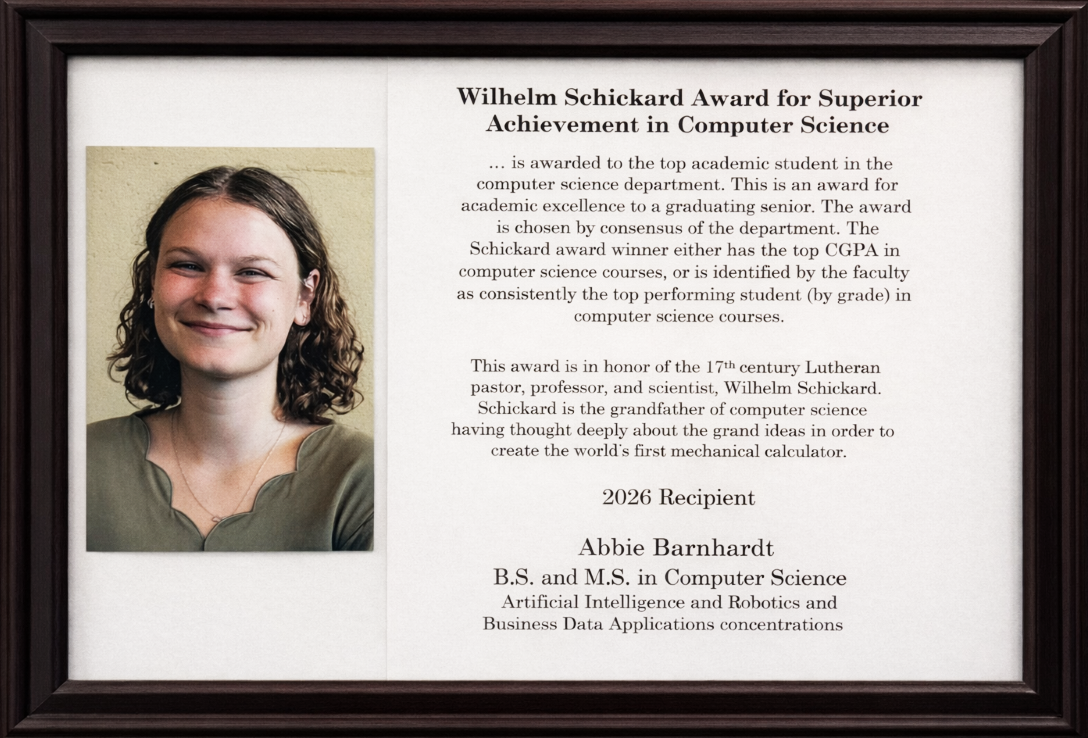
girl on award

How many Disney movies feature a “princess” who graduates at the top of her class with an award in one hand and a signed job contract in the other? Not enough.

After creating one of the strongest senior capstone projects, Barnhardt received the Wilhelm Schickard Award for Superior Achievement in Computer Science. Dr. Michael Litman, professor and chair of the Department of Computer Science, said he has not seen a project like it in the 15 years he has taught the course.

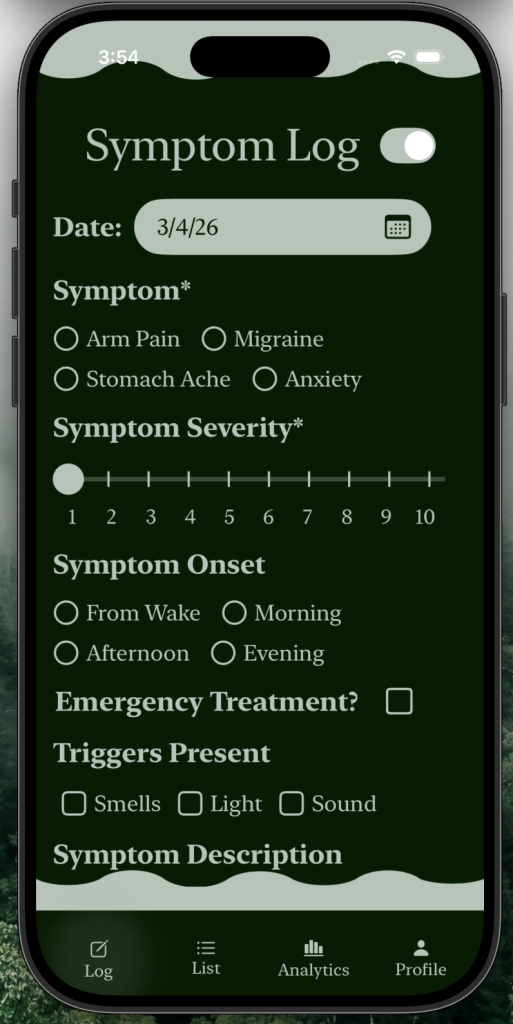
As a chronic migraine sufferer, Barnhardt developed an app for chronic illness tracking and management and received strong feedback from Litman. “That was the moment,” she said, “It really clicked for me that I was good at this.”
black app screen with text

More than just good, Litman said Barnhardt reminded him why he became an educator in Christian higher education.

“That is not a small thing!” said Litman. “Her personal drive, her passion to learn, and her dedication to quality are unique among students today.”

Although the app still has a few bugs to resolve before it can be widely available, Barnhardt identified a weakness in existing platforms. She set out to create her own, combining coding with data visualizations that reveal patterns in symptoms.

“Abbie is a reminder that our current and future generations are still worth investing in,” Litman said. The computer science faculty unanimously selected her from a strong graduating class in a field historically dominated by men.


Coding a career path

At Region 1 Planning Council, Barnhardt will create data visualizations for grants and foundations and contribute to coding projects. She will primarily use her AI concentration along with skills from her Business Data Applications coursework.

“This role does not rely heavily on the hard skills taught in the Business Data Applications concentration, but it does require strong soft skills,” Barnhardt said. “Since we create visuals for other organizations, a business mindset helps analysts understand what clients need and produce stronger results. Understanding the audience is an important step in the process.”

Barnhardt became more interested in coding after taking Litman’s classes during her freshman year. At the time, she was enrolled in a double major in professional communication and data science and applied analytics. After discussing her academic path with Litman, she decided to switch majors before her sophomore year.

“Financially and academically, it made more sense,” Barnhardt said. “I really love coding, so this path allowed me to keep all the data science classes while adding more computer science courses.”

Before she received the job offer, Barnhardt interned with the organization. She helped create a machine learning model that predicted which census tracts in the region were most susceptible to climate events based on socioeconomic and related data.

“This required extensive coding, math, and a clear understanding of which variables might be related,” she said.

She shared another example from her internship in which she worked on a grant application for a hospital planning to expand its emergency room.

“Using a business mindset, we determined what would be most convincing to the board and created visuals around that,” Barnhardt said. “This involved understanding the decision-making process, motivating factors, and basic business and economic principles.”


Visualizing impact

Blending artificial intelligence with business data applications has opened doors for Barnhardt. She now pursues work that connects technical precision with community needs.

She brings a passion for charts, data visualization and coding, along with a strong business mindset. Barnhardt is ready to make an impact that extends beyond the classroom.


Fun facts

  • She was featured in The College Tour
  • She started the Data Science and Applied Mathematics Club

Check it out. “New Concordia program promises Computer Science bachelor’s and master’s in just four years.”


“The School of &” blog series highlights the distinctive identity of Concordia University Wisconsin’s School of Arts & Sciences, where interdisciplinary connections shape learning and purpose. Each month, the series features Concordia students and alumni who have paired majors, minors and certificates in thoughtful and creative ways, showing how this approach influences both their education and their sense of calling.

These stories reveal how students connect their studies, develop their gifts, and live out their callings in service to the Church and the world.


Want in?

Concordia University Wisconsin is a Lutheran higher education community committed to developing students in mind, body and spirit for service to Christ in the Church and the world.

Concordia’s Computer Science Scholars program combines undergraduate and graduate study. Students can earn both a bachelor’s and a master’s degree in as little as four years. Those who finish in four years pay undergraduate tuition and complete their master’s at no additional cost. Contact an admissions counselor to learn more.


From classroom to concert stage: CUW students pitch ideas to grow Country in the Burg

Students in the Advanced Public Speaking course presented strategic ideas to a local community leader to increase awareness and student engagement for a charitable music festival.


The audience was Alex Uhan, founder, organizer and driving force behind Country in the Burg (CITB), a Cedarburg-based country music festival that features national artists while giving back to the community. Since its launch in 2019, the festival has supported a variety of charitable organizations, drawing approximately 4,500–5,500 attendees each day.

Concordia University Wisconsin is also a proud sponsor of the event.


From classroom to community

The presentation served as the culminating assignment for the Advanced Public Speaking course, taught by Sandra Jahns. Throughout the semester, students engaged directly with Uhan—meeting with him twice prior to their final presentation and again for their formal pitch. These interactions gave students valuable insight into the festival’s mission, audience and current challenges.

The central issue they were tasked to address: College students are largely unaware of Country in the Burg and are not purchasing tickets.

With the 2026 festival scheduled for August 28–29—and a lineup featuring artists such as Scotty McCreery, Josh Turner, Rodney Atkins, Brantley Gilbert, Mitchell Tenpenny, and Drake White—the opportunity to expand awareness among CUW students is both timely and significant.

“We have a wide demographic of people who attend Country in the Burg,” Uhan said. “But when you look at a lot of country music festivals, college students make a solid chunk of that. CITB and CUW are only 10 minutes from each other. It’s a perfect connection to not only grow awareness from our CITB fans about CUW and how amazing of place it is, but also CUW students and families finding out about our festival and wanting to attend and be part of it.”


Student-driven ideas with real potential

The presenting team included:

  • Carter Fritzinger, business communication major
  • Erica Herzog, mass communication major
  • Emma Kaiser, business communication major
  • Aili Scott, mass communication major
  • Rosa Yadgir, mass communication major

Several other students from the course were also in attendance, supporting their peers and participating in the professional presentation experience.

Together, the group outlined a clear objective: ensure that every CUW student knows about the event, has easy access to tickets, and feels connected to Country in the Burg.

To accomplish this, they proposed a range of creative, student-led solutions.

One idea featured a campus-wide poster competition, inviting student groups—such as athletic teams, theater organizations and clubs—to design and distribute promotional materials throughout the community. Each poster would include a QR code linking directly to ticket sales, with incentives like prizes or a percentage of proceeds encouraging participation.

Another concept leveraged social media with the question: “How do you live country?” This campaign would invite students to share their own experiences, building awareness through authentic, peer-driven content.

In addition, Aili Scott developed merchandise concepts designed to promote the festival and expand its visibility both on campus and beyond.

“I was inspired by country-western themes and other examples of country festival graphics, but I also wanted to incorporate Cedarburg’s beauty,” Scott said about the design process. “I wanted my designs (see below) to be simple mock-ups that could be translated to everyday wearability and aesthetic. From the perspective of a college student and music lover, I combined the themes into something I personally would wear.”


A growing partnership

Beyond the classroom, the project has sparked ongoing conversations about deeper collaboration.

There is also potential for internships across multiple CUW programs—including communication, finance and marketing—allowing students to continue contributing to the festival while gaining valuable professional experience.

“What these five students did was really impressive,” Uhan said. “You can tell they took their time to really develop a plan that would work for us.”


Living out Concordia’s mission

Experiences like this reflect Concordia’s commitment to preparing students for lives of purpose and service, equipping them to use their gifts in meaningful ways.

By working on a project that blends communication strategy, creativity and community impact, students not only strengthened their professional skills but also contributed to an initiative rooted in giving back.

For these students, the assignment was more than a presentation. It was an opportunity to engage with a real client, solve a real challenge, and take part in work that serves others.

“Presenting our ideas to a real client was honestly both exciting and a little nerve-wracking, but it made the whole experience feel so much more meaningful,” Kaiser said. “It pushed us to take the project seriously and really think through every detail, knowing it wasn’t just for a grade anymore.

“This experience taught me a lot about communicating clearly and confidently, especially in a real-world setting,” she continued. “I realized it’s not about sounding perfect—it’s about being prepared, genuine, and working together to present something you believe in. More than anything, it reminded me how important teamwork is and how much stronger ideas become when everyone contributes.”

And for Country in the Burg, it may be the beginning of a growing partnership—one that brings fresh energy, student involvement, and shared purpose to a festival committed to making a difference.

“It will be a great relationship for future years, as the tradition gets passed down to new students that come to CUW, about how fun CITB is and how they get to say their university is part of a music festival that gives back to charities,” Uhan said.


Get involved

Country in the Burg returns August 28–29 in Cedarburg, featuring nationally recognized artists and a mission rooted in giving back to the community. Interested in attending or learning more? Visit countryintheburg.com to explore the lineup, purchase tickets, and see how the festival supports charitable causes.

*Note: Concert photos courtesy of Country in the Burg.

For more information on CUW’s previous local partnerships, read “Rise, shine and fellowship: Strategic sponsorships bring summer fun to the community”


Want in?

Concordia University Wisconsin is a Lutheran higher education community committed to helping students develop in mind, body and spirit for service to Christ in the Church and the world.


Looking ahead: NSSC Space Summit explores the future of space

What does the future of space look like — and how should we prepare for it?


On Thursday, March 26, 2026, Concordia University Wisconsin will host the National Security and Space Center (NSSC) Space Summit, an evening dedicated to exploring the evolving space domain through the lens of strategy, innovation, and vocation. Held in the Terrace Room (AL114) from 4:30–8 p.m., this free event invites students, faculty, and community members to engage in meaningful conversation about one of the most important frontiers of our time.


Anticipating the future of space

This year’s summit centers on “Strategic Foresight for Space” — a forward-looking approach to understanding the challenges and opportunities shaping space exploration and development. From human settlement and commerce to diplomacy, governance, and technological advancement, the conversation will span disciplines and perspectives.

“As we look ahead, the space domain is no longer a distant concept—it is a present reality shaping economics, security, and human flourishing,” said Dr. Lamont Colucci, professor of Political Science and director of the NSSC. “Strategic foresight helps us think wisely and act responsibly in a domain that will define the next century.”

The evening will feature a lineup of distinguished speakers:

4:30 p.m. – Chris Schaeffer & Tyler Murray: Need for American Focused Space Primacy

5:20 p.m. – Joel Mozer: Long-term Strategic Planning for an Evolving Space Domain

6:10 p.m. – Rick Tumlinson: Flags & Footprints vs. Factories and Families. It’s Not Who Gets There First.

7 p.m. – Brent Ziarnick: Spacepower Development and the Virtuous Cycle

Together, these presentations will challenge attendees to think critically about the role of space in shaping our shared future.


A unique Concordia initiative

The NSSC reflects Concordia’s commitment to preparing students for lives of purpose and service. As a Lutheran higher education community, Concordia is dedicated to developing students in mind, body, and spirit for service to Christ in the Church and the world.

“At Concordia, we believe education is not only about knowledge, but about formation,” said Rachel Ware Carlton, professor of Music and dean of the School of Arts and Sciences. “Events like the Space Summit invite students to consider how their vocations intersect with some of the most pressing and complex challenges facing our world.”

Through the NSSC, that mission extends into the critical and rapidly growing fields of national security and space. The center creates opportunities for interdisciplinary dialogue — bringing together insights from political science, engineering, theology, economics, and beyond — to better understand how space exploration intersects with human flourishing and global responsibility.


Leadership grounded in experience

The center is led by Colucci, former inaugural director of Doctrine Development for the United States Space Force. A U.S. diplomat and Fulbright Scholar, he brings both academic depth and real-world experience to the NSSC’s work — an approach shaped by a clear understanding of long-term consequence. As he reflects, “Failure of foresight is rarely visible in the moment, but it is always obvious in defeat.”

He is joined by a diverse advisory board of faculty and community leaders representing disciplines ranging from physics and medicine to theology and history, ensuring that conversations around space are both rigorous and holistic.


Preparing for what’s next

As humanity stands on the threshold of a new era in space, the NSSC Space Summit serves as a reminder that these conversations are not just technical or political — they are deeply human. Questions of ethics, leadership, innovation, and service all play a role in how we move forward.

“The future of space will be shaped by the people who are willing to think deeply, collaborate broadly, and act with purpose,” Colucci said. “That’s exactly the kind of formation we strive for at Concordia.”

Students at CUW are invited into these conversations not only to learn, but to lead — to consider how their gifts and vocations might contribute to shaping the future of space for the good of their neighbors and the world.

All are welcome to attend this engaging and thought-provoking evening.


Want in?

Concordia University Wisconsin is a Lutheran higher education community committed to helping students develop in mind, body and spirit for service to Christ in the Church and the world.


The quarterback who carried Concordia home to Austria

Yannik Gruner turned his experiences at CUW into leadership on the football field and in the business world.


Under the Saturday night lights at Tomasini Stadium, the Falcons line up at the 20-yard line as the crowd rises to its feet and students wave their blue and gold. The quarterback calls the snap, the line surges forward, and the ball breaks through the defense as teammates and fans erupt in celebration against the backdrop of Lake Michigan’s cool evening breeze.

This could describe one of many experiences on the Concordia University Wisconsin football field for 2023 alumnus Yannik Gruner. As a former CUW quarterback, he has taken his experiences back to his home country of Austria, where he now serves as the head coach for the WU Tigers, the team of the Vienna University of Business and Economics.

Gruner, who attended CUW after participating in a foreign exchange program, has served as the head coach for the Tigers since last summer; prior to that, he was the team’s pass game coordinator. In addition, Gruner, who graduated from CUW with degrees in economics as well as finance, with a minor in political science, is also the co-founder and one of the mergers and acquisitions (M&A) advisors for Adquin & Co., an Austrian-based, specialized firm focused on strategic M&A research, buyer/seller identification, and advisor matching.


Where economics meets politics

Concordia prepared Gruner not only for a career in coaching, but also gave him the flexibility to shape an academic path that supported his business ambitions.

“I initially went into college pursuing a bachelor’s degree in political science,” Gruner said. “However, I quickly realized that one of my major interests was economics and, in particular, the commercial aspects of it. Therefore, I decided to shift my focus to economics. Combining it with finance gave me a specialization that I believed would provide me with a useful background, regardless of what area I’d go into after college.

“The minor in political science was merely out of interest,” he added. “I just wanted to learn more about politics by some great professors at the university.”

And that he did.

Throughout his academic journey, he worked toward attaining a more holistic understanding of the world. His two degrees, with a minor in political science, certainly helped him gain that understanding.

“From high school onward, I have been interested in the interconnectedness of politics and economics. Studying both disciplines allowed me to analyze issues from multiple angles,” Gruner said. “Even on a smaller scale, many of the principles discussed in economics and political science apply (e.g. negotiation, diplomacy, strategic decision making). Therefore, I believed that especially economics and political science naturally complement each other.”


Prepared for two callings

While his experiences as a quarterback on the Falcons football team provided a strong foundation for his coaching role at Vienna University, his educational focus at Concordia prepared him for a career in mergers and acquisitions.

“M&A is a highly dynamic environment that is clearly influenced by macroeconomic factors like interest rates. However, the political aspects should not be underestimated either,” he said. “For example, the developments of the recent months have led to a greater willingness by European nations to invest in defense tech. This has subsequently led to increased deal activity from both private equity investors and strategic acquirers, along with a broader understanding of the sector’s strategic importance.”

Gruner’s football coach while he was at Concordia, Greg Etter, said he is impressed with Yannik’s success post-graduation. “Yannik was a student of the game, always trying to learn and improve,” Etter said. “He was a great leader, hard worker and truly cared about his teammates. Very selfless! I believe all of these traits will make him a very successful coach. It is our hope that the Lutheran and Christian values taught at CUW follow our graduates throughout their lives.”


One word: Purpose

Gruner carries Concordia into his current and future endeavors, whether it be on the field with his team or in the office. When asked what one word sums up his experiences at Concordia, he said, “Purpose.”

“Many students arrive on campus unsure of their life’s purpose and with major decisions ahead of them,” he said. “CUW’s mission and community helped me find mine in using my strengths to help others, whether that be as a coach, in my job as an M&A advisor, or in my personal life.”


“The School of &” blog series highlights the distinctive identity of Concordia University Wisconsin’s School of Arts & Sciences, where interdisciplinary connections shape learning and purpose. Each month, the series features Concordia students and alumni who have paired majors, minors and certificates in thoughtful and creative ways, showing how this approach influences both their education and their sense of calling.

These stories reveal how students connect their studies, develop their gifts, and live out their callings in service to the Church and the world.


Want in?

Concordia University Wisconsin is a Lutheran higher education community committed to helping students develop in mind, body and spirit for service to Christ in the Church and the world.


Concordia’s new master’s in AI makes regional headlines

Concordia University Wisconsin’s newly launched Master of Science in Artificial Intelligence is garnering strong attention across regional media, underscoring both the timely relevance of the program and Concordia’s role as a leader in preparing graduates for an AI-driven future.


The fully online graduate degree is designed to equip students with advanced technical skills, ethical grounding, and real-world AI experience needed to lead responsibly in today’s data-driven industries.

Stories have been recently featured in the following four news outlets.


No. 1: 620 WTMJ: In-depth radio coverage

On 620 WTMJ-AM, CUW’s Michael Litman, professor of computer science, joined Wisconsin’s Midday News to discuss the new AI master’s program and its impact. During the interview, he addressed the importance of ethical, vocationally informed AI education and explained how the program prepares students for work across a range of industries.

The broadcast expanded the university’s reach beyond print and digital platforms to radio listeners throughout Wisconsin.


No. 2: BizTimes Milwaukee features CUW’s forward-looking initiative

BizTimes Milwaukee reported on the launch of the AI master’s program, noting the growing demand for artificial intelligence expertise and the need to develop skilled professionals in the region.

The story positioned Concordia as contributing to Wisconsin’s technology sector and detailed how the program responds to industry needs.


No. 3: Urban Milwaukee amplifies the announcement

Urban Milwaukee published coverage of the official press release announcing the fully online program.

The story noted the program’s flexibility for working professionals and its emphasis on practical application and ethical discernment. The coverage introduced the program to a broad Milwaukee-area audience and underscored Concordia’s continued expansion in graduate education.


No. 4: Fox 11 WLUK in Green Bay

Fox 11 News (WLUK) in Green Bay published a story highlighting how the curriculum blends technical competencies with ethical decision-making and is structured for working professionals.

The report emphasized how the program prepares graduates not only to develop AI systems, but also to manage them responsibly. It also addressed the program’s appeal to professionals seeking career advancement or transition in a changing technology environment.


Preparing graduates

The media attention reflects the significance of the moment. As a Lutheran university committed to developing students in mind, body and spirit for service to Christ in the Church and the world, Concordia’s entrance into artificial intelligence education extends beyond industry response.

The program is designed to prepare graduates to think critically, lead ethically and serve faithfully within a rapidly evolving technological landscape.

Regional coverage signals that this is more than a program launch. It is a story about a university engaging emerging technology while remaining grounded in mission and purpose.


Want in?

Concordia University Wisconsin is a Lutheran higher education community committed to helping students develop in mind, body and spirit for service to Christ in the Church and the world.


Professor Spotlight: Mario Macari, The Digital Chameleon

Assistant Professor Mario Macari in the Department of Digital Media and Design is a digital chameleon in academia and industry. 

Macari grew up in the Milwaukee area and always wanted to become an animator or a comic book illustrator. His childhood consisted of reading superhero comics in the 60s and 70s, and watching Warner Bros. animations on TV, which furthered his artistic passion. 

After being initially rejected by the art director of DC Comics, Macari persisted in creating his own comics, but later encountered the harsh reality of comic book making. 

“There are so many people into it, and you can’t make much money in it,” Macari said. 

Macari graduated from the Milwaukee Institute of Art and Design in 1983 and entered the workforce just as the digital revolution began. He had to recondition his style with the times, transforming himself into a digital chameleon. 

He launched his career in commercial and illustration sketching for Dungeons and Dragons children’s books. Then he transitioned to early technology, where he used computers to place perspective into his drawings and learned the art of Photoshop as it became standardized in the industry. 

In the 1990s, Macari wore many hats, developing CD-ROMs, programming websites, and transitioning towards teaching. From there, he would come to travel the country, instructing at a corporate level.

He taught thousands the art of Photoshop in a seminar form, until it became too much for him and his newly growing family. 

“You don’t even remember where you are. You’re living in a hotel room all the time,” he said. After decades of freelancing and agency work, Macari returned to instructing. 

Now in academia, he is exploring AI and intends to utilize it in his creations and teaching style. 

Student Josh Bowen appreciates Macari’s unique teaching approach. 

“I think he had a fairly progressive take on AI in education. He always wanted to make sure that we were being shown that it is, in fact, a tool that is being used by creatives,” Bowen said. 

Though Macari views the constant need to keep up with technology as “exhausting,” his primary advice to students is to never stop learning and to integrate their faith into their professional life.

— Erica Herzog is a writer for The Beacon. She is a sophomore at Concordia, marjoing in Mass Communications and minoring in Law & Politics.

Concordia University launches fully online Master of Science in Artificial Intelligence

Concordia University Wisconsin has launched a fully online Master of Science in Artificial Intelligence (MSAI), designed to prepare ethical, highly skilled AI professionals for leadership in today’s rapidly evolving, data-driven industries.


As artificial intelligence transforms sectors including health care, finance, manufacturing, education, and public service, organizations increasingly need professionals who not only understand AI technologies, but who can apply them responsibly. Concordia’s MSAI program combines advanced technical training with a distinctive emphasis on ethics, vocation and societal impact.

“Artificial intelligence is not just about building systems — it’s about leading wisely in how those systems are used,” said Rachel Ware Carlton, professor and dean of the School of Arts and Sciences. “At Concordia, we prepare students to pair technical excellence with moral discernment.”

The fully online program is designed for working professionals and features a hands-on, project-based curriculum. Students learn to build and evaluate machine learning models, apply AI solutions to real-world challenges, and address ethical issues such as bias, transparency, data privacy, and accountability.

To support responsible engagement with AI, CUW has introduced BoodleBox as a structured resource within its online learning environment. BoodleBox allows students to interact with AI tools as part of their coursework under faculty guidance and within clear academic integrity expectations. The goal is not unchecked experimentation, but thoughtful formation — equipping students to use powerful tools wisely and appropriately.

Students also benefit from access to CUW’s AI & Quantum Innovation Lab, which supports applied research, experimentation and interdisciplinary collaboration. Through real-world datasets, enterprise tools, and industry-aligned use cases, students gain practical experience while engaging in thoughtful ethical analysis of emerging technologies.

Graduates of the MSAI program are prepared for roles such as AI engineer, machine learning engineer, data scientist, applied AI consultant, and AI product or technical lead. The degree also provides strong preparation for doctoral study or advanced research.


Want in?

Concordia University Wisconsin is a Lutheran higher education community committed to helping students develop in mind, body and spirit for service to Christ in the Church and the world.


Building an uncommon education: Austin Kerbs charts an interdisciplinary path in Arts & Sciences

“The School of &” blog series highlights the distinctive identity of Concordia University Wisconsin’s School of Arts & Sciences, where interdisciplinary connections shape learning and purpose. Each month, the series features Concordia students and alumni who have paired majors, minors and certificates in thoughtful and creative ways, showing how this approach influences both their education and their sense of calling.

These stories reveal how students connect their studies, develop their gifts, and live out their callings in service to the Church and the world. Click here to read our next story about alumnus Yannik Gruner.


A career path that spoke

Economics. Policy. Ethics. Psychology. Community health. The environment. Senior Austin Kerbs took all of his interests and created a career path that spoke to him. With a major in Environmental Studies and minors in Spanish and Economics, Kerbs is preparing for a career in urban planning, grounded in ecological responsibility and human flourishing.

“People normally associate environmental work with conservation or being a park ranger, but I wasn’t sure that was my calling,” he said. “However, I stumbled upon a career path that spoke to all my primary interests. Urban planning combines all these disciplines to solve modern problems and shape environments to benefit people and the planet.

“When researching which undergraduate degrees would serve me best,” he continued, “I landed on Environmental Studies. Through this major, I would not only study the law and policy of the environment but also the ecology and biological functions that keep the world in balance.”


Connecting disciplines

Kerbs describes his academic path as a “winding mountain trail rather than a straight boulevard.”

But, at what point did economics enter the picture for him? What made him think, “This would complement my major well?”

“The study of economics has always been a focus of my academic interest,” Kerbs explained. “In fact, urban planning is the convergence of economics, government policy, psychology, and environmental science. Economics became the natural addition to my Environmental Studies major.”

Bretta Speck, assistant professor of Environmental Science, is one of Kerbs’ instructors and has seen firsthand how his coursework in Environmental Studies and Economics complements the way he approaches class discussions and projects.

“In my ecology course, we study how plants and animals interact with each other and their environment,” Speck said. “Many of the equations used to quantify resource allocation, competition modeling, and future population dynamics are the same equations that are used in economics for nature’s human counterparts.

“When we talk about how to manage our natural resources,” she added, “Austin looks at not just the scientific side of what is best for the environment, but also thinks about the policy and economic side of how to accomplish such goals.”


Beyond the classroom

During his time at Concordia, Kerbs had an opportunity to work with the Milwaukee Metropolitan Sewerage District during an internship. There, he served in their Stormwater Management Division as a Fresh Coast Guardian. “I supported green infrastructure projects (rain gardens, bioswales, rain barrels) to manage stormwater where it lands and promoted sustainable urban development across multiple municipalities,” he said. “One of my favorite projects was working on MMSD-owned properties, identifying and maintaining native plants and removing invasive species.”

This internship enabled him to see the interconnectedness of metropolitan and rural areas, Speck said. “MMSD’s work on restoration of native plants and landscapes directly improves the water quality for the entire Milwaukee River Watershed and thus Lake Michigan. It has inspired Austin to implement some of these practices here at CUW.  It’s this passion and drive that makes me know he has a promising future ahead of him.”


Creative balance

In addition to his studies, Kerbs finds time to participate in one or two of Concordia’s theatre shows each academic year. His repertoire includes “Beautiful the Musical,” “A Christmas Carol,” and “Singing in the Rain.” Last semester, he performed in “Madagascar” as Rico the Penguin. While he enjoyed performing in the production, he also saw a connection to his studies.

“‘Madagascar’ was a story about anthropomorphic animals that were sent to their native environments, despite being so far removed from these habitats that it felt foreign to them,” he explained. “The same can be true of people. Sometimes we feel foreign when returning to nature or moving to a new city. We like to set our roots in comfortable places, and change is difficult.”

He added: “Humans, like our creator, are designed to be creative beings. Very few creatures God has created have the capacity to innovate and create new things in the same way that people do. Finding a creative outlet is so important to find peace and focus in the fast-paced environment at university.”


What lies ahead

Kerbs, who hails from Appleton, Wis., plans to graduate this year. As he prepares for his next chapter, he trusts that God will provide the opportunities needed to maximize his talents, education and experience. And he doesn’t foresee an end to learning about the world, nature and economics.

“We are continually learning new things,” he said. “I want to apply the things that I learn to make the lives of people better and create a city that is a leading example for the world to follow… I do not expect to follow my plans exactly, as God has His own plan for my life. I will do my best to serve God and His people in any role that I am in.”


Want in?

Concordia University Wisconsin is a Lutheran higher education community committed to helping students develop in mind, body and spirit for service to Christ in the Church and the world.


Urban Milwaukee and Fox6 Milwaukee: Concordia’s AI innovation makes headlines across TV and digital media

Concordia University Wisconsin is gaining attention beyond campus for its thoughtful and innovative use of artificial intelligence.


In recent weeks, the university’s new AI tools, which are scheduled to launch in February, have been featured in two separate media venues, underscoring Concordia’s growing role in shaping conversations about technology, ethics, and education. A television interview with Dr. Michael Litman, professor and chair of the Department of Computer Science, offered a firsthand look at how these tools will be used in the classroom, while a local online publication amplified Concordia’s message by picking up the university’s own story. Together, the coverage reflects how Concordia’s work in AI is resonating with the wider community.


Dr. Michael Litman

Fox6 Milwaukee

Litman spoke with Fox6 Milwaukee host Ted Perry in a 12-minute segment, a notably long conversation by television standards, allowing time for meaningful discussion about how Concordia is approaching artificial intelligence in higher education.

The extended format gave Litman the opportunity to explain not only what the tools do, but why Concordia is committed to using AI thoughtfully, responsibly, and in service to student learning.

Take a look at the segment by clicking here.


Urban Milwaukee

In addition to the television spotlight, Concordia’s AI tools were also featured in an online story by Urban Milwaukee, extending the reach of the university’s message through a respected local digital publication. The piece drew from Concordia’s own story and highlighted how the university is integrating artificial intelligence into teaching and learning with intention and care. By amplifying Concordia’s perspective for a broader civic audience, the coverage reinforced the university’s role as a thoughtful contributor to regional conversations about emerging technology and its impact on education.


Want in?

Concordia University Wisconsin is a Lutheran higher education community committed to helping students develop in mind, body and spirit for service to Christ in the Church and the world.


Faith in action and hope in Christ: CUW faculty reflect on Dr. King’s legacy

As we pause to remember the life and legacy of Dr. Martin Luther King Jr., we give thanks for his courageous witness to justice, dignity and love of neighbor.


Guided by his Christian faith, Dr. King challenged individuals and communities to seek truth, extend grace, and work faithfully toward a more just world.

In this spirit, we share two reflections from CUW faculty members, who offer thoughtful insights on faith, vocation, and what it looks like to live out Christ-centered service in our everyday lives.


Faith That Worked, Vocation That Cost, Justice That Served

By Kenneth E. Harris Jr., PhD
Associate Professor and Department Chair
Justice and Public Policy

The Rev. Dr. Martin Luther King Jr. is often remembered as a dreamer. Before he was a dreamer, he was a pastor. Before he was a symbol, he was a servant. Before he was celebrated, he was condemned. His legacy cannot be understood without recognizing that his faith was not decorative; it was operational, as he made clear in his 1963 book, “Strength to Love.”

Rev. Dr. King’s faith did not live in stained glass. It lived in streets, jails, pulpits, courtrooms and burial grounds. His theology was not about escape from suffering, but responsibility within it. Writing from a Birmingham jail cell in 1963, he argued that injustice anywhere is a threat to justice everywhere, insisting that Christian faith must confront social sin, not merely personal morality.

This belief shaped his vocation.

Rev. Dr. King did not treat his calling as a career. He treated it as an assignment from God. Vocation, for him, was not about personal comfort or safety. It was about obedience. He understood that purpose often demands sacrifice and that leadership often requires loneliness. In his final speech, “I’ve Been to the Mountaintop,” delivered in 1968, he accepted the possibility of death because he believed he had been called to do God’s will.

Justice, in Rev. Dr. King’s vision, was not a slogan. It was structure. It was policy. It was access. It was dignity. He did not speak only about love; he spoke about voting rights, housing, labor and economic inequality. In “Stride Toward Freedom,” published in 1958, he wrote that “true peace is not merely the absence of tension; it is the presence of justice.” He understood that reconciliation without equitable treatment is theater, not transformation.

Yet, his pursuit of justice was always anchored in service.

He never argued that Black or White people deserved power over others. He argued that all people deserved power over their own lives. His work was not about dominance — it was about deliverance. Influenced by Jesus’ model of servant leadership in Mark 10:45, he believed moral courage was the highest form of leadership, a theme later emphasized by historian Clayborne Carson in “The Autobiography of Martin Luther King Jr.”

What troubles many today is not his dream — it is his discipline. Not his hope — but his insistence. Not his speeches — but his demands.

We quote Rev. Dr. King when he comforts us. We ignore him when he confronts us. But his legacy does not belong to nostalgia. It belongs to the world.

Throughout the coming days, as we attend Chapel, attend class, and interact with administration, faculty, staff and students, we must all remember that faith that does not move is not faith, vocation that does not risk is not calling, and justice that does not disrupt evil and oppression is not justice. Thus, service to Christ and the world that does not cost is not service.

Rev. Dr. King did not give us a dream to admire. He gave us work to finish. Consequently, the question is not whether we will honor his work. The question is, are we willing to continue his work?


Hope, Truth, Courage and Vocational Calling in Divisive Times

By Lori Woodall-Schaufler
Professor
Theatre

“We are now faced with the fact that tomorrow is today. We are confronted with the fierce urgency of now.” Dr. King spoke these words exactly one year-to-the-date before he was assassinated, expressing his feelings of concern towards the Vietnam War.

On April 4, 1967, our nation and our world were embroiled in divisive cultural wars, bloody fighting wars, and spiritual and emotional upheaval much like today. The “urgency of now” ties into a burning question that seems to resonate throughout social media of “What can we do?” to heal political and cultural division, to stop the spread of spiritual/moral apathy, and to save our children (and ourselves) from a world that seems to be spiraling out of our control in the face of a digitized future of algorithmic bias and misinformation. The very thought and real presence of broken families, communities, churches, and systems from the heap of societal assaults on our conscience can overwhelm one to the point of silence.

What can you say or do to reverse the often-temporary absolutes one clings to for moral or cultural convenience?

Many wonder how to live faithfully when voices are loud, wounds are real, and unity feels like a distant memory or pipe dream. Trust can feel thin and truth elusive. Dr. King, much like his revolutionary 16th century namesake, Martin Luther, both shared a conviction that faithfulness means standing for truth even when it’s costly. Loving one’s neighbor is not optional, but tied to our Christian vocation to serve our neighbor in the ordinary facets of our life.

We are called to protect the vulnerable, acting for the good of others as an act of faith. Dr. King famously said, “Darkness cannot drive out darkness; only light can do that. Hate cannot drive out hate; only love can do that.” This echoes the words of Scripture: “The light shines in the darkness, and the darkness has not overcome it.” (John 1:5) We are called to love our neighbors and our enemies. Christian love is not weakness, though it can appear to be in a current culture obsessed with “winning.”

What has been “won” is our redemption through the Cross. Because of this prior love exemplified on the Cross, we can courageously love in a manner that embodies truth and rejects cruelty. We can aide a neighbor, even when it’s hard.

King cautions, “The arc of the moral universe is long, but it bends toward justice.” (1967) As a lifelong Theatre artist, I examine all characters and plots through “arcs,” placing an emphasis on the journey more so than the final destination. Arcs reflect transformation, embraced as superior to chronological order. They capture internal shifts in a way that sequence cannot. As I reflect on Dr. King’s statement, I think of how our human transformation is ever-evolving, inviting us to walk alongside one another as we navigate the complexities of our human experience.

Joy can be found in the journey, and it gives us hope. We can be hopeful that it ends in justice because, through Christ’s sacrifice, we have overcome. Our doctrine of vocation reminds us that God has placed us in specific callings as teachers, students, leaders, family, artists, scientists and neighbors, not to withdraw from the world in fear, but to serve within it with courage. Dr. King’s life reminds us not to imitate the world’s anger, nor to retreat in silence, but to use what God has given to serve in spaces, both significant and small.

Faithful witness does not have to involve shouting, but is showing up with compassion, grace and integrity, trusting that our call is deeper: shaped by the Gospel, serving in humility, committed to a truth that can only be formed by love. “For at one time you were darkness, but now you are light in the Lord. Walk as children of light.”  (Ephesians 5:8–9)

Faith and action. Called and responsive. Tomorrow is Today, and we can make a difference with our love.  


chapel

Answering Dr. King’s call to love our neighbor

In honor of Dr. Martin Luther King Jr., you are invited to pause, reflect and serve. On Friday, January 23, we will gather in Chapel to hear God’s Word and sing together, with gospel choir Joyful Noise, as we reflect on our Christian calling to love our neighbors in the places God has put us.

Following Chapel, you are invited to take part in a tangible opportunity to serve our neighbors through a partnership with the Milwaukee Rescue Mission. After Chapel, you may:

  • Write notes of encouragement for neighbors served by the Milwaukee Rescue Mission
  • Learn more about the Mission and future service opportunities

After the group from Chapel subsides, the activities will be moved to the library so that students, staff and faculty can participate throughout the day.

As Lutherans, we confess that we are saved by grace alone through faith in Christ. Freed by that Gospel, we are sent into our vocations to serve others. In simple acts, spoken words, written notes, and faithful presence, we bear witness to Christ’s love by offering comfort, hope and peace to our neighbors.


Want in?

Concordia University Wisconsin is a Lutheran higher education community committed to helping students develop in mind, body and spirit for service to Christ in the Church and the world.