Dr. Don Galster: A Passion for Education, Leadership, and Faith

Through his work, Dr. Galster is preparing the next generation of educators to teach with focus, grace, and purpose.


Dr. Don Galster has dedicated over 30 years to education, working in diverse settings across multiple states. His journey has taken him from public school classrooms to administrative leadership, and now, to a meaningful role at Cross Trainers Academy, a Christian school serving students in Milwaukee and a part of the Milwaukee Rescue Mission. As an adjunct professor at Concordia University, Dr. Galster brings a wealth of experience and wisdom to future educators and aspiring school leaders. His work is deeply shaped by his faith, his belief in the transformative power of education, and his commitment to serving where he is most needed.

Bringing Experience into the Classroom

Dr. Galster teaches ED 1103 – Human Relations for the Educator/Teacher and EDG 6100 – Leadership in Administration and Cultures of Change at Concordia. He particularly enjoys working with non-traditional students in his undergraduate course, many of whom are already employed as teaching assistants.

“I did not have this course in my own teacher preparation program, and I had no knowledge of how to communicate with key parties, including students, colleagues, administrators, and parents. ED 1103 provides this valuable learning, essential to the success of new teachers,” he explains. “It’s also rewarding to help TAs, who already understand the classroom setting, take the final steps toward earning their teaching degree.”

His graduate-level course allows him to mentor aspiring school administrators, many of whom already have experience in education. “I enjoyed being able to share my practical knowledge with these professionals,” he says. “And I even learned a few things about organizational leadership from students coming from healthcare backgrounds!”

From Business to Education: A Calling to Teach and Lead

Dr. Galster initially studied economics and business administration but soon realized his true calling was education. He pursued a master’s degree in curriculum development with secondary education certification and began his career as a high school social studies teacher on the west side of Chicago.

“It was valuable experience, but a rough area. After a few years, I moved to the suburbs and later to Florida, where I enjoyed the beach life,” he recalls. “There, I was encouraged to explore school administration, and after starting a family, the idea of making a greater impact—and earning a better salary—became appealing.”

What initially felt like a reluctant move away from coaching basketball soon became his passion. “I realized it was the leadership aspect that motivated me—the ability to create and facilitate improvement and change in an entire school rather than just in my own classroom. I became a leadership-theory junkie, and that’s been my path ever since.”

After earning a specialist’s degree in school administration, principal certification, and eventually a PhD and superintendent’s license, Dr. Galster served in various educational leadership roles before moving back to the Midwest.

Finding Purpose at Cross Trainers Academy

Nine years ago, Dr. Galster experienced a deepening of his faith and a shift in his career path. “Through God’s guidance, I moved from 25 years in public education to Christian education. I transitioned from the highest-performing schools in Wisconsin to some of the lowest. I prayed for God to lead me where I was needed, and He led me to Cross Trainers Academy.”

The transition was humbling. “I had to admit that all of those suburban districts I worked in would have done just fine with or without me. But going somewhere where people feel achieving success is almost impossible—that’s where I am meant to be. I am exhausted by the challenges, but I am more motivated by challenge than anything else.”

Dr. Galster sees the impact of his work daily. “Many of our students come from trauma-filled backgrounds. Some don’t have any role models at home, and many parents are incarcerated. Schools become social workers, teachers, and providers of basic needs. If there’s still time and space, there can even be schooling.”

But the rewards are immeasurable. “The most meaningful moments are watching seniors graduate because I know how hard their journey has been. I love when they finally ‘get’ why I have high expectations. And when students come to faith in Jesus Christ, the change is something only God can bring about.”

The Realities and Rewards of Urban Education

Dr. Galster is a strong advocate for educators considering careers in urban education. “It is the best place to learn. Educators who gain strong experience in an urban setting can succeed anywhere. The same cannot be said for those who start in suburban schools.”

But he is also honest about the challenges. “It’s a marathon, not a sprint. It’s not for everyone, and many walk away. But there is nothing more genuine than helping a child in an urban setting succeed when so many obstacles exist in their path. In an urban school, when a child succeeds, you know you played a part.”

Faith in Action: A Christ-Centered Approach to Leadership

Dr. Galster’s faith is central to his work as both an educator and administrator. “Before my faith journey became real, I existed as two separate people—a neutral professional at work and a Christian believer outside of work. It dawned on me that if I could apply the strength and wisdom of my Christian faith to being a school leader, the result would be powerful. That’s when I left public education for private Christian education. My work is now a ministry, not just a job.”

This perspective has reshaped his leadership style. “As a Christian leader, I still maintain high standards, but I lead with more gentleness, grace, and forgiveness. Helping struggling students succeed through love does not mean we are weak—it means we are strong, resilient, and determined.”

A Lasting Impact on Education

Dr. Galster’s work at Concordia is an extension of his ministry. “Every time I am asked to teach a course at Concordia, I am thrilled. Seeing students improve based on my feedback, hearing how they’ve landed new jobs, and receiving their thank-you notes at the end of a term—it all reinforces why I do this.”

Through his leadership at Cross Trainers Academy and his teaching at Concordia, Dr. Galster continues to shape the next generation of educators and administrators, equipping them with the knowledge, skills, and faith to transform lives.


Want in?

Concordia University Wisconsin is a Lutheran higher education community committed to helping students develop in mind, body, and spirit for service to Christ in the Church and the world. Our Education programs focus on optimizing your abilities to serve students, schools, and the community through education. We develop well-rounded educational professionals that can teach and lead in rural and urban communities. With a Christian-centered focus, relevant curriculum, and engaging faculty you can play a meaningful role in the world of education.


Dr. Adam Paape is assistant dean of the School of Education at Concordia University Wisconsin.
Ben Groll – A Passionate Future Social Studies Educator with Faith at His Core


At Concordia University Wisconsin, the Secondary Social Studies Education program equips students to inspire the next generation by fostering an understanding of history, civic competence, and cultural awareness. Among the many aspiring educators is Ben Groll, a remarkable pre-service teacher whose passion for Social Studies is deeply intertwined with his faith and commitment to student growth.

An Exemplary Future Teacher

Ben’s journey at CUW has been marked by his strong work ethic, reflective nature, and dedication to his students’ holistic development. Professor Jonny Balsman, assistant professor of education, highlights Ben’s dedication, saying, “Ben is an exemplary pre-service teacher consistently demonstrating hard work and discernment in his preparation for the classroom. He is thoughtful, detail-oriented, and deeply reflective on both the best practices in teaching and the holistic development of his students as children of God. His future Social Studies students will undoubtedly benefit from his ability to connect historical content to relevant contemporary issues, fostering a more meaningful learning experience. Ben’s passion for teaching and his commitment to student growth make him a valuable asset to the future of education.”

Ben’s preparation for the classroom goes beyond simply delivering content. He strives to create a space where his students can engage with history by connecting the past with the present. Ben’s ability to relate historical events to contemporary issues reflects his desire to make learning relevant and engaging.

Faith and Passion for History

One of the standout aspects of Ben’s experience at CUW his integration of his Christian faith into his teaching philosophy. Ben’s journey is more than just academic; it’s vocational. His strong Christian values guide how he views his students. They are not just learners, but children of God who deserve thoughtful, caring, and ethical guidance. This faith-based approach adds depth to his role as an educator. He provides his students with not only academic instruction but also moral and spiritual support.

Ben reflects on how his faith shapes his approach to teaching:

“As someone who has grown up in church environments, the love of Jesus is inherent to my identity. Throughout high school and into college, I’ve gone out of my way to serve the young people in my community. I’ve coached a wide range of ages and learned that being a mentor comes very naturally to me. It makes me even more eager to enter the classroom.”

As Dr. Betsy Pease, chair of the history department, explains:

“Ben has shown a real enthusiasm for history throughout the duration of his time at CUW. That has made him a joy to have in class and that I know will make him a terrific teacher. He asks really great questions of the past, showing how important history is to concerns we have today. A great example of this is his Senior Seminar project. Ben is researching how the International Olympic Committee and its president responded to global political pressures in the 1940s-1970s, and thus helped shape our current debates about sports, athletes, and culture. It has been a great gift to work with Ben as he develops his vocation for teaching.”

This project showcases Ben’s keen ability to explore complex historical issues and relate them to modern-day conversations. His dedication is not only about understanding the past, but how those events influence our present and future.

What Inspired Ben to Become a Teacher

When asked what motivated him to pursue a career in education, Ben says, “I was inspired by my past teachers. And I love to serve others!”

This simple yet powerful reason underscores his commitment to making a positive impact in the lives of his students.

The Concordia Difference: Faith, Leadership, and Growth

Ben’s choice to attend Concordia University Wisconsin was deeply influenced by the institution’s holistic approach to education.

“I knew it was a renowned program for education. It provided me with the opportunity to become a better teacher. But I’ve also grown as a leader and a Christian,” Ben shares. This combination of academic excellence and spiritual growth has been pivotal in shaping his journey.

Ben also credits two faculty members for their profound influence on his development as an educator. “Dr. Pease has inspired in me an insatiable appetite for all things history and has taught me the complex and nuanced nature of our past. Her vision of our country and our world’s culture has helped me become a better educator. Professor Balsman has also been an amazing example to me for how to be an educator of the whole person. His creative lessons that incorporate character development and faith have shown me just how important it is to include that in one’s lessons.”

When reflecting on his most rewarding experiences at CUW, Ben highlights his relationships with his professors:

“They’ve given me incredible support and have reaffirmed that this is the vocation for me.”

Ben’s involvement in extracurricular activities has also played a significant role in his personal and professional development.

“As a member of the men’s volleyball team and a leader on campus as a former RA, I’ve been able to supplement my education with fantastic character and leadership-building opportunities,” he explains. “These experiences have taught me the skills that will support me as a future professional in the workplace.”

Lessons Learned at Concordia

CUW’s faculty and staff have also provided Ben with support that has shaped his perspective as an educator.

“The faculty and staff have given me hands-on support and incredible accommodations while I pursue my goals. They’ve given me the opportunity to study abroad. That grew my worldview and will help me engage with the diverse students of this country,” he says.

Ben is excited to bring the strategies he’s learned at Concordia into his future classroom.

“I’m really excited to bring diverse lesson planning and creative writing into my classroom. Concordia has taught me so many strategies for learning. The practice we get in student teaching will help me learn just how effective those strategies are.”

Advice to Future Educators

For those considering a future in education at Concordia, Ben offers this advice: “I would tell future students to take the time to speak with Concordia’s faculty if they are on the fence. The energy and genuine kindness they will show you will make the decision very easy.”

Looking to the Future

As Ben looks forward to his teaching career, he is excited to bring his blend of faith, passion for history, and dedication to student development into his classroom. His future Social Studies students will not only learn the importance of historical events but will also understand how those events connect to their own lives. Ben’s ability to foster this kind of meaningful learning experience is what sets him apart as an educator.

Ben Groll’s journey through Concordia University Wisconsin has prepared him well to inspire future generations. His faith and his passion for teaching will undoubtedly have a lasting impact on the students he teaches. The CUW community is proud to support his journey and looks forward to watching him continue to grow and succeed.


To learn more about the Secondary Broadfield Social Studies Education program at CUW and how it can prepare you for a rewarding teaching career, visit CUW’s program overview.


Want in?

Concordia University Wisconsin is a Lutheran higher education community committed to helping students develop in mind, body, and spirit for service to Christ in the Church and the world.


— This story is written by Adam Paape, Assistant Dean in the School of Education at Concordia University Wisconsin and Ann Arbor.

Email us

Do you have a story idea or media inquiry for Concordia’s Strategic Communications team? Send an email to news@cuw.edu.

If this story has inspired you, why not explore how you can help further Concordia’s mission through giving.

NLSW: Luke Witte


Meet Luke Witte (’27) from Lutheran Westland, majoring in Computer Science.


Why should someone from Lutheran Westland consider CUW?

They have some of the best people you will ever meet. Everyone is always very welcoming. There are also so many things to do outside of class, you’ll never feel bored.

How did Lutheran Westland prepare you for life after high school?

Most importantly, it gave me a Christian background that will stay with me the rest of my life. It also prepared me for the classes here. The teachers I had at Lutheran Westland pushed me in their classes and when I came CUW, the classes did not feel as difficult as they could have.

What has been the impact of a Lutheran education in your life?

I’ve gone to Lutheran schools for all my life. I’ve always enjoyed being surrounded by friends that for the most part, share my exact beliefs or very similar. They help me to think about what it means to be always Lutheran in my life, especially here at college when its easy to lose yourself in your regular school life and sports.

Have there been any teachers and or professors who have made an impact on you?

Yes. During high school, I had a teacher for Chemistry, AP Calc, Physics, and Programming named Mr. Montney. His programming class was one of the biggest reasons I decided to go into computer science. Not to mention, he was an amazing teacher, and model to look up to for me and many of my fellow classmates. He had a huge impact on all our lives and had a way of making arguably some of the hardest classes in high school much more enjoyable.

What is the most underrated element of CUW?

I would say the many clubs that they have here may be the most underrated part. Coming into college, I had no idea how many and what clubs they might have. I didn’t think I would find one I enjoyed, but I ended up finding a spot in a few of them. I joined the Ultimate Frisbee club team and they were the best group of people I have ever met and they helped me tremendously in adjusting to coming to college. Going to play frisbee with them was like an escape from school and track stress. I also joined the Computer Science club which meets every week to help younger students with their homework, and the Hackathon club which puts on coding events every semester with the aim of making fun competition and teaching out of coding.

What is your favorite spot on campus?

My favorite spot on the CUW campus would have to be the computer science lounge. Its been getting new furniture and renovations since I got here and it just keeps getting better and better. It’s a nice place to just sit down and work on homework. It feels like a technologically heavy place and to me it’s a good feeling to have going into computer science.

What drew you to Concordia?

I was drawn to Concordia Wisconsin first by their Lutheran education and environment. Secondly, their department of computer science is the best that I’ve seen in any of Concordia’s. The staff of professors they have in the department are amazing and so knowledgeable within each of their concentrations. The concentrations of computer science themselves that each new freshman gets to pick from also really helped me to decide to come here.

What has been your favorite class here at CUW and why?

My favorite class here so far was my Coding 1 class that I took for the first semester with Dr. Litman. Even when I didn’t understand how to code some of my assignments, Dr. Litman was understanding of that and always helped us to understand after the assignment was turned in. Despite the confusion, I always found the assignments to be fun to code too.


Want in?

Concordia’s computer science degree integrates liberal arts with technical training, offering a comprehensive approach to the dynamic field. Emphasizing problem-solving through technology, the program equips you to create and manage innovative solutions in the ever-evolving tech landscape. With five diverse concentrations and flexible electives, you can tailor your education to match your interests. The curriculum covers hardware, software, databases, coding, and user interfaces, providing a solid foundation through Concordia Core and Technology Core. After completing core courses, you have the flexibility to specialize in specific areas or explore additional fields, ensuring a well-rounded bachelor’s in computer science degree.


NLSW: Payton Bickett


Meet Payton Bickett (’24) from Lake Country Lutheran, majoring in Elementary/Special Education.


Why should someone from Lake Country Lutheran consider CUW?

CUW is a great school for students from LCL looking to transition to college but keep the Lutheran education foundation. The university’s commitment to academic excellence, combined with its Lutheran heritage, creates a unique and supportive environment for students navigating the crucial step from high school to college.The supportive network at CUW understands the importance of preserving the sense of community that student similar to what they would have experiences at LCL. The university strives to recreate this sense of belonging through various student organizations, faith-based activities, and mentorship programs, ensuring that students feel connected and supported as they navigate the college landscape.

One of the key strengths of CUW lies in its ability to provide a nurturing atmosphere that upholds the values and principles of the LCMS. The university’s Lutheran identity fills various aspects of campus life, fostering a community where students can continue to grow spiritually and intellectually. The chapel services, religious studies programs, and campus ministries serve as pillars, ensuring that students have ample opportunities to deepen their faith while pursuing higher education.

CUW, similar to LCL, has a commitment to academic rigor that encourages success for its students. The university offers a diverse range of programs, providing students with the flexibility to explore various disciplines while rooted in a faith-based context. The faculty play a pivotal role in guiding students through their academic journey. This integration of academic excellence and spiritual growth sets CUW apart as an ideal choice for students seeking a holistic college experience.

How did Lake Country Lutheran HS prepare you for life after high school?

Lake Country Lutheran High School (LCLHS) has been instrumental in preparing me for college. The school’s commitment to academic excellence, character development, and a supportive community has equipped me with the skills and mindset necessary for success. The rigorous curriculum challenged me academically, fostering critical thinking and problem-solving skills. The emphasis on spiritual growth provided me with a strong moral foundation, while the focus on character development instilled qualities like integrity and responsibility. Engaging in leadership opportunities such as LIFT leader and extracurricular activities allowed me to develop essential skills like teamwork and communication. The supportive community at LCLHS created an environment where I felt known and valued, contributing to a positive transition to college at Concordia. The school’s emphasis on college and career readiness and involvement in extracurricular activities further enriched my overall educational experience. In summary, LCLHS has not only prepared me academically but has also nurtured my personal and spiritual growth, laying a solid foundation for success in high school and beyond.

What has been the impact of a Lutheran education in your life?

The impact of Lutheran education on my life has been transformative, beginning with my transfer to a Lutheran school in fourth grade. Since then, attending Lutheran schools has not only provided an environment of academic excellence but has also fostered spiritual growth and a strong sense of community. The decision to make this transition marked a pivotal moment, introducing me to an educational setting where Christian values were seamlessly integrated into the learning experience. This shift in perspective influenced not only my academic journey but also shaped my character and deepened my faith.

Have any teachers or professors impacted your life while at CUW and Lake Country Lutheran?

Gratitude fills my heart as I reflect on the faculty in these Lutheran schools, who have played a central role in my educational experience. Their commitment to academic excellence has been complemented by a genuine extension of God’s love through personalized guidance, encouragement, and support. The integration of faith into daily learning, coupled with a strong sense of community, has provided a nurturing environment that goes beyond traditional education. The faculty’s dedication to fostering an atmosphere of love and care has left an indelible mark on my life, making my educational journey within Lutheran schools truly enriching and spiritually fulfilling.

What is the most underrated element of CUW?

The dance team! ?

What is your favorite spot on campus?

Evelyn’s place or the business building

What drew you to Concordia?

The Education department offers a dual certification without dual major program. This is very rare and saves education majors a lot of time in their studies by combining coursework that would otherwise crossover.

What has been your favorite class here at CUW and why?

My favorite class during my time at CUW was Teaching Students with significant disabilities. This class was taught by Dr. Hensel and was very interactive. This course was crucial in my preparation for becoming a special education teacher.


Want in?

Our comprehensive program, guided by experienced faculty, nurtures your passion and skills to support K-9 students, including those with disabilities. Starting in your freshman year, you’ll engage in education coursework and fieldwork, gaining content knowledge, instructional strategies, and management skills. Graduates with dual licensure in general and special education are highly sought after. Rooted in a liberal arts foundation with a Christian emphasis, our focus extends beyond academics to develop the mind, body, and spirit of teacher candidates. The program leads to a Wisconsin teaching license in Elementary/Middle Education (K-9th) and Cross Categorical Special Education (K-12), with options for a Lutheran Teaching Diploma (LTD) or a Christian Teaching Certificate (CTC). Enjoy small class sizes and diverse student teaching opportunities locally and beyond.


How to prepare for the job market

Finding the right job is not always an easy task. However, there are ways to make sure you are ready to face the job market. By taking the time to develop your skills and knowledge, you’ll become an attractive candidate for employers.

To make sure you’re a strong candidate, focus on improving your communication skills and your ability to work with others. Finally, prepare to discuss your qualifications and experiences during the interview process. These steps can help you achieve the qualities desired by employers and become the perfect employee.

Research, research, research

The job market can be overwhelming. The first step is to do thorough research to know exactly what is out there and what you want. Think about these questions during your research process.

  • What industries or companies interest me?
  • What are my expectations for the position?
  • What skills do I need for the job?
  • What is the process to obtain the position I want?
  • What are the goals and values of the company?

After narrowing your search, choose positions that interest you, and review specifics on the role and the company. You want a position that fits your skills and values.

Interview the right way

Interviews are an inevitable part of getting a job. Many times there are many other candidates fighting for the same role. So, you need to stand out and show why you’re perfect for the job. How can you stand out in this job market?

Know the company

It’s critical that you have some background knowledge about the company. Don’t go in blind! Look closely at your resume and modify it to reflect why you are perfect for the position. Have specific examples that demonstrate how your skills will fit into the role.

Take time to understand more about the company and its mission. Hiring managers appreciate applicants who demonstrate their commitment by researching and familiarizing themselves with the company.

Have questions at the ready

Interviewer: “Do you have any questions for us?”

Candidate: “I don’t think so.”

Every interview always ends with this question, and most of us say no which then ends the interview. However, this is the part where you get to ask questions and make sure they are the right fit for you.

Prepare thoughtful questions about the position, the team or department, and the overall direction of the company. Some of my favorite questions to ask are:

  • What’s your favorite part about working here?
  • What you are looking for in an ideal candidate?
  • Can you tell me what the day-to-day will look like?

Preparing questions can demonstrate your intelligence, seriousness, and ability to provide value to the company fast. It’ll also spare you the awkward, “Nope, I’m good.”

Bring your notebook

Taking careful notes during interviews is a must. Being able to look back on information discussed with the interviewer, such as a department’s goals or difficulties, will help you stand out. Additionally, demonstrating an understanding of the company’s systems and how they fit together will display your value to the company.

Practice makes perfect

To be sure of yourself during an interview, it is necessary to PRACTICE beforehand. Doing mock interviews with a trusted friend or family member is a great way to prepare without anything being official. Try answering common interview questions until you feel comfortable. This will help you walk into your interview ready to represent yourself well and put your best foot forward.

Build a strong network

Forming professional relationships is one of the biggest sources of success when it comes to the job market. Your network can help you find jobs and different opportunities. 

You have more connections than you might even realize. Friends, family, neighbors classmates, your church congregation, and social media followers are all connections. 

Start to interact with people who might have a connection or are part of an industry you are interested in and build your network.

Cultural competence

Not everyone looks, thinks, or believes the same way you do. Can you navigate those differences to work well with others? If you’re culturally competent, you’re conscious of the difference between yourself and employees of other cultural, ethnic, or even socioeconomic backgrounds. Embrace your differences, appreciate them, and learn from them, to strengthen your working relationships.

Become a better communicator

Communication is something we all do, but are not all good at. Nevertheless, it’s a part of every area of our lives. Both written and oral communication are skills crucial to being a great employee. 

If you’re a weak communicator, you’ll have a hard time meeting expectations and being understood. Just like communication is the key to a relationship, it is also the key to any role.

Check this out: Unlock Your Dream Job With 3 Hirable Skills

Be ready to adapt

With the world constantly changing it’s important that you’re adaptable. Be flexible with new tools, teams, and environments. A company might make a number of changes to the workforce or company in general for a number of reasons.

So, how can you become adaptable? Be willing to learn. Keep up with current trends in your field. Or ask your employer for personal development opportunities.

When you are flexible and adaptable, you’ll become a valuable and better employee.

Feel ready to tackle the job market?

Don’t rush yourself if you don’t feel prepared; take some time to hone your skills and bolster your assurance. But, if you are confident and ready, you have the capability to accomplish your goal!

Faculty Spotlight: Dr. Michael McKinnis

Dr. Michael McKinnis, fondly nicknamed “Dr. Mac”, is an associate professor in the occupational therapy department. Not only does he teach for CUW OT, Dr. Mac is an alumnus of Concordia University Wisconsin’s occupational therapy program!

His clinical background is acute care occupational therapy, specializing in fall prevention. Dr. Mac started with the OT department in 2007 as an adjunct instructor, and then joined as a full-time professor in 2013. In May 2021, he completed his PhD in Leadership from Cardinal Stritch University.

What do you love about the CUW OT program?

I have been involved with Concordia’s OT program in different roles for the last 16 years. The one constant of our program is change. We are always adapting to stay up with the latest in education and the OT field. Our latest change was the development of a new OT curriculum. The new curriculum allows our students to build fundamental skills in advocacy, leadership, integration of faith and practice, best practice and professional and clinical skills. The first year allows the students to develop a strong foundation in these key areas. The 2nd year allows students to stand on this foundation as they expand their knowledge and explore opportunities in the field of OT. 

What is your area of expertise within Occupational Therapy? Share a little bit about the ways you involve students/community?

My areas of expertise are teaching in simulation lab, fall prevention, and interprofessional education.

Simulation Lab

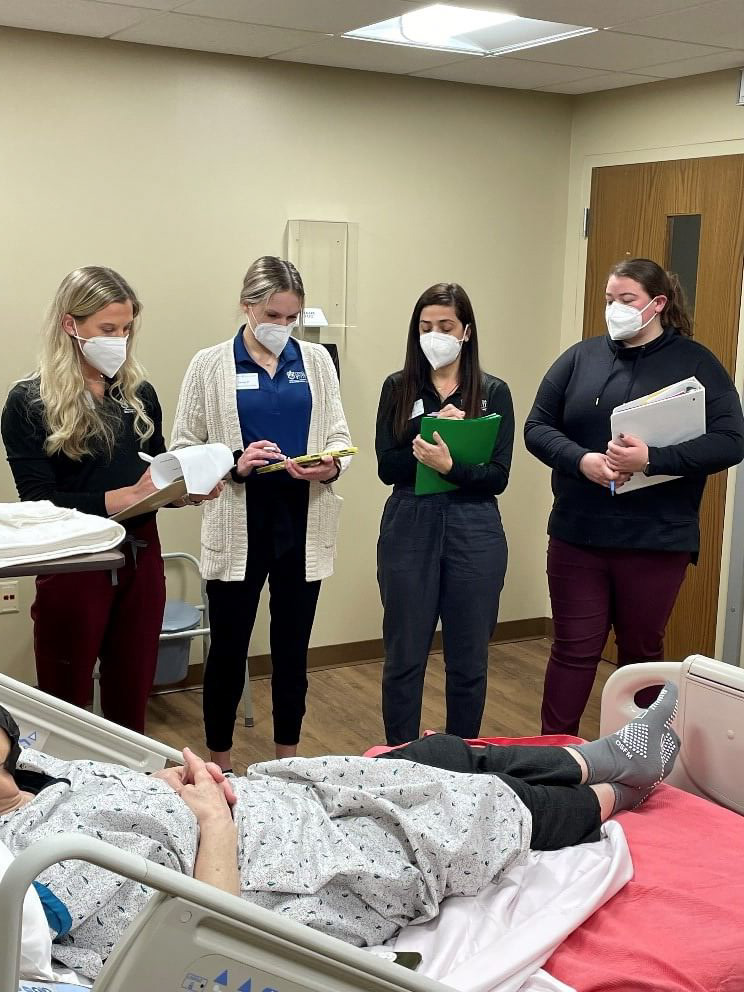
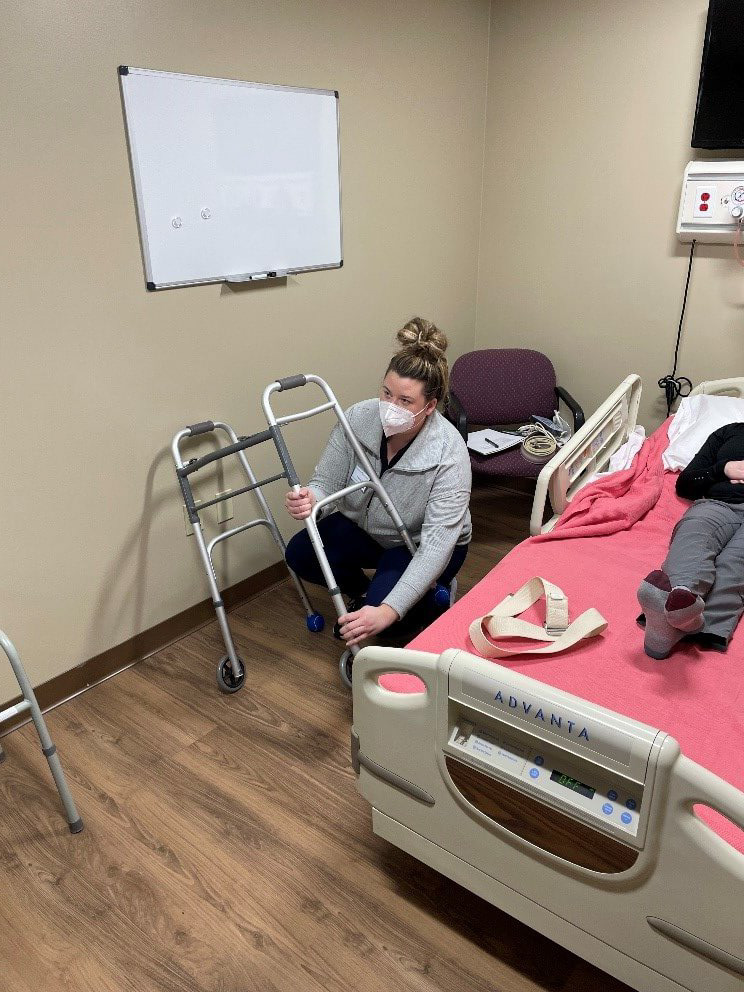
My experience in multiple adult areas of practice provides me the clinical background for teaching in our simulation lab. In January of 2023 we opened our brand-new simulation lab. The new space allows student to experience a “real world” hospital room equipped with hospital beds, vital monitors, medical lines, and chair lifts. The students, often working in pairs, receive the case study prior to lab which allows them to develop a plan. Each week the simulation is designed with a variety of patient diagnoses, vital signs, patient psychosocial factors and is portrayed by a standardized patient actor.

This lab offers students the opportunity to work in real-time on interview skills, provide evidenced-based assessments and interventions. The session is completed with a debriefing session. This is one of the most important parts of the lab. The students participate in the feedback process with faculty and peers. This safe space allows them the opportunity to reflect on what went well and discuss areas of growth. This reflective exercise helps the students improve with communication, therapeutic use of self, and critical thinking skills. The new lab also offers the ability to record the sim session and allows students the ability to review the session at a later time.

As a professor, sim lab allows me to engage with students as we discuss important questions about the patient and OT practice. It is one of the best modalities to teach and assess clinical skills. The lab allows a paper case to come alive.  Where else can you learn and interact with a “patient” a day after a heart surgery? It’s a safe place to learn because regardless of the outcome, everyone including the patient goes home at the end of the session! 

Fall prevention

My two other areas of expertise, fall prevention and interprofessional education, are often combined. People will often ask me, “Why do I care about fall prevention?” My passion for addressing fall prevention comes from a desire to see older adults have an increased quality of life. I hear stories all the time about someone’s relative falling and injuring themselves. The number is too high. It is estimated in the United States that an older adult dies every 20 minutes from a fall and roughly 25-33% of older adults sustain a fall each year, decreasing qualify of life and increasing health care cost (CDC, 2023). In Wisconsin, it is estimated that over 270,000 adults 65 and older fall each year (CDC, 2023). This means my neighbors are having unnecessary injuries from a fall.

Interprofessional education

Evidence-based practice recommends an interprofessional team to address this concern. OT is one of the disciplines uniquely qualified to assess and educate older adults on how to decrease falls in their home and community.

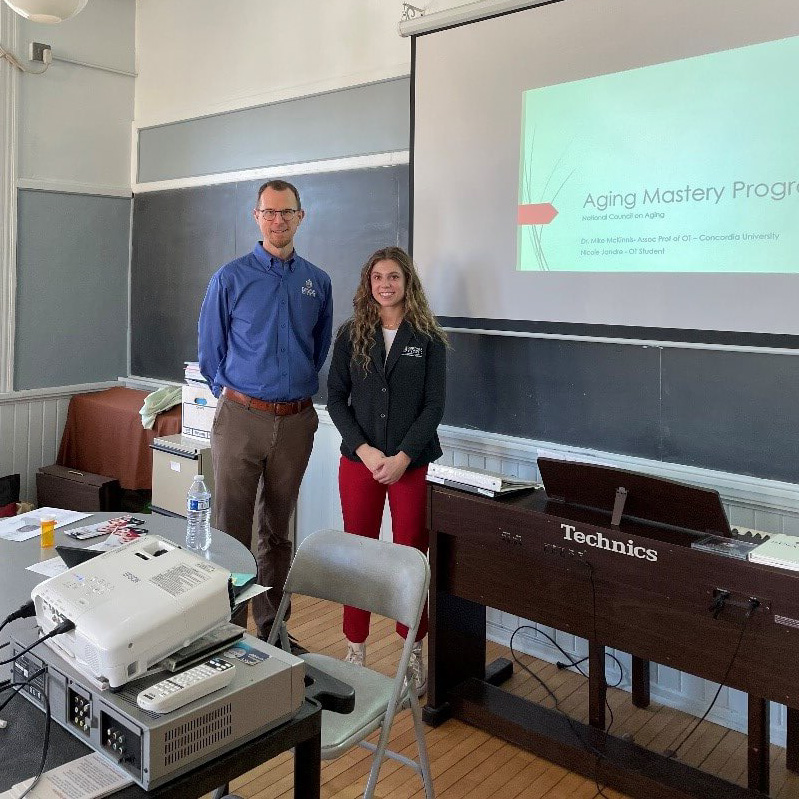
As a leader in falls prevention, I use my skill in this area to help meet our university and OT mission of serving and empowering communities. My desire to serve communities has been put on hold for the last few years due to the global pandemic. I was very happy this year when things began to return to normal. In September of 2022 I was able to connect with older adults as part of Milwaukee County Falls Prevention Coalition (MCFPC) fall prevention event. This spring, I was able to share the updated fall prevention guidelines with Concordia physician assistant students. I was able to connect with the area community by presenting at Stepping On and providing at the fall prevention session for the National Council on Aging (NCOA) Aging Mastery Program.

In addition, I love when I am able to mentor students and bring them along with me to events. Nicole Jandre was able to assist me in giving talks to the physician assistant students and the Aging Mastery Program. During fall prevention week in September of 2023, I will be leading a group of OT students to participate in the MCFPC fall prevention event.  


Earn your initial teacher licensure in this accelerated program

Tatiana was already dedicating her time and talent to education when she decided to fulfill her dream of becoming a licensed teacher. Through the Concordia Accelerated Plan for Teacher Licensure (CAPTL), Tatiana is now leading a classroom as a certified teacher. Learn about her experiences in our online program.

The CAPTL program is for individuals that already hold a bachelor’s degree in any field. We will develop and enhance your teaching skills and strategies through coursework, observation, and the ever important student teaching. Faculty will provide continuous support and feedback throughout the program to ensure your teaching career will flourish.


What was your bachelor’s degree in?

I earned a Bachelor of Arts in English Literature and in Spanish from the University of Wisconsin-Madison. I knew I was passionate about English and Spanish, but I wasn’t sure which profession I wanted those subjects to translate to at the time. A campus priest suggested I work at St. Peter for a year, I figured I had nothing to lose. That first year in teaching was a whirlwind especially because it was when COVID hit, but I still fell in love with teaching.

Are you currently teaching in a school?  If so, where?

Yes! I teach at St. Peter Catholic School in Ashton, Wisconsin. I am confident that the Lord has called me to education, and I love serving my students everyday. 

What made you interested in our CAPTL program?

I jumped headfirst into teaching with not much thought about long-term plans in education. As it became clearer and clearer that teaching was my calling, I began the hunt for a flexible program to earn my Wisconsin teacher license. Concordia’s CAPTL program was the perfect fit! It helps non-traditional students like me earn their teacher licensure and their master’s degree in education.

Tell us about your experiences in the CAPTL program. 

My cohort was absolutely the best part of my experience in the CAPTL program. We worked together to reach success in all of our classes, and we also keep in touch about personal struggles and achievements.

One assignment that was really memorable was in the course “Interdisciplinary Instruction — Teaching in the Middle School.” We were asked to reach out to thank a teacher that had been influential during our time in school. It was nostalgic to be back in touch with a teacher from our past. Everything comes full circle, I suppose! 

As for student teaching, honestly, after the balance of teaching full-time and keeping up with classwork, student teaching was a breeze. It reminded me why I love what I do. 

What grade level(s) do you see yourself teaching during your career?

I thought I would really enjoy teaching middle school. I’ve been teaching 4th and 5th graders for the last four years and I truly love this age.

What made Concordia stand out versus other institutions?

After speaking with other universities, it was clear that Concordia’s CAPTL program would be best for me. It was the most cost effective option per credit. Also, the elementary education licensure range was broad (Kindergarten through 9th). The staff that I spoke with on the phone were incredibly helpful and encouraging. I knew I would be valued and supported at Concordia.

Read more CAPTL student experiences and what to expect in our accelerated teaching licensure program.


Are there other pathways to teaching license?

Concordia’s School of Education has multiple pathways to help individuals earn their teaching license.

The CAPTL program

In this accelerated program, your core courses will focus on building your teaching skills and strategies. Then you fulfill required hours in the classroom observing and student teaching which will further establish your teaching abilities and confidence. Tatiana pursued her teacher licensure in elementary education but we offer other grade levels to meet your needs!

The 3YR teacher licensure + bachelor’s degree program

Our 3-year online accelerated program is also for non-traditional students. If you are seeking to earn your teacher license and your bachelor’s degree together, this is the program. You can select from one of the following grade levels.

The School of Education at Concordia is working to deliver programs to non-traditional students that want to have a career in teaching. If you want to teach, we can help your earn your teaching licensure. It is a rewarding career that gives you the opportunity to work with today’s youth and prepare them for promising futures.

Faculty Spotlight: Jennifer Becker

Jennifer Becker, Ph.D. is the Director of Licensing and Assessment in CUW’s School of Education and also serves as the Director of the Office of Field Experience. Her teaching responsibilities include both graduate and undergraduate education courses. Dr. Becker has also been serving as the Assistant Director of the Doctorate of Education in Leadership in Innovation and Continuous Improvement (LICI) and as advisor to the New York LICI program co-horts.

How long have you been serving in education and what made you choose this career path?

Prior to joining Concordia University Wisconsin, I served for 20 years as a K-12 teacher. My greatest joy over those years was making learning an enjoyable experience and inspiring children to become lifelong learners. Now educating at the University level, helping adult students discover learning tactics and supporting them as they find answers to their questions, inspires me as a teacher. I am now able to help pre-service teachers discover the how and why of teaching and learning. Then they can create student-centered classrooms where children are supported as they discover their world.

Any advice for current teachers/administrators?

Of course, teaching isn’t all joyful learning and exciting “light-bulb” moments. Balancing the demands of teaching and personal life is one of the greatest challenges of all. In the midst of the challenges, remember the students are your ministry and establishing strong connections enables deep learning to take place. Take joy in the role you’re able to play in student development and lifelong learning habits.

What are the strengths of Concordia’s Ed.D. program?

My favorite course to teach in our LICI program is our Dissertation Seminar, allowing me to support my student’s exciting research. The structure of our dissertation process and the multi-disciplinary programming is our strength. Students get to work with their dissertation chair from the very beginning. This individualized support continues throughout the entire program creating an excellent student experience and producing higher quality dissertations.

Name something fun about yourself?

Well, I enjoy farming and gardening, which can be more challenging in Wisconsin’s shortened growing season, but I like the challenge. One of the things I learned long ago is that, depending on my chosen plants, starting seedlings indoors in February is a must and saves me the expense of buying started plants from the store. This year I hope to try making a quilt, so if you have any quilting experience please send your advice!

Thanks for your time getting to know Dr. Jennifer Becker. If you’re considering an online doctorate but aren’t sure where to start, stop by our head-to-head match-up between the Ed.D LICI and DBA using the button below.

Must-read children’s books for Black History Month

During February we celebrate Black History Month. While Black history should be incorporated into year-round learning for students, this month provides an opportunity to dig deeper and celebrate the accomplishments of Black pioneers and trailblazers!

Reading is powerful and telling stories are even more so. As an educator, reading aloud is one way to engage students with content from Black authors and illustrators. Here are some titles to include in your celebration for Black History Month:

The Electric Slide and Kai

By Kelly J. Baptist, illustrated by Darnell Johnson
Kai’s aunt is getting married, and everyone in the Donovan family is excited about the wedding … except Kai. More than anything, he wants to prove that he can boogie with the rest of his family, but can he break through his nerves and break it down on the dance floor?

Marvelous Mabel: Figure Skating Superstar

By Crystal Hubbard, illustrated by Alleanna Harris
A captivating journey into the history of one of the world’s unsung heroes of American Figure Skating.

Sunday Shopping

By Sally Derby Miller, illustrated by Shadra Strickland
Every Sunday night a young girl and her grandmother go on an imaginary shopping trip in this delightful picture book.

Saving the Day: Garrett Morgan’s Life Changing Invention of the Traffic Signal

By Karyn Parsons, illustrated by R. Gregory Christie
This book tells a little-known story about a man whose talent would be a gift to the world.

Mae Among the Stars

By Roda Ahmed, illustrated by Stasia Burrington
Mae Jemison was the first African-American woman in space, and this book shares her dreams as a child, her hard work and ultimately, her success in and out of space.

Ron’s Big Mission

By Rose Blue and Corrine Naded, illustrated by Don Tate
This book shares the accomplishments of Ronald McNair, an American physicist and NASA astronaut who died during the Space Shuttle Challenger launch, and the lesser-known story of how he helped integrate a library as a kid.

More Than Peach

By Bellen Woodard, illustrated by Fanny Liem
This picture book spreads 11 year old Bellen’s message of inclusivity, empowerment, and the importance of inspiring the next generation of leaders.

Want to learn more?

You can learn more about Black History Month here.

Learning how to teach word problems to students

Word problems can be tricky, especially for students who struggle with reading or for whom English is not their primary language. Being able to teach these students to understand, is an important skill that our students in the elementary education program learn.

This semester, students in our Number Sense course spent time learning strategies for teaching students how to solve word problems. Each group was given a different type of addition or subtraction word problem based on the same fact family, although they weren’t told this initially. The students’ names were written into the problems to make them more engaged and relevant to the class.

Groups were then given resources with a few common representations for addition and subtraction problems. Additionally, they had examples of each of the types of addition and subtraction word problems with unknowns in any of the places. 

Each group worked together to identify the type and subtype. Then they would create a visual representation of the problem, write a number sentence, and identify wording that might be tricky for early elementary students. Here are the main concepts they learned during the activity.

Use visuals

Using pictures and other visuals helps young students to see how many of something there are, without counting. For example, drawing out five dots plus four dots is a lot easier to understand for younger students. This process is called subitizing. Defined by My Learning Springboard, subitizing is “the ability to instantly recognize the number of objects without actually counting them.”

Another visual method is called a tape diagram. A tape diagram is good to use when numbers in the problem get too large to draw each item. The tape diagram helps students make sense of the quantities in the problem and write a number sentence to model the problem. You could also use plastic bear counters, which are often part of math manipulatives in kindergarten and first grade, or stickers. We don’t recommend using food as manipulatives because so many children have food allergies. 

Acting it out

Having students “act out” the word problem is another visual way to picture the problem in the real world. This would be especially helpful to struggling readers and English language learners.

Three-reads strategy

The three-reads strategy is another way to help students comprehend the problem. 

  1. The teacher first reads the problem without the numbers and may have the students act out or talk with a partner about what is happening in the story. 
  2. Next, the class reads the problem together with the numbers, and the teacher models how to underline the important quantities in the problem. 
  3. Finally, the class reads the problem again and the students turn and talk about what question they are trying to solve. 

This could be a way to introduce a new type of problem to your students or may be especially helpful when working with a group of struggling readers or English language learners. 

We’re proud of the great conversations students had as they considered strategies they could use to help early elementary students decipher addition and subtraction word problems.

If you’re interested in becoming a teacher, you can learn more here.