Like father, like son: An uncommon journey of education and service

On a sunny May weekend, two names rang out across the Concordia University Wisconsin commencement stage over the course of two days — Shaun Luehring and son Casey Luehring. One, a seasoned educator and president of a school network. The other, a new nurse preparing to begin his first job in a hospital emergency department.


Two days. Two ceremonies. One proud family.

“It was like, oh, me and you are next,” Casey recalled of the moment he and his dad realized they would both be graduating together. “That was great.”


A Shared Path to Concordia

Shaun’s journey to Concordia began in 2014 when he earned his master’s degree while working as a principal and teacher in California. Having grown up in the Appleton area, Concordia was a natural choice for him when he looked for a program to support his professional development.

“I grew up in the Appleton area, so knew about Concordia and decided that Concordia was the place that I would do it online,” Shaun said. He subsequently decided to pursue a doctorate in Leadership, Innovation, and Continuous Improvement, which aligned with his passion for improving education, especially for underserved communities.

Casey’s connection to Concordia didn’t begin until a few years later. After attending Kettle Moraine Lutheran in Jackson, Casey knew that Concordia was the place to pursue his nursing degree.

“I liked that Concordia was really close to home, and Concordia had one of the best nursing programs,” he said. “And also, their faith-based approach.”


Different Paths, Same Purpose

Shaun’s professional career has been rooted in education, particularly in low-income, underserved areas. He began his career as a principal and teacher in Michigan before moving to California, where he started his master’s program. Later, Shaun moved back to Wisconsin in 2019 eventually taking on the role of president and CEO at LUMIN Schools. It was during this period that he began his doctoral studies.

“I wanted to make sure that our underserved children in the city have every opportunity that God has planned for them,” he said. His work influenced his Ph.D. research on how children who are behind in their studies can thrive later in life.

Meanwhile, Casey’s passion for healthcare blossomed in high school. Initially considering a career in sports medicine, Casey soon realized that nursing, with its direct impact on patients, was where he wanted to focus.

“Nursing, you’re bedside with the patient all the time, so you get to help them one on one. I feel like you have a lot of impact with nursing that you don’t get with other professions,” he said.


Support Through the Struggles

Although their academic paths were different, Shaun and Casey found support and encouragement in each other. Shaun reflected on how the shared experience of being in higher education—despite being in different programs — was a source of motivation.

“We both pretty much put our head down and got the stuff done,” Shaun said, adding that their dinner conversations often turned to academics. “There’s a lot of fun in learning together. Even though we weren’t learning the same stuff, sometimes there was overlap.”

Casey echoed the sentiment, noting how his father’s journey motivated him to stay focused.

“It was encouraging, just knowing that I’m not the only one in school,” he said. “It helped me prioritize school above other things.”


The Christian Foundation

One area of overlap was Concordia’s Christian foundation as a key element in their education. Shaun, despite studying online, found the connection with his professors invaluable.

“Even though it was online, you still have contact with really, really great people,” Shaun said. “Without that human connection, I don’t think it would have been the same.” He pointed to his final doctoral course, “Christian Leadership Journey,” as an experience that deepened his understanding of Christian principles within education and leadership.

For Casey, the faith-based environment at Concordia enriched his nursing education. The Christian element provided a foundation that helped him grow personally and professionally, especially as he prepares to enter the healthcare field.


Looking Ahead

Starting in June, Casey will begin working in the emergency department at Aurora Medical Center – Grafton and plans to further his education with certifications and possibly pursuing an advanced degree.

Shaun, meanwhile, intends to continue his work at LUMIN Schools, focusing on helping underserved children succeed and fostering the development of future leaders.

“I just want to be a vehicle that God uses to help people flourish,” he said.


Want in?

Concordia University Wisconsin is a Lutheran higher education community committed to helping students develop in mind, body, and spirit for service to Christ in the Church and the world.
Faculty Spotlight: Dr. Michael McKinnis

Dr. Michael McKinnis, fondly nicknamed “Dr. Mac”, is an associate professor in the occupational therapy department. Not only does he teach for CUW OT, Dr. Mac is an alumnus of Concordia University Wisconsin’s occupational therapy program!

His clinical background is acute care occupational therapy, specializing in fall prevention. Dr. Mac started with the OT department in 2007 as an adjunct instructor, and then joined as a full-time professor in 2013. In May 2021, he completed his PhD in Leadership from Cardinal Stritch University.

What do you love about the CUW OT program?

I have been involved with Concordia’s OT program in different roles for the last 16 years. The one constant of our program is change. We are always adapting to stay up with the latest in education and the OT field. Our latest change was the development of a new OT curriculum. The new curriculum allows our students to build fundamental skills in advocacy, leadership, integration of faith and practice, best practice and professional and clinical skills. The first year allows the students to develop a strong foundation in these key areas. The 2nd year allows students to stand on this foundation as they expand their knowledge and explore opportunities in the field of OT. 

What is your area of expertise within Occupational Therapy? Share a little bit about the ways you involve students/community?

My areas of expertise are teaching in simulation lab, fall prevention, and interprofessional education.

Simulation Lab

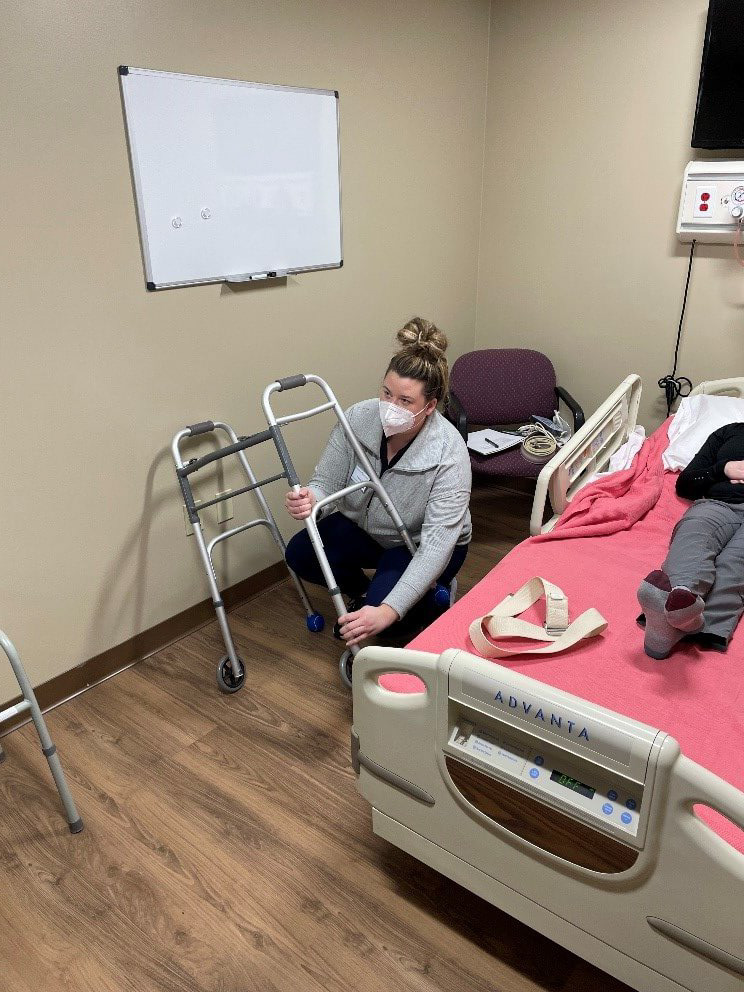
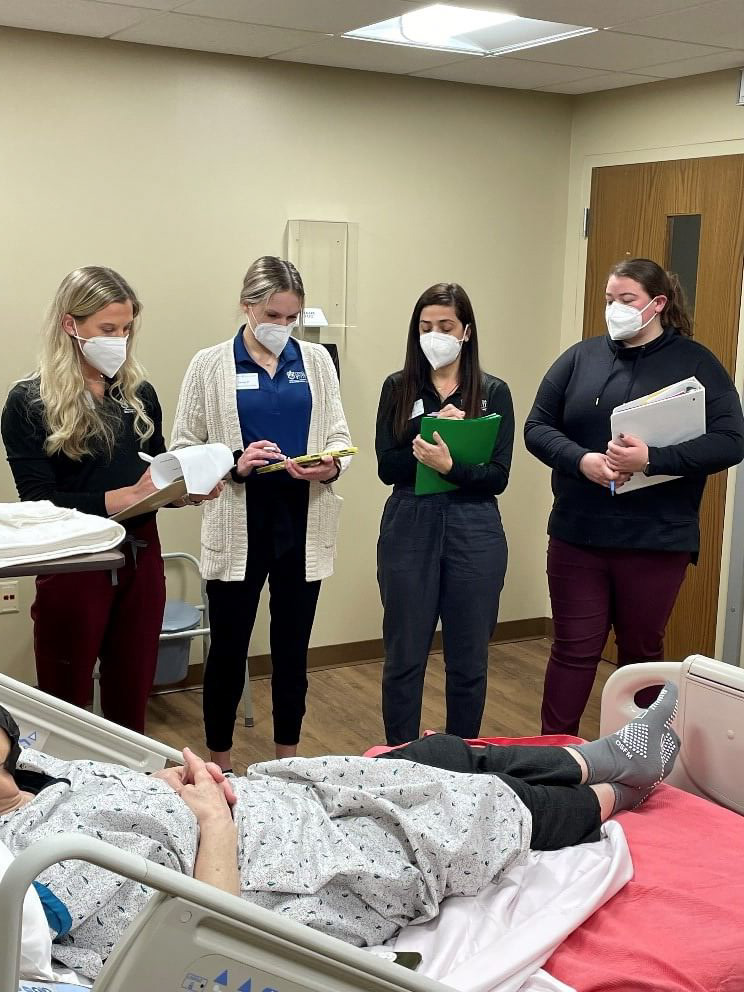
My experience in multiple adult areas of practice provides me the clinical background for teaching in our simulation lab. In January of 2023 we opened our brand-new simulation lab. The new space allows student to experience a “real world” hospital room equipped with hospital beds, vital monitors, medical lines, and chair lifts. The students, often working in pairs, receive the case study prior to lab which allows them to develop a plan. Each week the simulation is designed with a variety of patient diagnoses, vital signs, patient psychosocial factors and is portrayed by a standardized patient actor.

This lab offers students the opportunity to work in real-time on interview skills, provide evidenced-based assessments and interventions. The session is completed with a debriefing session. This is one of the most important parts of the lab. The students participate in the feedback process with faculty and peers. This safe space allows them the opportunity to reflect on what went well and discuss areas of growth. This reflective exercise helps the students improve with communication, therapeutic use of self, and critical thinking skills. The new lab also offers the ability to record the sim session and allows students the ability to review the session at a later time.

As a professor, sim lab allows me to engage with students as we discuss important questions about the patient and OT practice. It is one of the best modalities to teach and assess clinical skills. The lab allows a paper case to come alive.  Where else can you learn and interact with a “patient” a day after a heart surgery? It’s a safe place to learn because regardless of the outcome, everyone including the patient goes home at the end of the session! 

Fall prevention

My two other areas of expertise, fall prevention and interprofessional education, are often combined. People will often ask me, “Why do I care about fall prevention?” My passion for addressing fall prevention comes from a desire to see older adults have an increased quality of life. I hear stories all the time about someone’s relative falling and injuring themselves. The number is too high. It is estimated in the United States that an older adult dies every 20 minutes from a fall and roughly 25-33% of older adults sustain a fall each year, decreasing qualify of life and increasing health care cost (CDC, 2023). In Wisconsin, it is estimated that over 270,000 adults 65 and older fall each year (CDC, 2023). This means my neighbors are having unnecessary injuries from a fall.

Interprofessional education

Evidence-based practice recommends an interprofessional team to address this concern. OT is one of the disciplines uniquely qualified to assess and educate older adults on how to decrease falls in their home and community.

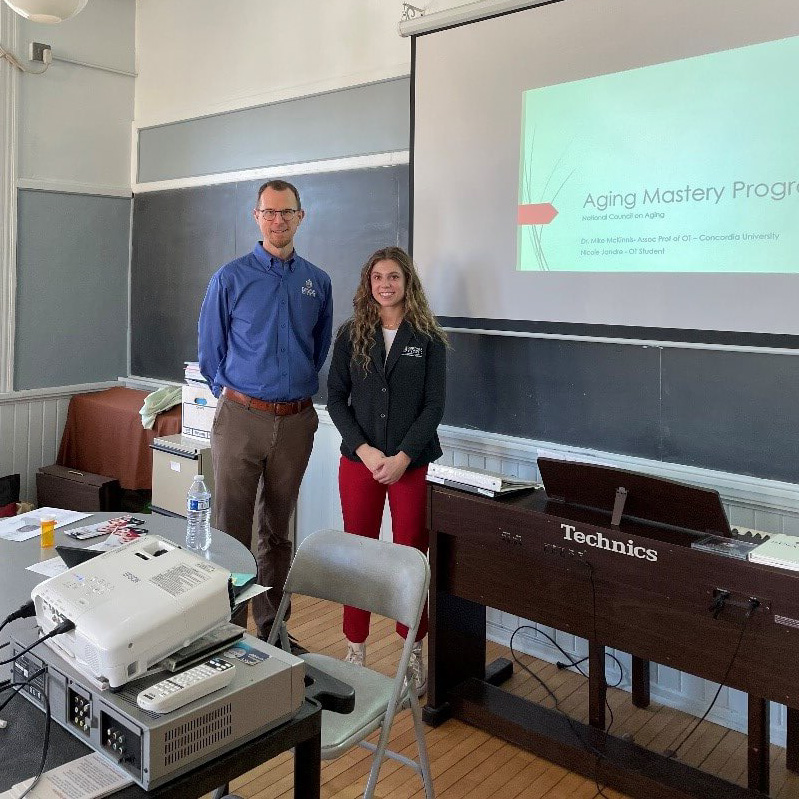
As a leader in falls prevention, I use my skill in this area to help meet our university and OT mission of serving and empowering communities. My desire to serve communities has been put on hold for the last few years due to the global pandemic. I was very happy this year when things began to return to normal. In September of 2022 I was able to connect with older adults as part of Milwaukee County Falls Prevention Coalition (MCFPC) fall prevention event. This spring, I was able to share the updated fall prevention guidelines with Concordia physician assistant students. I was able to connect with the area community by presenting at Stepping On and providing at the fall prevention session for the National Council on Aging (NCOA) Aging Mastery Program.

In addition, I love when I am able to mentor students and bring them along with me to events. Nicole Jandre was able to assist me in giving talks to the physician assistant students and the Aging Mastery Program. During fall prevention week in September of 2023, I will be leading a group of OT students to participate in the MCFPC fall prevention event.  


Faculty Spotlight: Jennifer Becker

Jennifer Becker, Ph.D. is the Director of Licensing and Assessment in CUW’s School of Education and also serves as the Director of the Office of Field Experience. Her teaching responsibilities include both graduate and undergraduate education courses. Dr. Becker has also been serving as the Assistant Director of the Doctorate of Education in Leadership in Innovation and Continuous Improvement (LICI) and as advisor to the New York LICI program co-horts.

How long have you been serving in education and what made you choose this career path?

Prior to joining Concordia University Wisconsin, I served for 20 years as a K-12 teacher. My greatest joy over those years was making learning an enjoyable experience and inspiring children to become lifelong learners. Now educating at the University level, helping adult students discover learning tactics and supporting them as they find answers to their questions, inspires me as a teacher. I am now able to help pre-service teachers discover the how and why of teaching and learning. Then they can create student-centered classrooms where children are supported as they discover their world.

Any advice for current teachers/administrators?

Of course, teaching isn’t all joyful learning and exciting “light-bulb” moments. Balancing the demands of teaching and personal life is one of the greatest challenges of all. In the midst of the challenges, remember the students are your ministry and establishing strong connections enables deep learning to take place. Take joy in the role you’re able to play in student development and lifelong learning habits.

What are the strengths of Concordia’s Ed.D. program?

My favorite course to teach in our LICI program is our Dissertation Seminar, allowing me to support my student’s exciting research. The structure of our dissertation process and the multi-disciplinary programming is our strength. Students get to work with their dissertation chair from the very beginning. This individualized support continues throughout the entire program creating an excellent student experience and producing higher quality dissertations.

Name something fun about yourself?

Well, I enjoy farming and gardening, which can be more challenging in Wisconsin’s shortened growing season, but I like the challenge. One of the things I learned long ago is that, depending on my chosen plants, starting seedlings indoors in February is a must and saves me the expense of buying started plants from the store. This year I hope to try making a quilt, so if you have any quilting experience please send your advice!

Thanks for your time getting to know Dr. Jennifer Becker. If you’re considering an online doctorate but aren’t sure where to start, stop by our head-to-head match-up between the Ed.D LICI and DBA using the button below.