Month: November 2023
The sweet taste of success for local alumnus
The Essential Guide to Earning a Master’s in Leadership
Influential leaders and managers continue to be highly sought-after in today’s ever-changing world. People need to know which direction a company or organization is going in and who they must follow to get there.
Leaders must create a strategic vision and motivate followers on the path to the future. Often, this looks like inspiring change and encouraging collaboration. Additionally, leaders need to know how to create a motivating work culture. If you want to grow as a leader in these areas, consider earning a master’s in leadership.
What is a Master of Science in Leadership?
Simply put, an M.S. in Leadership focuses on developing and enhancing the skills and knowledge necessary for influential leadership roles in various fields and industries. It aims to equip students with the expertise to lead, manage, and motivate individuals and teams within organizations. The goal is to provide students with a comprehensive understanding of leadership principles and practical skills they can apply in real-world professional settings. An MSL is an interdisciplinary degree, meaning it is valuable across various industries, as all organizations and sectors need capable and creative leaders.
What are some benefits of earning a master’s in leadership?
Earning a Master’s in Leadership degree offers various benefits that can significantly impact personal and professional development. Some of these advantages include:
- Enhanced leadership skills: The program is designed to cultivate and refine leadership abilities, including strategic thinking, decision-making, communication, conflict resolution, and team management. These power skills are highly sought-after in leadership positions across industries.
- Versatility: Leadership skills are transferable across various sectors, from business and healthcare to education and non-profit organizations. This versatility enables graduates to explore diverse career paths.
- Influence and impact: Effective leaders have the potential to influence and impact their teams, organizations, and even communities positively. This degree provides the tools to make such contributions.
This degree suits individuals seeking to advance their careers in leadership roles, whether they are already working professionals or recent graduates aiming to enter the workforce with solid leadership skills and knowledge. Overall, it helps students develop the abilities necessary to lead teams, manage resources effectively, and navigate the complexities of modern organizations.
All about Concordia’s master’s in leadership (MSL)
Concordia’s MSL degree is designed to provide the necessary tools to understand themselves as leaders. Therefore, learning how to successfully unleash the expertise of their team members to drive organizational growth and success.
We aim to help students achieve their career goals in various settings, such as business, government, non-profit, and education. The courses focus on leadership at different levels, such as:
- Business strategy
- Leadership and management
- Leading changes
- Managing human capital
- Organizational performance
Above all, you will leave the program with a new understanding of how leading, inspiring change, and building commitment create positive organizational momentum.
What makes Concordia’s MSL program unique?
Complete in less than two years
Concordia’s MSL program requires 30 semester hours of credit or ten courses. As a result, you can complete it online in less than two years, with new classes starting every eight weeks. This flexibility allows you to obtain your degree while working full-time from anywhere worldwide. You will advance through the program with other students as you collaborate and learn from one another.
Transferrable credits
Another great benefit is that up to six credits can be transferred from another program or university. Also, 12 credits can transfer into the Doctorate of Business (DBA) program, which will save you time and money if you are continuing to advance your degree.
Christian perspective
The master’s in leadership program allows you to research business concepts through a Christian lens. CUWAA’s MSL program prepares you to be a leader in diverse communities and businesses as it blends Christian leadership and ethics with theory and practice. You will study theoretical aspects of leadership from a Christian perspective. After that, you will learn how to implement those theories in your work and leadership experiences.
How is Concordia University unique?
Concordia is a Lutheran Christian school that integrates those Christian values with our programs. In this model, students acquire knowledge and skills in liberal arts disciplines that prepare them to serve Christ in the Church and the world. We bring a holistic approach to every class we offer our students.
We challenge our students academically and allow them to grow spiritually with us in ways they may not find at other universities. Concordia is a community whose calling is to ensure student success and well-being.
How long does it typically take to complete the degree?
The average time to complete the program is 18 months.
What format is offered? How long are the classes?
Our MSL program is offered entirely online in a collaborative format. Classes are eight weeks each. The online structure is very flexible but requires discipline and organization to set up a schedule to complete coursework on time.
How much does the program cost?
This program is $699 per credit hour.
Are there scholarships available?
Yes! We have Uncommon Scholarships available for many qualified students. Our available scholarships include the following:
- Business Community Scholarship: If you are an employee of one of our corporate partners, you may qualify for this scholarship.
- Academic Community Scholarship: If you are an employee of one of our Preferred Education Partner schools or districts, you may qualify for this scholarship.
- Christian Community Scholarship: If you are an employee of any qualifying Christian church or Christian K-12 school, you may qualify for this scholarship.
- Alumni Scholarship: If you graduate from one of Concordia University System school programs, you may qualify for this scholarship.
- Veterans and Dependents Scholarship: If you are a veteran, the spouse of a veteran, or a child of a veteran(age 17-26), you may qualify for this veteran scholarship when federal veteran education benefits are exhausted or unavailable to you.
When funding your education, talk with your employer to see if they will be willing to pay a portion of your tuition. There may be funds, scholarships, or benefits their companies may offer.
Entrance Requirements
- Bachelor’s degree
- Cumulative GPA of 3.0 or higher for full acceptance
Admission Requirements
- Apply Online
- One-page essay
- Describe your reason for pursuing a master’s in leadership
- Resume of your education and employment experience
- Two signed letters of recommendation
- All official transcripts leading to your bachelor’s degree
Ready to jump in?
Whether you are ready or have more questions about earning a Master’s in Leadership, we’re here to help.
Enlisting alumni to build community in the Occupational Therapy program
Hear from two CUW Occupational Therapy alumni how mentoring current students helps both parties grow in the field.
Building community is a very important part of the Occupational Therapy program at Concordia University Wisconsin. To us, community is not only while students are with us in class, but also extends to our alumni. Alumni can engage with the OT program in several ways, including being guest speakers, attending our biannual continuing education event where students present research, or engaging in virtual book clubs.
Another way we love to engage with our alumni is through fieldwork (FW) experience. All OT students complete 2 three-month FW experiences after completing courses. For each of these experiences, we need FW educators, and we are so happy when our students are matched with CUW OT alumni in the field. Here are perspectives from two alumni who are currently supervising CUW occupational therapy students.
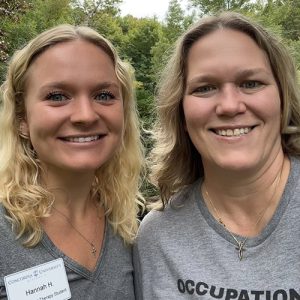
Michelle Kelly & Hannah Held
Michelle Kelly: I graduated from CUW in 2000 and I am currently practicing in the subacute rehabilitation setting, supervising student Hannah Held.
Why do you take Level II students?
I enjoy being a Fieldwork Educator to Level II students as I feel it is important as a therapist to provide the same opportunities to grow and learn in the fundamentals of occupational therapy as I had when I was a student. I have always felt that this is a way to give back to our profession, and I love that the students also teach me new techniques and information as well.
What do you appreciate about CUW OT students?
Concordia students are entering their fieldwork ready and eager to start practicing. They have a strong foundation of theory and clinical skills, and they share a passion for occupational therapy with their patients!
What was your favorite or most memorable experience while you were in the OT program at CUW?
There were so many memories from my time at Concordia from our OT program that it is hard to pick just one. My favorite experience was Dr. Dvorak’s Human Anatomy class and lab. It was the class I had I feared the most starting the program, and it ended up being my favorite!
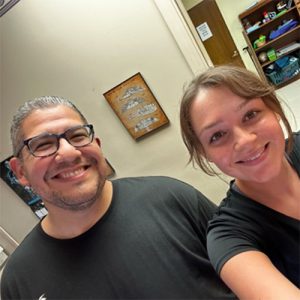
Rick Camacho & Julia Wol
Rick Camacho: I graduated from CUW in 2017 and I am currently the director of rehab in a SNF in Aurora, Illinois, supervising student Julia Wol.
Why do you take Level II students?
I take on students for two reasons. The first is to pay it forward. Every OT who is working now has had a fieldwork educator who has volunteered their time to advance the Occupational Therapy profession. They take the time to share knowledge that only comes from practical experience. As a COTA and then as a graduate of the CUW bridge program I have had 4 Level II fieldwork instructors and numerous Level 1 instructors who volunteered their time to assist my OT journey, and as part of the OT community I feel strongly that their commitment should be honored and continued.
The second reason, coincidentally, is that my first fieldwork instructor as a COTA student was also an alum of CUW, Carolyn Calamia. Sometimes you don’t realize the impact an individual has on your life until well after the interaction has taken place. Luckily for me I came to that realization at that moment. Carolyn was a great mentor, and through her guidance and encouragement, I made the decision to continue my education. Her drive and motivation to not settle and advance her career was inspirational. The impact she had on my life as a fieldwork educator is another reason why I take on students. I hope that I can inspire and make a positive impact on my students, too.
What do you appreciate about CUW OT students?
I think first and foremost is that CUW students come prepared. Having gone through the program, I understand firsthand the level of education CUW students get—not only through the curriculum, but also from the staff of the program who all bring years of clinical experience to the classroom. For me, it is that combination that makes me appreciate CUW OT students.
What was your favorite or most memorable experience while you were in the OT program at CUW?
I think my most memorable experience was simply walking at graduation. What really made it special was walking with my classmates. There is a strong bond that is developed from spending time in a shared experience and having gone through the CUW OT program I got to know some wonderful individuals. Every class is unique and, as a group, has a personality all on its own. My cohort was no different. I’m a better OT having known those wonderful classmates of mine. I wouldn’t have made it without their support.
Want in?
Wherever you are in your journey into occupational therapy, Concordia University has options for you at the undergraduate, master’s, and doctoral levels. As a Christ-centered university, our program will help you advance in your calling, by learning from experienced therapists in a hands-on environment and developing a foundation in ethical leadership.
Advent God With Us: Preface
Emmanuel—God with us—is beyond extraordinary if we truly pause, even momentarily, to reflect.
How can it be that the one and only, all-powerful God of the universe came to earth to be born to a nondescript carpenter and his betrothed in the most base and humble of circumstances—even for them? And while an “advent” is the coming or arrival of something—or someone—important or noteworthy, this Advent is not simply uncommon, it is unfathomable. Yet our God has shown us time and time again that He can use the shabby to highlight the sublime, as He has woven and revealed His story throughout history. They said, “Is this not Jesus, the son of Joseph, whose father and mother we know? How can he now say, ‘I came down from heaven’?” (John 6:42).
God With Us: the uncommon advent of our Savior explores the contrast—God’s eternal truth in a world ripe with lies, God’s grace right before our eyes. The meditations penned for this year’s edition utilize the LCMS daily lectionary and reflect the individual and personal ways that the Holy Spirit has worked in and through each life. The authors are part of the Concordia University community—faculty, staff, administrators, or students from our Wisconsin or Ann Arbor campus—who has been eternally redeemed by the newborn king in Bethlehem. We pray that these daily readings from God’s Word and varied voices and experiences of the authors will be used by the Holy Spirit to bless and encourage you during this Advent.
Jason Germain and Marc Martel, in their refrain of How Many Kings (2008), communicate the core of this sacred season compellingly.
How many kings step down from their thrones? How many lords have abandoned their homes? How many greats have become the least for me? And how many gods have poured out their hearts to romance a world that is torn all apart? How many fathers gave up their sons for me? Only one did that for me.
So, I invite you to pause and ponder and pray. May the uncommon love and sacrifice of our swaddled Savior touch your heart and life in a fresh way through the power of the Holy Spirit.
Schedule
Foreword | CUW student / Director of Web and Design Dan Baker
Dec. 3 | Isaiah 9:8-10:11 and 1 Peter 5:1-14 | Rev. Dr. Ryan Peterson, VP of Administration
Dec. 4 | Isaiah 10:12-27a, 33-34 and 2 Peter 1:1-21 | Brooke Johnson, Associate VP of Academics
Dec. 5 | Isaiah 11:1-12:6 and 2 Peter 2:1-22 | Dr. Jordan Beck, Arts & Sciences, CUW
Dec. 6 | Isaiah 14:1-23 and 2 Peter 3:1-18 | Grace Sugg, CUW Student
Dec. 7 | Isaiah 24:1-13 and 1 John 1:1-2:14 | Lisa Mariani, President’s Office, CUW
Dec. 8 | Isaiah 24:14-25:12, Obadiah 1-21, 1 John 2:15-29 | Dr. Michael Uden, VP for Enrollment
Dec. 9 | Isaiah 26:1-19 and 1 John 3:1-24 | Alex Riehle, Admissions, CUW
Dec. 10 | Isaiah 26:20-27:13 and 1 John 4:1-21 | Dr. Kyle Chuhran, Education, CUAA
Dec. 11 | Isaiah 28:14-29, 1 John 5:1-21, 2 John 1-13, 3 John 1-15 | Jenifer Pries, Athletics, CUAA
Dec. 12 | Isaiah 29:1-14 and Jude 1-25 | Aaron Halboth, CUAA Student
Dec. 13 | Isaiah 29:15-30:14 and Revelation 1:1-20 | Dr. R. S. Hill, Arts & Sciences, CUAA
Dec. 14 | Isaiah 30:15-26 and Revelation 2:1-29 | Dr. Kehinde Irabor, Arts & Sciences, CUW
Dec. 15 | Isaiah 30:27-31:9 and Revelation 3:1-22 | Dr. Elizabeth Eernisse, Health Professions, CUW
Dec. 16 | Isaiah 32:1-20 and Revelation 4:1-11 | Harrison Hulse, CUW Student
Dec. 17 | Isaiah 33:1-24 and Revelation 5:1-14 | Dr. Angela Brooks, Business, CUW
Dec. 18 | Isaiah 34:1-2, 8-35:10, Micah 1:1-7:20, and Revelation 6:1-17 | Kyle Thoms, Admissions, CUAA
Dec. 19 | Isaiah 40:1-17 and Revelation 7:1-17 | Christy Call, Strategic Partnerships, CUW
Dec. 20 | Isaiah 40:18-41:10 and Revelation 8:1-13 | Dr. Patrick Steele, Arts & Sciences, CUW
Dec. 21 | Isaiah 42:1-25 and Revelation 9:1-12 | Rachel Yuhas, CUAA Student
Dec. 22 | Isaiah 43:1-24 and Revelation 9:13-10:11 | Dr. Jeff Smith, Health Professions, CUAA
Dec. 23 | Isaiah 43:25-44:20 and Revelation 11:1-19 | Dr. Beth Heiss, Business, CUAA
Dec. 24 | Isaiah 44:21-45:13, 20-25, Daniel 10:1-12:13, Isaiah 48:1-22, and Revelation 12:1-17 | Dr. Erik Ankerberg, CUWAA President
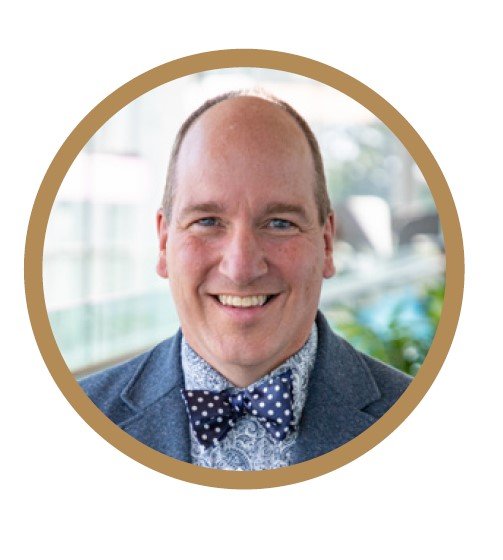
DR. MICHAEL UDEN
Vice President, Enrollment
About this series
“God With Us: the uncommon advent of our Savior” is a sampling of biblical meditations composed by members of the CUWAA community. It is our prayer that you will take time during the Advent season to read and reflect upon God’s Word and await the coming of Jesus with newfound enthusiasm and anticipation through the Holy Spirit.
Can I Earn a Professional Counseling License as a School Counselor?
We are in a time when the mental, emotional, and behavioral health of our entire population, especially our children, is at an all-time low. School Counselors are defined by the American School Counselor Association (ASCA) as “certified/licensed educators who improve student success for all students by implementing a comprehensive school counseling program” (2023).
School Counselors play an integral role in our schools by “leading, advocating, and collaborating to promote equity and access for all students by connecting their school counseling program to the school’s academic mission and school improvement plan” (ASCA, 2023). With the growing need for mental health support, it can also be highly beneficial for a school counselor to earn their credentials as a Licensed Professional Counselor (LPC).
Adds value
Having a dual licensure adds value to your school counselor role. Dr. Jill Hubble, an adjunct instructor for the Graduate Counseling program, says, “Agency directors and Principals have told me that having a school counseling and clinical counseling degree makes me “highly valuable” in both arenas.”
Adjunct instructor Heidi Schildt, MSE, LPC, also agrees. She says, “I have found that being licensed in both worlds has helped at the clinic and school. I find myself explaining how the school world works during our weekly supervision at my clinic. I’m often helping families/school professionals understand how the clinical aspects of therapy might benefit their children/students.”
Increase in demand
Not only can you add value to your position, but demands for counseling and therapy are increasing. Dr. Amanda DeSua, M.A. Ed., Ed. D, NBCT, adjunct instructor, states, “The need for school-based therapy is growing. When counselors have their professional counseling license, they can provide therapy on-site to students who may not otherwise receive this level of support due to transportation barriers. Having an understanding of the school environment as well as the therapeutic process is an incredible asset.”
Further learning
Receiving dual licensure also broadens your education and understanding of the whole person and the mental health field. Adjunct instructor Rick Hudson articulates, “As a School Counselor, obtaining my LPC has given me a greater appreciation and understanding of mental health accessibility, treatment, and practice. It has also helped to narrow the focus of my time with students and expand my efforts for all with ASCA mindsets and behaviors through social and emotional learning.
Our graduate counseling program at Concordia University Wisconsin prides itself on employing multi-dimensional practitioners with robust and comprehensive knowledge as adjunct faculty to teach, guide, and mentor our students.
What’s next?
Are you a school counselor looking to add to your professional licensure or interested in becoming a counselor? Contact us to see how our flexible, online Master’s in Counseling degree can help you reach your goals!
New Veterans Day walk/run highlights Veterans Week at CUW
In 2023, Concordia University Wisconsin continues its strong tradition of supporting veterans and the military with a variety of special events.
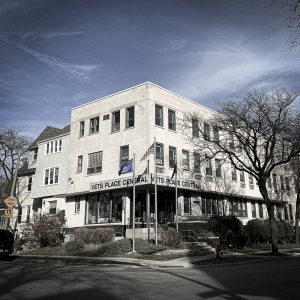
Social work event
Today, students from the Bachelor of Social Work program will be at Boudicca House, a transitional living facility for women veterans with children, and Vets Place Central, which provides transitional housing for veterans in Milwaukee. Students from the Social Work 326 class will conduct interviews to sharpen their intake skills and get more comfortable interacting with members of a larger community. It also gives the veterans a chance to tell their stories and feel appreciated for their service to our country.
As he did last year, CUW Assistant Professor of Art Paul Calhoun, a renowned photographer, will be on hand to photograph the subjects. A gallery of his work along with essays written by last year’s students will soon be on display in CUW’s Rincker Library.
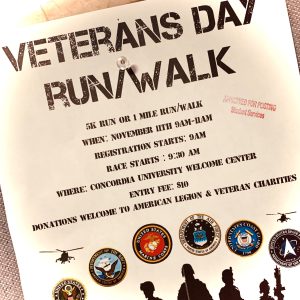
Veterans Day Run/Walk
On Saturday, November 11, the Veterans Engagement Department will host a 5K Run & 1 Mile Run/Walk in support of veterans charities. The run/walk will begin at 9:30 a.m., with registration opening at 9:00.
To enter, simply report to the CUW Welcome Center (inside the main doors) with a $10 donation. Free will donations supporting the American Legion & Veterans Charities are also welcome.
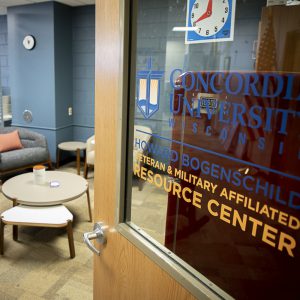
Here to serve
Of course, none of these activities would be possible without the commitment to helping veteran and military students every day of the year. It’s what earned CUW a Top Ten Military Friendly® School designation by the website MilitaryFriendly.com, ranking first in the nation among peer institutions: Private Schools Offering Doctorate.
Click here for a summary of how CUW supports military and veterans students.
Want in?
Concordia University Wisconsin (CUW) is a Lutheran institution that is proud to be Military Friendly. You can be assured that we are committed to providing first class service to support our Active, Reserve, and Veteran personnel and their families. To learn more of what we offer this important community, click the link below.
When disaster strikes, CUW nursing students are prepared to respond
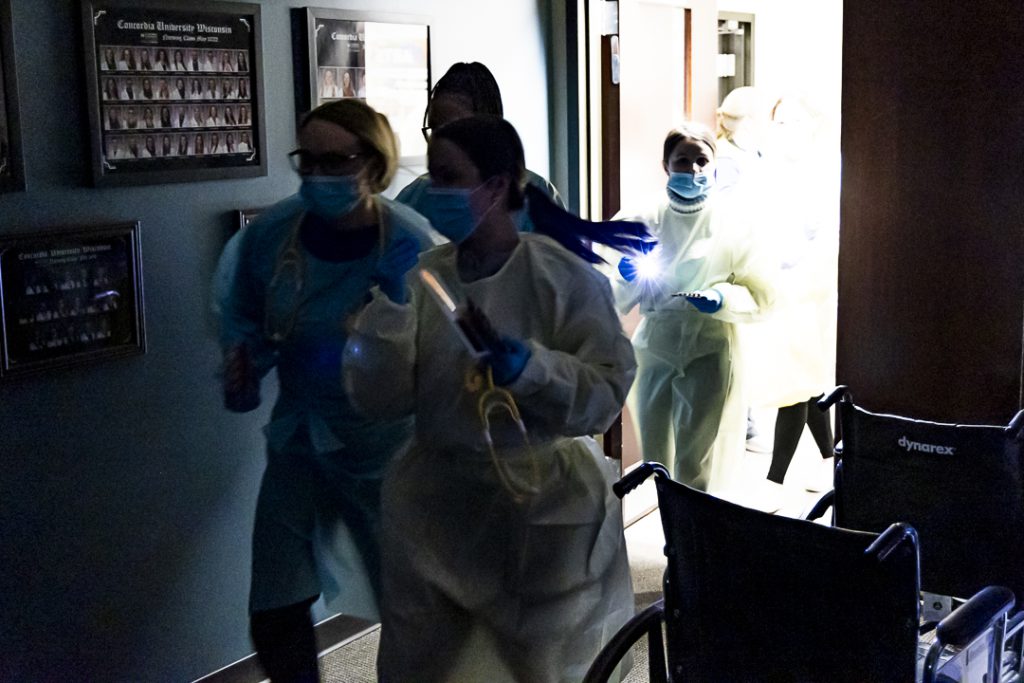
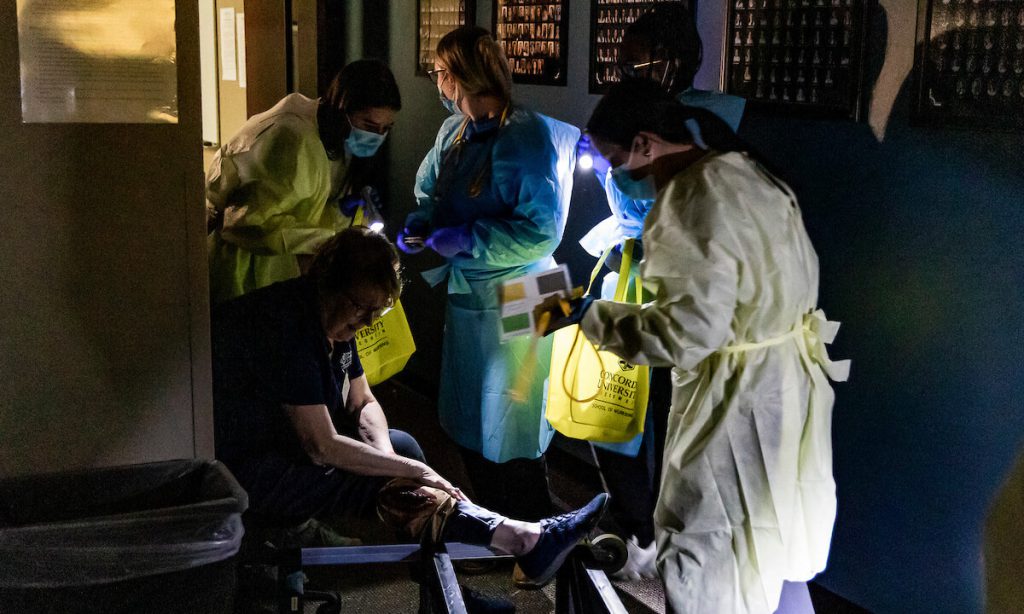
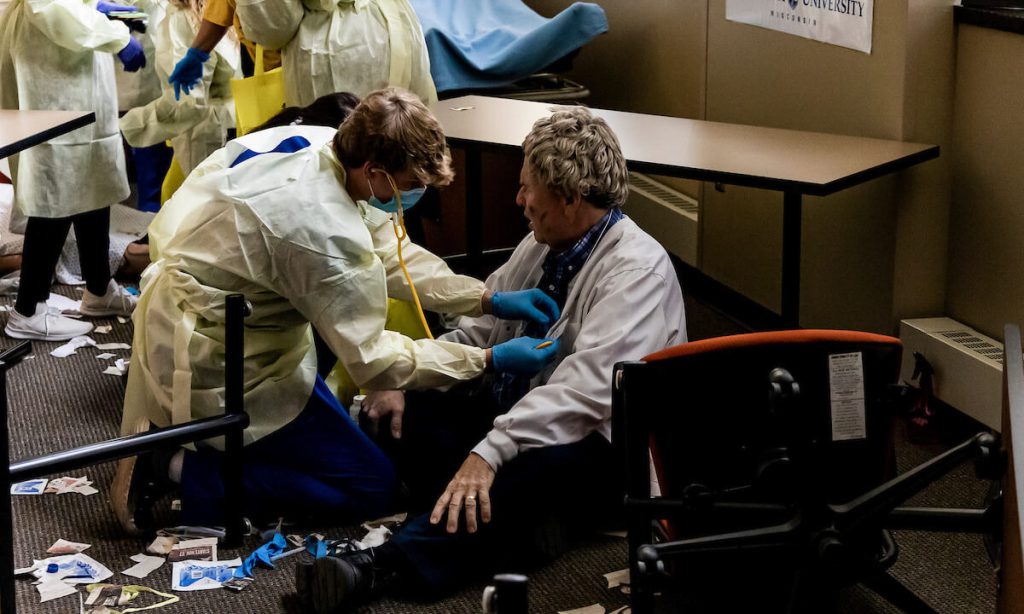
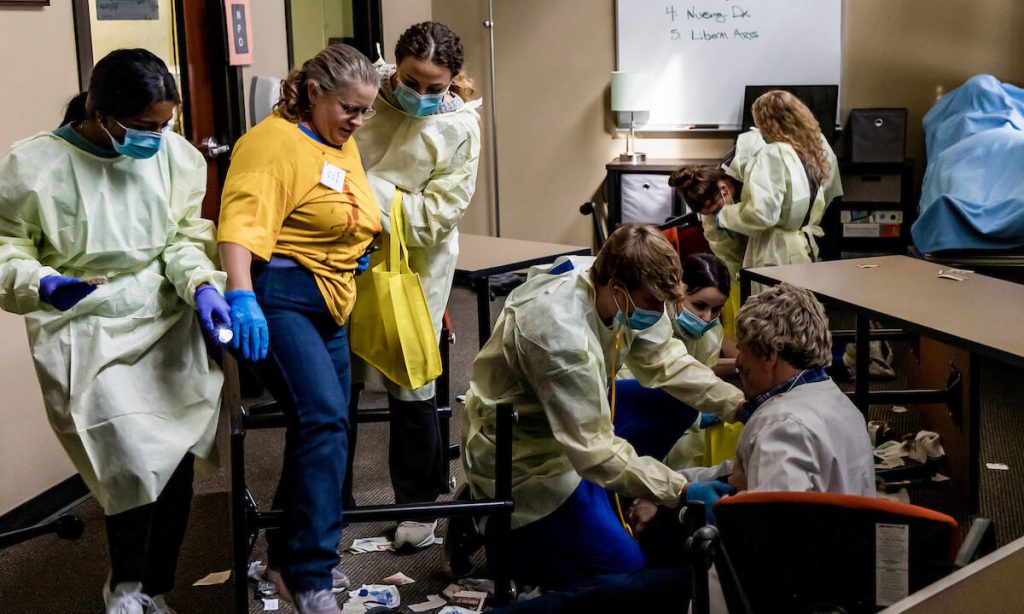
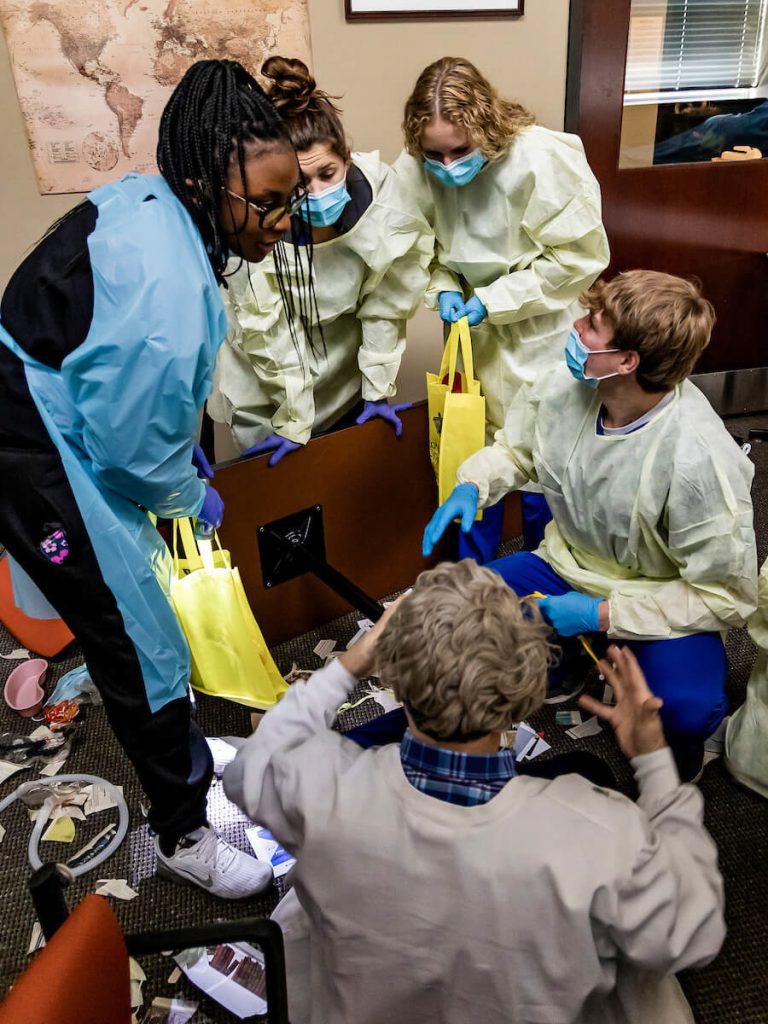
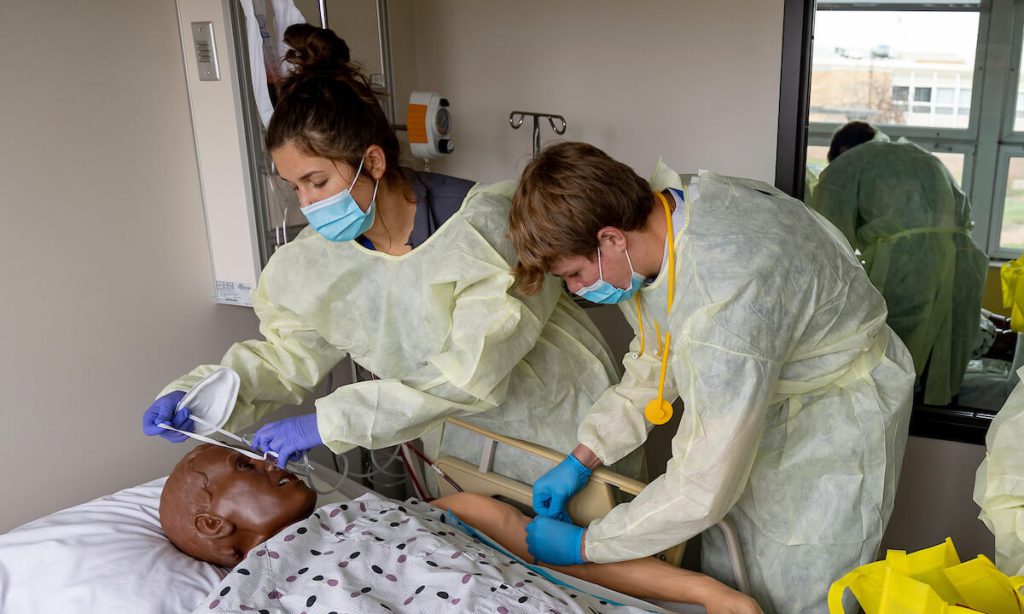
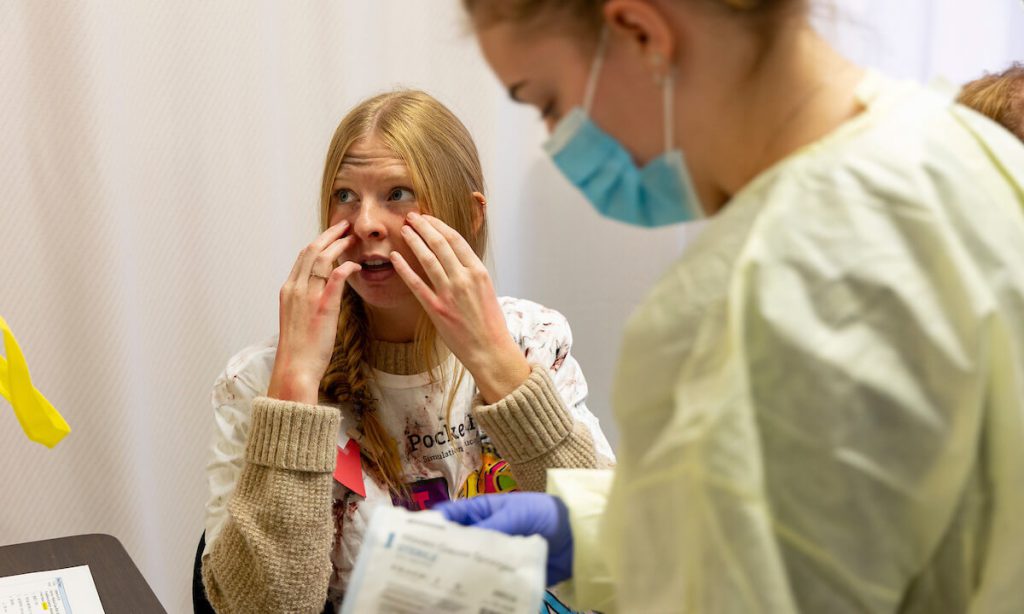
Last week, junior nursing students at Concordia participated in a full-scale disaster simulation. The exercise was meant to equip students to respond in a swift, competent, and cooperative manner should a real scenario arise.
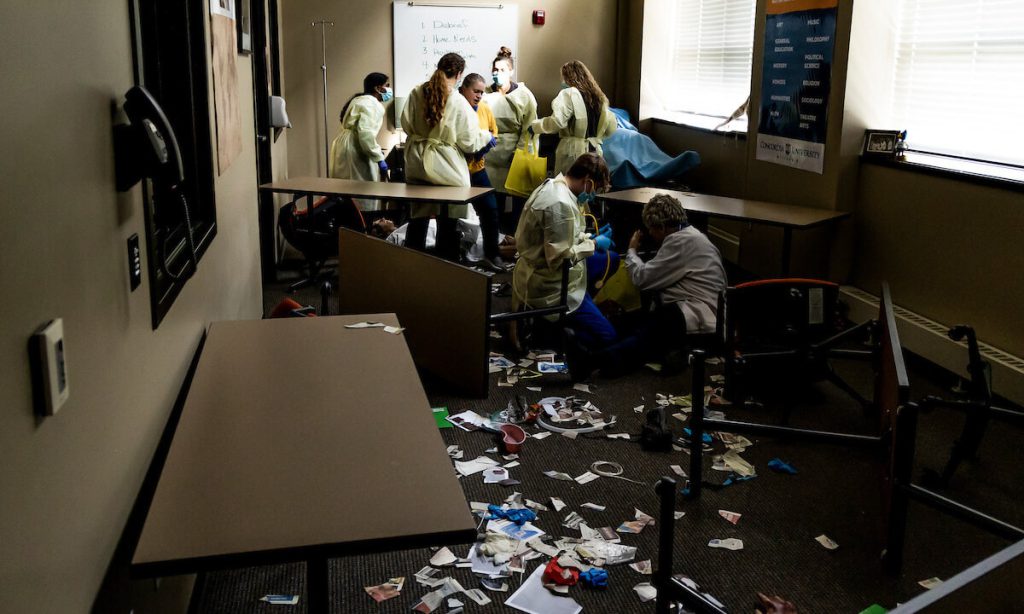
*Content warning: This post contains images that may appear graphic. Please note that these are simulated wounds and scenarios.
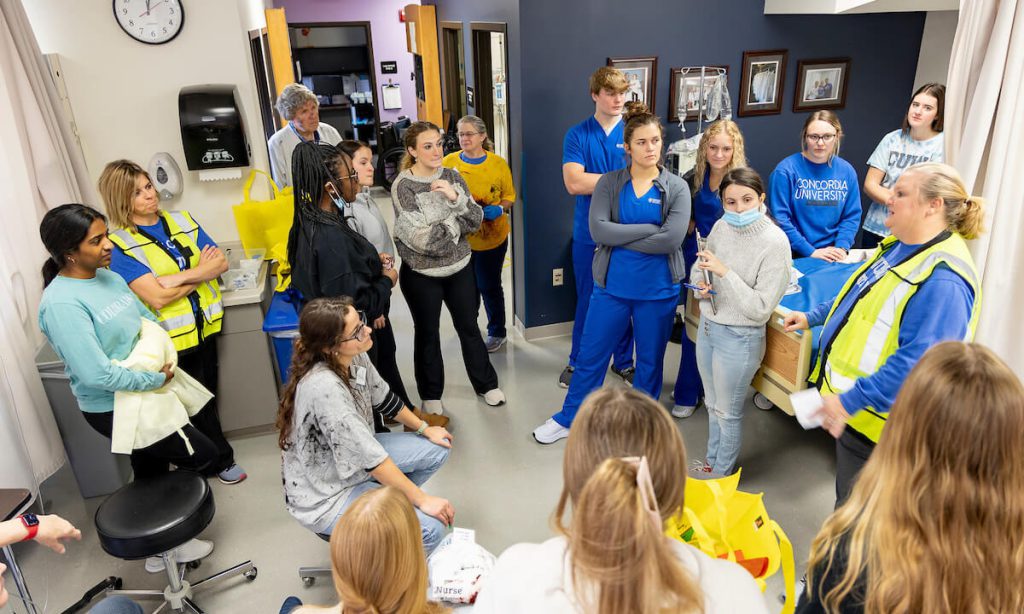
Under the direction of CUW Nursing Simulation Lab Coordinator Tina Gaffney, MSN, RN, about 12 students participated in the first of two days of a disaster simulation on Friday, Nov. 3.
A handful of faculty members and former students served as actors during the drill in order to more fully simulate the emotions that could be present at a disaster scene. The exercise presented students with a scenario involving a chemical explosion in a researcher’s laboratory. Students needed to appropriately triage the situation and respond to the needs presented.
At the conclusion of the disaster simulation exercise, students debriefed the experience. Beyond the emotional component of care, students must learn essential critical thinking skills under, sometimes, high-stakes conditions.
“Prevention and preparedness are essential parts of our students’ training,” said Gaffney. “Students need to practice these skills, ideally before a human life is at stake. By design, simulation exercises help students experience learning in a way that attempts to closely mimic what they could face someday.”
Students in the nursing program at CUW begin simulation practice in their sophomore year. Skills practice and clinical placements are also added in year two. Simulation exercises cover areas such as:
- End-of-life procedures
- Medication administration
- IV, tracheostomy care, and suctioning
- Poverty care/navigating the health care system
- CODE scenarios
Disaster simulation scenes


Want in?
The School of Nursing is dedicated to providing a rigorous Christ-centered education that develops and inspires highly skilled professional nurse leaders who are prepared to serve diverse communities with excellence, truth, integrity, and compassion to promote health and healing.
Life Coaches: for Excellence in Life
Are you familiar with the CUW Life Coaching program?
Students can benefit from life coaching to excel in and out of the classroom. This program is intended to assist with life objectives, approaches to problem-solving, and difficult choices we face throughout our lives.
In the fall of 2021, CUW launched the Life Coaching program, which was developed by certified Life Coach and trainer Tracy Tuffey, MSW, LCSW, and Dr. Charnetta Gadling-Cole. Dr. Daniel Upchurch and his agency, Positivity+, also worked to certified CUW life coaches and provided CUW with the platform that was used at the start of the life coaching program.
This program aims to assist students’ mental, physical, and spiritual well-being while increasing their possibilities and providing them with the necessary support. It can be difficult to balance challenges when embarking on a new journey, but these coaches can offer guidance and help you create a strategy to reach your objectives in life can be difficult at times, and in college, you are discovering who you are.
A majority of these coaches hold certified licenses in support, coaching, and therapy. We currently have ten different life coaches on staff at our campus. Kari Metts, Eugene Pitchford, Holly Griskell, Rob Collier, Marnie Lawler McDonough, Vittoria Sipone, Aimee Wiley, Jess Valdes, and Tracy Tuffey.
Kari Metts, a coach who has been a Life Coach at CUW since the program started, was the one whom I spoke with. I conducted a Q&A session and discussed the advantages of life coaching and why students ought to select it.
Q. What does the Life Coaching program offer & what is it all about?
A. “Life Coaching is a service provided to students who would like tips on time management; study skills; prep for presentations; encouragement; support; a sounding ear to discuss topics for a paper or project. A Life Coach is someone at the ready for a student to talk to when it’s a pressing issue and can’t wait. We are NOT a replacement for students that are in need of or who are currently receiving professional therapy assistance.”
Q. Why is it beneficial to students?
A. “Life Coaching is beneficial to students because we “coach and assist” with the mundane things that can’t wait. We know that life is hard, because we’ve been in your shoes, survived and we want to provide advice and encouragement. I like to say that there are lessons in the messes and your response determines the outlook. You will either learn from it, not repeat it; or, wallow in it and remain stuck.”
Q. How should a student go about finding a Life Coach?
A. “Go see Rebecca Hasbani, Intake Coordinator, or send her an email at Rebecca.hasbani@cuw.edu, or visit the Life Coaching website.”
Q. Anything else you think is beneficial for students to know?
A. “Yes! The main job of a Life Coach is to listen; assist; encourage and support. We want all students to be successful during their academic journey and provide some pointers that they can use afterwards.”
Every day, college students deal with a variety of stressors. Our daily lives involve a variety of challenges, such as those related to money, education, professional choices, personal lives, and even interpersonal relationships. In college, we are maturing into responsible adults, and enduring all these challenges while attending classes can be extremely exhausting. Because of this, life coaching can be a highly useful technique for assisting students in overcoming these difficulties. This program’s objective is to assist college students in managing their stress and anxiety. Talking to a Life Coach can assist people in reaching their goals and furthering their personal development while also continuously improving themselves. It’s critical to ask for the assistance you require because, although we occasionally tend to believe we are capable of doing it all, we are not.
Need a Coach?
After reading more about Life Coaching, I believe that many college students should take advantage of this fantastic opportunity. It helps you focus on your simultaneous physical, mental, and spiritual well-being and has a great impact on your everyday life. Additionally, the Life Coaching program greatly improves and shows excellent academic achievement by assisting with planning and organizing to ensure that you are maintaining task completion. Finally, it supports personal development and fosters a positive outlook that leads to significant achievement in life.
Visit the Life Coaching page on the CUW website to find out more about this as well as the backgrounds of the Life Coaches!
— Paityn Taormina is a writer, editor, and social media assistant for The Beacon. She is a senior majoring in Mass Communication while minoring in Social Work. Paityn is on the Acrobatics & Tumbling team and will graduate with a bachelor’s degree in May of 2024.
Supporting Our CU Heroes: Services for Military and Veteran Students
Transitioning from active military service to college life can be a significant challenge for many. Veteran students face many obstacles, ranging from adjusting to civilian life to managing the demands of school work. Fortunately, Concordia recognizes the needs of our students. We provide support to Veterans and military-affiliated students. Let’s explore the services and assistance available to help our heroes.
Veterans Resource Centers
Concordia has a dedicated Veterans Resource Center on campus. This is a hub of support and information for military and dependent students. Our team offers assistance in navigating VA benefits, connecting with other veterans, and accessing academic resources. Post-traditional students who are not located at or near our campuses are welcome to communicate via email or through virtual options.
Flexible Scheduling
Our post-traditional degree programs are designed for working adults like Veterans. Students can choose between online learning and evening classes that meet virtually once a week. Therefore, the student gets complete control over their education without sacrificing family life or work schedule. Additionally, tuition is paid by term to Concordia or you, depending on the VA educational benefit the veteran is eligible for.
Counseling and Mental Health Services
Transitioning from military service to college life can be emotionally challenging. The Concordia University Counseling Center staff is here to provide caring, competent counseling in a confidential setting whenever you need us. We even have two comfort dogs, Zoey and Sage, who are on staff if you need non-human companionship.
Additionally, at Concordia, we have the Falcon Peer Support Network (FPSN). FPSN promotes student well-being and empowers them to create a resilient community by supporting each other’s identity, mental health and well-being, and day-to-day lives through weekly peer facilitating groups and community-building events. This initiative is led by student directors and leaders under the supervision of Student Wellness.
There are also weekly and bi-weekly peer groups to get involved in. To get connected with a Peer Support Group, email studentwellness@cuw.edu or talk to any of the Student Directors or Leaders to learn more!
If you are struggling, please know you are not alone. Reach out to the Counseling Center. We’re here for you in your time of need.
Financial Aid and Scholarships
In addition to VA benefits, Concordia offers scholarships and financial aid for military and veteran students. These resources can help offset the cost of education for a veteran or dependent. For a comprehensive list of financial options, visit here.
Career and Academic Support
Veterans who face academic challenges can benefit from personalized tutoring sessions and access to study resources. The Academic Resource Center (ARC) provides free services, programs, and support for all CUW students so they can grow into independent learners and adjust to life as a college student by offering:
- Accessibility Services
- Academic Resources
- Make-up Testing
- Protecting Your Mental Health
- Shifting Your Mindset
- Time Management
- Online Learning Strategies
We also offer academic advising through The Center for Academic Advising and Career Engagement (CAACE), which provides professional advising for Concordia students and alums to support the discovery and achievement of academic, career, and vocational goals.
Concordia also offers an Alumni Mentor Program that establishes meaningful, personal, and professional coaching relationships between current CUW students and alums. This program helps create a deeply meaningful impact on both mentees and mentors.
Students will learn from gifted and successful CUW alums outside the classroom to enhance their CUW educational experience, preparing them for success in the workforce.
Accessibility Services
Accessibility support services can assist in providing necessary accommodations, ensuring that veteran students have equal access to education. CUW is committed to removing barriers that prevent students with disabilities from achieving their academic goals. Whether you are a current CUW student or an incoming freshman, the information below will help you begin registering with the ARC.
What’s next?
Concordia is committed to supporting Veteran and Military Affiliated students on their educational journeys. The support we have available to veteran students and dependents not only helps students succeed academically but also honors their service to our country.