‘Tis the Season to See CUW’s “A Christmas Carol”

The closing weekend of A Christmas Carol starts today!

The Concordia Players Theatre is coming up on its second weekend of performances of A Christmas Carol, an adaptation of the classic Charles Dickens novel about the redemption of the bitter Ebenezer Scrooge and the importance of generosity, humility, and family.

A Christmas Carol, originally authored in 1843, has been a holiday favorite onscreen and onstage since the original onstage adaptation in 1844. CUW is producing an adaption by Steven Young, which features the real story of Charles Dickens and his family in tandem with the well-known characters audiences love. Dickens is a constant presence in the play, his life story providing additional nuance to a well-known classic.

Senior Caleb Dunst, playing Charles Dickens, found it to be “quite a task to take on the role of a man going through potentially the roughest patches of his life. He’s uninspired, frustrated, miserable, and yet still needs to find solace in the end.” Dunst considers the role his “most involved role by far.”

Sophomore Joshua Bowen, who stars as the show’s Scrooge, commented on his experience playing the iconic character.

“A difficult aspect of getting into the role of Scrooge was his change of heart. The audience needs to be able to see where Scrooge’s changes begin and the pain he endures to get to the changes,” Bowen says. “I learned that Scrooge isn’t just a grumpy, stingy old man. He’s just a man who’s afraid of loss, and he pushes people away because he doesn’t want to lose anyone again.”

Despite the natural challenges of the character, he has thoroughly enjoyed “doing Scrooge’s crotchety old man mannerisms” and having the opportunity to interact with most of the other characters on stage.

The production boasts one of the largest casts the theatre department has seen in recent years, featuring 36 CUW actors and 23 children from the community. The youth actors are divided into two casts. Fog, snow, and actors on stilts are just a few of the special effects that help the story come to life.

Senior Clara Ellis, Christmas Carol’s stage manager, expressed her pride in the cast and the work they’ve done.

“This cast works so well together… The college actors have been fantastic with the kids,” she says. “Most of them have been at most, if not all, of the “children” rehearsals and have been helping our child supervisor, Josh Barclay, by hanging out with them, watching them, helping them with lines, playing games, and lots more to help them feel comfortable with being here and around a lot of people they don’t know.”

Christmas Carol opened last weekend on Friday, November 10th. This week the cast has welcomed many local school groups into Todd Wehr Auditorium for matinee showings before their second round of performances (November 16th to November 19th), totaling 12 shows in a span of 10 days.

Concordia plays have typically been held for one weekend only, with the exception of last fall’s production of Pride and Prejudice, which added a second weekend due to high demand. Double weekends have become less feasible for the department in recent years as they work around the performances of musical ensembles and the growing number of events in need of the large space the auditorium provides. It was decided that A Christmas Carol, being as large and iconic as it is, was deserving of a longer run.

When asked why people should attend the show, Ellis said, “Christmas Carol is such a classic show. Each and every one of the actors has worked super hard to put on a great show… There are also a lot of funny jokes made throughout the show, but you’ll have to come and see it to hear those.”

“Come for the ghosts, if nothing else,” Dunst says. “There’s so much that has been put into them, both from a technical aspect as well as portrayal. They look and sound awesome.”


Catch it before it ends!

Tickets are available for purchase online or at the box office. Concordia students can attend for $5, and faculty and staff for $7. Additional pricing is available on CUW’s website. You can find A Christmas Carol highlights and takeovers by the cast on the theatre department’s Instagram, @cuwplayers.


Mikayla Amack, editor of The Beacon

—Mikayla Amack is an assistant editor and writer for The Beacon, the official student newspaper of Concordia University Wisconsin.

Looking back, looking forward, hearts together


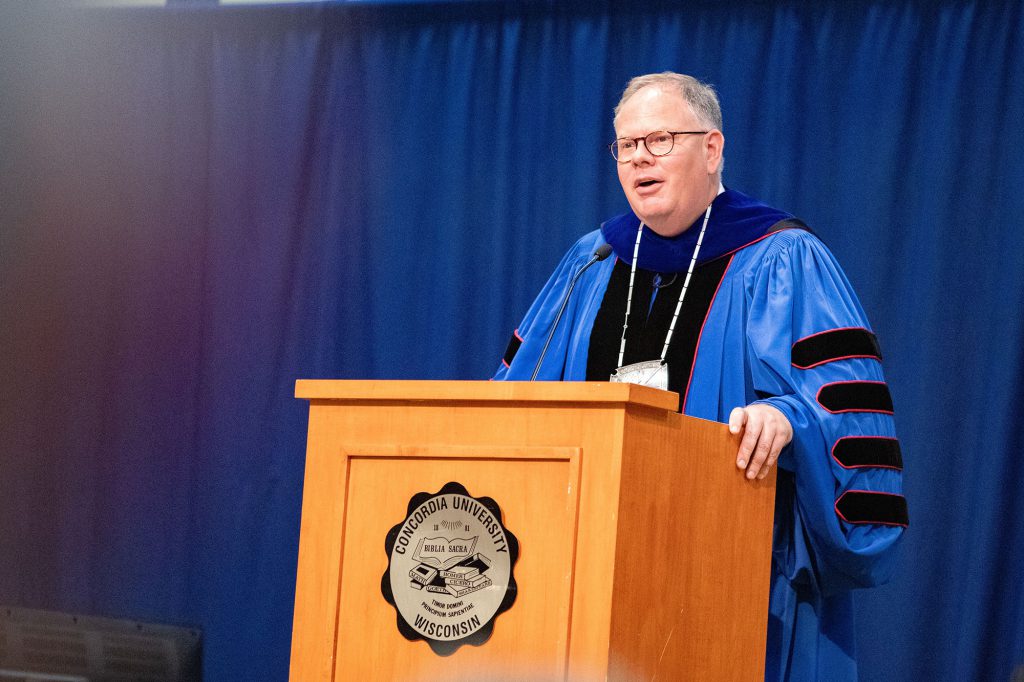
President Ankerberg addressed an audience of Concordia supporters during his inauguration ceremony on Friday, Sept. 29, and shared his vision for the future of the university.

Editor’s note: A version of this letter first appeared in the fall 2023 edition of Hearts Together. The official magazine of Concordia University Wisconsin and Ann Arbor publishes biannually.


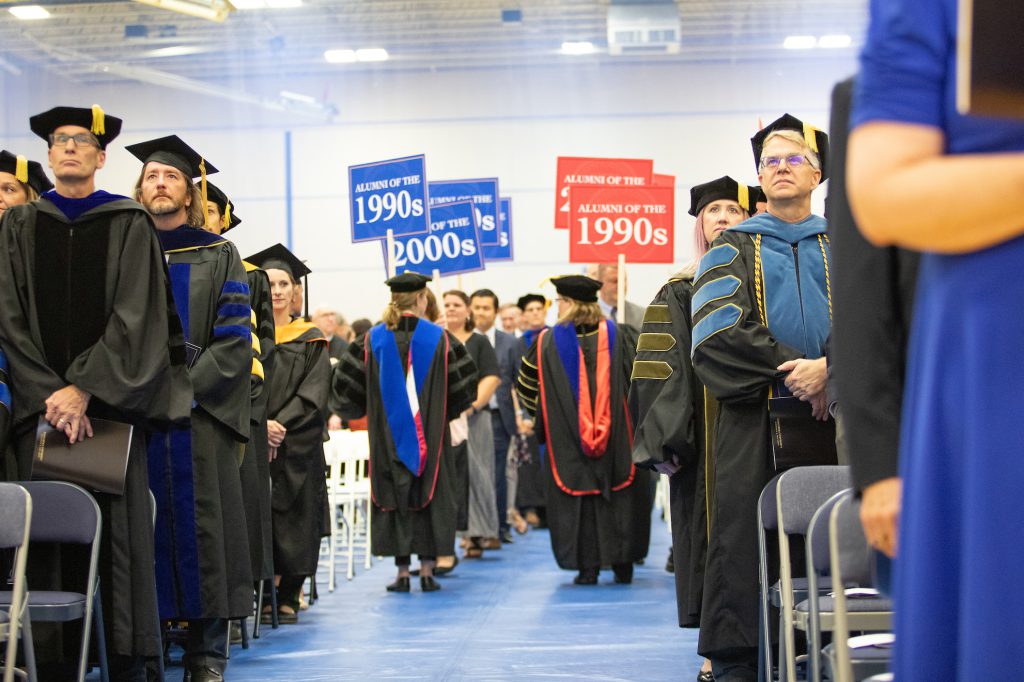
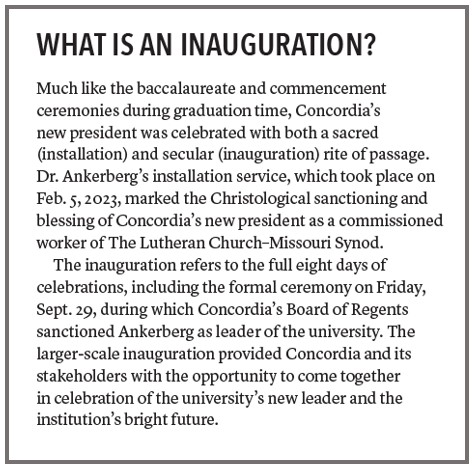
At the end of September, Concordia University and its community of supporters marked the inauguration of Erik P. Ankerberg, PhD, with eight days of celebrations on the Mequon and Ann Arbor campuses. Students, employees, alumni, donors, and friends ushered in their new president with a speaker series, special guest preachers, a student poetry contest, a gala, and lots of light hearted fun and games. For his inauguration ceremony on Friday, Sept. 29, Ankerberg addressed the audience and shared his vision for the future of the university. Here is his address.


By Erik P. Ankerberg, PhD, University President

“I wasted time, and now doth time waste me.”

This is the lament of William Shakespeare’s King Richard II, as the failed leader reflects on losing his crown and his kingdom. For me, as a recovering English professor, this confession is one of the saddest moments in Shakespeare’s plays. How does a leader come to the end of his play, and his life, and make peace with his own shortcomings—not to mention the prospect that others will remember him as an
abject failure?

On a day when we are celebrating our university and our work together, I believe it is healthy and honest to face facts. We know we live in a world in which higher education is a challenged enterprise, and many are ambivalent about our efforts. When we consider the factors that impact our commitment to mission, our enrollment, our financial position, and the public perception of our work, we would do well to consider the ways we can ensure, as a university community, that we are not, in Richard’s words,
wasting time.

Today I would gently suggest we can understand our work in relation to three pillars that demonstrate that we, as a university community, are making the most of the time we have:

1) Authentically living out our university values;
2) Pursuing the status of rising regional university;
3) And making our students—and the world—whole.

University values

First, we should remember that our university’s values, in a tangible way, provide the framework of our life together in this community. That is precisely why we are focusing on them so intently this week, and I am so grateful for the thoughtful presentations that we are enjoying throughout this Inauguration Week. When we consider the benefits of being a university that is Christ-centered, a place focused on truth and integrity, excellence, and service, we begin to understand the gravity of the promises we are making to one another. I just want to take a moment and provide a brief summary of my initial understanding of each value:

Christ-centered

Because we are Christ-centered, the person, death, and resurrection of Jesus Christ intersects with every aspect of our work as a university. From that perspective, everything revolves around Him. As a result, we continually look to strengthen our ability to love and care for each other because each person is precious—each one made in the image of God. Consequently, we welcome all to our university community and surround them with the love, joy, mercy, and peace that our Savior brings to us.

Truth and integrity

Likewise, we pursue truth and integrity because when we pursue and encounter truth we discover He is a person—Jesus Christ. From that perspective, we realize that He is our terminus. He provides the integrity—the bond—that holds creation and all of our relationships together; consequently, we care about each individual as a complete human person. In that context, we learn from Him to listen to others, to care about their hurts, and care for their needs. He nurtures empathy within us; He encourages us to be concerned about justice and dignity; and He does this because He gives us hope as He reminds us that He makes all things new.

Excellence

We promote excellence because we want each member of our university community to grow—not just in knowledge and skill—but virtue, as well. We privilege the liberal arts—the studies that free us from the control of others, and simultaneously we invest intentionally in those disciplines that lead more directly to professional careers. We believe that excellence is distinct from elitism, and we prepare our students well to lead lives that are extraordinary—not because of wealth or social status or achievement—but because of faithfulness that manifests itself in an authentic concern for others.

Service

We prioritize service because we want our students to live out an understanding of vocation that transcends the whims or limits of mere careerism and explores widely their roles in families and the church and the state. We strive to orient everyone in this community to turn outward, to look beyond the horizon of their aspirations, and to seek the flourishing of all they meet in their daily lives.

A rising university

The second pillar that allows us to make the most of our time is aligning ourselves with traditional university success markers. In a highly competitive world—with wavering public confidence in higher education—we recognize the value of using data to demonstrate our university’s contributions to the region. We certainly hope those in our communities will recognize Concordia as a rising regional university—one with a reputation for curating a portfolio of academically rigorous programs and delivering outcomes that prove our commitment to student success.

Likewise, we, like every university, want to thrive: We seek to grow enrollments and our endowment; we should aspire to serve an equal number of traditional undergraduate and post-traditional students; we must pursue a better sense of fiscal discipline and become financially self-sustaining at each campus. We want our retention and graduation rates to demonstrate our influential status as a higher-education institution of choice across the states we serve.

That is why we are in the middle of doing what most universities do today: We are developing a university strategic plan, master plans for both of our campuses, and both strategic budget and enrollment plans. We are also in the process of initiating a comprehensive campaign. These are the necessary steps that denote our health and point us toward an encouraging future. At the same time, while pursuing these positive metrics we must be wise and self-aware enough to acknowledge that a thriving university is feckless and poverty-stricken if it is not faithfully living out its missional commitments.


Making individuals whole

The third pillar involves two interrelated steps: making students— and the world—whole. The first step is making our students whole by encouraging them to gather all that the world has to offer. The cantankerous 20th-century Welsh poet priest R. S. Thomas’ poem “Threshold” gives us a sense of the choices we face as we educate students today:
I emerge from the mind’s
cave into the worse darkness
outside, where things pass and
the Lord is in none of them.

I have heard the still, small voice
and it was that of the bacteria
demolishing my cosmos. I
have lingered too long on

this threshold, but where can I go?
To look back is to lose the soul
I was leading upwards towards
the light. To look forward? Ah,

what balance is needed at
the edges of such an abyss.
I am alone on the surface
of a turning planet. What

to do but, like Michelangelo’s
Adam, put my hand
out into unknown space,
hoping for the reciprocating touch?

Thomas’ poem reminds us that our education allows us to access the widest and deepest forms of knowledge. We can expose students to the most magnificent aspects of the physical world—from the microscopic influence of bacteria to the macrophysical movement of planets—but we come to recognize the limitation of that kind of education: It is incomplete. Thomas’ speaker would have us reach toward the transcendent with wonder, grace, imagination (and we might even say faith). From Thomas’ perspective, then, education makes a person whole when she comes to terms with all that the material world offers, but is only complete when she realizes she is a creature in a world much larger than she realizes and then turns to engage—seriously and intentionally—that which is beyond her temporal experiences with the gift of hope.

The second step is to encourage our students to pour out themselves and all they have gained in an effort to make the world whole. The 17th-century British poet George Herbert explores this possibility in his dramatic sonnet “The Holdfast,” where his speaker and the speaker’s interlocutor wrestle with essential questions about the nature and purpose of life:

I threaten’d to observe the strict decree
Of my dear God with all my power and might;
But I was told by one it could not be;
Yet I might trust in God to be my light.
“Then will I trust,” said I, “in Him alone.”
“Nay, e’en to trust in Him was also His:
We must confess that nothing is our own.”
“Then I confess that He my succour is.”
“But to have nought is ours, not to confess
That we have nought.” I stood amaz’d at this,
Much troubled, till I heard a friend express
That all things were more ours by being His;
What Adam had, and forfeited for all,
Christ keepeth now, who cannot fail or fall.

Herbert’s speaker—like most of us in the contemporary world—wants to advocate for a quality of life that is determined by our own efforts and knowledge and skill—our own “power and might.” The interlocutor frustrates the speaker by continually unraveling his assumption that the “good” things he has accumulated constitute a “good” life. Herbert proposes a provocative understanding of life: We are better off when we acknowledge that we have nothing, and—ironically—we actually possess “all things” only when we first admit that we do not own or control the world around us. From this perspective, we might gain the “world” of knowledge and skills and achievements, but we can only avoid “losing our souls” when we confess that those things were never truly our possessions in the first place. Their true value and purpose only become apparent when we willingly learn how to lose things we have gained—by pouring out ourselves and all that we have into the gaping holes of our neighbors’ lives.

Shakespeare’s Richard does indeed find a form of redemption for his wasting the time in his life—the self-awareness he gains allows him to rise to defend himself, even as he comes to his tragic end. He thinks, and he acts nobly—not a bad model for us as a university community today. When we intentionally remember our university values and live them out in our life together as a university community; when we seriously and consistently hold ourselves accountable to the markers that we believe define the meaningful work of a rising regional university; when we make students whole by helping them gain all of the knowledge and skills available to us, and at the same time encourage them to give up those things to make others whole—only then do we see the true opportunities that lie before us. As we pursue these three pillars, we will come to remember that, through the blessed work of the Holy Trinity, we have in the past carried out—and we must continue in the future to carry out—the extraordinary work of providing our students with a transformative and uncommon education that develops students in mind, body, and spirit for service to Christ in the Church and the world. If we bring ardor and faithfulness to that work, we will come to see that we are not wasting time; we are not serving time; we are redeeming time.


Support Concordia’s commitment to whole-student development

We invite you to honor President Ankerberg’s start at Concordia by supporting our students through scholarship aid or the university’s greatest need, the Concordia Fund. Gifts of any size are appreciated and do make a difference. Visit cuw.edu/give or cuaa.edu/give.


The fall 2023 Hearts Together magazine hits mailboxes in November. View a PDF version of the magazine here. If you are not on our mailing list, but are interested in receiving a free copy, email Jennifer.Hackmann@cuaa.edu.


Grad on the go: Adam VanderVeen (’14)


Master of Business Administration alumnus Adam VanderVeen is now the marketing director at Triumph Motorcycles America Ltd. in Atlanta, Georgia.

Editor’s note: A version of this letter first appeared in the fall 2023 edition of Hearts Together. The official magazine of Concordia University Wisconsin and Ann Arbor publishes biannually.


Adam VanderVeen has one rule when evaluating career opportunities: say yes. His bold and trusting acceptances led him on a remarkable career path, culminating in the position of marketing director at Triumph Motorcycles America Ltd. in Atlanta, Georgia.

VanderVeen’s unconventional journey started in Iraq, where he served as a Marine. After deployment, he accepted a promotions role at Harley-Davidson, became a professional MMA fighter, ran a video company, started a lifestyle magazine, and completed his MBA at Concordia University.

He credits Concordia’s supportive culture and independent spirit for helping him ignite his entrepreneurial interests and harness his diverse experiences.

“My many interests didn’t seem that unusual at Concordia,” said VanderVeen. “Concordia is a culture of many paths. There are tons of exceptional people doing really different things, and they will go out of their way to help you use all you were given to succeed.”

VanderVeen eventually replaced MMA fighting with motor sport racing when he accepted a marketing role at Evinrude Outboard Motors. Several promotions later, the marketer with many interests made his triumphant move to Atlanta.


Want in?

Concordia’s MBA program is designed for working professionals. Whether you want to advance your career or become a better leader, an MBA from Concordia University Wisconsin will give you an advantage in the workforce. 


The fall 2023 Hearts Together magazine hits mailboxes in November. View a PDF version of the magazine here. If you are not on our mailing list, but are interested in receiving a free copy, email Jennifer.Hackmann@cuaa.edu.

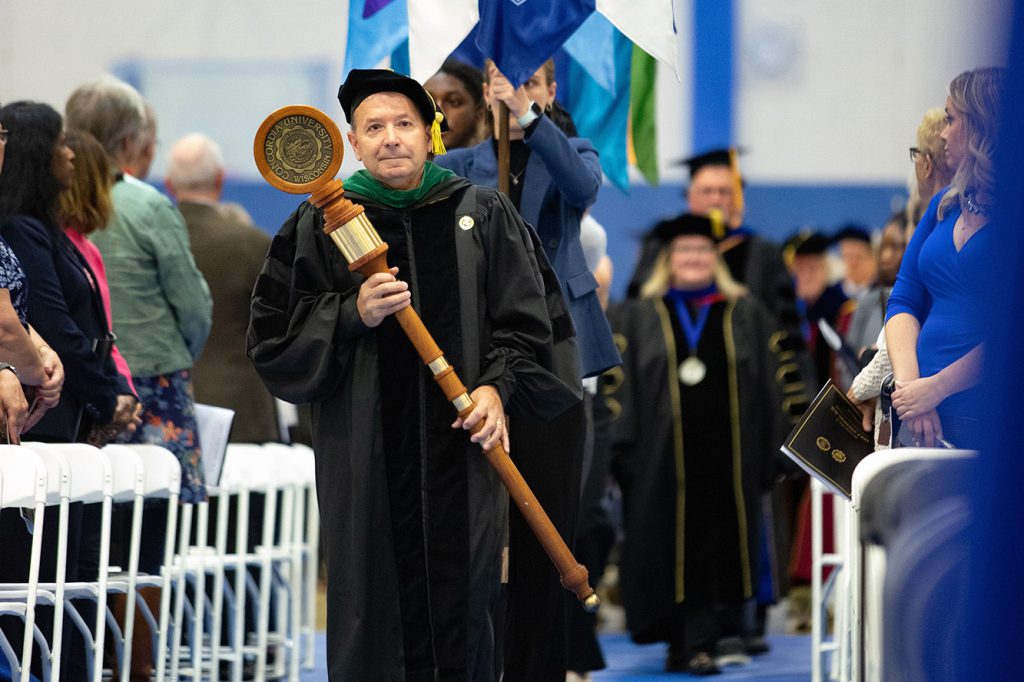
Take five: Director of Sports Medicine Angi Steffen (’07)


Get to know one of our uncommon Concordians, Angi Steffen (’07), director of sports medicine at CUW.

Editor’s note: A version of this story first appeared in the fall 2023 edition of Hearts Together. The official magazine of Concordia University Wisconsin and Ann Arbor publishes biannually.


Angi Steffen is the best friend a Falcons student-athlete can have—especially when aches, pains, and injuries inevitably become a part of the athletic life. An athlete herself from a young age (Angi played for the Falcons Softball team), she thought a career in athletic training, that let her “get paid to watch sports,” seemed almost too good to be true. She’s a Concordia lifer, a 2007 graduate of the athletic training (AT) program, and one of the most popular and valued members of the athletics staff. In other words, she’s the one who has turned out almost too good to be true!

Who has been a big influence or mentor for you at CUW?

From an athletic training/sports medicine standpoint, Russ DeLap and Katherine Liesener, previous and current AT academic program directors. Both are still at CUW, and I continue to learn from them in different capacities. From an athletics administration standpoint, Rob Barnhill and Stacey Brunner-Jones. I’ve known both since I was an undergraduate student here, and both have been critical to my growth in a professional role and increased responsibilities over the years.

What has been the biggest or most exciting sports moment here for you?

Without spending too much time racking through the years, I would have to say Softball’s 2023 post-season run. They were the first team to win a regional tournament and advance to the Sweet 16 in CUW’s NCAA era, something that only 16 teams in the nation accomplish. AND the team that ended their run went on to win the national championship!

As a kid, what did you want to be when you grew up?

A veterinarian. So I guess I stayed in health care but tossed in my passion for athletics. I’ve always loved dogs. I currently have Ali, a sweet 14-year-old beagle mix living her best life.

What do you love about your job now?

The lack of monotony. Some days are more mundane, sitting behind a desk, doing admin stuff. But others are out on the sidelines in all the elements—that’s where you’ll catch the biggest smile. I’ve gotten to visit states and see things I wouldn’t otherwise have. And, of course, watching student-athletes return to competition following long-term injuries can’t be topped!

What’s the weirdest thing that has ever happened at a game?

(Head Football) Coach Etter loves this story: I once took out a sideline official during a football game! We were sprinting in opposite directions and collided. I wasn’t fazed, but he went down, laid there, looked up at me, and tossed the flag! I don’t think I took a breath for the next two drives until I knew the penalty wasn’t going to hurt us or change the outcome of the game. Now we laugh about it often!


Want in?

Athletic trainers play a vital role in the athletic program, on and off the field. They typically provide the first care an athlete receives following injury. They collaborate with other health care professionals to ensure athletes receive high-level care for the return to the field and other physical activities.


The fall 2023 Hearts Together magazine hits mailboxes in November. View a PDF version of the magazine here. If you are not on our mailing list, but are interested in receiving a free copy, email Jennifer.Hackmann@cuaa.edu.


Make it new: President Ankerberg’s Hearts Together opening address


For the opening letter of Hearts Together, President Ankerberg discusses the “new” that has already been promised to God’s people.

Editor’s note: A version of this letter first appeared in the fall 2023 edition of Hearts Together. The official magazine of Concordia University Wisconsin and Ann Arbor publishes biannually.


Make it new.

These three simple words encapsulate the professional and almost sacred obligation of the poet Ezra Pound and his fellow proponents of modernism. They held a goal to reinvent the literature, the art, the very life of the 20th century. The novelty of Pound’s revolutionary assertion certainly stems from its expression of an optimism for the transformation of a culture and its society.

High hopes for this new start

In a way, the beginning of each new academic year offers a similar kind of opportunity, in the spirit of Pound, to make all things new again. I cannot deny that I have begun my first full academic year as president of Concordia University Wisconsin and Ann Arbor with high hopes. Many of you may hold similar optimism for me.

Such optimism resonates with Emily Dickinson’s poetic definition of hope, where she writes, “Hope is the thing with feathers that perches in the soul, and sings the tune without the words, and never stops at all.” We want so earnestly to define our life in terms of hope, but often we fail to understand exactly why we so desperately need hope.

As you might imagine, my best intentions as a president will not always come to fruition—sometimes it will be my fault, and sometimes it will be because of circumstances beyond my control. Thankfully, the same does not have to be said when it comes to our eternal futures.

The challenges we face, as individuals and as a university community, remind us that sin is the only thing we contribute to our salvation. This awareness and emptiness and longingness for something more defines the cry of the psalmist in Psalm 42. He writes, “As a deer longs for flowing streams, so my soul longs for you, O God. My soul thirsts for God, the living God.”

The psalmist’s images of longing and thirst capture the bareness of our lives. When left to ourselves and our own imagination and effort, we know we are broken and dead and unable to manufacture anything that is true or beautiful or good or satisfying or enduring or even living in our lives. Instead, we are left to echo the writer’s later question in this psalm: “When shall I come and behold the face of God?”

When shall I behold the face of God?

What an essential question for us! The manner in which we answer the question defines how we understand our present and our future. If we believe that our good intentions, our pious works, our carefully curated network of right, connected people will somehow bring us face-to-face with God, we’re sorely mistaken. In reality, we’re only constructing a hell of our own making.

If we wish to experience hope rather than hell, like the psalmist, we are invited to remember our experiences in the house of God. Our Lord mercifully reciprocates this act of remembering with one of his own. When we are despondent like the psalmist, when our souls are cast down within us, when we are disquieted or in turmoil about the state of our lives, we come to the house of God. In His holy temple, we remember how our Lord remembers us.

This new academic year certainly provides us with many opportunities to make our lives new, and, yes, a lot of good can come from those efforts. But let us remember that our Lord has created a new for us that will not disappoint. He has created a new home for us to occupy—a home of hope that He has built with water and His Word and His body and His blood. Because of His enduring love, we will live with Him and praise Him, not only today but for all eternity.


Want in?

Christ-minded. Ethical. Hard working. Respectful. Curious. Leader. While all our students are different, certain qualities unite our community and make us Concordians. We look forward to welcoming you to the ranks of our alumni.


The fall 2023 Hearts Together magazine hits mailboxes in November. View a PDF version of the magazine here. If you are not on our mailing list, but are interested in receiving a free copy, email Jennifer.Hackmann@cuaa.edu.

A tale of many tiles

Or, “How many iconic Concordia floor tiles does it take to cover the original hallways of our beloved CUW campus?”


According to my golf rangefinder, it’s 135 yards (or 405 feet) from the Welcome Center, where the tiles start, down the hallway to the Loeber Hall doorway to the west. According to my yardstick, this hallway is approximately 8 feet wide. This means about 3,240 square feet of flooring is covered in little square tiles. Each tile, including half the mortar, is ~2.25 inches on each side., or 5.0625 in2. That’s 28.444 tiles per ft2, which adds up to more than 92,000 individual tiles. In just this one hallway.

If you multiply that figure by the total square footage of tiled hallway at CUW, you get … let’s see … times the hypotenuse … carry the 1 … a little over a bazillion. Truth is, I don’t know how many square feet there are—but there are a lot of tiles. Probably somewhere south of a million—but not too far south!

Square dealings

Like painting the Golden Gate Bridge (which never stops), keeping all the tile repaired is an ongoing challenge. Given as they were first installed in 1958, that means the tiles are 65 years old in 2023! That’s a lot of wear and tear in six-and-a-half decades. (Concordia moved to its present location in 1983.)

They break down in different ways, said Steve Hibbard, director of buildings and grounds at CUW. The primary problem is that the subfloor materials wears out and turns powdery over time, and the tiles lose their connection to the floor beneath. You can hear this effect sometimes when you walk down the hallways, particularly with hard-soled shoes. “You can tell by the sound which part of the floor is going to come loose next,” he explained.

The expanding and contracting of the flooring within and between all the different buildings is also a factor. Those brass strips you see separating some of the hallways are actually expansions joints, designed to absorb some of the changes, add a little flexibility, and minimize the damage.

In most cases, individual tiles, or small groups, will crack or come loose. “But sometimes you’ll get a whole section of floor that will just kind of pop,” Hibbard said.


All squared away

One big problem with keeping them repaired is that these tiles have become difficult to source. For one, small tiles these days typically come in a pre-laid webbing, to make installation much quicker and easier. Another challenge is that the tiles, as noted above, don’t necessarily have a standard size. Finding individual tiles that fit is problematic.

That means that tiles are reused as often as possible. Recycled tiles become available when tiles are removed, such as to install carpet in a residence hall, or install more modern, lower-maintenance flooring material.

“We carpeted Heidelberg one of my first years here, and that was a mistake,” Hibbard says. “We installed it over the tiles, but that didn’t stop the tiles from loosening. After a while, you could hear them crunching underneath.”

So now the tiles are removed before any carpeting is installed. But it’s hard to remove them in one piece. They also come up with a lot of mortar and grout stuck to them. They have to be cleaned up before they can be reused.

“When I first started here,” Hibbard recalled, “they used to soak old tile in some sort of solution to help remove the old mortar so they could be used again. But now we just use a grinder to mechanically clean them up.”

As you can imagine, it’s not a simple or easy job—especially when you consider that some of the tiles are not even exactly the same size.

Wittenberg Hall was the last building completed—they were built generally from east to west, Hibbard said. Because so many tiles were needed, some of the floors toward Wittenberg don’t quite match the others. They are a tiny bit bigger and have a slightly different pattern. This just adds to the overall maintenance challenge.


Tile tidbits

  • Laying all the floor tiles for all the original buildings took three years to complete.
  • Years ago, one man on the maintenance crew was known in particular for taking care of the tile, Hibbard said. “Big Gene,” they called him, a testament to his height, which Hibbard estimates at 6’-5” or more. He could frequently be found lying on the floor working on the tile. When he retired, Jeff Shawan, associate professor of art at CUW, created a unique tile-based work of art to present to him and commemorate his years of service.
  • These days, Chris Wach, maintenance tech-carpenter with Building and Grounds, bears primary responsibility for keeping up with tile maintenance. He has a standing work order to fix tile forever. (If you see him working in the hallway, feel free to express your appreciation!)
  • One downside of the tiles is how noisy the rough surface can be. If you’ve ever been in class or in Chapel when someone pushes a metal cart down a tiled hallway right outside the door, you know what we’re talking about!
  • It’s difficult to say just how many different colors are used. Upon examination, you’ll see different shades of rust, gray, yellow, blue, and green—and more! There’s no pattern to how they are positioned; it’s all completely random.
  • The colors of the tiles have influenced many of the paint color choices throughout campus.

Square roots

It would be tempting to say that the tiles aren’t worth the trouble. Tiles continue to wear out and break, and Hibbard said the stockpile of reusable tile is running short. But the multi-colored mosaic of our flooring has become a part of the lore surrounding Concordia’s rich history. The tiles are a connection to and a reminder of God’s amazing provision when this beautiful campus came into our possession. They’re not going away any time soon!

“Over the years I’m finding there’s more interest in the tile than when I first started here,” Hibbard said. More people say, ‘Oh, these are kind of cool!’ And some of the tiled hallways are disappearing, so there’s a desire to keep the tiles as long as possible.

“I’ve been reaching out to some companies to see if we can still get that tile, and I think we should be able to,” he adds. “I haven’t found a source just yet—but we’re not giving up!”


Want in?

Concordia University Wisconsin is a Lutheran higher education community committed to helping students develop in mind, body, and spirit for service to Christ in the Church and the world. Our vision is to be well known nationally and internationally as a premier Lutheran Christian university, widely recognized for meaningful integration of faith and learning. To learn more or to apply, visit cuw.edu or click the link below.


The Same but Different: CUW Alumni Return as Employees


When students graduate from Concordia University Wisconsin, they are well prepared to enter the workforce and many do so by staying at CUW for the beginning of their careers. While Concordia graduates can be found all around campus, the Athletics department boasts a particularly high number of former Falcons.

Emily Binley, the field hockey graduate assistant coach, is one of the many CUW alum turned employee. After graduating in December of 2022 with her bachelor’s in graphic design, and leaving behind a record-making four years anchoring the team’s defense as goalie, she returned to CUW field hockey this fall. Instead of preparing for practices by getting in her goalie gear, she instead packs her clipboard and whistle.

“I wanted to give back to the program that I played for,” she says.

Field hockey is not the only part of the athletics department that has valuable alumni on their staff. Megan Bauknecht is a full-time athletic trainer and recent graduate of the CUW athletic training master’s program.

“Being able to work at the college I went to and already having the trust of the coaches was something I was looking forward to,” Bauknecht shares about her transition from CUW student to employee.

Trust and understanding are important in any workforce. These alumni employees get the chance to start building this trust even before they earn their degrees.

Binley says, “We are a tight-knit family and go through the ups and downs together, that’s what makes me feel like part of the family.”

A common concern with someone coming to work at their alma mater is the fluidity of the transition from student to employee. Bauknecht shares that she thinks this transition applies to any fresh graduate, whether they are working at their alma mater or not. The same feeling of finally putting to work what you learned in school exists for everyone.

Becoming a coach of the team you recently retired from may have different feelings attached. “There’s time that you just want to get on the field and do it, but now I have to change my mindset to help everyone who is on the field to be able to execute their goals,” Binley says.

One of Bauknecht’s favorite things about CUW is that “Everything is right there.” For many people, their future careers are also right there.

Alumni are employed all over campus and in athletics. Athletic trainers, field hockey, men’s lacrosse, women’s soccer, wrestling, men’s and women’s volleyball, both men’s hockey teams, and esports, all have alumni on their staff.

These connections formed throughout each student’s time at CUW can play a major role in landing a job after graduation. It should be known that any graduate who takes an offer at CUW will not be alone in that decision.

Interested in learning more about CUW’s athletic programs? Check out our athletics website.


—Abigail McGue is a writer for The Beacon, the official student newspaper of Concordia University Wisconsin.

CUW has largest international enrollment of WI private colleges

Concordia University Wisconsin’s international student enrollment contributes $22.1 million to the state’s economy, more than any other private college in Wisconsin, according to the recently released 2023 Open Doors Report on International Education Exchange.


CUW now sits at third on the list of Wisconsin colleges where international enrollment has an impact on the state. This is the first time ever that Concordia’s 2022-23 international enrollment surpassed that of Marquette University. The 2023 Open Doors Report looks at school enrollment data from 2022-23.    

About the Open Doors Report on International Education Exchange

The Open Doors Report provides a critical benchmark on the state of international and U.S. higher education student mobility. The U.S. Department of State’s Bureau of Educational and Cultural Affairs (ECA), along with the Institute of International Education (IIE), annually release the report during International Education Week, which Concordia celebrated a week early this year.

According to the report, CUW’s 2022-23 international enrollment also supported 214 jobs in Wisconsin. Nationwide, international students studying at U.S. colleges and universities contributed $40.1 billion and supported 368,33 jobs to the U.S. economy. For every three international students, one U.S. job is created and supported by spending occurring in the higher education, accommodation, dining, retail, transportation, telecommunications, and health insurance sectors.

Concordia’s reported international enrollment in 2022-23 was 659 students. This year, that total has nearly doubled.

Scenes from CUW’s International Education Week celebration

CUW opted to celebrate International Education Week (IEW) early this year to allow staff opportunity to travel to Concordia’s Ann Arbor campus and join in IEW festivities there.

Click below to view a gallery of photos from the week’s activities on the CUW campus.


About the Concordia International Center

Care to learn more about the Concordia International Center (CIC)? Everyone in the CIC has lived and studied abroad at some point in their lives, so they get how long and confusing the process of becoming an international student can be. That’s why they’re here to help, every step of the way.

How these Army veterans are rising in the ranks with a DBA from CUW

Wisconsin veterans, you might have more military benefits available to you than you think! Learn how these Army veterans capitalized on military benefits to earn their DBA.


Ryan Moore at Bagram Airfield, Afghanistan in 2014.

Ryan Moore, of Neenah, enlisted in the U.S. Army directly after graduating from high school. He says he didn’t have the emotional maturity at the time to tackle higher education. He certainly didn’t think he would engage in much more than a few years of schooling beyond what was required.

Now, after 17 years of military service, he has three degrees under his belt – one bachelor’s and two master’s degrees – and he’s en route to his fourth degree, a Doctor of Business Administration from Concordia University Wisconsin.

Capitalizing on military benefits

Ryan Moore

Suffice it to say Moore has morphed into a man who makes the most of his opportunities and potential. It’s surprising then that he almost unwittingly left some of his earned military benefits on the table.

When he began to research doctoral programs a couple of years ago, he was prepared to pay out of pocket for the terminal degree.

“I assumed I had maxed out the credits available to me under the GI Bill at that point,” Moore said.

“As a veteran, if you’re interested in a school or a program, really be sure to check in on the benefits,” he continued. “If not at the school, then check in with your county representatives. Sometimes you just don’t know until you reach out.”

It wasn’t until Moore began the application process at Concordia and connected with CUW’s Veteran Services Office that he learned about a 2020 bill Gov. Tony Evers passed. The Wisconsin Veterans Grant for Private Non-Profit Schools extends similar benefits as the WI GI Bill to private and independent universities in the state.

Professional advancement

This grant, combined with Concordia’s extremely generous military credit transfer policy, has allowed Moore to rise in the ranks as a civilian. Over the summer, he landed a new job as Director of Human Resources and Operations at Northwestern Mutual. He had just enrolled in CUW’s DBA program when he was interviewing for the position. Undoubtedly, his doctoral pursuit helped push his name to the top of the candidate list.

“It shows that I take my education very seriously,” Moore said. “It offers me a specialized set of skills that I’m able to put towards this company. Especially within HR, it’s important to be that scholar-practitioner and understand why we do what we do.”

Like Moore, other veterans have flocked to CUW’s DBA program as a way to help them advance their careers. James Trazile and CJ James, both U.S. Army veterans, are anticipating the degree will open doors to new job prospects in the government realm.

Trazile served eight years in the U.S. Army and left active duty this past summer. He now works as a Rating Veterans Service Representative for the U.S. Department of Veterans Affairs (VA).

“The DBA definitely opens up better prospects for me,” Trazile said. “The VA has many opportunities once I earn that degree.”

CJ James

James, a Milwaukee native, echoed Trazile’s sentiment. She currently serves as a civilian in human resources at the Milwaukee Recruiting Battalion. She ended her term of active duty in 2013 after 10 years with the Army.

“With the federal government, you can apply for higher-level jobs with a doctoral degree,” she said. “The fact that Concordia’s DBA is online makes it as convenient as possible for me to earn my degree without interfering too much with my work life and my responsibilities as a mom.”

The Concordia DBA difference

James Trazile

For all three military veterans, the online format of CUW’s DBA program was a key part of their decision to enroll. 

Trazile presently lives on the East Coast. However, the Haitian native considers Wisconsin his home and he’d eventually like to return to the Badger State.

Even from afar, Concordia has provided a hospitable environment for him.   

“Every time I come back to campus I always feel welcome and I always feel like it is somewhere I belong. I started my Concordia journey as an MBA student, and I wanted to continue to be a part of the Concordia family through the DBA program.”

When push came to shove, the convenience of an online program ultimately won out for Moore as well. He had plenty of options when it came to earning his doctorate. He was seriously considering a PhD from the University of Notre Dame for a while, but his commitment to his family and raising two young children made it difficult for him to justify relocating to Indiana for a degree. He’s been pleased to find that the quality of CUW’s program has lived up to his standards of excellence.

Moore cited additional selling points for the CUW program:

  • Access to experts: “I have a research advisor with whom I get to meet regularly. This individual is clearly an expert in the field. …I ran into Drs. (Matt and Laura) Hurtienne at the most recent Society for Human Resource Management (SHRM) state conference. I think they were presenters. It makes a big difference to have direct access to people who know their stuff.”
  • Curriculum above the curve: “(This program) really immerses you in all the theories and latest research. All the data that Concordia has shown me, I truly believe that this program is above the curve, and it probably will be the next MBA.”
  • Online, but not impersonal: “With some of my previous (online graduate) experiences, I didn’t meet my cohort until I walked, but with Concordia I really appreciated getting to know people before we even started this journey.” While Concordia’s DBA program is online, there are two requisite on-campus residencies at the start and midway through the program to encourage relationship building and networking. 
  • Solid care and support: “I’ve just been blown away by the support and the generosity at Concordia. People are so nice, and I’ve been so impressed with everyone I’ve interacted with at Concordia.”

Want in?

If you’re feeling inspired to earn your doctorate, learn more about Concordia’s DBA by clicking below.


Honoring veterans by sharing their stories

A new gallery in the Rincker Library puts words and pictures together to share the stories of veterans and refugees as captured by CUW social work students.


It’s been said that “One picture is worth a thousand words.” “But I’ve never believed that,” says Paul Calhoun, renowned photographer and assistant professor of art at CUW. Sometimes there’s much more to a story than a picture alone can tell.

That’s the idea behind the new gallery going up in CUW’s Rincker Library. It features a collection of portraits by Calhoun and essays by social work students, who interviewed the subjects and wrote up their stories. The subjects are veterans; a gallery going up at a later date will feature refugees. What the groups have in common is that both face challenges fitting into and feeling at home in our society.

Words and pictures

Last Veterans Day, students in CUW’s social work program—at the direction of Dr. Sarah Collins, director of the Master of Social Work program—spent time interviewing veterans at Vets Place Central in Milwaukee. Later they interviewed student refugees at the Milwaukee School of the Arts. The students wrote essays about their subjects, which hang in the gallery alongside Calhoun’s portraits.

Calhoun and Collins have vastly different backgrounds, but they share an interest in helping these groups. Calhoun has traveled the world photographing various people groups experiencing oppression and hardship. Collins, originally from Chicago, has lived and worked as a teacher and social worker in Alaska, Portland, Oregon, and several South American countries.

When her students work with and interview veterans, they learn valuable intake skills while also growing more comfortable with people outside their normal social and cultural circles. The veterans benefit by getting a chance to tell their stories and feel appreciated for their service to our country.

Photo: Paul Calhoun

“It’s about learning how to engage, learning how to ask questions, and learning how to start to write that up, but also engaging and understanding differences in diversity,” Collins said. “It’s also about learning what services these veterans have received, or haven’t received, and how social workers can help in that area.”

The eyes of the storm

Together, the photos and essays make a powerful statement about what these different groups have had to deal with. Calhoun is an expert at drawing you in to his subjects through his use of light, shadow, and texture. Most of the time, it’s all about the eyes, such as with on particular subject who left a lasting impression:

I photographed a young refugee woman at the High School of the Arts. She wore a face covering. Her face was covered, but she was always smiling, always. You could just see it in her eyes. That’s the only way you could recognize it. So I got to know her a little bit and I asked her what kind of a student she was. She said, “Well, I’m a four-point student. I’m going to nursing school next year.”

Then she said, “But I can only go to school half days now because my mother has PTSD.” And then I guess I was a little nosy, I said, “Well, why does she have PTSD?” And she said—she was from Myanmar—she said her mother saw a number of friends and relatives killed there. And I said, “How did your family manage to get out?” She said, “Well, there was a Buddhist monk who managed to hide us in a Buddhist temple. And when things died down, we escaped and left. And when the government found out about what he had done, they killed him.”

But what was most interesting to me is, here is a person who’s gone through—she came here when she was eight—she’s gone through significant trauma and still has this incredible attitude about life, which I find remarkable. And that comes through in every photograph I took of her. It’s her eyes. Her eyes are just sparkling, you know?

To see more of Calhoun’s work and read the essays written by the social work students, visit the Rincker Library on the CUW campus during regular hours.


Want in?

Concordia University Wisconsin is a Lutheran higher education community committed to helping students develop in mind, body, and spirit for service to Christ in the Church and the world. To learn more about CUW’s Bachelor of Social Work program, click on the link below.