Demystifying poster presentations: a guide to enhance research & networking

Concordia’s Office of Research and Sponsored Programs unpacks some of the common misconceptions and concerns about presenting a research poster at a conference. 


Have you ever been taken aback by some popular (or not) opinions or perceptions about certain subjects that are misconstrued? Well, we know how you feel! Explore with us some common misconceptions and concerns about presenting a research poster at a conference, based on feedback received and expressed concerns (which you may also harbor). 

Some misconceptions about research poster presentations 

  • It can be awkward, and people may not stop by anyway.
  • It’s not a REAL presentation.
  • It’s a mystery, where do I even begin?
  • It’s too much effort.
  • I’m not qualified enough to do it (I don’t know enough).
  • Posters are just for students. I’m too experienced to present a poster.
  • I am an international student.
  • I’m just a student.

Which one did you dwell on? Well, we’ve got news! 

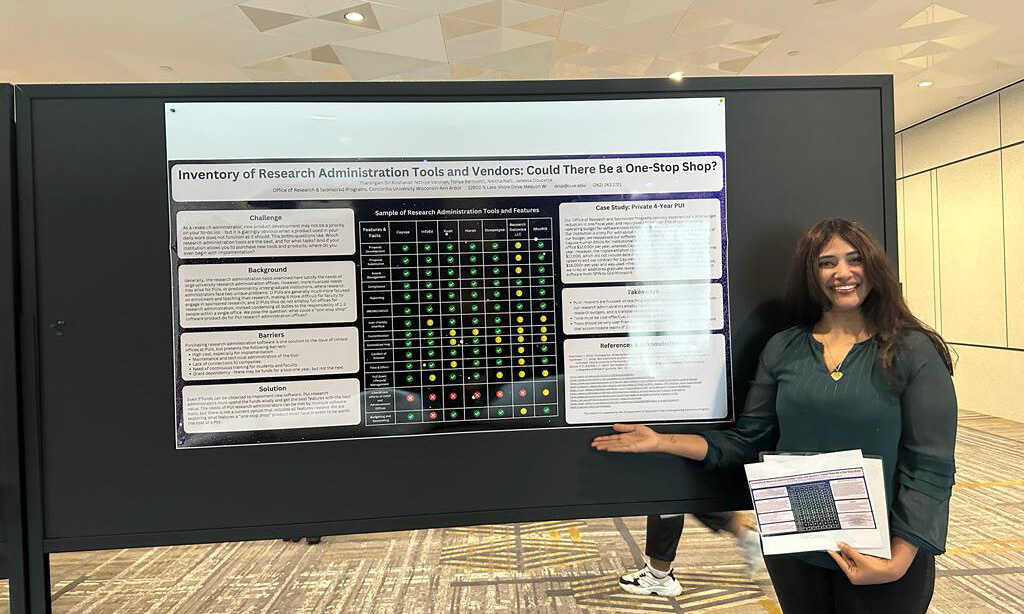
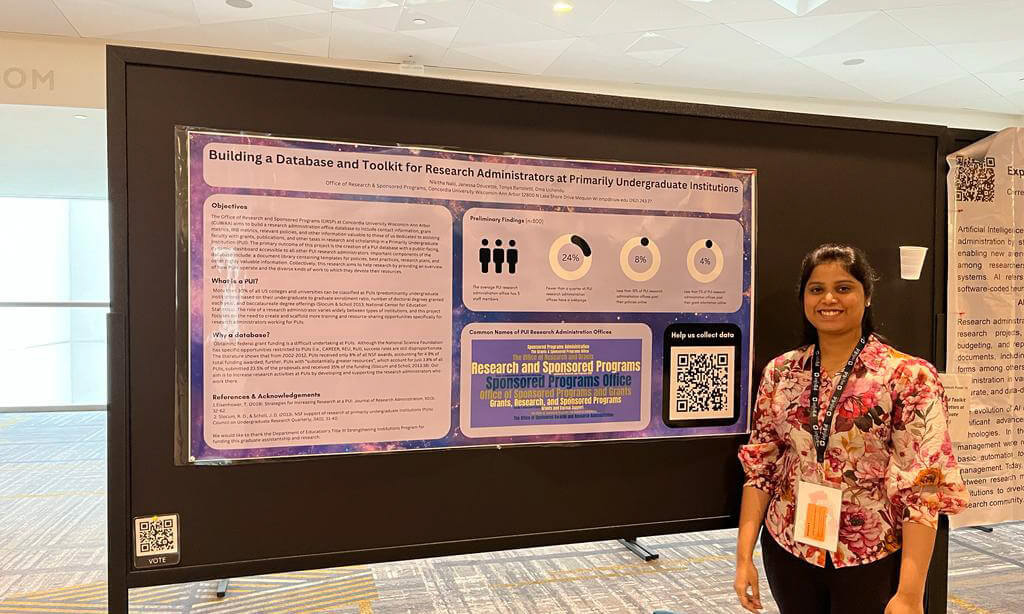
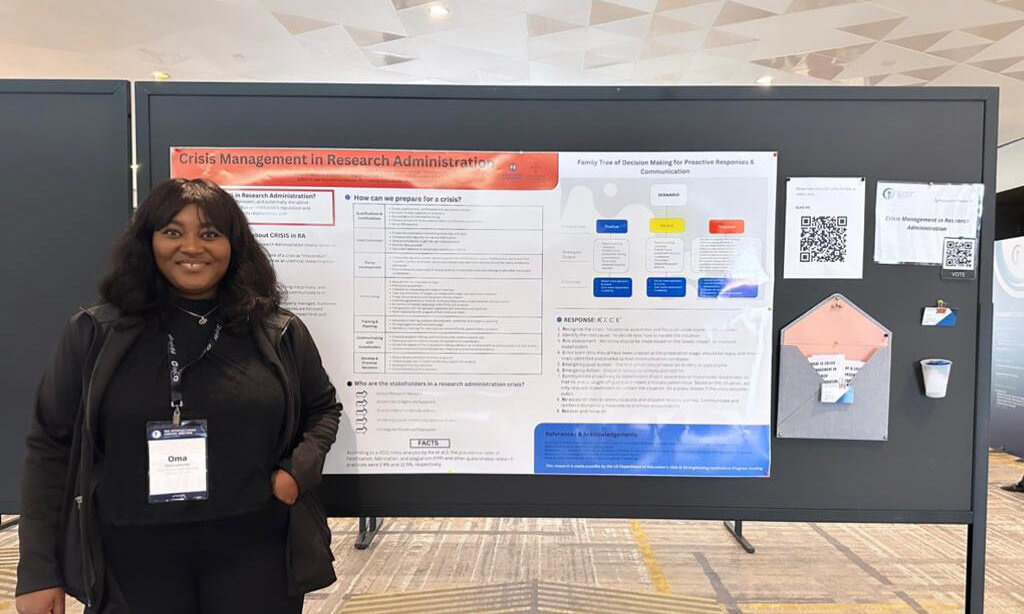
On the 15th of October 2023, three international students, graduate assistants from the CUWAA Office of Research and Sponsored Programs (ORSP), set out to present three research posters on varying subjects in research administration at the Society of Research Administrators International (SRAI) a global conference for researchers in Seattle, Washington. The presented posters got much traction from hundreds of audiences from different research institutes and professional expertise including industries in education, health, business, agriculture, and service rendering.  
Did you know?

Presenting a poster at a conference is a step towards thought leadership!

Thought leaders are well-informed in subject matters and considered experts. They are considered dependable sources who transform concepts into reality, inspire and influence people with their creative ideas, and demonstrate how others can replicate their success. 

Let’s try to demystify this subject by providing some clarity on presenting a research poster at a conference. 

Facts about presenting a research poster at a conference 

  • Students present research posters
  • Link up with other colleagues in varying organizations
  • Gain insights/ valuable inputs, and feedback
  • They are a great introduction to academic conferences
  • Networking & future collaborations
  • Career development & advancement
  • More credibility (in the subject matter poster is about)
  • Travel, explore, and make new connections
  • Free/future funding can be a huge possibility

(The three research poster presentations aforementioned in this post were made possible by the US Department of Education’s Title III Strengthening Institutions Program funding.) 


Want in?

So, are you interested in presenting your research at a professional conference, but aren’t quite ready to give a talk? Submitting a poster presentation is your best bet. Join ORSP on Thursday, Nov. 9 to learn the basics of how to design and make a poster that conference-goers will remember.

Click here to view full event details. Click below to register and begin your journey to thought leadership!  


Fulbright Scholar-in-Residence contributes to CUW’s pharmacy research

Meet Concordia’s Fulbright Scholar-in-Residence, Nickania Pryce, from Jamaica.


Concordia has welcomed Nickania Pryce, a Fulbright Scholar-in-Residence from Jamaica, to campus this year. This is the third time in the past decade that Concordia has been selected as a host institution for the prestigious Fulbright Program.

Founded in 1946, the Fulbright Program is the United States government’s flagship international academic exchange program which operates in over 160 countries worldwide. Each year, the Fulbright Board awards approximately 8,000 grants split roughly among 2,000 U.S. students, 4,000 foreign students, 800 U.S. university professors, and 1,000 visiting professors. On average, Fulbright awards a scholarship annually to only one out of every five applicants.

A Fulbright pharmacist

Altogether, Pryce will spend 10 months in the U.S. teaching within Concordia’s School of Pharmacy and assisting with research efforts alongside Terry Elinor-Reid, PhD, assistant professor of pharmaceutical sciences at CUW. Reid is an accomplished researcher who is also a native Jamaican. Reid’s research is currently focused on finding a cure for HIV through the use of computer-aided drug discovery technologies. The pair plan to explore latency reverse agents that can activate HIV latent reservoirs. The hope is to one day completely eradicate the virus through antiretroviral therapy.

Pryce says Reid’s research is new territory for her despite her decades of experience in pharmaceutical practice and a love of laboratory research.

“I’m learning a lot; it’s very exciting,” says Pryce. “I am really anticipating some great things coming out of this research.”

Mutually beneficial

Concordia faculty and students are learning a great deal from Pryce too. She brings new insights to lectures based upon her experiences with the health care system in Jamaica. These ideas spur conversations and help build cultural awareness among students and faculty alike.

“Being here helps me realize that we are doing some great things in Jamaica despite being a developing country,” says Pryce. “At the same time, the practices of Concordia’s pharmacy and the advancements that exist in the U.S., I can carry some of that back home. There’s a lot that we can learn from each other.”


Want in?

As a CUW pharmacy student, you can expect to participate in active applied learning throughout your degree program. Our accomplished faculty teach and mentor each individual student in a welcoming Christ-centered environment. Our highest priority is helping you develop your talents for a rewarding life, not only a career.


What do I need to know about research in a doctoral program?

One of the core components of earning a doctoral degree is truly embracing, understanding, and implementing the practice of research. The idea of research can be daunting to a student embarking on this path for the first time. Most importantly, students shouldn’t be afraid of research. Many students learn to love research once they dive in.

Why is research so important in a doctoral program? 

Preliminary research shows readers what has come before and why a topic is crucial and worth studying. Rather than learning content (like in traditional courses), research allows a student to analyze a subject in depth from many points of view. Students spend adequate time searching for and reading many articles contributing to their topic. Ultimately, they will then collect and analyze the research on a particular subject – contributing to the field in that specific topic.

What kind of research?

In short, a doctoral student will learn about the many different types of research. Broadly, there are two types: qualitative and quantitative. There are also mixed methods that combine the two. Within all, there are many topics – both elementary and advanced. Quantitative topics include inferential statistical tests and topics like correlation and modeling. Qualitative research comprises collecting descriptive data such as what they can discover in a focus group discussion.

Students are sometimes afraid of research because it’s new to them. The best advice is to embrace the opportunity to learn the various research components to pick the most appropriate methodology for the study. Some students prefer to answer a research question by statistically analyzing data. Other students need to investigate more in-depth behavior using techniques such as observations or interviewing. Students shouldn’t choose their research methods based on what techniques are the easiest – instead, they should decide what’s most appropriate to answer the research question best.

What is the goal of research?

The goal of research and, ultimately, the dissertation is to investigate an aspect of a particular topic that may have yet to be thoroughly analyzed. Sometimes, this may be specific to an area where a student works; other times, it’s more generalizable to a broader audience. The most important goal is that the research contributes to the body of literature and understanding of a particular topic so that others will learn and benefit from what was discovered or analyzed.

What happens after the research concludes?

The first thing is to congratulate yourself on a job well done! It’s a challenging task to move from a typical classroom student to an independent scholar directing your work. This concludes as a complete dissertation and presentation of what you learned. After that, consider disseminating your findings to a broader audience. Think about presenting to your colleagues or at a conference. Push yourself to publish your results in a journal. The hard work from your dissertation should benefit others and serve as your culminating project for your doctorate.

In the end, you’ll be happy you are finished, but you’ll also hopefully be pleased with the process and reflect on how much you learned as an independent scholar.

What’s next?

Are you interested in continuing education? If so, consider learning more about what the Doctorate of Education in Leadership program can do for you and your goals. 

International Education Week 2023

Learn about new cultures, try new foods, and meet new people! All during International Education Week: November 6-10.


Monday, November 6: India

9:30 a.m. | Chapel
• International Chapel Service including Flag Procession 
• Special message – Dr. Cario 
• Gospel choir 

9-9:30 a.m. & 9:50-10:15 a.m. | Outside of Chapel
• Global Café – India

12-1 p.m. | Siebert Dining Hall
• Lunch menu: Indian 
• Indian Music/Dancers

4-6 p.m. | Concordia International Center
• Indian Celebration – Food, Henna and fun activities 


Tuesday, November 7: Africa & African Diaspora

9-9:30 a.m. & 9:50-10:15 a.m. | Outside of Chapel
• Global Café – Africa

12-1 p.m. | Siebert Dining Hall
• Lunch menu: African 
• Live Lunch Music: Mr Lucky Diop & Kassumai African Troupe 

3-5 p.m. | Concordia International Center
• Jamaican Culture Workshop – 3-4 p.m.
• “Learning to Color Inside & Outside the Lines” – 4-5 p.m. 


Wednesday, November 8: Latin America

9-9:30 a.m. & 9:50-10:15 a.m. | Outside of Chapel
• Global Café – Costa Rica

12-1 p.m. | Siebert Dining Hall
• Lunch menu: Latin American
• Live Lunch Music: Latin Jazz – Isaiah and Company  

4-6 p.m. | Concordia International Center
• “Yes You Can!” – Study abroad – 3-4 p.m. 
• LSU Carnival – Latino Dance and Culture Workshop – 4:30 p.m. 


Thursday, November 9: Europe

9-9:30 a.m. & 9:50-10:15 a.m. | Outside of Chapel
• Global Café – Europe

12-1 p.m. | Siebert Dining Hall
• Lunch menu: European/German 
• Live Lunch Music: Carol & the Keynotes – Polka  

3:30-6 p.m. | Concordia International Center
• Austrian cultural workshop – 3:30-4:30pm  
• JED – Student Listening Sessions – 5-6pm 


Friday, November 10: Asia

9:30 a.m. | Chapel
• Special music – Chapel Choir (African language) 
• Multicultural Visit Day – Admissions 

9-9:30 a.m. & 9:50-10:15 a.m. | Outside of Chapel
• Global Café – China

12-1 p.m. | Siebert Dining Hall
• Lunch menu: Asian 
• Chinese Music & Artistry 

3:30-4:30 p.m. | Concordia International Center
• Chinese Writing & Art

5 p.m. | Terrace Room
• Operation Christmas Child Packing Party
• CAB & CIC


Operation Christmas Child

Throughout International Education Week, please consider donating to Operation Christmas Child in the barrels around campus. And then join us for the packing party on Friday! 


About the CIC

Welcome to Concordia from the International Center! Everyone in the Concordia International Center (CIC) has lived and studied abroad, so we get how long and confusing the process of becoming an International Student can be. That’s why we’re here to help, every step of the way.

Oh, for Keip’s sake: fish in trees, secret gardens, and little houses

The first in a series of adolescent literature recommendations by CUW students/future educators.


“Oh, for Keip’s sake” is a blog series dedicated to the sharing of books with people who care—books that are especially for people who work with adolescent readers. And maybe even a few adolescent readers as well.

Dr. Val Keiper has charged the students in his Adolescent Literature course to review and recommend their favorites in the hopes of encouraging a love of reading. Learn more about this blog series here.

Julia’s pick: Fish in a Tree by Lynda Mullaly Hunt

“I absolutely loved Fish in a Tree by Lynda Mullaly Hunt! Ally is a sixth grader who just can’t read. She is diagnosed with dyslexia with the help of her new teacher, Mr. Daniels (who is exactly the kind of teacher I want to be someday!). Along with her friends, Keisha and Albert, Ally slowly realizes that she can take on the world!” —Julia Schulteis

Ellie’s pick: The Secret Garden by Frances Hodgson Burnett

“A secretly wonderful classic, The Secret Garden is a classic written by Frances Hodgson Burnett. I know what you are thinking: “A classic, ugh!” But this classic is AMAZING. I had hesitations, of course, about this book, but it ended up being fantastic! I also would recommend listening to this book to fully understand the accents each character brings.

The Secret Garden starts out with Mary, a spoiled sad looking child living in India. Her parents both died, leaving her to move to Yorkshire to live in her uncle’s manor. It is a quite peculiar place. Hundreds of rooms that have been shut off, along with a garden following her aunt’s death 10 years ago. Mary’s uncle is barely around, and when he is he is shut off in his study. Mary soon becomes curious and starts discovering things. She is most curious about the garden. After a series of events, she finds the key and door to the garden. She allows Dickon, a friend of nature, into her secret. But one thing that Mary doesn’t understand is the crying at night. When she explores, she is told to get back in her room. Mary finally finds the source, her cousin, Colin, a sickly boy who believes he’s going to die. Mary tells him of the garden, and he slowly wants to go outside. Mary, Dickon, and Colin spend the summer growing in their own way.” —Ellie Lankey

Josie’s pick: Little House in the Big Woods by Laura Ingalls Wilder

“This book is based out of the woods of Wisconsin. This is about a family of five that lives in a log cabin in the woods. They lived a very basic life. The father went and worked out in the woods by finding food for the family. The MA fixed the food and took care of the children at home and worked and did the dishes. 

They tell stories about during the wintertime when no one could go outside and play. They talked about their daily life’s and how they had certain days for everything they do, and Sunday was the day of rest like in the bible. They found it hard to do nothing on Sunday. They also talked about how it worked when it was time to harvest the wheat.

I did not know that Laura Ingalls was born in Wisconsin, non the less that that book was based out of Wisconsin until now. I like these older books. I like how you can find out how life was in the olden days.  It was a very different way of living life and I find it interesting to how they did everything back then. It was a good reread book it had been a while since I read that book.” —Josie Zweifel


Want in?

The School of Education at Concordia University focuses on optimizing your abilities to serve students, schools, and the community through education. Program develop well-rounded educational professionals who can teach and lead in rural or urban communities, parochial or public settings. With a distinctly Christ-centered approach to our curriculum, engaging faculty who have plenty of real-world experience and passion for their subjects can help play a meaningful role in preparing you for your next step.


An introduction to Concordia students’ adolescent literature recommendations

Dr. Val Keiper, Family Life program director and long-time Elementary Education professor at Concordia, has charged his students with sharing their reading recommendations for youth.


Hello, and welcome to the first edition of “Oh, for Keip’s sake,” a blog series dedicated to the sharing of books with people who care—books that are especially for people who work with adolescent readers. And maybe even a few adolescent readers as well.

I’m Dr. Val Keiper, and I serve as the program director of CUW’s Family Life master’s program and a professor in the Elementary Education Department. Throughout my years (and years and years!) of teaching, I have observed that reading has all too often become one of those things that adolescents “have” to, rather than “get” to do. And often, when we tell them they “have to,” readers of a certain age shut down. 

Which is a problem because, first off, reading IS genuinely fun! Not only that, we know that it is one of the single most important contributor’s to a young person’s academic growth. One of my personal passions is connecting with my (adult) students about their favorite adolescent reads. My classroom at Concordia has a floor-to-ceiling wall of shelves filled with YA books, and I love striking up conversations with students about some of their favorites.

Sometimes all it takes is a little positive peer pressure. Excitement is contagious, and I try to show my excitement for reading as often as possible. So for my Adolescent Literature course this year, I’ve charged my students with sharing their excitement for reading beyond the walls of Concordia.

So…here goes: books for you, shared by my adolescent students, in no particular order.


Want in?

The School of Education at Concordia University focuses on optimizing your abilities to serve students, schools, and the community through education. Program develop well-rounded educational professionals who can teach and lead in rural or urban communities, parochial or public settings. With a distinctly Christ-centered approach to our curriculum, engaging faculty who have plenty of real-world experience and passion for their subjects can help play a meaningful role in preparing you for your next step.


Concordia’s enrollment growth shines in 2023 census report

Concordia University Wisconsin and Ann Arbor is celebrating overall enrollment growth this year, thanks to record-high numbers on its Michigan campus and an increase among new traditional undergraduate students and graduate populations in Mequon.


Recently released fall 2023 census data shows that CUWAA is up 4 percent in total enrollment from last year. Altogether, Concordia University Wisconsin and Ann Arbor serves 6,415 students, according to a third-Friday in September census snapshot.

“Concordia’s enrollment growth is due to a collective dedication to our university’s mission, as we nurture each student’s dreams and aspirations,” says Assistant Vice President of Enrollment Services Robert Nowak. “Our students feel this from the very first ‘hello.’ It is a blessing and a privilege to be entrusted to help students along the way. We know there is a lot of great things yet to come, and we continue to reach for new horizons.”

Greater graduate populations

On the Mequon side, CUW saw noticeable growth among its graduate populations, with 17 percent more students enrolled in 2023 than in fall of last year. Two programs that had the most noticeable jumps are:

  • Master of Science in Computer Science | 702 students in 2024, more than double last year’s count
  • Master of Science in Business Analytics | 85 students in 2024, up 68 students from last year

CUW provides a robust slate of graduate-level programs, with dozens of master’s degrees available to learners worldwide. Additionally, Concordia offers six doctoral options, more than any other Lutheran university in the nation. Learners can earn terminal degrees in pharmacy, physical therapy, occupational therapy, nursing practice, business administration, and leadership in innovation and continuous improvement.

New students, new transfer partnerships

The Mequon campus is also trending towards increases among its undergraduate population, as CUW welcomed more new students at the start of the academic year (550) than last year. New student counts include all incoming freshmen and transfer students. Numbers are tallied on the first day of the academic year as opposed to the third Friday in September.      

Nowak notes that CUW’s transfer student uptick is the result of new partnerships formed with various two-year colleges. The Office of Admissions, in tandem with Concordia’s Financial Aid Office has also increased scholarship offerings to attract the ever-growing transfer student population.

Learners from around the world

In 2022, Concordia’s Office of Admissions formed a dedicated department devoted to international admissions. The team has contributed to a boom in international enrollment at CUW. Prior to COVID, Concordia boasted the fourth-largest international enrollment of any college or university in Wisconsin. This year, international has more than doubled from Concordia’s highest count pre-pandemic. As of census, Concordia had 87 undergraduate international students enrolled and 1,097 graduate students.

Next week, the CUW will celebrate International Education Week, a joint initiative of the U.S. Department of Education and the U.S. Department of State. The goal of the global initiative is to promote programs that prepare Americans for a global environment and to attract future leaders from abroad to study in the U.S.

Growth without sacrificing quality and commitment to the university’s mission

While Concordia is dependent upon tuition dollars derived, in part, from enrollees, its driving force remains its commitment to “helping students develop in mind, body, and spirit for service to Christ in the Church and the world.” Results of a university-conducted survey administered to May 2023 graduates show the university is making good on its mission:

  • 92% of graduates agreed that they are better prepared to serve and lead by putting the needs of others first
  • 92% agreed that their academic program helped them to develop skills to be successful
  • 89% agreed that their time at Concordia helped them better understand their calling and purpose in life

Concordia welcomes learners of all religious backgrounds, but the university’s affinity to its Lutheran commitment is clear. As such, more Lutherans choose to enroll at CUW than any other Lutheran university nationwide. Results of the 2022-23 Concordia University System report, the most recent data available, show that CUW serves 1,099 Lutheran (any denomination) undergraduates and 541 Lutherans at the graduate level.   

Learn more fast facts about CUW here. Read about the enrollment celebrations of Concordia’s Ann Arbor campus here.


Want in?

Christ-minded. Ethical. Hard working. Respectful. Curious. Leader. While all our students are different, certain qualities unite our community and make us Concordians. We look forward to welcoming you to the ranks of our alumni.


Home is Where You (Try To) Park


There have been many changes during this school year at Concordia University Wisconsin. We have welcomed in a new president – and a mac-and-cheese bar – but not all of the changes are leaving students with feelings of excitement and positivity. Concordia has introduced new parking policies this year, leaving many students confused and frustrated.

Not only can your car now be towed at your expense for having a certain amount of violations, but for the first time in CUW history, commuters are being required to pay the $200 parking fee. A junior who is currently a commuter shared his frustrations about the abrupt change. When entering college, he made the choice to commute from a financial standpoint. He was still able to get a quality education from the college of his choice but skip some of the more sizable costs like housing and a meal plan.

When the fall semester was right around the corner, he was surprised to see the additional $200 parking fee. Since there was no email sent out during the summer, he was left to find an additional $200 within his budget to pay for an amenity that was previously offered for free. And, with his current class schedule, he is only on campus two days a week. That amounts to about six dollars every time he parks on campus. After bringing the concerns to an administrator on campus, they gave him a simple solution: just park your car at the hospital (1.3 miles from campus) and walk to your classes.

Commuters aren’t the only ones on campus who were surprised by these new policies. A graduate student was surprised to find a ticket on her car during the first week of classes. She had previously purchased a parking permit during the summer and was waiting to get her sticker to place on her car. As a graduate student, she would be getting a black sticker, allowing her to park on the surface lot. But lack of communication and a busy first week of school left her unsure of when to pick up her parking pass. Her car was safely backed in on the third floor of the parking structure. Since she had already purchased a parking pass, she was shocked when she was notified of a parking violation. When she returned to her car, she had noticed that many cars around her did not have stickers either. But something about these cars was different: they had no tickets on their windshields. She was confused but later learned that this was the same day that many of the commuter students got their first tickets.

There is a common theme between the stories of these students on campus. A general lack of communication and transparency. The commuter students were not informed about the hefty additional fee they would need to pay for the fall semester. Those who had ordered a parking pass online over the summer were not notified of a date when their pass would be ready to pick up. And, although campus safety generously provided a grace period before writing out tickets the first few days students were back on campus, they did not communicate when their grace period would end. This led to many students finding a ticket on their windshield the very first week of classes.

Another student that was affected is a senior who is a member of the residence life staff on campus. He received an email notifying him that he was ticketed for a surface parking violation. This in itself is not unusual. What is unusual is that he has a parking pass that allows him to park on the surface lot. As unusual as this is, this is not a new issue for many who have a car on campus. Many students have shared their frustrations with tickets and violations that they do not understand. Not only has there been an increase in students getting tickets, there still seem to be fewer available parking spots than what is needed. The parking structure and the surface lots are bursting at the seams and there is no sign of a solution.

If you have a vehicle on campus, it is very important to look over the parking policies. And make sure you know what surface lots you are allowed to park in if you have surface parking.


Students can share their parking concerns with the Student Government Association on campus.


— Grace Velzke is a writer and social media manager for The Beacon. She is a junior pursing a degree in Mass Communication with a minor in Business Communication.

Go for the gold…Vitality Gold!

Week 43

Spiritual wellness requires the same level of attention as the other pillars of health. Now that we are halfway through the semester, it’s a great time to ensure you are maximizing points for attending Bible Study or leading a Sunday School class.  Vitality awards 30 points weekly for attending Bible Study or leading Sunday School lessons. Snap a picture of your study or curriculum lesson and upload weekly!

Week 44

Do your mental health check-in for 225 points, if you haven’t already. With days getting shorter, it’s a great time to check-in and make sure you are prepared for ensuring a mentally healthy fall and winter season. Navigate to Health Profile/Vitality Review and scroll to Mental Well-Being Reviews. There are three short surveys to assess various components of mental wellness-each worth 75 points.

Week 45

Did you go to the dentist this year? If so, navigate to Health Profile/Vitality Review, select Prevention from the side-bar, and select the hyperlink for dental screening. Upload an EOB, medical record, proof of payment, or a completed Prevention Activity form(available from Vitality) to earn 200 points. (And remember, if you are on Concordia’s Plan, you need one cleaning per year to increase your benefit maximum for next year!)

Week 46

Fall Sports are coming to a close, and winter sports are kicking off! Parents- you are instrumental in developing healthy habits with your children and Vitality wants to reward you for it! You can earn up to 350 points per child for their completion of either a sports league, athletic event, practices or lessons. Navigate to Points/Points Planner and scroll down to Healthy Kids.

Week 47

Didn’t do your Biometric testing yet? There’s still time, and you have free testing options available!! Biometrics testing offers you the ability to amass a LOT of points very quickly-over 4,000 are available. Within Vitality, navigate to Resources/Guide to Vitality/Vitality Points/Vitality Check. There is a quick link that will pop up allowing you to schedule an appointment at a time convenient for you! (Or if you have the tests done with your doctor, be sure to get a printout of the numbers)

The scientific breakdown of fetal pain during utero development

Last week, the Concordia Center for Bioethics hosted a webinar featuring Dr. Katrina Furth, who shared how we all changed from one cell into organisms that can reason, remember, and relate to others.


As a senior biomedical sciences major and bioethics minor I made sure to be in the audience. Here’s a bit about what I learned.

About the speaker

Dr. Katrina Furth is an associate scholar at the Charlotte Lozier Institute in Washington, DC, which promotes science and statistics for pre-life causes. Since graduating with a PhD in Neuroscience from Boston University, she has worked as an adjunct professor at Catholic University in Washington, DC. She is also the lead author of the VoyageofLife.com website.

Dr. Furth addressed students and employees at Concordia University on Tuesday, Oct. 24 via a webinar that also reached many all over the country.

Definitions established

As any good argument does, Dr. Furth began her talk by explaining the differences in definitions used for the topic of fetal development. She described the confusion that surrounds the varying idea as to when life begins. According to her, the starting point of life occurs when a “unique living individual is formed.” Using this definition, her argument revolves around the idea that life begins at fertilization between the egg and sperm.

After establishing the meaning of her words, Dr. Furth moved into the meat and potatoes of her conversation by going over the timeline in which a fetus grows. As it develops, she highlighted anatomical stages of growth, such as structures necessary for the reception and awareness of pain, and the first detectable heartbeat. While it isn’t exactly clear when a fetus can feel pain, science is showing that it’s much earlier than the abortion deadline of 24-26 weeks gestational age. To add flavor to her talk, she also included visuals, one of those being a video captured by a 4D ultrasound which showed a fetus’ face in agony as its body was pierced by a needle containing anesthesia.

Application

To ensure the facts presented in her webinar could not be dismissed by those who are Pro-Choice, Dr. Furth left the religious aspect of fetal development at the door and strictly presented scientific facts with the hope that her Pro-Life stance would be powerful enough to dissuade those who listened from getting an abortion.

As someone who hopes to become a medical doctor one day, I found this talk enlightening as it equipped me with language and knowledge to utilize should the debate arise in my profession. While Dr. Furth did address certain times in which an abortion may be necessary, such as ectopic pregnancy, she also talked about the research scientists are conducting that would allow for the replanting of the zygote into the uterine lining. This procedure would be done as a way to maintain the life of the developing fetus as well as the mother.

After attending the talk, I am thankful to be attending a Christian university that instills moral ethics into the medical actions in which I hope to one day work with.


Want more?

The Concordia Center for Bioethics is a Christian academic center that applies God’s Word to issues involving biology and health care through teaching, service, and research. View the CCB website by clicking below.


—This article is written by Hunter Moore. He plans to graduate in May 2024 with a bachelor’s degree in biomedical sciences and a minor in bioethics.