CUW engineers cost-effective solutions for adaptive toys

Concordia University Wisconsin is putting its brand-new industrial engineering program and extensive 3D printer inventory to good use, collaborating with Penfield Children’s Center on a charitable project.


CUW engineering major Lucas Kearney recently helped to design an adaptive button for 3D printing within Concordia’s Makerspace. The button came at the request of Penfield Children’s Center, a nonprofit early education, health, and wellness center that offers services and family programming to more than 1,400 Milwaukee-area children annually. Penfield gifted the completed buttons to children attending their annual holiday party last Saturday.

What is an adaptive toy or device?
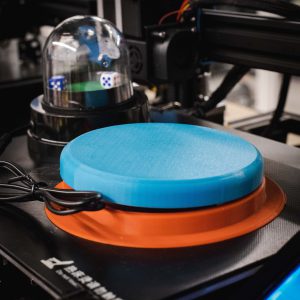
Adaptive toys or devices are every day items modified to accommodate a disability or fit a specific therapeutic need. The adaptive button that Kearney designed, for example, is a larger version of a tabletop push button that can be easily navigated by a child with disabilities or developmental delays. The button contains a connector that can then be plugged into an auxiliary jack to trigger a toy or device.

While adaptive toys have proven successful within the therapeutic realm, they often come with a hefty price tag. Vladimir Bjelic, a speech-language pathologist who works at Penfield, says an adaptive toy can cost anywhere from 200 percent to 300 percent more than a non-adaptive toy. Penfield has been able to reduce the price of the adaptive toys they use at their center by partnering with local school groups to have “build days.”  

Concordia’s 3D printing contributions could help further reduce costs for Penfield in the future. The buttons CUW printed cost between $1-$6 per unit, compared to the $40-$100 cost Penfield had been paying. The buttons were the first venture between Concordia and Penfield. However, Bjelic says he is eager to explore more partnership opportunities in the future. 

3D printing for therapeutic needs

Concordia’s Makerspace hosts the largest collection of 3D printers of any nonprofit organization in the state. As such, it has tremendous capacity to serve the community. In 2020, Concordia notably put its inventory to good use by printing much-needed PPE amid the coronavirus pandemic.

Since then, Assistant Professor of Computer Science Yiming Liao, who oversees the space, has expanded the lab’s applications. He has partnered with faculty from Concordia’s School of Health Professions to design and print other adaptive equipment for clients of the PT/OT Community Clinic, including an adaptive video game controller and an adaptive hair braiding tool.

Launching industrial engineering
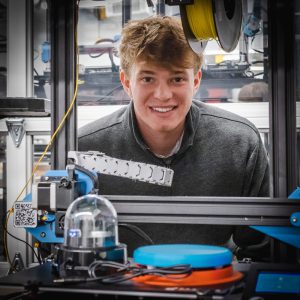
Concordia announced last November its plans to launch two bachelor’s degrees in engineering. In July, the university hired Dr. Subha Kumpaty to helm the new programs. While the programs’ scheduled start isn’t until next fall, some students already decided to commit to the major.

Kearney, who helped design the adaptive button for Penfield, is a freshman at CUW from Tinley Park, Illinois. As a high schooler, Kearney knew his eventual career track would involve something in the medical or engineering fields. When Concordia’s Head Baseball Coach Eddy Morgan recruited him to play for the Falcons, Kearney decided on CUW, even though the university didn’t have the full gamut of programs offerings he was weighing. Upon admission, he declared as a nursing major. However, he quickly switched once he learned about Concordia’s plans to launch the engineering programs.

“Thanks to Dr. Kumpaty, I’m already involved in a lot of opportunities, including an internship in the field,” Kearney said. “I’m super impressed by him. Not only does he have the brains to run a new program, but he has the expertise to understand the application of the subject in the real world.”


Want in?

Concordia University Wisconsin now offers bachelor’s degrees in chemical or industrial engineering. The programs will officially launch in fall 2024; however, applications are now being accepted for a pre-engineering track.

CUW’s engineering programs are distinct in the marketplace because they are anchored in the liberal arts and designed to prepare engineers through a Lutheran-Christian worldview. Students will hone their science, math, and technology skills for success in their vocation. And they will also deepen their people- and critical-thinking abilities to solve problems and contribute to a better world.

Church worker, Lutheran enrollment is strong at CUW

Within the Concordia University System, Concordia University Wisconsin and Ann Arbor continues to serve the most Lutheran students and the largest population of church work students for the LCMS, according to the fall 2023 CUS report.


Concordia University Wisconsin and Ann Arbor is a proud member of the Concordia University System (CUS). This nationwide network of Concordias consists of six members – with locations in Ann Arbor, California, Chicagoland, Mequon, Minnesota, and Nebraska. While each institution of higher education is independently governed and operated (outside of CUW and CUAA), all hold a shared fidelity to the teachings of The Lutheran Church-Missouri Synod. Together, these Concordias are continuing the good work of raising up future leaders for the LCMS and beyond.

Each fall, the CUS releases an enrollment report for its member institutions. The fall 2023 report shows that the Mequon campus alone serves 215 undergraduate students who are pursuing degrees in church work fields – more than any other LCMS university nationwide. CUW also serves the greatest number of rostered church workers at the graduate level. Meanwhile, for the fourth straight year, the Ann Arbor campus’s total church work population increased, demonstrating promising forward momentum.

Church work highlights

CUW

  • The largest pre-seminary population in the CUS
  • The sole Director of Church Ministry (DCM) program in the CUS (CUW’s DCM program enrolls more students than any equivalent program in the system)
  • 124 rostered church workers at the graduate level, twice as much as the next-largest population
  • 4 church work-specific scholarships
  • 97 church work endowments (awarded annually)
  • $804,000 awarded to church workers in 23-24
  • $26,000 – average aid awarded

CUAA

  • The sole Family Life Ministry program in the CUS
  • The only STEPS program (a paid internship program for undergraduate church workers)
  • A 10:1 church work student-to-faculty ratio
  • 4 church work-specific scholarships
  • 63 church work endowments (awarded annually)
  • $200,000 awarded to church workers in 23-24
  • $26,000 – average aid awarded

Lutheran learners

The fall 2023 CUS report also shows the vibrancy of CUWAA’s efforts to prepare future Lutheran leaders for the world, whether as a church worker or through a non-rostered vocation.

CUW and CUAA together enroll 1,917 students at the undergraduate and graduate levels who are declared Lutheran (any denomination).

Other highlights include:

CUW

  • 1,099 Lutheran students at the undergraduate level (largest in the CUS)
  • 541 Lutheran students at the graduate level (largest in the CUS)

CUAA

  • 90% of the undergraduate population declared Christian (largest in the CUS)
  • 20% of the total population declared Lutheran (third-largest in the CUS)

Want in?

We invite you to explore whether God is calling you to join the ranks of CUWAA alumni who serve Christ as church workers throughout the world. Each campus offers more than a dozen majors that distinctly prepare learners for church work. Explore your options by clicking below.


CUW student seeks to honor father through social work career

Giselle Torres’s father immigrated to America as a teenager. A social worker helped him along the way. Now, Giselle is pursuing a career in the field.


Giselle Torres doesn’t often have heart-to-heart conversations with her father. It’s not that she feels his love and support any less as a result; he just tends to show his affection in ways other than verbal affirmations.

But on a November morning in 2021, the conditions were right for the father-daughter duo to have a meaningful chat, and it couldn’t have come at a more opportune time.

The Horicon native had stumbled through a COVID-ridden end to her high school tenure, started college at Concordia University Wisconsin in a still-altered social environment, and was feeling a bit lost. She wasn’t sure what she wanted to do with her life. She tested the waters with a few classes her freshman year at CUW, but nothing felt right until she enrolled in an introductory social work class. 

Career options abound within the social work field

Prior to this class, Giselle admits that she had a narrow understanding of the social work profession.

“I thought it was just Child Protective Services,” Giselle says. “I didn’t realize all of the different options a person had within the social work field.”

She was newly learning about the profession when she traveled to her home over Thanksgiving Break and joined her dad for one of their favorite seasonal traditions: deer hunting.

“It was around 4 a.m. and we were sitting in the tree stand together. Everything was calm and quiet, and we had the chance to just kind of whisper conversation to each other,” Giselle explains.

In the midst of the quiet, Giselle’s father asked a question that was uncharacteristically probing for him: “What are you thinking of doing with your life?” He knew Giselle was struggling to find her footing. That’s when Giselle began to share about her social work class. To her surprise, her father knew all about the profession.

“He told me, ‘You know, a social worker helped me on my citizenship journey,’” Giselle recalls.

Immigration journey

Both of Giselle’s parents immigrated to America as teenagers. Her father traveled from Mexico to California at age 17. He spoke very little English at the time, and the only person he knew was his brother who had joined him on the journey to citizenship.

Having not even completed high school, Giselle’s father found work as a laborer. He attended night classes to earn his high school diploma and become more fluent in English. Eventually, work took him to Horicon, Wisconsin.

“He had to start from the bottom and work his way up,” Giselle says. “Both my parents have gone through so much to get me and my sister to where we’re at in our lives.”

Her parents worked hard to navigate the citizenship process too. Giselle’s father shared with his daughter how much the help of a social worker had meant to him during that journey. This was enough to solidify Giselle’s career plans.

Giselle is currently interning with Lutheran Social Services in Milwaukee and is helping with their refugee resettlement program. She plans to graduate in May 2024 with her bachelor’s degree in social work.

In Giselle’s opinion, there is no better way to honor her parents than to show kindness and care to others who are in a place where they once found themselves.

“Everything I’m doing is partly for my parents, because it’s their hard work that I’m honoring,” says Giselle. “It’s their pride that I’m carrying.”


Want in?

Concordia’s social work program uses Christian service, quality research, and hands-on learning to grow you as a competent professional. Earn your bachelor’s degree at CUW and then continue on to acquire an MSW, the most sought-after social services degree. Learn more about our programs by clicking below.


Concordia prof contributes to new form of RNA folding research methodology

Jeff Potratz, PhD, has put his scholarship pursuits into high gear over the past year thanks in large part to a semester-long sabbatical to pursue a new methodology for RNA folding that utilizes fluorescence instead of radioactivity.


Potratz serves as an associate professor of physical sciences at CUW. He earned his terminal degree in biochemistry from the University of Texas at Austin (UTA) in 2012. This past spring, Potratz took a leave of absence from his teaching responsibilities at Concordia to return to his alma mater. There, he worked alongside his doctoral mentor, Rick Russell, to investigate ribonucleic acid (RNA) folding.   

RNA folding

RNA is a molecule similar to DNA but it most often presents in a single-stranded form. For decades, researchers have investigated RNA for its implications on regulating gene expression.

Potratz was specifically interested in the RNA, Tetrahymena Ribozyme, which has long been used as a model system to study RNA folding and typically requires the use of radioactivity. For one to conduct research with radioactivity it requires a license that ensures an intense standard of security measures are met. It is common for larger research universities like UTA to have a radioactivity license, but it is much rarer for mid-sized or smaller universities to have one, making this type of research virtually unfeasible at a majority of the nation’s higher education institutions.  

While Potratz needed radioactivity to validate his research, his ultimate goal was to find an alternative method of researching the Tetrahymena Ribozyme – one that didn’t require an expensive license.

“My goal was to take the molecule and shift it into something we can work with here at Concordia,” Potratz said. “It worked better than I would have even thought. The implications for this now are that students at CUW can begin to do this high-caliber research right on our premises.”

Last month, Potratz’s research publication on Tetrahymena Ribozyme folding went live. Click here or below to read the publication.

Instilling a love of research among students

Research is a laudable pursuit for numerous reasons, not least of which is the skillsets it develops for those who undertake it. This is why Potratz and many other professors at Concordia actively seek out students who have the acumen for research and encourage them to consider participation in it.

“It really allows students to see what research looks like – the successes, but more often the struggles,” said Potratz. “There are lessons to be learned in struggles too. The attention to detail you need to have, the collaboration it requires, and a true understanding of what is happening in this little test tube. All of it is tremendous practice for students.”

Paige Russell, a May 2023 graduate, received the opportunity to step into research last fall. Russell earned her bachelor’s in biomedical sciences and is currently applying to PA programs. Potratz approached her with the prospect of contributing to his research using Desmos software. Initially released in 2011, Desmos is an advanced graphing calculator implemented as a web application.

Following lessons shared with his biochemistry classes utilizing the software, Russell led focus groups and interviewed students to collect data. At the end of the discovery and refinement process, Russell and Potratz ended up with a lesson plan that the Journal of Chemical Education published.

“Honestly, I didn’t think I would ever do research before Dr. Potratz asked me,” Russell said. “The personalized nature of this particular research, being able to have the conversations with Dr. Potratz, and just learning how to interact with peers in a scholarly manner was really helpful to me.”

Click here or on the image below to view their publication.


Want in?

Concordia’s Department of Physical Sciences has mission-driven professors who are experts in their field and who actively participate in myriad research opportunities. These individuals take a hands-on approach to learning, and help prepare students for vocations in research, education, graduate studies, and much more. 


CUW has largest international enrollment of WI private colleges

Concordia University Wisconsin’s international student enrollment contributes $22.1 million to the state’s economy, more than any other private college in Wisconsin, according to the recently released 2023 Open Doors Report on International Education Exchange.


CUW now sits at third on the list of Wisconsin colleges where international enrollment has an impact on the state. This is the first time ever that Concordia’s 2022-23 international enrollment surpassed that of Marquette University. The 2023 Open Doors Report looks at school enrollment data from 2022-23.    

About the Open Doors Report on International Education Exchange

The Open Doors Report provides a critical benchmark on the state of international and U.S. higher education student mobility. The U.S. Department of State’s Bureau of Educational and Cultural Affairs (ECA), along with the Institute of International Education (IIE), annually release the report during International Education Week, which Concordia celebrated a week early this year.

According to the report, CUW’s 2022-23 international enrollment also supported 214 jobs in Wisconsin. Nationwide, international students studying at U.S. colleges and universities contributed $40.1 billion and supported 368,33 jobs to the U.S. economy. For every three international students, one U.S. job is created and supported by spending occurring in the higher education, accommodation, dining, retail, transportation, telecommunications, and health insurance sectors.

Concordia’s reported international enrollment in 2022-23 was 659 students. This year, that total has nearly doubled.

Scenes from CUW’s International Education Week celebration

CUW opted to celebrate International Education Week (IEW) early this year to allow staff opportunity to travel to Concordia’s Ann Arbor campus and join in IEW festivities there.

Click below to view a gallery of photos from the week’s activities on the CUW campus.


About the Concordia International Center

Care to learn more about the Concordia International Center (CIC)? Everyone in the CIC has lived and studied abroad at some point in their lives, so they get how long and confusing the process of becoming an international student can be. That’s why they’re here to help, every step of the way.

How these Army veterans are rising in the ranks with a DBA from CUW

Wisconsin veterans, you might have more military benefits available to you than you think! Learn how these Army veterans capitalized on military benefits to earn their DBA.


Ryan Moore at Bagram Airfield, Afghanistan in 2014.

Ryan Moore, of Neenah, enlisted in the U.S. Army directly after graduating from high school. He says he didn’t have the emotional maturity at the time to tackle higher education. He certainly didn’t think he would engage in much more than a few years of schooling beyond what was required.

Now, after 17 years of military service, he has three degrees under his belt – one bachelor’s and two master’s degrees – and he’s en route to his fourth degree, a Doctor of Business Administration from Concordia University Wisconsin.

Capitalizing on military benefits

Ryan Moore

Suffice it to say Moore has morphed into a man who makes the most of his opportunities and potential. It’s surprising then that he almost unwittingly left some of his earned military benefits on the table.

When he began to research doctoral programs a couple of years ago, he was prepared to pay out of pocket for the terminal degree.

“I assumed I had maxed out the credits available to me under the GI Bill at that point,” Moore said.

“As a veteran, if you’re interested in a school or a program, really be sure to check in on the benefits,” he continued. “If not at the school, then check in with your county representatives. Sometimes you just don’t know until you reach out.”

It wasn’t until Moore began the application process at Concordia and connected with CUW’s Veteran Services Office that he learned about a 2020 bill Gov. Tony Evers passed. The Wisconsin Veterans Grant for Private Non-Profit Schools extends similar benefits as the WI GI Bill to private and independent universities in the state.

Professional advancement

This grant, combined with Concordia’s extremely generous military credit transfer policy, has allowed Moore to rise in the ranks as a civilian. Over the summer, he landed a new job as Director of Human Resources and Operations at Northwestern Mutual. He had just enrolled in CUW’s DBA program when he was interviewing for the position. Undoubtedly, his doctoral pursuit helped push his name to the top of the candidate list.

“It shows that I take my education very seriously,” Moore said. “It offers me a specialized set of skills that I’m able to put towards this company. Especially within HR, it’s important to be that scholar-practitioner and understand why we do what we do.”

Like Moore, other veterans have flocked to CUW’s DBA program as a way to help them advance their careers. James Trazile and CJ James, both U.S. Army veterans, are anticipating the degree will open doors to new job prospects in the government realm.

Trazile served eight years in the U.S. Army and left active duty this past summer. He now works as a Rating Veterans Service Representative for the U.S. Department of Veterans Affairs (VA).

“The DBA definitely opens up better prospects for me,” Trazile said. “The VA has many opportunities once I earn that degree.”

CJ James

James, a Milwaukee native, echoed Trazile’s sentiment. She currently serves as a civilian in human resources at the Milwaukee Recruiting Battalion. She ended her term of active duty in 2013 after 10 years with the Army.

“With the federal government, you can apply for higher-level jobs with a doctoral degree,” she said. “The fact that Concordia’s DBA is online makes it as convenient as possible for me to earn my degree without interfering too much with my work life and my responsibilities as a mom.”

The Concordia DBA difference

James Trazile

For all three military veterans, the online format of CUW’s DBA program was a key part of their decision to enroll. 

Trazile presently lives on the East Coast. However, the Haitian native considers Wisconsin his home and he’d eventually like to return to the Badger State.

Even from afar, Concordia has provided a hospitable environment for him.   

“Every time I come back to campus I always feel welcome and I always feel like it is somewhere I belong. I started my Concordia journey as an MBA student, and I wanted to continue to be a part of the Concordia family through the DBA program.”

When push came to shove, the convenience of an online program ultimately won out for Moore as well. He had plenty of options when it came to earning his doctorate. He was seriously considering a PhD from the University of Notre Dame for a while, but his commitment to his family and raising two young children made it difficult for him to justify relocating to Indiana for a degree. He’s been pleased to find that the quality of CUW’s program has lived up to his standards of excellence.

Moore cited additional selling points for the CUW program:

  • Access to experts: “I have a research advisor with whom I get to meet regularly. This individual is clearly an expert in the field. …I ran into Drs. (Matt and Laura) Hurtienne at the most recent Society for Human Resource Management (SHRM) state conference. I think they were presenters. It makes a big difference to have direct access to people who know their stuff.”
  • Curriculum above the curve: “(This program) really immerses you in all the theories and latest research. All the data that Concordia has shown me, I truly believe that this program is above the curve, and it probably will be the next MBA.”
  • Online, but not impersonal: “With some of my previous (online graduate) experiences, I didn’t meet my cohort until I walked, but with Concordia I really appreciated getting to know people before we even started this journey.” While Concordia’s DBA program is online, there are two requisite on-campus residencies at the start and midway through the program to encourage relationship building and networking. 
  • Solid care and support: “I’ve just been blown away by the support and the generosity at Concordia. People are so nice, and I’ve been so impressed with everyone I’ve interacted with at Concordia.”

Want in?

If you’re feeling inspired to earn your doctorate, learn more about Concordia’s DBA by clicking below.


When disaster strikes, CUW nursing students are prepared to respond

Last week, junior nursing students at Concordia participated in a full-scale disaster simulation. The exercise was meant to equip students to respond in a swift, competent, and cooperative manner should a real scenario arise.

*Content warning: This post contains images that may appear graphic. Please note that these are simulated wounds and scenarios.


Under the direction of CUW Nursing Simulation Lab Coordinator Tina Gaffney, MSN, RN, about 12 students participated in the first of two days of a disaster simulation on Friday, Nov. 3.

A handful of faculty members and former students served as actors during the drill in order to more fully simulate the emotions that could be present at a disaster scene. The exercise presented students with a scenario involving a chemical explosion in a researcher’s laboratory. Students needed to appropriately triage the situation and respond to the needs presented.

At the conclusion of the disaster simulation exercise, students debriefed the experience. Beyond the emotional component of care, students must learn essential critical thinking skills under, sometimes, high-stakes conditions.

“Prevention and preparedness are essential parts of our students’ training,” said Gaffney. “Students need to practice these skills, ideally before a human life is at stake. By design, simulation exercises help students experience learning in a way that attempts to closely mimic what they could face someday.”

Students in the nursing program at CUW begin simulation practice in their sophomore year. Skills practice and clinical placements are also added in year two. Simulation exercises cover areas such as:

  • End-of-life procedures
  • Medication administration
  • IV, tracheostomy care, and suctioning
  • Poverty care/navigating the health care system
  • CODE scenarios

Disaster simulation scenes


Want in?

The School of Nursing is dedicated to providing a rigorous Christ-centered education that develops and inspires highly skilled professional nurse leaders who are prepared to serve diverse communities with excellence, truth, integrity, and compassion to promote health and healing.


Fulbright Scholar-in-Residence contributes to CUW’s pharmacy research

Meet Concordia’s Fulbright Scholar-in-Residence, Nickania Pryce, from Jamaica.


Concordia has welcomed Nickania Pryce, a Fulbright Scholar-in-Residence from Jamaica, to campus this year. This is the third time in the past decade that Concordia has been selected as a host institution for the prestigious Fulbright Program.

Founded in 1946, the Fulbright Program is the United States government’s flagship international academic exchange program which operates in over 160 countries worldwide. Each year, the Fulbright Board awards approximately 8,000 grants split roughly among 2,000 U.S. students, 4,000 foreign students, 800 U.S. university professors, and 1,000 visiting professors. On average, Fulbright awards a scholarship annually to only one out of every five applicants.

A Fulbright pharmacist

Altogether, Pryce will spend 10 months in the U.S. teaching within Concordia’s School of Pharmacy and assisting with research efforts alongside Terry Elinor-Reid, PhD, assistant professor of pharmaceutical sciences at CUW. Reid is an accomplished researcher who is also a native Jamaican. Reid’s research is currently focused on finding a cure for HIV through the use of computer-aided drug discovery technologies. The pair plan to explore latency reverse agents that can activate HIV latent reservoirs. The hope is to one day completely eradicate the virus through antiretroviral therapy.

Pryce says Reid’s research is new territory for her despite her decades of experience in pharmaceutical practice and a love of laboratory research.

“I’m learning a lot; it’s very exciting,” says Pryce. “I am really anticipating some great things coming out of this research.”

Mutually beneficial

Concordia faculty and students are learning a great deal from Pryce too. She brings new insights to lectures based upon her experiences with the health care system in Jamaica. These ideas spur conversations and help build cultural awareness among students and faculty alike.

“Being here helps me realize that we are doing some great things in Jamaica despite being a developing country,” says Pryce. “At the same time, the practices of Concordia’s pharmacy and the advancements that exist in the U.S., I can carry some of that back home. There’s a lot that we can learn from each other.”


Want in?

As a CUW pharmacy student, you can expect to participate in active applied learning throughout your degree program. Our accomplished faculty teach and mentor each individual student in a welcoming Christ-centered environment. Our highest priority is helping you develop your talents for a rewarding life, not only a career.


Concordia’s enrollment growth shines in 2023 census report

Concordia University Wisconsin and Ann Arbor is celebrating overall enrollment growth this year, thanks to record-high numbers on its Michigan campus and an increase among new traditional undergraduate students and graduate populations in Mequon.


Recently released fall 2023 census data shows that CUWAA is up 4 percent in total enrollment from last year. Altogether, Concordia University Wisconsin and Ann Arbor serves 6,415 students, according to a third-Friday in September census snapshot.

“Concordia’s enrollment growth is due to a collective dedication to our university’s mission, as we nurture each student’s dreams and aspirations,” says Assistant Vice President of Enrollment Services Robert Nowak. “Our students feel this from the very first ‘hello.’ It is a blessing and a privilege to be entrusted to help students along the way. We know there is a lot of great things yet to come, and we continue to reach for new horizons.”

Greater graduate populations

On the Mequon side, CUW saw noticeable growth among its graduate populations, with 17 percent more students enrolled in 2023 than in fall of last year. Two programs that had the most noticeable jumps are:

  • Master of Science in Computer Science | 702 students in 2024, more than double last year’s count
  • Master of Science in Business Analytics | 85 students in 2024, up 68 students from last year

CUW provides a robust slate of graduate-level programs, with dozens of master’s degrees available to learners worldwide. Additionally, Concordia offers six doctoral options, more than any other Lutheran university in the nation. Learners can earn terminal degrees in pharmacy, physical therapy, occupational therapy, nursing practice, business administration, and leadership in innovation and continuous improvement.

New students, new transfer partnerships

The Mequon campus is also trending towards increases among its undergraduate population, as CUW welcomed more new students at the start of the academic year (550) than last year. New student counts include all incoming freshmen and transfer students. Numbers are tallied on the first day of the academic year as opposed to the third Friday in September.      

Nowak notes that CUW’s transfer student uptick is the result of new partnerships formed with various two-year colleges. The Office of Admissions, in tandem with Concordia’s Financial Aid Office has also increased scholarship offerings to attract the ever-growing transfer student population.

Learners from around the world

In 2022, Concordia’s Office of Admissions formed a dedicated department devoted to international admissions. The team has contributed to a boom in international enrollment at CUW. Prior to COVID, Concordia boasted the fourth-largest international enrollment of any college or university in Wisconsin. This year, international has more than doubled from Concordia’s highest count pre-pandemic. As of census, Concordia had 87 undergraduate international students enrolled and 1,097 graduate students.

Next week, the CUW will celebrate International Education Week, a joint initiative of the U.S. Department of Education and the U.S. Department of State. The goal of the global initiative is to promote programs that prepare Americans for a global environment and to attract future leaders from abroad to study in the U.S.

Growth without sacrificing quality and commitment to the university’s mission

While Concordia is dependent upon tuition dollars derived, in part, from enrollees, its driving force remains its commitment to “helping students develop in mind, body, and spirit for service to Christ in the Church and the world.” Results of a university-conducted survey administered to May 2023 graduates show the university is making good on its mission:

  • 92% of graduates agreed that they are better prepared to serve and lead by putting the needs of others first
  • 92% agreed that their academic program helped them to develop skills to be successful
  • 89% agreed that their time at Concordia helped them better understand their calling and purpose in life

Concordia welcomes learners of all religious backgrounds, but the university’s affinity to its Lutheran commitment is clear. As such, more Lutherans choose to enroll at CUW than any other Lutheran university nationwide. Results of the 2022-23 Concordia University System report, the most recent data available, show that CUW serves 1,099 Lutheran (any denomination) undergraduates and 541 Lutherans at the graduate level.   

Learn more fast facts about CUW here. Read about the enrollment celebrations of Concordia’s Ann Arbor campus here.


Want in?

Christ-minded. Ethical. Hard working. Respectful. Curious. Leader. While all our students are different, certain qualities unite our community and make us Concordians. We look forward to welcoming you to the ranks of our alumni.


CUW alumni discuss applications for new Interprofessional Clinic


Concordia’s School of Health Professions hosted an alumni and community engagement event aimed at assessing the physical health and care needs of Ozaukee County and beyond.


Tonight’s “Creating Community Collaborations” event not only gave School of Health Professions faculty a chance to showcase Concordia’s new Interprofessional Clinic; it also provided faculty and staff with an opportunity engage participants in focus group discussions to determine if there are unmet needs in the community that Concordia can play a role in addressing.

Already Concordia students, under the supervision of licensed professionals, provide quality health and social care services to dozens of community clients on an ongoing basis. These services include the decades-running Occupational Therapy/Physical Therapy Community Clinics. Various other School of Health Professions programs have plans to utilize the space as well.

Concordia looks to supplement the services clients may receive at health care systems throughout the state. The CUW operation places a special focus on serving the underserved through free or reduced-price services.

If you were unable to attend the event but would like to share your thoughts on unmet needs in the community, please click on the link below.


Want in?

The School of Health Professions at CUW offers a range of professional programs and degrees at the bachelor’s, master’s, and doctoral levels. Whether you pursue your education through online instruction or through classroom learning, you can expect a distinctive learning environment that will prepare you for a career marked by excellence, compassion, and service. Health Professions undergraduate students also participate in the Concordia Core, a rigorous, liberal arts curriculum integrated with Lutheran distinctives.