Former Milwaukee Mayor Tom Barrett Reflects on Time as U.S. Ambassador to Luxembourg

Former Milwaukee Mayor and U.S. Ambassador to Luxembourg Tom Barrett visited Concordia University Wisconsin Oct. 16 to discuss his experiences representing the United States in one of Europe’s most innovative nations.


Barrett, who served as Milwaukee’s mayor for 18 years and previously represented Wisconsin in the U.S. Congress, shared stories and lessons from his three-year diplomatic post, describing Luxembourg as “a small country with a big footprint.”

From Farmland to Space

Barrett traced Luxembourg’s transformation from an agricultural society to a modern powerhouse of finance and space technology. “They threw the dice in the 1960s, thinking, agriculture has gone away, steel is going away. What do we bet on next? And the next bet was the finance industry. But then, going back again to the late 1980s, that’s when they made the decision as a government that they wanted to get into the space industry.”

He explained how Luxembourg became home to SES, “the largest satellite company in the world,” and how it established a national space agency to support private innovation and mineral rights in outer space. “They made the decision then after that also to create a space agency within the government. And they along with the United States passed legislation that dealt with ownership of minerals in space to really set the benchmark so that you had incentives for people, private companies, and others to do the exploration.”

Barrett said Luxembourg’s willingness to take calculated risks has paid off. “They’re professional gamblers when it comes to the country,” he said. “It’s an amazingly wealthy country. Per capita, number one, number two, number three, depending on how people do it, but it is way up there.”

From Farmland to Space

Barrett emphasized the strong bond between Luxembourg and the U.S. “They love the United States. They want to be with us on just about anything they can, particularly when it relates to finance or space exploration, because they trusted us. They trusted us immensely.”

Former Milwaukee Mayor and U.S. Ambassador to Luxembourg Tom Barrett makes a point during his speech at CUW.

He also highlighted Luxembourg’s participation in international agreements such as the Artemis Accords, which outline principles for cooperative space exploration. “It was led by the United States and the State Department and NASA,” Barrett said. “But one of the original signers to this was Luxembourg because again they want to be, as I would describe it sometimes, the big kid on the block.”

A Culture of Peace and Perspective

Reflecting on the country’s modern stability, Barrett said, “Because of NATO, because of our investment there, because of what happened, Luxembourg has endured its longest period of peace in over 300 years. Eighty years without a war.”

He also noted that the memory of past occupation still shapes Luxembourg’s worldview. “They have much more of a sensitivity, for example, when Russia invaded Ukraine, because as people would say to me, you as an American don’t understand what it’s like to have another country occupy you. We understand that.”

Multilingual, Modern, and Financially Disciplined

He described Luxembourg as “the most multilingual place I’ve ever been in my life,” saying that “over half of the people who live in Luxembourg can speak four or more languages. And as an American, it’s very humbling. Because on a daily basis, they would speak French, German, Luxembourgish, English, large Portuguese population, Spanish presence, just unbelievable. And so they’re very, very linguistically gifted.”

“If you look at France, for example, right now, where there’s turmoil in government for the last 13 months, a big part of it is their budget goals, where I think their debt is going to be 122% of their gross domestic product. In Luxembourg, their debt is going to be 30% of their gross domestic product.”

As he concluded, Barrett connected his European service and Luxembourg’s memories of World War II to his upcoming travels in Asia, where he plans to visit Vietnam.

“I’ve been watching this Ken Burns documentary, which is 18 hours long, and it’s not a fun thing to watch about French involvement in Vietnam, American involvement in Vietnam, and all the challenges that occurred there 50 years ago,” he said. “I can’t help but think about that experience, very controversial at the time, and still in some quarters controversial. I juxtapose that with this amazing, amazing perception that my wife and I had seen in Luxembourg, that we were beloved because we [the United States] saved the country.”


Want in?

Concordia University Wisconsin is a Lutheran higher education community committed to helping students develop in mind, body, and spirit for service to Christ in the Church and the world.


The Woman Conductor: Concordia’s own featured in international organization magazine

CUW’s associate director of instrumental music and music recruiter was recently interviewed for The Woman Conductor.


Johanna Anderson, Concordia University Wisconsin’s associate director of instrumental music and music recruiter, was recently interviewed for The Woman Conductor. The magazine is typically published three times a year and is produced by Women Band Directors International, a global organization that supports and connects women band directors around the world. WBDI has members across the United States and in multiple other countries, and the magazine reflects that international reach. While much of its content focuses on music education in the U.S., it also serves an international readership of women conductors and music educators.

Click here to read the interview with Jean Flaherty, community band editor of the publication The Woman Conductor.


Want in?

Concordia University Wisconsin is a Lutheran higher education community committed to helping students develop in mind, body, and spirit for service to Christ in the Church and the world. For more information about music programs at Concordia University Wisconsin, visit the Department of Music.


Real stories, real impact: CUW SLP students learn with veterans, providers and peers in powerful evening of connection

An on-campus conversation on military culture, TBI, PTSD—and the power of empathy in clinical care.


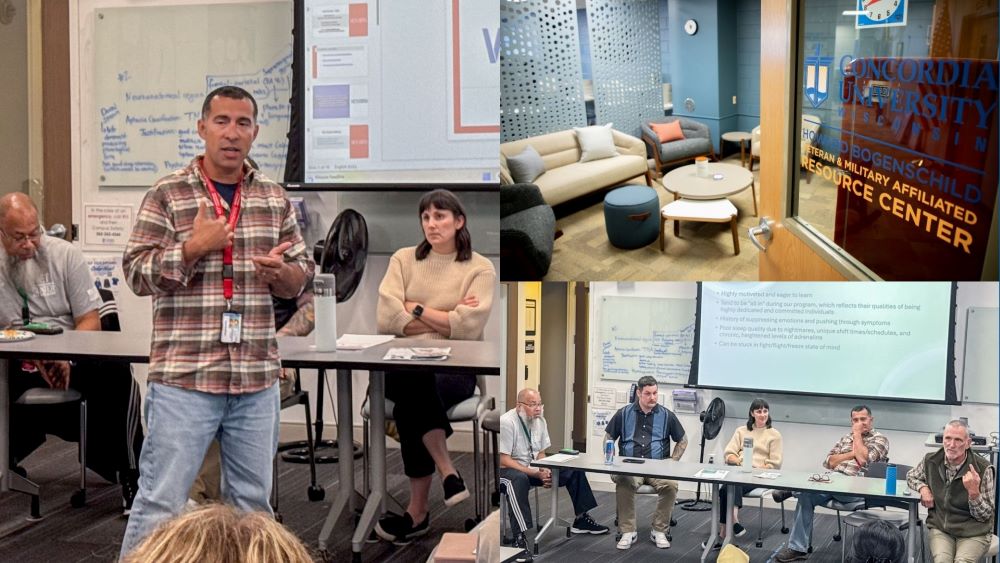
On Wednesday evening, Oct. 8, 2025, second-year graduate students in Concordia University Wisconsin’s Master of Science in Speech-Language Pathology program experienced one of the most powerful sessions of their semester so far. Guests from the Milwaukee VA, the Milwaukee Vet Center and the BRAVE Program (Building Resilience through Action in Veterans and First Responders) joined the class for a frank, deeply human discussion about military culture, traumatic brain injury (TBI), post-traumatic stress disorder (PTSD) and the path to recovery.

The event, part of the course Multicultural Considerations for Speech-Language Pathologists taught by Dr. Mikaely T. Schmitz, CCC-SLP, invited students to learn directly from those living and serving in this space.

SLP students met providers who support veterans living with cognitive-communication challenges related to PTSD, TBI, executive function, concussion and blast injury. The evening’s presenters included Dr. Michael McBride (VA); Richard Clark and Azael “Ozzie” Brodhead (Milwaukee Vet Center); Megan Utic, MS, CCC-SLP (BRAVE Program, MCW); and AJ, a veteran who courageously shared his story publicly for the first time.

CUW Veterans Outreach Coordinator and Army veteran Kari Metts also attended, sharing reflections on the complexity of women’s experiences in military service and the often unseen realities of female veterans.

From systems to stories

a mix of people in the classes

The evening followed a deliberate structure: beginning with the macro level (the Veterans Affairs system), then the community level (Vet Center and BRAVE collaborations), and concluding with the individual—AJ’s lived experience.

SLP students spent the evening unpacking military culture, the lived impact of TBI and PTSD, and what truly person-centered, trauma-informed care looks like. Throughout the discussion, they heard why “readjustment counseling” (Vet Center language) matters, how stigma can keep veterans from seeking support, and why quality-of-life goals must anchor care.

Clinically, they examined how mild TBI often evades standard imaging, why executive function complaints are common, and how patient-reported outcome measures (PROMs) can reveal functional challenges even when standardized test scores appear “average.”

Clark and Brodhead explained that Vet Centers create a safe, stigma-free space for veterans and their families, offering counseling, outreach, and whole-health approaches separate from the larger VA medical record system. They emphasized a mission of “readjustment counseling,” centering connection over diagnosis and confidentiality as a cornerstone of care.

Utic’s presentation on the role of speech-language pathologists in recovery and the BRAVE Program outlined how interdisciplinary teams—including SLPs, PTs, OTs and social workers (all majors of study available in the CUW School of Health Professions)—serve veterans and first responders through functional, evidence-based, person-centered therapy. The program focuses on recovery from TBI and PTSD using tailored interventions, fatigue management, patient-reported outcome measures, and real-world strategy training as anchors of SLP care.

“Functional therapy,” Utic explained, “means fewer worksheets and more real-world strategy use, helping clients build skills that translate to daily life.”

A veteran’s voice

For many students, the most unforgettable part of the evening came when AJ, a veteran of multiple deployments who sustained several blast injuries, spoke candidly about his experiences with TBI, PTSD and the ongoing process of healing.

It was AJ’s first time sharing his story in a public setting. His honesty, vulnerability and unfiltered perspective created a rare learning moment. He reflected on loss, mistrust, memory gaps, and the difficulty of reconnection after returning home, painting a portrait of resilience that moved the entire room.

“The people you are serving have been through hell … meet them where they are.”
– AJ, Veteran speaker

When invited into the discussion, Metts offered insights into the realities of female veterans and the frequent invisibility they face in both civilian and military circles. She spoke about how identity, gender and recognition intersect in veterans’ lives. The dialogue that followed modeled the kind of interdisciplinary empathy and exchange Concordia aims to foster, where each story adds a new dimension to understanding.

One student later thanked the speakers, saying, “Before I came here, so much of my education had been online or through videos made years ago. Tonight felt different—real, powerful and personal.”

What Speech-Language Pathology students practiced and learned

  • Person-first military history. Students practiced asking if someone served—recognizing that many individuals do not self-identify as “veterans.” They learned to use the “four W’s” (what branch, when, what job, where) and follow with how service has affected health and daily life, framed through practical empathy.
  • Foundations of empathic interviewing. Students explored how tone, pacing and curiosity foster trust, allowing clients to share experiences that might otherwise remain unspoken—skills they will build upon at the VA on Nov. 12.
  • Function over checkboxes. Students examined how standardized scores can appear “average” while participation and quality of life still suffer. They discussed how patient-reported outcome measures (PROMs) and contextualized tasks help identify meaningful goals for recovery.
  • Why multidisciplinary intervention matters. Recognizing that TBI and PTSD frequently co-occur and executive function is a key area to address, students observed how overlapping symptoms benefit from coordinated, team-based approaches rather than siloed treatment—underscoring the value of collaborative, whole-person care.

Beyond the classroom

This powerful on-campus session is the first part of a two-part experience. On Nov. 12, Schmitz and her graduate students will visit the Milwaukee VA campus for an evening of learning, connection, empathy training and a shared meal with veterans.

Students will meet and engage in intentional conversations with veterans living with cognitive-communication challenges related to ADHD, executive function, concussion and blast injury, continuing the applied learning they began on campus.

For Schmitz, these moments represent what teaching at Concordia is all about.

“Our students learn to see support of functional cognition and communication not just as a clinical skill, but as a way of restoring connection, purpose and dignity,” she said. “Partnering with the VA, the Vet Center and BRAVE brings our mission—service to Christ in the Church and the world—to life.”

Uncommon Connection

“This has been one of only a handful of opportunities in my 18 years at the VA to partner with the community and share our mission of veteran care,” wrote Dr. Michael McBride, local recovery coordinator and psychiatrist at the Milwaukee VA. “Frankly, the experience made me wish I was a student again.”

Jonathan Stone, LCSW and Milwaukee Vet Center director, reflected on AJ, the veteran who presented: “To see him find purpose, connection and community in that moment warms my heart beyond words … you’re not just helping veterans, you’re saving lives, restoring dignity and reminding them that they are not alone.”

Schmitz frames the class, Multicultural Considerations for Speech-Language Pathologists, around person-centered care. “Our aim is to learn from the people and providers closest to the work,” she said. “This discussion honored the complexity of veteran identity and emphasized our calling to serve thoughtfully, humbly and with evidence-based skill.”

Why it matters

  • Mission in action: Experiences like these embody Concordia’s commitment to forming clinicians who serve others in mind, body and spirit.
  • Evidence meets empathy: Students connect current research on TBI, PTSD and communication with patient-reported realities and lived experience.
  • Community partnership: The evening showcased the strength of Milwaukee-area collaborations across the VA, Vet Center, MCW BRAVE Program and CUW’s Speech-Language Pathology program.

About the programs

  • Vet Centers provide confidential, community-based counseling and outreach for veterans and their families, emphasizing trust, reconnection and peer support.
  • The BRAVE Program delivers interdisciplinary outpatient care for TBI and PTSD, blending neuropsychology, speech-language pathology, physical therapy and counseling to rebuild cognitive and emotional strength.

Written by Dr. Mikaely Schmitz, CCC-SLP, associate professor of Speech-Language Pathology.


Want in?

Concordia University Wisconsin is a Lutheran higher education community committed to helping students develop in mind, body and spirit for service to Christ in the Church and the world.

If you’re inspired by the ways Concordia students are learning to serve others through evidence-based, compassionate care, consider exploring CUW’s undergraduate and graduate programs in Communication Sciences and Disorders and Speech-Language Pathology. Whether you’re just beginning your journey or seeking advanced clinical training, our programs prepare you to make a meaningful difference in the lives of others.

Learn more about how Concordia integrates faith, science, and service in the preparation of future speech-language pathologists, or schedule a campus visit to experience our mission in action.


Breaking the silence around Latino mental health

Hispanic Heritage Month is a time to celebrate, reflect and heal.


It’s when we honor the stories, sacrifices and spirit that have shaped generations of Latino families. But celebration also means reflection—acknowledging not just where we’ve come from, but what we continue to carry.

In the Latino community, we’re taught from a young age to be strong, to keep pushing and to never let anything break us. We hear phrases such as “échale ganas” (give it your all) or “no te rindas” (don’t give up) —words meant to inspire resilience but that can also teach us to hide what we feel. Many of us grew up in families where mental health wasn’t discussed. If you were struggling, you were told to pray, work harder or be grateful—anything but admit you were hurting.

This silence comes from love and survival. Our parents and grandparents faced hardships they couldn’t afford to break down from—crossing borders, working endless hours and building lives from nothing. They believed staying strong meant staying silent—and in doing so, we learned to bury emotions that needed to be felt.

Hispanic Heritage Month reminds us that our heritage is not only about music, food and tradition—it’s also about healing. It’s about recognizing that our stories include both joy and struggle, faith and fear, resilience and rest.

Mental health isn’t a weakness; it’s part of being human. Healing starts when you stop running from pain and begin accepting it—not as who you are, but as something that walks beside you. There’s no magic fix—it’s daily work: getting up, breathing and doing one small thing that helps you feel like yourself again.

Healing isn’t loud; it’s reading a few pages, going for a walk, calling someone you trust or resting without guilt. You can be hurting and healing at the same time. Acceptance doesn’t mean giving in; it means saying, “This is part of my story, but not the whole story.” That’s when things start to shift.

Loving your mental health doesn’t mean loving the pain. It means loving what it teaches you: discipline, growth and self-understanding. Struggle can push you to start therapy, get active or open up to loved ones. Struggling doesn’t mean you’re weak; it means you’re alive and still fighting.

For our community, healing is an act of revolution. Talking about mental health, showing emotion and seeking help challenge generations of silence. Strength isn’t always keeping it together—sometimes it’s sitting with your pain and saying, “I’m still here.”

So this Hispanic Heritage Month, let’s honor our ancestors by doing what they couldn’t always do—by speaking, feeling and healing out loud. Because “échale ganas” doesn’t just mean push through. It can also mean take care of yourself, breathe and keep going—gently.

— Written by Ramon Rios, student VP for Latino Student Union (LSU). He is a junior and Business Administration major.


Take a moment

Take a moment today to check in with yourself, a friend or a loved one. CUW offers counseling for students that need it.


Want in?

Concordia University Wisconsin is a Lutheran higher education community committed to helping students develop in mind, body, and spirit for service to Christ in the Church and the world.

CUW’s Counseling Center staff are here to provide caring, competent counseling to students, faculty and staff in a confidential setting whenever you need us. We even have a comfort dog, Runner, on staff if you need non-human companionship. If you are struggling, please know you are not alone. Reach out to the Counseling Center. We’re here for you in your time of need.


Falcons reunite for Welcome Back Weekend

Campus comes alive as the Concordia community rallies for a weekend of fun and fellowship.


It was a big week on the Concordia University Wisconsin campus as families and alumni returned to celebrate the university and its students with sporting events, games, special activities, food and—most importantly—each other. From Oct. 10–12, Welcome Back Weekend brought friends, families, students and alumni together to create lasting memories and enjoy all that Concordia had to offer. The campus buzzed with energy as attendees enjoyed everything from bonfires and fireworks to tailgate festivities, live music and athletic games. The weekend wrapped up with worship and brunch, leaving the community feeling reconnected and full of Falcon pride.


Want in?

Concordia University Wisconsin is a Lutheran higher education community committed to helping students develop in mind, body, and spirit for service to Christ in the Church and the world.


Lead the Change in Healthcare: Why an MSN Degree Matters Now

Healthcare is evolving rapidly, and nurses are key. Earning an MSN empowers nurses to expand their impact, step into leadership, and confidently meet growing demands.

1. Meeting the Moment: Why an MSN Matters Now

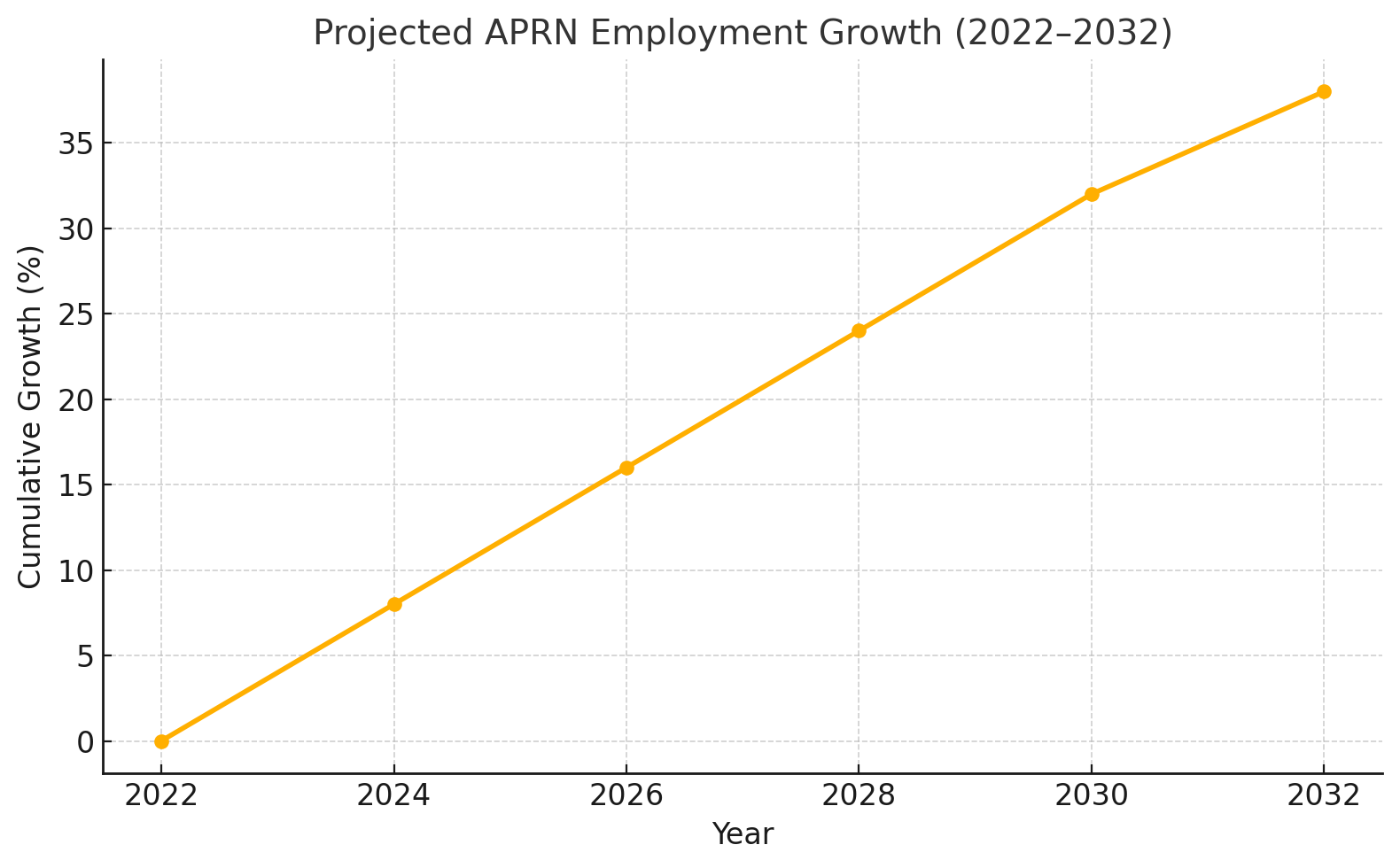
The healthcare landscape is transforming rapidly. Emerging technologies, an aging population, and a nationwide nursing shortage have created both challenges and opportunities. According to the U.S. Bureau of Labor Statistics, employment for advanced practice registered nurses (APRNs) is projected to grow 38% through 2032—far faster than the average for all occupations.

That surge represents more than job growth—it’s a call to leadership. Nurses with an MSN are positioned not only to fill these essential roles but to help shape what comes next in patient care. They serve as innovators, educators, and advocates for more equitable and effective health systems.

Projected_APRN_Growth

2. Advancing Skills, Expanding Influence

An MSN transforms experienced caregivers into strategic leaders. The curriculum extends beyond clinical expertise to integrate leadership, healthcare informatics, evidence-based practice, and policy development.

Graduates of online MSN programs are equipped to:

  • Lead patient care units or clinical departments.
  • Implement quality and safety initiatives across systems.
  • Champion technology adoption, from telehealth to AI-assisted diagnostics.
  • Mentor future nurses or design curriculum as nursing educators.

In short, the degree shifts nurses from providing care to directing the future of care, bridging compassion with leadership and innovation.


3. Career Growth and Compensation

For most nurses, the motivation begins with service, but career advancement and financial stability are meaningful rewards as well. The median annual salary for nurse practitioners now exceeds $128,000, with top earners surpassing $160,000 depending on specialization and region.

An online MSN degree opens the door to specialized and influential roles, such as:

  • Nurse Practitioner (NP): Providing primary or specialty care.
  • Clinical Nurse Leader (CNL): Coordinating evidence-based improvements.
  • Nurse Educator: Teaching and shaping the next generation of caregivers.
  • Nursing Administrator: Managing teams, budgets, and organizational outcomes.

Each role offers greater autonomy, purpose, and professional fulfillment—proof that advanced education benefits both nurse and patient.


4. A Win-Win for Healthcare Partners

Hospitals and healthcare organizations also thrive when nurses pursue advanced degrees. MSN-prepared nurses bring leadership, data literacy, and a systems-level understanding that elevate both care quality and team performance.

Employers consistently report benefits such as:

  • Improved outcomes through evidence-based leadership.
  • Higher retention and satisfaction among empowered nursing staff.
  • Stronger pipelines for internal leadership succession.

In essence, supporting nurses in earning an MSN strengthens the entire care system—building a workforce that leads with integrity, insight and compassion.


5. Flexibility That Fits Today’s Nurses

Concordia University Wisconsin understands the balance nurses must maintain—between patient care, family, and personal growth. That’s why CUW’s online MSN program is designed specifically for working professionals, offering:

  • Online and hybrid learning formats for maximum flexibility.
  • Multiple specialization tracks aligned with real-world needs.
  • A faith-based community where students are known, supported, and valued.

At CUW, students don’t just learn—they’re equipped to lead with integrity. It’s an environment where education nurtures the whole person: mind, body and spirit, consistent with CUW’s mission to prepare servant leaders who live out their calling in the world.


6. The ROI of an MSN: Purpose and Impact

While an MSN offers strong financial potential, the true return on investment runs deeper. Graduates often describe the experience as a transformation—from nurse to leader, and from career to calling.

MSN-prepared nurses step forward with renewed clarity of purpose. They gain the confidence to lead initiatives that enhance patient safety, promote health equity, and elevate their colleagues. Their impact is not only clinical but deeply personal, improving lives, mentoring others, and serving communities with integrity.

This is the essence of an MSN: a credential with heart—where skill meets calling, and leadership is rooted in service.


Lead the Change in Healthcare

The future of healthcare depends on compassionate, well-equipped leaders. An online MSN degree isn’t just another credential; it’s preparation for meaningful impact.

At Concordia University Wisconsin, nurses grow in skill, faith, and purpose—ready to meet today’s healthcare challenges with excellence, empathy and grace.


? FAQ

How long does it take to earn an MSN?

Most programs, including CUW’s, can be completed in 2–3 years, depending on prior education and pace.

Can I work while earning my MSN?

Yes. CUW’s online and hybrid options are intentionally designed for working nurses balancing career and life.

What are the top MSN specializations?

Common tracks include Family Nurse Practitioner, Adult/Gero PC NP, Clinical Nurse Researcher.

Why choose a faith-based MSN program?

Because leadership in healthcare is about both skill and heart. CUW integrates Christian values into every aspect of learning, preparing nurses to serve with compassion and integrity.


Your skills, your compassion, your faith — they’re exactly what healthcare needs right now.

? Step forward with purpose through Concordia University Wisconsin’s online MSN program and become the leader you’re called to be. CUW has also announced the launch of a new Direct Entry Master of Science in Nursing (DE-MSN) program, click link for more information.


Engineering the future with hands-on experience

Internships bridge theory and practice, producing industry-ready engineers. CUW students proudly share their stories.


Engineering offers students a pathway into many different careers. According to the U.S. Bureau of Labor Statistics, engineers earned a median annual wage of $97,310 in 2024, with jobs projected to grow faster than average through 2034. Off to a strong start, Concordia University Wisconsin is in its second year of engineering programs, and students are already securing summer internships in this growing field.

Chair of Engineering, Subha Kumpaty, Ph.D., D.Min., P.E., FASME, says the vision for all Concordia engineering programs is to produce Christ-centered engineers who integrate faith and learning. “They are ultimately serving God’s purposes in each of their lives, which will have a significant benefit to the community,” he says. Their stories reflect this mission in action.

CUW engineering students put learning into practice

It’s not just about your résumé—it’s about your growth

woman with brown hair in black dress

Jackie’s story: This past summer, Industrial Engineering major Jacqueline “Jackie” Ferrer (’28) interned with Global Power Components, a growing company known for its motto, “Everything but the Generator.” There, Jackie gained hands-on experience with industry software, machinery operations, and optimization processes, while applying classroom knowledge to real-world projects. For her, the experience went beyond technical training—it provided insight into future career opportunities, reinforced the value of perseverance, and deepened her understanding of goal-setting. Jackie also credits her faith as a source of strength and positivity, helping her stay focused on future opportunities. Her story reminds us that internships aren’t just résumé builders—they’re powerful opportunities to discover career paths, grow in confidence, and connect learning to faith-driven work.


Living out your calling with excellence

boy in blue with arms crossed

Caeden’s story: Industrial Engineering major Caeden Kreibich (’28) spent his summer interning at Ci-Dell Thermoset Plastics in Mequon, Wis., where he gained valuable experience in plastic molding and manufacturing. His projects included designing fixtures and tooling in SolidWorks to improve automation efficiency, developing a program to inspect part measurements, and conducting a Design of Experiments study to optimize processes. He also handled hands-on tasks like repairing machines and standardizing equipment lists—gaining a well-rounded view of engineering in action. Caeden says the experience was both exciting and formative, reinforcing his decision to pursue Industrial Engineering at CUW, where small class sizes and supportive professors help him grow in both knowledge and confidence. His faith also guided his choice to study at Concordia, where he could strengthen both his skills and his spiritual life. His story shows how internships provide a chance to turn lessons into impact, prepare for meaningful careers, and live out one’s calling with excellence.


Aligning faith with professional growth

man with glasses and green checkered shirt

Amos’s story: This summer, freshman Industrial Engineering student Amos Armstrong (’29) interned at Hayes Performance Systems as a New Product Development Supply Chain Intern, working closely with lead engineers. His role involved supplier communication, database and process management, inventory control, and logistics—giving him real-world experience in the fast-paced world of manufacturing and supply chain operations. Amos says the most valuable part was seeing how classroom learning connects directly to problem-solving in the workplace. The experience sharpened his technical and communication skills while preparing him for future leadership opportunities. Amos chose Concordia for both its strong technical training and Christian values, which keep him grounded in integrity, humility, and service. His story is an inspiring example of how early internships can build confidence, strengthen career readiness, and align faith with professional growth.

business room with equipment

Want in?

Concordia University Wisconsin is a Lutheran higher education community committed to helping students develop in mind, body, and spirit for service to Christ in the Church and the world. Concordia University Wisconsin offers three distinct engineering programs designed to prepare students for impactful careers. The Chemical Engineering program equips students with strong technical and problem-solving skills to address global challenges in sustainability, safety, and health, with career paths in chemical, pharmaceutical, and safety engineering. The Industrial Engineering program focuses on designing efficient systems, improving productivity, and enhancing workplace safety, preparing graduates for versatile roles in manufacturing, management, and beyond. The Mechanical Engineering program provides a solid foundation in math, science, and engineering principles while emphasizing hands-on experience in mechanics, thermodynamics, materials, and system design, leading to careers in mechanical, aerospace, automotive, and related industries—or advanced study.


More students answering the call to grow, serve and lead at Concordia

At a time when universities nationwide are bracing for enrollment declines, Concordia University Wisconsin is celebrating growth in its freshman enrollment.


This fall, CUW experienced an 8% increase in new freshmen compared to last year, a notable achievement amid national concerns about the looming “demographic cliff.”

The demographic cliff refers to the sharp decline in the number of college-aged students—typically starting around 2025–26—due to the drop in birth rates after the 2008 recession. Concordia’s results show that the university’s mission-driven approach and strong recruitment partnerships are making a difference.

Leah Toerpe, ’01, the university’s director of Traditional Undergraduate Admission, said she believes there are a number of factors responsible for the enrollment growth. “It’s a campus-wide effort,” she explained. “We drive prospective students to visit campus so they can experience CUW personally. And when they are here, students notice the mission in action, while the Admission team drives the front-of-stage role for recruitment and admission.”

She added: “We are supported across the campus. Academic faculty, for example, take time from their busy schedules to meet a visiting student and share the highlights regarding their programs, and invite students to shadow classes.”

Broader trend

Concordia’s enrollment success reflects a broader trend across campus. Many programs have adapted their recruitment efforts, hosting hundreds of in-person and virtual events to connect with prospective students from a greater distance.

For example, the School of Pharmacy hosted “more than 100 events annually, several of which we have transitioned to virtual formats,” said Katelyn Wilson, assistant director of Admissions Operations in the School of Pharmacy. “This allows us to connect with students from a greater distance and broaden access to our office and school.”

For many students, they choose Concordia as their school because of the university’s Christian values and mission to develop students in mind, body, and spirit for service to Christ and the world.

“For some, it is the top reason they choose us,” Toerpe said. “For others, something else brought them here. But as we live out our mission daily, those who came for other reasons notice the impact it has on their lives while they are here. And our students learn that CUW is a campus for everyone.”


Want in?

Concordia University Wisconsin is a Lutheran higher education community committed to helping students develop in mind, body, and spirit for service to Christ in the Church and the world.


A new era of innovation: CUW opens AI & Quantum Innovation Lab to inspire servant leaders in science, technology

Students, faculty, staff and community members gathered October 7 to celebrate the unveiling of Concordia University Wisconsin’s new AI & Quantum Innovation Lab on campus.


The university’s newest space not only anchors the school’s cutting-edge Artificial Intelligence program, but also provides tools to expand human creativity and discovery.

The celebration featured special remarks and interactive demonstrations, including virtual reality experiences and an introduction to “Solomon,” the university’s most powerful computer, developed by Dr. Michael Litman, professor and chair of Computer Science.

“The lab will be a place where innovation meets integrity,” said Dr. Robert Balza, associate vice president of Academics for Teaching, Learning and Academic Innovation. He emphasized that the space, which is rooted in Concordia’s mission to help students develop in mind, body, and spirit for service to Christ in the Church and the world, treats AI and quantum not merely as engines of efficiency, but as tools for service, preparing vocation-ready graduates.

However, the program, which leads to a Bachelor of Science in Applied Artificial Intelligence, doesn’t start with tools; it starts with values. Concordia’s “Christian emphasis on the distinctive powers of the human soul and the ethical use of AI” is imperative, explained Dr. Angus Menuge, professor and chair of Philosophy.

Mission of CUW’s AI & Quantum Innovation Lab

What distinguishes Concordia’s Innovation Lab from others in the state is its mission-driven foundation—integrating faith and technology to deepen and enrich learning.

The new lab will strive to:

  • Deepen understanding of Artificial Intelligence and Quantum Computing while confronting the ethical dilemmas these technologies pose.
  • Build bridges between students, faculty, and industry partners to create meaningful collaborations that advance both knowledge and application.
  • Provide hands-on opportunities through internships, projects, and research that prepare students to serve and lead in a rapidly evolving technological landscape.
  • Incubate and accelerate student and faculty-led initiatives, including grant-funded projects, that align innovation with service to community and society.

More information on AI at CUW

  • To learn more about the lab, including current research and areas of focus, click here.
  • View the biblical guidelines created by members of CUW’s Theology Department here.
  • To consult with the AI team about a project, fill out the form here.
  • Read the article on the Applied Artificial Intelligence program here.

The AI & Quantum Innovation Lab is located in the lower level of the Robert W. Plaster Free Enterprise Center on Concordia’s campus, 12800 N. Lake Shore Drive, Mequon.


Want in?

Concordia University Wisconsin is a Lutheran higher education community committed to helping students develop in mind, body, and spirit for service to Christ in the Church and the world. The Applied AI program is designed to prepare students to lead in one of the fastest growing career paths today using technical skills, ethical reflection, and real-world problem-solving skills.


Cutting through the noise: Steve Forbes on the future of America’s economy

At CUW’s annual Liberty, Faith, and Economics Summit, Forbes summed up the day with his keynote speech, leaving students hopeful and inspired.


“Most great ideas sound crazy at the beginning, and then they become acceptable,” stressed Steve Forbes, chairman and editor-in-chief of Forbes Media, during his keynote speech, “How Entrepreneurs, Not Government, Built America.” His talk was presented in partnership with Young America’s Foundation on Tuesday evening, Oct. 7, 2025, at the Concordia Center for Environmental Stewardship.

With real-life examples and historical facts, not to mention some witty humor, Forbes lit up a full room of attendees—many of whom came to hear his speech after a full day of listening to other speakers such as:

“We’re deeply grateful to Rick Esenberg, Dr. Sam Gregg, and Andrew Stuttaford for sharing their insights and engaging our students in such meaningful conversations,” said Scott Niederjohn, Ph.D., dean of the Batterman School of Business.

three photos from speaker series

“It was an honor to welcome more than 500 students, faculty, staff and community members to our seventh annual Liberty, Faith, and Economics Summit,” he continued. “The energy in the room—especially during Steve Forbes’ keynote—reflected a genuine excitement for thoughtful dialogue on faith, liberty and economic freedom.”


man with grey hair next to woman with long blonde hair

Ground your faith

Jenna Piwowarczyk, a junior political science major and chairman of the CUW Young Americans for Freedom, found Forbes’s speech to reinforce the value of traditional American economic principles.

“I am left hoping that students understand that the current state of our economy is not the way it has to be,” said Piwowarczyk. “As Americans, we always have the opportunity for success—it takes education, action and grit to get our economy back on track.”

Before addressing today’s economic challenges, Forbes reminded the audience to appreciate what America has provided. “We should remind ourselves that for all the troubles we have today, the basic strengths of this country are still very evident, especially in terms of innovation and creativity,” he explained.

“In healthcare, we’re developing vaccines for cancer—something that would have seemed unbelievable just a few years ago. Within a generation, we may be able to replace organs like hearts and kidneys as easily as changing a tire, rather than waiting for a hopeful replacement.”


closeup of man giving speech with glasses on

Grow your economy

Forbes is no stranger to the political scene, running in two presidential elections, one in 1996 and the other in 2000. He is a distinguished businessman who has carried the Forbes brand into the digital era, expanding its global footprint. During his speech to CUW, he presented several key points for growing the economy, some of which were:

  • Implement low, flat tax rates
  • Reduce government regulations
  • Maintain a stable currency

“Imagine if the Federal Reserve were in charge of the Time Bureau and decided to float the clock—60 minutes one hour, 48 minutes the next. Life would be difficult,” said Forbes.

“I guarantee you, if they don’t do something like announcing they want a stable dollar and get over this chatter about a weak dollar, we’re going to have problems in the future.”


students and faculty sitting during a speaker

Pursue your future

At the root of it all, people want to succeed. We want to make enough money to pay our bills, buy a new car, dine at a new restaurant downtown, and still have something left over in the bank. Through his stories of American ingenuity, Forbes inspires the audience to consider what could make them successful.

He emphasized that entrepreneurship means putting ideas out there without knowing whether people will accept them—it’s about taking risks. “You create new knowledge through experimentation—in the laboratory, the marketplace, or elsewhere. That’s how you move ahead,” he said.

The government, however, creates a wedge through its regulations, taxes, and other barriers. Forbes said, “In terms of regulations, deregulate—that’ll go a long way to reviving American manufacturing, especially with AI.”


Want in?

Concordia University Wisconsin is a Lutheran higher education community committed to helping students develop in mind, body and spirit for service to Christ in the Church and the world.

The Batterman School of Business enrolls the most students out of CUW’s six academic schools. The BSB offers a complete range of business education programs and degrees including bachelor’s degrees for undergraduate and adult accelerated students, as well as licensures and certifications. Graduate programs include our highly ranked Master of Business Administration program (with 12 concentrations), and master’s degrees in accountancy, business analytics, and more. The school also offers a Doctor of Business Administration degree, the only one of its kind in the Milwaukee area, as well as a Ph.D. in Business Administration.