Associate Professor of Computer Science Robert Wahl, PhD, talks with The National about the ongoing writer-actor strike in Hollywood and why there are concerns about the use and implications of artificial intelligence in film and television.
The strike that is upending Hollywood continues. On May 2, the Writers Guild of America went on strike over an ongoing labor dispute with the Alliance of Motion Picture and Television Producers (AMPTP). Later, Hollywood actors joined the stand, and, as of late, there doesn’t appear to be an end in sight.
What is behind the dispute? An issue at the heart of it all is the use of artificial intelligence and its implications for writers, producers, actors, and the like when it comes to compensation and the ethics of it.
In the media
Before the strike even started, Concordia Associate Professor of Computer Science Robert Wahl, PhD, had published a paper on the ethics of AI in media. More recently, he spoke with a leading publication in the Middle East called The National.
“I’m definitely not in the panic state,” Wahl told the publication, “but [AI] is going to be big, it’s going to affect a lot of things that we do … and there’s currently no rules or regulations on this.”
Click here or on the image below to read the piece.
Want more?
We are in a world where almost everything we do involves computers, and that isn’t changing anytime soon. Technology, advancement, and innovation surround us and it’s a smart, always evolving field to get involved in.
At Concordia University, you become part of a genuine community of learning; a place where your faith and your intellect intertwine; where you are uniquely developed to achieve your fullest potential. The School of Arts and Sciences encompasses a broad range of disciplines, across 13 departments, which house more than 40 degree programs. The School also guides the experience of all Concordia undergraduate students through the Concordia Core.
Join your fellow alumni! Apply now to mentor a CUW student.
You have wisdom to share. Why not share it with a Concordian?
The benefits of mentorship are widely documented and far-reaching – both for the mentee and the mentor. That’s why Concordia University Wisconsin is pleased to launch a new university-wide mentorship program to support students in their vocations and prepare them for their next steps after graduation. The CUW Alumni Mentor Program aims to establish meaningful, personal, and professional coaching relationships between current CUW students and alumni. The new program will begin this academic year. It will officially kick off with a “launch event” on Sept. 20.
In 2021, Concordia’s Office of Alumni Relations sought to receive feedback from Concordia’s alumni base through the Alumni Attitude Survey, a third-party survey tool that has been used by dozens of universities nationwide.
According to survey results, CUW alumni are highly pleased with their decision to attend Concordia. 90% of alumni surveyed described their decision to attend CUWAA as “good” or “great,” while 92% described their overall opinion of the university as “good” or “excellent.” Both numbers exceeded national averages.
Within the survey, alumni also shared vital feedback that led to the creation of the new mentor program. Among the “Top Four” priorities survey respondents indicated was a desire to “mentor students and provide job shadowing opportunities” as well as “serve as ambassadors promoting CUWAA to others.”
“We have alumni who are living the mission vocationally, whether it’s through their careers, service, or as parents and friends. These are people who understand the mission of Concordia and live out that mission regularly,” says Director of Alumni Relations Greg Witto. “They have invaluable wisdom to share with current Concordia students who are looking for answers as to how they, too, can live out the mission as a teacher, pharmacist, nurse, or any other profession.”
The vocational aspect is something that sets Concordia’s mentoring program apart, explains Stacy Tolomeo, assistant director of Industry Relations.
“From a student perspective, they ask, ‘How do I live out my faith in the workplace?’ Depending on the workplace, that might be a tricky question to answer, but we know our Concordia alumni will be prepared to answer that in a more nuanced and authentic way than we ever could.”
What you’d be committing to
Program organizers will select alumni who apply for their belief in the CUW mission, expertise in their industry, and commitment to vocation. Mentors will then match one-to-one with a student mentee. The pair is encouraged to meet in person when possible, but no one will be excluded from participation based on geographical location.
The time commitment is a monthly, minimal obligation. Mentors can expect to commit to:
Mentor training (in-person and virtual options available)
A 60-minute launch event on September 20
One-hour (minimum) monthly meetings from September through April arranged according to the mentor/mentee’s schedules
A year-end celebration in April (Date TBD)
Want in?
Christ-minded. Ethical. Hard working. Respectful. Curious. Leader. While all our students are different, certain qualities unite our community and make us Concordians. We look forward to welcoming you to the ranks of our alumni.
Have you ever wondered how some of our buildings got their names? Here’s your quick guide to the people whose namesake will go down in Concordia history.
Many of Concordia’s buildings and facilities honor a significant person or place in the university’s history. Some of the individuals are now passed, but their contribution to the university lives on through their namesake. Scroll down to learn the significance of each of the monikers.
A special thanks to Dr. Bill Cario for lending his history chops to this blog!
Classrooms
Albrecht
Building/facility: Classrooms and Albrecht Lounge (aka the Student Union)
Building/facility: Barth Hall; the Todd Wehr Auditorium and classrooms
Named after: Rev. Dr. G. Christian Barth
Barth succeeded Albrecht to serve as CUW president from 1921 to 1934.
Fun fact: While Barth was president, the field house mysteriously burned down and the school had to rebuild. People joked that Ackmann was behind it – a desperate move to provide an excuse to upgrade the previous sub-par facility. Either way, the result was a sparkly new facility for Concordia’s budding athletics programs.
Loeber
Building/facility: Loeber Hall; science, art, and other classrooms
Named after: Rev. Christian H. Loeber
Loeber was the first full-time president of Concordia University Wisconsin. He served for eight years, from 1885 to 1893.
Fun fact: Concordia saw its first choirs former (in 1885) during Loeber’s tenure.
Rincker
Building/facility: Rincker Hall; education, nursing, and other classrooms
Named after: Rev. Leroy C. Rincker
Rincker was Concordia’s fourth president. He served from 1935 to 1953.
Fun fact: It wasn’t until 1935, while Rincker was president, that Concordia’s mascot officially became the Falcons. Rincker was also the only CUW president to die while in office.
Robert W. Plaster
Building/facility: Concordia’s newest academic building, Robert W. Plaster Free Enterprise Center; business classrooms, the Makerspace, and the Speech, Language, and Hearing Lab
Named after: Robert W. Plaster
Plaster founded Empire Gas Corporation which was one of the largest retail propane distributors in the nation at the time of its eventual sale in 1996. In 1983, the Robert W. Plaster Foundation was created with the primary goal of helping academic institutions provide affordable college education to those in need. The Foundation made a substantial contribution to Concordia’s building.
Fun fact: Robert W. Plaster often said, “The difference between mediocrity and success is an hour a day.”
Stuenkel
Building/facility: Stuenkel Hall; computer science classrooms and labs and Concordia Central
Named after: Rev. Dr. Walter W. Stuenkel
Stuenkel served as university president from 1953 to 1976.
Fun fact: Twelve years into Stuenkel’s presidency, Concordia went co-ed. The school welcomed its first female learners in 1965. Stuenkel was also the first of two Concordia presidents to famously don a bowtie as a staple wardrobe item.
Ferry served as president of CUW from 1997 to 2021 and over CUAA from 2013 to 2021. During his time as president, he was one of many who championed the start of a pharmacy school. It was, at the time, one of only two schools of pharmacy in Wisconsin.
Fun fact: Ferry takes his health seriously. He is an avid runner. In fact, he’s probably in the middle of a running streak as we speak.
Patrick T. Ferry Hall
An exterior view of Albrecht
A lab in Loeber
Plaster building
Athletics
R. John Buuck Field House
Building/facility: R. John Buuck Field House; Concordia’s gymnasium
Named after: Rev. Dr. R. John Buuck
Buuck preceded Dr. Ferry as president of the university. He served from 1979 to 1996.
Fun fact: Enrollment skyrocketed during Buuck’s presidency. Within his first decade as president, Concordia’s student count grew from 376 to surpass 1,000. A relocation from downtown Milwaukee to Concordia’s current campus location in Mequon helped opened up room for growth.
Named after:Catalyst Construction, a Milwaukee-based construction company whose CEO is Matt Burow. Burow donated significantly to the project.
Fun fact: Burow’s wife attended CUW.
Kapco
Building/facility: Kapco Park; Concordia’s baseball field which is shared with the Northwoods League team, the Lakeshore Chinooks
Named after: Kapco, Inc.
Kapco, Inc. Owner Jim Kacmarcik contributed the lead gift for the baseball field, which opened in 2012. Kacmarcik was previously a part owner of the Lakeshore Chinooks.
Fun fact: Kapco Park was designed with a special nod to four Milwaukee Brewers greats, with the distance from home plate to various points in the outfield measuring in at distances that honor players’ career numbers. Left field is 317 feet from home (in honor of Jim Gantner’s #17 MLB jersey), left-center is 344 feet (for Hammerin’ Hank Aaron), center is 404 feet (for Paul Molitor), and right is 319 feet (for Robin Yount).
Tomasini
Building/facility: Tomasini Stadium; CUW’s football field
Named after: John Tomasini (’87)
John Tomasini, president of D.F. Tomasini Contractors, played football for Concordia from 1983-87. For his outstanding athletics career, he was inducted into the Concordia Hall of Fame in 2003.
Fun fact: Tomasini rushed for over 3,000 yards during his collegiate career. He was named an all-conference running back and earned NAIA Player of the Year honors in 1986.
Tomasini StadiumKapco Park
Residence Halls
Augsburg
Building/facility: Augsburg Hall
Named after: A city in Germany/the Augsburg Confession
Augsburg, Germany is the city where Philipp Melanchthon composed the Augsburg Confession, which was presented to the Roman emperor in 1530 as a full account of the Lutheran Reformation. Lutherans still honor the document as a faithful summary of Lutheran beliefs.
Fun fact: A colleague of Martin Luther, Melanchton was a responsible for a Lutheran education emphasis.
Chemnitz
Building/facility: Chemnitz Hall, Concordia’s newest residence hall
Named after: Martin Chemnitz
Author of the Book of Concord, Chemnitz was instrumental in detailing the doctrines of the Reformation and the standard of Lutheran unity.
Fun fact: Chemnitz’s nickname was “the second Martin,” as Chemnitz’s work built on that of Martin Luther.
Coburg
Building/facility: Coburg Hall
Named after: A city/fortress in Germany
Martin Luther sought refuge at Coburg Fortress in 1530 because he was under imperial ban. He spent his time there writing many important correspondences and translating the Bible to German.
Fun fact: Two Reformation leaders, Lucas Cranach the Elder (1506) and Martin Luther (1530), lodged in Coburg Castle at various times in their lives.
Heidelberg
Building/facility: Concordia’s Interprofessional Clinic and School of Health Professions faculty offices
Named after: The Heidelberg Disuptation
The Heidelberg Disputation is Martin Luther’s follow-up to the 95 Theses. He had the opportunity to defend them publicly in Heidelberg, Germany, in 1518 before the general chapter of the Augustinians of Germany. Some even consider the Heidelberg theses more important than the 95 Theses.
Fun fact: The first and second floors of Heidelberg were recently converted from residence hall rooms to School of Health Professions office spaces and the Interprofessional Clinic.
Katharine
Building/facility: Katharine Hall
Named after: Katharine von Bora; Martin Luther’s wife
Like her husband, Katharine was a seminal figure in the Reformation. Together they built a new life and family in Germany. She provided Martin Luther with the respite from his struggles in the Reformation.
Fun fact: Katharine was a Roman Catholic nun before she married Luther.
Regents
Building/facility: Regents Hall
Named after: Concordia’s 1999 Board of Regents
Fun fact: Concordia’s School of Pharmacy held its first classes in the basement of Regents while a new academic building was erected.
Wartburg
Building/facility: Wartburg Hall
Named after: Wartburg Castle, located outside Eisenach, Germany
Wartburg Castle served as yet another retreat/hideout for Luther. During his time at Wartburg in 1521-22, he continued his biblical translation work.
Fun fact: Luther hid in Wartburg Castle for 10 months and, while there, disguised himself as a knight.
Wittenberg
Building/facility: Wittenberg Hall
Named after: Wittenberg, Germany
Wittenberg was the center of Martin Luther’s Reformation effort. This German city was home Wittenberg University (the first Lutheran university) where Luther once served as a professor.
Fun fact: The church where Luther posted his 95 Theses was in Wittenberg.
Wittneberg
Wartburg
Regents
Katharine
Coburg
Chemnitz
Augsburg
Other
Luther
Building/facility: Welcome Center, administrative, admissions, and other offices
Fun fact: Except for Concordia University in Seward, Nebraska, each of the Concordias throughout the nation have a statue of Martin Luther on campus. CUW’s was dedicated in 2016.
The Siebert Lutheran Foundation gave a significant donation in the mid-1990s to help refurbish Concordia’s dining hall. The new eating quarters were dedicated in 1996.
Todd Wehr was co-founder of Wehr Steel Company, which later begat the Todd Wehr Foundation. Much of the foundation’s funds went to supporting charitable religious, scientific, and educational organizations.
Fun fact: When Concordia purchased its current campus from the School Sisters of Notre Dame, the auditorium was a gymnasium.
Siebert Dining HallTodd Wehr Auditorium
Want in?
Your generous donation is more than just a gift of money. It’s a gift that directly helps our students develop in mind, body, and spirit for service to Christ in the Church and the world. Click below to learn more about our different giving options.
Editor’s note: This story first appeared in the fall 2021 edition of Hearts Together, a publication of Concordia University Wisconsin and Ann Arbor.
Perhaps the most important news we learned in the latest edition of the Alumni Attitude Survey is affirming that we are making good progress in alumni engagement with the adjustments we have made since alumni provided feedback in the first survey administered in 2016. You spoke, we listened.
We are pleased that 90% of alumni surveyed in 2021 describe their decision to attend CUWAA as good or great! This year, 92% of alumni currently describe their overall opinion of CUWAA as good or excellent. This exceeds the national average and is an increased positive response from 85% in 2016.
Almost 3 out of 4 alumni (74%) describe their alumni experience as good or excellent in the 2021 survey, which is higher than the national average. This is also a significant improvement from the previous survey results when just under half of the alumni surveyed replied with good or excellent (47%).
According to the survey, CUWAA alumni identified two of the top four important things for alumni to do: 1.) Mentor students and provide job shadowing opportunities and 2.) Serve as ambassadors promoting CUWAA to others.
In response Concordia has strengthened its efforts with these initiatives:
We will develop multiple avenues for alumni to mentor students.
We will continue to expand efforts to provide meaningful opportunities for alumni to connect and grow.
Want in?
Whether your memories of Concordia go back to the Milwaukee campus 50 years ago, to last year’s graduation or at a CUW Center, your Concordia experience can continue. As a graduate of Concordia University Wisconsin, you are automatically part of the Alumni Association with a community of more than 32,000 special and impressive alumni.
It has been 40 years since CUW made the move from downtown Milwaukee to Mequon. Here’s what else was happening in the world 40 years ago.
On Sept. 15, 1982, The Lutheran Church-Missouri Synod purchased 102 acres from the School Sisters of Notre Dame on behalf of CUW. At the time, the school was the fastest-growing Lutheran college in America. The new property allowed Concordia to relocate from its original stomping grounds in downtown Milwaukee to wide-open possibilities in Mequon. The move was made ahead of the 1983-84 academic year. On Sept. 11, 1983, Synod and college leaders officially dedicated the new campus.
The move to the new campus was a momentous occasion in Concordia’s history, and one that many who experienced it remember well. Click below to watch a video from 2008 (the 25th anniversary of the move to Mequon) where Concordia professors and leaders share about the transition.
Elsewhere in the world in 1983
But what else was happening in the world in 1983? Let’s put Concordia’s historic move into context. In 1983:
The average cost of a new house was $82,600.
The average annual income was $21,070.
You couldn’t turn on the radio without hearing Michael Jackson, The Police, Donna Summer, or Hall & Oates.
Terms of Endearment won the Oscar for best picture.
The Cabbage Patch Kids craze swept the nation.
Nestle introduced a new sugary treat, Nerds.
The first Mario Bros. game jumped into arcades in Japan.
Ronald Reagan was president.
Shoulder pads were a fashion trend for women.
Gas was $0.96 a gallon.
Top baby names were Jennifer and Michael.
The series finale of M*A*S*H hit television sets.
McDonald’s made Chicken McNuggets available in restaurants worldwide.
The world’s population was about 4.72 billion; China’s population surpassed 1 billion.
Chuck Hull invents the 3D printer.
Word processor software “Multi-Tool Word” (later to become Microsoft Word) was released in the U.S.
The popular children’s television show Reading Rainbow debuted.
Lech Wałęsa, former president of Poland, won the Nobel Peace Prize.
The Price is Right added Plinko to its roster of games.
A gallon of milk cost $1.17.
The holiday favorite was A Christmas Story.
Schools “dared” to keep their kids off drugs with the introduction of the D.A.R.E. program.
Want in?
You can become a part of Concordia’s history, too! Join the tens of thousands of alumni who have call CUW their alma mater. Start by scheduling a visit to our beautiful campus!
Will the Chicago NASCAR street races really bring economic benefits for the Windy City? These economists say no.
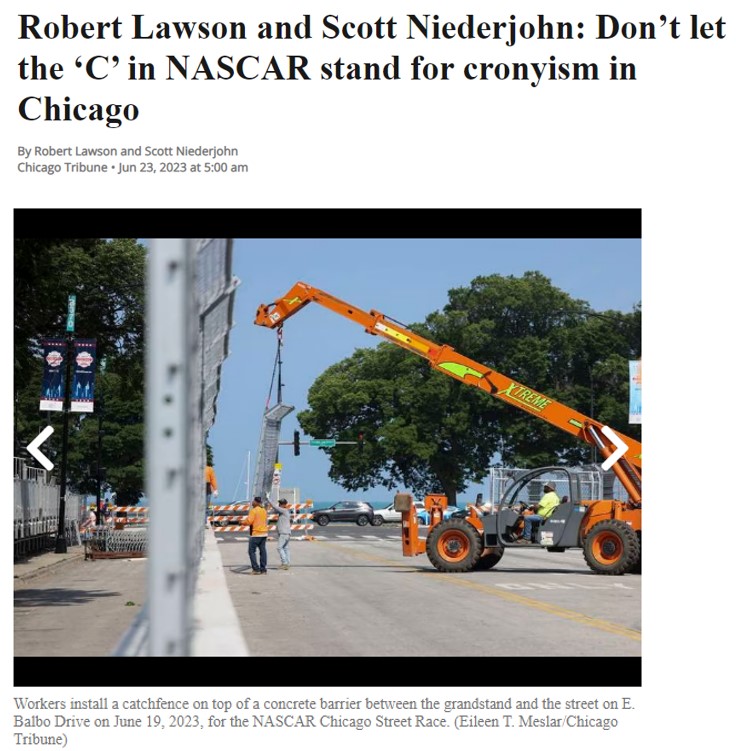
Setup for the inaugural NASCAR event in Chicago is off to the races. A three-year deal that former Chicago Mayor Lori Lightfoot signed into existence will bring stock car drivers to the Windy City for a competition that’s a first of its kind in more ways than one.
Typically, NASCAR races take place at privately owned tracks that are specifically designed for spectators. The Chicago NASCAR races will instead utilize existing city streets: a 2.2-mile circuit that will take drivers past some of the city’s most iconic landmarks and most notable streets. As one could imagine, traffic will be significantly impacted for the two-day event. Temporary stands and event staging is being erected. It’s a massive undertaking.
But will the bottom line be worth it for Chicago? NASCAR officials say yes. Concordia’s Scott Niederjohn and fellow economist Robert Lawson say not so much.
Niederjohn, a professor at CUW, serves as the director of the Concordia Free Enterprise Center. Lawson is an economics professor and director of the Bridwell Institute for Economic Freedom at Southern Methodist University’s Cox School of Business. Both share a passion for car racing.
In the media
On Friday, the Chicago Tribune published their co-authored op-ed titled, “Don’t let the ‘C’ in NASCAR stand for cronyism in Chicago.” Click below to subscribe to the Tribune to read their piece, or scroll on to read a few key points.
Chicago NASCAR Takeaways
“Almost all racetracks are privately owned by entrepreneurs trying to make a buck. … However, if the other major sports can slop up billions of dollars from the taxpayer trough through publicly financed stadium deals, for how long can the two premier racing series in North America – NASCAR and IndyCar – resist the urge to join in the feeding frenzy? The answer, sadly for NASCAR at least, is that they can’t.”
“The costs to the city have not been well publicized, which suggests a lack of government transparency. Still, news media reports suggest huge and ill-specified subsidies are involved.
“Undoubtedly, city leaders will point to the intangible ‘benefits’ to the city of having NASCAR in town. Though a NASCAR-commissioned report estimates an economic impact of $113 million, neutral analysts view such studies as unreliable.”
“With the sharply limited seating available on a street circuit compared with a fixed road course or oval track, prices are at least two to three times higher than for normal races. …(And) unlike regular racing venues where you can bring in your own food and beer, outside food and drink are banned at the Chicago races. Fans can count on adding a couple of hundred extra bucks, given festival prices.”
“On the NASCAR Cup schedule, the Chicago street race venue replaces Road America in Elkhart Lake, Wisconsin. Did this legendary American racing venue lose out to Chicago in free and open market competition? No, the privately owned Road America lost this event to a government-subsidized deal. … Road America lost because Chicago politicians subsidized NASCAR with money that they took from Chicago residents.”
Want more?
Niederjohn oversees the Concordia Free Enterprise Center (CFEC). CFEC promotes the ideals of a free and virtuous society, which ultimately unleashes the nearly unlimited creative potential of the human spirit while producing remarkable levels of economic and human flourishing.
In honor of Father’s Day, we asked a few CUW employees to submit their favorite Dad Jokes.
It’s a day to celebrate the dads in your life. And what better way to let fathers shine on their special day than to share a few jokes from their namesake genre?
Even better, we’ve solicited Dad Jokes straight from the source. Here are some favorites from a few CUW employees who are fathers.
Steve Taylor
Vice President of Student Life
What’s red and smells like blue paint?
Red paint
What’s red and bad for your teeth?
A brick
What’s green and has wheels?
Grass. I lied about the wheels.
Adam Paape
Assistant Dean of School of Education
I saw my math teacher with a piece of graph paper yesterday.
He must be plotting something!
David Hengst
Associate Director of Graduate Admission
What do you call a deer with no eyes?
Noideer (Pronounced: No idea’r)
Scott Van Ornum
Professor of Chemistry
Dr. Van Ornum offers a joke that combines nods to his preferred pen color to use in class and his family pets, three beloved Ragdoll cats.
What is a Ragdoll cat’s favorite color?
Puuuurrrrrple!
Chris Brandt
Director, Business Intelligence
Cassette tapes had a side A and a side B.
It was only natural that the successor was the “CD”!
When I was young, I was poor.
After many years of hard work, I am no longer young.
Why is gravity so cheap?
It’s MASS produced!
What do you call 100 rabbits walking backwards?
A receding HARE line!
Why was 2019 afraid of 2020?
They got in a fight over COVID masking in 2021!
The adjective for “metal” is “metallic.”
But for “iron” it’s “ironic.”
Want in?
Dads can be students, too! Our post-traditional programs offer flexibility so that you don’t have to sacrifice those precious life moments while pursuing your degree. See what CUW has to offer!
While some independent pharmacies have succumbed to the pressures of retail competition, CUW alumnus Michael Vineburg has found his niche serving the people of Port Washington.
Port Washington is no stranger to small businesses. The city is known to favor fidelity to mom-and-pop shops over large retail chains. Not least among these small-scale operations is Port Family Pharmacy, which is owned and operated by CUW alumnus Michael Vineburg (’16).
Port Family Pharmacy is the sole independent pharmacy in the approximately 12,500-person city. In 2022, Vineburg purchased a former Pizza Hut on one of the city’s main drags and converted the building into a health space that now proudly serves the community.
And the community has responded with enthusiasm. Last year, residents voted Port Family Pharmacy the best pharmacy in Ozaukee County. Praise for the business is also readily evident on the town’s unofficial Facebook group, “Port Washington Voice.”
The value of independent pharmacies
One of the main advantages of an independent pharmacy is also one of its biggest challenges from a business perspective: fewer clients. If the business can withstand the competition from larger-scale operations, however, the benefits of a personalized approach to health care can be immeasurable.
“It’s easy to bounce back and forth between health care providers, but when you do that you often lose the opportunity for your pharmacist to know your full medication history,” said Nancy Stoehr, PharmD, a professor and director of admissions at Concordia’s School of Pharmacy. “The more information we have on our patients, the better the care. And we get that from having continuity in our patient’s health care records and health care history.”
That’s precisely what drew Vineburg to community pharmacy: the relationships.
“I have a very idealized notion of how pharmacies should be,” Vineburg told CBS 58 reporter Emerson Lehmann. “That pharmacy where … it was a community place. Not just a place for healing, but also a place to build relationships and communicate with your community.”
In the media
Vineburg and Stoehr spoke with CBS 58 about the benefits of independent pharmacy. Click on the image below to view the full segment.
Want in?
As a CUW pharmacy student, you can expect to participate in active applied learning throughout your degree program. Our accomplished faculty teach and mentor each individual student in a welcoming Christ-centered environment. Our highest priority is helping you develop your talents for a rewarding life, not only a career.
Employee survey feedback determines Top Workplace award winners. The surveys are conducted by a third-party research partner named Energage LLC. Concordia’s 2023 results show that 74% of employees feel engaged in the company. Additionally, marks went up related to how well-informed employees feel and flexibility afforded.
“It is a joy to be part of an organization that has such a strong history of employee engagement,” said President Erik P. Ankerberg, PhD. “Our shared mission and commitment to providing students with the highest-quality experience is clearly strong. I want to extend my sincere thanks to the employees here who care so deeply about their work and our students.”
Here’s a peek at the employee base at Concordia:
11:1 student-to-faculty ratio
88% of full-time faculty have terminal degrees
100% of 2022 doctoral graduates and 92.9% of traditional bachelor’s degree graduates reported feeling like faculty and staff personally cared for them and their growth as an individual.
100% of full-time faculty are Christian; 44% are Lutheran
To view the Top Workplaces special section in the Milwaukee Journal Sentinel, click HERE.
Want in?
If you’re looking to join the Concordia team, check out our employment page.
Meet Hallie Barteau (’23), a nursing graduate who advocates for her patients at the state level as well as their bedside.
Hallie Barteau knows that in order to affect a patient at bedside, she’ll do well to keep an eye on the Senate floor.
Following high school, Hallie worked as a Certified Nursing Assistant within a nursing home. It was there that she first experienced the disconnect that can happen when laws are made without the input of a practitioner.
“There were rules that went into place that I personally felt were more disruptive to my work, or even potentially dangerous for the patient,” Hallie said. “Sometimes a law can make sense on paper, but if it doesn’t match up with practice, at the end of the day it doesn’t make sense.”
And if there’s one thing Hallie is passionate about, it’s making things make sense for the benefit of her patients.
This weekend, she joins CUW’s 600-plus candidates for graduation as they celebrate the completion of their academic degrees. Hallie has earned her Bachelor of Science in Nursing. She graduates Summa Cum Laude.
After graduation, she’ll begin a job as a registered nurse working on a progressive care unit in Froedtert Hospital’s Center for Advanced Care. But don’t be surprised if one day you find Hallie with legislators on the floor—or at least influencing them.
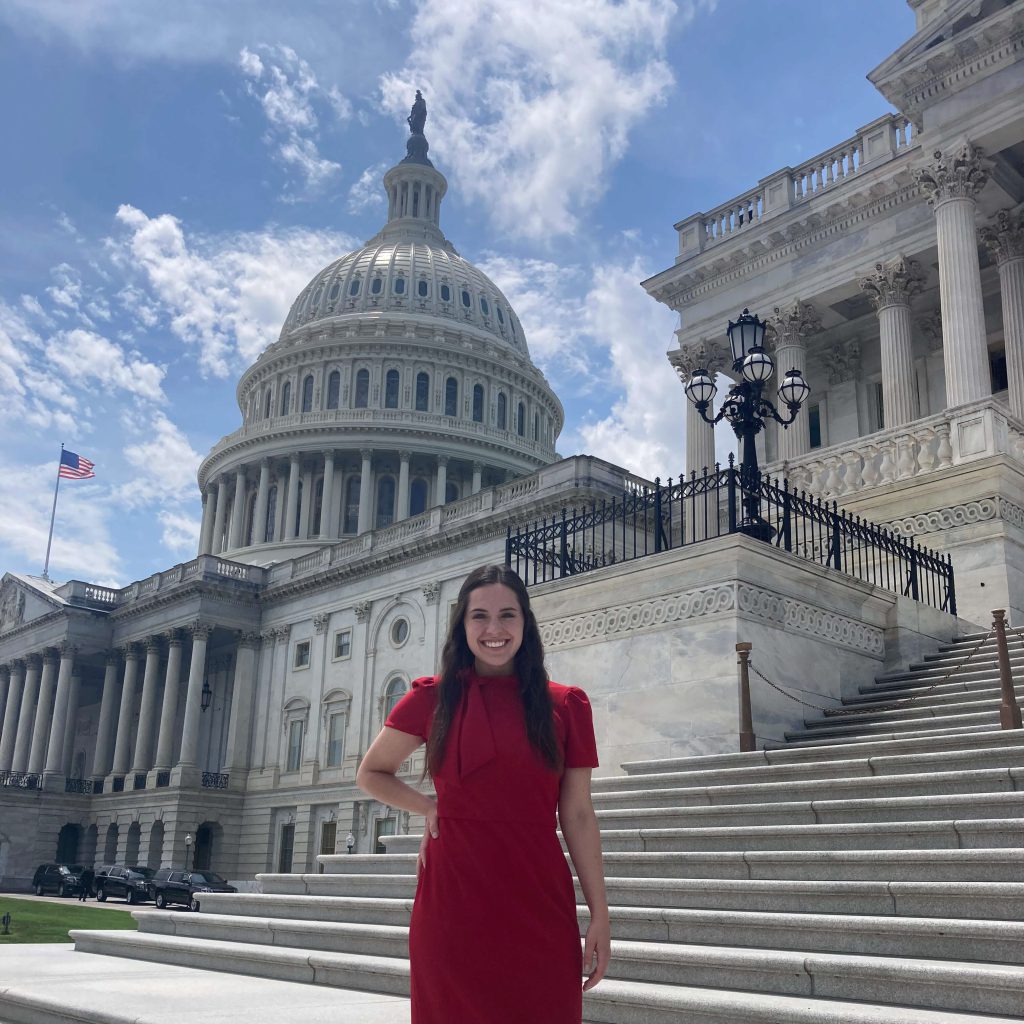
She’s already dipped her toe into the world of policymaking. She interned two consecutive summers for the U.S. government: one in 2021 with the U.S. House of Representatives and the other in 2022 with the U.S. Senate. The latter took her to Washington, D.C. for the summer where she worked under a senior policy advisor. There she got to see the legislative process in action.
In February 2022, fellow student nurses in Wisconsin elected her to serve as Legislative Vice President for the Wisconsin Student Nurses Association. During her one-year term she drafted a resolution that passed unanimously, not just in Wisconsin but nationwide.
Through her role with WSNA, she participated in the annual Nurses Day at the Capitol and even got to introduce two State Senators to a crowd of hundreds of professionals who attended the event. And she serves as the student representative on the Wisconsin Nurses Association’s Public Policy Committee. The group meets monthly to review legislation at the state level and weigh in from their lens of expertise.
“I love policy. It’s a passion of mine,” said Hallie. “We, as nurses, care about the best thing for our patients, and the best thing for our patients sometimes comes down to what is best for the nurses. We should be showing up to talk to legislators and help in that way.”
Compassion for the patient experience
What drives her passion for policy is her patients, explains Hallie. Not so long ago, Hallie required the care of compassionate nurses herself during two separate trips to the emergency room while she was enrolled at Concordia.
On the first day of her sophomore year at CUW, doctors diagnosed Hallie with eosinophilic esophagitis (EOE), a chronic autoimmune disease that causes inflammation in the esophagus. Her situation became perilous when, over the summer, a piece of food lodged in her esophagus causing tremendous pain each time she swallowed.
Then, a few months later, she received a second diagnosis: postural orthostatic tachycardia syndrome (POTS). The condition sees an excessively reduced volume of blood return to the heart upon standing after sitting or lying down. As a result, individuals with POTS often experience dizziness, lightheadedness, or fainting when they stand.
Both of Hallie’s conditions were preceded by a period of uncertainty and lots of hospital visits as doctors investigated what might be the cause of her symptoms.
“There was a lot of worry and then, frustration,” Hallie said. “But I’m a resilient person so I did know that I would get through it. Something that I’ve always been told by different faithful people in my life is that God is with you through the highs and lows. That was definitely a comfort to me to know that He is bigger and stronger than any medical condition.”
Modeling Christian care
As Hallie learned to adjust to her new normal, she received support from many different Concordians. One such individual was Professor Brenda Jobe, DNP, RN, FNP, who has dealt with her own health battles. Jobe was diagnosed with multiple sclerosis in 1994. When the disease prevented her from practicing nursing in a clinical setting, Jobe turned her talents towards the classroom.
Nursing excellence at Concordia means holistically caring for the individual—in mind, body, and spirit. Jobe shares with each cohort of students a prayer practice she used when she worked bedside. While taking patients’ vital signs, she’d go through sets of timed intervals to measure radial pulse, then respiration, and so forth. Jobe would quietly add a 30-second count to allow time to inwardly say a prayer on behalf of her patient. She encourages students to consider doing the same.
Hallie also employs a prayer practice on behalf of her patients. When she began clinical rotations during her Concordia tenure, she would reserve her commute time for prayer. She plans to continue the practice as she starts her new job.
“I pray for the patients that I will soon provide for and that I can be equipped to best care for them,” Hallie said. “Sometimes it can be a very crazy work setting and prayer helps me keep focus. It makes me feel like I am doing my very best to provide for those patients and care for their human dignity.”
Sometimes it can be a very crazy work setting and prayer helps me keep focus. It makes me feel like I am doing my very best to provide for those patients and care for their human dignity.
Hallie Barteau (BSN ’23)
Advocating for others
Hallie cares deeply about preserving human dignity—whether that is done directly through practice or by advocating for laws that will best help her patients and colleagues. In Hallie’s opinion, both are necessary to ensure the very best care.
“The reason I initially got into nursing is for bedside,” Hallie said. “I love my patients. I love helping them. What drives my passion for policy is my patients, so if I didn’t go to the bedside and hear firsthand what they struggle with, I wouldn’t be able to advocate for them as effectively.”
Her own health journey provides motivation as well. The uncertainties and worries of her conditions helped her gain empathy for others who may be facing similar challenges.
“A lot of times a person’s struggles can help them be a more well-rounded and thoughtful person,” Hallie said. “Having that understanding of how I felt when I received my diagnoses will help me to support my future patients and be the very best nurse I can be.”
Editor’s note: This is one in a series of stories highlighting a few Concordia’s uncommon May 2023 graduates. Faculty and staff submit candidates for consideration. Stories are posted in the days leading up to commencement. View more uncommon graduates here.
Want in?
The School of Nursing at CUW develops nurses ready to excel in today’s challenging health care context. As a nursing student, you will learn to care for people of all ages in both acute care settings and the community. Instructors and classroom experiences blend curricular rigor with a passion for care. This balance helps develop you uniquely both to serve with professional excellence and to fulfill your sense of calling as you care and serve throughout your career. Nursing undergraduate students also participate in the Concordia Core, a rigorous, liberal arts curriculum integrated with Lutheran distinctives.