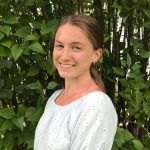
CUW Music alumni reflections: Craig Toerpe

Meet Craig Toerpe (’00), a former coach and educator who discovered you don’t have to be a music major to find major music opportunities at CUW.


To read more inspiring stories of CUW music alumni, click HERE. To help support the new CUW Music building, click HERE.

Quarter Notes

  • Name: Craig Toerpe
  • Hometown: Sheboygan, WI
  • Now Resides: West Bend, WI
  • Degrees/Certificates:
    • Exercise Physiology/Sports Medicine/Physical Therapy
    • Lutheran Education Teaching Certificate
    • Master’s in Education Administration
  • Primary Instrument: Trumpet
  • CUW Ensembles: Wind Ensemble, Jazz Ensemble, Pep Band

Whole Notes

First Job:

Biology/Physics/Chemistry Educator/Soccer and Track/Field Coach at Orlando Lutheran Academy (6th-12th) in Orlando, FL.

Current Job:

Gift Planner for the LCMS Foundation deployed to serve The South Wisconsin District.

Who or what inspired me to pursue music:

I started learning the trumpet in 4th grade at St. Paul’s Lutheran School, Sheboygan, WI, and continued to play through my middle school years at Trinity Lutheran in Sheboygan and all four years at Sheboygan Area Lutheran High School. When I met “Coach” [Dr. Louis Menchaca, CUW Music Dept. Chair], and he shared I did not have to be a music major to continue to play and perform at the collegiate level, I was all in.

Favorite CUW memory:

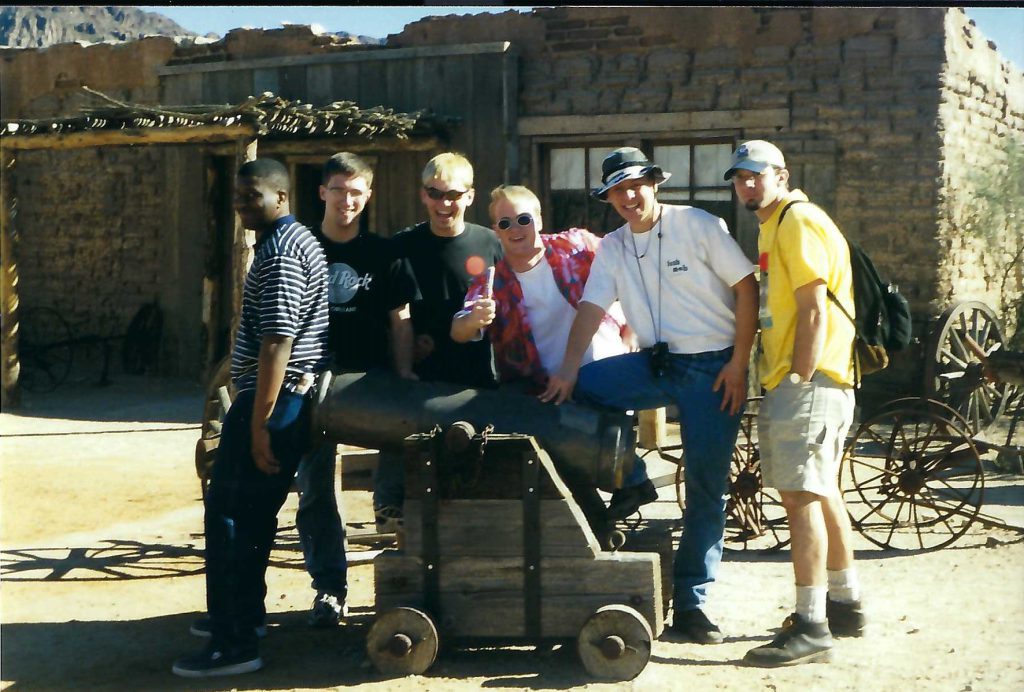
There are so many to choose from, but one that shaped my life forever was a trip to Chicago Brian Graun and I planned. We would gather a bunch of band and choir members for the lighting of Michigan Avenue, the weekend before Thanksgiving. We would all crowd into a hotel room in downtown Chicago, shop, eat and wear all our performance attire and attend a Chicago Symphony concert for $5 (Student Rush price).  As it turned out, my ticket was next to Leah Meixell (Alum 2001). The rest is history and we have been happily married for 20 years now! Best ticket purchase of my life!

P.S. Another unforgettable CUW memory was when Dr. Menchaca traveled to Minnesota to play for our wedding. He raised the roof with his piccolo trumpet during his rendition of “Trumpet Voluntary“!

If you were to visit my home today, you would hear my two girls practicing piano or the boys practicing trumpet and baritone. During dinner you will hear either music streaming or vinyl playing in the background. Leah and I love to support the local arts and attend the Milwaukee Symphony, local chamber ensembles, and, of course, Christmas at Concordia. My prayer is that current and future generations of CUW musicians will create their own memories and take their God-given talents to the next level with the new music facility.

Craig Toerpe

Favorite CUW Music memory:

Again, too many to choose from. My first Christmas at Concordia experience for sure … performing with all the ensembles and watching the “snow” fall from the ceiling was incredible. And, during commencement when my name was announced, the entire band/percussion went crazy on their instruments. Talk about a grand exit! And I can’t forget to mention I was an honorary member of the “Fat Man March.”

What CUW Music has meant to me:

My parents would tell you I was an energetic child, always running around the house. When I was not running, I was listening to music. By the time I was two years old, my father taught me how to load and listen to an 8-track tape. My favorite band was ELO (Electric Light Orchestra) and to this day, I still listen to Jeff Lynn and his orchestra. Music has always been a big part of my life as continue to listen to AM/FM radio, cassettes, CD, Sirius XM, and vinyl, once again. While at CUW, Jay Schroeder and I hosted “Reservoir Radio,” and our purpose was to “change two dimensional minds, one by one.” We curated playlists to help all our listeners appreciate all genres of music. These experiences would shape my gratitude for all forms of melodies and continue my passion to seek out opportunities to both play and listen to music.

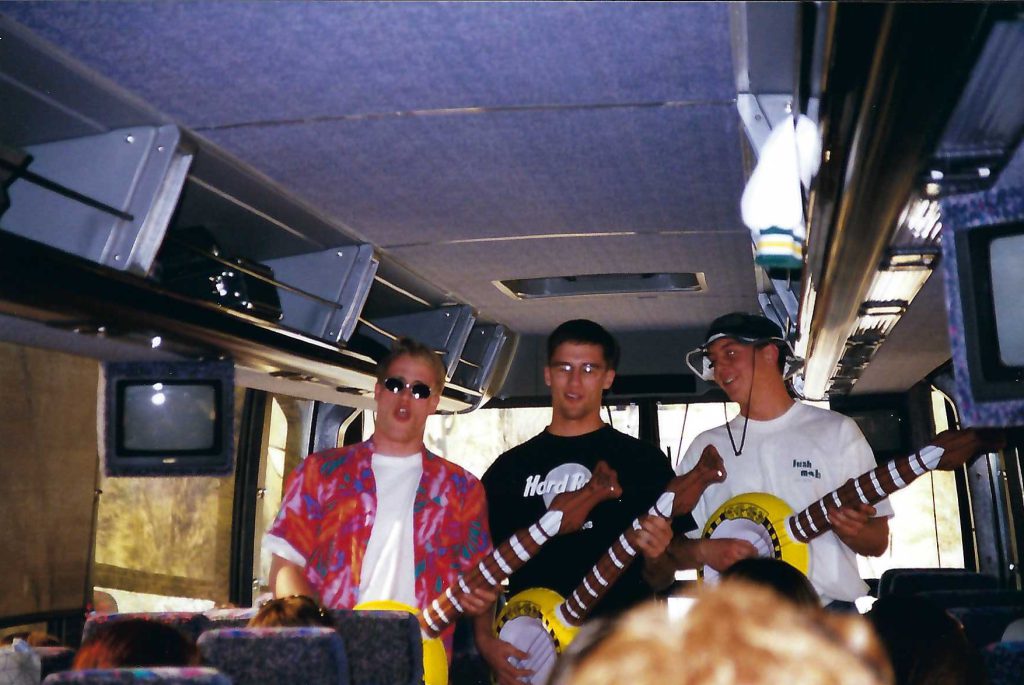
CUW gave me many opportunities to gain experience, perform and appreciate unique styles of music without having to declare music as a major. I could dive into classical or contemporary pieces with the Wind Ensemble. I was able to be loud, upbeat, and brassy with Pep Band, while dialing back the tone and tempo for Jazz Ensemble. Each ensemble not only served another occasion for me to perform, but also built upon a foundation of musical literacy with a new group of musicians. Little did I know when I participated in these ensembles with these musicians, I would have formed connections and friendships that still exist today.

If you were to visit my home today, you would hear my two girls practicing piano or the boys practicing trumpet and baritone. During dinner you will hear either music streaming or vinyl playing in the background. Leah and I love to support the local arts and attend the Milwaukee Symphony, local chamber ensembles and of course, Christmas at Concordia. My prayer is that current and future generations of CUW musicians will create their own memories and take their God-given talents to the next level with the new music facility. Just look at how music has shaped, not only my life, but the next generation of musicians in my life. Thank you, Dr. Menchaca, for your dedication to building and developing a music program at CUW, with a reputation and reach far beyond Mequon, Wisconsin! Thank you, Coach, for your mentorship, leadership, and friendship.


How you can help!

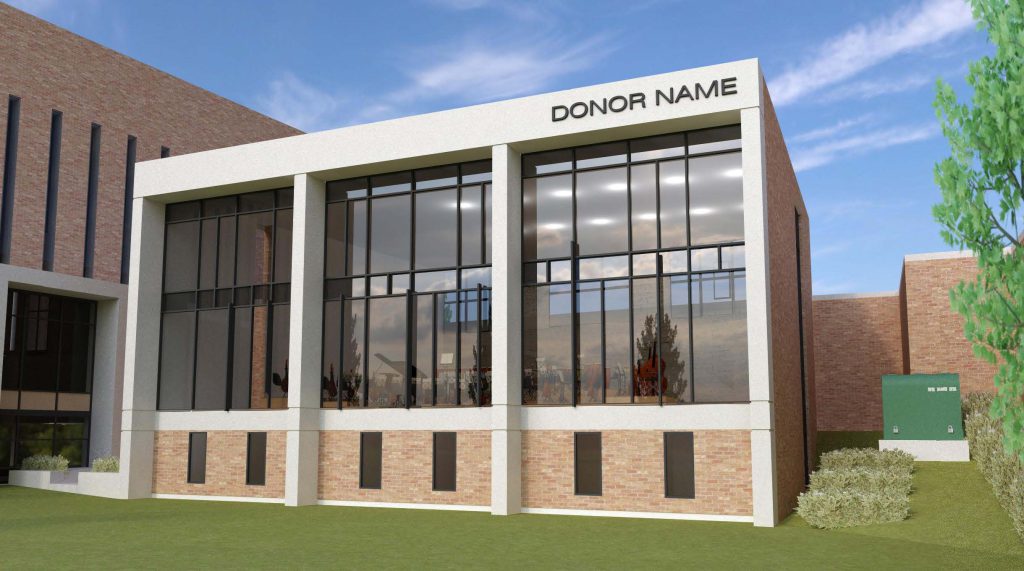
The CUW Music Department is currently raising funds to build a new, long-overdue music rehearsal space. The new building will devote 6,800 square feet to rehearsal and practice rooms for the 225-plus students at Concordia who are majoring in music programs or involved in one of CUW’s 12 music ensembles. If you’d like to help, click the link below to find out how to contribute.


Want in?

Since 1881, Concordia University’s mission has been teaching and preparing students for careers and vocations that serve The Lutheran Church – Missouri Synod. Music has always been an integral part of that mission. The music department contributes to the spiritual, cultural, artistic, academic and co-curricular aspects to University life on campus. As the campus has grown in scope and size the music department has become more integral to the University mission.


TMJ4: A new school year ahead at Concordia for Cardinal Stritch students

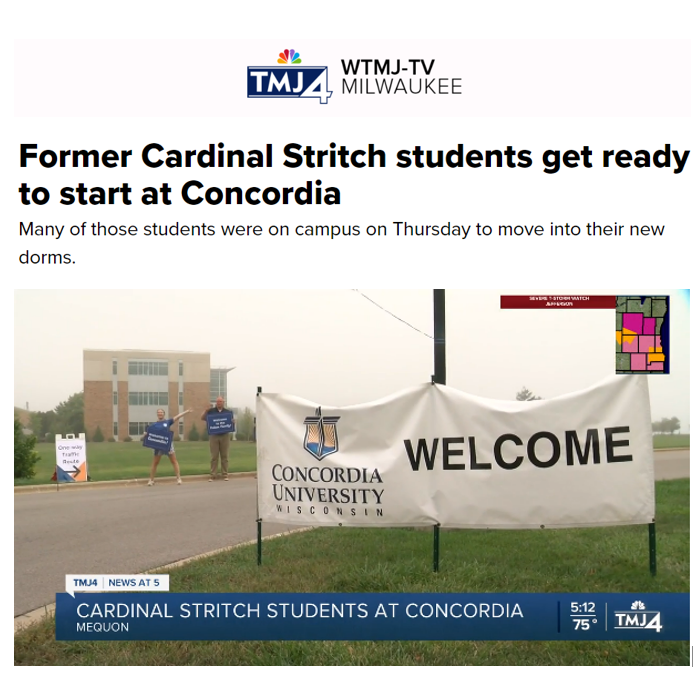
Concordia is excited to welcome some new members to the fold this academic year. During CUW’s Move-in Day on Thursday, TMJ4 stopped by to feature a Cardinal Stritch transfer student as he anticipates a new start.


Despite receiving news last spring that his university would shutter its operations at the end of the semester, Jacob Carlson is meeting the new academic year with optimism. The former Cardinal Stritch University SGA president made the decision to transfer to Concordia shortly after learning the news. There wasn’t a doubt in his mind that CUW would be his new “right fit.”

He even started his time at CUW earlier than most Stritch transfers. Over the summer, Carlson worked as a student ambassador within CUW’s Admissions Office. Even though he’s only called CUW home for about three months now, it hasn’t tampered his Falcon pride. He regularly takes prospective students and families on tours throughout the university and talks up the perks of choosing Concordia.

On Thursday, during CUW’s freshmen/transfer Move-in Day, Carlson was again on the front lines—alongside Freddy the Falcon and President Erik Ankerberg—welcoming new Concordians onto campus.

In the media

TMJ4 reporter Sarah McGrew stopped by campus during Move-in Day activities to capture the scene. She spoke to Carlson and Interim Vice President of Student Success Dr. Elizabeth Polzin about their hopes for the new school year.

Click here or on the image below to watch the segment.


Want in?

Whether you’re a high school student looking for the traditional college experience, a working professional considering a career change, or a curious, lifelong learner with a passion for knowledge, Concordia offers many options to help you grow your faith and reach your uncommon potential. Come see for yourself!

It’s ‘Baby Day’ for CUW OT students!

One of the highlights of the busy summer schedule in the Occupational Therapy program is when the babies come by for their annual visit.


By Kelly Osowski

As the OT Adult Clinic Coordinator and Professor in the OT program here at CUW, it has been my honor to coordinate the adult clients in the Community Clinic as well as coordinate “Baby Day” in Occupations Across the Lifespan class. This course is offered to our Post-baccalaureate, Accelerated, and Bridge OT students during their time here at CUW.

In the course Occupations Across the Lifespan, students learn the development of the human lifespan beginning at conception and ending at death through an occupational lens. This course covers the physical, cognitive, and emotional changes that occur across the eight major stages of development: prenatal, infancy, early childhood, mid-late childhood, adolescence, early adulthood, middle adulthood, and late adulthood.

Living dolls

“Baby Day” is when we coordinate babies ages birth to 5 years old from the community with students in the course Occupations Across the Lifespan to test infant reflexes. “Baby Day” is an unforgettable lab experience for OT students. As an occupational therapy practitioner for over 10 years, I still remember “Baby Day” in my graduate program. The hands-on learning experience with babies in order to learn development, reflexes, and how to interact with the baby and parent/caregiver is foundational as an occupational therapy student. The caregivers/parents appreciate the “play time” while students appreciate the low stakes opportunity to test out infant reflexes.

Students learn reflexes such as the palmer grasp which onset is at birth and integrates (disappears) at 3 – 4 months old. The Palmer Grasp is elicited when pressure is placed on the palm of the hand, the response then is the flexing of the fingers. The palmer grasp reflex is a precursor to voluntary grasp and fine motor tasks such as writing. OT students also learn about the Asymmetrical Tonic Neck Reflex (ATNR) which onset is birth and integrates (disappears) at 4-6 months. The ATNR occurs when a child actively turns their head or the student passively turns the child’s head to the right or left. The response is the child’s arm extends on the face side and the back arm flexes. The ATNR purpose is for hand-eye coordination and a precursor for rolling. These are just two of the many reflexes our OT students have the opportunity to elicit and observe in the “Baby Day” lab experience.

“Baby Day” is offered to students and the community fall, spring, and summer semesters and we invite babies from our OT alumni, CUW faculty/staff, and local families to join in the learning experience. “Baby Day” takes place in our new Interprofessional Community Clinic here on the CUW campus.


Want in?

Wherever you’re at in your journey into occupational therapy, Concordia University has options for you at the undergraduate, master’s, and doctoral levels. As a Christ-centered university, our program will help you advance in your calling, by learning from experienced therapists in a hands-on environment and developing a foundation in ethical leadership.


Kelly Osowski is the Occupational Therapy Adult Clinic Coordinator and Professor in the OT program at Concordia University Wisconsin,

Meet CUW’s 2023-24 Residence Life team!

Introducing the team that’s already working hard to help students get the most out of living on campus.


Even before new freshman and most returning students start moving in on campus, the Residence Life team has been hard at work—training, team-building, and getting things ready for the start of a new school year. Meet the team whose goal it is to make the upcoming school year the best you’ve ever had!

Resident Directors (RDs)

These full-time staff members who live and work on campus. They oversee the residence halls and supervise the Assistant RDs (ARDs) and Resident Assistants (RAs).

Mason Brown: Regents Hall

Mason is working on his master’s degree in counseling through CUW. He is also working with Campus Ministry to support and advise the student leaders of BUILD, Street Team, EMT, and the Spring Break Mission Trip.


Josh Warlick: Wittenberg Hall & Heidelberg Hall

Josh is beginning his second year with CUW, overseeing two predominantly freshmen halls. He is working on his master’s degree in higher education and is now managing the ResLife Instagram page.


Quinn Roekle: Wartburg Hall & Katharine Hall

On staff since 2013, Quinn has a master’s degree in Student Personnel Administration in Higher Education from CUW. In addition to the RD role, Quinn serves the university at-large by leading certification training for QPR (suicide prevention) and supporting the Faith Associates.


Kyle McCarragher: Augsburg Hall & Coburg Hall

Kyle is a former teacher, currently working on his doctorate through ASU. On staff since August 2020, Kyle supervises the largest RA staff, and is responsible for two halls that house over 450 students.


Liv Bloom: Chemnitz Hall

Liv has a master’s degree in Counseling through CUW, takes lead on RA training, and works closely with AbleLight College.


RAs and Assistant RDs

Note: Order of names listed does not correspond to positions in photo. For more information about students’ various majors, click here.

Augsburg Hall

  • Assistant RD: Kayla Nommensen | Mequon, WI | Graphic Design/Animation
  • Jakob Quarne | Roberts, WI | Marketing and Business Communication
  • Nick Chiappetta
  • Savannah Landphier | Sussex, WI | Pharmaceutical Sciences
  • J.J. Hatton | Green Bay, WI | Rehabilitation Science
  • Jillian Wolf | Oak Creek, WI | Nursing


Chemnitz

  • Assistant RD: Benjamin Groll | Oak Park, IL | History & Secondary Education
  • Corrin Charlson | Rogers, MN | Psychology & Social Work
  • Nick Klein | Auburn, MI | Exercise Physiology
  • Ava Booth | Plymouth, WI | Elementary Education
  • Samuel Butterfield | St. Louis, MO | K-12 Business Education
  • McKenna Augustine | Kiel, WI | Communications Sciences & Disorders
  • Zachary Leahy | West Dundee, IL | Finance
  • Brooke Braga | Belgium, WI | Nursing
  • Joshua Peterson | Palatine, IL | Business Analytics
  • Tia  Fuller | Greendale, WI | Exercise Physiology/Pre-PT

Coburg

  • Assistant RD: Angelina Reiter | St. Louis, MO | Mathematics & Secondary Education
  • Bernie VanDen Heuvel | Valders, WI | Rehabilitation Science/Pre-PT
  • Paige Zirbel | Manitowoc, WI | Rehab Science/Pre-PT
  • Courtney Tesch | Appleton, WI | Marketing & Management
  • Gloria Maxson | Fort Wayne, IN | Exercise Physiology
  • James Schultz | Overland Park, KS | History
  • Paige Mielke | Indianapolis, IN | Director of Church Ministries
  • Jordan Wright | Fort Wayne, IN | Interior Architecture & Design
  • Heidi Hahn | Oconomowoc, WI | Christian Elementary Education
  • Aaron Yurk | Grafton, WI | Interior Architecture & Design/Business Education
  • Sophie Lally | Surig, WI | Rehabilitation Science/Pre-OT

Heidelberg

  • Assistant RD: Sabrina Moore | Park Ridge, IL | Rehabilitation Science/Pre-OT
  • Zane Farra | Pewaukee, WI | Marketing
  • Alex Uttley | St. Louis, MO | Pre-Seminary

Katharine

  • Assistant RD: Abby Popp | St. Peters, MO | Early Childhood/Special Education
  • Ellie Mroczenski | Wausau, WI | Secondary Education & Natural Sciences
  • Grace Spaletto | Palatine, IL | Business Analytics (BA) & Management Information Systems (MBA)
  • Amber Fietzer (Alternate RA) | Manawa, WI | Biomedical Sciences

Regents

  • Assistant RD: Eddie Braatz | West Allis, WI | Sports Entertainment and Business
  • Austin Northern
  • Katie Siudak | Green Bay, WI | Psychology
  • Tyler Murray | Kankakee, IL | Accounting
  • Sydney Lilienthal | Plover, WI | Exercise Physiology/Pre-PT
  • Remy Stafford | Chicago, IL | Sport and Entertainment Business
  • Lauren Werries | Quincy, IL | Management
  • Will Bauer | New Berlin, WI | Biomedical Sciences
  • Mekhi Sutton (Alternate RA)

Wartburg

  • Assistant RD: Abby Popp | St. Peters, MO | Early Childhood/Special Education
  • Zoe Buske | Milwaukee, WI | Psychology and Social Work
  • London Kubisiak | Wisconsin Rapids, WI | Communication Sciences & Disorders
  • Molly Prendergast | Elkhorn, WI | Biomedical Sciences
  • Stephanie Eseyin | Milwaukee, WI | Business Management & Business Communication
  • Amber Fietzer (Alternate RA) | Manawa, WI | Biomedical Sciences

Wittenberg

  • Assistant RD: Sabrina Moore | Park Ridge, IL | Rehabilitation Science/Pre-OT
  • Kailey Ramaker | Cedarburg, WI | Rehabilitation Science/Pre-PT
  • Lily Atwood
  • Allie Wieringa | Naperville, IL | Rehabilitation Science/Pre-OT
  • Kristin Karas | Milton, WI | Early Childhood/Special Education
  • Jonah Jurss | Sheboygan, IL | Rehabilitation Science/Pre-PT
  • Andrew Elmhorst | Manawa, WI | Rehabilitation Science/Pre-PT
  • Owen Burns | Morris, IL | Secondary Education/Math

Want in?

Living on campus at Concordia University Wisconsin is a fantastic opportunity to interact with other students from different backgrounds, cultures, and experiences. You can fully soak in the true “college experience,” by getting involved in the social, intellectual, physical, cultural, and spiritual events CUW offers. The best part of living on campus? You can sleep in longer each morning because your classroom is just a short walk away. To learn more, click the link below:


Overview of the IP Clinic: “If You Build it, He Will Come” 


By Lois Harrison, Interprofessional Clinic Coordinator

Who doesn’t love the movie Field of Dreams? There are so many lessons we can learn from it … 

  1. Don’t be afraid to be innovative and have some “crazy” ideas.
  1. Building relationships and strengthening your community are important.
  1. When we follow our vision, it leads to purpose and fulfillment.

The quote in the title of this blog comes straight from the movie and embodies our dream of creating a dedicated interprofessional clinic space on Concordia’s campus to meet both the educational needs of our students, and unmet healthcare needs of our community. Well, we did build it and they are coming! The Interprofessional (IP) Clinic opened its doors in January. All of the current and future activities that will take place within it support Concordia’s mission of “helping students develop in mind, body, and spirit for service to Christ in the Church and the world.” It exemplifies the values we hold as a university … Christ-centered, truth/integrity, excellence, and service.  

This “innovative and crazy idea” has been over 25 years in the making. Physical Therapy (PT) and Occupational Therapy (OT) began providing pro bono services in our lower-level classrooms. This meant the faculty and students would remove all the desks/chairs, move the equipment around in the room, and then put everything back after each session. We found that this experiential learning format was valuable to the students and the community and started looking for physical space in the community. We were blessed to have had temporary space at Repairers of the Breach daytime homeless shelter, Gerald L. Ignace Indian Health Center, and Portal Inc. Then it was back to campus in the Concordia Center for Environmental Stewardship, Pharmacy building, once again down to the lower-level classrooms, and now finally in a dedicated clinic space. Whew! It’s been a long journey to be sure! 

Strength in numbers

The Interprofessional Clinic is certainly all about “building relationships and strengthening our community.”  The School of Health Professions (SHP) now has two clinics that will collaborate to provide services to the community and enhance the education of our students. The Speech Language and Hearing Clinic is adjacent to the new IP Clinic. Between the two clinic spaces, we can offer occupational and physical therapy, and speech, language and hearing services to children and adults.  

Together, these spaces are available for use by all SHP programs. In addition to the speech services provided 4 days per week, the occupational and physical therapy programs offer pro bono services to the community 2 days per week. In addition, diagnostic medical sonography, social work, physician assistant, and our rehabilitation science students may be involved in activities that utilize the clinic spaces. Specific spaces within the IP Clinic include … 

  • A large open gym space 
  • Private treatment/consultation rooms 
  • Simulated apartment 
  • Observation room 
  • State of the art simulation lab space 
  • Workspace for students 

We have followed our university’s vision and it has indeed led to “purpose and fulfillment.” The new clinic provides space that allows us to continue our efforts to educate all of our students to be effective interprofessional practitioners. Interprofessional education (IPE) occurs when two or more professions learn from, about and with each other. It is all about learning team-based care. Our medical and social care systems are so complex that we know that one discipline cannot provide the best care alone.  It takes a strong team to focus on the most effective care of future clients. 

A special alumni event

We are here to serve, and there are many underserved individuals in our community. These include those whose insurance no longer pays for services (as is often the case with rehab services), who don’t have any insurance at all, or who would simply benefit from additional services. Our goal is to continue our valuable collaborations with our community partners to enhance the quality of services they already provide, and work with them to help meet the unmet needs of our community.

To that end, we will be holding a special alumni event, “Creating Community Collaborations: A CUW Alumni Event” that will take place on Wed. Oct. 25, 5:30-7:30 p.m. At this event, we will provide tours of our clinic spaces, but it will also be a collaborative event where essential conversations can occur so we can hear from you what the unmet community needs are. So please save the date and consider joining us in October! Watch for additional blogs from each of the SHP programs that will come out next month to learn how each SHP program is currently, or will be, utilizing the IP Clinic spaces.


Want in?

The School of Health Professions at CUW offers a range of professional programs and degrees at the bachelor’s, master’s, and doctoral levels. Whether you pursue your education through online instruction or through classroom learning, you can expect a distinctive learning environment that will prepare you for a career marked by excellence, compassion, and service. Health Professions undergraduate students also participate in the Concordia Core, a rigorous, liberal arts curriculum integrated with Lutheran distinctives.

Lois Harrison, PT, DPT, MS, is an associate professor and the Interprofessional Clinic Coordinator at Concordia University Wisconsin.

Inauguration celebration: Submit an original poem to win $200

To commemorate the inauguration of Erik P. Ankerberg, Ph.D. as president of Concordia University Wisconsin and Ann Arbor, students have the chance to submit an original poem that celebrates CUWAA’s mission.


During his interview process for president of Concordia University Wisconsin and Ann Arbor, Dr. Ankerberg chose to open his employee-wide address by highlighting one of his favorite poems. “The Bright Field” by prolific Welsh poet R.S. Thomas is often lauded for its noncomplex, yet profoundly powerful text. The poem reminds the reader about the glory of a simple moment, and to live each day, each moment purposefully and gratefully.

I have seen the sun break through
to illuminate a small field
for a while, and gone my way
and forgotten it. But that was the
pearl of great price, the one field that had
treasure in it. I realise now
that I must give all that I have
to possess it. Life is not hurrying

on to a receding future, nor hankering after
an imagined past. It is the turning
aside like Moses to the miracle
of the lit bush, to a brightness
that seemed as transitory as your youth
once, but is the eternity that awaits you.

Perhaps there is a lesson in Thomas’ words for Concordians…or perhaps there is a new lesson or insight to be unlocked by a current Concordian?

As part of the inauguration celebration for our new university president, Concordia’s Office of Student Success, in partnership with the CUWAA English Department, invites current students to sit a moment and reflect upon Concordia’s mission statement:

Concordia University Wisconsin and Ann Arbor is a Lutheran higher education community committed to helping students develop in mind, body, and spirit for service to Christ in the Church and the world.

Students, then try your hand at a turn of phrase! Write an original poem inspired by Concordia’s mission statement and enter it for a chance to win $200 and the opportunity to read your work aloud in front of the Concordia community during inauguration week.

Related: Don’t know how to write a poem? The Poetry Society can help!

Contest parameters

  • Poems must be original works.
  • The deadline for submission is Sept. 16, 2023.
  • Any currently enrolled CUWAA student (whether undergraduate, accelerated, graduate, etc.) is eligible.
  • Faculty/staff judges will determine winners based on their poem’s originality, use of language/poetic techniques, and the development of ideas inspired by CUWAA’s mission.
  • Poets should aim to capture the essence of the CUWAA mission without relying too heavily (if at all) on the language in the mission statement.
  • Poems should be a maximum of 3 minutes in length when read aloud.

Awards

Winners will be announced on Monday, Sept. 25. The winner is eligible to receive:

  • A $200 gift certificate to the CUW bookstore or Cardinal Closet
  • An opportunity to read the winning poem aloud at the Hearts Together Gala or Hearts Together Dinner
  • Publication privilege on the CUWAA website

Want in?

Submit your original poem on the theme of “mind, body, spirit” by Sept. 16, 2023 for the chance to win prizes.


In the media: KFUO hosts talk faith and engineering with CUW’s new department chair

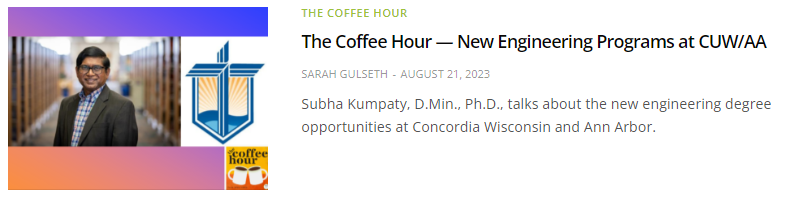
Concordia’s newly hired Chair of Engineering brings a unique blend of experiences and expertise to his role. Hosts from The Coffee Hour on KFUO spoke with Subha Kumpaty, PhD, about how these assets will impact Concordia’s new engineering programs.


Concordia University Wisconsin continues its momentum toward launching chemical and industrial engineering degrees. The two new bachelor’s degree programs are slated to begin in fall of 2024. Just last month, the university announced the man who will be leading the programs.

Subha Kumpaty, holds PhD, master’s, and bachelor’s degrees in engineering. He earned his doctorate in Engineering Science (Mechanical) from the University of Mississippi. His master’s and undergraduate degrees came from respected universities in his home country of India. Prior to accepting the CUW position, Kumpaty taught at the nationally ranked Milwaukee School of Engineering (MSOE) for over 25 years.

His credentials in the subject field alone make him an obvious choice for the CUW role. However, Kumpaty’s dedication to faith puts him over the top. Well into his successful career, Kumpaty decided to pursue a Doctor of Ministry from Tyndale Theological Seminary in Hurt, Texas to further equip himself for lay ministry. He brings this passion to the forefront now on behalf of Concordia.

In the media

Last week, Kumpaty joined Andrew Bates and Sarah Gulseth, hosts of KFUO’s The Coffee Hour, on a call to talk about his new role, his unique background, and his plans for Concordia’s burgeoning programs.

Click here or on the image below to hear the segment.


Want in?

Concordia is now accepting applicants for its chemical and industrial engineering programs, which are scheduled to start classes in fall 2024. The Bachelor of Science in Chemical Engineering degree has a specialized focus on clean energy, while the industrial engineering bachelor’s degree balances technical skills, faith-based learning, and a liberal arts foundation.

The Essential Guide to Becoming a Counselor

Are you someone who possesses a deep sense of empathy, excellent communication skills, and a genuine desire to make a positive impact on the lives of others? If so, the role of a counselor might be the ideal path for you.

Whether you’re drawn to assisting individuals with their mental health or guiding students through their academic and personal journeys, the field of counseling offers a fulfilling way to help others. If you’re intrigued by the idea of turning your compassion into a rewarding career, read on to uncover the transformative journey of becoming a counselor.

Why is therapy important for mental health?

Therapy is important for mental health for many reasons:

  1. Safe Space: Therapy provides a confidential and non-judgmental environment where individuals can freely express themselves.
  2. Professional Guidance: Therapists are trained professionals with expertise in understanding human behavior and mental health. They can help individuals gain insights into their thoughts and behaviors while learning coping skills.
  3. Skill Building: Therapy equips individuals with valuable life skills that are necessary for navigating challenges in daily life.
  4. Support: For many, therapy offers a supportive relationship that may be lacking in other areas of life.
  5. Prevention and Early Intervention: Therapy can help identify and address mental health concerns before they escalate into more severe issues.
  6. Improved Relationships: Individuals can develop a deeper understanding of themselves and their relationships with others.
  7. Stress Reduction: Talking about challenges and learning effective skills to reduce stress and anxiety.
  8. Personal Growth: Encourages individuals to examine their beliefs, values, and goals, leading to a more fulfilling and meaningful life.

People can go to therapy for a wide range of issues and do not have to have suffered a large trauma to benefit. It is definitely not for everyone. So, it’s important to be open to the idea and have a willingness to be vulnerable. It’s also important to find a counselor/therapist/psychologist/etc. that you work well with and are comfortable with. It’s not uncommon to try out several different people before finding the right fit.

Why are counselors important?

Counselors are vital because they provide support, guidance, and knowledge to individuals facing various challenges in life. As unbiased third-party professionals, they offer a safe and confidential space for clients to express their feelings, thoughts, and concerns. They work collaboratively with clients to set realistic goals and overcome obstacles. Ultimately, their goal is to help clients improve their emotional well-being, relationships, and overall quality of life.

What are some pros and cons of being a counselor?

While being a counselor can be highly fulfilling, it can also be very exhausting. Here are some pros and cons of becoming a counselor.

Pros:

  1. Making a Difference: Counselors have the privilege of being a positive force in the lives of their clients or students. Often they witness personal growth, improved mental health, and enhanced relationships as a direct result of their guidance, which can be incredibly fulfilling.
  2. Flexibility: Depending on the setting, counselors may have some flexibility in their work hours, allowing for a better work-life balance. Private practice counselors, for example, might have more control over their schedules.
  3. Varied Specializations: Counseling offers a wide variety of specializations, from marriage and family therapy to substance abuse counseling, career counseling, school counseling, and more. This allows counselors to choose an area that aligns with their passions and interests.
  4. Personal Growth: The insights gained from helping others can lead to increased self-awareness and a deeper understanding of human behavior.
  5. Continuous Learning: The ongoing learning process keeps counselors intellectually engaged and allows them to stay at the forefront of effective practices.

Cons:

  1. Emotional Toll: Dealing with clients’ or students’ emotional issues can be draining for counselors. Therefore, it’s critical to have self-care strategies in place to prevent burnout.
  2. Client Resistance: Some clients or students may be resistant to change or initially reluctant to engage. It can be challenging to help individuals who are not fully invested or are hesitant to open up.
  3. Limited Control: Counselors often work within the constraints of ethical guidelines, legal regulations, and the boundaries set by their clients. This can limit the approaches they can take in certain situations.
  4. Limited Resources: In certain settings, such as community mental health centers or schools, counselors might have limited resources. This can impact the quality and quantity of services they can provide.
  5. High Responsibility: Counselors hold significant responsibility for their client’s well-being. This responsibility can be stressful, especially when dealing with severe mental health issues.

Although becoming a counselor can be rewarding, it also demands self-awareness, resilience, and a commitment to self-care to manage potential challenges effectively.

All About Professional Counselors

A professional counselor is a trained mental health professional who provides therapeutic support and guidance to individuals, couples, families, or groups facing a wide range of emotional, psychological, and life challenges. The primary goal of a professional counselor is to help clients improve their mental health, cope with difficulties, and enhance their overall well-being.

A professional counselor’s role can look different depending on the setting. However, in general, this position is clinical one-on-one counseling with appointments throughout the day. If you are in private practice, you might be more flexible with your schedule. On the other hand, you’ll have a tighter schedule in a clinic with appointments, groups, etc.

Professional counseling encompasses a diverse range of specializations, each tailored to address specific mental, emotional, and psychological needs. Some specializations include:

  • Career Counselors: aid clients in identifying suitable career paths, assessing skills, and providing guidance on professional development.
  • Clinical Mental Health Counseling: focuses on assessing, diagnosing, and treating a wide range of mental health issues and emotional challenges.
  • Clinical Rehabilitation Counseling: focuses on helping individuals with disabilities or injuries regain their independence, improve their quality of life, and achieve their personal, vocational, and social goals.
  • Marriage and Family Therapists: help clients improve relationships within familial and partnership dynamics, help individuals navigate conflicts, and foster healthier interactions.
  • Substance Abuse Counselors: assist those struggling with addiction, guiding them through recovery and relapse prevention strategies.

The typical salary for a professional counselor, according to the Bureau of Labor Statistics, is $48,520 annually. Although this depends on experience and specialization.

So, what characteristics make a successful professional counselor? Strong communication, empathy, and advocacy skills are important. Developing active listening, patience, problem-solving skills, and healthy boundaries and also essential to your training as a counselor.

How to become a professional counselor

Becoming a professional counselor typically involves several steps, including education, training, and licensure. Here’s a general roadmap to becoming a professional counselor:

  1. Do research and gain experience: It’s important to do research on what professional counselors do and if the career is a good fit for you. Also, it’s helpful to gain some experience working with children and adults. You may consider volunteering or job shadowing.
  2. Obtain a bachelor’s degree: Start by earning a bachelor’s degree in a related field, such as psychology, counseling, social work, or a similar discipline.
  3. Earn a master’s degree: Pursue a master’s degree in counseling, psychology, clinical mental health counseling, or a related field.
  4. Complete practicum and internship: Most counseling programs require students to complete supervised practicum and internship experiences. Therefore, you’ll gain hands-on experience working with clients under the guidance of licensed professionals.
  5. Obtain state licensure: To practice as a professional counselor, you’ll need to obtain a license from your state’s licensing board. Licensure requirements vary by state but generally include completing a certain number of supervised hours, passing an exam (such as the National Counselor Examination for Licensure and Certification), and meeting educational criteria.

Remember that the specific steps and requirements can vary based on your location and the area of counseling you’re interested in. It’s essential to research the requirements in your state to ensure you’re on the right path toward becoming a licensed professional counselor.

All About School Counselors

A school counselor is a professional who works within an educational setting to provide support and guidance to students in various aspects. A school counselor works with all students to support their success in three domains: social/emotional, academic, and career. School counselors implement programming, and one-on-one counseling, and are an integral part of the school team.

There is no average day for school counselors. Many times school counselors are faced with situations that need to be addressed immediately and anything that may have been planned for the day is put on hold.

Overall, school counselors are meeting with students for academic and career planning, going into the classroom delivering social/emotional programming, consulting with teachers and district administrators, meeting with students and parents, etc. A school counselor’s role will look slightly different depending on the school.

The typical salary for a school counselor, according to the Bureau of Labor Statistics, is $60,510 annually. Although this depends on experience and location.

So, what characteristics make a successful school counselor? A successful school counselor will be a strong advocate for their students, an excellent communicator, organized, creative, and empathic.

How to become a school counselor

Becoming a school counselor typically involves a combination of education, training, and licensure. Here’s a general outline of the steps to become a school counselor:

  1. Do research and gain experience: It’s important to do research on what school counselors do and if the career is a good fit for you. Many students have a background in education however it’s not required. Any experience working with children is helpful. You may also consider volunteering at a school, camp, or after-school program.
  2. Obtain a bachelor’s degree: Start by earning a bachelor’s degree in a related field such as psychology, counseling, education, social work, or a related discipline.
  3. Earn a master’s degree: Pursue a master’s degree in school counseling, educational counseling, or a closely related field.
  4. Complete supervised experience: Many school counseling programs require students to complete supervised practicum and internship experiences within educational settings. This hands-on experience is crucial for developing practical skills.
  5. Obtain state licensure: School counselors typically need to obtain state licensure or certification to work in public schools. Requirements vary by state.
  6. Take required exams: Depending on your state’s requirements, you may need to pass a specific exam for school counselor licensure. This could include exams like the Praxis School Counseling or state-specific tests.

Remember that specific requirements can vary based on the state and educational institution where you wish to work. Always check with your state’s licensing board and educational institutions to ensure you’re meeting all the necessary qualifications to become a school counselor.

Are professional and school counselors in high demand? Why?

Yes! Mental health professionals have always played an important and high-demand role. However, the rise of mental health awareness and need since the pandemic has really increased the demand for these professionals.

As a result, mental health awareness has reached new heights. People from all walks of life have come to recognize the importance of seeking support and understanding the impact of mental health on the overall quality of life. The stigma surrounding mental health discussions has begun to erode, and more individuals are proactively seeking help when facing stress, anxiety, depression, and other mental health concerns.


What makes Concordia’s Master’s in Counseling program unique?

Concordia’s Master’s in Counseling program offers two tracks: professional counseling and school counseling. We also offer a certificate in substance abuse counseling if students want to get an extra license.

Our exceptional instructors contribute to a personalized learning experience for our students. These dedicated educators, actively engaged in their respective fields, offer not only individualized attention but also bring current real-life examples and research directly into the classroom.

Additionally, the flexibility of our online coursework proves invaluable to individuals leading busy lives, juggling full-time work and other commitments outside of their educational journey.

How is Concordia University unique?

Concordia is a Lutheran Christian school that integrates those Christian values with our programs. In this model, students acquire knowledge and skills in liberal arts disciplines that prepare them to be of service to Christ in the Church and the world. We bring a holistic approach to every class we offer our students. We challenge our students academically but also give them the chance to grow spiritually with us in ways that they may not find at other universities. Concordia is a community of people whose calling is to ensure both student success and well-being. 

Another perk of our graduate programs is flexibility. This makes the transfer process easy and saves students time and money. Our admissions counselors can provide transcript evaluations for a more accurate amount of credits. All we need is your unofficial transcripts from previous schools attended.

How long does it typically take to complete the degree?

The length of the programs depends on how long you take to complete practicum hours and how many courses you take at once. Keeping this in mind, our school counseling track normally takes between 2.5 to 3 years to complete. Our professional counseling track can take between 3 to 3.5 years to complete.

Practicum/internship requirements

Practicums and internships hold significant importance in the development of professional and school counselors. They bridge the gap between academic training and professional practice. Additionally equipping counselors with the skills, confidence, and ethical grounding needed to provide effective support to clients. These experiential learning opportunities are instrumental in shaping well-prepared and empathetic professionals in the field of counseling.

While each state has a different practicum/internship, in Concordia’s program you will follow Wisconsin requirements. Students in the professional counseling track will complete a total of 700 hours of practicum and internships. This breaks down to 100 hours of field-based experience and 600 hours of internship.

Students in the school counseling track will complete a total of 600 hours. They will do 200 hours in elementary, middle, and high school.

What format is offered? How long are the classes?

Our Master’s in Counseling program is offered almost fully online. There are only two courses, individual and group counseling, that are required in person. However, there are two options to complete those that make it more flexible. Classes are eight weeks each. The online format is very flexible but requires discipline and organization to set up a schedule to complete coursework on time.

Who are the faculty in the program? Will students have regular communication with them?

Backed by a dedicated team, our program benefits from the expertise of more than 20 adjunct faculty members who are actively practicing as school and professional counselors. Our Program Director, Leah Herr, brings firsthand experience as a former High School Counselor and is currently pursuing her doctorate in Higher Education Leadership.

Complementing our leadership, Assistant Director Laura Adameak, a former Art Teacher and School Counselor, enriches our team with her unique background. Both our program directors and adjunct faculty are always eager to connect with students, fostering a supportive and engaging learning environment. We are all here to help as you pursue a career in counseling.

How much does the program cost?

This program is $690 per credit hour. The school counseling track is 48 credits (45 credits for licensed teachers). And our professional counseling track is 60 credits.

Are there scholarships available?

Yes! We have Uncommon Scholarships available for many qualified students. Our available scholarships include:

  • Business Community Scholarship: If you are an employee of one of our corporate partners you may qualify for this scholarship.
  • Academic Community Scholarship: If you are an employee of one of our Preferred Education Partner schools or districts you may qualify for this scholarship. 
  • Christian Community Scholarship: If you are an employee of any qualifying Christian church or Christian K-12 school you may qualify for this scholarship. 
  • Alumni Scholarship: If you are a graduate of one of Concordia University System school programs you may qualify for this scholarship.
  • Veterans and Dependents Scholarship: If you are a veteran, the spouse of a veteran, or a child of a veteran(age 17-26), you may qualify for this veteran scholarship when federal veteran education benefits are exhausted or unavailable to you. 

When it comes to funding your education, have a conversation with your employer to see if they will be willing to pay a portion of your tuition. There may be funds, scholarships, or benefits their companies may offer.

Entrance Requirements

  • Bachelor’s degree
  • 3.0 GPA for full acceptance. Students with a GPA below 3.0 are still encouraged to apply as we do look at the whole student (essay, letters of recommendation, and experience).
  • No teaching license required

Admission Requirements

  • Apply Online
  • All official transcript
  • Current resume
  • Two letters of recommendation
  • Upload a 1½-2 page personal essay concisely written using the APA format (American Psychological Association).
    • Describe your reasons for pursuing the Counseling program at Concordia University Wisconsin and include the following:
      • Why do you want to be a Counselor? How has your life led you to this profession?
      • What are your career goals and how will obtaining this degree from CUW help you reach those goals?
      • How do you plan to adjust your life to accommodate the intense demands of studying for the Counseling program (time, energy, commitment, change, frustration)?

Ready to start?

To learn more about the Master’s in Counseling degree check out our program page below.

Information provided by Leah Herr, Concordia’s Program Director for the Master’s in Counseling program.
Why I joined the Falcon Peer Support Network—and why you should too!

The Falcon Peer Support Network at CUW exists to empower students to create a resilient community and to support each other’s mental health, well-being, and day-to-day lives through weekly, peer-facilitated groups and community-building events.


By Sydney Kalk

The funny thing about feeling alone is that we are all feeling it together. A recent study found 53% of college students say that they’re lonely. Even constantly surrounded by peers, chances are you or someone close to you can relate.

For a long time, I was dealing with this too. With time and help, I began to feel better, and that’s when I started being open with others, sharing my story, and establishing myself as a safe person. In time, others took note of this and, before long, I had people coming to me with really hard things. It became clear to me how much was going on behind closed doors; how many other people felt completely alone too.

About the Falcon Peer Support Network

I began to look for ways to better help these individuals in my life. I learned about the Falcon Peer Support Network. The main goal of a peer support network is to empower students to create a resilient community and to support each other’s mental health, well-being, and day-to-day lives through weekly, peer-facilitated groups and community-building events. The peer support group has an emphasis on things like self-care, stress management, and building meaningful connections and friendships.

When I learned about the Falcon Peer Support Network, I immediately loved the idea and wanted to get involved. I learned that help was needed to expand to the graduate level. As a graduate student myself, this is exactly where I felt called to help.

Together with a fellow graduate-level CUW student and a faculty advisor, we are now off and running. We began holding groups in April and have been growing ever since. I currently lead groups weekly over Zoom. These meeting times typically have discussion themes such as life balance, self-esteem, or stress management. We talk about tips, we share stories, we listen, and we support.

Any CUW student can join. We have groups for undergraduates and graduates. You just need to start by filling out a simple questionnaire so we can connect you with the right group.

For the graduate groups, this month’s meeting times and themes are:

  • Tuesday, August 22 at 7 p.m. | Redefining balance
  • Tuesday, August 29 at 7 p.m. | Check-in: How’s the start of the year been?

Need more reasons to give the Falcon Peer Support Network a try? Read on!

1. Improve your mental health and wellbeing

There are many ways connection can positively impact your mental health and well-being. People who feel connected and supported are more likely to make healthy choices, have better mental and physical health outcomes, and are better able to cope with hard times, stress, anxiety, and depression.

2. Improve your academics

According to Wilson (2018), “As school connectedness increases, so does a student’s academic success.” Social connectedness was also found to impact graduate prospects and employability. The Peer Support Network can help you feel more connected and therefore could positively influence your academic and career success.

3. Make new friends and connections

Groups are open to all students. This allows you to meet and connect with students in programs far outside of your own. We often connect well with others in our program as we share similar passions, but connecting with others over other things is important too. Having connections based on other hobbies and interests can give our minds a much-needed break and keep our lives more balanced.

4. Give back to others

By joining our network not only are you gaining support, but you are also giving it. Listening to others, sharing what has worked for you, and how you handle challenges you face are all ways you will be giving back.

5. You deserve it!

You are worthy of being supported, heard, and seen, and to have a safe place where you can open up, ask questions, and share! We weren’t created to be or feel alone. We were created to love and be loved as Jesus commanded in John 15: 12-13, “Love each other as I have loved you.”

Want in?

Interested in joining the Falcon Peer Support Network? Click on the button below and complete the intake survey. Afterwards, you will receive a follow-up email with more information and a group invite.

Interested in leading?

If you are interested in leading a group in the future, please contact Sydney.Kalk@cuw.edu if you are a graduate/online student, and email student.wellness@cuw.edu if you are an undergraduate student.


—Sydney Kalk is a graduate student at CUW and one of the graduate-level Falcon Peer Support Network leaders.

Achieve a Master’s Degree through a Business Skills Course

In our fast-paced world, the key to personal and professional growth lies in staying ahead of the curve. As the job market shifts and evolves, embracing lifelong learning is becoming a strategic approach to thriving in any field.

Continuing education courses are an easy way to gain skills and be a lifelong learner. At Concordia, our new course lets you develop skills and pursue a master’s degree to enhance your abilities.

Business Skills for Faith-Based Organizations Program

Our Business Skills for Faith-Based Organizations Program will help you develop the skills to lead with purpose and vision. We have thoughtfully structured our program into eight micro-learning courses. These small modules cater to your busy schedule and offer detailed information on important aspects of managing an organization. Here’s a glimpse of the diverse topics we cover:

  1. Human Resources Management and Development: Learn the art of nurturing your most valuable asset—your team. Explore effective recruitment, training, and performance evaluation strategies to build a motivated and engaged workforce.
  2. Conflict Resolution: Acquire the skills to transform challenges into opportunities for growth and unity within your organization.
  3. Financial Management: Discover balance sheet elements, analyze cost accounting tools, handle cash, and evaluate the organization’s financial health.
  4. Social Media Marketing: Use social media to effectively communicate and engage with your community in the digital age.
  5. Fundraising: Explore innovative fundraising strategies that align with your organization’s values and resonate with your supporters.
  6. Strategy: Develop a clear and compelling strategic vision for your organization’s future.
  7. Change Management: Navigate the complexities of change with confidence.

By the end, leaders will complete action plans that will foster useful solutions for major pain points in their organization. Additionally, upon successfully completing this program, you will have the opportunity to transfer your CEUs into 9 graduate-level academic credits.

The Path to an MBA

After completing the business skills course, you’ll have the opportunity to take one more course from our MBA program and receive a graduate certificate. Furthermore, finishing the Graduate Certificate in Management places you well on your way to pursuing a Master of Business Administration (MBA) degree. In other words, once earning the graduate certificate, you’ll have 1/3 of our MBA program completed.

Therefore, you’ll have the opportunity to pursue your master’s degree. Not only will you save valuable time but also provide cost-effective advantages as you make progress toward higher educational goals.

Gain additional insights about this opportunity through our MBA Program Director, Dr. Amber Gray.

Join Us Today

We invite you to embark on this enriching educational journey. And, embrace the opportunity to network with like-minded peers, exchange insights, and grow together as leaders of faith-based organizations.

Equip yourself with the tools needed to navigate the challenges and opportunities that lie ahead. Additionally, unlock your full leadership potential, making a profound difference in your organization and the lives you touch.

We are thrilled to stand by your faith-based organization as you journey toward a promising future. Together, let’s ignite positive transformation and equip leaders to foster a world filled with compassion and prosperity.