DBA or EdD: Which Doctorate Should You Choose?

When comparing Doctorate of Business Administration (DBA) programs with Doctorate of Education (EdD) programs, it can be hard to determine which one is the best fit for you.

What are your career goals?

Nobody knows your goals and dreams better than you do. So, what are your career goals? Why are you pursuing a doctorate? Thinking through your “why” is an essential part of selecting the program that fits you best.

Concordia offers both DBA and EdD programs. The infographic above explores the similarities and differences between both doctorate programs. The similarities are in the middle, and each program’s distinct features are to the left and right, respectively.
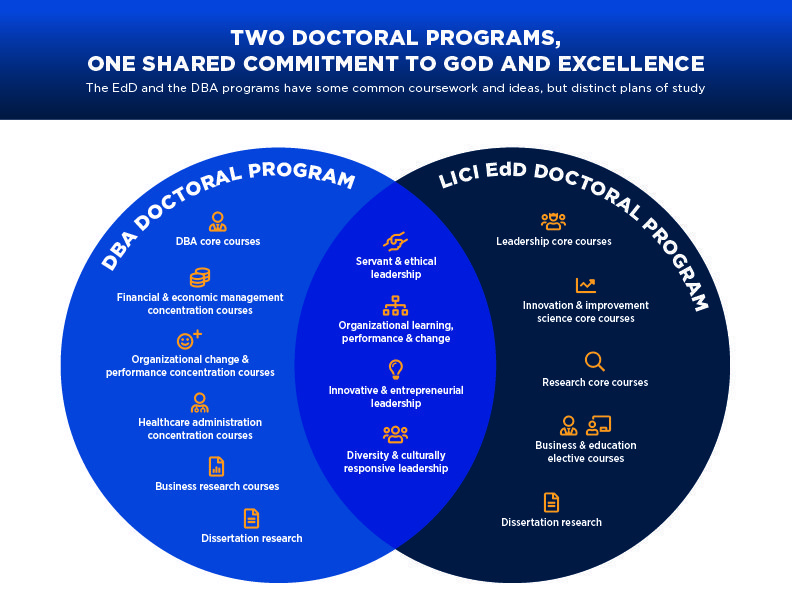
DBA vs LICI program diagram

Concordia’s DBA Program

The Doctorate of Business Administration program prepares you for the complexities that are ever-present in the business world. Concordia University takes a holistic approach to prepare Christian leaders, and the students in our program will learn to address these problems by combining both quantitative and qualitative business concepts. This approach leads to real change that translates to long-term growth and profitability.

The DBA Program has four concentrations:

  • Finance and Economic Management
  • Organizational Change and Performance
  • Business Sustainability

What sets Concordia’s DBA apart from other programs?

Our program will prepare you as a leader to make data-informed decisions through the study of real-world business and organizational trends. We will address not only quantitative business concepts but qualitative concepts as well. Our doctorate is much more balanced. The qualitative aspect of teaching the human element and a holistic approach sets us apart from other schools. 

Students are coming to us because of the way we structure our research project. You’ll begin your research right away, and you’ll have 1:1 mentoring and support throughout the process.

Who is the ideal student for the DBA program?

If you’re highly motivated and looking at improving both your personal situation and your organization, you should consider this program. Often, a DBA is preferred for candidates seeking promotions. Our program emphasizes leadership and administration, and if you can see yourself enjoying one of our three concentrations, this program could be a great fit for you.

Concordia’s EdD (LICI) Program

Concordia’s Doctorate of Education in Leadership in Continuous Improvement (LICI) is a cross-disciplinary program that will help you develop into an innovator who can make an impact in any vocation.

The mission of the EdD (LICI) program is to prepare and equip you to be driven to learn.

There are three core areas of concentrated study in this program.

  • Leadership Core
  • The Innovation and Improvement Science Core
  • The Research Core

You can customize these cores to meet your needs. Additionally, you can choose either the Business Emphasis or the Education Emphasis for your electives, or a combination of the two.

What sets Concordia’s EdD (LICI) program apart from other programs?

Innovation and continuous improvement are vital to the health of any organization. These two aspects are the foundation of our program. Also, the interdisciplinary nature of the program is much more realistic and global than what other programs can offer. Our student makeup reflects this as well. Students begin their dissertation work on day one. This doctorate is for working professionals, and we structure our research to meet their unique needs. Our program infuses Christian teachings along the doctoral journey.

Who is the ideal student for this program?

Growth-minded individuals who want to apply teaching and learning across disciplines will love this program. The research process will be especially enjoyable if you want to find real-world answers to big problems. Our focus is on continuous improvement and innovation, so anyone who wants to grow personally and help their organization improve will be a good fit.

Next Steps

You’ve just learned a little more about Concordia’s DBA and EdD (LICI) programs. If you’re still feeling unsure about which direction you want to go, feel free to request more information about our DBA or EdD (LICI) programs. Our university’s name, Concordia, literally means “hearts together.” Your journey continues one step at a time, and we’d love to walk alongside you.

This blog was originally published on December 23, 2020. It has been updated to reflect current information.

Are You Ready to Get Your Teaching License in Wisconsin?

You can get your teaching license through Concordia University’s CAPTL program.  CAPTL stands for Concordia Accelerated Programs for Teacher Licensure.

What is the curriculum like?

Our curriculum emphasizes working with diverse student populations. Additionally, you’ll grow as a reflective practitioner and understand how to differentiate instruction to meet the academic needs of all learners.

Once you complete student teaching, you’ll finish your capstone project. You’ll earn a master’s and a teaching license with our Master of Science – Teaching and Learning degree!

This program is ideal for working adults who wish to achieve their dream of becoming licensed teachers in Wisconsin, and it does qualify for financial aid.

It is accredited by the Higher Learning Commission and a regional accreditation agency recognized by the U.S. Department of Education. Additionally, it is approved by the Wisconsin Department of Public Instruction.

Step 1. Decide What You Want to Teach

What do you want to teach?

We need great teachers, and are so excited to help you on this journey!

What age of students are you hoping to work with? This will help you determine what kind of licensure you want to pursue. Is there a certain subject area you’re passionate about?

If you’re unsure about these things, connecting with a counselor can help you identify what kind of licensure matches your career goals.

An initial teaching license in Wisconsin is the license you get when you first begin your teaching career.

Initial Teaching Licenses in Wisconsin:

  • Special Education: Cross-Categorical (Grades 4K-12)
  • Elementary (Grades 4K-9)
  • Early Childhood (Birth –  grade 3) and Elementary (Grades 4K-9)
  • Secondary (Grades 4-12 or 4K-12th depending on content area)
    • Licenses available: Art Education, Broad Field Social Studies, Science, Business Education, English/LA, Mathematics, Physical Education, World Languages (Spanish)
    • Please note! For a Secondary license, you must already have content knowledge in the area. We suggest an undergraduate major in the content area you are looking to become licensed in.

Step 2. The Transcript Evaluation

This program requires a bachelor’s degree.

  • Send unofficial transcripts to your admissions counselor. Include any transcripts where college credit was received.
  • Our program coordinator will evaluate your transcript to make sure you are eligible for the license you are seeking.
  • The program coordinator will reach out to you with that evaluation, including information about our next cohorts!

Step 3. The Application

After learning that you are eligible for licensing, we welcome you to apply!

After you apply…

You’ll have to submit a few items along with your application. The application page will prompt you for each item. You do not need to complete the application in one sitting.

  • Send your official transcripts (electronically or through the mail) to Concordia University Wisconsin Admissions (electronically or through the mail).
  • Upload a current resume.
  • Upload a personal essay, describing your reasons for obtaining a teaching license and pursuing our program. What goals do you have?
  • Submit two letters of recommendation.

Step 4. Acceptance!

Our program directors will review you application.

  • If you get accepted, you will receive an initial acceptance letter with a required Letter of Understanding and Background Check forms to complete.
  • Return those documents, signed.
  • Congrats! You’ll be fully accepted at this point!
  • Check out our Uncommon Scholarships.

Frequently Asked Questions:

How long are the classes?

  • Classes are 8 weeks long

Are classes face-to-face or online?

  • Fall cohort: virtual classes
  • Spring cohort: online classes
  • In-person requirements: Clinical observations, pre-student teaching, and student teaching

How long is the program?

  • Program length: 24-36 months, depending on the license.

Didn’t see your question? Ask a counselor here!

If you still have questions about what it takes to get your teaching license through Concordia University, you can book a call with one of our Inquiry Support Specialists.

This blog was originally published on December 14, 2020. It has been updated to reflect current information.

What is the difference between an LPC and an LCSW?

Counselors and social workers indeed have many similarities. They are both trained to provide mental health services to people and the community. But, were you aware that licensed professional counselors and licensed clinical social workers have some key differences? Counselors and social workers train differently, for example. Therefore, their scope of responsibility is different. Both counselors and social workers often work together on integrated, interdisciplinary teams to ensure the best for their clients.

Licensed professional counselor (LPC)

The American Counseling Association defines the term counselor this way:

“Counseling is a professional relationship that empowers diverse individuals, families, and groups to accomplish mental health, wellness, education, and career goals.”

  • Required degree: Master’s in Counseling
  • Clinical requirements: 700 as part of a master’s program + post-graduate internships as mandated by each state
  • Common workplaces: Hospitals, mental health clinics, residential care facilities, schools, and private practice

A career in counseling focuses on helping clients with specific issues, such as mental health diagnoses, substance abuse, or behavioral issues. They also can specialize in different types of counseling, including substance abuse or marriage and family counseling.

While some counselors work in private practice, many also work in hospitals and schools, while usually working alongside psychologists, psychiatrists, and social workers. The bulk of educational preparation as a counselor involves advanced counseling theory and techniques.

Licensed clinical social worker (LCSW)

The National Association of Social Workers defines social work like this:

“Clinical social work is a specialty practice area of social work which focuses on the assessment, diagnosis, treatment, and prevention of mental illness, emotional, and other behavioral disturbances.”

  • Required degree: Master’s in Social Work
  • Clinical requirements: 900 as part of a master’s program + post-graduate internships as mandated by each state
  • Common workplaces: Hospitals, clinics, community centers, social welfare agencies, schools, and private practice

While clinical social workers can perform counseling services, it is only one component of their duties. Social workers assist their clients with finding and accessing resources that promote a client’s quality of life and may be involved in the legislative process dictating these services. Social worker training usually includes counseling techniques and training in-laws, best practices, and finding resources for clients.

Is counseling or social work right for you?

When choosing a career path, it is important to know what you are looking for in a career, as well as the education path. Do you want to focus on counseling or be able to have other duties besides just therapy? How fast do you want to complete your degree? What setting do you want to work in?

Having a hard time deciding?

Shadow a counselor or clinical social worker for a day. Being able to see what a typical day in the field is like is a wonderful way to decide what the best fit may be.

Get started today

Ready to start? Concordia University offers a Professional Counseling and a Master of Social Work program. With flexible and online options, it is easier to achieve your educational goals.

5 Reasons why you should get a STEM degree

The importance of STEM education is nothing new. From analytical thinking to creative problem-solving and experiential learning, the benefits of STEM have made their way into the classrooms of school-age children. But, what about college? Should you pursue a STEM degree? Check out our five reasons why you should consider earning a STEM degree.

5. Learn technical concepts and skills

Earning a STEM degree won’t guarantee you a job. But, if you’re engaged in your studies, you’ll get to challenge your brain with deep concepts and complex topics. The U.S. Department of Education highlights how important STEM skills, content knowledge, and literacy are when it comes to facing the challenges ahead of us as a country and as a world.

4. Job security

STEM programs are still in-demand. In fact, the Bureau of Labor Statistics estimates that the STEM employment rates will grow another 8% by 2029. One of the largest jumps in STEM career opportunities appears to be happening within the mathematical sciences field. This would include business analytics and data science, for example. Job security isn’t guaranteed in any field, but STEM skills can help to equip you with highly marketable skills.

3. High earning potential and flexibility

Income is not everything. However, it’s an important factor to recognize when choosing a degree program and field of study. STEM jobs are well-known for their high salaries. As of 2022, STEM jobs saw an annual mean income of $100,900, according to CNBC. This is nearly double that of non-STEM jobs. In addition to higher salaries than non-STEM jobs, most men and women who currently work in STEM careers state that the flexibility to balance work and family is most important to them.

2. You love to problem-solve.

Problem-solving is the foundation of STEM education. Technically, problem-solving is considered a soft skill. Improving your soft skills, like problem-solving, will help you find success in every area of your life, but especially in the workplace. In order to solve a problem, you must identify it. If you love to figure out how things work or why something isn’t working a STEM degree could be a great fit for you. Problem-solving requires creativity, so if you’re concerned about

1. You want to make a difference.

It can be easy to think that when choosing a career path, you either want to work with people or you don’t. Whether you want to be interfacing with people frequently, or you’d prefer minimal interpersonal communication, STEM jobs contribute to important projects that impact real people. Even further, the U.S. Department of Energy states that some of the fastest-growing STEM jobs are positions that help care for our planet and fight climate change.

Or, consider something like digital accessibility. STEM makes important and enjoyable tools more accessible to a variety of people. Have you ever used an app that just didn’t make sense or was hard to use? Think about how important it is to create apps that are usable by a diverse population. Accessible technology means that users can interact with the tech in a way that works best for him or her. STEM professionals can be a part of improving and innovating with accessibility in mind.

If you love STEM content and want to use your talents and passion to serve the world around you, pursuing a STEM degree can help you live out your vocation.

Getting your STEM degree at Concordia University Wisconsin

Concordia University Wisconsin offers a variety of STEM-designated degree programs for undergraduate and graduate students. If you want more information about our STEM programs, we’d love to hear from you.