This story is written by Mike Zimmerman, videographer/photographer for Concordia University Wisconsin. He may be reached at michael.zimmerman@cuw.edu or 262-243-4380.
The grant, awarded by the Association of Schools and Programs of Public Health (ASPPH), is intended for “fostering collaborative partnerships that will innovatively enhance the education of undergraduate public health students.”
The CUW Bachelor of Science in Public Health (BSPH) program got a lift in May when the CUW School of Pharmacy (CUWSOP) was one of just six schools to receive the new ASPPH grant. The BSPH program, launched the fall of 2022, includes two concentrations: Community Health and Pre-Clinical. Currently, it is only offered on the CUW campus, with classes taught in person.
The plans proposed by the CUWSOP would create a three-pronged approach to helping and encouraging students to pursue a public health degree at CUW.
1. Expand online availability
The first, explained Dr. Sandy Slater, Director, Bachelor of Science in Public Health Program at CUW, is to explore shifting some of the course work to an online/virtual approach. “This would enable us to reach more students who are unable to attend CUW in person, including students at Concordia University Ann Arbor,” she said.
2. Create a “three plus two” path
The second pathway is to examine creating a “three plus two” option for public health. “This would give our public health majors a fast track option for completing a master’s in public health at our sister school in Irvine, California,” Slater said. “They’d be able to earn both a bachelor’s degree, from CUW, and a master’s degree, from Irvine, in just five years.”
3. Partner with MATC
Finally, the grant will fund exploring a partnership with Milwaukee Area Technical College (MATC). “We’re working on a potential articulation agreement that would give those graduating with certain MATC associate degrees the opportunity to enroll and earn a bachelor’s degree at CUW,” Slater explained. “MATC has also some nutrition courses that we don’t offer, so it would fill in some gaps for us, as well.”
Besides being one of just six programs to receive the award, another reason to feel proud is that this is the grant’s inaugural year. “We were selected for the first cohort to receive this grant,” Slater said. “We’re excited to be selected alongside some very prominent schools, and look forward to make the most of this opportunity.”
Want in?
Develop the skills, compassion, and knowledge to successfully master the two key principles of public health, prevention and health equity. The Bachelor of Science in Public Health program will prepare you to work with interdisciplinary teams to improve health and well-being at a local, national or global level. Engage in real-world experiences to better understand the goals and challenges you will encounter in public health.
Gracie, the new therapy dog in the Veterans Department, will be on hand in the upcoming school year to share her special brand of joy with CUW’s veteran and military students.
“It’s a dog’s life,” people sometimes say. But what does that mean? Turns out, back when dogs were more about work than companionship, it was meant as a negative. But these days, it’d be hard to imagine a dog with a sweeter life than Gracie.
Gracie, a 3-year-old (almost) English Labrador Retriever, is now a consistent presence at the Howard J. Bogenschild Veteran and Military Affiliated Resource Center on the CUW campus. Her job description? “She just hangs out here, and all the veterans get to love on her, and hang out with her,” said Gracie’s owner, Mikayla Allsop (’25). “She’s also going to be part of our social media campaign in the fall, to help bring in more students.”
Allsop, a marketing major who spent time in the U.S. Navy before transferring to CUW from Alverno College, said her family has always had Labrador retrievers, and was happy to offer Gracie’s services when she had the idea for a veterans comfort.
“I have a perfect dog at home, who would love to come in!” she said at the time. Keith Casey, Director of CUW Veteran Services, liked the idea, telling Allsop to “do your research” before putting together a formal proposal. Once the CUW administration signed off, it was all systems go.
Pilot pooch
Unlike Zoey and Runner, CUW’s official comfort dogs, Gracie does not have any special certifications. But she was required to pass a “good citizenship test” at a local dog training center. “She passed with flying colors,” Allsop said. If you’ve already met Gracie, you likely know her to be exceptionally friendly, calm, and, well behaved. In other words, the perfect personality for doing the “work” she’s been assigned.
Because Gracie is Allsop’s personal dog, she will be leaving next spring when Allsop graduates. That’s sad for Gracie fans, but it works out well for a potentially long-term canine addition to the Resource Center staff. “We’re looking at this as a pilot program,” Casey said, “to see if it’s feasible to continue to have a therapy dog in the Resource Center, and see if we can find a sponsor to provide some funding.”
So far, in just the few months since Gracie started in March, you’d have to consider the program a success.
“I don’t think I’ve met anyone who hasn’t loved her,” Allsop said. “She’s very good at picking up emotions and matching the energy of whoever she’s with.”
In case you’re wondering, no, you don’t have to be a veteran to come and meet Gracie. For one thing, she’s often out and about on campus taking walks with Allsop or Casey. And anyone is welcome to stop by the Veterans Resource Center (in the lower level of Rincker Hall) to say hello.
While you’re there loving on Gracie, just be sure to take a moment to learn about all the great work that goes into making CUW a top Military Friendly school year after year. And to thank a veteran student for the sacrifices they’ve made to help protect our freedoms!
Want in?
Concordia University Wisconsin is a Lutheran higher education community committed to helping students develop in mind, body, and spirit for service to Christ in the Church and the world. To learn more about our Military Friendly campus and all we do to support veteran and military students, click the link below.
Kelly Osowski will spearhead the new program, a unique, post-secondary certificate program that allows people with intellectual and developmental disabilities to realize their dream of receiving a college experience.
Concordia University Wisconsin has long had a heart for helping young people with intellectual and developmental disabilities. In recent years, the AbleLight College program filled this important role. Before that, Bethesda College program served those needs. Now, this type of program will be more fully integrated into Concordia University Wisconsin with the new Hesed Transition Program.
Earlier this month, Kelly Osowski, assistant clinical professor of occupational therapy at CUW, was named to be the program’s director.
In a letter sent recently to parents, Osowski explained, “I am thrilled to join this community and continue the outstanding work that has been established. My background in occupational therapy, coupled with years of experience in healthcare and academia, positions me well to guide our students towards achieving their goals of independence and vocational success.”
We are committed to our mission to uplift and empower individuals with intellectual and developmental disabilities as they navigate the challenges of transitioning into adulthood.
Kelly Osowski
Osowski brings a unique background to the role. She has been an assistant clinical professor of occupational therapy at CUW since 2022, playing an integral role in developing, staffing, and managing CUW’s Interprofessional Clinic, which opened last year. She has also worked as an occupational therapist for the Aurora Grafton Medical Center since 2012. In these roles, she has extensive experience developing care and advocacy plans for her patients.
Care and compassion
Her passion for serving those with intellectual and developmental disabilities has grown from her work with such patients as an occupational therapist. In particular, one special patient at the Interprofessional Clinic at CUW has helped her sense this calling.
“There’s a client in the Community Clinic, who’s been coming for a while, and has developmental disabilities, who really helped me change up how I saw my practice as a therapist,” Osowski explained. “It’s not just about working with the physical side of things, but also the mental and emotional. I was able to help him advocate for himself in his group home, and he really appreciated it. He helped me use my skills as a therapist in a different way.”
That type of approach is a perfect fit for Concordia’s mission, to help students “develop in mind, body, and spirit for service to Christ in the Church and the world.” Though the new initiative will follow in the tradition of the AbleLIght College program, which previously served the needs of students facing special challenges at Concordia, the Hesed Transition Program will be more fully integrated into the Concordia way of life.
“Now that we’re officially part of Concordia, the faith-based part of things will be emphasized more than ever,” she explained. “Jesus loves everybody, and we want to make sure all students know and experience that.”
It also means looking for more opportunities for other CUW students to interact and build relationships with Hesed students. Learning to transition into the world beyond college, after all, is a challenge every student faces—and it includes getting comfortable with people who face different types of challenges than they do.
Living and learning
From an academic standpoint, the new program will also include a bit more structure than previous iterations.
“We’ll be incorporating badge assignments into the curriculum,” Osowski said, “which simply means that in addition to graduating from the program with their certificate, students will be able to point to specific classes they’ve taken and skills they’ve developed, to help them get into a particular field they may be interested in.”
The top priority, as always, is to make sure these students are well cared for, Osowski added—and to make sure parents share that confidence. As she assured parents in her letter, “We are committed to our mission to uplift and empower individuals with intellectual and developmental disabilities as they navigate the challenges of transitioning into adulthood.”
Want in?
Concordia University Wisconsin is a Lutheran higher education community committed to helping students develop in mind, body, and spirit for service to Christ in the Church and the world. To apply for or learn more about the Hesed Transition Program, click the link below.
Rev. Dr. Kurt Taylor, associate professor of theology at CUW, retires as Air Force chaplain after more than 24 years of military service.
In honor of Memorial Day 2024, we’re recognizing our own Rev. Dr. Kurt Taylor, who recently retired after more than 24 years as an Air Force chaplain. Throughout his career, Taylor has tirelessly preached the Gospel to countless airmen, shining the light of Christ in what is often the darkest of hours. We can think of no more important duty regarding the many men and women in history who have paid the ultimate price in defense of our freedoms.
When God called him, Kurt Taylor answered. When his country called, he answered again.
The first call came in 1993, when he became a parish pastor in Calumet County, Wisconsin. Joining the military at that time wasn’t something he had thought much about. His father had served in the Navy, but it was long before he came along, he said. But then he felt “a pull from God.”
“We were surrounded by corn and cows in central Wisconsin,” he recalled. “My wife and I are both city people, and if we wanted to breathe city air, we’d go to Appleton. And to get there we had to drive past a building with a big, lit-up sign that said, ‘Armed Forces Recruiting Center.’ Every time we’d drive past it, I’d think about it some more.”
Ultimately, a friend who’d become an Army chaplain invited him to spend a weekend with him at Wisconsin’s Fort McCoy. After seeing both how his friend served and how he lived, Taylor said he learned two things: “First thing was that I wanted to be a military chaplain. The second thing was I didn’t want to do it in the Army!”
So, after investigating the Navy and the Air Force, Taylor decided the latter would be the best fit for him.
“It was this crazy pull. And now, when students walk into my office here and, and they’re in some other major, and they don’t know quite how to enunciate it, other than ‘I think I should be going into church work’ … that’s when I usually start laughing and say, ‘Yes, I know exactly what you’re talking about.’
“This is God at work, and recognizing God at work. You can’t explain it, and you can’t fight it.”
God had other plans
He joined the Air National Guard, as he and his wife, Christine, didn’t see full-time deployment as the best option for raising a family. But only two years later, September 11 happened, and it wasn’t long before was called up to serve in Kyrgyzstan, just north of Afghanistan, for six months. It was there that he had one of his most intense, and certainly most meaningful, duties: ministering to fighting men and women on their way to or from the heat of battle.
“I talked to numerous, numerous people,” he recalled. “I had two or three spiritual guidance appointments a day, every day, for six months. They were either scared to go in [to battle] or traumatized coming out. That was a real challenge; but it was also incredibly rewarding.”
Another challenge was just winning over the base commander, who didn’t like that a reservist had been appointed head chaplain. By the time Taylor went home, however, the colonel was so pleased with his service he gave him a challenge coin as a memento, which Taylor cherishes to this day.
Back in the United States, Taylor was stationed with the 110th Wing at Battle Creek (MI) Air National Guard Base (ANGB), making trips to Michigan about once a month from his “day job” as associate professor of theology and director of the DCM (Director of Christian Ministries) program at CUW. For the past five years, he has also been working with Selfridge ANGB outside Detroit, helping that base establish a chapel program there. The full-time chaplain had been deployed for six months, leaving them empty-handed for a time.
“So our wing commander said, ‘Kurt, I want you to build that program over there so that when he gets back, there will be a strong chapel program to return to.’” Taylor recalled. “And now, for the first time in the state of Michigan, instead of Battle Creek and Selfridge being completely separate, we have created Chapel Team Michigan. It’s something I’m very proud of.”
Introducing Jesus
One of the privileges of military chaplain service is ministering to people who often don’t necessarily have a relationship with Christ—or know precious little about Him.
“As a parish pastor, I’m used to being invited into people’s lives who are committed Christians,” Taylor said. “In the Air Force, it’s not always like that. And so I’m invited into intimate parts of people’s lives, when things can be falling apart.
“When you’re in a public setting, like a ceremony or something, you keep things pretty generic. But when you’re one-on-one with somebody … Boy, I let the cross fly! Jesus, Jesus, Jesus. And I know for a fact that some of the people I talked to about Jesus hadn’t really heard other than His name before. So to be able to bring Christ to people who didn’t know who He is was constantly a thrill.”
An unbeatable team
Another aspect of military service is that it’s always about the team. Taylor is quick to recognize those he serves alongside—including his civilian brethren here at Concordia.
“When I was brought on here, they knew full well I was already obligated to the Air Force, and never once did they question that obligation,” he said. “They have only supported it, and I’m very grateful.”
In the Air Force, he feels privileged to have served with so many outstanding people, particularly at the Battle Creek and Selfridge bases.
“Next to the six-month deployment, these past five years have been the pinnacle,” he said. “The people that work with me, our team, are just the highest quality people. I set the vision and they did the work, which is how it ought to go. I didn’t have to ask them to do anything; they all knew what to do and how to do it.
“I’ve also appreciated the relationships I’ve had with my commanders over the years,” he added. “For whatever reason, they always seemed to trust me, and would sometimes tell me things they wouldn’t tell anybody else. I’m very grateful for that privilege.”
As he so beautifully put it in his retirement speech: “When I joined, people asked me why did I join the military, and I gave the standard answers: to serve God and country. But then I would also answer there’s a selfish reason I joined, and that’s because I wanted to hang out with heroes. And as I look around this room, may I say, ‘mission accomplished.’
“To God be the glory.”
Want in?
Concordia University Wisconsin is a Lutheran higher education community committed to helping students develop in mind, body, and spirit for service to Christ in the Church and the world. To learn more, click the link below.
The winter of 2022-23 was a rough one for our beloved icon. Repairing it is no easy task. But don’t worry, a fix is in the works!
“Water always wins.”
It’s a phrase you hear sometimes when talking to contractors, or landscapers, or plumbers. It basically means that water tends to go where it wants, and over time it finds a way into things.
In the case of CUW’s Fishers of Men statue, water, over time (probably years) had found its way inside the arm of one of the Fishers (Simon or Andrew? Who knows?). When enough water pooled there, and it got cold enough to freeze solid (and expand), over and over, eventually the arm basically burst, kind of all at once. That’s why it looks the way it does right now.
Bad news, good news
The bad news is that it’s not an easy fix. That’s why it’s taken a while to formulate a plan. The good news is, a plan is in place and repairs should happen soon.
Jeff Shawhan
The man behind it all is our own sculptor in residence, Associate Professor of Art Jeff Shawhan. For a guy who has built a reputation as one of the world’s foremost snow sculptors, it’s perhaps ironic that he’s repairing damage done by snow and ice. But his breadth of knowledge and experience in the sculpting world makes him just the right man for the job.
If you had always assumed the statue was made of bronze, you wouldn’t be alone. In fact, it’s made of composite materials that Shawhan believes the artist, Igor Vasiljev, likely formulated himself.
“It’s basically a cement base,” Shawhan said. “There are two layers: a fiberglass layer on the inside with cement on the outside. When you have two different materials like that, everything’s about the coefficient of expansion. They shrink and expand at different rates. And it’s not a temperate climate here; it rains all the time, it freezes, it’s constant on and off. That’s where the stress comes from.”
An ongoing process
Fortunately, Shawhan was able to salvage most of the broken parts, so it’s more a matter of “connecting the dots” than trying to reconstruct the arm from scratch. It’s not the first repair that’s ever been done to our campus icon, and it won’t be the last.
“It’s always going to have to be fixed and repaired occasionally,” Shawhan said. “For instance, in the past, Dr. [Gaylund] Stone has done a great job color-matching and restoring some of the paint. It’s like building a road. It wears over time and will need maintenance now and then.”
Repairs should begin any time, he said, weather and schedules permitting. The goal is to have a fully repaired statue to greet returning students in the fall, if not much sooner.
And once again, a fully restored Simon and Andrew will be in place to remind our community of Jesus’ desire to make us all “fishers of men.”
Want in?
Concordia University Wisconsin is a Lutheran higher education community committed to helping students develop in mind, body, and spirit for service to Christ in the Church and the world. To learn more or apply today, click the link below.
Meet James Jacobs (’24), whose path from a 27-year stint in the military to a new career in elementary education has included some very challenging obstacles — including a serious stroke and a lengthy hospital stay.
Editor’s note: This is one in a series of stories highlighting a few Concordia’s uncommon graduates. Faculty and staff submit candidates for consideration. Stories are posted in the days leading up to commencement. View more uncommon graduates here.
James Jacobs had just finished a class at Concordia University Wisconsin and was walking out to his car when everything suddenly went wrong. The world started spinning. He couldn’t walk to his car, couldn’t even stand. He started throwing up. Somehow, he managed to call 9-1-1 and soon an ambulance was on its way. Next thing he knew he was lying in a bed at Columbia St. Mary’s Hospital.
It was a stroke. And it would be a month before he could go home.
James, a 27-year veteran of the United States Army, had recently retired from active duty and started a path to a new career. He originally joined the Army Reserve to earn some money for college, but he liked it so much he decided to become a career man. He worked in a variety of capacities, from nuclear warfare to railroad infrastructure, but he especially enjoyed being an instructor.
After his military retirement, he began to explore his higher education options and landed on Concordia for its combination of a faith-based education, excellent program reputation, and commitment to military veterans.
This weekend, he’ll join Concordia’s nearly 900 other graduates as they participate in commencement exercises. James will walk the commencement stage as a candidate for his Bachelor of Science in Elementary Education. He has his sights set on teaching in a kindergarten classroom.
Kindergarten vet
James will acknowledge he doesn’t fit the typical prototype for a kindergarten teacher, but, nevertheless, he’s incredibly passionate about helping children start out on the right foot academically. Watching his daughter Madison, now 22, go through the education system reinforced to James how important the early years are.
“Those formative years, like kindergarten through second grade, they’re so foundational,” James said. “And if you don’t get a good educational foundation, everything after that, it’s a really hard struggle.”
He regrets that he didn’t do better in school during those early years. He never learned to enjoy it, and struggled because of it.
“I would like to prevent kids from making some of the mistake that I made when I was in school,” James said.
A seasoned veteran
Unlike many non-traditional adult students, James took almost all of his classes in-person at the CUW campus. Being significantly older than most other undergrads sometimes made things a little awkward, but it’s a situation he learned to embrace rather than struggle against.
“Everyone in my class was like the age of my daughter,” he said, “but as time went on, the students were all very welcoming, and by the time I finished, I did feel like a peer with all the 20 year olds. And I’m 48!”
“Sometimes they said I’m like their uncle,” James continued. “Like the cool uncle they can always come to if they have any problems. And so that’s how I would try to be.”
He has also appreciated all the support he’s gotten from the Veterans Office on campus. He hangs out frequently at the Howard J. Bogenschild Veteran and Military Affiliated Resource Center in Rincker Hall, enjoying the company of fellow veterans, as well as the helpful staff there.
“Most of my classes were at Rincker, so I would be in there almost every day between classes, talking to Kari [Metts] or Colonel [Keith] Casey, or whoever was in there. All of them are great!”
No warning signs
When the stroke hit, James had no reason to suspect he was at risk.
“I was fine before that happened,” he recalled, “and then it just came absolutely out of nowhere. And then I’m sitting in a hospital bed, not knowing if I’ll be able to walk again, or read, because of the double vision and cognitive delay, and things like that.”
It happened on October 24, 2022. By January he was walking again, and able to resume his classes for the spring semester. “I was back at Concordia taking 18 credits,” he said, “even though the doctors and physical therapists were trying to talk me out of it. They didn’t think I would be able to do that. But I was pretty adamant — and pretty stubborn!”
It would take a lot of work, as doctors told him the part of his brain that controlled standing and walking had suffered some permanent damage. “I couldn’t use it again, so I had to create new neural pathways.”
James credits a strong faith in God, along with great support from friends, family, and people at Concordia, for his exceptional recovery. His daughter moved in with him when he couldn’t drive or walk. His mother and his girlfriend, Irene, were both there for him, as well.
“Everyone at Concordia was very nice,” he said. “Dr. [Val] Keiper communicated with other professors, so they all knew what was going on. They were like, just worry about getting better, and then we’ll worry about you coming back when the time comes.”
Professor of Elementary Education Val Keiper, PhD, visited James while he was still in the hospital. Elizabeth Polzin, EdD, vice president of Student Success and associate professor of education, helped him with his course schedule and got him connected to CUW’s Academic Resource Center. There, he got set up with some textbooks on tape, while his reading cognition was still compromised.
“We’re really proud of what James has accomplished,” said Keiper. “He’s been an inspiration to us all. His commitment to children is evident in his patient, persistent approach.”
Fresh challenges ahead
And now, just over a year later, he’s student-teaching kindergarteners in Oak Creek, Wisconsin, and preparing to walk across the stage at commencement on Saturday. He has also been honored with the Marsha Konz Education Award, given for superior achievement in the field of teacher education, and he’ll graduate Summa Cum Laude. What a journey!
The challenges ahead will be of a different sort — but they’re perhaps no less daunting. Have you ever been in charge of a room full of kindergarteners?
“Oh, yeah, it’s very challenging!” James said. “I’m working with 24 five year olds! It can be a headache, but it’s very rewarding. It’s really great to work with the kids, I love it.”
Want in?
In the CUW School of Education, our programs focus on optimizing your abilities to serve students, schools, and the community through education. We develop well-rounded educational professionals that can teach and lead in rural and urban communities. With a Christian-centered focus, relevant curriculum, and engaging faculty you can play a meaningful role in the world of education. To learn more or apply today, click the link below.
Harrison Hulse (’24) has grown from a shy, uncertain freshman into a confident, accomplished scholar and respected spiritual leader.
It’s freshman move-in day on the CUW campus: August, 2020. The Covid-19 pandemic is in full swing as freshman Harrison Hulse sets foot on the bluff for the very first time; the pandemic made it impossible for him to visit before he enrolled.
Harrison, who had traveled from Apex, North Carolina (a suburb of Raleigh), to begin his Concordia journey, would be the first to admit CUW hadn’t been his first choice. The U.S. Naval Academy, Duke, and UNC Chapel Hill were all higher on his list. But for different reasons, none of those schools worked out.
What did work out was an amazing four years as an outstanding student—and student leader—at CUW.
“It seemed like God had torn down or closed off every other door to open up this one,” Harrison recalled, “and He said, ‘This is where you’re going to go and just wait and see all the wonderful things that I can do here, through you and for you.’”
A tough transition
Randy, Spencer, Erika, and Harrison Hulse.
Coming out of high school, Harrison’s head was still spinning just a bit. His father, Randy, had passed away barely two years earlier, following a battle with melanoma skin cancer. His twin brother, Spencer, was off to the University of North Carolina Charlotte to study English and creative writing, leaving their mother, Erika, home alone. So there were a lot of reasons it was tough to move so far away.
“But I think in a lot of ways, it was almost necessary,” Harrison said. “I went to a public high school. Even before I got on the pre-seminary path, I recognized that I stood out amongst my peers. That is, we just didn’t share the same worldview.”
It didn’t help that he was more interested in learning and studying than hanging out with friends.
“For the longest time, I was a pretty closed off individual,” he explained. “I kept to myself, and I loved to ‘live in my books.’ So when I got to Concordia, one of the challenges was to figure out who I was as a people person—and finding out that God was calling me to burst out of my shell a little bit and become interested in other people in a way that I hadn’t been before.”
Covid restrictions made it especially difficult to interact with and get to know people. The first semester was a little rough. But God put people and opportunities in his path that helped him find his footing.
It seemed like God had closed off every other door to open up this [door to Concordia]. He said, ‘This is where you’re going to go and just wait and see all the wonderful things that I can do here, through you and for you.’
Harrison Hulse (’24), Applied Theology/Theological Languages
“By my second semester here, I had found a group of people with whom I could laugh and share good things and hang out and have a good time and really connect in a way that I hadn’t been before,” he said. “And that was really powerful to me, all on the basis that we share this awesome hope in Jesus Christ.”
A father’s influence
Harrison credits both his parents with helping him develop such a strong faith. He describes his mother as “an abundant source of joy in my life with an amazing joy in the Lord.” But it was his father, he said, who really inspired him to get on the pre-seminary path.
“He is the primary reason I’m here now, even though I never actually talked with him about it,” Harrison said. “All of my decisions that led me to this path, God led me down after he died.”
Originally, Harrison had wanted to become a lawyer. In the months and years following his father’s death, however, he took a time to evaluate his life and where it was headed. To a certain extent, he felt he had been “going through the motions” and doing all the things that were expected of him, rather than seeking what God wanted for his life.
“Through reflection on His Word, and prayer, and support from my family and wonderful friends, I came to this conclusion that God has given me these gifts: a love for reading and writing and for Him, and a desire to share His love with others. And where else can I use and express those gifts most bountifully but in the pastoral ministry?
“So even though I never talked with my father about it, in a sense, he pushed me to go. His death and his memory helped reorient me.”
A rare combination
Harrison also plays sousaphone in the Pep Band, and has played tuba in the University Band and Symphonic Wind Ensemble.
Scholastically, Harrison is as solid as they come. He is graduating Summa Cum Laude with a double major in applied theology and theological languages, as well as a minor in philosophy. He tutors fellow undergrads in the Academic Resource Center (ARC) and is the editor in chief of Quaestus, CUW’s “student-led journal presenting ideas about Liberty, Faith, and Economics from a Christian perspective in order to promote human flourishing.” He’s also the president of the Pre-Seminary Student Association (PSSA)—not to mention president of the Campus Ministry Leadership Team (CMLT).
“That’s a pretty rare combination,” said Rev. Dr. Jason Soenksen, professor of theology at CUW and one of Harrison’s key mentors. “Harrison is a very mature student, very gifted in a lot of ways. He could do a lot of things, wherever God leads him. He would be a great parish pastor—or an excellent professor, if he wanted to be.”
Ministry minded
Before becoming president of CMLT, Harrison served for two years as a leader of the Youth Ministry (Y-Min) team. The primary activity of Y-Min is to organize lock-in events for various local congregations.
“That was always one of my favorite things, going out into the community and hanging out with some kids all night, getting all crazy and playing games and also sharing the love of Jesus,” he said. “That was always a great respite from the grind of classes and other stresses of everyday life.”
After two years with Y-Min, Harrison started to feel as though God was equipping him for a larger role in CMLT. For his senior year, the 2023-24 school year, Harrison was selected by his peers to serve as president. It’s been a tenure that will be remembered fondly.
“Many great things have been accomplished this year in campus ministry, fueled by Harrison’s cooperative spirit, his winsome leadership, and, above all, his deep and committed faith,” said CUW Campus Pastor Steve Smith. “His kind spirit and gentle yet confident way of leading have been a blessing to many.”
The path ahead
Sarah and Harrison
So, what started as a daunting, uncertain, Covid-restricted journey to a distant new land will finish with confidence, honors, accomplishments, and legacy. He’ll be heading to Concordia Seminary in St. Louis in the fall, after which he plans to become a parish pastor, at least for a while. He’ll be accompanied by his new bride, Sarah Wallace (’23). The couple met as freshmen, started dating during their sophomore year, and plan to be married in June of this year. (Sarah is a Lutheran Education graduate who completed her degree in just three years!)
“Sarah is an amazing woman and has been a huge part of my time here,” Harrison said. “She has helped me through the tougher times, helping me process things about my dad’s death, showing me my blind spots and the things God is calling me to do that I wouldn’t otherwise recognize. I can’t thank her enough for that.”
Through it all, the key element has been faith. It’s fitting that this year’s campus theme and theme verse—“In Every Way, God’s Path” (Proverbs 3:5-6)—reflects his own path so well. It’s something Harrison’s dad would certainly approve. And be proud of.
“The amazing thing about my dad’s illness was, throughout his treatment he was not just a spoken witness but a living witness, a testament to his faith in Jesus,” Harrison said. “Even at his celebration of life, a lot of people came because they saw Jesus in him. And that definitely left a mark on them.”
Just as Harrison will no doubt, through his own spoken words and living witness, leave a mark through his service to Christ in the Church and the world.
Editor’s note: This is one in a series of stories highlighting a few Concordia’s uncommon graduates. Faculty and staff submit candidates for consideration. Stories are posted in the days leading up to commencement. View more uncommon graduates here.
Want in?
As a school of The Lutheran Church-Missouri Synod (LCMS), Concordia University Wisconsin strives to present the clearest expression of God’s Word centered on the life, death, and resurrection of Jesus as our Savior as is stated in the Lutheran Confessions. You can expect members of the Theology Department to teach the timeless truth of the Bible with energy and warmth, applying the Gospel message to each student’s life. To learn more about the Theology Department, click the link below.
For the second year in a row, Concordia is ranked #1 among private schools offering doctorate programs. Also for the second time, we’re #1 for military spouses, too!
“Once again, we’re honored to announce that we’ve achieved a high ranking the annual Military Friendly® survey,” said Keith Casey, Director of CUW Veteran Services. “We are especially pleased to be named a spouse-friendly school for the second year, because family relationships and support are so important for veterans and military students, throughout their military careers and educational journeys.”
CUW’s rankings have improved steadily as the department has made improvements and enhancements to help serve veteran and military students. One big change has been the Howard J. Bogenschild Veteran and Military Affiliated Resource Center in the lower level of Rincker Hall, which opened in 2022. It provides a spacious, comfortable area for veterans students to relax, study, or hang out with fellow veteran and military students.
Also worthy of recognition has been the work of Barb Ellmaker, CUW’s VA Certifying Official. Ellmaker was recognized by fellow School Certifying Officials (SCOs) at Veterans Administration for her outstanding work.
“Barb has been with CUW for many years, and is a wealth of knowledge for student veterans and families,” said Christy Call, Director of Strategic Partnerships at CUW. “The details required in her work are many, and she always provides a great customer experience for student veterans and families in addition to her technical knowledge. She is beloved by students and I’ve had individuals ask about her specifically when I have been out promoting Concordia, years after they have left the university.”
Congratulations and thank you to all the faculty, staff, and students who help make our campus so welcoming to veteran and military students!
Selection process
Institutions earning the Military Friendly® School designation were evaluated using both public data sources and responses from a proprietary survey. More than 1,800 schools participated in the 2024-2025 survey with 537 earning special awards for going above the standard. The 2024-2025 Military Friendly® Schools list will be published in the May and October issue of G.I. Jobs magazine and can be found at www.militaryfriendly.com.
Methodology, criteria, and weightings were determined by Viqtory with input from the Military Friendly Advisory Council of independent leaders in the higher education and military recruitment community. Final ratings were determined by combining the institution’s survey scores with the assessment of the institution’s ability to meet thresholds for Student Retention, Graduation, Job Placement, Loan Repayment, Persistence (Degree Advancement or Transfer) and Loan Default rates for all students and, specifically, for student veterans.
“Military Friendly is committed to transparency and providing consistent data-driven standards in our designation process,” said Kayla Lopez, National Director of Military Partnerships, Military Friendly. “Our standards provide a benchmark that promotes positive outcomes and support services that better the educational landscape and provide opportunity for the Military Community. This creates a competitive atmosphere that encourages Institutions to evolve and invest in their programs consistently. Schools who achieve awards designation show true commitment in their efforts, going over and above that standard.”
Want in?
Concordia University Wisconsin (CUW) is a Lutheran institution that is proud to be Military Friendly. You can be assured that we are committed to providing first class service to support our Active, Reserve, and Veteran personnel and their families. CUW has been serving the needs of students since 1881 as a Lutheran higher education community committed to helping students develop in mind, body, and spirit. Concordia is nationally recognized and fully accredited by the Higher Learning Commission-North Central Association of Colleges and Schools.
It’s a familiar phrase, one we think of on Palm Sunday and Jesus’ triumphal entry into Jerusalem. The people are praising Jesus, recognizing Him as the Messiah, come to deliver the people.
But what does “Hosanna” really mean? It has an interesting background.
Yes, it is used as a word of praise. But taken more literally from the Hebrew, derived from the Hebrew phrase yasha anna, which means “save, please,” or “save us now.” It is a cry to God for deliverance.
The word first appears in the New Testament in the Gospel of Matthew:
And the crowds that went before him and that followed him were shouting, “Hosanna to the Son of David! Blessed is he who comes in the name of the Lord! Hosanna in the highest!”
Matthew 21:9
At the time, the people of Israel were looking for the Messiah to come and deliver them. So it makes sense they were asking Jesus, who they recognized as King (the palm branches they were waving signified royalty), to “save us.”
What the people—and even the disciples—struggled to understand was that Jesus had not come to deliver them from Roman rule. Rather, He came deliver them (and us) from sin—to serve as a final, perfect sacrifice, once and for all.
Little did those in the crowd know—or at least truly understand—what was to come that very week. As Jesus told his disciples, quite plainly, on the way to the Holy City:
“See, we are going up to Jerusalem. And the Son of Man will be delivered over to the chief priests and scribes, and they will condemn him to death and deliver him over to the Gentiles to be mocked and flogged and crucified, and he will be raised on the third day.”
Matthew 20:18-19
He could hardly have been more direct, but even the disciples didn’t fully grasp what was to come. As CUW Pastor Steve Smith preached on Wednesday in Chapel, “Our hearing of God’s Word and God’s plan is so faulty and so selective, that we often only hear what we want to hear, of Jesus’ plan.”
So Palm Sunday can stir up a mix of emotions. Yes, it’s triumphant. Yes, Jesus is King. Yes, the people were jubilant. At the same time, they didn’t truly understand what was going to happen just five days later. Or, especially, in a week.
But it in that moment, on that day, hope was at its highest. Excitement reached a fever pitch. Jesus was praised, rightly so, as the triumphant Messiah King, come to save His people.
And it was glorious.
Want in?
Concordia University Wisconsin is a Lutheran higher education community committed to helping students develop in mind, body, and spirit for service to Christ in the Church and the world. For more information about Christian life at CUW, click on the link below.
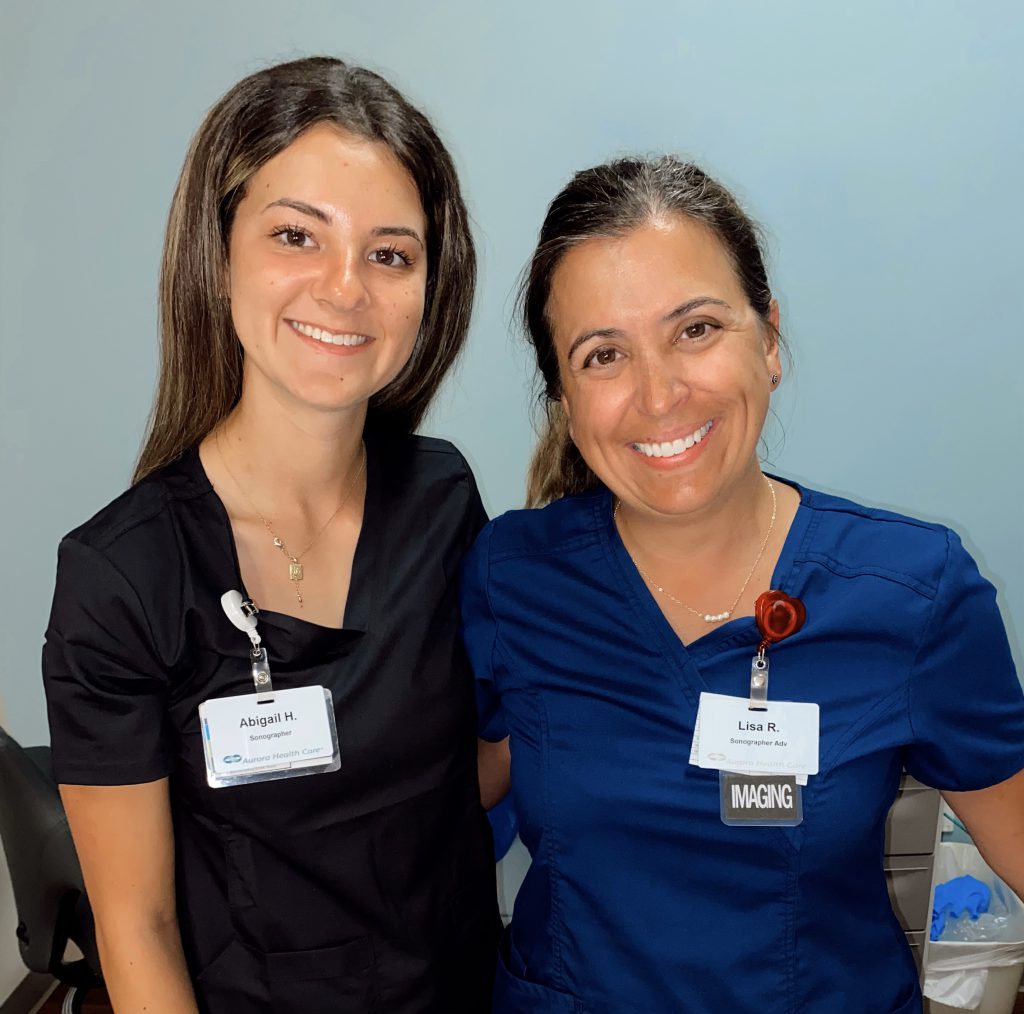
We asked recent DMS graduate Abby Hillner (’22) to share some thoughts about what she loves about her new profession—and what she loved about her Concordia experience.
What’s it like working with a former professor as a colleague?
I really enjoy working alongside my former professor, Lisa Reimer, who helped prepare me for a career in ultrasound. The CUW DMS program is a small, close-knit program, so you really get to know your instructors, which is helpful when it comes to employment opportunities and makes working as colleagues all-the-more fun! Lisa was a helpful recommendation for me when first applying to my current full-time position at the Aurora Germantown Clinic where she picks up hours. It’s also nice working together because we can review interesting ultrasound cases which takes me back to the classroom days. I love learning, so having Lisa as a knowledgeable resource with all her ultrasound experience is a privilege!
How well did the Concordia program prepare you for your profession?
My first job out of college was at Aurora St. Luke’s Medical Center, which is one of the largest hospitals in Wisconsin. At St. Lukes I performed tough exams such as transplants, hemodialysis mappings, grafts and much more. These exams aren’t typically encountered in a clinical setting. My first year at St. Luke’s was a challenge, as expected, but I made it through using the skills I learned while at Concordia. I was hired as an extern at St. Luke’s about five months before graduating, which transferred into a full-time position immediately after graduation.
In ultrasound, you will always come across difficult cases that require critical thinking to navigate. Concordia’s program taught me to consider the tools in my toolbox (ultrasound machine settings) and to think critically when scanning pathology or coming across an anatomical variant that is not frequently seen. Concordia’s program exposed me to thousands of exams as a student at various clinical sites including Ascension, Froedtert, and ProHealth, among others to train me to think critically. It’s nerve-racking being a new graduate because there is a level of independence and confidence that only comes with experience, but the skills I graduated with from CUW’S DMS program set me up for success.
What are some other thoughts on the CUW DMS program?
Concordia’s sonography program provided my class with a large variety of clinical sites so we could learn different exam protocols, work with technologists of all skill levels and be exposed to different specialties within the ultrasound world. My favorite part about the program was the small size and the ability to receive one-on-one instruction from my professors. We were able to schedule time to practice scanning in lab and the instructor was available to answer questions in-person or over the phone during the blocked time. The instructors had flexible office hours to go over questions related to didactic coursework as well. Instructors even visited clinical sites to review our progress and find areas we could improve upon. The amount of attention we received from instructors really showed their dedication to our success in the program.
Why should someone choose this profession?
Ultrasound is unlike other medical professions. It’s very user dependent so you truly feel like you are part of the diagnostic process. Our images help patients receive answers regarding the cause of their symptoms and we have the privilege of working closely with doctors and radiologists. There are a large variety of exams that we perform including (but not limited to) vascular exams, obstetrical exams and abdominal exams. A career in sonography is not only rewarding because of our involvement in the diagnostic process, but it also pays extremely well. There is a high demand for sonographers, so it has great opportunities for job growth and only requires four years of hard work and dedication to create an excellent and rewarding career. If you are passionate about patient care, hardworking, enjoy anatomy and can train yourself to critically think, a career in ultrasound is a solid fit.
Why did YOU choose this profession?
I chose ultrasound because I have a love for and gift of caring for people and have always been fascinated by the human body. I was also fascinated by ultrasound technology. Performing ultrasound exams requires a heavy level of training, as the diagnosis resulting from an ultrasound exam can determine whether or not medical intervention is necessary. With that comes great responsibility, which makes the career even more rewarding. There is a large variety of ultrasound exams, too, which makes each day on the job a little different. Four years of hard work was, without question, worth it.
What might surprise people about being a medical sonographer?
People are often surprised by the variety of exams sonographers perform and how specific the degree and training requirements are. You must have 1,680 clinical hours completed to graduate, in addition to successful completion of scan lab proficiencies and clinical competencies. People are also surprised at the physical demands of the job; it is important to establish sound ergonomic habits during training to protect your body from injury.
Want in?
Concordia University Wisconsin is a Lutheran higher education community committed to helping students develop in mind, body, and spirit for service to Christ in the Church and the world. To learn more about the Diagnostic Medical Sonography program, click the link below.