Called to Serve: in the military, the church, and the world

CUW biblical studies student Tsiltiyah Fogle is already using her studies—and military experience—to serve veterans and others.


The list of people who come to a new country at age 18 and within months join that country’s military is probably very short. But it includes Tsiltiyah Fogle, a CUW biblical studies major and U.S. Marine Corps veteran who is already using her own experiences to help veterans and others cope with life’s challenges.

Tsiltiyah Fogle spent the first 18 years of her in Israel, but came to America as a young adult “to see what the U.S. was like and to get my life in order,” she says. Within a few months, she set her sights on joining the military.

“I realized I didn’t have anyone to help me with anything like college funds, a car, or anything else,” she explains, so she looked to the Marines as an avenue “to get on my feet on my own.”

“Also, I wanted to gain the character and morals the military offers like honor, courage, commitment, and so on,” she adds. “I also thought it would be fun!”

Overcoming her past

Like so many veterans, Tsiltiyah left her time in the Corps experiencing symptoms of complex post-traumatic stress disorder (PTSD). She struggled for years to get things under control. The breakthrough came in 2017, when she accepted the healing love and grace of Jesus.

“When I first became a Christian, I was experiencing, like, 62 serious symptoms of complex PTSD,” Tsiltiyah recalls. “Now, 33 of those symptoms don’t happen at all anymore, and 22 of them have gotten drastically better.”

What that means, she explains, is that instead of happening almost every day, they happen only two or three times a year. It’s a good thing, too—because she clearly has her hands full!
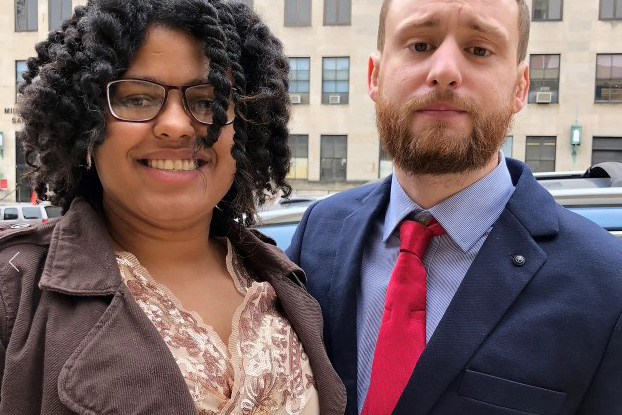
Tsiltiyah and Charles Fogle

She and her husband, Charles, a U.S. Navy veteran, are proud parents of three: ages 7, 2-and-a-half, and 18 months. They also recently started a non-profit organization: Chesed Life Builders, dedicated to helping veterans and other underserved communities by providing free and low-cost housing, as well as other services such as spiritual development and drug/alcohol counseling. They’ll also help veterans apply for V.A. benefits and help make sure they’re getting the most help they can.

“But we’re not just helping veterans, because civilians need help, too,” she explains. “We’re going to provide meetings that address the mind, body, spirit, financial, relational … basically the entire health spectrum of individuals, but from a Christian perspective.”

Though founded less than two years ago, Chesed Life Builders is already providing housing for 17 people in need people. One thing that makes their housing ministry different from most others is what she and Charles call a “scattered housing” approach. That is, many programs house participants in a “compound” setting, with dozens or even hundreds of people living four to a room in the same building. The Chesed approach is to provide multiple smaller housing opportunities, to spread people out more and give them more personal space.

“Why would you want to take a bunch of addicts and stick them together with a bunch of other addicts?” she asks. “I don’t mean that disrespectfully, but how can they get sober if they’re surrounded by people that are struggling with the same thing? They want to live like everybody else. And I’ve heard a lot of people in vulnerable populations say they’d rather live on the street than go into some of these group housing programs.”

Sustainable ministry

The organization is funded largely by the Fogles themselves, as well as by private donations, various grants, and income from Ephrata Farm, a faith-based, sustainable 8.82-acre vegetable plantation outside Racine, Wisconsin. It not only generates income, it provides job opportunities for people being helped by Chesed Life Builders.

 As their website states:

Our mission in the agriculture industry is rooted in community service across Southeastern Wisconsin. Through partnerships with local pantries and CSA sales, we aim to provide quality, affordable, and organic produce. A significant portion of our farm’s revenue supports our nonprofit initiatives, reinforcing our commitment to local welfare and sustainability.

Running a non-profit definitely has a “business” side to it, but it’s first and foremost a ministry. Tsiltiyah’s husband, Charles, is on track to graduate soon with a master’s degree in nonprofit management, while Tsiltiyah is set to graduate from CUW in May with a degree in biblical studies.

At the heart of it all is a devotion to Christ. Tsiltiyah herself knows the life-changing power of Jesus, seeking to share His love and use His teaching to help people.

She originally was on the social work track, but switched to Biblical studies “because I really believe that that’s what I’m supposed to be doing.” After that, she plans to purse a doctorate of divinity from Trinity International University in nearby Bannockburn, Illinois. The goal is for Charles—who also plans to pursue a doctorate in law—to manage the business side of things, while Tsiltiyah will oversee the spiritual and counseling needs of program participants.

“Our goal is to get residents on their feet, where they don’t really need nonprofits services anymore,” Tsiltiyah says. “But they’ll be welcome to stay as long as they need to. It all depends on their circumstances.”

Three kids. A farm. A non-profit. And a full load of classes at school. Now those are some circumstances! But through it all, Tsiltiyah knows that it’s the love and strength of her Savior, Jesus Christ, that will keep her and Charles chasing after His will for their lives.

“Jesus has done a lot for me,” she says. “I used to never experience joy or peace or anything like that. But now, even though I’m still struggling with like ten things, I have joy and peace a lot of times, and my devotion to Christ is all-day, every day, because that’s the only way anyone can truly live their best life.”

And isn’t that all that any of us can really ask for?


Want in?

Concordia University Wisconsin is a Lutheran higher education community committed to helping students develop in mind, body, and spirit for service to Christ in the Church and the world.
Collaborative Leadership: The Future of Organizations

In a rapidly changing business environment, one leadership approach has proven powerful in fostering innovation and success: collaborative leadership!


Instead of just zeroing in on individual wins or segregation between separate departments, collaborative leaders take a team-first approach. As they say, there is no “I” in “team.” Leaders listen, keep the conversation open, and they help create a space where people feel safe sharing ideas and info. It’s this kind of vibe that helps an organization’s overall success.

Here’s a quick look at what makes collaborative leaders so effective, and how CUWAA is building these skills through our unique MBA and continuing education programs.

Key Characteristics of Collaborative Leaders

  • Sponsoring Collaboration
  • Active Coaching
  • Building Community
  • Balancing Relationships and Tasks
  • Clear Roles with Flexible Tasks
  • Psychological Safety

Collaborative leadership is all about teamwork, communication, and supporting each other to reach for the common good of the workplace and its employees. Leaders who believe in collaborative leadership don’t just make decisions on their own–they listen, encourage dialogue, and create a space where everyone’s ideas matter.

CU Inc.’s Collaboration with Walgreens

Earlier this year, CUWAA partnered with Walgreens to provide leadership development for their employees. This collaboration showcased CUWAA’s approach to business education, where leadership is not just about profit but about integrating values, ethics, and holistic well-being into the workplace.

Deaconess Kim Schave, PhD, CPA, Director of MBA Programs at CUWAA, shared her perspective:

“I am very grateful for the opportunity that Walgreens afforded us to contribute to the development of their employees on the topic of Collaborative Leadership. It provided them with a glimpse of what we offer in our MBA and Continuing Education programs. Beyond just a focus on profits, our programs incorporate sustained advantages by integrating ethics and values into our curriculum. We are intentional about helping students thrive in mind, body, and spirit and preparing students for success in their business vocations.”

CUWAA’s MBA Program

We understand the importance of having collaborative skills in the workplace, CUWAA has designed an MBA program that understands a student’s development. We prepare leaders who are well-rounded in mind, body, and spirit.

Here are three ways Concordia’s MBA program prepares students to lead in collaborative environment:

Personalized support

CUWAA assigns each MBA student a Student Engagement Specialist who supports them at every step of their academic journey.

Experiential learning

MBA students will complete six credits of experiential learning, choosing from; internships, global study programs, and specialized certifications in areas such as Six Sigma and project management.

Focused development

The MBA curriculum emphasizes both qualitative and quantitative analysis. Students can customize their education by selecting from 12 concentration areas, ensuring that they gain expertise relevant to their goals.


Want in?

Collaborative leadership is essential for the success and growth of any organization. CUWAA’s MBA and continuing education programs are specifically crafted to develop leaders and prepare them, so they can create workplaces that inspire and empower others. Concordia University Wisconsin is a Lutheran higher education community committed to helping students develop in mind, body, and spirit for service to Christ in the Church and the world. To learn more about continuing education opportunities at CUW, click the link below.


New Spiritual Sheriff in Town


Have you ever been going a little too fast down Port Washington Road and you see a Police car and your heart drops to your stomach, and you immediately put the breaks on what you are currently doing? In the same way, you might be taking a stroll throughout campus, you’re on your phone, you’re listening to music, you are in your own world. Then, you see someone down the opposite side of the hallway, they are wearing a black button-up shirt and a clerical collar. You immediately stand up straight, you pause your music, you look into the Reverend’s eyes, and you let out a professional, “Hello.” I am here to tell you that CUW has a new sheriff in town, the difference is, he is not going to write you a ticket.

If you have not caught on yet, Rev. Jonathon Bakker is the new campus pastor after Rev. Steve Smith’s 22 years as the campus pastor. Pastor Bakker grew up in Ontario, Canada where he also attended high school. To what may come as a surprise, his dream was to become a professional trombone player. The monthly time when he did go to church with his family as a kid, the choir caught his attention every time, that is part of the reason he became fascinated with music. His fascination caused him to practice the trombone for up to four hours a day. When it was finally time for him to attend college, he chose Concordia Ann Arbor to be a music major. After some time spent at CUAA, his focus began to shift towards theology.

The change was due to subtle seeds being sowed in his mind. In his words, “I would be approached by my classmates, especially early on saying, ‘what’s your major,’ I would say, ‘I am a music major,’ [they replied saying], ‘oh so you’re going to be a Lutheran School teacher.’ I said, ‘no I’m not,’ they said, ‘oh, so you’re pre-seminary.’

“Over time, I did a couple of semesters in the education program, and I was working toward Lutheran teaching, kind of like what they offer here, and once I had to read some of [Martin] Luther’s writing’s I was addicted to Theology. It was the one thing that interfered with my practice schedule with trombone: not girls, not clubs, not other activities with my friends, not video games, none of that stuff got me excited as Theology did and then I was at a crossroads.”

To put an end to the internal conflict that Pastor Bakker had between being an orchestra player or a pastor, he talked to his home pastor, Rick Fry, who was the one that eliminated Pastor Bakker’s objections to not becoming a pastor.

After college, Pastor Jonathon Bakker attended the Concordia Seminary in Fort Wayne to become a pastor. From 2006 to 2015, he was an Associate Pastor at Christ the King Lutheran Chapel, which is based in the Central Michigan University campus. Then from 2015 to 2024, Bakker served as the Senior Pastor at Zion Luther Church in Mt. Pleasant Michigan. What I found most fascinating about Pastor Bakker’s experience as a pastor is that he was a Chaplin for the Michigan State Police Dept. for 14 years.

During that time, he was able to view the brokenness of human nature in a distinct perspective. Instead of dealing with the public, he was able to personally know what people that protect and serve go through. He rode alongside police officers, he did tactical drills with them, he went to their union rallies where he was able to relate to them, and he was able to feel a lot of their emotional pain.

In his words, “They see and experience a lot of awful stuff and have much more trauma on a regular basis than the regular person does. And they cope so well most of the time, but occasionally when they needed someone to talk to, I was a friendly supportive set of ears that was outside the chain of command.”

And that is the thing that really sets Pastor Bakker apart, he is not here to condemn, he is not here to judge, God has brought him to CUW to be a listener. His broad perspective of mental health and his willingness to lend an ear to anybody makes him a great fit at CUW. Next time you are in the hallway, do not be afraid to say “hello” or spark up a conversation with him.

—Peyton Smith is a writer for the Beacon. He is a senior mass communication major graduating in may 2025 with a minor in political science.

Freshmen Feature

Get to know the CUW Freshmen Students. The Freshman Feature aims to help integrate CUW freshmen into the Concordia community. Every week, meet and learn about two new freshmen.


Nora is an Elementary and Special Ed Major at CUW

Meet Nora Finnegan, an Elementary and Special Ed major from Appleton, Wisconsin. On her first day, she couldn’t go anywhere without someone giving her directions. Nora is most looking forward to her class about engaging children’s literacy. Nora enjoys the Best Buddies club on campus and the support system of her friends and family. She and her roommates wanted to have a colorful room, so they chose a colorful theme. She chose Concordia for the cross-categorical major and the community.

Josephina is an Art Education major at CUW

Meet Josephina (or Jozie) Albertin, an art education major at Concordia. She hopes to one day teach art to middle schoolers. Jozie has been involved in the musical this year and hopes to continue participating in the musicals for the rest of her time at college. She looks forward to making new friends here at CUW and continuing to hang out with the amazing friends she has already made!


—Cassidy Gallagher is a student writer and editor for The Beacon. She is a sophomore pursuing a major in mass communication and English.

—Aimee is a student writer and social media coordinator for The Beacon. She is a sophomore pursuing a major in Mass Communication and Theatre.

The Weight of Silence: Being Palestinian

The views and opinions expressed in the following article do not necessarily reflect the views or opinions of Concordia University Wisconsin. The editorial board of The Beacon has reviewed but is not affiliated with the content and as such op-eds published in The Beacon should not be considered the official view of the University. 


Growing up in a multicultural household, I learned early on the power of stories—stories of resilience, culture, and identity. My father’s stories about his childhood in Palestine were more than just memories—they were lifelines to a place that is an essential part of who I am. My Palestinian heritage is a wellspring of resilience, culture, and community. nothing could prepare me for the painful realization I’ve had this year: the extent to which my people, Palestinians, are dehumanized—right here, in the very institution I trusted to expand my understanding of the world.

This year has been a journey of painful discoveries. I expected that, as a Palestinian, my narrative might be misunderstood or even dismissed. But what I didn’t expect was the casual, almost effortless way my professors, peers, and the university itself would strip away our humanity. It’s one thing to feel unseen; it’s another to feel actively erased. The stories of my family, the very real pain and history they endured, are treated as irrelevant—or worse, as something to be feared.

Professors have labeled Palestinians “terrorists” without hesitation or nuance, reducing my people to nothing more than a threat. These words aren’t just statements—they’re daggers. They cut deep, because they not only erase our history and struggle but our very humanity. It’s as though in their eyes, we are not allowed to exist beyond this harmful stereotype. We are reduced to violence, stripped of our culture, our pain, and our dignity.

My father’s childhood home in Palestine stands as a symbol of that vulnerability. We don’t know if it’s still standing. The house where he grew up, where generations of my family lived, is exposed to the constant threat of demolition. Every day that goes by, I wonder if the home that holds so much of our family’s history is still there—or if it’s been reduced to rubble, another casualty of a conflict that has taken so much from us.

The fear of losing our home isn’t new to my family. My grandfather, a proud man who worked hard to build a life for his children, was threatened so severely by the Israeli Defense Forces (IDF). Those threats were not empty; they made it impossible for him to return to his home, the land where he had rooted his entire existence. His life, like the lives of so many Palestinians, was disrupted, displaced, and uprooted by forces beyond his control.

When I think about what it means to be Palestinian, I think about my grandfather’s strength, my father’s memories of a house we may never see again, and the unbreakable connection we have to the land, no matter how far we are from it. I carry that legacy with me every day. It’s what gives me pride, even in the face of a university that refuses to acknowledge my humanity.

I didn’t come to this university expecting my identity to be celebrated, but I did expect to be seen as human. This year, I’ve come to understand that for some, my humanity is a burden—too inconvenient to acknowledge, too controversial to engage with. But despite their attempts to silence me, I cannot stay silent. I refuse to accept the erasure of my people, my family, and my story.

This year has shown me how easy it is for an institution to make a people invisible. I walk through halls where my identity as a Palestinian is either ignored or demonized. My family, my heritage, and my people are not acknowledged as fully human—merely a problem to be discussed in passing, something to be feared, not understood.

The university’s indifference isn’t neutral—it is a form of violence. By refusing to recognize the humanity of Palestinians, it contributes to the erasure of our identity. Every time a professor makes an offhand comment about Palestinians, every time an event ignores our narrative, they add to this dehumanization. It tells me, and everyone who identifies with my story, that our existence doesn’t count.

Being Palestinian is more than just a label. It’s a life filled with love, joy, culture, and history.  But here, it has been reduced to a single word: terrorist. That reduction is the most painful part, because it denies us the fullness of our lives and experiences. I’m not asking for agreement or understanding from everyone. What I am asking for is basic humanity. To see us as more than a stereotype. To acknowledge that our existence, our stories, are real.

—Published Anonymously; The editorial board of The Beacon has reviewed but is not affiliated with the content and as such op-eds published in The Beacon should not be considered the official view of the University. 

What can you do with a degree in psychology?

Psychology is a degree that can yield a wide range of career opportunities. Let’s explore some of them together.


What comes to mind when you think about careers in psychology? Do you think of a counselor? Maybe you think of criminal psychology? The possibilities are practically endless! A degree in psychology can set you up for success for a wide range of careers. Want to have a hands-on approach with helping people in their journey in life? You got it. Maybe you are the kind of person who would prefer to stay in your own bubble and have an impact from a distance. You can do that too!

When you boil down psychology, it comes down to understanding how the brain works, how people relate to others, and how children develop. Now, with that knowledge, you can apply that thinking to almost any career.


Let’s explore some different career paths

*Please note: some of these paths may require additional education

Psychiatric Aide/Attendant

As a psychiatric aide/attendant you would work under direct supervision of nursing and medical staff assisting with daily life activities for mentally impaired or emotionally distressed patients.

Average salary: $41,000 annually

Detective and Criminal Investigators

As a detective or criminal investigator, you will investigate crimes at the federal, state, or local level, gather evidence, and assist in arrests.

Average salary: $86,030 annually

Preschool Teacher

Influence and teach future generations through planned curriculum and social and intellectual activities.

Average salary: $41,410 annually

Additional Roles:
  • Forensic Psychologist
  • Group Facilitator
  • Social Worker
  • Substance Abuse Counselor
  • Volunteer Coordinator
  • Public Relations Specialist
  • Healthcare Administrator

Want to get into the world of psychology?

Concordia University Wisconsin is proud to offer both a fully online and traditional in-person Bachelor’s in Applied Psychology program. Contact us or learn more below


Concordia education gave Boxdorfer a step up

Marvin “Tony” Boxdorfer, a 1971 graduate of Concordia High School (pictured with Linda, his wife of 52 years), has built many of his life goals on what he learned through his Lutheran education.


“Concordia is a place where you want to send your children and grandchildren because it’s going to prepare them for their future…. (Concordians) are the people that the world needs.”

Tony Boxdorfer (’71)

Most importantly, he said, “my goal in life is to make sure my wife, children and grandchildren believe in Jesus Christ. And I have been successful.”

He added: “The rest of my personal and business life I have tried to help people see the potential in themselves. My focus has been convincing people that they can become whatever they wish. This means build them as people and Christians.”

After graduating from Concordia, Boxdorfer studied business at the University of Kentucky. There, he met his wife, Linda, whom he has remained married to for 52 years. Together, they have two daughters—Shannon and Jennifer—three dogs and 22 horses.

By trade, Boxdorfer is a financial services advisor, owning his own business, but one of his loves is taking care of the horse farm on which he lives with Linda in Indiana. He loves the hands-on work but makes sure each week he gets everything done in time to go to church.

“We all love (the work), but it’s exhausting and exhilarating at the same time,” he said. “It’s a dirty job. (But) it’s fun.”

Boxdorfer said, when he reflects back on his years with Concordia, he sees it as the time when he got his “achievement drive motivation.”

He said: “It was a group of people you just wanted to be a part of. It was challenging to be young, independent, unlimited, and free to discover your potential. It just made me want to be better.”

He added that he didn’t really know how good his education was until he left Concordia and went on to a university and his career.

“During my experience at Concordia, I was 14 to 17 years old. It was later when I looked back that I realized the tremendous education that I had received,” he said. “I think all of our professors were teaching at the college level. The other students were extremely smart and it was hard to compete. I always told people that I graduated in the top of the bottom third of my class. When I took my college entrance exams, I found out I was in the 20th percentile nationally.”

Boxdorfer said he believes Concordia is a “place where you want to send your children and grandchildren because it’s going to prepare them for their future…. (Concordians) are the people that the world needs.” They are highly-educated, and love and help others, he added.

What advice does he have for current Concordia students?

“Your job is to develop yourself to become everything you wish to be and do. Then apply that ability to those you love and work with so they can also learn how to benefit others.”


Want in?

Concordia University Wisconsin is a Lutheran higher education community committed to helping students develop in mind, body, and spirit for service to Christ in the Church and the world.


Online Transfer Student Survival Guide

The best word that describes a transfer student is “courageous.”


By Leah Fassbender, Post Traditional Admissions Counselor, Concordia University Wisconsin

Each transfer student experience is unique. A transfer student comes from a prior college that they may have loved and been heavily involved in. Next, they enter as a fully online student with less personal engagement and more responsibility such as delegating classroom discussion responses, posts and projects that are due each week. As a transfer student myself, I found it to be essential to follow these few tips that helped me to stay on track, be efficient and also feel fulfilled like I once did when I was an in-person, technical college student

Set Yourself up for Success

When I start a new class, I enter into my online course and start with the syllabus. It is essential to read through the syllabus as your professor will give a description of the class and set a timeline of assignments. They will include their contact information either by phone, email or in-person.

Get Organized

Once I have read through the class syllabus, I then go through each of the modules and create a document that has each assignment and due date. You can either create a document to cross off or insert into a planner. This will help you to stay organized and to not miss an assignment. At the start of each week, I take a look at what assignments I will need to complete for the week.

Be Engaged

One of the things I missed the most from in-person classes was my engagement with others. I felt that it was something I was going to lose when transferring to a fully online student. It helps to feel engaged by being interactive with your online classmates and professor. Get involved in your discussion boards and learn from your classmates. You can always reach out to a fellow classmate to meet and have a study session near you.


Being a transfer student is one of the most rewarding feelings. You get to widen your educational horizons and get to know others from all over the country or state. When you cross that stage, you will know you put your all into each discussion, assignment, and project while you managed work, family and your social life. That takes courage, determination, and discipline!


Want in?

Have questions about transferring to Concordia? Connect with us at admission@cuw.edu


Early Assurance into Concordia’s School of Pharmacy just got more accessible

Concordia’s School of Pharmacy is expanding its Early Assurance Pathway and adding a new opportunity for PharmD-bound students to earn a $1,000 scholarship.


What is Early Assurance?

CUW’s Early Assurance (EA) Pathway, as the name implies, provides students with an earlier-than-usual route to graduate school admission. Already in high school students can apply to the pathway and receive word about their admittance before they begin college. Those who are accepted into the EA Pathway can pursue their undergraduate degree or prerequisites with peace of mind knowing their spot within Concordia’s Doctor of Pharmacy program is secure, given they continue to fulfill all requirements to remain in the pathway. Additionally, those who are admitted into the EA Pathway receive a free fee waiver for the PharmCAS application, cutting down on their overall application costs.

Students may apply for Early Assurance during their senior year of high school. Admittance into the pathway is determined by factors including the student’s GPA, letters of reference, and knowledge of the pharmacy profession.

Early Assurance expanded

Historically, Concordia’s EA pathway was only open to high school seniors who chose to complete their undergraduate coursework at CUW. This year, however, the university is extending the opportunity to all current college freshmen as well as students who intend to enroll at any collegiate-level institution nationwide.

Any student is eligible to apply to the EA Pathway as long as they achieve a minimum high school GPA of 3.0 (4.0 scale) or achieve a minimum first-year collegiate GPA (at least 12 credits) of 3.0 (4.0 scale).

Applications and Letters of Recommendation must be completed by June 1. Early application is encouraged. The School of Pharmacy Office of Admissions and Recruitment will review student applications and determine who will be offered an interview. Following an interview with CUW’s School of Pharmacy, students will receive word if they’ve been admitted into the EA pathway.

$1,000 Scholarship for CUW undergrads

For those who still choose to complete their pharmacy prerequisites at Concordia, there is a new scholarship opportunity available to them. Concordia will grant a $1,000 stackable scholarship to those who are admitted into the EA program and choose Concordia for their undergraduate experience.  

To learn more about CUW SOP’s Early Assurance pathway and its criteria, click here.


Want in?

Concordia University Wisconsin’s School of Pharmacy is one of only three PharmD offerings in Wisconsin, and Concordia is the only private Christian university in the state to host a pharmacy school. CUWSOP graduates routinely earn high pass rates on national certifying exams, with last year’s cohort earning the second-highest NAPLEX pass rate in the region. Graduates also routinely exceed national residency match rates.


CUW Chapel schedule: Nov. 4 – Dec. 6, 2024


Join us in the Chapel of Christ Triumphant for daily Chapel services, Monday-Friday at 9:30 a.m.

Schedule subject to change. In-person attendance is always encouraged, but Chapel services can also be livestreamed HERE. Catch up on previous sermons via the Chapel YouTube channel HERE.


Monday, November 4: Guest Preacher

Rev. Luke Otten, Holy Cross & Christ the King, Racine, WI | Psalm 119:1-8 | LSB 536

Tuesday, November 5: Guest Preacher

Rev. Dr. Brian Heller, Specialized Pastoral Ministry, LCMS | Mark 12:28-37 | LSB 694

Wednesday, November 6

Preacher: Rev. Jonathon Bakker | Hebrews 9:11-14 (15-22) | Haven Musicians

Thursday, November 7: Matins

Leader: Rev. Jonathon Bakker | Mark 12:28-37 | Te Deum: LSB 940; Hymn: LSB 708

Friday, November 8: Guest Preacher

Rev. Meador, South Wis. District, LCMS | Deuteronomy 6:1-9 | LSB 498


Monday, November 11: Matins

Leader: Rev. Jonathon Bakker | Mark 12:38-44 | LSB 760

Tuesday, November 12: Guest Preacher

Rev. Phillip Hillenbrand | Mark 12:38-44 | LSB 758

Wednesday, November 13

Preacher: Rev. Kurt Taylor | 1 Kings 17:8-16 | Haven Musicians

Thursday, November 14

Preacher: Rev. Jonathon Bakker | Hebrews 9:24-28 | LSB 530

Friday, November 15

Preacher: Rev. Joshua LaFeve | Psalm 146 | LSB 797 | Chapel Choir | WLI Recognition


International Education Week

Monday, November 18: Matins

Leader: Rev. Jonathon Bakker | Procession: LSB 816 | Mark 13:1-13 | Te Deum: LSB 941; Hymn: LSB 714

Tuesday, November 19: Guest Preacher

Rev. Dustin Anderson, St. John, Port Washington, WI | Mark 13:1-13 | LSB 666

Wednesday, November 20

Preacher: Rev. Harald Tomesch | Hebrews 10:11-25 | Haven Musicians

Thursday, November 21: Guest Preacher

Rev. Marshall Frisque, St. John, Fredonia, WI | Psalm 16 | LSB 763

Friday, November 22

Preacher: Rev. Nathan Jastram | Daniel 12:1-3 | LSB 508 | Chapel Choir


Monday, November 25: Guest Preacher

Rev. Kyle Verage, Good Shepherd, Pleasant Prairie, WI | Mark 13:24-37 | LSB 336

Tuesday, November 26

Preacher: Rev. Jonathon Bakker | Isaiah 51:4-6 | LSB 516

Wednesday, November 27: Thanksgiving Break

No Classes; No Chapel

Thursday, November 28: Thanksgiving Day

No Classes; No Chapel

Friday, November 29: Thanksgiving Break

No Classes; No Chapel


Monday, December 2: Guest Preacher

Rev. Thomas Schmitt, St. Martin, Chilton, WI | Psalm 25:1-10 | Printed Hymn

Tuesday, December 3: Matins

Leader: Rev. Jonathon Bakker | Luke 21:25-36 | Benedictus | Hymn: LSB 345

Wednesday, December 4

Preacher: Rev. Steve Smith | 1 Thessalonians 3:9-13 | Haven Musicians

Thursday, December 5

Preacher: Rev. Jonathon Bakker | Jeremiah 33:14-16 | LSB 352

Friday, November 1: December 6

Preacher: Dr. Erik Ankerberg | Luke 21:25-36 | LSB 334 | Chapel Choir


2024-25 theme: Inseparable Love

For I am sure that neither death nor life, nor angels nor rulers, nor things present nor things to come, nor powers, nor height nor depth, nor anything else in all creation, will be able to separate us from the love of God in Christ Jesus our Lord. -Romans 8:38-39


Learn more

At CUW you can see and feel a Christian emphasis from how our professors teach in the classroom to how our athletes play on the field. We instill in our students that living a full Christian life is about more than worship. CUW is a Christian university, not because we’re perfect people, but because we’re forgiven sinners who gather together in Christ. To learn more, click the link below.