As conversations around space continue to shift from science fiction to national priority, Concordia University Wisconsin is helping lead the way through the work of Dr. Lamont Colucci.
A professor of political science and director of the National Security and Space Center, Colucci brings a steady, informed voice to one of today’s most complex frontiers. His expertise sits at the intersection of global politics, defense strategy, and the rapidly evolving role of space in international affairs.
Beyond the classroom, Colucci is a trusted resource in national conversations. He has shared insight on The Downlink podcast, contributed analysis to Geopolitical Futures, and has been featured twice in The Epoch Times (check it out here and here). In each setting, he helps audiences better understand how space impacts security, policy, and the future of nations.
At Concordia, this work reflects something deeper than academic achievement. It is part of a broader mission to develop thoughtful leaders prepared to serve the Church and the world with clarity, wisdom, and purpose.
Through faculty like Colucci, students are not only learning about global challenges. They are being equipped to engage them—grounded in truth, guided by faith, and ready to lead in places many have yet to imagine.
Click to learn about our last NSSC Space Summit, organized by Colucci.
Want in?
Concordia University Wisconsin is a Lutheran higher education community committed to helping students develop in mind, body and spirit for service to Christ in the Church and the world.
While the excitement for Concordia’s Got Talent enraptures the students at CUW, many have not heard about the opening event for it. The Show Your Talent: Career Fair has been a passion project of Student Government President Mikayla Sells, since the spring of 2025. After a successful first run of Concordia’s Got Talent, also known as CGT, in 2025, Mikayla and fellow SGA member Dalton Hirbar, began to wonder what other talents SGA could help to showcase. Their idea: create a space where companies and students can meet and build relationships without the stress of interviewing for a job.
As the SGA President began reaching out to companies to sponsor CGT 2026, they were offered the opportunity to participate in a career fair before the big show. The response was incredible! The choice became so popular amongst companies that Sells had to shut down registration early. When asked why companies were so eager to do a career fair with Concordia, Sells claimed that local companies are enticed by CUW students because of the reputation that our University has been built over the years with alumni. Originally there was a concern that companies would not attend a career fair at this point in the year as most positions and internships are filled during this season. Of course, that would turned out to be an insignificant problem and it became clear that companies truly do want to connect with the students that Concordia has to offer no matter the time of year.
The Career Fair has a variety of companies and organizations in attendance. While most fairs tend to be business and finance focused, this particular event has attendees from healthcare, education, business, social work, and many more.
Our Student Government wants this event to not just be for students who are close to graduating, but for underclassmen too. Sells pointed out that often at Career Fairs students find out information about their chosen career that they may not like and choose a different path during their education because of it. “Especially for young college students, if you are questioning what you want to do, this is a great spot to see all the different potentials of what different careers might be like,” claims Mikayla Sells. In addition, students can learn things they may not have thought of, how to talk to employers, and get a feel for what life outside of college might look like.
Mikayla Sells especially highlighted how beneficial the Career Fair will be for those who go, saying, “Being able to practice conversing with professionals in a very safe space, would be my biggest encouragement.” It was also stressed that students in attendance would gain extra raffle tickets, free headshots, free drink coupons for the Coop, and free food.
With the end of the semester marks 145 years that the Student Government Association has served Concordia and its students. During that time the campus has flourished and expanded due to projects spearheaded and funded by SGA; most notably the outdoor basketball court and Siebert’s Dining Hall and Field House remodels. Student Government also charters and supports clubs on campus. Student Government has deeply impacted not only the students it serves, but the students who chose to serve within the association. Student senators find themselves challenged to be better leaders, deeper thinkers, and overall, more caring, servant-hearted individuals. I (Makayla) would recommend anyone who wishes to make a difference in the world to start with joining Student Government and allow the lessons that it gives to lead you through the next steps of life.
All undergraduate students are welcome to join SGA. If you are interested, please reach out to sga@cuw.edu.
Event Details: The Show Your Talent: Career Fair Thursday, April 23rd 4:00-6:00 pm Robert Plaster Building
Students, alumni and guest artists return to CUW to celebrate the longtime director’s final concerts and lasting influence.
On April 17 and 18, Concordia University Wisconsin welcomed students, alumni, families and friends for a weekend of music and reflection. The occasion marked the retirement of Dr. Louis A. Menchaca, whose 34 years of service have shaped the university’s instrumental music program and the lives of those within it.
Across two evenings, the campus community gathered to honor Menchaca’s final concerts as director of instrumental music, a role he has held since 1992. The performances carried a shared purpose, offering thanks through music and presence.
Friday night featured the University Band and Jazz Ensemble. On Saturday, the Symphonic Wind Ensemble and Chamber Orchestra took the stage, joined by Seraph Brass Quintet and alumni performers who returned to be part of the celebration. Together, the concerts reflected the depth and continuity of Concordia’s instrumental program.
The weekend created space for connection. Alumni greeted one another, families filled the audience and current students stepped into a tradition built over decades. For Menchaca, that sense of continuity has always mattered.
“This weekend was an unbelievable cap to very blessed 34-year run,” Menchaca said. “To have two sets of parents and children in the alumni band was quite an event.”
He noted the range of experiences woven into the performances, from student milestones to guest artistry.
“The weekend concerts were filled with so many story lines—our Symphonic Wind Ensemble being supported by the world-class brass quintet Seraph Brass,” he said. “The alumni band returned, with members from across the nation, as well as saying goodbye to all our talented music seniors and senior soloists.”
Menchaca has long found joy in seeing students grow into confident musicians and educators, and in watching those same individuals carry their gifts into classrooms and communities across the country.
That legacy was visible throughout the performances. Alumni returned not only to celebrate, but to play alongside current students. Each ensemble reflected the steady leadership and care that have defined Menchaca’s time at Concordia.
“It was quite overwhelming and joyful to see students and parents from each decade of service,” Menchaca said. “The concerts truly confirmed that the liberal arts music-making experience can positively impact lives. It also makes for both life-long partners as well as life-long friends.”
Saturday evening concluded with Menchaca’s final piece at the podium. As the music came to a close, the standing ovation that followed recognized more than a single moment. It honored years of teaching, mentorship and a commitment to helping students find their place on stage.
“It was a magical weekend,” Menchaca said.
While retirement brings a new season, Menchaca’s influence continues through the program he helped build and the people he has guided along the way. His work remains present in rehearsal rooms, classrooms and concert halls connected to Concordia.
Moments from the April 17–18 retirement concert weekend capture the music, the reunion and the final bow.
Want in?
Concordia University Wisconsin is a Lutheran higher education community committed to helping students develop in mind, body and spirit for service to Christ in the Church and the world.
Concordia Bible Institute (CBI) has served Concordia University Wisconsin and the surrounding areas since 2000, strengthening biblical literacy through podcasts, seminars, and now study guides.
CBI was founded by a generous benefactor who wanted to promote biblical literacy. Dr. John Saleska, a longtime college and seminary professor, served as CBI’s first director until Dr. Brian German joined the CUW faculty in 2014 and became CBI’s current director.
According to Dr. German, Dr. Saleska offered on-campus Bible studies along with weekly podcasts. Since Dr. German has joined, he has continued on-campus Bible studies, now produces two weekly podcasts, and conducts “on the road” seminars at local congregations.
Dr. German points to their mission statement, which inspires others to confess the saving truth of Christ: “The Concordia Bible Institute provides Christ-centered Bible instruction from distinguished experts who teach ‘Christ In Every Word’ of the Old and New Testaments, to strengthen faith and spread belief in the one true God.”
CBI has a small yet loyal audience in southeastern Wisconsin who listen to podcasts and attend local seminars. Within the past year, CBI has made a big push to expand its online audience.
Since August, CBI’s YouTube channel has grown from 10 to 230+ subscribers. They have joined various platforms and begun consistent posting on Instagram, Facebook, and TikTok, with some videos reaching over 2,000 views.
Student worker Srujana Challuri is a computer science graduate student who joined the CBI team in August. She applies her skills to develop CBI’s digital presence and generate study guides from every podcast Dr. German has recorded.
According to Challuri, she developed a Python script to fetch podcast transcripts and then created structured study guides with the help of artificial intelligence.
While CBI processes the implications of these study guides, these resources could help pastors to have a few extra Bible studies on hand or content for student-led Bible studies on campuses across the synod.
The CBI team hopes to see CUW students and laity utilize CBI resources, such as weekly recorded podcasts or study guides.
Dr. German and Challuri encourage CUW students, staff, and faculty to subscribe to CBI’s YouTube channel and follow them on social media platforms.
For their next step, CBI is considering a dedicated website for accessibility and organization of the study guides.
— Melena Weber serves as Student Editor for The Beacon. She is a junior studying Mass Communications and Hospitality & Event Business. She is the Membership Coordinator for Campus Activities Board and the Student Engagement Intern for Concordia Crew.
Students at Concordia University Wisconsin are increasingly using artificial intelligence tools in their coursework, raising questions about how AI impacts learning, grades and long-term knowledge retention.
Assistant Professor of Environmental Science, Dr. Bretta Speck, said her views on artificial intelligence are mixed, reflecting a broader uncertainty among faculty about its role in education.
“When it comes to AI, I have very conflicting views on the topic,” Speck said. “As one who cares deeply for the environment, I worry about the impact of data centers on our land and water here in Wisconsin.”
Speck also emphasized the importance of preparing students for a workforce where AI is becoming increasingly common, even if that means adapting traditional teaching methods.
“As a professor trying to equip our CUW students for the job market, I feel it is necessary to begin incorporating AI in our courses,” Speck said.
Some students, however, are more hesitant to rely on artificial intelligence in their academic work. Elizabeth Princeton, a junior special education major, said she rarely uses AI because her field depends heavily on hands-on experience and real-world interaction.
“In special education, so much of what we do is based on working directly with students and adapting in the moment,” Princeton said. “AI can’t really replicate those real-life teaching situations or the relationships we build with our clients.”
While some professors are beginning to integrate AI into assignments, others remain cautious, concerned that overreliance could negatively affect students’ ability to retain information and perform independently on exams.
Speck said AI can be beneficial when used intentionally, but warned that it may limit deeper learning if students depend on it too heavily.
“I think AI can be a useful, time-saving tool when used appropriately,” Speck said. “On the flip side, if students aren’t taking the time to think about topics and issues for themselves, they likely aren’t actually learning the content I’m trying to teach.”
As artificial intelligence continues to evolve, students and faculty at Concordia are still working to determine how to balance its use in the classroom while ensuring graduates are both technologically prepared and capable of independent, meaningful learning.
— Alexandra Princeton is a junior majoring in Mass Communications with a minor in Marketing, set to graduate in December 2026. She currently works at Baird in downtown Milwaukee and serves as Student Editor for The Beacon.
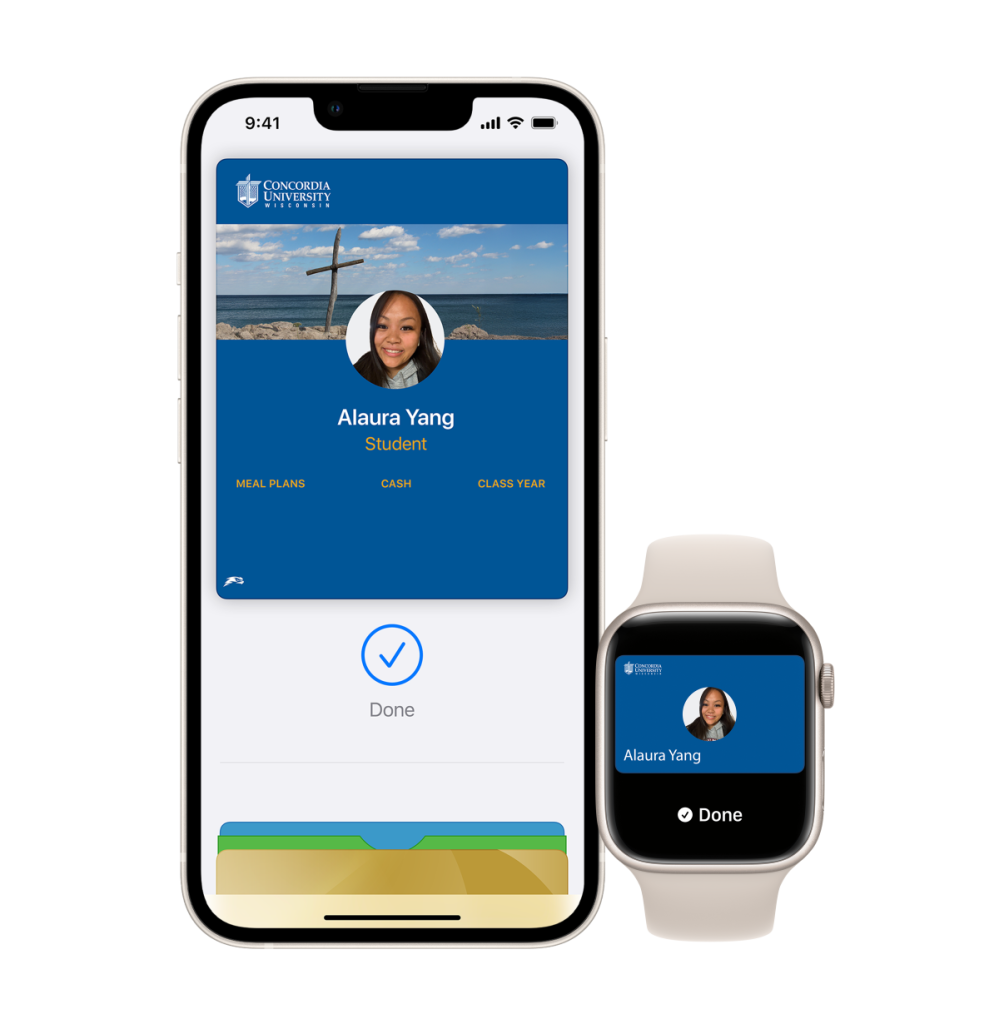
Students can now use their phones to enter buildings, make purchases and move through campus with ease.
It’s early. You’re heading to class, beverage from the Coop in one hand, backpack over your shoulder. You reach the door and pause, digging through your bag for your Falcon OneCard.
You think, “It’s in there. It always is.”
By the time you find it, someone else has already tapped in and held the door. It’s a small moment, but it adds up. Now, it doesn’t have to.
Mobile ID allows students to add their campus identification directly to their phone. The access you rely on every day stays the same, but it fits more naturally into how you already move through campus.
“Tap-to-pay technology has become a standard part of how we interact and pay,” said Sean Young, director of unified communications and audio-video services. “This upgrade enhances the OneCard experience, aligning with today’s expectations and offering greater convenience for our community.”
Built for the way students move
As the day picks up, so does your pace. You move from class to class, stop at the cafeteria, attend a campus-wide event and head back to your residence hall before going out again.
Your phone is already part of that rhythm, always within reach.
Mobile ID fits into those in-between moments. There is nothing new to remember. Your ID becomes part of what you already carry.
For students living on campus, that difference shows up quickly. Late-night entry feels easier. Moving between buildings feels more seamless. The small pauses begin to fade.
Physical IDs are still available, but Mobile ID offers another option—one that meets you where you are.
Security that keeps up with you
Mobile ID is protected by the same security features you already use, including passcodes, fingerprint recognition or facial authentication.
If your phone is lost, access can be turned off quickly, giving you less to worry about and more control over what happens next.
“Mobile ID lives within Apple Pay and Google Wallet and is protected by the same industry-leading security protocols used to safeguard credit cards and payment information,” Young said. “This ensures OneCard accounts remain safe and secure.”
Getting started is straightforward
Adding Mobile ID is simple. Download the app, follow a few steps, and get started by watching the video.
The process varies slightly by device. iPhone users add their ID through Apple Wallet. Android users follow a similar path through Google Wallet.
After that, it becomes part of your routine:
Tap to enter.
Tap to pay.
Tap and keep moving.
“Students have long used the 360u app to upload photos, add funds and check balances,” said Young. “Bringing the physical card into a mobile format is a natural next step, offering greater convenience.”
He added: “With enhanced security features and seamless integration into Apple Pay and Google Wallet, Mobile ID makes accessing campus services easier and helps keep buildings more secure.”
A small change that shapes the day
By the end of the day, it is easy to forget the moments that once slowed you down—searching through your wallet, doubling back or waiting at a door. Now, your day moves with fewer interruptions, so you can focus on where you are going next.
Note: Mobile ID is available to students only.
Want in?
Concordia University Wisconsin is a Lutheran higher education community committed to helping students develop in mind, body and spirit for service to Christ in the Church and the world.
Senior psychology majors present research shaped by faith, service and academic study.
Concordia University Wisconsin will host its annual Arts & Sciences Research Symposium Thursday, April 23, in the Terrace Room from noon to 1 p.m. The symposium coincides with World Psychology Day, a time to recognize psychologists and their contributions to global challenges and mental health awareness. The campus community is invited to engage with student research across disciplines.
Rooted in Concordia’s Christ-centered mission, the study of human behavior reflects a shared commitment among students and faculty to serve others with compassion, integrity and purpose.
That calling is especially visible within the Bachelor of Arts in Psychology program, one of the university’s largest majors. Students enter the program with a desire to better understand others and to serve their communities. CUW’s program blends academic study with experiential learning to prepare students to engage thoughtfully with a range of human experiences.
Purposeful research
At this year’s symposium, 11 senior psychology students will present independent research projects developed over the course of the academic year. Each project reflects careful study and a focus on questions that connect to real-world concerns.
Topics include social media’s influence on academic self-efficacy, a weeklong cognitive behavioral intervention among female CUW athletes, and mental health considerations for children with dyslexia. Additional research examines the relationship between religious participation and coping strategies among Concordia students.
For Autumn Snow, a senior psychology major, research became a way to connect her academic work with her personal experience as a student-athlete. Her project explored how cognitive behavioral techniques can help reduce performance anxiety among female collegiate athletes. She said the experience deepened her understanding of how psychology can support others in meaningful ways.
“Through Concordia’s program, I’ve been challenged academically and encouraged to grow as a person,” Snow said. “My professors have invested in me in ways that have shaped both my character and my purpose. This experience strengthened my desire to pursue a career as a therapist, where I hope to support others in their mental well-being.”
Preparing students
Senior psychology majors from last year’s symposium.
Faculty design the research process to prepare students for what comes next, both academically and professionally.
“Our psychology seniors have worked incredibly hard over the last year to develop scientific studies that have real-world impact,” said Sthephany Escandell, assistant professor of psychology. “As their research faculty, I am very proud of their accomplishments. The skills they have learned through this process will easily translate to graduate school, the workforce, and their lives as informed research consumers and producers.”
The symposium will feature more than 40 projects from across the School of Arts and Sciences. While topics vary, each presentation reflects a shared commitment to careful study and meaningful application.
“Concordia University Wisconsin’s psychology department is committed to providing all majors with meaningful experiential learning opportunities, such as engaging in independent research and collecting original data,” said Dr. Rachel Pickett, professor of psychology and department chair. “These experiences not only help students grow in their ability to apply the concepts that they learn in the classroom; they also make them competitive candidates for jobs and graduate programs.”
“We are grateful for the dedicated faculty and students in the Department of Psychology who continue to use their God-given gifts to make a meaningful difference in the world,” said Escandell. “Happy World Psychology Day!”
World Psychology Day at Concordia highlights both celebration and purpose. It affirms the value of studying human behavior with care and points to the responsibility that follows. Students pursue this work with intention, seeking to understand others and serve where they are called.
Sthephany Escandell, assistant professor of psychology and senior research faculty advisor, contributed to this article.
Want in?
Concordia University Wisconsin is a Lutheran higher education community committed to helping students develop in mind, body and spirit for service to Christ in the Church and the world.
Concordia University Wisconsin’s acrobatics and tumbling team traveled to Texas for the 2026 NCATA National Championships, where they competed as the No. 2 seed in pursuit of a national title.
The trip offered more than competition, giving the team time to prepare mentally and bond through shared experiences leading up to and throughout the tournament.
After arriving, the team attended a banquet hosted by East Texas Baptist University, where teams gathered to socialize and share a meal before competition began. Earning the No. 2 seed granted Concordia a bye day, allowing athletes time to adjust, practice, and enjoy the Texas weather. The day began with a 9 a.m. practice, followed by time back at the hotel, where the team stayed for better food options and activities.
Later that afternoon, the team took a break from competition intensity. After lunch, they relaxed at a rented pool, using the time to reset before their semifinal matchup against Trine University. That evening, the team went to dinner together at Papacita’s.
On competition day, the Falcons left the hotel around 9 a.m., listening to music and building energy for the meet. Facing Trine in the semifinals, Concordia maintained the lead throughout, though the outcome came down to the final event—a common scenario between the two teams. Concordia secured the win with a score of 216.635 to 203.580, advancing to the championship meet against the University of Mary Hardin-Baylor.
Following the victory, the team celebrated together at a local venue with food trucks and live music, spending time with family, taking photos, and returning to the hotel.
The next day featured event finals, during which Concordia qualified for seven events. Although the team did not win any titles, they maintained strong energy and support for one another. After a quick turnaround, they competed in the championship meet. While Concordia fell short, they achieved a season-high score of 9.5 in their synchronized pyramid.
Nationals was about more than the results for Concordia’s acrobatics and tumbling team. It was the quality time, connection, and celebration of their hard work throughout the season that made the experience just as valuable as the competition itself.
— Grace Partain is a writer for The Beacon. She is a Mass Communication major graduating in 2027. She is a member of the acrobatics and tumbling team.
Concordia’s Got Talent returns as a night designed for the CUW community to come together.
There’s something about stepping onto a stage that changes a person.
For some students, it begins with nerves. For others, it’s a step into something new. As the first Concordia’s Got Talent took shape last year, participants stepped onto the stage not fully knowing what to expect—but many left with an experience that stayed with them.
Now in its second year, CGT will take place Thursday, April 23, at 7:30 p.m., in the Todd Wehr Auditorium. The event aims to build on its original foundation, returning with new energy and expanded opportunities for both performers and audience members.
Keep it simple
Concordia’s Got Talent made its debut last year as a new way to connect the CUW community.
“CGT started from a simple idea I had—creating something that would bring the entire campus together and highlight what makes Concordia truly special and uncommon: the people,” said alumnus Dalton Hribar ’25.
Hribar, who graduated last May with his bachelor’s degree in accounting and his MBA, developed the concept during his time as SGA chief financial officer. Inspired by shows like America’s Got Talent, he set out to create something similar at Concordia while keeping the focus on community.
“I wanted to create something similar on campus, but in a way that intentionally included every part of Concordia—students, faculty and staff,” he said.
Bringing that vision to life required more than planning an event. It meant coordinating across departments, building a team and shaping something entirely new.
“Planning and executing CGT was a behemoth of a task that required a tremendous amount of work, but it was incredibly fulfilling,” Hribar said.
Throughout the process, he worked closely with students, faculty and staff from across campus. Those relationships carried into the night itself.
“Being able to connect with so many people throughout the entire process—from the initial idea to the final execution—was one of the most meaningful parts of the experience,” he said. “You can truly feel the light of Christ within the CUW community, and it became even more evident through every interaction.”
Bringing it all together
When the event finally arrived, Hribar not only helped lead it behind the scenes but also hosted it.
“Feeling the energy of the room, seeing over 500 people in the audience and recognizing familiar faces from all aspects of CUW was incredibly special,” he said.
As the night came to a close, the significance of it became clear. “I stood on the stage while everything was being cleaned up, and I had a deep sense of gratitude,” Hribar said. “Seeing it all come together and be such a success—far beyond what I expected—was a blessing and made every hour of work worth it.”
Making moments that matter
For last year’s winners, the impact of the event extended far beyond one night.
“CGT was such a wonderful and unexpected opportunity in our lives,” said Rachel Pope, a junior studying Lutheran music education. “It can be vulnerable to put yourself out there like that, and I applaud all of the participants for sharing their talent with hundreds of people.”
Pope and her performance partner, Tirzah Schmickle, took first place with an original song—an experience that led to something more.
“The support and positive feedback we received influenced us to start a band and share our music,” Pope said.
Now performing as Letters to the King,, the duo has released original music and continues to pursue new opportunities.
“CGT gave us the confidence to pursue this dream of ours, and we will always be grateful for that,” Pope said.
From music and dance to comedy and unique acts, the show gives students space to share parts of themselves not always seen in the classroom.
“It provides a platform for students to express their creativity and unique talents, which is often missing in traditional academic settings,” said Austin Kerbs, co-chair of the SGA PR and Social Programming Committee.
For Norah Hau, co-chair of the same committee, the event is an invitation to the broader campus community. “It’s a campus-wide event celebrating the incredible talents of students across all disciplines,” she said.
The evening will feature student performers competing for top honors. The winner will receive a $1,500 scholarship, with additional awards for runner-up and fan favorite.
For those in the audience, the experience goes beyond the stage. Expect food, raffles with high-value prizes and interactive elements throughout the night.
“It’s a fun, high-energy campus event and an opportunity to support friends and peers,” Kerbs said.
Before the show, students can attend a new addition to the day. The “Show Off Your Talent” Career Fair and Networking Event will run from 4 to 6 p.m., in the Robert Plaster Building.
“This is a great opportunity to connect with professionals, explore career opportunities and build your network before enjoying the show,” Hau said.
Why it matters
At its core, Concordia’s Got Talent is about connection.
“It strengthens campus culture and school spirit,” Kerbs said. Hribar added that the event gives students the opportunity “to be seen, known and celebrated in ways that go beyond the classroom.”
For some students, it may be their first time on stage. For others, it may mark the beginning of something they carry forward long after graduation.
“My hope was always that CGT would become something bigger than just one event—something that lasts and continues to bring people together,” Hribar said. “Seeing it continue into a second year is incredibly meaningful.”
Know before you go
Concordia’s Got Talent
Thursday, April 23 7:30 p.m. Todd Wehr Auditorium
During the event
Free food and snacks Raffles with prizes Vote for Fan Favorite
Before the show
“Show Off Your Talent” Career Fair & Networking Event
4–6 p.m. Robert Plaster Building
What to expect
Connect with professionals Explore career paths Free food and drinks Extra raffle entry for CGT
Want in?
Concordia University Wisconsin is a Lutheran higher education community committed to helping students develop in mind, body and spirit for service to Christ in the Church and the world.
Concordia University Wisconsin students will soon perform in “Concordia’s Got Talent”, an annual opportunity for students to engage personally and thoughtfully with the student community.
Performing in the show requires students to audition, giving them a chance at winning $1,500 if selected for the best act.
CGT contestant Genna Rector, is doing a choreographed dance to “Move” by Mercy Me, because it is a fun song to dance to.
“The song that I chose is just one of those that I feel like I have a good amount of choreography. I can finish it up fairly easily choreography wise. It’s a really fun song and I do like to move, so “Move” is a perfect song for me,” Rector said.
Another contestant, Lydia Treu is singing “Rise up” by Andre Day, because the message means a lot to her.
“I wanted to pick a song that was meaningful to me, instead of just picking a song that’s popular. The song has themes of perseverance and hope,” Treu said. “Strength is found all around us, not just within. You aren’t facing your challenges alone; everyone has hard times. When times get stressful and dark, all we need is that light.”
Rachel Pope and Tirzah Schmickle won CGT last year by singing an original song called “More Like You”, which later kick-started their band called Letters to the King.
The advice that Pope gives to the next CGT contestants is to focus on the preparation put into the performance. “Just go there and have fun. Don’t stress about it. I mean, it’s scary. You’re in front of a lot of people but try not to psych yourself out and think about all that. Just think about the practice that you put into your own talent. If you put in the work, it won’t be as bad as you think it is,” she said.
Students can come watch this year’s student performances at “Concordia’s Got Talent” on April 23rd at 7:00pm in the auditorium.
— Kirsten Harrington is a writer for the Beacon and a junior majoring in photography and minoring in Mass Communications. She works as a student photographer, taking photos at campus events.