How an MBA Accelerates Your Career Path

If you’ve hit a career plateau, an MBA can help you move from execution to strategy, build financial confidence, grow a high-value network, and lead change with clarity, skills employers expect in senior leadership roles.

The career plateau problem

You’ve put in the time. You’ve earned promotions, led teams, and proven you can handle responsibility. On paper, everything looks right. But day to day, your work still revolves around meetings, deadlines, and operational problem-solving. The bigger decisions—the ones that shape direction and long-term growth—are being made somewhere else.

This is a common crossroads for experienced managers. It’s not about effort or ambition. It’s about preparation. Moving from manager to leader requires a broader lens, stronger business insight, and the confidence to think beyond your immediate role. For many working professionals, an MBA becomes the turning point that unlocks the next stage.

From managing tasks to leading strategy

Managers keep things running. Leaders decide where things are going. That distinction matters more as organizations grow more complex—and as leaders are expected to connect decisions across departments, markets, and stakeholders.

An MBA helps shift your mindset from short-term execution to long-term strategy. Instead of asking, “How do we get through this quarter?” you start asking, “How does this decision position us for the next five years?” Coursework in strategy, organizational leadership, and decision-making pushes you to zoom out, see the whole organization, and build plans that can withstand change.

What that looks like in the workplace:

  • You align team goals to company strategy (not just quarterly metrics).
  • You spot tradeoffs earlier—time, talent, budget, risk—and communicate them clearly.
  • You bring options to leadership, not just problems.

That’s the kind of thinking employers look for when identifying future directors, VPs, and senior leaders.

Financial fluency: speaking the language of leadership

One of the biggest barriers between management and leadership is financial confidence. Many capable managers excel at people leadership or operations but hesitate when conversations turn to budgets, forecasts, or investment decisions.

An MBA builds financial fluency so you can read balance sheets, evaluate risk, and understand how decisions affect the bottom line. More importantly, you learn how to translate numbers into strategy. That changes how you show up in meetings. You’re no longer reacting—you’re contributing insight, asking sharper questions, and helping guide decisions.

A helpful way to think about this shift: leadership isn’t just approving spend—it’s understanding why a spend matters, what it competes with, and what success should look like.

Expanding your network: leaders don’t climb alone

Career advancement rarely happens in isolation. Relationships matter, especially at higher levels of leadership where roles are shaped by trust, credibility, and reputation.

MBA programs bring together professionals from different industries, roles, and backgrounds. These peers become sounding boards, collaborators, and—often—advocates. Over time, alumni networks can also help you learn about roles earlier, prepare for interviews more strategically, and make smarter career pivots because you’re not navigating alone.

If you want to get more value from the network experience, go in with intention:

  • Share what you’re working toward (role, industry, leadership gap you’re closing).
  • Offer support first—introductions, feedback, or a resource you’ve used.
  • Stay connected after the course ends. The long-term relationships are where the real momentum builds.

Building confidence to lead change

Leadership means navigating uncertainty. Whether it’s adopting new technology, managing organizational change, entering new markets, or restructuring teams, leaders are expected to make informed decisions without perfect information.

MBA programs create space to practice. Through case studies, simulations, and applied projects, you learn how to evaluate options, communicate decisions, and lead through resistance. The classroom becomes a lower-risk environment to build confidence—so when real-world challenges arise, you’re ready to lead with clarity and conviction.

This matters because many promotions don’t happen when you “do your job well.” They happen when decision-makers trust you to handle ambiguity well.

Flexibility to pivot and grow

Not every leadership path follows a straight line. Many professionals use an MBA to pivot into new industries or functions—such as healthcare, finance, nonprofit leadership, or technology.

Because an MBA builds a broad business foundation (marketing, operations, finance, leadership), your skills become more transferable across sectors. Concentrations can help you align your studies with a specific goal while keeping your options open. In a job market that shifts quickly, that flexibility can be a real advantage.

The ROI: more than a salary increase

Yes, many people associate an MBA with higher earning potential—but the “return” goes deeper than compensation alone. A more complete way to evaluate ROI is to look at what an MBA can unlock:

  • Credibility: It signals advanced business knowledge and leadership readiness.
  • Mobility: It can make new roles or industries feel more realistic and reachable.
  • Longevity: Strategic thinking helps you stay relevant as industries evolve.

The real value is acceleration: moving faster and further toward meaningful leadership roles because you’re better prepared for the scope of decisions leaders carry.

Why timing matters

The workplace is changing quickly—technology, globalization, and economic uncertainty are reshaping how organizations operate and lead. Standing still is no longer a neutral choice.

Starting an MBA now can position you to adapt, lead change, and stay competitive. It’s not about chasing trends—it’s about building durable skills that help you make stronger decisions, communicate with confidence, and step into greater responsibility.

Conclusion: from manager to leader starts here

Becoming a leader takes more than experience. It takes perspective, preparation, and purpose. An MBA equips you with tools to think strategically, lead confidently, and expand your influence.

At Concordia University Wisconsin, the MBA experience is designed for working professionals, with flexible online, in-person, and hybrid formats and a values-based approach to leadership grounded in integrity. If you’re ready to move from managing what’s in front of you to shaping what comes next, CUW can help you take that step with support, structure, and a clear path forward.


FAQ: common questions about MBAs and career growth

Can an MBA really help me move into leadership?
It can. An MBA strengthens strategic thinking, financial literacy, and decision-making—core skills employers often expect in senior roles.

Is an MBA worth it for experienced managers?
For many professionals, yes—especially if you feel “stuck” and need broader business perspective, stronger confidence with finance, or leadership credibility to compete for the next level.

Do I need to change industries for an MBA to be valuable?
Not at all. MBAs can help you advance within your current field or pivot by building transferable skills across core business functions.

How do I select an MBA program that accommodates my work schedule?
Look for flexible delivery options (online/hybrid), clear support resources, and coursework that connects to real workplace scenarios—so what you learn translates quickly into your role.

Who this is for?
Working professionals who want to advance into director-level leadership and beyond, without stepping away from career momentum.

Ready to take the next step?

Explore CUW’s MBA pathways designed for busy adults: online on your own time or via Zoom in real-time. Built on values-based leadership and real-world application. A customizable, flexible MBA that helps you move your career forward.

 

Chapel Schedule 2026


Gather in the Christ Triumphant for daily chapel, Monday through Friday at 9:30 a.m.

Schedule subject to change. In-person attendance is always encouraged, but Chapel services can also be livestreamed HERE. Catch up on previous sermons via the Chapel YouTube channel HERE.


2025-26 theme: Free to Serve

‘For you were called to freedom, brothers and sisters; only do not use your freedom as an opportunity for the flesh, but through love serve one another. For the whole law is fulfilled in one word: You shall love your neighbor as yourself.’ Galatians 5:13-14


Jan. Chapel

  • Monday, Jan. 5: Rev. Jonathon Bakker | 1 Kings 3:4-15
  • Tuesday, Jan. 6: Matins | Liturgist: Bakker | Matthew 2:1-12
  • Wednesday, Jan. 7: Rev. Taylor | Psalm 72:1-11(12-15)
  • Thursday, Jan. 8: Rev. Eric Skovgaard,| Ephesians 3:1-12
  • Friday, Jan. 9: Rev. Jastram | Isaiah 60:1-6

  • Monday, Jan. 12: Rev. Tomesch | Romans 6:1-11
  • Tuesday, Jan. 13: Morning Prayer | Liturgist: Bakker | Matthew 3:13-17
  • Wednesday, Jan. 14: Rev. Jonathon Bakker | Isaiah 42:1-9
  • Thursday, Jan. 15: Guest Rev. Daniel Reh | Psalm 29
  • Friday, Jan. 16: Rev. Aaron Moldenhauer | Matthew 3:13-17

  • Monday, Jan. 19: No service
  • Tuesday, Jan. 20: Matins | Liturgist: Bakker | 1 Corinthians 1:1-9
  • Wednesday, Jan. 21: Rev. Jonathon Bakker | Psalm 40:1-11
  • Thursday, Jan. 22: Rev. German | John 1:29-42a
  • Friday, Jan. 23: Rev. Soenksen | Isaiah 49:1-7

  • Monday, Jan. 26: Guest Rev. Peter Bender | Titus 1:1-9
  • Tuesday, Jan. 27: Matins | Liturgist: Bakker | 1 Corinthians 1:1-9
  • Wednesday, Jan. 28: Rev. Jonathon Bakker | 1 Corinthians 1:10-18
  • Thursday, Jan. 29: Rev. Pietsch | Isaiah 9:1-4
  • Friday, Jan. 30: Rev. LaFeve | Psalm 27:1-9(10-14)

Feb. Chapel

  • Monday, Feb. 2: Rev. Jonathon Bakker | Luke 2:22-32
  • Tuesday, Feb. 3: Matins | Liturgist: Bakker | Matthew 5:1-12
  • Wednesday, Feb. 4: Rev. Aaron Moldenhauer | Micah 6:1-8
  • Thursday, Feb. 5: Rev. Michael Larson | Psalm 15
  • Friday, Feb. 6: Rev. Tomesch | 1 Corinthians 1:18-31

  • Monday, Feb. 9: Rev. Jonathon Bakker | Psalm 112:1-9
  • Tuesday, Feb. 10: Morning Prayer | Liturgist: Bakker | Matthew 5:13-20
  • Wednesday, Feb. 11: Rev. Jacob Schultz | 1 Cor 2:1-12(13-16)
  • Thursday, Feb. 12: Rev. Dr. Mark Rabe | Isaiah 58:3-9a
  • Friday, Feb. 13: No Service

  • Monday, Feb. 16: Guest Rev. Craig Reiter | 2 Peter 1:16-21
  • Tuesday, Feb. 17: Matins | Liturgist: Bakker | Matthew 17:1-9
  • Ash Wednesday, Feb. 18: Liturgist: Bakker | Psalm 51:1-13(14-19)
  • Thursday, Feb. 19: Rev. LaFeve | Matthew 6:1-6, 16-21
  • Friday, Feb. 20: Rev. Taylor | Joel 2:12-19

  • Monday, Feb. 23: Rev. Jonathon Bakker | Genesis 3:1-21
  • Tuesday, Feb. 24: Rev. Dr. Nathan Meador | Acts 1:15-26
  • Wednesday, Feb. 25: Guest Rev. Jack Gilbert | Matthew 4:1-11 | Haven
  • Thursday, Feb. 26: Matins w/Benedictus | Liturgist: Bakker | Romans 5:12-19
  • Friday, Feb. 27: Rev. Jastram | Psalm 32:1-7

Mar. Chapel

  • Mar. 2 to Mar. 6: Spring Break, No Service

  • Monday, Mar. 9: Rev. Taylor | Psalm 95:1-9
  • Tuesday, Mar. 10: Matins | Liturgist: Bakker | John 4:5-26
  • Wednesday, Mar. 11: Rev. Jonathon Bakker | Romans 5:1-8 | Haven
  • Thursday, Mar. 12: Rev. Jason Schockman | John 4:5-26
  • Friday, Mar. 13: Guest Rev. Aric Fenske | Exodus 17:1-7

  • Monday, Mar. 16: Rev. LaFeve | John 9:1-7, 13-17, 34-39
  • Tuesday, Mar. 17: Morning Prayer | Liturgist: Bakker | Isaiah 42:14-21
  • Wednesday, Mar. 18: Rev. Jastram | Romans 5:1-8 | Haven
  • Thursday, Mar. 19: Rev. Pietsch | Matthew 2:13-15, 19-23
  • Friday, Mar. 20: Rev. Jonathon Bakker | Ephesians 5:8-14

  • Monday, Mar. 23: Rev. Aaron Moldenhauer | Ezekiel 37:1-14
  • Tuesday, Mar. 24: Matins | Liturgist: Bakker | John 11:17-27, 38-53
  • Wednesday, Mar. 25: Rev. Jonathon Bakker | Luke 1:26-38 | Haven
  • Thursday, Mar. 26: Rev. Greg Hovland | Romans 8:1-11
  • Friday, Mar. 27: Rev. Joshua Teggatz | Psalm 130

  • Monday, Mar. 30: Rev. Jonathon Bakker | John 12:1-23
  • Tuesday, Mar. 31: Rev. Jonathon Bakker | John 12:23-50

Apr. Chapel

  • Wednesday, Apr. 1: Matins with Benedictus | Liturgist: Bakker | John 13:16-38
  • Thursday, Apr. 2: Liturgist: Bakker | Hebrews 9:11-22

  • Monday, Apr. 6: No Service
  • Tuesday, Apr. 7: Rev. Jonathon Bakker | Jeremiah 31:1-6
  • Wednesday, Apr. 8: Rev. Jonathon Bakker | Psalm 16 | Haven
  • Thursday, Apr. 9: Matins | Liturgist: Bakker | Matthew 28:1-10
  • Friday, Apr. 10: Rev. Ben Leeper | Colossians 3:1-11

  • Monday, Apr. 13: Rev. Jonah Burakowski | Psalm 148
  • Tuesday, Apr. 14: Rev. Paul Marks | 1 Peter 1:3-9
  • Wednesday, Apr. 15: Rev. Alvaro Witt | John 20:19-31 | Haven
  • Thursday, Apr. 16: Morning prayer | Liturgist: Bakker | John 20:19-31
  • Friday, Apr. 17: Rev. Aaron Fenker | Acts 5:29-42

  • Monday, Apr. 20: Rev. Erik Ankerberg | Psalm 116:1-14
  • Tuesday, Apr. 21: Matins | Liturgist: Bakker | Luke 24:13-35
  • Wednesday, Apr. 22: Rev. Carl Seeger | 1 Peter 1:17-25 | Haven
  • Thursday, Apr. 23: Rev. Chris Dhuse | Acts 2:14a, 36-41
  • Friday, Apr. 24: Rev. Aaron Koch | Luke 24:13-35

  • Monday, Apr. 27: Morning prayer | Liturgist: Bakker | 1 Peter 2:19-25
  • Tuesday, Apr. 28: Rev. Jonathon Bakker | Psalm 23
  • Wednesday, Apr. 29: Liturgist: Bakker
  • Thursday, Apr. 30: Liturgist: Bakker | John 10:1-10
  • Friday, May 1: Rev. Jonathon Bakker | Ephesians 2:19-22

Note: This schedule is updated frequently.

Learn more

At CUW you can see and feel a Christian emphasis from how our professors teach in the classroom to how our athletes play on the field. We instill in our students that living a full Christian life is about more than worship. CUW is a Christian university, not because we’re perfect people, but because we’re forgiven sinners who gather together in Christ. To learn more, click the link below.


New year, new tools: CUW expands campuswide access to generative artificial intelligence

BoodleBox, a secure, integrated platform for learning, launches in 2026 at Concordia University Wisconsin.


Preparing students for a changing world means more than keeping pace with technology. It means giving them the tools — and the guidance — to use it well. Beginning Feb. 1, CUW will provide students, faculty and staff with access to BoodleBox, a platform for generative artificial intelligence.

BoodleBox brings a suite of AI tools together in a secure, university-supported environment. The platform uses CUW single sign-on and integrates with Canvas, allowing students and faculty to access tools directly within their courses.

“This is about meeting students where they are,” said Dr. Leah Dvorak, vice president of academics. “Artificial intelligence is already shaping nearly every profession, and we have a responsibility as a university to help students engage with these tools thoughtfully, ethically and with purpose.”

Through the platform’s implementation, Dvorak said, CUW is reinforcing its commitment to preparing students for life beyond graduation.

“Our responsibility is to ensure graduates are prepared for the realities of today’s workforce,” she said. “Employers are seeking individuals who can use AI tools creatively and responsibly while exercising strong judgment and discernment.”

BoodleBox will also allow students to take a portfolio of custom bots or collaborative projects with them after graduation.

“That portability gives students a tangible way to demonstrate their skills and confidence using AI,” Dvorak said.


Premium AI tools available

Through BoodleBox, the CUW community will have unlimited access to paid versions of AI tools, including ChatGPT 5.1, Claude 4.5 (Haiku, Opus and Sonnet), Gemini 2.5 Pro, Perplexity, Semantic Scholar and DALL-E 3 for image generation. Instead of navigating individual subscriptions or limited free trials, users can explore multiple tools side by side in one place.

That access matters, Dvorak said, because limits built into free tools can become barriers to learning. Many platforms restrict daily prompts or features, which can interrupt coursework and disadvantage students without paid subscriptions. BoodleBox removes those obstacles, ensuring equitable access to advanced tools.


Designed with education in mind

girl on computer in courtyard

The platform was selected with teaching and learning as the priority. BoodleBox allows users to compare different AI models and versions, helping students see how responses vary and how models evolve. It also includes research-focused tools such as Perplexity and Semantic Scholar, which support information gathering and source-based inquiry.

Faculty have also begun exploring the ability to create AI bots trained on specific course materials. Instructors can upload texts, documents or approved resources and build bots that respond using only that content. Faculty and students can then collaborate using those bots alongside a wide range of large language models within shared group chats.

“This creates an environment where students and faculty can engage directly with AI while remaining anchored in course content,” Dvorak said. “It allows them to see both the strengths and limitations of these tools and reinforces the role of human judgment.”

Students can ask questions, review concepts and deepen understanding while remaining grounded in course-specific material.


Faculty perspectives on AI and learning

Dr. Michael Litman, professor and chair of the Department of Computer Science, sees this approach as essential to preserving deep learning in an era of instant answers.

“As a professor of computer science, I see generative AI fundamentally reshaping how students learn — not by replacing instruction, but by changing how students process and internalize what they are taught,” Litman said. “When answers are always one search away, students can default to consumption rather than synthesis. AI amplifies that tension.”

Litman believes generative AI is most valuable when used as a partner in reflection rather than an answer engine.

“The real opportunity is treating AI as a dialogue partner,” he said. “After instruction, students can revisit ideas, ask clarifying questions, test assumptions and explore alternate explanations without the pressure of speaking up in class. That private, iterative conversation allows students to wrestle with complexity at their own pace.”

From an academic leadership perspective, Dvorak emphasized that AI is already reshaping disciplines across science, health care and beyond.

“Artificial intelligence is changing the way knowledge is generated, applied and evaluated,” she said. “What once required years of work can now happen in moments, which challenges us to think differently about how we teach students to analyze, interpret and use information wisely.”

Dvorak noted that AI-assisted tools are becoming standard across many professional fields.

“We are reaching a point where fluency with AI will be an expectation rather than an advantage,” she said. “Our goal is to ensure students understand not only how to use these tools, but when and why they should be used.”

Together, Litman and Dvorak see generative AI as a tool that, when guided intentionally, strengthens rather than replaces human expertise.

“Used well, AI pushes students to ask better questions, identify gaps in their understanding and connect ideas across disciplines,” Litman said. “The goal isn’t faster completion of assignments. It’s helping students value learning itself.”

“Our students will be prepared for what comes next,” Dvorak added.


Prioritizing security and responsible use

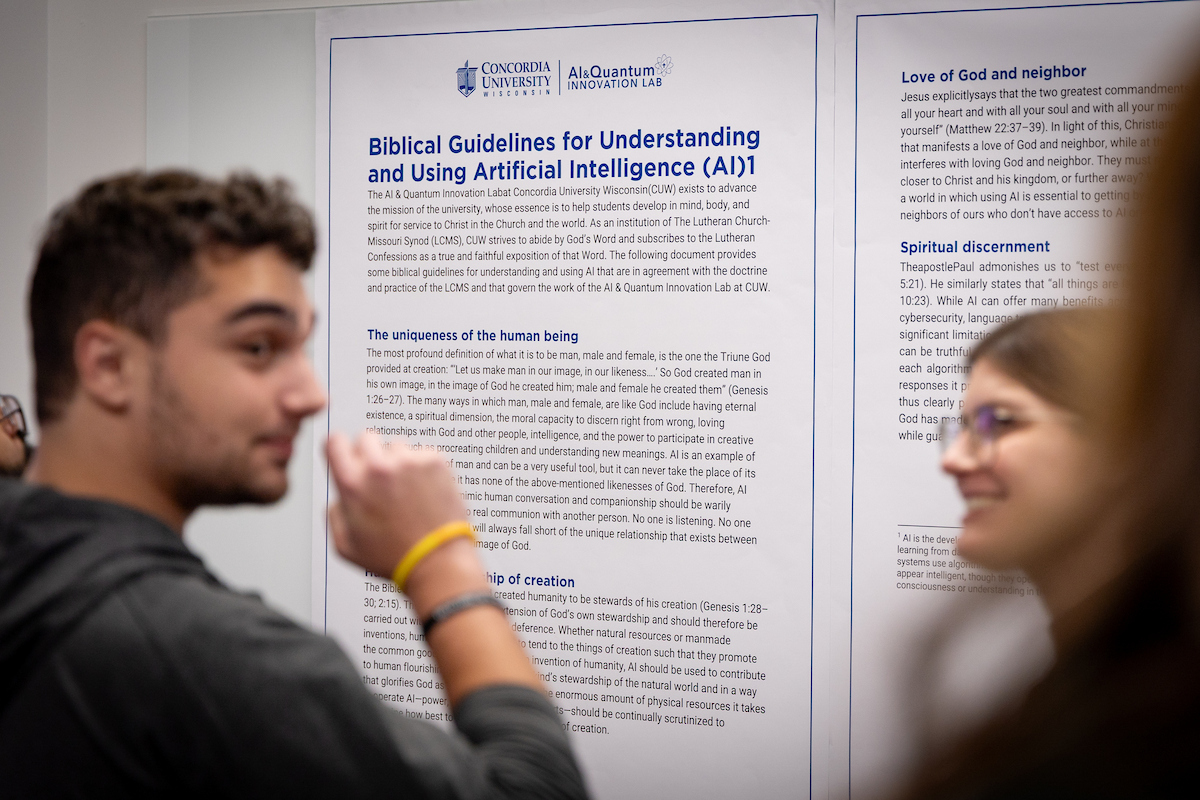
sign of biblical use of AI

Security and privacy were central to CUW’s decision to adopt the platform. BoodleBox is HIPAA- and FERPA-compliant and does not use entered data to train large language models, providing a safer environment for learning.

The launch of BoodleBox also aligns with CUW’s Artificial Intelligence Governance Plan, developed by the university’s Strategic Task Force on AI. The plan establishes expectations for ethical AI use, rooted in the university’s Christian commitment to integrity, stewardship, human dignity and care for one another. It outlines responsibilities for students, faculty and staff while preserving academic freedom through flexible syllabus policies.

“Our goal is not to prescribe how faculty teach,” Dvorak said. “It is to provide clear guidance so expectations are transparent and AI use supports meaningful learning.”


Training and what comes next

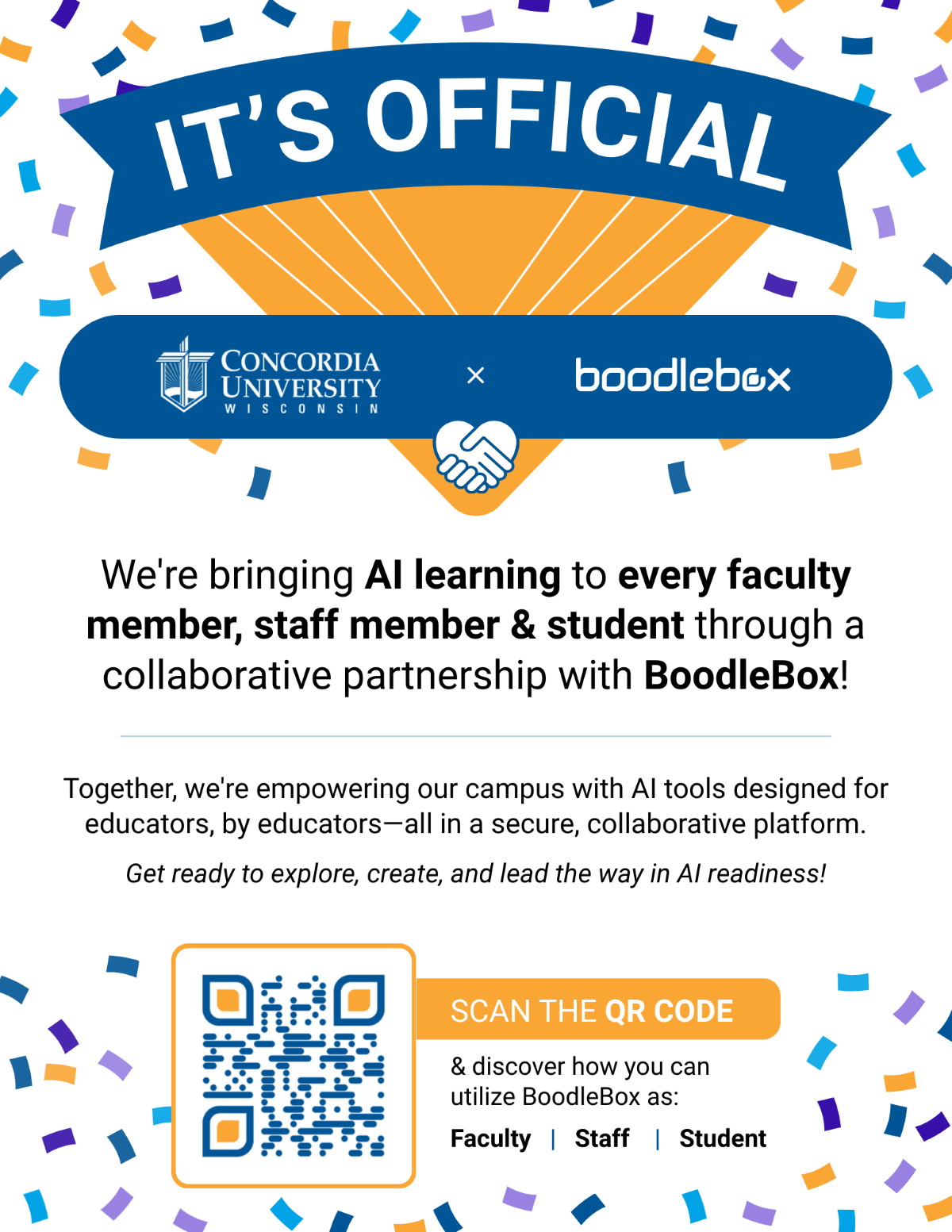
BoodleBox template with QR code

Discipline-specific training is a key part of that approach. CUW’s goal is for every student, in every program, to receive instruction on how AI is used within their field. Training opportunities for faculty, staff and students will begin shortly after the platform’s launch and will be offered both in person and online, with ongoing support through the Center for Excellence in Learning and Teaching and Information Technology.

As CUW continues to expand its work in artificial intelligence, including new undergraduate and graduate programs, BoodleBox represents a step forward that balances innovation with responsibility.

“Generative AI does not diminish education,” Litman said. “When used intentionally, it can restore curiosity, reflection and meaningful intellectual engagement.”

“This is an important moment for our campus,” Dvorak said. “We are embracing new technology in a way that reflects who we are and prepares our students for meaningful work and service.”

While there will always be a place for an unplugged classroom, Dvorak added, more faculty are finding creative ways to incorporate ethical and transparent AI use into assignments rather than banning it altogether. A recent faculty survey showed that more than two-thirds of CUW courses already include some form of AI-related learning opportunity for students.

Updated on Jan. 7, 2026.


Further exploration

computer station

Want in?

Concordia University Wisconsin is a Lutheran higher education community committed to helping students develop in mind, body and spirit for service to Christ in the Church and the world.