Cassidy’s Picks

Monthly Picks Preview


About?

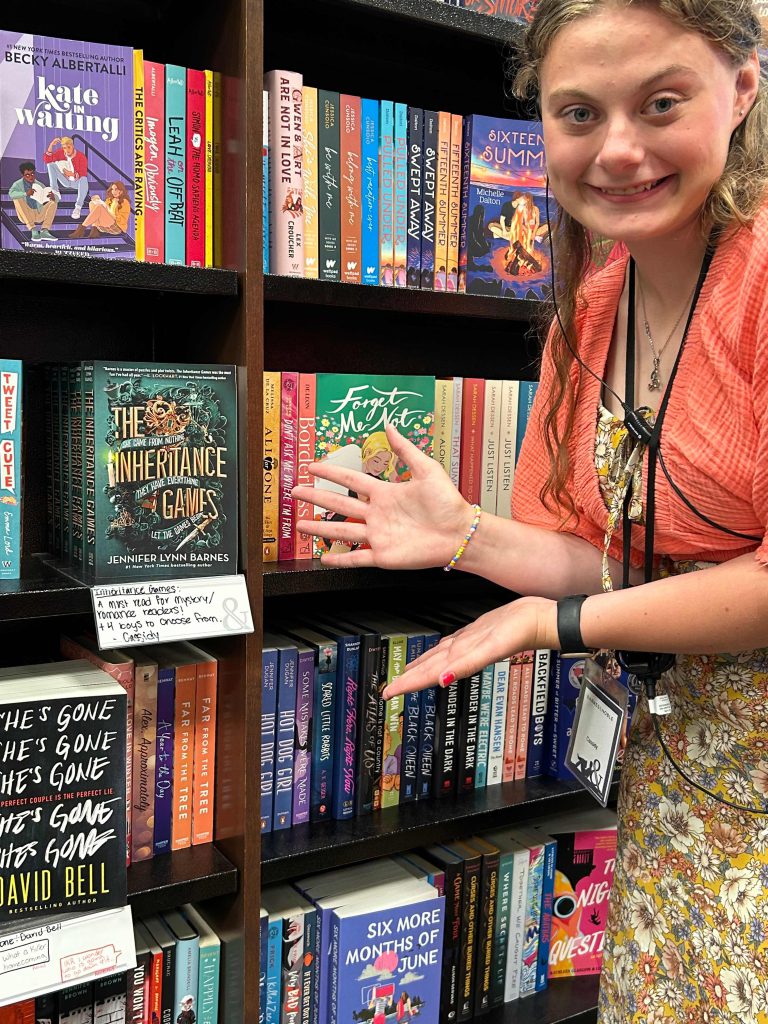
Hello readers! My name is Cassidy. I am a Sophomore at Concordia University Wisconsin, majoring in English and Mass Communications. This year, I will share some book recommendations with you.

I love to read, so there will be plenty of material. One of my favorite things about reading is the variety of escapes. Barnes & Noble’s idea inspired me to create a monthly pick per genre for students. Each genre will have a specific book devoted to it every month.

Why Read?

You might be asking yourself, why should I read? If you enjoy reading you can use this for book recommendations and reviews. Moreover, if you dislike reading, maybe it’s because you haven’t picked up a book that spiked your interest. The nice thing about reading is that it is imprinted; the pages are not going anywhere. You can like or dislike a story, but it does not mean it will change. The whole point of a book is to initiate conversation. Whether that is a way you relate to the book or a way to communicate with others.

Additionally, reading offers unforgettable experiences where lessons are learned, funny stories are shared, or even a quote you loved or a character you wish was real. There is no limit to the imagination. So, I encourage you to pick up a book you are passionate about and try to connect with it.

While exercising is important for your body, reading is important for your mind. Reading is a crucial life skill you can use with other things. Overall, getting into the habit of reading a book is so important. You will find that a book is the most loyal friend. Join me on my reading journey and see where it takes you.

Cassidy’s first Book Recommendation at
Work A.K.A. Barnes & Noble.

Articles on the Importance of Reading

“Why We Need to Read” – Wall Street Journal Article

“Reading Literature Makes Us Smarter and Nicer” – TIME Magazine

——Cassidy Gallagher is a student writer and editor for The Beacon, the official student newspaper of Concordia University Wisconsin. She is a sophomore pursuing majors in Mass Communication and English and plans to graduate in 2027.

Tis the Election Season


Every holiday, whether it is Christmas or Thanksgiving, there is one rule, “no politics at the dinner table.” This rule was perhaps instilled in family households for a number of reasons, including politics causing tension within families, its polarizing nature having the power to end relationships, etc. For some reason, politics has an inexplicable power over people. As a human race, we can agree that we long for politics not to have a grip over people’s lives. That seems like wishful thinking, but that wish can be achieved. The only way to ameliorate the awkwardness that politics puts in the air is to address the elephant in the room (in this case, red elephant). The elephant being one’s own personal beliefs and opinions. Now, no one can just abruptly regurgitate their opinions they have been digesting for many years (we have seen how that has backfired in society these days). In order to normalize talking about proclivity towards a way of thinking is to slowly introduce personal differences into the public sphere with patience and dignity. And what better time to make known our differences than the upcoming election.

Here at CUW, 25 students were interviewed about their thoughts regarding the upcoming election and American politics as a whole. To get the most weighted poll as possible, 14 men and 11 women of various grade levels were interviewed.

When asked if they were voting, all but one student said “yes.” That is not a surprising statistic. Based on polling across the country, educated people are more likely to vote. The reason behind that can be best explained by the civic education hypothesis, which states that, “education can provide both the skills and knowledge necessary to become an active and informed voter[1].” And even though the data shows that young, educated people are more likely to vote, it is still reassuring to know that many CUW students are participating members of society. And if you are one the few that are vacillating whether to vote or not, there are many great resources on campus that will help you become more pertinacious about American politics. Taking a class by CUW’s very own Dr. Lamont Colucci or Dr. Jeff Walz goes a long way. You might just find out how your opinions lines up with fellow students. Speaking of common opinions, the verdict of students’ opinions can be formed into four implications: politics is divisive, it often results in violence, the media plays too much of a role in politics, and people are so entitled to their opinion to the point where it becomes a personality trait.

Here is what many students said about politics being divisive,

  • “There is a lot of division” “People can’t agree, so it’s split on both sides”
    • “People make it such a big deal that they let it divide us to a point where it’s not necessary”
    • “Some people don’t like to talk about politics because it’s so polarized” “they believe other people will look at them differently just because they believe in a certain idea”
    • “As a nation we are already very divided when it comes to politics and this election is just further proof of the division we have”
    • “We are too polarized”

Quotes about violence and politics,

  • “There is a jump to violence instead of reasoning with others”
    • “I think that people get too aggressive about politics and it becomes violent and there’s a lot of harsh words and judgements that come along with politics”
    • “I think the aggressiveness of it all is pretty intimidating”

Quotes about media and politics,

  • “People have this idea that if you talk politics that you’re instantly in this group of weirdos and I feel people try to make you out to be a radical person for that party, but if people did their own research and delve into it instead of believing what they see on the media they would find out it’s pretty normal to talk about your beliefs”
    • “A lot of it starts in the media” “There is a lot of public shaming no matter who you vote for”
    • “A lot of people don’t know much, so they vote on what they think is popular”
    • “People pay attention to what is said in the news rather than actually looking up the information for themselves. Politics is very generational within family beliefs, so it creates a strong bias that very rarely gets exposed to the whole picture.”

Quotes about politics and self-entitlement,

  • “Voting is important, but some people make it their whole personality in a sense”
    • “When people make it a personality trait it splits people apart”
    • “When people make it a personality trait it causes issues and creates the hateful world we’re in today”

It is fair to say that many other people born in the new generation feel this way. This makes engaging in politics seem futile, but there is hope. The way that the founding fathers set up the American government makes it easy to take part in the system and do our best to change it for the good of America. The only hard part is knowing where to begin. The simplest way is to get used to being outside the comfort zone, join a club, take a social studies class, try becoming part of a local association. And if you still do not know where to go, come to a Student Government meeting and see what goes on behind the scenes.

For more information on how to register to vote click here.


— Peyton Smith is a writer for the Beacon. He is a senior mass communication major graduating in may 2025 with a minor in political science.

[1] Educator, A. S. B. and S., Shearer, A., Educator, B. and S., Commentary, G., Analyst, A. D. F. S., Desikan, A., Analyst, F. S., Director, C. Williams Research, Williams, C., & Director, R. (2023, August 28). What makes the college-educated more likely to vote?. The Equation. https://blog.ucsusa.org/alyssa-shearer/what-makes-the-college-educated-more-likely-to-vote/ 

Spotlight on Concordia’s Future Educators: Angelina Reiter

At Concordia University Wisconsin, students are nurtured to serve, lead, and inspire future generations, embodying the mission of educating the whole person—mind, body, and spirit. One student who exemplifies this holistic approach is Angelina Reiter, a senior in the Secondary Mathematics Education program, whose journey is deeply rooted in her faith and commitment to teaching.


A Calling to Serve

Angelina’s desire to pursue education comes from the influence of mentors both inside and outside the classroom. “I have been inspired to pursue a career in education so I can instill courage into the hearts and souls of those around me,” she says. Angelina is driven by a mission to encourage students and affirm their identity in Christ, just as her mentors did for her.

Why Concordia?

Concordia’s mission of educating the whole person was a significant factor in Angelina’s decision to join the program. She reflects on how this approach has impacted her educational journey: “Concordia has shown me how important it is to teach the entire person in mind, body, and spirit.” This Christ-centered mission has been pivotal in preparing Angelina for her future role as a teacher.

Angelina’s experience with her professors and advisors has played a key role in her development. “At Concordia, I have received a great amount of knowledge from my advisors and professors that I am very excited to bring into my own classroom. From classroom management tips to lesson plan essentials, I feel well prepared to create a God-centered respectful community in my classroom.”

A Passion for Teaching Mathematics

Angelina’s excitement for teaching math is clear, and she’s determined to make the subject more engaging for her students. “Typically, students see a lot of math homework and math tests, but I want my students to master content and apply it to their everyday lives.” She’s committed to integrating hands-on learning projects and formative assessments into her classroom, allowing students to take ownership of their learning. “In order to achieve this goal, I must bring in more hands-on learning to the classroom and allow students to grow in being responsible for their own learning.”

Leadership Rooted in Humility and Christ

One of the most profound lessons Angelina has learned at Concordia is the true meaning of leadership. “I have grown in what I believe a leader is at its core. A leader is someone who humbles themselves and leads like Jesus.” She references John 13, where Jesus washes His disciples’ feet, as a model for leadership: “Jesus (the Mighty one) gets down on His hands and humbly washes His disciples’ feet. That is what I model now—that is how one becomes a great leader.”

This Christ-like humility has shaped Angelina’s approach to leadership, both in the classroom and beyond. “I have learned that people respond best when I am humble and serving them on my hands and feet, doing whatever they need in the moment. At Concordia, I have redefined the word ‘leader’ to just that. Jesus, in His greatness and perfection, got down on His hands and feet and served those around Him.” This servant leadership is something Angelina plans to bring into her future classroom, leading her students by example.

Looking Ahead

Angelina feels prepared to take on her calling as an educator, with faith guiding her path. “Here I am, Lord, send me,” she says, quoting a phrase that has resonated with her throughout her journey. After graduation, she will be teaching mathematics to students she feels God has chosen her to serve. “I feel prepared and encouraged in mind and spirit from my mentors and support network at Concordia. I am ready to serve students and teach them as a whole person.”

For Angelina, teaching is not just about imparting academic knowledge—it’s about nurturing the spiritual and moral development of her students as well. “I want to teach them math content as well as enrich their moral beliefs and show them the light of Christ. Concordia has shown me how important it is to teach the entire person in mind, body, and spirit, and with that, I feel very prepared for my future career as an educator.”

Faith and Passion

When asked about how her love for Jesus and children aligns with her teaching philosophy, Angelina’s answer is simple: “Jesus is easily the Master Teacher. He models great teaching strategies such as repetition, real-world application, and more. I try my best to model after Jesus.” Her passion for both education and faith is evident in everything she does. “I truly love people and want to ignite a love of Jesus for them in their hearts.”

Angelina’s commitment to her faith is at the heart of her teaching philosophy, and she is eager to plant seeds of faith in her students’ lives while inspiring them to become lifelong learners. “I seek my everyday strength and joy from Jesus, and that is how I get my motivation to be an educator and one who loves the people around me.”

Learn More

For more information on Concordia’s Secondary Mathematics Education program, visit the program overview.


Want in?

Concordia University Wisconsin is a Lutheran higher education community committed to helping students develop in mind, body, and spirit for service to Christ in the Church and the world. To learn more or apply today, click the link below.