Thirty-five interviews and years of research reveal the voices, values and vision behind a transformative era in Concordia’s history.
For more than two years, a team of Concordia University Wisconsin faculty and staff has been engaged in an ambitious effort to preserve and share an important chapter of the university’s history.
Supported by a $40,000 NetVUE grant, “Reframing the Institutional Saga” has documented the experiences, perspectives, and memories of those who helped shape Concordia during a period of significant growth and change. The project focuses on the years 2000-23, capturing an era marked by institutional growth, academic expansion, and an ongoing commitment to Lutheran higher education.

Originally proposed in 2023, the project was designed to preserve institutional memory, examine the role of the liberal arts in Concordia’s mission, and better understand how the university’s identity has evolved while remaining grounded in its Lutheran foundation. The research team officially began its work in February 2024.
“This project began with a simple conviction: if we didn’t capture these stories now, many of them would be lost,” said Dr. Bill Cario, former university interim president, provost, and professor of history who co-led the project. “The people who built Concordia’s culture and carried its mission forward have experiences worth preserving for future generations.”

Capturing voices before they are lost
At the heart of the project are 35 oral history interviews conducted with faculty and staff members, many of whom are also Concordia alumni. Together, these firsthand accounts provide a unique perspective on the university’s development during a transformative period in its history.
In addition to the oral histories, the project includes a collection of scholarly essays and personal vignettes exploring key themes, events and institutional milestones. The collection, Living Uncommon: Retrospections on Lutheran Identity and Mission at CUWAA, is currently registered with the U.S. Copyright Office.
The project was led by Cario, Dr. Susan Mobley and Dr. Sandra Jahns, all of the School of Arts and Sciences. Theresa Kenney contributed the book’s design work, while faculty contributors included Joshua La Feve, Lori Woodall, and Kenney. Brenda Jobe also assisted throughout the research process.
As researchers reviewed interviews and historical materials, three recurring themes emerged: Concordia’s mission-centered culture, the central role of spiritual life on its campuses, and the leadership that helped guide the university through seasons of growth and change.
Studying change while living through it
The project itself unfolded during a period of institutional transition. As Concordia navigated operational changes, staffing transitions, and revisions to university learning outcomes and the core curriculum, researchers found themselves documenting history while simultaneously living through it.

“As the university was experiencing change, we found ourselves studying change,” said Jahns, assistant professor of Communication. “That forced us to move beyond documenting events and ask deeper questions about identity, mission, and what it means to be a Lutheran university today.”
Those questions helped shape the project’s second phase and informed many of the essays and reflections included in the final publication.
Mission, worship and community
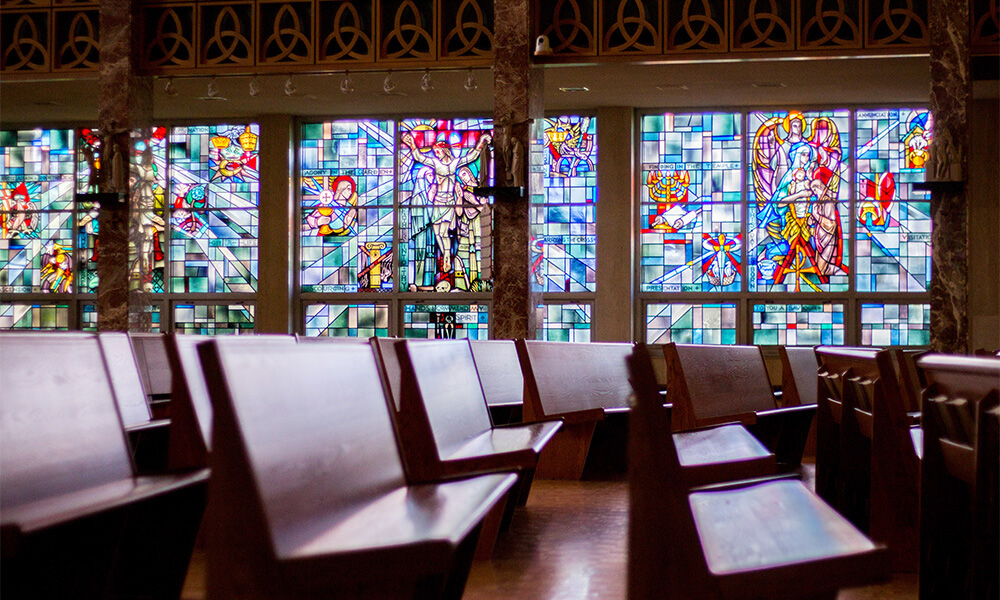
One of the strongest themes to emerge from the oral histories was the importance of Concordia’s spiritual life and mission-centered culture. Interviewees repeatedly pointed to Chapel, worship, and the integration of faith and learning as defining characteristics of the Concordia experience.
Researchers found that despite changes in programs, facilities, and organizational structures, Concordia’s commitment to developing students in mind, body and spirit has remained remarkably consistent. Participants described a university where faith is not simply discussed in the classroom, but lived out through relationships, service, worship and community.
Together, these stories reveal how mission and Christian community have remained defining characteristics of Concordia’s identity throughout periods of growth and change.
Leadership and stewardship
The oral histories also highlighted how leadership helped guide Concordia through significant periods of transformation. Participants reflected on the leadership of Rev. Dr. R. John Buuck and Rev. Dr. Patrick Ferry, whose combined decades of service oversaw major milestones in the university’s history, including enrollment growth, academic expansion, and the development of new programs and schools.

Yet one of the project’s most important findings was that mission and culture were sustained not only by presidents and administrators, but by faculty and staff across the university.
“One of the clearest findings from the project was that Concordia’s mission has never rested solely with its leadership,” Mobley said. “Faculty and staff have been the stewards of the culture, the people who translate mission into lived experience for students every day.”

The enduring role of the liberal arts
Researchers also found a remarkable continuity in Concordia’s historic commitment to the liberal arts. Across mission statements, curriculum documents, and personal recollections, a common theme emerged: Concordia seeks to prepare students not only for careers, but also for lives of purpose, service and Christian vocation.
Grounded in Lutheran educational tradition, the university’s approach to education has consistently emphasized the holistic development of students. The research concluded that Concordia equips graduates for vocations that encompass both career and calling.
“When we looked across two decades of interviews, documents, and reflections, we found a remarkable continuity,” Cario said. “Programs changed, campuses grew, and challenges emerged, but Concordia’s commitment to developing students in mind, body, and spirit remained constant.”
A book years in the making
The project has culminated in the publication of a nearly 170-page book combining oral histories, essays, vignettes, and photographs documenting Concordia’s history and mission. Living Uncommon: Retrospections on Lutheran Identity and Mission at CUWAA has been self-published by Concordia University and will be made available through Amazon near the end of the summer.
In addition to the printed volume, a digital archive will preserve the material for future generations of students, faculty, staff, alumni, and researchers.

Want in?
Concordia University Wisconsin is a Lutheran higher education community committed to helping students develop in mind, body and spirit for service to Christ in the Church and the world.