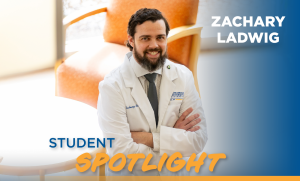
Zachary Ladwig’s path to pharmacy was not clearly defined from the start. He describes it as “muddy.”
Through personal challenges and new opportunities, pharmacy student Zachary Ladwig found direction. He is on track to graduate with his Doctor of Pharmacy degree in May 2027.
While his future in pharmacy has become clearer in recent months, Ladwig is still exploring how his vocation will take shape. The profession offers opportunities ranging from direct patient care to work in automation and technology.
“I can’t say exactly where I’ll end up,” he said, “but I’m confident it will be somewhere I’m happy and comfortable.”
He remains open to serving where he feels called and continues to explore interests in engineering, robotics and community pharmacy. Of those interests, community pharmacy stands out for its opportunity to build lasting relationships with patients.
“I like the idea of being the guy at the CVS,” he said with a smile.
Time and place
Drawn early to the outdoors, pharmacy was not Ladwig’s first choice, but it became his right choice.
After earning a bachelor’s degree in biology with a minor in chemistry from Western Michigan University, Ladwig initially planned to become a field biologist.
That career path changed after his sister was diagnosed with a brain tumor. Time spent with her in hospitals ignited his interest in healthcare. His mother, who worked as a nurse until he was in middle school, also helped shape that perspective.
At a time when he was struggling with his faith and looking for a profession that offered flexibility and long-term growth, Ladwig received an unexpected email promoting CUW’s School of Pharmacy. The timing stood out, and he felt called to move forward.
At CUW, Ladwig has become increasingly interested in how medications work and why providers prescribe them. He also appreciates the flexibility the profession offers. The field allows him to explore a variety of career paths while remaining connected to patient care.
“I have found that I can have a profound impact on the quality of patient care through prevention and education,” he said.
A timely mentor
Early in the program, Ladwig found a mentor in Michael Brown, PhD, associate dean in the School of Pharmacy. “I’ve appreciated his approach of sharing opinions without trying to convince me,” Ladwig said.
Brown, who has worked with Ladwig now for several years, describes him as an exemplary student and servant leader.
“Through his commitment to the profession and volunteer service, Zack exemplifies what it means to be a Doctor of Pharmacy student,” Brown said. “I am very confident that he is going to be an amazing pharmacist.”
Ladwig describes Brown as someone with decades of experience in pharmacy, academia and life. “He is sincerely dedicated to helping each of his students find their unique vocation,” Ladwig said.
Brown’s practical advice has reshaped how Ladwig views his own educational journey and the evolving role of technology in pharmacy.
Technology with purpose
Ladwig believes technology should be approached with curiosity rather than fear.
Robotic dispensing systems are becoming increasingly common in hospitals, community pharmacies and long-term care facilities. By assisting with counting, packaging and labeling medications, they give pharmacists and technicians more time to be present with patients.
Ladwig points to nursing homes as one example. Facilities serving large numbers of residents often manage high volumes of daily medications. Automated systems and single-dose packaging help streamline that process without overwhelming local pharmacies.
“It also helps nursing home staff reduce errors,” Ladwig said.
Barcode technology helps staff track medications from the time they are ordered through administration. By verifying the prescribed medication and its packaging, it helps ensure patients receive the correct medication.
Bridging the gap
While he remains open to where his vocation may lead, Ladwig is confident in the value of his work and the role pharmacists play in patient care. He believes pharmacists can help bridge important gaps in healthcare.
“I believe my skills help patients manage their health with confidence, reduce unnecessary emergency room visits and support the overall care team,” he said.
Fun facts
- Pharmacists are among the most accessible healthcare providers.
- Ladwig spent a summer interning at the Clement J. Zablocki VA Medical Center.
- Omnicell technology and other mobile dispensing systems help hospitals shorten the time between a medication order and patient administration.
- Today, Ladwig’s sister is doing well, and he remains committed to a career in healthcare.
“During my VA internship, they truly wanted me there as a student,” he said. “I was a learner first and a worker second.”
Interested in pursuing pharmacy? Read “Is Becoming a Pharmacist Worth It?”
Want in?
Concordia University Wisconsin is a Lutheran higher education community committed to helping students develop in mind, body and spirit for service to Christ in the Church and the world. The School of Pharmacy develops servant leaders who provide value-based, patient-centered care and improve the health of rural and urban communities through excellence in teaching, research, service and practice.