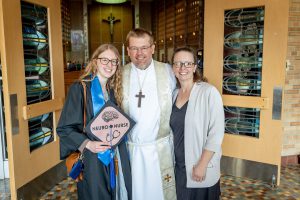
 Nursing grad Allie Sahlberg with her parents, Rev. Eric and Amy Sahlberg.
 Across Wisconsin and the nation, healthcare systems are facing a critical workforce shortage. Hospitals, clinics, long-term care facilities, and community health organizations continue to feel the strain as demand for care grows and staffing gaps widen.
Concordia University Wisconsin is helping meet this urgent need by preparing 388 healthcare graduates in the class of 2025 who are ready to serve where they are most needed.
“Nursing shortages are being felt in every corner of healthcare, from hospitals and clinics to long-term care and community settings,” said Jessica Leiberg, PhD, DNP, dean of the School of Nursing at CUW. “Our calling as a School of Nursing is to prepare graduates who are clinically prepared, compassionate in their care, and ready to serve patients and families from the moment they enter the profession.”
Graduates stepping into high-demand healthcare roles
In 2025, CUW awarded 1,772 degrees, many in healthcare and health-related fields that are experiencing significant workforce shortages. These graduates are entering the profession prepared to serve patients, families, and communities across the region and beyond.
This year’s healthcare-related graduates include:
- 68 Bachelor of Science in Nursing
- 39 Doctor of Pharmacy
- 37 Master of Occupational Therapy
- 35 Doctor of Physical Therapy
- 30 Master of Science in Physician Assistant Studies
- 29 degrees in Professional Counseling
- 26 Master of Science in Speech-Language Pathology
- 25 Family Nurse Practitioner graduates
- 22 Master of Social Work
- 17 Master of Science in Athletic Training
- 11 MBA in Healthcare Administration
- 10 MSN in Adult/Gerontology Primary Care Nurse Practitioner
- 9 Doctor of Occupational Therapy
- 8 Bachelor’s degrees in Diagnostic Medical Sonography
- 8 MSN in Healthcare Informatics
- 8 Bachelor of Science in Radiologic Technology
- 6 Doctor of Nursing Practice
Together, these graduates are helping fill critical gaps in nursing, pharmacy, rehabilitation sciences, behavioral health, primary care, and healthcare administration — areas where workforce shortages directly affect patient outcomes and access to care.
Education rooted in service and purpose
Concordia’s approach to healthcare education is grounded in its Lutheran mission to develop students in mind, body and spirit for service to Christ in the Church and the world. Students are prepared not only with clinical knowledge and professional skills, but also with a strong sense of vocation and responsibility to serve others with compassion and integrity.
“At Concordia, we emphasize care for the whole person,” Leiberg said. “Our students learn that nursing is both a profession and a vocation — one that requires excellence, integrity and a deep commitment to serving others.”
Graduates leave CUW ready to step into frontline and specialized roles, equipped to care for patients, support clinical teams, and strengthen the healthcare systems their communities rely on.
Strengthening communities through workforce impact
At a time when healthcare workforce shortages dominate national and state conversations, CUW’s graduates represent immediate, tangible impact. They are joining healthcare teams, supporting clinical partners, and helping stabilize systems that communities depend on every day. As healthcare challenges continue to evolve, CUW remains committed to preparing skilled, compassionate professionals who are ready to meet today’s urgent needs and tomorrow’s challenges
Want in?
Concordia University Wisconsin is a Lutheran higher education community committed to helping students develop in mind, body and spirit for service to Christ in the Church and the world.