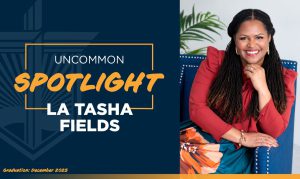
From teaching her lined-up dolls as a child to instructing college students today, meet La Tasha Fields (’25), a graduate of the Leadership in Innovation and Continuous Improvement (LICI) program at Concordia University Wisconsin.
No two educational journeys are the same. La Tasha Fields’ path was no exception. As a Marquette University undergrad with a degree in elementary education and social science, she began her career as a district-level teacher leader for Milwaukee Public Schools.
When she noticed her students were struggling with literacy, she decided to pursue CUW’s Master of Science in Education — Literacy. “I didn’t truly know how to teach reading in a way that helped students engage and grow,” Fields said.
After receiving her master’s degree, not only was she better prepared to help students, but she also became an adjunct professor at Concordia in addition to her work with MPS.
Perseverance Pays Off

Fields first began her doctoral work in the language and literacy program at Cardinal Stritch University and was devastated when the university closed. Newly married at the time, she had already paused and restarted her educational journey once. Determined to finish, she eventually found her way back to Concordia.
Over the last 10 years of her roughly 21 years of service at MPS, she continued to pursue higher education. Today, she proudly holds a Doctor of Philosophy in Leadership in Innovation and Continuous Improvement (LICI).
“I really believe I was called to teach,” Fields said. “Even as a little girl I played school with my cousins, bossed them around, and when they wouldn’t listen, I lined my dolls up and taught them instead. My mom even bought me a chalkboard — I was that kid.”
Dr. Steven Witt, professor of education and director of the graduate literacy program — and her former Concordia supervisor — agreed to serve as her chair. “He helped me reestablish a committee and essentially start fresh,” Fields said.
“Concordia’s LICI program is very structured, and that structure set me up for success,” she said. “At Concordia, I always knew the next step, and that helped me finally finish this past summer.”
A Dissertation of Purpose
Fields’ dissertation examined how Black teen girls navigated the literacy challenges embedded in their educational environments. Rather than labeling them as “struggling readers,” she found that many demonstrated proficiency in some areas but not in others — a clear indication of systemic gaps in the support and instruction they were provided.
“One of the most disheartening findings was how many of them suffered in silence,” Fields explained. “They didn’t know how to ask for help or were ashamed to.”
Yet there were uplifting examples. Fields found that some girls received meaningful support from churches, families and tutors. “One young woman, for instance, was given a leadership role in her church, where she read Bible stories to children — even though she wasn’t considered the ‘best’ reader at school.”
Witt, who served as Fields’ dissertation chair, expressed deep admiration for her work, noting the meaningful insights it offered. “Her dissertation is profoundly impactful, reflecting her commitment to elevating voices that too often go unheard,” he said.
Fields also worked closely with Dr. Kathleen Kannass, LICI professor. “She was instrumental in helping me recruit participants for my study,” Fields said. “She went out of her way to connect me with others, which ultimately led me to a third of my participants. This really helped me stay on track with my completion timeline.”
Deeply moved by Fields’ dissertation, Kannass described it as a strong example of Fields’ concern for justice and compassion for people. “LaTasha is an outstanding individual. She has a strong faith, is community-minded and service-oriented. We are proud to have her as a LICI alum,” she said.
As for what comes next, Fields remains open — and hopeful. “If we build an educational system capable of effectively serving Black girls — seeing them, hearing them, meeting them where they are — everyone will benefit, because those are things all students need.”
A Devoted Network
Fields’ mother, Denise, was one of her greatest supporters. No one else in her immediate family had ever reached this level of education. “That meant nobody could help me with the academic side of the doctoral journey, but they poured into me with encouragement, prayer and practical support,” Fields said. “My mom would say, ‘I know I can’t help you write, but I can pray, or bring you lunch.’”
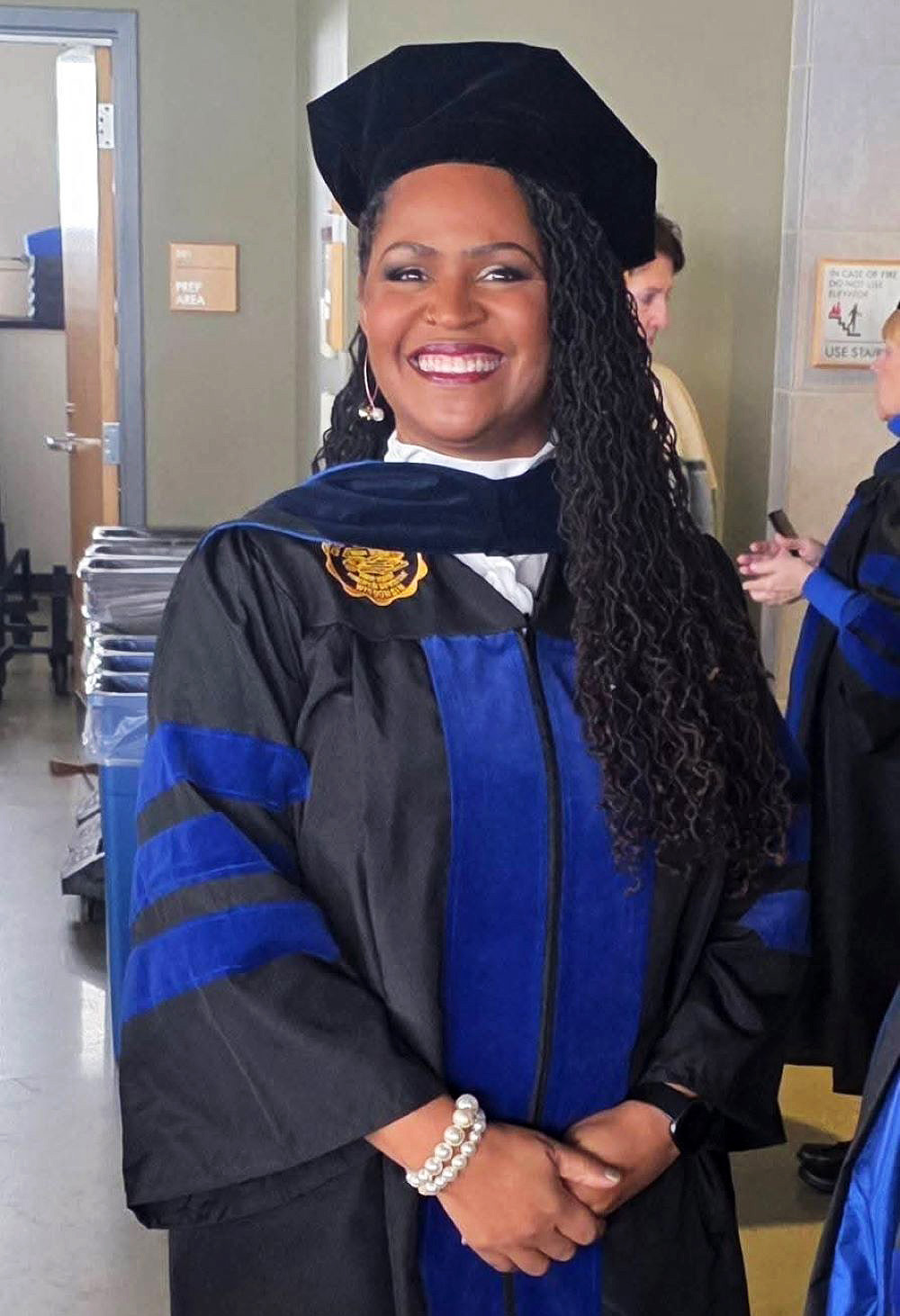
Support from her mother and her husband made a significant difference. “Being the first in the family to earn a doctorate feels like something I did not just for me, but also for my family — something that adds to our collective story and opens doors for the next generation.”
Jason Fields, her husband of eight years, walked alongside her throughout the journey. “La Tasha’s pursuit of her doctorate, something I had the opportunity to watch, was a case study on discipline, dedication and leadership,” he said. “She never missed a beat. After watching her, I learned firsthand what needed to be done if I wanted to follow in her footsteps. It was amazing to see.”
Coincidentally, Jason is also pursuing his doctorate at Concordia in the same program. Reaching the stage first, Fields laughed that he was not thrilled — in a playful way. “Early on, he told me, ‘You’re not going to be the only doctor in the house.’ So when he enrolled, that actually motivated me even more,” Fields said with a smile. “I’m a little competitive. I wanted to finish before him, and I did.”
Undoubtedly, Fields believes God placed her in the right place at the right time. “I’m honestly asking God what’s next,” she said. “I was so focused on finishing that I didn’t let myself think too far ahead about the next big move. My doctoral journey didn’t follow my usual pattern of ‘set a goal, accomplish it.’ It was more like ‘set a goal, pause, restart, life happens.’”
One thing Fields is certain about is her life’s purpose.
“My deeper calling is service,” Fields said. “Literacy is just the area where I’ve developed expertise so I can serve children, youth and now adults more effectively — particularly those who have been overlooked or who are suffering in silence.”
At a Glance
- Who has made the biggest impact on your college journey? “I am forever grateful for my husband, whose steady support made it possible for me to keep going. He stepped in and took care of things at home when I was exhausted and had nothing left to give. He also gave me space to write. Additionally, my mother’s unwavering encouragement and belief in me — especially in the moments when my own faith wavered — kept me grounded and moving forward. Their love and support made this journey possible.”
- What does graduation mean to you in one word or phrase? “Freedom”
- If your life had a theme song right now, what would it be? “A Beautiful Day” (India Arie)
- What’s your go-to comfort food when you need a pick-me-up? Blueberry Pie Smoothie Bowl
- If you could teleport anywhere for a weekend getaway, where would you go? A luxury spa in Ghana
- What’s something small that never fails to make you laugh or smile? Receiving random phone calls or texts from my nieces and nephews.
Fun Fact
Fields owns Onyx Educational Consulting, which she started roughly four years ago. Through Onyx, she offers professional development for K–12 schools and teachers.
“I haven’t poured a lot of energy into growing it yet because I was so focused on finishing my dissertation,” Fields said. “Now that school is done, I plan to revisit what’s already happening in Madison — particularly programs for Black girls — and see where there might be gaps I can help fill through my work.”
Editor’s note: This is one in a series of stories highlighting a few Concordia’s uncommon graduates. Faculty and staff submit candidates for consideration. Stories are posted in the days leading up to or after commencement. View more uncommon graduates here.
Want in?
Inspired by a Christian worldview, stewardship, and service, the mission of the cross-disciplinary LICI doctoral program is to prepare and equip individuals to be lifelong learners and exceptional leaders who will make a positive impact and add value to their vocations and communities.