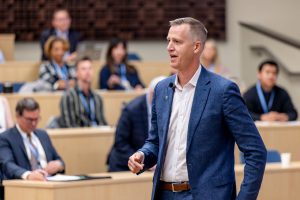
Dale Kooyenga’s keynote speech at the third annual Ignite & Inspire Leadership Conference left attendees with more than just inspiration—it left them motivated.
In a time shaped by artificial intelligence, smartphones, and endless digital content, the ability to think independently and read a physical book from cover to cover has never been more important. In fact, one of the most impactful statements Dale Kooyenga made during the conference was simple: “Your phone is the enemy.”
Kooyenga, president and CEO of the Metropolitan Milwaukee Association of Commerce and a current School of Business board member, delivered an hour-long presentation at the conference, hosted by the Batterman School of Business in CUW’s pharmacy building. What began as a memoir of his life evolved into a lesson on leadership in today’s economy.
As a growing regional leader in business education, the Batterman School of Business prepares future professionals not only with the hands-on skills needed to enter their chosen fields, but also with the mindset to become strong industry leaders. One way the school accomplishes this is through its network of professionals who come to campus to share their experience and knowledge with students and community leaders alike.
“The Concordia Batterman School of Business wants to be a resource and a destination for area businesses, their executives, employees and their families,” said Dean Rennicke, assistant dean for external relations. “Kooyenga’s willingness to serve on the Batterman School of Business Advisory Board helps connect our students and faculty with leaders in the business community while giving us insight into the needs of regional employers.”
From basketball benchwarmer to CEO
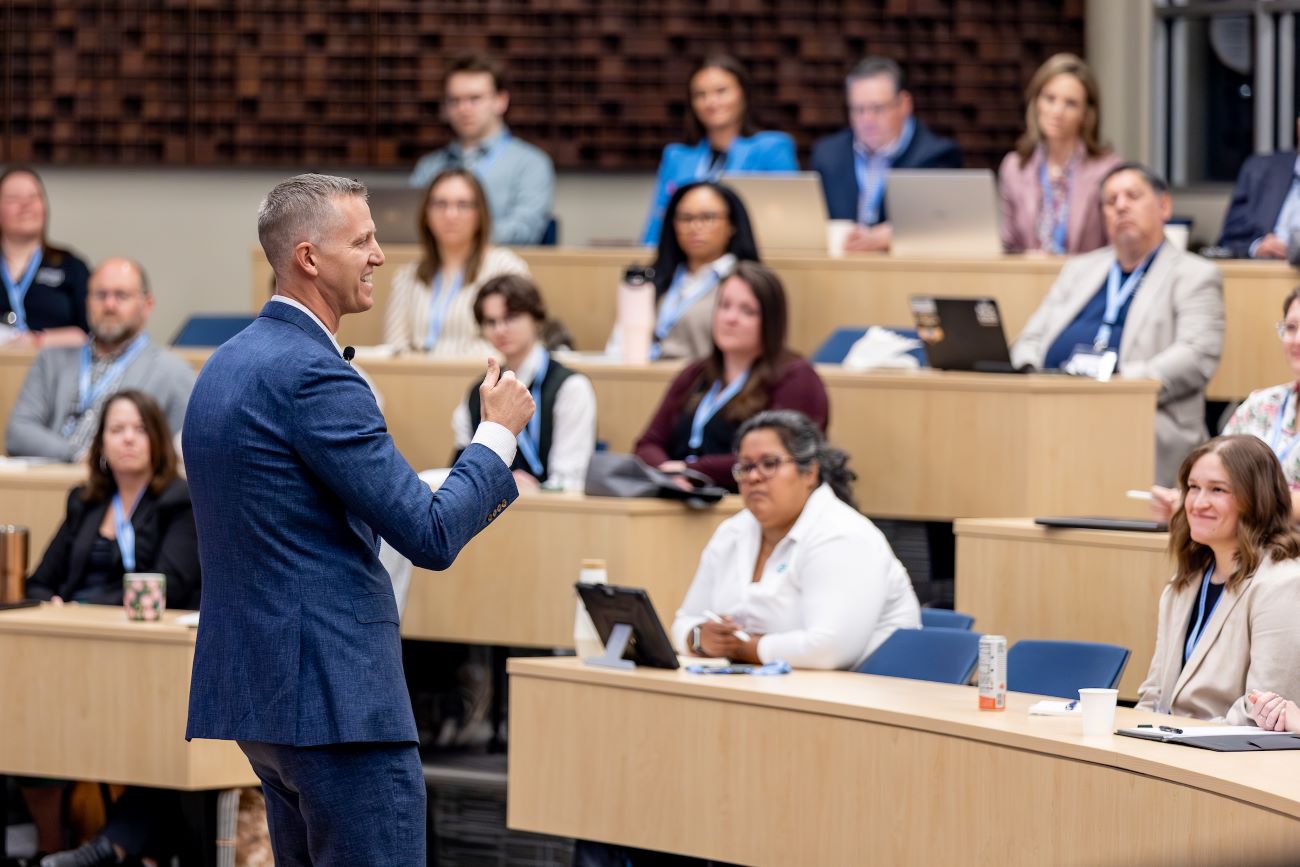
At 21 years old, Kooyenga dreamed of playing college basketball. In front of conference attendees, he joked about his struggles with the sport during high school and college, which eventually led him to shift his focus toward accounting. After earning his CPA from Lakeland University, he worked at KPMG for a decade before spending 12 years as CFO of a startup company.
While building his accounting career, the Sept. 11 terrorist attacks occurred. Kooyenga recalled exactly where he was at that moment, as many people still can. Having recently moved into a new apartment on Milwaukee’s east side, he remembered yelling to his roommates, “America is being attacked.”
“That day changed everything for me,” he said.
He felt called to enlist in the Army. With a deep conviction to serve, he deployed to Iraq. He later worked as an economic officer using his accounting and business background.
“One lesson from Iraq stayed with me forever: War is not just about combat. It’s about rebuilding communities,” he said. “Those experiences changed how I viewed leadership, sacrifice and purpose.”
He has served for more than 21 years in the U.S. Army Reserve and currently holds the rank of lieutenant colonel. He also spent eight years in the Wisconsin State Assembly and four years in the Wisconsin State Senate.
Today, he is president and CEO of MMAC, representing more than 2,000 businesses and 300,000 employees across southeastern Wisconsin.
Why are we doing this?
After sharing a bit about his life’s journey, Kooyenga, in a behind-the-scenes interview, shared an important message about what is needed from the next generation of leaders.
He said they need to be able to adapt, create and innovate.
Using artificial intelligence as an example, Kooyenga explained that AI is only as good as what it is querying. He called it “Garbage in, garbage out.” A term used to explain that the quality of output is only as good as the quality of input.
Workers need to constantly evaluate how their work can improve. “The next generation has to constantly think about productivity. How can I get more out of what I’m doing?” Kooyenga said. “Working harder matters, but working smarter matters more.”
Artificial intelligence is a tool that helps workers move beyond mundane tasks and focus on innovation, he explained.
Five tips for today’s leaders
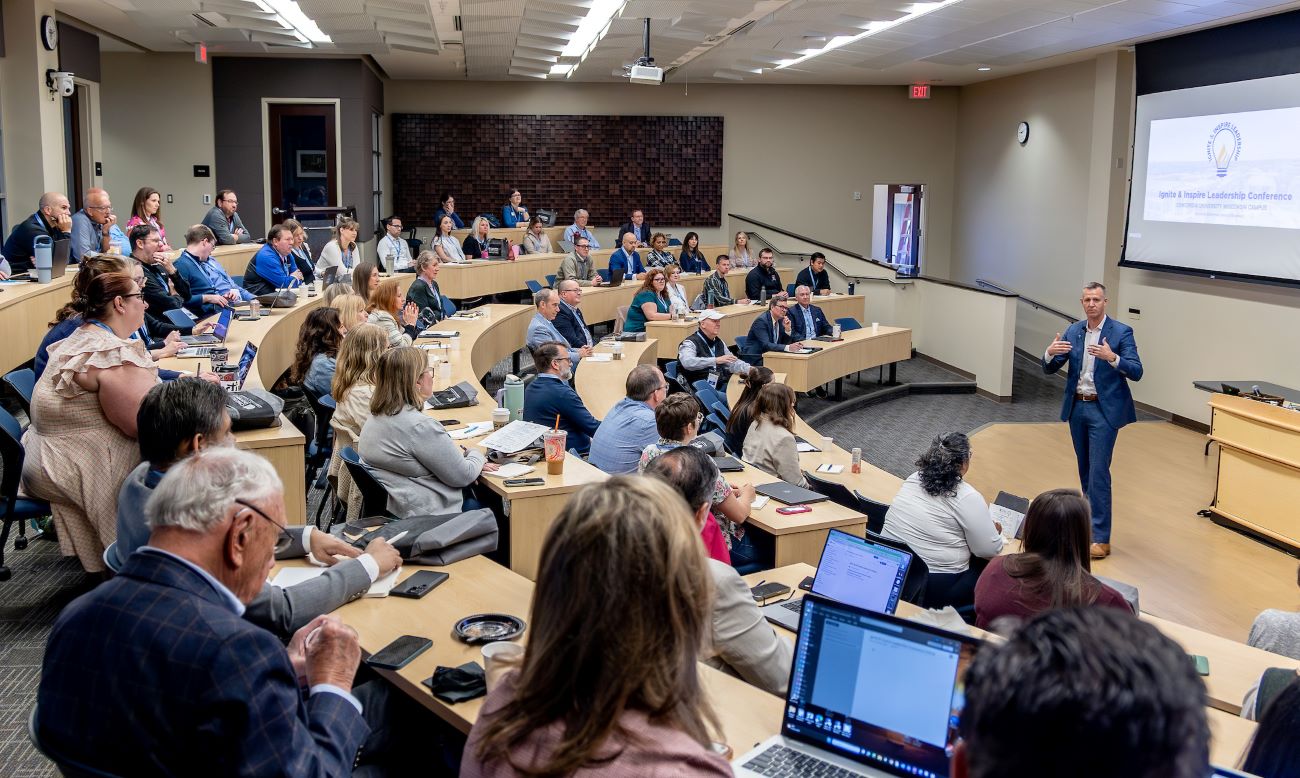
To “win” in the professional world, Kooyenga said people need to be smart, adaptable and intentional about how they grow. He shared five lessons that have guided his own career.
No. 1 and No. 2: Build experience and maintain balance
Kooyenga encouraged attendees to build expertise in multiple areas rather than becoming narrowly focused on a single discipline. Exploring different industries is valuable, he said, but constantly jumping from job to job without direction is not.
“Every industry has its own language,” he noted. People should not be afraid to build expertise in one area while continuing to explore others.
“You have to develop the networks and the knowledge,” he said. “Simultaneously try to create expertise, network, knowledge, dive in—all while not being afraid to experience other industries and lay that on top of that.”
Kooyenga referenced the 10,000-hour rule popularized by Malcolm Gladwell in Outliers: The Story of Success, which suggests mastery comes through years of deliberate practice.
“I put 10,000 hours into politics. I put 10,000 hours into the Army, and I’ve put 10,000 hours into my CPA career,” he said.
He also emphasized maintaining balance outside of work through what he called the “four-legged stool” of life: physical health, intellectual growth, relationships and community, and spiritual grounding.
Without one of those areas, he said, balance becomes difficult to maintain.
No. 3: Read constantly
Kooyenga remembers the moment his principal caught him reading Stephen King’s It during a Christian junior high assembly. After passing the book among classmates and drawing their attention to an inappropriate section of text, the incident ended with a phone call home to his parents.
What happened next shaped his relationship with reading for the rest of his life.
“I remember coming home, and my dad tossed a book at me and said, ‘Keep reading, don’t bring it to school,’” Kooyenga said. “And I think that was the right answer because I subsequently got into the classics, and now I read Christian stuff and C.S. Lewis.”
For Kooyenga, the lesson was simple: keep reading.
“I didn’t want to read what they told me to read. I just wanted to read my own stuff,” he said.
He described himself as “not a very good high school student” with a 2.9 GPA, but said he was an avid reader growing up and remains one today. Now, he finishes approximately 50 books a year across a wide range of subjects.
No. 4: Communication matters
Kooyenga encouraged attendees to approach conversations with curiosity instead of trying to prove something. He said leadership is about listening more, learning constantly and treating networking as a service rather than extraction. Suggested reading: The Next Conversation by Jefferson Fisher.
No. 5: Meaningful work and meaningful relationships
Kooyenga referenced Harvard professor and social scientist Arthur Brooks, whose research focuses on happiness. He encouraged attendees to evaluate how they spend their time and whether those activities contribute to meaningful work or meaningful relationships.
10 books recommended for leaders
- The Next Conversation by Jefferson Fischer
- Being Mortal: Medicine and What Matters in the End by Atul Gawande
- Patriot: A Memoir by Alexei Navalny
- Strength to Love by Martin Luther King Jr.
- Shoe Dog: A Memoir by the Creator of Nike by Phil Knight
- The Personal Memoirs of Ulysses S. Grant by Ulysses S. Grant
- The Fountainhead by Ayn Rand
- The Pillars of the Earth by Ken Follett
- Man’s Search for Meaning by Viktor E. Frankl
- Amazing Grace: William Wilberforce and the Heroic Campaign to End Slavery by Eric Metaxas
To learn more, check out “Rising to the Top: Batterman’s Vision for Regional Excellence.”
Want in?
Concordia University Wisconsin is a Lutheran higher education community committed to helping students develop in mind, body and spirit for service to Christ in the Church and the world.