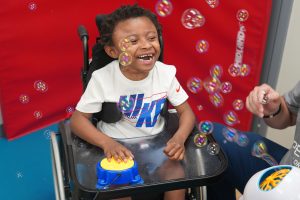
CUW students will put their engineering skills to work making play more accessible for children with disabilities.
A toy that sings, dances or lights up at the push of a button may seem simple. But for some children, pushing that button is anything but. That is where Concordia University Wisconsin engineering students are stepping in.
On Oct. 24, students will gather in CUW’s Collaboratorium, located inside the Robert W. Plaster Free Enterprise Center, for the university’s first build day modeled after Inclusive Play: Toys for All, a collaboration between Penfield Children’s Center and Marquette University’s Opus College of Engineering. Their goal is to adapt as many as 120 off-the-shelf toys so children with physical or developmental disabilities can operate them using accessible external switches.
Subha Kumpaty, PhD, chair of Concordia’s engineering and mathematics department, says the project brings together technical learning, student leadership and service in a way that fits naturally with Concordia’s mission.
“Service learning is part of our DNA,” Kumpaty said. “We want to develop students who will serve Christ in the Church and the world. This is right in that alley.”
It only takes a few to move a mountain
Concordia’s involvement began in 2023, when Kumpaty connected with Vladimir Bjelic, a speech-language pathologist at Penfield Children’s Center, through CUW Professor Yiming Liao. Soon after, engineering students began designing and 3D printing adaptive switches for toys used by children with disabilities.
Last spring, the effort resulted in approximately 50 to 60 adaptive switches for Penfield. Kumpaty also sent groups from CUW to Marquette University’s Inclusive Play: Toys for All build days in 2024 and 2025, where they gained hands-on experience adapting the toys themselves.
Those who participated came back wanting more of their classmates to have the same experience. As interest grew, Bjelic and Kumpaty began working to bring a build day to Concordia for the first time.
“All of our students should be doing it, not just four of us or eight of us,” Kumpaty said. “When the students themselves started saying we should really be involved in this, I started thinking, ‘How can we do a build day ourselves?’”
On Oct. 24, they’ll get that chance. The event calls for eight workstations with teams of four or five at each. Trained student leaders will guide them through opening each toy, locating its activation circuit, installing a 3.5 mm jack, soldering and insulating the new connection, reassembling the toy and testing both its original and adapted controls. The goal is not simply to make the toy work. It also has to be safe, durable and ready for use by a child.
Organizers Lucas Kearney and Evan Delvaux have helped turn the idea into a working plan, coordinating funding, toy selection, tools, volunteer training and station logistics. Kearney, a junior, is studying industrial and mechanical engineering with a minor in computer science emphasizing AI and robotics. Delvaux, a sophomore, is pursuing bachelor’s degrees in industrial engineering and computer science, with an emphasis in AI and robotics. He is also pursuing a master’s degree in artificial intelligence through the CS Scholars program.
Planning this event has required both to manage budgeting, scheduling, problem-solving and coordination with campus and community partners. The experience has also made the importance of inclusive design more tangible for both.
Just think about it. A relatively small design change can determine whether a child can independently interact with an everyday object. That makes every detail matter. “The work cannot stop at ‘it turns on,’” Kearney and Delvaux explained. “We have to think about durability, loose parts, strain relief, clean wiring and consistent testing.”

The power of a button
Bjelic has spent 13 years working as a speech-language pathologist. At Penfield, he works primarily with children from birth to age 3 through Milwaukee County’s Birth to 3 Program. But adaptive switches can benefit people well beyond early childhood.
The same concept can be applied to everyday items such as fans, drink dispensers, mixers and blenders, allowing someone to operate them using a larger, more accessible switch. A child learning to cook, for example, could activate a mixer while making cookies with a parent. Similar adaptations can give children, teenagers and adults greater access to everyday activities.
The possibilities are endless. Bjelic has also worked with older students using adaptive switches for functional activities, including one student who used a switch to operate a fan during a school activity. For him, the goal is the same at any age: finding ways for people to participate more independently in everyday life.
For those unfamiliar with adapted toys, their importance goes well beyond playtime. Many commercially available toys require a child to squeeze a small foot, press a particular switch or make another precise movement to activate the toy. A child with cerebral palsy or another physical disability, for instance, may understand perfectly well what the toy does but be physically unable to make it respond. That often leaves the child watching while someone else, such as a parent, activates it.
“It’s a nice way of playing, but it’s a different feeling when a child is able to activate the toy herself,” Bjelic said.
Adapted toys change that by giving children another way to interact with a toy independently. Engineers can bypass the toy’s original switch and connect it to a larger external button. Depending on a child’s movement, that button can be pressed with a hand, elbow, foot, head or another part of the body.
Once a child makes the connection, “I hit the button, the dog barks,” Bjelic said, something special begins to happen. “They get this little glimpse in their eye and you see that they comprehend that,” he said.
Bjelic has seen children vocalize, smile or show other expressions while interacting with the toys. For some families, it can even create new opportunities for a child to play alongside a parent or sibling.
That understanding of cause and effect can also help therapists learn more about what a child understands and may open the door to other forms of communication, including augmentative and alternative communication systems.
“For me, yes, I can work on speech and language and all these other areas,” Bjelic said, “but I think the most important thing is that it gives these kids a chance to be a child and play and engage with their parents and siblings.”

Removing the barriers to play
Cost is one reason this work matters. Bjelic recalled finding that an ordinary toy costing about $40 could cost roughly $120 once adapted for accessibility. In some cases, adapted versions were several times more expensive than their off-the-shelf counterparts.
That price difference helped lead to the creation of Inclusive Play: Toys for All about five years ago through Bjelic and Marquette engineer Molly Erickson.
To date, the program has adapted 942 toys and distributed more than 800 to roughly 35 clinics and organizations in the United States and abroad, including locations in Wisconsin, Illinois, Indiana, South Carolina and Kansas, as well as Mexico City, Belize and Manila, Philippines.
Support for Concordia’s build day has come from across campus and beyond. Student Government Association is providing $2,000 to the Concordia Engineering Network, a student organization for engineering students, to purchase toys, while the engineering department has procured additional supplies and accessories needed for the build.
Milwaukee Tool has also generously supplied many of the tools needed to equip the event’s eight stations. The company sees the partnership as an opportunity to support the next generation of problem-solvers and makers while strengthening the communities it serves.
“We’re proud to partner on projects that provide students with hands-on experiences while making a positive impact for others,” said Jake Schaller, senior talent acquisition manager at Milwaukee Tool.
With the necessary tools at hand, teams can work simultaneously rather than wait for equipment.
Building with purpose
High school students, including members of the Grafton High School robotics team and students from Living Word, are also expected to participate or observe. They’ll have lunch with CUW students and tour the engineering labs.
Kearney and Delvaux hope the experience shows them that engineering is collaborative, creative and useful now, not something they have to wait until college to experience.
Bjelic hopes the experience stays with students long after the last toy is tested, showing them how their engineering skills can be used to help others.
“You’re giving these kids who require assistance and require more help than other kids an opportunity to play and live and laugh and just be a child.”
It is an opportunity Kumpaty believes is worth the time, resources and effort behind Concordia’s first build day.
“Even if one child has benefited, it’s worth it,” he said.
Want in?
Concordia University Wisconsin is a Lutheran higher education community committed to helping students develop in mind, body and spirit for service to Christ in the Church and the world.