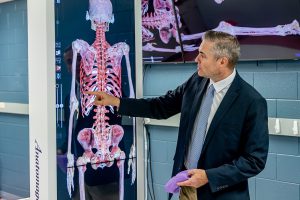
Meet Hans. He’s the image on one of Concordia University Wisconsin’s newest tools — the Anatomage Table. Through this cutting-edge technology, Hans supports nursing and health professions students at CUW.
The Anatomage Table is a life-sized, touchscreen digital anatomy system that helps students explore God’s design of the human body with clarity and depth. Using high-resolution images from real human cadavers — and in some cases animals — it provides a safe, interactive way to study anatomy through virtual dissection, layered views and detailed 3D exploration. This tool supports the university’s commitment to developing knowledgeable, compassionate health professionals who serve others with skill and integrity.
“Students from a wide range of academic programs will benefit from this new Anatomage Table,” said Dr. Robert Balza, biology professor and associate vice president of Academics for Teaching, Learning, and Academic Innovation.
He added: “Nursing students will be able to visualize catheters moving through a semi-transparent body. Physical therapy students will be able to view how muscles move joints in exquisite detail. There is an ultrasound application that is great for our sonography students. Rehab sci and premed biology students will be able to use this machine to help learn the names of bones and muscles. SLP (speech-language pathology) students can explore the detailed anatomy of the mouth and neck in 3D. Pre-vet students will even be able to explore the anatomy of household pets and farm animals!”
During a recent demonstration of the equipment, Balza showed how Hans could be virtually dissected and viewed layer by layer. He even pointed out the cancer “growing” within Hans. He added that the images were based on a real person, nicknamed Hans by the manufacturer.
Digital tools that deepen learning
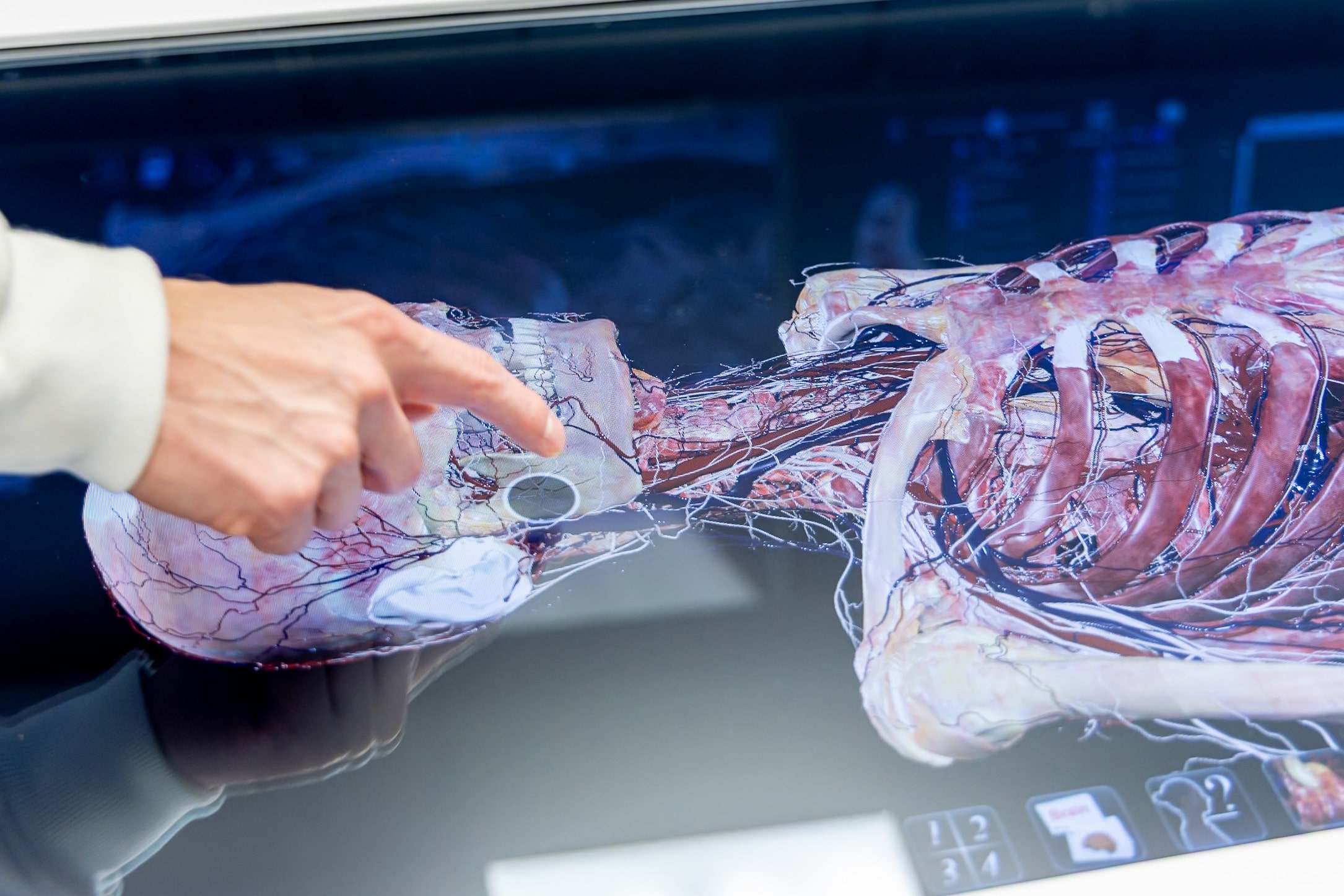
Because it isn’t limited like a traditional cadaver, the digital model allows students to return to structures again and again — undoing dissections, shifting perspectives and isolating specific systems to deepen understanding. Its interactive touchscreen format encourages curiosity and keeps learners engaged as they work through challenging anatomy concepts.
With warranty, CUW’s Anatomage Table cost about $100,000 and was made possible through a donation made by a generous family. “This table is the premium ‘convertible’ model that flips up for use in a lecture hall, so it is very versatile,” Balza said.
Biomedical science senior Madeline Brashaw has had an opportunity to observe the table in action.
“When Dr. Balza first told me about the Anatomage Table, I was beyond excited for CUW,” Madeline said. “It sounded like an amazing opportunity for students to become fully immersed in seeing real models without having to immediately go into a cadaver lab. The first time (I saw) the table, I thought it was very interesting. Not only did it allow me to see each individual part of the human body, but it also allowed me to fully comprehend everything as a whole.”
Strengthening understanding through practice
Madeline, who serves as the president of Concordia’s Pre-Med Club’s, plans is to become a physician and is now pursuing clinical experiences to complement her academic training. The members of the Pre-Med Club recently had an opportunity to see the table and how it works.
“(Those) that attended this meeting were impressed by how realistic and detailed the table was,” she said. “Many people enjoyed seeing the birth simulation.”
Balza said the table will not entirely replace real cadavers because it’s important for students to actually feel muscle and other parts of the body during dissection. In addition, it will not replace clinical experiences with hospital partners, either. “This is just one more tool in our toolbox that allows us to provide students a wide range of experiential learning opportunities,” he said.
As for Madeline, she is looking forward to more opportunities to work with Hans.
She said: “There are so many different features on the human models, but it does not stop there. There are some programs on the table that can help with chemistry and physics understanding as well. The more you interact with it, the easier using it will be. This will help you not only recognize muscles, bones, and nerves, but to fully understand how they interact with each other.”
Want in?
Concordia University Wisconsin is a Lutheran higher education community committed to helping students develop in mind, body, and spirit for service to Christ in the Church and the world. The School of Health Professions (SHP) and School of Nursing offer a wide variety of accredited programs at both the undergraduate and graduate level. Our programs are provided in a variety of teaching formats (face-to-face, online, blended) and our curriculum emphasizes service to the community and inter-professional collaboration.