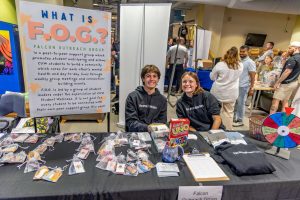
 The Falcon Outreach Group (FOG) helps create opportunities for students to connect and encourage one another. Here, FOG leaders Dom Coletta and Natalie Raymond welcome students at Concordia's Mental Health Fair.
Funding for suicide prevention initiatives and 10 new automated external defibrillators will help Concordia University Wisconsin strengthen mental health support and emergency preparedness on campus.
At Concordia, caring for students means supporting their well-being in mind, body and spirit. Two recently awarded grants will help the university build on that commitment by expanding mental health and suicide prevention efforts and increasing access to lifesaving emergency equipment on campus.
The Garrett Lee Smith Campus Suicide Prevention Grant will provide federal funding to support student mental health and suicide prevention initiatives, while a grant from the Firehouse Subs Public Safety Foundation has provided 10 automated external defibrillators (AEDs) to enhance campus emergency preparedness. Together, these investments reflect Concordia’s ongoing commitment to creating a campus community where students feel supported, connected and safe.
Garrett Lee Smith grant expands mental health support and suicide prevention efforts
CUW has taken an important step toward strengthening student mental health services and suicide prevention efforts through the Garrett Lee Smith Campus Suicide Prevention Grant.
Awarded in September, the grant provides $124,940 in first-year federal funding, with anticipated federal support totaling $495,972 over four years, contingent on continued funding and satisfactory progress. Concordia is also providing institutional matching support.
“This award is a major step forward in how we care for students at Concordia,” said Rebecca Hasbani, Counseling Center coordinator and project director for the grant. “It gives us resources to recognize concerns earlier, help students access care, and follow through so they remain supported.”
The grant will strengthen several areas of student support, including access to counseling, early identification of mental health concerns, crisis response and care coordination. It will also expand suicide prevention training for faculty, staff and student leaders, helping more members of the Concordia community recognize when someone may be struggling and connect them with appropriate resources.
The grant will also support campus initiatives that foster connection and belonging, including the Falcon Outreach Group, Mental Health Week and Love Week. These programs are especially important for students navigating academic pressures, loneliness, relationship challenges and other difficulties that can affect their well-being.
Building connections and a sense of belonging
For Natalie Raymond, a psychology major with an educational studies minor who is set to graduate in December 2027, helping fellow students build meaningful relationships is an important part of campus well-being.
As leader of the Falcon Outreach Group, Raymond helps create opportunities for students to connect, encourage one another and develop friendships. The group’s activities are designed to welcome students whether they arrive with friends or on their own.
“Every student has a place in FOG, regardless of their major, background, or interests,” Raymond said.
One of her favorite examples of that mission in action was the group’s Fiddleheads & Fellowship event at Fiddleheads coffee shop in Cedarburg. Students received journals and reflected together on their personal strengths, positive habits they hoped to develop and ways to put their strengths into practice.
“This group of students who previously did not know one another were soon relating to and encouraging each other,” Raymond said. “It was so cool to see this unfold!”
Experiences like these demonstrate how friendship and belonging can support students through the challenges of college life. The Garrett Lee Smith grant offers an opportunity to build on those connections.
“I hope that students will become more aware of the support that is offered here, both from trained counselors and from students, faculty and staff,” Raymond said.
Her perspective reinforces the importance of combining professional mental health services with a campus culture in which students look out for one another.
Caring for students in mind, body and spirit
Hasbani said the grant represents more than expanded services. It reflects Concordia’s Lutheran mission.
“Our Lutheran identity calls us to recognize each person’s God-given worth and respond to our neighbors with compassion,” Hasbani said.
Over the next four years, the project aims to strengthen follow-up services and expand suicide prevention efforts across campus. A key goal is to reach 700 to 800 students annually through Question, Persuade, Refer (QPR) training. The project will also expand QPR instructor certification opportunities for faculty and staff, increasing the number of trained individuals who can deliver the training. These efforts will help equip more faculty and staff to recognize warning signs, respond appropriately and connect students experiencing suicidal thoughts with the resources they need.
Just as important is helping students feel comfortable seeking support before challenges become crises.
“We want students to hear this clearly: you matter to this community, your struggles deserve care, and you do not have to face them alone. You do not have to wait until you are in crisis to reach out,” Hasbani said.
Firehouse Subs grant brings lifesaving AED technology to campus
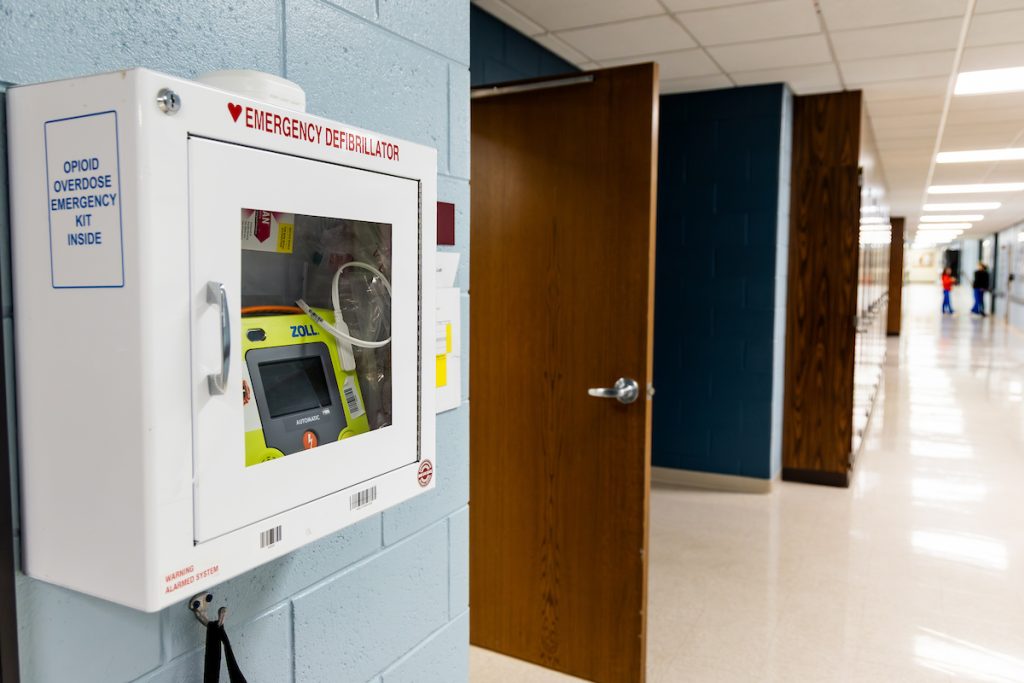
Concordia has strengthened its ability to respond to cardiac emergencies, thanks to a grant from the Firehouse Subs Public Safety Foundation. The grant provided 10 new automated external defibrillators, an in-kind gift valued at $19,075. Now installed throughout campus, the devices put lifesaving technology within reach of students, faculty, staff and visitors when every second matters.
AEDs are designed to help save lives when someone experiences sudden cardiac arrest. The new ZOLL devices help Concordia maintain reliable emergency equipment while providing technology that can guide rescuers through a potentially lifesaving response.
Matthew Fox, a 2001 Concordia graduate with a degree in exercise leadership and now a channel partner manager at ZOLL Medical, says keeping this equipment current is essential.
He explained that AEDs perform regular self-tests to help ensure they are ready when needed. The new ZOLL units also feature real-time CPR feedback, which measures the depth of chest compressions and prompts rescuers to push harder when necessary.
Preparing the campus community to respond
But having the right equipment is only part of being prepared. Ensuring that members of the campus community know how to respond during an emergency is equally important.
“Having accessible equipment is essential when responding to a cardiac emergency. Just as important is ensuring that our CUW community knows how to recognize a medical emergency and feels confident taking action,” said Rhonda Verdegan, PhD, professor in Concordia’s Athletic Training Education Program and a CUW first aid and CPR trainer.
Through first aid and CPR training, faculty and staff develop the skills and confidence to recognize emergencies, call for help, perform CPR and use an AED.
“Most importantly, I want people to remember that they can make a difference, even if they are not medical professionals. Knowing what to do and having the confidence to act can save a life,” Verdegan said.
Fox also addressed what it takes to use an AED in an emergency. “The most important thing to understand about any AED is that they are designed to be easy to use,” he said.
He added that seeing his alma mater invest in campus safety is especially meaningful. “It is always great to see the university continue to make investments in its own community to keep the students, staff, visitors and alumni safe when they are on campus,” he said.
For Verdegan, preparing others to respond in an emergency also reflects something deeper.
“At Concordia, we recognize that we are called by God to serve and care for our neighbors,” Verdegan said. “That commitment extends to how we care for one another within our campus community, especially during a medical emergency.”
With new AEDs installed across campus and ongoing opportunities for first aid and CPR training, Concordia is helping equip its community not only with lifesaving technology, but also with the knowledge and confidence to act when someone needs help.
Want in?
Concordia University Wisconsin is a Lutheran higher education community committed to helping students develop in mind, body and spirit for service to Christ in the Church and the world.