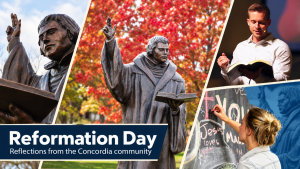
From the first Lutheran hymnals to the concerns of today’s students, explore how Concordians have reflected on the Reformation and its enduring message over the years.
What comes to mind when you think of the Reformation? Martin Luther? A church door? The opening notes of “A Mighty Fortress Is Our God”?
Each offers a connection to a history we remember on Oct. 31. But at the heart of Reformation Day is a message that reaches into our lives today: Salvation is God’s gift, given by grace through faith in Jesus Christ.
Over the years, members of the Concordia University Wisconsin community have explored that message through theology, music, education and their own experiences. This Reformation Day, we’re revisiting several of those reflections, including a student perspective on finding community and hope amid the pressures of college life.
Understanding the Reformation
On Oct. 31, 1517, Martin Luther proposed his 95 Theses for debate, challenging the sale of indulgences. The questions he raised helped spark the Reformation and a renewed focus on the Gospel.
In his 2019 reflection, Dr. Jason Lane explores that history and the teachings central to the Reformation: Christ alone, grace alone, faith alone and Scripture alone. His article also invites readers to consider our continuing need for repentance and God’s mercy.
Read “What is the Reformation? Expert thoughts from Dr. Jason Lane.”
Receiving the gift of grace
We’re accustomed to working toward something. Study for the exam. Finish the assignment. Meet the deadline. Somewhere along the way, it can become easy to apply that same thinking to our relationship with God.
“Solas Applied,” originally published in 2017, explores the freedom found in knowing that salvation cannot be earned. Through reflections from Concordia faculty and alumni, the article considers how Scripture alone, faith alone and grace alone shape our understanding of God and our relationships with one another.
Sharing our faith through song
For many Christians, hymns become familiar companions throughout life. We sing them in chapel, remember them during difficult seasons and return to their words for comfort.
“Reformation Hymnals 500 Years Later,” published in 2024, explores Luther’s efforts to restore congregational singing and the publication of the first Lutheran hymnals in 1524. It offers a look at how music helps bring the Gospel into the voices and lives of God’s people.
Read “Reformation Hymnals 500 Years Later.”
Listening to today’s students
What connections might students draw between the Reformation and their own experiences?
In “The 95 Theses of a modern student,” theology majors Adam Everroad (’26) and Rachel Webb (’27) consider academic burnout, the need for meaningful relationships and Christian hope for the future.
Their 2025 reflection invites the campus community to listen, support one another and consider how students can carry their faith into their future vocations.
Read “The 95 Theses of a modern student.”
Living out Concordia’s Lutheran identity
The Reformation also provides an opportunity to reflect on what it means to learn and serve at a Lutheran university.
In his 2025 reflection, President Erik Ankerberg considers how Concordia’s identity takes shape through its daily work. He connects education with faith in Christ, care for others and preparation for lives of service.
Read “What It Means to Be a Christian University in 2025.”
As we observe Reformation Day, these perspectives invite us to open Scripture, listen to one another and give thanks for the grace we receive in Christ. It is a message we need on Oct. 31—and every day that follows.
Want in?
Concordia University Wisconsin is a Lutheran higher education community committed to helping students develop in mind, body and spirit for service to Christ in the Church and the world.