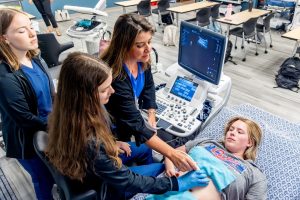
Diagnostic Medical Sonography students gain more hands-on experience with technology used in clinical settings.
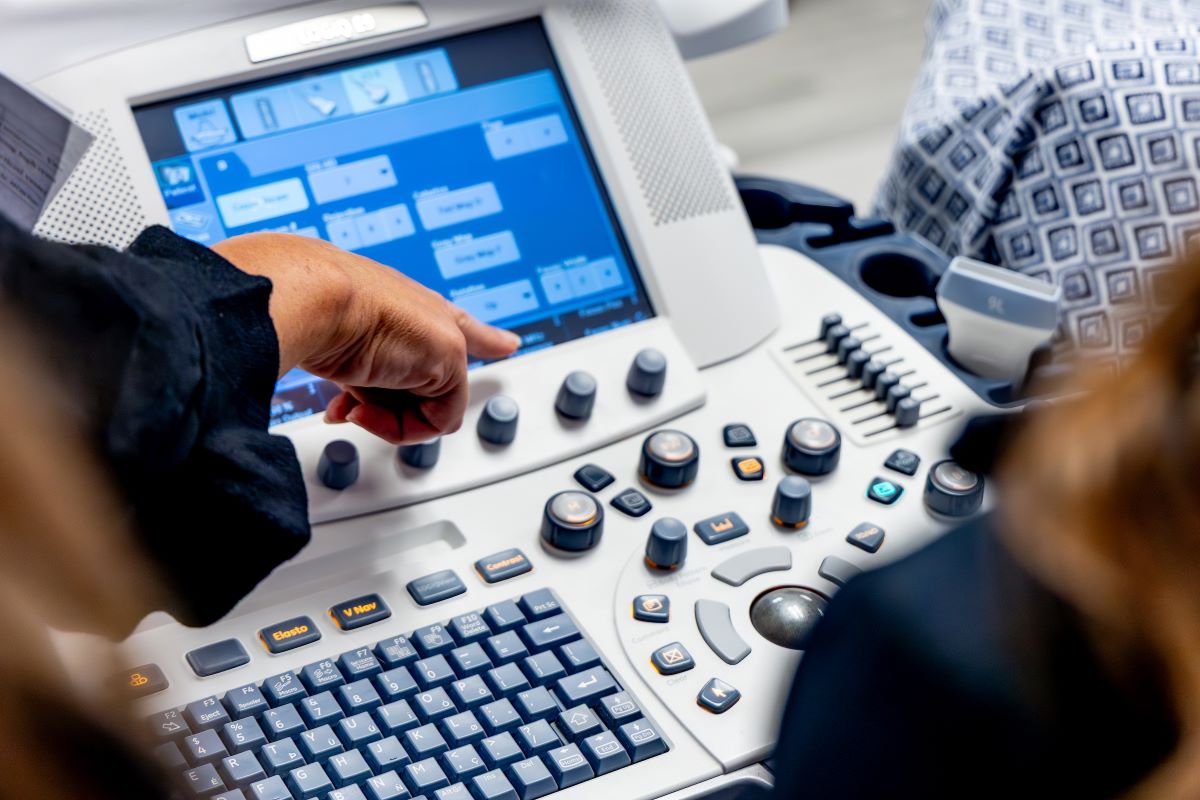
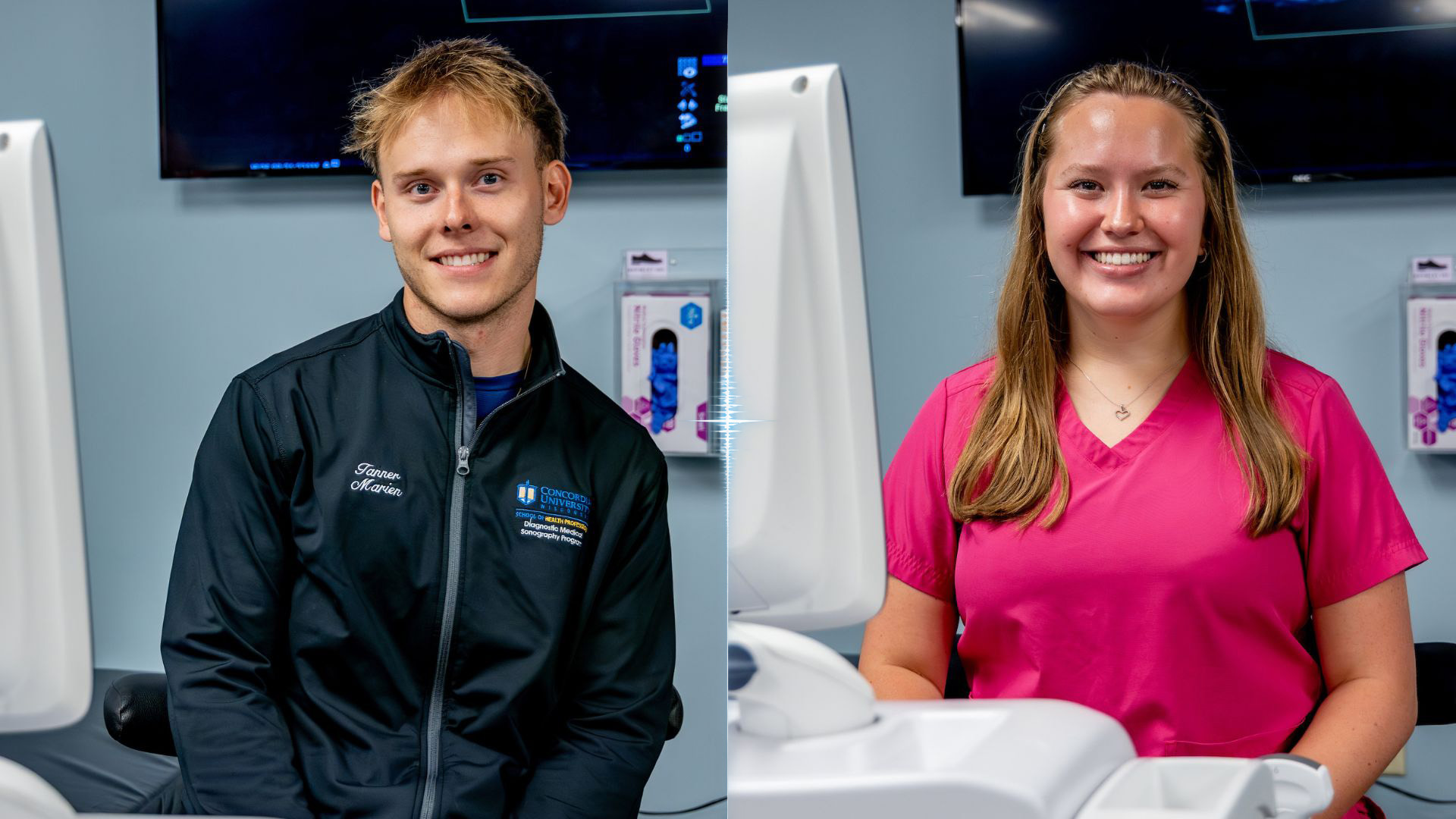
As a patient, you may not realize just how many buttons, knobs and controls there are on an ultrasound machine. But there are a lot, according to Concordia University Wisconsin Diagnostic Medical Sonography senior Tanner Marien. In fact, he describes it as “a million,” an exaggeration that illustrates just how much time students need to become comfortable and confident using medical equipment.
That time especially matters when the person on the exam table is no longer a classmate or practice model, but a real patient. For a DMS student walking into a clinical setting for the first time, all those controls can be intimidating, Marien emphasized.
“You can get stage fright when you’re scanning an actual patient,” he said. “It’s real life.”
That is why two ultrasound systems recently donated to Concordia by Aspirus mean much more to students like Marien and fellow senior Bryn Falk than simply having additional equipment in the scan lab.
The donated GE ultrasound systems (GE LOGIQ E9s, for those in the know) are similar to those DMS students encounter at many of their clinical sites. More access means more time to learn the controls, practice scanning and develop the muscle memory needed to operate the systems without constantly looking down.
“The machines definitely better prepare you for the clinical sites because a lot of them have GEs,” Marien said. “If you’re working on it at least once a week before you’re regularly scanning, you are definitely miles ahead.”
Falk, nodding in agreement, said that familiarity allows students to turn their attention to something far more important once they begin scanning patients: the person.
“It allows you to focus on the actual anatomy and pathology on your patient, rather than struggling with the machine,” Falk said, adding that the patient is “the most important part.”
How does practice prepare you for clinicals?
Lisa Reimer, chair of CUW’s Imaging Department and director of the DMS program, sees the difference that familiarity can make.
Reimer compared learning to operate an ultrasound system to learning the controls of a car. After enough time behind the wheel, a driver no longer needs to look for the windshield wipers. The movement becomes automatic. Sonographers develop a similar type of muscle memory.
“We’re watching the screen, our left hand is typing and our right hand is scanning,” Reimer said. “The muscle memory to how far does my hand travel to get to this function, we’re not looking down trying to find it after we get familiar with the equipment.”
That familiarity becomes especially valuable because sonography requires students to perform several tasks at once.
“You’re watching, observing, making sense of the images, you’re keystroking to improve your images, you’re scanning, finding new windows to get that ideal picture,” Reimer said. “And then you’re talking with your patient to reassure them, make sure they’re doing OK.”
Knowing the equipment also allows students to give more of their attention to the patient.
“When you’re actually scanning patients in real life, you’re not wasting their time,” Marien said. “They feel comfortable having you scan as a student because you’re confident, and you already know what you’re doing before you even step foot in the hospital.”
When can you start scanning?
Concordia students begin scanning during their junior year, shortly after entering the professional phase of the DMS program.
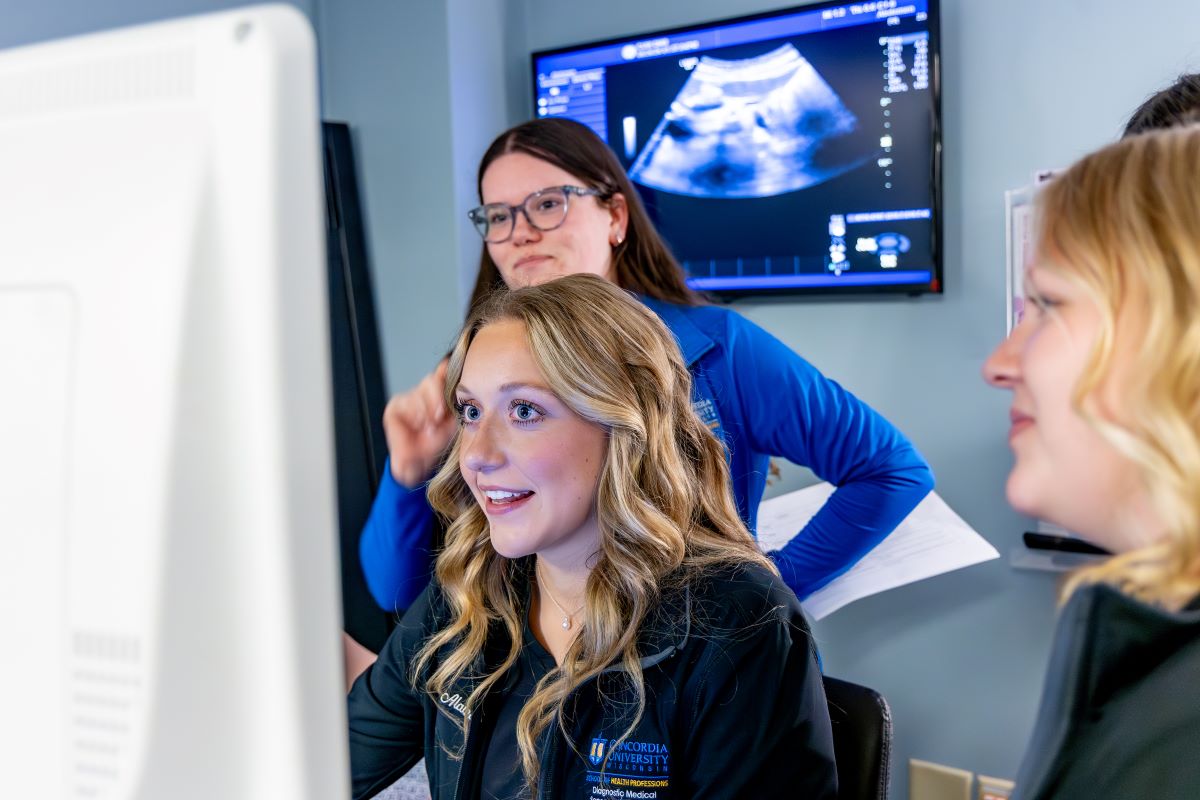
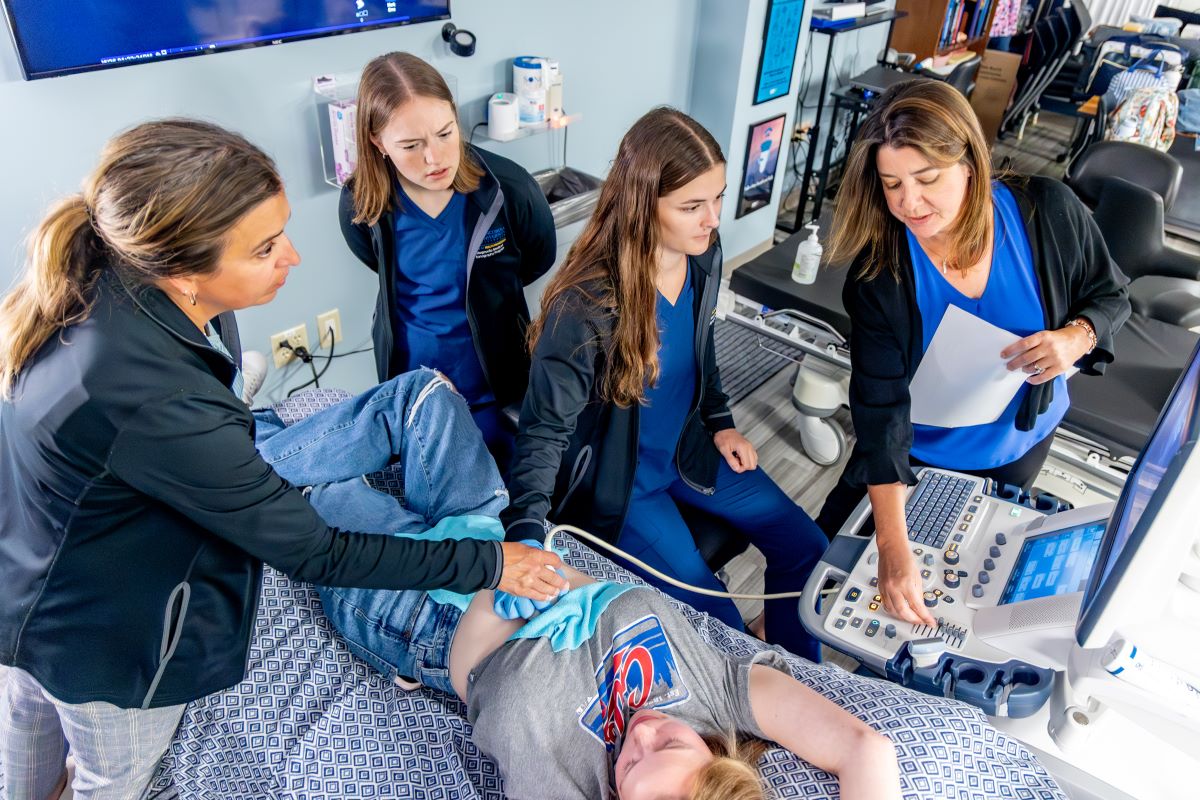
The newest juniors got an introduction to the equipment during a scan lab led in part by senior students. Marien, Falk and their classmates walked the juniors through buttons, knobs and other machine functions. Students also practiced by scanning Jell-O molds containing hidden objects, an exercise that allowed them to practice scanning while testing their ability to identify what they saw on the screen.
The Aspirus donation gives students more opportunities to work on equipment comparable to what they may use during clinical rotations. Previously, students rotated among the university’s available systems, including older equipment. With a variety of systems now available, students can spend more of their lab time developing familiarity with newer equipment.
That practice extends beyond learning which button does what. Sonographers must learn how to adjust depth, gain and other settings to produce diagnostic-quality images. Among students and professionals, Falk said, there is a simpler phrase for getting it right: making a “pretty image.”
“You’re also looking through the entire organ, so you have to make sure that your depth is good and your gain is good,” Falk said. “All the different little functions that optimize your images are really good so that you can make sure that you get the most out of your scan for your patients.”
And no two patients are exactly alike.
“Even though you’re scanning a liver on 50 patients, it’s not going to look the same for any patient because everybody’s unique in their own ways,” Falk said.
Knowing the equipment gives students more freedom to concentrate on those differences.
How did CUW get the ultrasound systems?
The two systems came to Concordia because Aspirus was upgrading its own ultrasound equipment and the units being replaced had no trade-in value, Reimer said. That presented the healthcare organization with another option: donation.
“When the opportunity arose to donate these ultrasound systems, we wanted to ensure they would continue to provide value by helping educate the next generation of sonographers,” said Laurie Lemke, Northern Region manager of Imaging Services at Aspirus. “Concordia University Wisconsin was a natural choice because of its outstanding reputation for excellence in sonography education and its commitment to preparing highly skilled imaging professionals.”
For a university program, equipment that has reached the end of its service within one healthcare setting can still have years of educational use.
Hospital-grade ultrasound systems can cost hundreds of thousands of dollars, making regular replacement across an entire teaching lab difficult. Donations can help programs expose students to newer technology while giving existing medical equipment another useful purpose.
“When you buy new equipment and you don’t get anything on your trade-in and you’re just going to dispose of it anyway, we will take it,” Reimer said. “These are really great pieces of equipment.”
Aspirus has also indicated that additional probes, or transducers, will be donated to accompany the systems.
“This has been our biggest gift to date,” Reimer said. “We are really grateful people are thinking of Concordia as an option.”
Where could a career in sonography take you?
Through this new connection with Aspirus, Reimer has learned more about the demand for sonographers in northern Wisconsin, including communities around Eagle River and Tomahawk. The donation has also opened conversations about future opportunities for CUW students and alumni.
“We didn’t know that need existed,” Reimer said. “Some good conversations are coming out of that, and what a gift. We can now stay connected, and when they have job postings, we can make sure those get in front of our alumni and our current students.”
For now, the most visible effect of the Aspirus gift can be found in the DMS program’s scan lab at Concordia.
There, students can practice until reaching for a control becomes instinctive. They can learn how an image changes from one patient to another. They can make mistakes, ask their professors questions and try again.
Then, when the patient is real, they can focus less on finding the right button and more on the person in front of them.
“I feel like it’s so important to get hands-on experience before you enter the clinical setting,” Marien said. “The fact that we have access to more of these machines now … is so important to helping the students succeed.”
How to donate medical equipment or supplies?
When healthcare organizations upgrade equipment or retire supplies that can no longer be used for patient care, those resources may still have educational value for Concordia students.
Concordia’s Diagnostic Medical Sonography program welcomes conversations with healthcare organizations about equipment and supplies that could support hands-on student learning.
Potential donations may include:
- Ultrasound systems
- Ultrasound probes and transducers
- Medical supplies suitable for educational use
- Expired supplies that can safely be used for training, such as sterile trays
“Even though they can’t be used on patients anymore, they can be used for education,” Reimer said.
Interested in donating? Contact Lisa Reimer at Lisa.Reimer@cuw.edu or 262-243-2172.
Want in?
Concordia University Wisconsin is a Lutheran higher education community committed to helping students develop in mind, body and spirit for service to Christ in the Church and the world.