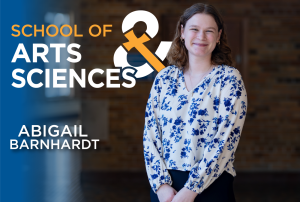
Abigail Barnhardt paired artificial intelligence with business data applications throughout her time at Concordia. She shaped her experience around the intersection of technology and real-world problem-solving.
Abigail Barnhardt followed in her older sister’s footsteps when she began her educational journey at Concordia. Her sister, Janelle, entered the Doctor of Pharmacy program, and the two will graduate together this May.
Barnhardt will earn both a Bachelor of Science in Computer Science with a concentration in artificial intelligence and a Master of Science in Computer Science with a concentration in business data applications.
During her time at CUW, Barnhardt developed a data-driven mindset and an interdisciplinary skill set that position her to take on larger projects with greater societal impact. She has accepted a full-time position with Region 1 Planning Council, a government agency that develops long-range plans for Northern Illinois. She will begin her career on strong footing.
The transition, however, feels bittersweet.
“I love school,” she said. “I love going to class, talking to professors, and spending time with friends.” As she looks ahead to full-time adulthood, she knows she will also miss giving college tours to prospective students.
“I always tell a story on tours,” Barnhardt said, noting that most guides do. They often describe a “wedding dress moment,” when they knew CUW was the right fit. Barnhardt did not have that experience. Instead, she built her sense of belonging over time and found it affirmed in moments like these.
“Last year we could see the northern lights over the lake,” she said. “Everyone was outside taking pictures. People were rollerblading, there was a bonfire, people were making hot dogs, and the Packers game was on a projector.”
She paused before adding, “That was my moment when I thought, ‘Yes, this was the right choice.’ It felt like a Disney movie.”
Capstone to calling
How many Disney movies feature a “princess” who graduates at the top of her class with an award in one hand and a signed job contract in the other? Not enough.
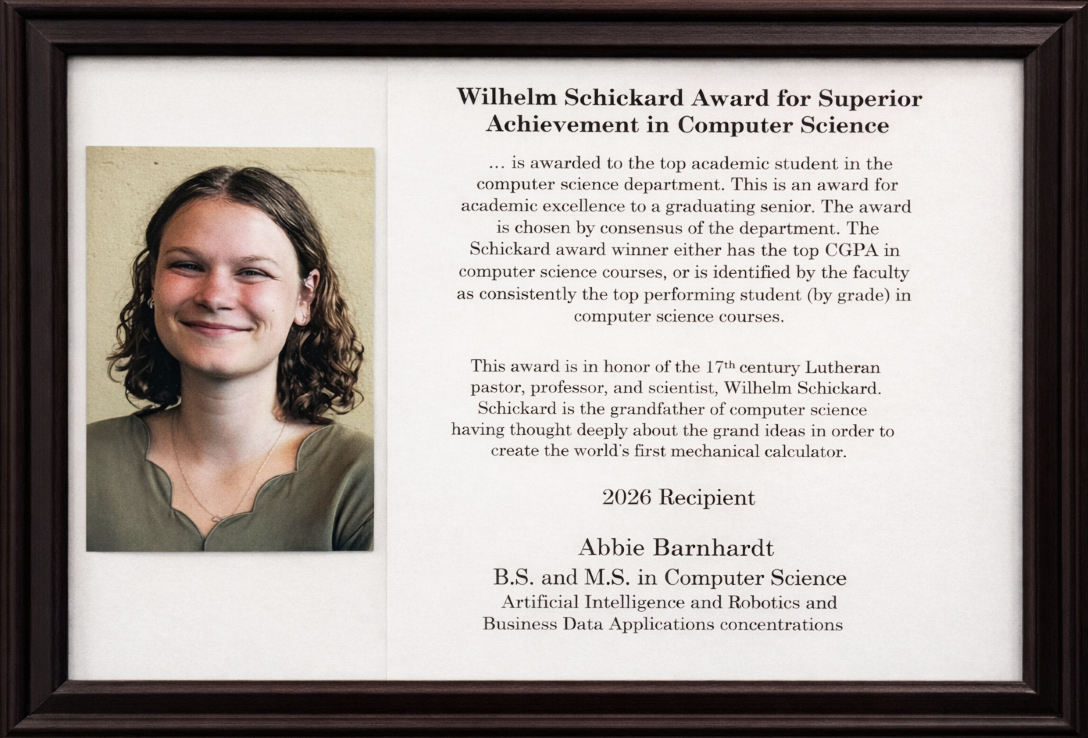
After creating one of the strongest senior capstone projects, Barnhardt received the Wilhelm Schickard Award for Superior Achievement in Computer Science. Dr. Michael Litman, professor and chair of the Department of Computer Science, said he has not seen a project like it in the 15 years he has taught the course.
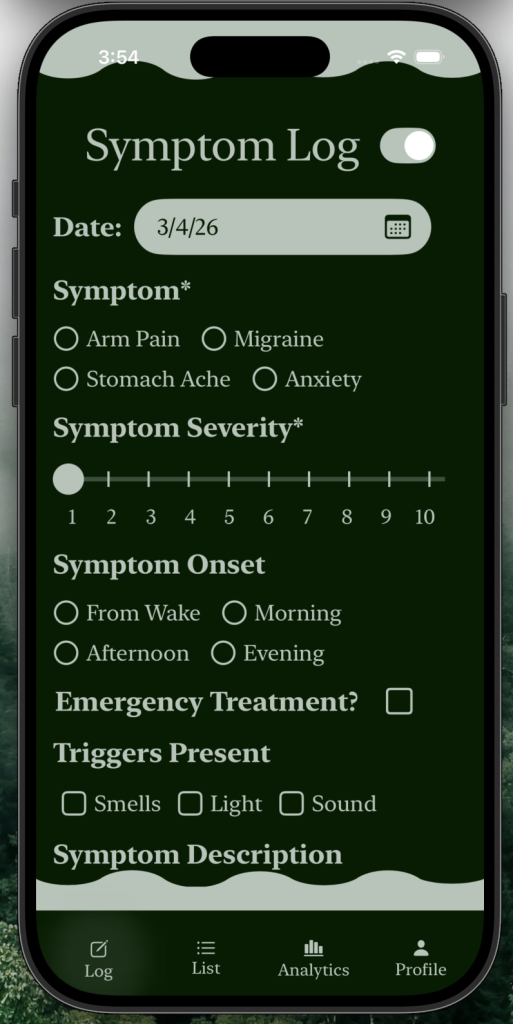
As a chronic migraine sufferer, Barnhardt developed an app for chronic illness tracking and management and received strong feedback from Litman. “That was the moment,” she said, “It really clicked for me that I was good at this.”
More than just good, Litman said Barnhardt reminded him why he became an educator in Christian higher education.
“That is not a small thing!” said Litman. “Her personal drive, her passion to learn, and her dedication to quality are unique among students today.”
Although the app still has a few bugs to resolve before it can be widely available, Barnhardt identified a weakness in existing platforms. She set out to create her own, combining coding with data visualizations that reveal patterns in symptoms.
“Abbie is a reminder that our current and future generations are still worth investing in,” Litman said. The computer science faculty unanimously selected her from a strong graduating class in a field historically dominated by men.
Coding a career path
At Region 1 Planning Council, Barnhardt will create data visualizations for grants and foundations and contribute to coding projects. She will primarily use her AI concentration along with skills from her Business Data Applications coursework.
“This role does not rely heavily on the hard skills taught in the Business Data Applications concentration, but it does require strong soft skills,” Barnhardt said. “Since we create visuals for other organizations, a business mindset helps analysts understand what clients need and produce stronger results. Understanding the audience is an important step in the process.”
Barnhardt became more interested in coding after taking Litman’s classes during her freshman year. At the time, she was enrolled in a double major in professional communication and data science and applied analytics. After discussing her academic path with Litman, she decided to switch majors before her sophomore year.
“Financially and academically, it made more sense,” Barnhardt said. “I really love coding, so this path allowed me to keep all the data science classes while adding more computer science courses.”
Before she received the job offer, Barnhardt interned with the organization. She helped create a machine learning model that predicted which census tracts in the region were most susceptible to climate events based on socioeconomic and related data.
“This required extensive coding, math, and a clear understanding of which variables might be related,” she said.
She shared another example from her internship in which she worked on a grant application for a hospital planning to expand its emergency room.
“Using a business mindset, we determined what would be most convincing to the board and created visuals around that,” Barnhardt said. “This involved understanding the decision-making process, motivating factors, and basic business and economic principles.”
Visualizing impact
Blending artificial intelligence with business data applications has opened doors for Barnhardt. She now pursues work that connects technical precision with community needs.
She brings a passion for charts, data visualization and coding, along with a strong business mindset. Barnhardt is ready to make an impact that extends beyond the classroom.
Fun facts
- She was featured in The College Tour
- She started the Data Science and Applied Mathematics Club
Check it out. “New Concordia program promises Computer Science bachelor’s and master’s in just four years.”
“The School of &” blog series highlights the distinctive identity of Concordia University Wisconsin’s School of Arts & Sciences, where interdisciplinary connections shape learning and purpose. Each month, the series features Concordia students and alumni who have paired majors, minors and certificates in thoughtful and creative ways, showing how this approach influences both their education and their sense of calling.
These stories reveal how students connect their studies, develop their gifts, and live out their callings in service to the Church and the world.
Want in?
Concordia University Wisconsin is a Lutheran higher education community committed to developing students in mind, body and spirit for service to Christ in the Church and the world.
Concordia’s Computer Science Scholars program combines undergraduate and graduate study. Students can earn both a bachelor’s and a master’s degree in as little as four years. Those who finish in four years pay undergraduate tuition and complete their master’s at no additional cost. Contact an admissions counselor to learn more.