
BoodleBox, a secure, integrated platform for learning, launches in 2026 at Concordia University Wisconsin.
Preparing students for a changing world means more than keeping pace with technology. It means giving them the tools — and the guidance — to use it well. Beginning Feb. 1, CUW will provide students, faculty and staff with access to BoodleBox, a platform for generative artificial intelligence.
BoodleBox brings a suite of AI tools together in a secure, university-supported environment. The platform uses CUW single sign-on and integrates with Canvas, allowing students and faculty to access tools directly within their courses.
“This is about meeting students where they are,” said Dr. Leah Dvorak, vice president of academics. “Artificial intelligence is already shaping nearly every profession, and we have a responsibility as a university to help students engage with these tools thoughtfully, ethically and with purpose.”
Through the platform’s implementation, Dvorak said, CUW is reinforcing its commitment to preparing students for life beyond graduation.
“Our responsibility is to ensure graduates are prepared for the realities of today’s workforce,” she said. “Employers are seeking individuals who can use AI tools creatively and responsibly while exercising strong judgment and discernment.”
BoodleBox will also allow students to take a portfolio of custom bots or collaborative projects with them after graduation.
“That portability gives students a tangible way to demonstrate their skills and confidence using AI,” Dvorak said.
Premium AI tools available
Through BoodleBox, the CUW community will have unlimited access to paid versions of AI tools, including ChatGPT 5.1, Claude 4.5 (Haiku, Opus and Sonnet), Gemini 2.5 Pro, Perplexity, Semantic Scholar and DALL-E 3 for image generation. Instead of navigating individual subscriptions or limited free trials, users can explore multiple tools side by side in one place.
That access matters, Dvorak said, because limits built into free tools can become barriers to learning. Many platforms restrict daily prompts or features, which can interrupt coursework and disadvantage students without paid subscriptions. BoodleBox removes those obstacles, ensuring equitable access to advanced tools.
Designed with education in mind

The platform was selected with teaching and learning as the priority. BoodleBox allows users to compare different AI models and versions, helping students see how responses vary and how models evolve. It also includes research-focused tools such as Perplexity and Semantic Scholar, which support information gathering and source-based inquiry.
Faculty have also begun exploring the ability to create AI bots trained on specific course materials. Instructors can upload texts, documents or approved resources and build bots that respond using only that content. Faculty and students can then collaborate using those bots alongside a wide range of large language models within shared group chats.
“This creates an environment where students and faculty can engage directly with AI while remaining anchored in course content,” Dvorak said. “It allows them to see both the strengths and limitations of these tools and reinforces the role of human judgment.”
Students can ask questions, review concepts and deepen understanding while remaining grounded in course-specific material.
Faculty perspectives on AI and learning
Dr. Michael Litman, professor and chair of the Department of Computer Science, sees this approach as essential to preserving deep learning in an era of instant answers.
“As a professor of computer science, I see generative AI fundamentally reshaping how students learn — not by replacing instruction, but by changing how students process and internalize what they are taught,” Litman said. “When answers are always one search away, students can default to consumption rather than synthesis. AI amplifies that tension.”
Litman believes generative AI is most valuable when used as a partner in reflection rather than an answer engine.
“The real opportunity is treating AI as a dialogue partner,” he said. “After instruction, students can revisit ideas, ask clarifying questions, test assumptions and explore alternate explanations without the pressure of speaking up in class. That private, iterative conversation allows students to wrestle with complexity at their own pace.”
From an academic leadership perspective, Dvorak emphasized that AI is already reshaping disciplines across science, health care and beyond.
“Artificial intelligence is changing the way knowledge is generated, applied and evaluated,” she said. “What once required years of work can now happen in moments, which challenges us to think differently about how we teach students to analyze, interpret and use information wisely.”
Dvorak noted that AI-assisted tools are becoming standard across many professional fields.
“We are reaching a point where fluency with AI will be an expectation rather than an advantage,” she said. “Our goal is to ensure students understand not only how to use these tools, but when and why they should be used.”
Together, Litman and Dvorak see generative AI as a tool that, when guided intentionally, strengthens rather than replaces human expertise.
“Used well, AI pushes students to ask better questions, identify gaps in their understanding and connect ideas across disciplines,” Litman said. “The goal isn’t faster completion of assignments. It’s helping students value learning itself.”
“Our students will be prepared for what comes next,” Dvorak added.
Prioritizing security and responsible use
Security and privacy were central to CUW’s decision to adopt the platform. BoodleBox is HIPAA- and FERPA-compliant and does not use entered data to train large language models, providing a safer environment for learning.
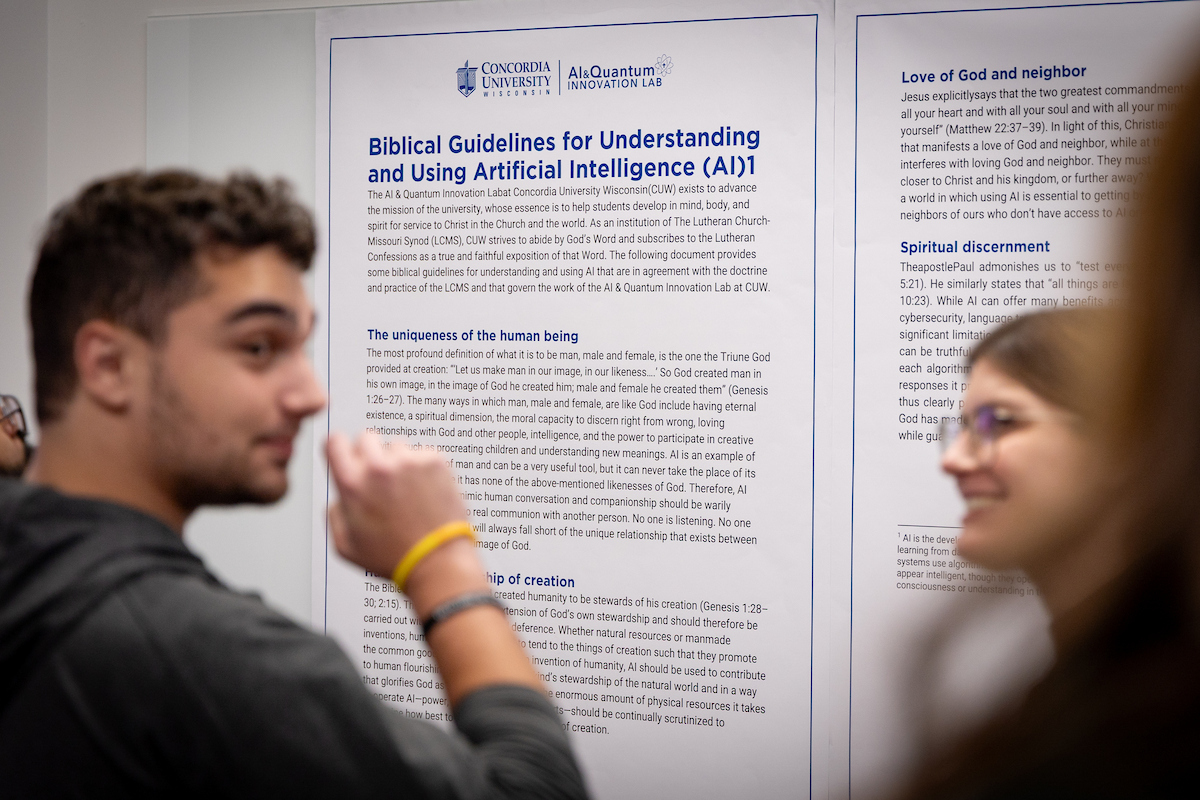
The launch of BoodleBox also aligns with CUW’s Artificial Intelligence Governance Plan, developed by the university’s Strategic Task Force on AI. The plan establishes expectations for ethical AI use, rooted in the university’s Christian commitment to integrity, stewardship, human dignity and care for one another. It outlines responsibilities for students, faculty and staff while preserving academic freedom through flexible syllabus policies.
“Our goal is not to prescribe how faculty teach,” Dvorak said. “It is to provide clear guidance so expectations are transparent and AI use supports meaningful learning.”
Training and what comes next
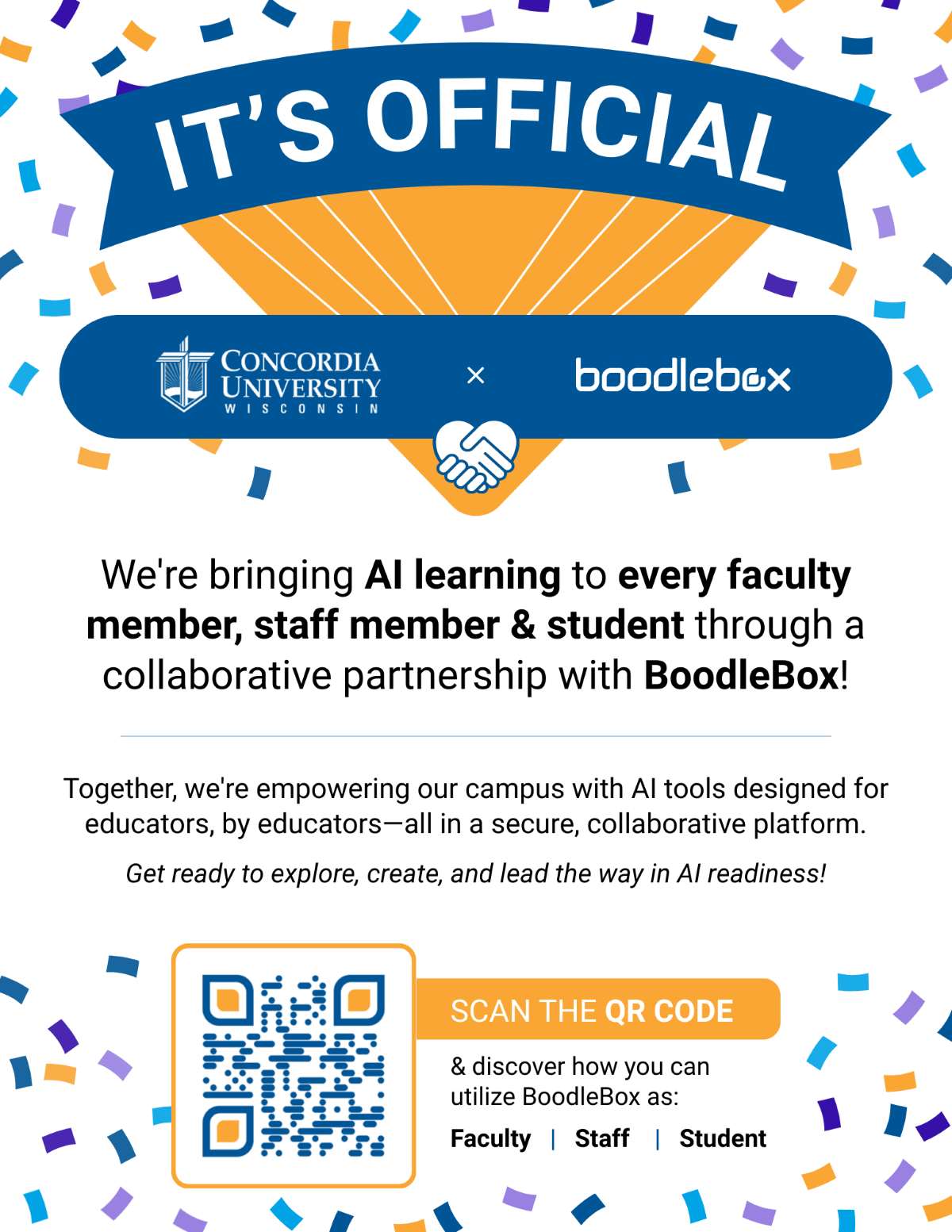
Discipline-specific training is a key part of that approach. CUW’s goal is for every student, in every program, to receive instruction on how AI is used within their field. Training opportunities for faculty, staff and students will begin shortly after the platform’s launch and will be offered both in person and online, with ongoing support through the Center for Excellence in Learning and Teaching and Information Technology.
As CUW continues to expand its work in artificial intelligence, including new undergraduate and graduate programs, BoodleBox represents a step forward that balances innovation with responsibility.
“Generative AI does not diminish education,” Litman said. “When used intentionally, it can restore curiosity, reflection and meaningful intellectual engagement.”
“This is an important moment for our campus,” Dvorak said. “We are embracing new technology in a way that reflects who we are and prepares our students for meaningful work and service.”
While there will always be a place for an unplugged classroom, Dvorak added, more faculty are finding creative ways to incorporate ethical and transparent AI use into assignments rather than banning it altogether. A recent faculty survey showed that more than two-thirds of CUW courses already include some form of AI-related learning opportunity for students.
Updated on Jan. 7, 2026.
Further exploration

- To learn more about the Bachelor of Science in Applied Artificial Intelligence, read “Transform the industry with a Bachelor of Science in Applied Artificial Intelligence degree.”
- Check out CUW’s new AI Lab, “A new era of innovation: CUW opens AI & Quantum Innovation Lab to inspire servant leaders in science, technology.”
- For nursing and AI, “Beyond the hype: Safe and ethical AI use for nurses.”
Want in?
Concordia University Wisconsin is a Lutheran higher education community committed to helping students develop in mind, body and spirit for service to Christ in the Church and the world.