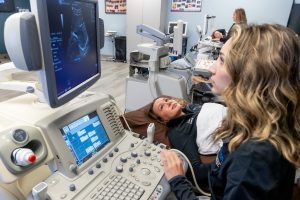
Diagnostic Medical Sonography students now have access to a space that is not only state-of-the-art, but will also push their education to the next level.
Unveiled this fall, Concordia University Wisconsin’s Diagnostic Medical Sonography (DMS) program now features a new lab designed to prepare students to meet the growing community demand for sonographers. According to the Bureau of Labor Statistics, employment in the field is projected to grow 13% between 2024 and 2034, with an average annual wage of $89,340. With an aging population, advances in technology, workforce turnover, and increased access to healthcare, the need for skilled sonographers has never been greater.
A new era of healthcare
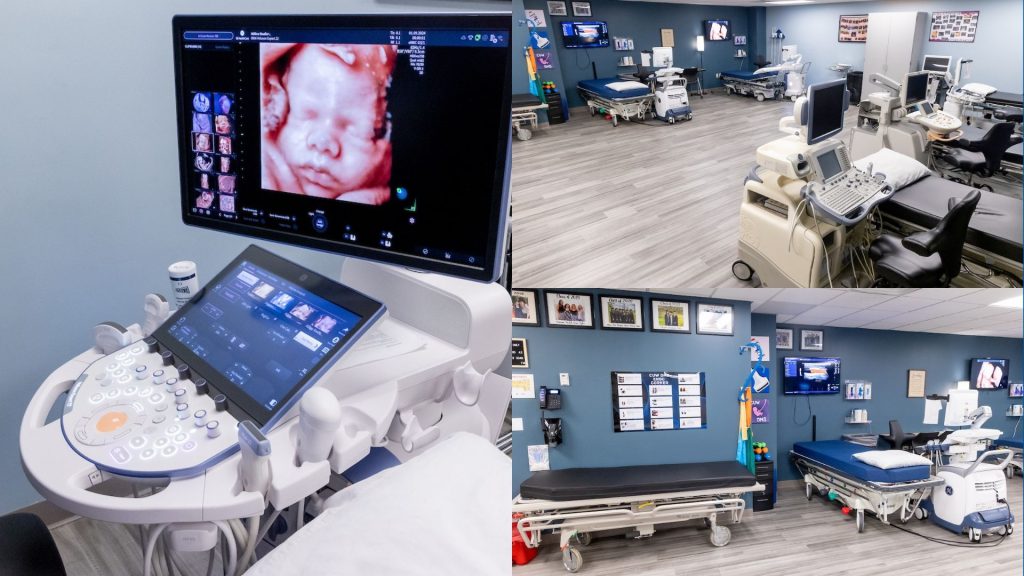
With an enhanced space featuring more equipment, updated technology, and improved vantage points, Lisa Reimer, director of CUW’s Diagnostic Medical Sonography Program and chair of the Department of Imaging, says students’ educational needs are being prioritized. They now have more hands-on opportunities with equipment, access to both live models and phantoms (simulated bodies), and more guided one-on-one support from professors.
“Our students experience a fully integrated program,” says Reimer. “In any given week, they’re learning in the classroom, practicing in the lab, and then reinforcing it all in the clinical setting with patient care.”
CUW is uniquely positioned compared to other programs where students may only use the equipment in a hospital setting. “We are able to provide training in the classroom first, and then students enter the hospital,” notes Linda Samuel, dean of the School of Health Professions.
According to Reimer, this helps students build initial muscle memory and understand protocols in a supportive setting where they can ask questions like: What images do I need to take? When do I take them? Is that a good image? If not, how can I make it better?
As a Christian university, CUW emphasizes serving Christ by serving others—even in the diagnostic process. “We are talking with our patients and interacting with them throughout their whole exam,” Reimer explains. Students develop multiple skills simultaneously: communicating with patients, capturing images, typing, annotating, and ensuring safety and comfort.
A new lab means clearer understanding
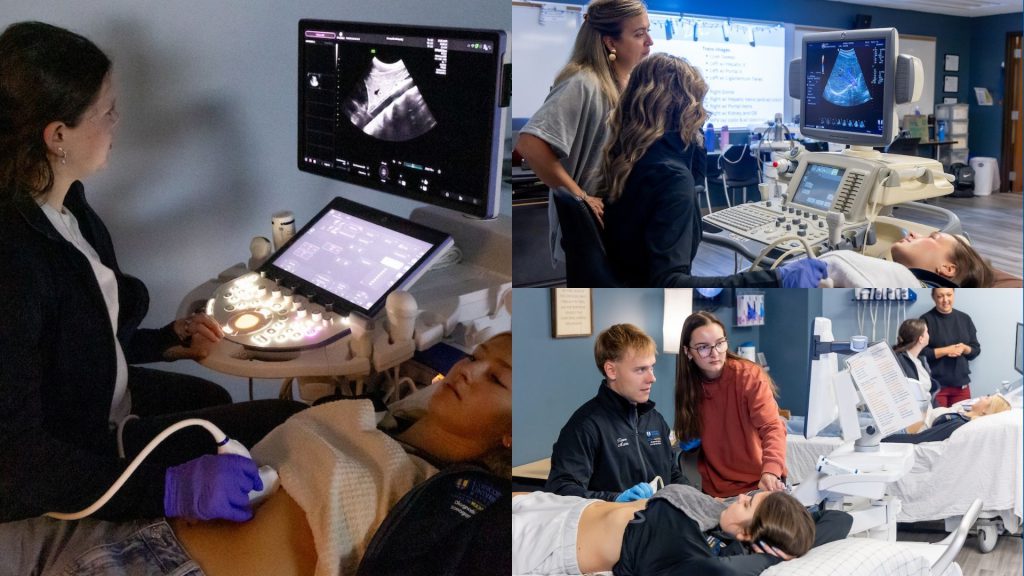
“The new DMS lab space allows my classmates and me to refine our skills and continue growing into the best sonographers we can be!” shares Avery Zangl, a senior in the DMS program. “Scanning always offers room for improvement and new learning, but the updated environment, combined with the guidance of our knowledgeable professors, truly supports our success.”
Hailey Foster, a junior in the DMS program, has also grown more confident in her scanning skills thanks to the space. She values the opportunity to practice outside of class and during personal time, without relying solely on a clinical site for experience. “With multiple machines to practice on and classmates to scan, this lab equips us with the abilities we need to take into our future careers,” she says.
Additional reading
Want in?
Concordia University Wisconsin is a Lutheran higher education community committed to helping students develop in mind, body, and spirit for service to Christ in the Church and the world. The Bachelor of Science in Diagnostic Medical Sonography (DMS) offers four distinct pathways to prepare learners to step forward into their calling as a medical sonographer: the undergraduate DMS certificate, in-person bachelor’s degree, in-person bachelor’s degree with DA, or an online sonography completion program.