
Who says math and art don’t mix? In CUW’s Elementary Curriculum and Methods in Teaching Mathematics course, future educators discovered just how powerful creativity can be when paired with numbers and shapes.
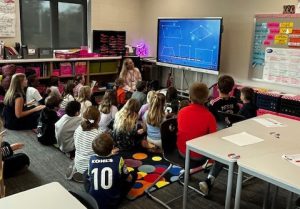
On Oct. 21, these 17 preservice teachers—majoring in Early Childhood and Elementary or focusing on Special Education—took their learning beyond the textbook by planning and teaching third-grade math lessons that integrated arts and music.
Singing shapes and sticky tunes
One group began their lesson with a “shape detective” activity, where students analyzed various quadrilaterals and described characteristics like equal sides, parallel sides and right angles. Then came the highlight—a catchy quadrilateral song with hand motions, led by Ava Booth, Elementary Education major with a concentration in Special Education (graduating May 2026).
After singing it through, one student exclaimed, “That’s a really catchy tune!” The preservice teachers agreed, noting that they wouldn’t forget the properties either after learning the song. Who knew geometry could be so musical?
“This was an awesome experience, and I’m grateful for the chance to teach in a real classroom,” said Booth. “The education department does a great job preparing us with hands-on practice before student teaching. I taught a song about the properties of quadrilaterals to 3rd graders, using hand motions to represent each property. It was fun, engaging and the students loved it!”
Art in motion: Learning through creation
The other three classes used art to make math concepts come to life. Students created artwork using quadrilateral cutouts, identifying the shapes within their masterpieces.
One creative student designed a butterfly picture featuring rectangles and squares—carefully pointing out that since all squares are rectangles, there were actually nine rectangles, six of which weren’t squares. Another group tied literature and geometry together by reading “Grandfather Tang’s Story” and making tangram animals inspired by the tale.
Meanwhile, the Quadrilateral Zoo challenged students to design a zoo map where each enclosure was a unique quadrilateral, complete with at least two parallel and two perpendicular paths. The activity encouraged both mathematical reasoning and artistic design.
And for those who love games, “Quadrilateral Guess Who,” a Creative Commons resource from the Georgia Department of Education (and a digital version from Amplify Classroom), kept everyone engaged as students asked questions like, “Does your shape have parallel lines?”
Why it works: The power of arts integration
Integrating art into academic subjects isn’t just fun—it’s backed by science. Studies, such as those highlighted in “Your Brain on Art: How the Arts Transform Us” by Susan Magsamen and Ivy Ross, show that arts-based learning can boost memory, motivation and comprehension.
For these preservice teachers, the experience underscored an important lesson: creativity makes learning stick.
Ready to blend your passions?
If the idea of infusing creativity into education excites you, maybe it’s time to take the next step toward becoming a teacher. Discover how you can inspire future learners to see math—and the world—through a more creative lens.
Written by Dr. Nicole Muth, professor of elementary education and mathematics at Concordia University Wisconsin’s School of Education.
Want in?
Concordia University Wisconsin is a Lutheran higher education community committed to helping students develop in mind, body, and spirit for service to Christ in the Church and the world. Our Education programs focus on optimizing your abilities to serve students, schools, and the community through education. We develop well-rounded educational professionals that can teach and lead in rural and urban communities. With a Christian-centered focus, relevant curriculum, and engaging faculty you can play a meaningful role in the world of education. For more information, click the link below.